In August of 1987, the University of Chile, located in the capital city of Santiago, fell into crisis. After more than a decade of military dictatorship led by Augusto Pinochet and the subsequent erosion of academic freedom rights, academic quality, and university prestige under military-appointed rectors, the university community and public had finally had enough. The campus and city erupted into strikes and protests led by a cross section of faculty, students, and public groups that had not been seen before. After months of protest, the movement succeeded in ousting the military-appointed rector, José Luis Federici. His replacement, a philosophy professor, marked a significant victory for university autonomy and academic freedom that foreshadowed more victories to come as the dictatorship slowly began to decay.
This essay employs the University of Chile as a case study to present a new perspective on the collaboration that existed within and between repressed academic groups that opposed the dictatorship during the 1980s. Through this perspective on academic freedom and education stakeholder responses to external threats, the essay finds that intra-stakeholder collaboration (i.e., collaboration within groups) set the foundation for future inter-stakeholder collaboration (i.e., collaboration between groups), thus facilitating advances for academic freedom rights during the dictatorship. This study subsequently reveals several insights into academic freedom struggles and the significance of stakeholder group collaboration.
The case of the University of Chile Crisis—the culmination of years of academic organizing during the Pinochet dictatorship—is significant for three reasons. First, the overwhelming majority of academic freedom studies examine cases based in the US and Europe. Existing research provides an overview of the European historical traditions and definitions of Lehrfreiheit and Lehrnfreiheit, or the freedom to teach and the freedom to learn.Footnote 1 Historical and contemporary literature also analyze the threats that academic freedom faces in the US and Europe from both internal and external stakeholders such as administrations, governments, and the public.Footnote 2 These discussions additionally consider whether the law is able to protect academic freedom, what the limits of academic freedom are, and how we should interpret the historical and traditional definitions of academic freedom.Footnote 3
Second, this broader literature largely focuses on the experiences of individuals and institutions, rather than cross-group collaboration.Footnote 4 Recent historical scholarship explores the experiences of stakeholders separately, such as students at the University of Austin Texas protesting against their school’s administration for academic freedom rights in the early twentieth century,Footnote 5 or students doing the same at the University of Illinois in the 1960s.Footnote 6 Other studies focus on single incidences of professors clashing with administrators at a specific institution over academic freedom concerns.Footnote 7 The academic freedom issues surrounding the hire, tenure, and promotion of women in higher education represent another pertinent topic, as historians analyze cases such as that of the Anthropology Department at Brown in the 1970sFootnote 8 and the University of New Zealand in the early twentieth century.Footnote 9
Third, specialized studies on academic freedom in Latin America emphasize the negative effects of dictatorships on academic freedom and state development during early stages of military rule. But these works rarely explore the evolution or status of academic freedom throughout dictatorships. Street, for instance, outlines a history of government intervention in higher education in Argentina, Brazil, Chile, Mexico, Paraguay, and Uruguay occurring at the start of authoritarian regimes.Footnote 10 Green reports on the human, civil, and academic freedom rights abuses during the Brazilian military dictatorship, but focuses specifically on the network of international human rights organizations that worked to oppose the regime.Footnote 11 Others demonstrate that dictatorships in Latin America resulted in specific scholars’ and universities’ loss of autonomy, highlighting individual examples of external military and political intervention on academic life.Footnote 12 These examples all relate to the literature on the effect that the relationship between the state and higher education has on academic freedom in Latin America.Footnote 13
Works on Chile follow a similar pattern found in these Latin American studies. There is a wealth of literature on repression during the Chilean dictatorship, and scholars have focused on academic freedom violations at the start of the dictatorship, such as the decade of the 1970s.Footnote 14 But the scholarship on the latter half of the dictatorship is more scarce. Moreover, the literature tends to focus solely on one specific stakeholder—such as students or professors—rather than collaboration within and between stakeholder groups.Footnote 15 Brunner, meanwhile, offers one of the most extensive examinations of the Chilean dictatorship and university life.Footnote 16 His work examines such events as the military seizure of the country’s universities, the removal of sociology and political science from the curriculum, and the exile of scholars from Chile. Additionally, Bayle chronicles the academics, scholars, and professors who were forced into exile by the dictatorship following the coup.Footnote 17 These important treatments of Chilean history, however, are missing discussion of the agency and activism of those affected by military intervention in academic life.
This essay offers a new portrait of academic freedom and education stakeholder responses to external threats. This new perspective illuminates the collaboration that existed within and between repressed interest groups that opposed the dictatorship and that effectively reinstated academic freedom rights in Chile. Drawing on a collection of secondary and selected primary sources—including government reports, newspaper accounts, and Spanish-language publications—the project traces intra- and inter-stakeholder collaboration in support of academic freedom during the 1980s, ultimately finding that intra-stakeholder collaboration set the foundation for future inter-stakeholder collaboration.Footnote 18 This study begins with an analysis of academic freedom and stakeholder experience before the 1980s in Chile, highlighting a relative absence of both inter- and intra-stakeholder collaboration during this period. As the military dictatorship intervened in university affairs, the absence of organized action gave way to a period of intra-stakeholder collaboration that occurred from 1980 to 1986. The events at the University of Chile and elsewhere prompted inter-stakeholder collaboration that occurred from 1987 to 1989.
The historical context surrounding Latin American dictatorships demonstrates the significance of this paper’s new perspective on inter-stakeholder collaboration. According to historical scholarship, the Chilean dictatorship was one of a wave of twentieth-century authoritarian regimes in Latin American countries such as those in Argentina, Brazil, Cuba, Guatemala, Paraguay, and Uruguay.Footnote 19 While the context, trajectory, and outcome of each dictatorship is distinct, scholarship recognizes that this era in Latin American history provides valuable insight into the democratization process, the nature of repression and dissent, and the impact of certain social movements such as the Mothers of the Plaza de Mayo and the Grandmothers of the Plaza de Mayo in Argentina.Footnote 20 While each authoritarian regime was met with protests from many factions of the population, this paper purposefully focuses on the case of Chile during the 1980s to expand scholarship’s current knowledge on how stakeholder mobilization and protest functions to protect academic freedom rights.Footnote 21 While the case of Chile certainly doesn’t exist in a vacuum, the University of Chile Crisis in particular advances our understanding of how academic freedom rights, the nature of repression, and stakeholder collaboration and experience shift as a dictatorship evolves and dissolves.
This study sheds light on the fight for academic freedom rights and the significance of stakeholder group collaboration in terms of process and outcome. The collaborative process within stakeholder groups demonstrates that stakeholders during the Chilean dictatorship were not simply victims of repression. They were also agents of change and cooperation, and their defense of academic freedom ultimately was a collective and cooperative endeavor. To that end, the stakeholder groups formed advocacy coalitions under shared beliefs in institutional autonomy and other core academic freedoms.Footnote 22
In terms of outcome, the collaboration between groups and the coalitions they built yielded important pressures that effected change. As students, faculty, the public, the media, and other academic organizations were united by their core beliefs that the university is the heart of Chilean history and culture, their coalition building and inter-stakeholder collaboration worked to influence academic freedom policy at the end of Pinochet’s dictatorship. The inter-stakeholder collaboration between interest groups thus contributes to our understanding of how stakeholders leveraged collective action to win back academic freedom rights. Taking all these components together, this study works to advance our historical knowledge of academic freedom, higher education under dictatorship, and university-based stakeholder organizing while also deepening our understanding that academic freedom is not achieved simply through a singular act. Rather, academic freedom struggles prompt a collaboration by multiple stakeholder groups to reinstate academic freedom rights. This paper finds that stakeholder groups such as faculty, students, the media, and the public formed a coalition united by their core beliefs in institutional autonomy, the value of the university in producing knowledge, and the university’s role in representing the core of Chile’s history and culture. In this way, the protection of knowledge, the university, and academic freedom itself became a social and collaborative process that spanned large segments of the population.
This essay begins with a brief discussion of how academic freedom, education stakeholders, and coalition building are defined and used. From there, the discussion turns to stakeholder experiences with repression, human rights violations, and academic freedom violations before the 1980s, which is followed by an examination of the types of repression that stakeholders experienced during the period between 1980 and 1986 that led students and faculty to collaborate within their stakeholder groups. The essay closes with an exploration of the inter-stakeholder collaboration that occurred from 1987 to 1989 during the University of Chile Crisis. Taken together, these sections shift our attention from individual experiences to collective action in the Chilean struggle for academic freedom.
Academic freedom, education stakeholders, and coalition building defined
This paper draws on standard historiographical definitions that view academic freedom as the right of students and educators to freely study, teach, research, and disseminate ideas in educational settings that are free from external interference. This aligns with widely used definitions in the social sciences, such as those advanced by Varieties of Democracy (V-Dem). In the V-Dem dataset, the Academic Freedom Index is an aggregate measure of five separate variables: “freedom to research and teach,” “freedom of academic exchange and dissemination,” “institutional autonomy,” “campus integrity” (in which universities are “free from politically motivated surveillance or security infringements”), and “freedom of academic and cultural expression.”Footnote 23
This definition of academic freedom, extending beyond simply the right of students and professors to study, advance, and disseminate knowledge, is necessarily broad, as other stakeholders such as the public, the media, and professional organizations play an integral role in our understanding of academic freedom violations in Chile. Such a definition also allows for a discussion of how political and violent repression, such as restrictions on political activity and the right to assemble, worked to repress academic freedom rights. This oppression created an atmosphere in which students and faculty were unable to study, advance, or disseminate knowledge because they were fearful of violent retaliation from the state.
To define education stakeholder in higher education, this project lightly draws from stakeholder theory.Footnote 24 Some define a stakeholder generally as an individual or group who “is affected by or can affect the achievement of an organisation’s objectives,”Footnote 25 whereas a stakeholder in higher education is any individual or group who is invested in or has influence on a university’s function, success, decisions, and policies.Footnote 26 Stakeholders in higher education can include students, professors, staff members, parents, administrators, alumni, the media, and the general public or community.Footnote 27 This paper focuses on students and faculty as the primary higher education stakeholders during the 1980s in Chile, and specifically emphasizes their experiences with academic freedom repression during the Pinochet dictatorship. However, the project also considers how other stakeholders and interest groups such as the public, the media, and academic and professional organizations played a role in interest group collaboration during the Chilean dictatorship. This paper uses stakeholders and interest groups interchangeably.
The paper additionally draws from the Advocacy Coalition Framework (ACF), a theoretical framework applied to policy processes. The ACF describes how groups called “advocacy coalitions” share core beliefs about a particular policy and thus cooperate to influence policy and achieve their policy goals.Footnote 28 This theoretical framework is useful in understanding both the development and effects of collaboration between stakeholder groups, as well as the context and culture that affects the success of advocacy coalitions.Footnote 29 Applying the ACF to the Chile case, we can see how the inter-stakeholder collaboration that took place between the different interest groups at the end of the Chilean dictatorship—students, faculty, the public, and other academic networks—worked successfully to regain academic freedom protections. These interest groups were united by a core belief in the academic freedom rights of campus integrity and institutional autonomy, as well the idea that the university is the heart of Chilean history and culture.
The Era before the 1980s
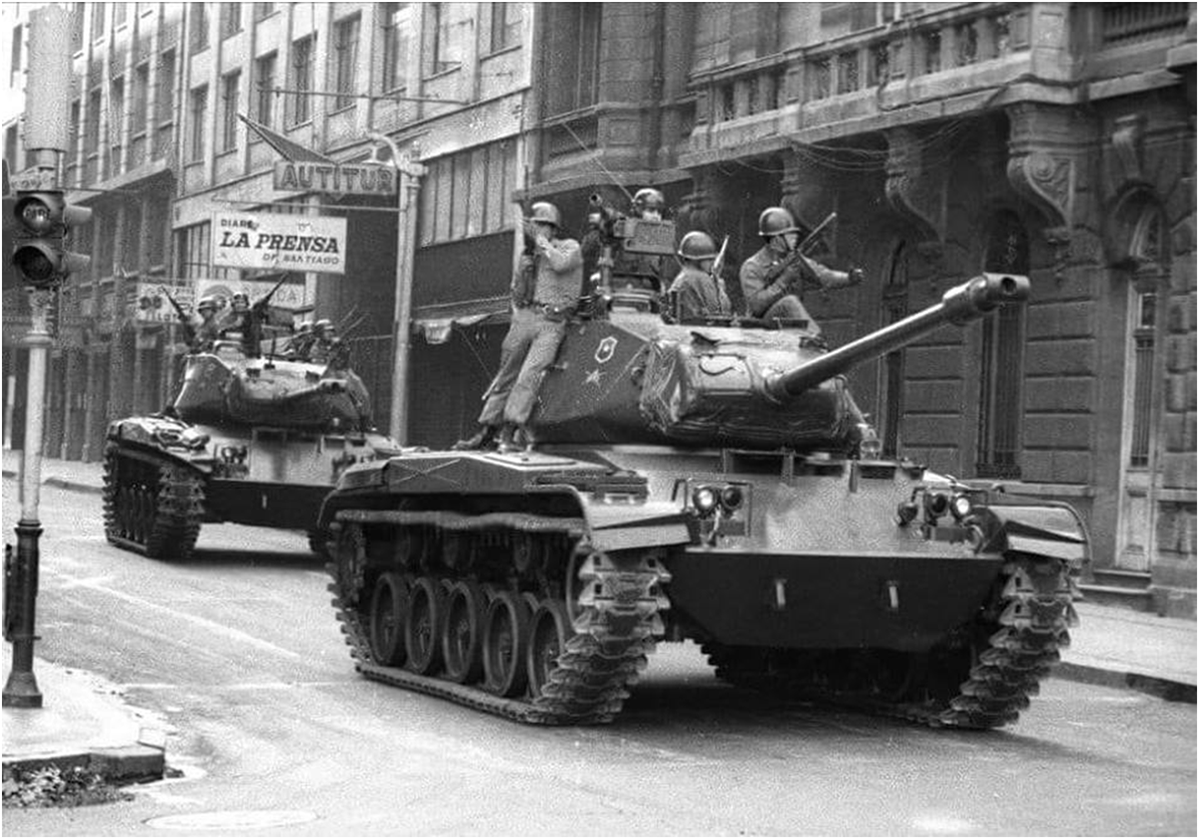
With the September 11th coup d’état in 1973 marking the beginning of Pinochet’s military dictatorship in Chile, the 1970s are well documented in terms of the human rights violations, repression, and academic freedom violations at the hands of the newly founded authoritarian regime. The reports of the military dictatorship in Chile often begin with an overview of the 1970 election of President Salvador Allende, a left-leaning candidate who won 36.6 percent of the vote and who touted a socialist agenda.Footnote 30 Allende’s socialist-based administration, as well as the fact that he won the plurality but not the majority of the vote, prompted stark opposition within the country, especially among right-leaning groups, businesses, and the middle and upper classes.Footnote 31 Finally, in 1973, the military, led by Army General Augusto Pinochet, enacted a coup d’état as seen in Figure 1, overthrew the Allende administration, and established its autocratic rule over Chile, which lasted until 1990.Footnote 32 While the extent of the human rights violations that occurred during Pinochet’s dictatorship is beyond the scope of this paper, it’s worth mentioning the human rights violations specific to academic freedom, which included the disappearances of faculty members and the suppression of university autonomy.Footnote 33
An M41 Walker Bulldog military tank patrols near the government palace in Santiago, Chile, during the 1973 coup. (Photo courtesy of Wikimedia Commons, https://commons.wikimedia.org/wiki/File:M41_walker_bulldog_de_la_caballer%C3%ADa_blindada_Chilena.jpg.)

During the 1970s, stakeholders lacked the means or resources to collaborate and oppose the dictatorship, and thus this era saw an absence any sort of academic freedom rights. Since universities are often described as places of resistance, it is no surprise that the Pinochet dictatorship immediately targeted higher education.Footnote 34 The Pinochet regime believed that education institutions, especially universities, were responsible for harboring leftist and espousing the Marxist ideas of the previous administration under Allende. Thus, from the regime’s perspective, targeting and controlling such institutions could restore “national” values and the military’s agenda.Footnote 35
Recognizing that education stakeholders were without the means to oppose the dictatorship, the Chilean military leaders took control of university decisions, finances, policies, and academics. They did so by firing, exiling, arresting, or forcibly disappearing the students, faculty, and administrators they suspected of opposing the regime.Footnote 36 As a result of the political purges and reductions in the number of first-year students permitted to enroll each year, enrollments in Chilean universities—including state-owned, private, and religious universities—decreased by 4 percent annually from 1975 to 1980.Footnote 37 Staff, faculty, and administrator numbers also fell after the start of the coup for similar reasons. For instance, the number of full- and part-time faculty fell by two thousand from 1973 to 1975.Footnote 38
The education ministry under the Chilean dictatorship—or junta, as scholars have called it—restricted interest group organizing.Footnote 39 Through education laws and policies it enacted, this ministry paved the way for the junta to increase its control over the university and limit academic freedom and political participation. The junta also carried out this aim by assigning military rectors to lead the universities and implement the military’s priorities, particularly by way of faculty appointments and firings.Footnote 40 Assigning rectors to the universities represents just one aspect of the overpowering authority of the minister of education, under the control of the military, on institutions of higher education in Chile.Footnote 41 The junta also implemented a mandatory National Security program which included mandatory coursework in “subversion, political ‘deviations’, political and ideological aggression, national defense, the armed services, and the Chilean doctrine of national security.”Footnote 42 The point of this program was to ensure that university graduates took responsibility for the national security concerns of the junta, and the implementation of this program was an indication that universities no longer had complete control over curriculum.Footnote 43
Beyond the dissolution of certain subject areas, disciplines, and majors in the social sciences, student opposition to the regime was restricted in other ways.Footnote 44 To limit student expression, the junta required that all student meetings had to be authorized; students were not allowed to “prepare, publish, post, or distribute written materials”; “student organizations” were replaced with student “social centers”; and student leaders were chosen by the rectors instead of being elected by the student body.Footnote 45 University students were no longer able to organize or participate politically and instead were encouraged to participate in social events such as “dances, concerts, and sports events.”Footnote 46 Broadly speaking, the military regime of the 1970s effectively rendered it impossible for students and faculty to freely study, advance, and disseminate knowledge and for administrators to have any semblance of sovereignty over their institutions.
Overview of Stakeholders and Interest Groups

Repression and intra-stakeholder collaboration, 1980-1986
Between 1980 and 1986, Chilean students and faculty members experienced extreme repression that limited their academic and human rights. The repression took different forms and included political, violent, or geographical—meaning the repressed groups were banished to remote areas of the country. These forms of repression eventually led students and faculty to collaborate within their stakeholder groups to confront the oppression.
At first, the suppression of academic freedom rights for students and faculty was focused on political expression. A 1981 law passed by the military junta banned all political activity at universities across the country.Footnote 47 This law resulted in a nationwide requirement that all public meetings receive preapproval from the “local military zone commander,” with the regime denying permission “when the subject [was] politically sensitive.”Footnote 48 Through this law, the regime banned practically all political activity in the universities and removed student activity centers from the universities.Footnote 49
Chilean faculty members also experienced political repression during this time, as the 1981 law had a chilling effect on professors’ right to research, publish, teach, or study politically sensitive topics. As had occurred in the years immediately following the coup, professors whose views contradicted the dictatorship or were thought to be politically suspect were often purged from the university.Footnote 50 According to reports at the time, in 1980 alone, 240 professors were dismissed from Chilean universities for political reasons.Footnote 51 Among them was Mario Zanartu, an economics professor at the University of Chile, who challenged the regime’s analysis of Chile’s economic situation. Malva Hernandez, a Spanish literature professor at the University of Chile, meanwhile, was dismissed because of her participation in a group investigating disappeared people; her son was arrested in 1976 and disappeared shortly thereafter.Footnote 52 Professors were often not only expelled from the university but also arrested and detained, as was the case with Maria Teresa Lopez from the Universidad Católica, who was let go after being detained for no cited reason.Footnote 53 In 1986, six professors were fired from the University of Concepción and thirty-one professors were removed from University of Antofagasta.Footnote 54
The state also engaged in violent repression against students and faculty. While political repression involves the restriction of certain rights and liberties, violent repression uses physical force to suppress people’s activity. During this period, the Avengers of Martyrs, a right-leaning terrorist group, worked alongside the military to abduct, torture, and murder several university students. These students, who were suspected of being leftists, included Angelica Diaz Tapia, Jose Eduardo Jara, Eduardo Jara Aravena, Cecilia Alzamora Bejares, and other students who remained unnamed.Footnote 55 These acts of violence occurred after Lt. Col. Roger Vergara Campos, a high-ranking officer and the director of the army intelligence school, was assassinated on July 15, 1980.Footnote 56 Pinochet’s administration claimed that far-left extremists were responsible for the attack, leading the military junta to increase crackdowns on university students and other groups deemed to be potentially leftist.Footnote 57 Faculty also faced violent repression.Footnote 58 Professors were kidnapped and murdered for their opposition to the military regime, including Professor Manuel Guerrero, sociologist José Manuel Parada, and artist Santiago Nattino.Footnote 59 Although these murders were mentioned in a United Nations report condemning Pinochet for the regime’s human rights violations, they did not result in charges or jail time for regime leaders.Footnote 60
In addition to political and violent repression, students and faculty faced geographic repression from the state. This involved banishment or exile to remote villages in the Andes, either in the far north or the far south of Chile. University students were among more than eighty-six people who were banished in 1982 for engaging in political activity on campus, participating in protests, and acting against the military junta in any way. Into his tenth year as dictator, Pinochet continued to ensure that all political activity was banned.Footnote 61
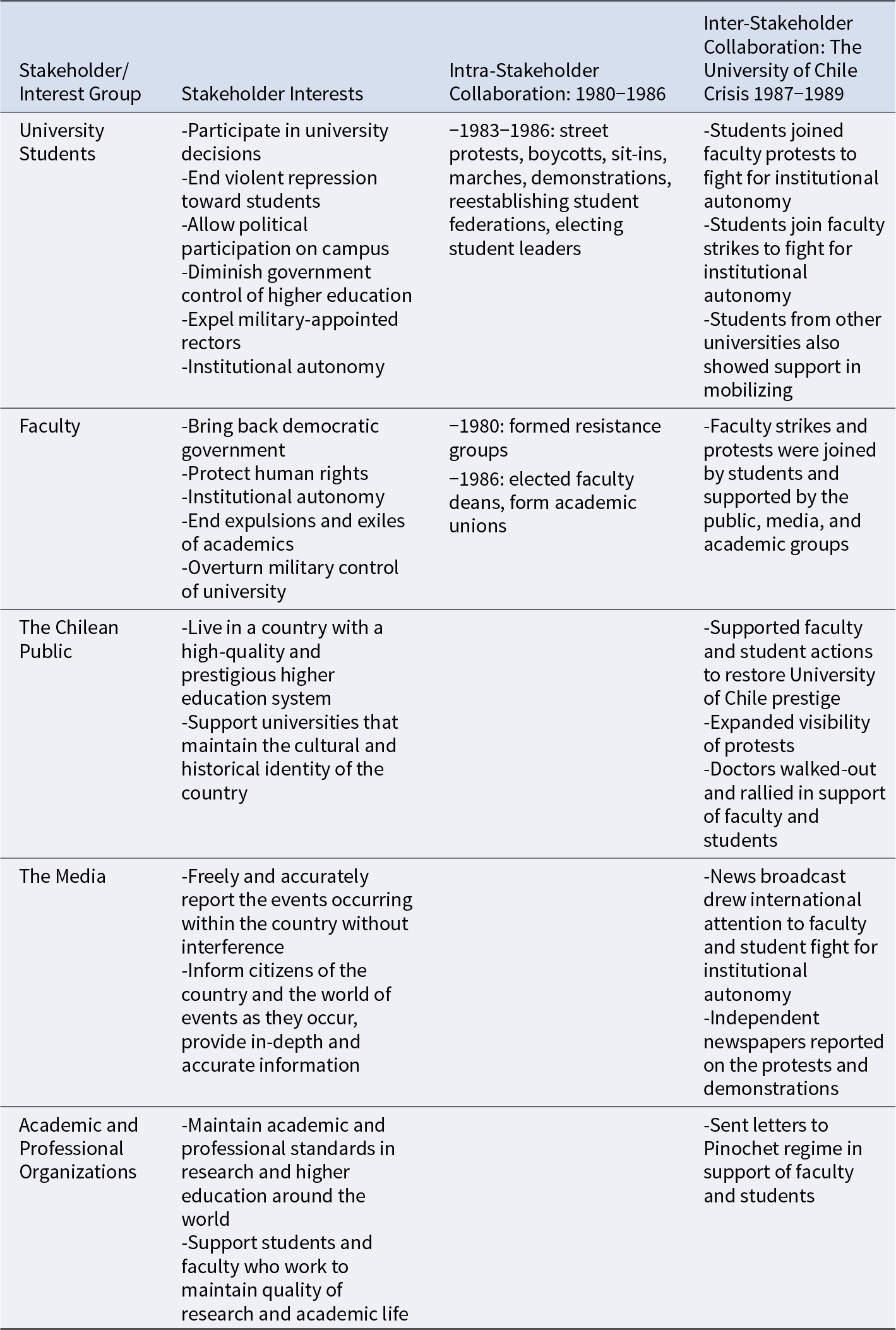
Between 1980 and 1986, university student groups responded to political, violent, and geographic forms of repression by collaborating and mobilizing despite the 1981 legislation banning political activity on Chilean campuses. Engaging in these activities often came at the expense of violent retaliation from the military junta, including exile, expulsion, arrests, and torture. Even though most substantial student protests started in the middle of 1983 and continued into 1984, students began to mobilize as early as 1980.Footnote 62 Table 1 outlines the stakeholder interests and types of collaboration that existed during this decade. To draw international attention, student groups at the University of Chile coordinated in 1981 to occupy both the French embassy and the UNESCO headquarters in Santiago. They wanted to highlight incidents of student repression, the obstacles blocking students from achieving a quality education, and the absence of student participation in university decisions.Footnote 63 The students also protested various other forms of academic freedom repression, including the military junta’s reduction of subject areas and degrees, the banning of student organizations and political activity on campus, the exile and expulsion of students for political participation on campus, and the expulsion of student leader Patricia Torres.Footnote 64
Starting in 1983, university students increasingly began to organize, mobilize, and protest in various ways, including street protests, boycotts, sit-ins, and marches. That year, they organized one of the largest student demonstrations in the country since the start of the dictatorship. In the regime’s response, dozens of students were arrested and two students were killed.Footnote 65 The increases in student political activity led to a corresponding rise in violent government retaliation in 1985, including students being arrested, placed into detention, kidnapped, or subjected to other forms of violence.Footnote 66 Multiple reports indicate that a student, Oscar Fuentes Hernandez, was shot by the Carabineros (Chilean police that associated with the military junta) for “distributing leaflets” and pamphlets that the military deemed inflammatory.Footnote 67 In fact, there were more reported kidnappings and threats in 1985 than all previous years since Pinochet took power (564), surpassing the totals in 1984 (402) and 1983 (212). The following year saw another spike in the number of threats and kidnappings (662).Footnote 68
Student mobilization continued to expand during this period, resulting in mass protests in 1986. Controversies prompting these protests included reports of students being suspended, expelled, abducted, arrested, tortured, and set on fire for their political activity. In a single month, nearly 632 students were arrested during a three-day stretch of student protest that stopped classes at many of Chile’s twenty-seven universities.Footnote 69
Students also began to collaborate, resist, and exercise their academic freedom rights by reestablishing student federations and groups that had existed before the military regime banned them following the 1973 coup. These included the Universidad Católica Students’ Federation and the University of Chile Students’ Federation (FECH). The reemergence of such groups can be attributed to students exercising one of the few freedoms that remained—that of voting for student representatives.Footnote 70 Although the 1981 law banning political activity on university campuses was still in effect, one of the few ways students were still able to engage in political activity was by electing student representatives, a freedom that was reinstated in 1979. In the 1980s, there was a resurgence of student political activity across Chile that started in 1979 when university students nationwide voted overwhelmingly (over 70 percent) in favor of removing the student government candidates associated with the university administration, the military-appointed rectors, and the dictatorship.Footnote 71 According to some reports, at the University of Chile, the candidates who expressed anti-government beliefs won 73 percent of the votes, while right-wing candidates won only 22 percent of them. A similar trend occurred at the University of Santiago, where 74 percent of the votes went to opposition candidates.Footnote 72
Being part of these student federations and groups prompted university students to vote in student leaders who openly opposed the government and worked to pressure the military junta to diminish government control of higher education. The military junta responded with violence and expulsions. (The US Department of State puts the number of expulsions around this time at two hundred students across Chile.)Footnote 73 In 1984, students from Universidad Católica protested the expulsion of twenty-one of their fellow students by participating in hunger strikes. Their colleagues had been expelled for demanding that the military-appointed rector, Vice Admiral Jorge Swett, step down. This protest occurred alongside a larger one involving fifteen student federations from different universities calling for the resignation of the military-appointed rectors and the restoration of institutional autonomy and democracy.Footnote 74
Student federation leaders were not immune to repression, however. The arrest and detention of student federation leaders, such as Tomás Jocelyn Holt, president of the Universidad Católica Students’ Federation, and Yerko Ljubetic, leader of FECH, for demanding the release of other student detainees led to an increase in student protest.Footnote 75 Other student demands during this time include the release of detained students but also the resignation of Sergio Gaete, the education minister who, according to students, ignored student demands.Footnote 76 There were also reports that students such as FECH’s vice president, Gonzalo Rovira, had been detained and sent to camps in the northern part of Chile for participating in a public works program that had existed since the 1960s but had been banned during the dictatorship.Footnote 77
The student organizations issued several demands. They wanted institutional autonomy to be reinstated in Chile, university life to be free from military government interference, and university administrators to be elected internally instead of by the military.Footnote 78 More student protests occurred in April of 1986. They centered on grievances such as the harsh disciplinary actions of military-appointed rectors and deans, the presence of security guards and supposed spies on campus, and the expulsion of students and professors for allegedly expressing anti-government thought. In response to the student protests, Pinochet ordered a military occupation of campuses located around Santiago, including the University of Chile and the Metropolitan University.Footnote 79 Broadly speaking, the collaboration between students to mobilize protests and reform student federations represents an unprecedented tactic in the collective effort to resist the Chilean dictatorship and regain academic freedom rights, as organization on that scale had not occurred to that point in Pinochet’s regime.
Between 1980 and 1986, faculty members at a variety of universities across Chile collaborated and cooperated to form resistance groups and fight for academic freedom. Clandestine groups of exiled professors, for instance, worked to combat the dictatorship and reinstate democracy. A collective that called itself the “Group of the 24” (or, in Spanish, “el Grupo de los 24”), was founded by Manuel Sanhueza, a former economist who had been removed from the University of Concepción.Footnote 80 The members of the Group of the 24 represented a range of professions and political ideologies—though most of them were academics—and were dedicated to fighting the regime and bringing back democratic government in Chile. They were critical of the 1981 constitution, arguing for its replacement by a democratic constitution, and sought protections for human rights.Footnote 81 A second group of professors called the Academy of Christian Humanism, supported by the Cardinal of Santiago, consisted of university professors who were dismissed from universities across Chile. The members of this group consisted primarily of left-leaning professors and Christian Democrats. Together, they formed “a kind of university in internal exile.”Footnote 82 With UNESCO’s support, the Academy created Analysis, a journal that publicly criticized Pinochet and the military junta.Footnote 83 Although both clandestine circles—the Academy and the Group of the 24—were created in the late 1970s (the former was started around 1976, the latter around 1978), their collaboration did not fully begin until the 1980s.
Faculty also began to collaborate to elect faculty deans and form academic unions. The dictatorship had maintained a ban on faculty-led elections since the 1973 coup.Footnote 84 Under General Roberto Soto, the rector of the University of Chile in 1986, faculty won the right to elect the deans of their departments, which resulted in faculty mobilizing to elect pro-democracy deans.Footnote 85 Under General Soto’s direction, other coup-era restrictions on academic union elections were reduced, thus resulting in the election of left-leaning candidates and Christian Democrats.
The University of Chile and inter-stakeholder collaboration, 1987-1989
The University of Chile Crisis of 1987 was the occasion that brought together students, faculty, and the public in a collective effort to oust a military-appointed rector. Prior to this event, these separate stakeholder groups collaborated internally but not with each other. Their cross-group effort sought to overturn external military control, to return institutional autonomy and academic freedom rights to university community members, and to restore the University of Chile’s prestige. The collaboration sparked by the crisis eventually led to the formation of an advocacy coalition to remove the military-appointed rector. This coalition was united by its core beliefs in institutional autonomy and the university’s role in producing knowledge and representing Chile’s history and culture. The protection of knowledge, the university, and academic freedom itself became a social and collective process that required the collaboration of multiple stakeholder groups and coalition actors.
The University of Chile Crisis was initiated by the military government’s appointment of José Luis Federici as the new rector of the University of Chile in August of 1987.Footnote 86 Acting out the regime’s plan, Federici promised to implement a rationalization program at the university to regain control and align the university with Pinochet’s economic goals, including shutting down state-run programs and businesses that did not generate sufficient profit.Footnote 87 Part of Federici’s program involved the firing of four faculty deans, the removal of thirty-five professors, and the expulsion of 150 students within the first few weeks of his tenure.Footnote 88 No formal statement explained the removals and dismissals, though the thirty-five professors who were removed were all associated with academic organizations that opposed the Pinochet regime.Footnote 89 The expulsion of another eighty professors, eight total deans and vice-deans, and the leadership of the academics’ association soon followed.Footnote 90 Federici also declared his intention of closing more departments and schools within the university.Footnote 91
Federici’s appointment as rector of the University of Chile prompted intense coordinated opposition among faculty members. They eventually went on strike to protest Federici’s personnel decisions and questionable qualifications, and the government’s involvement in university life.Footnote 92 Fernando Monckeberg, a biologist and university council spokesman, stated that “Federici is not an academic, he’s a dismantler of companies. He’s neither academically nor morally fit to be rector.”Footnote 93 Faculty members and students were also critical of Federici’s initiatives for being aligned with the Pinochet regime’s privatization and retrenchment policies. These initiatives included direct links between research funds and private industries, the slashing of salaries at the University of Chile’s teaching hospital, and the privatization of certain university programs. The University of Chile had already been experiencing drastic budget cuts since the 1973 coup, with the budget cut by 40 percent in 1982 and state financing dropping by 46 percent over the previous six years.Footnote 94 The budget cuts and financial overhauls coincided with the Pinochet administration’s implementation of neoliberal education reforms beginning in the 1980s. This model included emphasizing a free market economy, decreasing state financial support for education, supporting privatization of education, and encouraging competition.Footnote 95 Professors during this time therefore believed that if they confronted Federici and won, this would be a major hit against Pinochet’s regime as well.Footnote 96 Professors who had not yet participated in protests against the dictatorship soon joined in, and the movement became known as “el Paro de Federici,” or “the Stoppage (or Strike) of Federici.”Footnote 97
During the University of Chile Crisis, faculty members who also had administration duties at the University of Chile collaborated in the Council of Deans, a group of respected academics. Even before Federici was nominated, most of the council’s members had opposed his nomination.Footnote 98 During an emergency meeting in 1987, the first in nearly a quarter century, the faculty voted to carry on with the strike and to demand Federici’s dismissal.Footnote 99 Moreover, thirteen out of fourteen deans of faculties and institutions at the University of Chile and six out of nine of the governing body members demanded Federici’s resignation.Footnote 100 This uniting of the faculty and the deans under the core belief that Federici’s appointment was detrimental to the university represents a collaboration unprecedented during the Chilean dictatorship and the start of the burgeoning advocacy coalition for institutional autonomy.
Shortly after the faculty’s initial strike and protest, students joined “el Paro de Federici” and began collaborating with the faculty members to fight for institutional autonomy.Footnote 101 This collaboration occurred in two primary ways. First, the students joined the faculty’s strike in protest of Federici’s appointment.Footnote 102 Second and more prominently, the students joined the faculty’s protests and rallies to show disapproval of government intervention in higher education and economic policies that portended significant cutbacks.Footnote 103 Students and faculty protested together in demonstrations and marches in the street throughout Santiago, often resulting in violent repression from the junta in the form of tear gas and water cannons.Footnote 104 One student, Maria Paz Santibanez, was even shot in the head by a Carabinero in one of these protests.Footnote 105 The students were driven by their core beliefs that they had been campaigning for since the early 1980s—mainly their desire for the university community’s right to have a say in higher education policies and to receive a quality and well-rounded education.Footnote 106 Because these beliefs aligned with those held by faculty, the two groups were able to lead a united coalition against Federici and Pinochet’s regime.
When students joined the faculty in protest, the government responded by closing the University of Chile and suspending all activity. Citing the university as ungovernable, Federici declared that he made the decision under “rector’s decree”; he canceled all university events, threatened to suspend pay for professors, and suggested not awarding students any course credits for the semester.Footnote 107 The closing of the university, however, did not stop students and professors from continuing to collaborate. Valeria Sanchez, one of the student protesters, reported that while students continued to enter the campus to protest and to meet with the university leaders to discuss their demands, the university deans “would not let the cops in,” revealing that the solidarity within the coalition was strong.Footnote 108 Demonstrations by faculty and students continued, and violence often ensued. Seeking to control the demonstrations, Carabineros employed water cannons and tear gas as they shot, arrested, and detained students.Footnote 109 Despite Pinochet’s continued support for Federici, multiple colleges and universities across Chile also declared their support for the student and faculty protests at the University of Chile.Footnote 110 The student groups and federations at other universities in Santiago showed their support and solidarity by organizing and mobilizing student protests alongside the University of Chile protests. By communicating through “posting flyers, printed leaflets, and by word of mouth,” other student groups joined in “el Paro de Federici,” thus becoming part of the advocacy coalition.Footnote 111
Beyond the collaboration between faculty and students, members of the public mounted additional pressure against the regime. Doctors working at hospitals run by the state walked out on October 27, 1987, to protest Federici’s and Pinochet’s plan to fire University of Chile medical staff and 40 percent of doctors who taught at the university hospital.Footnote 112 The walkout, strike, and corresponding rallies were well attended, comprising about 90 percent of medical workers from across eight of Santiago’s hospitals.Footnote 113 By rallying at the University of Chile’s Medical School and showing their support for the striking and protesting faculty and students, these doctors also became coalition actors, united by the core belief that Federici’s policies and Pinochet’s dictatorship were ultimately harmful to universities and the greater community. Because the crisis unfolded at one of the oldest and most prestigious institutions of higher education in Latin America (the University of Chile was 142 years old in 1987), it attracted attention from around the world.Footnote 114 Members of the public described the university as the Chilean hub of culture, history, and identity.Footnote 115 Others lamented the decline of a university once considered a place for students and faculty to “think freely, to look at different alternatives for Chile’s problems.”Footnote 116 Independent magazines such as Revista Hoy and Mensaje as well as publications from the Catholic Church worked with the students at the University of Chile and other universities in Santiago to publish student demands and report news of the protests. Students in turn showed solidarity by protesting the arrests and incarceration of the magazine directors and editors.Footnote 117 The crisis prompted a CBS news broadcast about the protests to US audiences. The American Association for the Advancement of Sciences, the Institute of Medicine, the National Academy of Sciences, and the American Association of University Professors, meanwhile, sent letters to the Pinochet regime demanding due process and the return of expelled students and faculty.Footnote 118 In doing so, media and professional organizations drew attention to and expanded the visibility of the struggle for institutional autonomy in Chile.
After ten straight weeks of demonstrations that unified faculty, students, and the public, Pinochet replaced Federici with philosophy professor Juan de Dios Vial Larraín. The military government also passed legislation that granted the new rector additional powers and the freedom to reorganize the University of Chile after this dramatic event.Footnote 119 Questions of university administrative power and autonomy prevailed even after Federici’s removal and Professor Larraín’s appointment, given that Larraín, though a well-respected professor and not a military general, was not elected by the university community.Footnote 120 In addition, even though many universities were electing new rectors by 1989, the legacy of military-appointed rectors still had lasting consequences on the perception and quality of Chile’s education system. For instance, Australian academics boycotted a conference hosted by a Chilean university in 1989.Footnote 121 The outgoing military-appointed rectors continued to play prominent political roles. Among them was William Thayer, chosen by Pinochet to serve in the Senate beyond the dictatorship.Footnote 122 The continued presence of these leaders into the late 1980s and early 1990s reveals that even though interest groups collaborated and were able to gain back some aspects of academic freedom, Chile’s transition into democracy still contained remnants of Pinochet’s regime.
Conclusion
This essay on academic freedom and collaboration in Chile during the 1980s considers how education stakeholders collaborated in the face of military dictatorship to achieve protections for academic freedom, knowledge, and the university itself. It reveals that during the Chilean dictatorship, stakeholder groups such as students, faculty, the public, the media, and academic organizations collaborated among and between themselves to form coalitions centered on shared core beliefs to regain academic freedom rights.Footnote 123 The existing literature on academic freedom and Chilean dictatorship tends to focus on individual stakeholder experiences rather than collaboration within and between stakeholder groups. In considering the case of Chile during the 1980s, this study argues that educational stakeholders such as students and faculty ultimately came together to address academic freedom violations, revealing that the protection of academic freedom and knowledge is a collective, social, and collaborative endeavor.
The first form of collaboration that occurred during the 1980s in Chile that led to the protection of academic freedom rights was intra-stakeholder collaboration, or collaboration within stakeholder groups. The collaboration within stakeholder groups, carried out at great risks to their members, reveals that stakeholders during the dictatorship were not just victims of repression but also agents of change and cooperation. The intra-stakeholder collaboration during this era also reveals insights into the struggle for academic freedom during the 1980s. First, it suggests that students and faculty actively collaborated within their stakeholder groups to protest the suppression of political academic expression, campus integrity, and other academic freedom rights, illustrating that these acts of protest were not isolated cases but were instead an expression of the stakeholders’ agency in collaborating internally within their groups. The stakeholders therefore were not simply victims of academic freedom violations or repression, but instead leveraged their membership within certain stakeholder groups to bring collective action. Second, the results from this study reveal that stakeholder groups mobilized and collaborated for different reasons. For instance, the mobilization of university students and the resurgence of student federations was in direct response to dictatorship policy banning political activity on campus. On the other hand, the efforts organized between faculty members were a direct response to the dictatorship’s policy shifts regarding privatization and retrenchment within higher education. As such, the intra-stakeholder collaboration emerged during this period as a response to dictatorship policy that repressed academic freedom rights.
Intra-stakeholder collaboration set the foundation for future inter-stakeholder collaboration. This collaboration that occurred between interest groups and stakeholders produced a coalition centered on core beliefs during the University of Chile Crisis and reveals that intense collaboration between students, faculty, and the public played a role in the restitution of institutional autonomy and other academic freedom rights. This collaboration and cooperation between different interest groups, united by core beliefs regarding academic freedom, and the policy changes that resulted from their efforts, contribute to our understanding of how stakeholders can help reinstate academic freedom rights by acting within advocacy coalitions. Moreover, while much of the literature tends to focus on students as the primary initiators of mobilization to protest the military dictatorship, the University of Chile Crisis demonstrates that faculty were actually the group that initiated the resistance.Footnote 124 This revelation advances our understanding of faculty’s collective agency and the support they received from the public during the dictatorship.
If we apply the Advocacy Coalition Framework (ACF) to the crisis, we can identify the faculty and the students at the University of Chile as the principal coalition actors, united by their common values regarding institutional autonomy and their desire to have a say in how the university is run.Footnote 125 Having already cultivated these values within their respective stakeholder groups, the faculty and the students simply needed the University of Chile Crisis to prompt them to come together as a coalition. The general public’s support for academic freedom came from the attention that media and professional organizations called to the faculty and student efforts. In the ACF model, these actors—the public, the media, and other academic institutions—are the auxiliary coalition actors.Footnote 126 Through its emphasis on the university as the heart of Chilean culture, history, and society, and its desire to maintain the university’s prestige and tradition, the public expressed its concern about academic freedom and institutional autonomy. Institutional autonomy, the preservation of the university as the core of Chilean society, and the guarantee that professors and students have a say in how a university is run were the core concerns around which the advocacy coalition was built.
Observing the emergence of collaboration both within and between these different stakeholder groups throughout the 1980s also advances our understanding of how academic freedom rights and repression change as a dictatorship dissolves. In the case of Chile, Pinochet’s policies of academic freedom repression at the start of the dictatorship stifled the opposition’s ability to gain control.Footnote 127 Students and faculty therefore were unable to collaborate among or between themselves. However, as the dictatorship developed in the latter half of the 1980s and policies surrounding political activity on campus subsided, interest groups were able to form alliances to campaign for the restoration of academic freedom rights, as seen in the University of Chile Crisis.Footnote 128 While these two processes—the dissolving of the dictatorship and the development of coalitions between stakeholder groups—occurred simultaneously, these insights nevertheless extend our understanding of repression and dissent as a dictatorship evolves and ultimately dissolves. The results from this paper can be compared with other historical cases of dictatorial and authoritarian government in Latin America, thus extending our knowledge of social movements in democratization processes and the protection of academic freedom rights.
Analyzing the collaboration within and between stakeholders deepens our understanding of academic freedom beyond a singular act. It highlights a shift from viewing academic labor as a singular act to viewing it as a social, collective, and collaborative process of maintaining academic freedom. Much of the previous literature or coverage of academic freedom tends to focus on singular instances of struggle against repression, such as a group of professors or students clashing with their university’s administration.Footnote 129 This study, however, has approached the question of what happens when entire educational systems and networks are under siege. In the case of Chile, it finds that when faced with such adversity, education stakeholders, interest groups, and the public came together and formed an advocacy coalition founded on core beliefs for a collaborative defense of academic freedom in Chile in the 1980s. This approach reveals that the reinstatement of academic freedom rights requires social and collective action.
Such events call attention to the need to shift our thinking from seeing the preservation, protection, and development of academic freedom simply as individual incidents to conceptualizing it as a social and collaborative process. This shift offers implications for future work on academic freedom as historians consider the collaborative protection of knowledge and academic freedom through networks of educational stakeholders and interest groups.
Emma Peterson received her Ph.D. in Global Studies at the University of Massachusetts Lowell. Her research focuses on international and comparative education, particularly the internationalization of higher education. Peterson thanks her advisor and committee members for their continuous support and guidance. She also thanks the editors and anonymous reviewers for their invaluable feedback.