


Integration of fall-seeded cover crops into annual grain crop rotations has the potential to provide multiple conservation benefits, including improved soil quality, pest regulation, and maintenance of nutrient and water cycling (Schipanski et al. Reference Schipanski, Barbercheck, Douglas, Finney, Haider, Kaye, Kemanian, Mortensen, Ryan, Tooker and White2014). In the mid-Atlantic region, conservation tillage and cover cropping are widely promoted and incentivized as best-management practices to prevent sediment and nutrient loading into the Chesapeake Bay from agricultural lands. Fall-seeded cover crops are also particularly well suited for dairy farms in this region that utilize corn silage (Zea mays L.) rotations, given the potential for cover crops to capture residual nitrogen (N) while also providing an additional source of quality forage (Ketterings et al. Reference Ketterings, Swink, Duiker, Czymmek, Beegle and Cox2015).
Though the conservation benefits of establishing cover crops after corn are well documented, this practice is often limited in northern regions that have a short growing season following corn grain or silage harvest. Interannual variability in establishment of late-fall planted cover crops following corn harvest can produce losses in labor and seed investments. In addition, variable establishment success of cover crops decreases the likelihood of achieving conservation goals, such as reducing reactive N that is susceptible to leaching (Lee et al. Reference Lee, Yeo, Sadeghi, McCarty, Hively and Lang2016). There has been renewed interest in the mid-Atlantic and Midwestern Corn Belt regions for establishing cover crops earlier in corn using intercropping practices (Wilson et al. Reference Wilson, Baker and Allan2013). In recent years, the use of a new high-clearance, no-till drill has facilitated consistent establishment of annual ryegrass and various legume cover crops that are interseeded into standing corn (Roth et al. Reference Roth, Curran, Ryan and Mirsky2015). The drill is designed with high clearance capacity and sets of three drill units on 19-cm spacing between 76-cm crop rows. Consistent establishment is achieved by drilling cover crops at the V4 to V6 corn growth stage, approximately 35 to 56 d after planting (Roth et al. Reference Roth, Curran, Ryan and Mirsky2015).
Residual herbicide activity can impact emergence and performance of cover crops interseeded into the corn crop. Common soil-applied herbicides with moderate to long-lived soil residual properties have been shown to have the potential to reduce establishment of fall-planted cover crops (Cornelius and Bradley Reference Cornelius and Bradley2016; Yu et al. Reference Yu, Van Eerd, O’Halloran, Sikkema and Robinson2015). Therefore, the likelihood of injury from these herbicides is even greater when cover crops are established using relay cropping strategies (Tharp and Kells Reference Tharp and Kells2000). Interseeding cover crops typically occurs 35 to 56 d after application of soil-applied preemergence (PRE) herbicides and 10 to 14 d after a postemergence (POST) application in two-pass herbicide programs.
Designing herbicide programs that are compatible with cover crop interseeding requires negotiating the trade-offs between achieving acceptable levels of weed control to meet production goals and achieving consistent cover crop establishment to meet conservation goals. Acceptable trade-offs between production and conservation goals will vary at field and regional scales. In the mid-Atlantic region, where interseeding has generated considerable interest, corn is often grown on dairy farms in a corn silage rotation that includes 3 to 4 yr of annual grains followed by 3 to 4 yr of perennial forages such as alfalfa (Medicago sativa L.) or alfalfa–grass mixtures. Alternatively, many cash crop producers in this region grow grain corn in a corn–soybean [Glycine max (L.) Merr.]–wheat (Triticum aestivum L.) or wheat/red clover rotation (Ketterings et al. Reference Ketterings, Swink, Duiker, Czymmek, Beegle and Cox2015). Increasing cropping system diversity is an effective strategy for reducing weed populations and may permit reductions in herbicide inputs (Liebman and Dyck Reference Liebman and Dyck1993; Smith and Gross Reference Smith and Gross2007; Snyder et al. Reference Snyder, Karsten, Curran, Malcolm and Hyde2016). Consequently, mid-Atlantic producers that utilize diverse cropping systems may be able to effectively manage weed populations in no-till corn with two-pass programs using short-lived residual herbicides, thereby enabling cover crop interseeding. It is important to note, however, that these herbicide program strategies are not well-suited for cropping systems that are challenged by widespread glyphosate- or multiple-resistant weeds, particularly summer annual weeds such as Palmer amaranth (Amaranthus palmeri S. Wats.) that can emerge throughout the crop growing season (Ward et al. Reference Ward, Webster and Steckel2013). Best management practices for herbicide-resistant weeds include the use of residual herbicides at full label rates, and overlapping residuals are also often encouraged (Norsworthy et al. Reference Norsworthy, Ward, Shaw, Llewellyn, Nichols, Webster, Bradley, Frisvold, Powles, Burgos, Witt and Barrett2012). Under these scenarios, negotiating the trade-offs between production and conservation goals becomes more challenging and may preclude the use of relay cover cropping.
Herbicide trials were conducted over a 3 yr period across the mid-Atlantic to evaluate the effect of common PRE residual herbicides on interseeded red clover and annual ryegrass. The objective of this study was to develop management recommendations for herbicide programs that are compatible with interseeding cover crops into corn grown in the mid-Atlantic region.
Materials and Methods
Field trials were completed from 2013 to 2015 to evaluate the potential for PRE herbicides to reduce interseeded cover crop biomass. A field trial was conducted in 2013 and repeated in 2014 at the Pennsylvania State University Russell E. Larson Agricultural Research Center (RELARC) near Rock Springs, Pennsylvania (40°44′N, 77°57′W). Herbicides commonly used in no-till corn production were evaluated as single active ingredients and applied at standard label rates (Table 1). In 2014, additional field trials were conducted at RELARC, the Pennsylvania State University Southeast Agricultural Research and Extension Center (SEARC) near Landisville, Pennsylvania (40°07′N, 76°25′W), the US Department of Agriculture Beltsville Agricultural Research Center (BARC) near Beltsville, Maryland (39°02′N, 75°35′W), and the Cornell University Agricultural Experiment Station (CUAES) near Aurora, New York (42°45′N, 76°41′W), to compare standard label rates (1×) with reduced rates (0.5×) of single active ingredient herbicides as well as reduced rate (0.5×) programs of commercially available premixed products or tank-mix combinations (Table 1). In 2015, field trials were conducted at RELARC and SEARC to further evaluate standard label rates of single active ingredient herbicides as well as reduced rate programs (Table 1).
Herbicide treatments evaluated in three field trials conducted from 2013 to 2015. The first field trial was conducted in 2013 and 2014 at Rock Springs, PA (n=2). The second field trial (2014) was replicated at four locations: Beltsville, MD; Landisville, PA; Rock Springs, PA; and Aurora, NY (n=4). The third field trial (2015) was replicated at Rock Springs, PA, and Landisville, PA (n=2). Abbreviations: HPPD, 4-Hydroxyphenylpyruvate dioxygenase; PPO, protoporphyrinogen oxidase; SOA, site of action.

Soils at field trial locations included a Hagerstown silt loam (fine, mixed, mesic Typic Hapludult) at both the RELARC and SEARC locations, Codorus and Hatboro fine loam (fine-loamy, mixed, active, mesic Fluvaquentic Dystrudepts) at BARC, and Lima (fine-loamy, mixed, semiactive, mesic Oxyacquic Hapludalfs) and Honeoye silt loam (fine-loamy, mixed, semiactive, mesic Glossic Hapludalfs) at CUAES. Soil pH ranged from 6.3 to 6.6 and organic matter ranged from 1.6% to 2.9% across field trial locations (Table 2). Trials were located in fields with a history of no-till or reduced-till practices and followed either a winter grain or soybean rotation.
Description of soil characteristics for each herbicide field trial location.

a Abbreviations: OM, organic matter; CEC, cation exchange capacity; NA, not available.
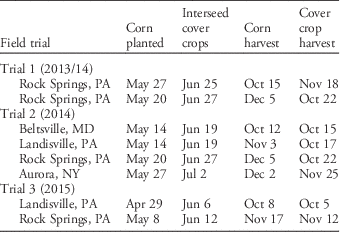
In each field trial, glyphosate-tolerant corn was no-till planted on 76-cm row spacing following a preplant glyphosate (1.26 kg ae ha−1) burndown application. Planting dates ranged from late April to early June, depending on trial location and environmental conditions (Table 3). Corn hybrid maturity was 94 d in New York, 95 d in Pennsylvania, and 111 d in Maryland. Corn seeding rates ranged from 69,000 to 87,000 seeds ha−1. Fertility programs utilized either preplant or preplant plus side-dress applications of N based on projected yield goals for the location, and fields were fertilized with phosphorous (P2O5) and potassium (K2O) according to recommendations based on soil testing prior to cash crop planting.
Dates of management and sampling activities.
Field trials were designed as randomized complete blocks with four replications. PRE herbicide treatments were applied within 1 to 2 d following corn planting using a handheld CO2 backpack sprayer calibrated to deliver 187 L ha−1 at 207 kPa. Herbicide treatments were imposed in four-row corn plots measuring 3 by 12 m. The number of herbicide treatments per field trial differed across site-years (Table 1). Depending on field size constraints and access to interseeder drills (two- or four-row units), cover crop treatments were either imposed as a split-plot (1.5 by 12 m) within herbicide main-plots (3 by 12 m) using a two-row interseeder, creating two interseeded inter- rows of each species per main plot, or as adjacent trials within the same field in 3- by 12-m plots using a four-row interseeder. Red clover and annual ryegrass were seeded at 11 and 22 kg ha−1, respectively.
Our research objective was to quantify residual herbicide effects on cover crop establishment rather than to evaluate weed control efficacy. Consequently, glyphosate (0.84 kg ae ha−1) was applied POST at the V3 growth stage to control emerged weeds prior to interseeding. Annual ryegrass and red clover were interseeded at the V5 growth stage of corn, which occurred 30 to 48 d after PRE treatment applications (Table 3). Aboveground cover crop biomass was collected from two randomly placed 0.5-m2 quadrats within the middle of an interseeded row to avoid potential edge effects in late fall (October or November) either prior to or after corn grain harvest, depending on feasibility at each trial location. Cover crops were oven dried at 55 C for at least 72 h and then weighed. Cover crop biomass was averaged across sampled quadrats within main plots prior to statistical analysis.
Statistical analysis was conducted on the effects of herbicide treatment on fall cover crop biomass. ANOVA was conducted separately on annual ryegrass and red clover fall biomass for each set of field trials with linear mixed-effect models using the function lmer from the lme4 package (Bates et al. Reference Bates, Maechler, Bolker, Walker, Christensen, Singmann, Dai, Grothendieck and Green2016) in R version 3.2.4 (R Development Core Team 2016). Herbicide treatments were fit as a fixed effect. Site-year and block nested within site-year were fit as random effects. In addition, we fit site, herbicide, and their interaction as fixed effects for the 2014 field trial conducted across four locations. We utilized log-normal models when fitting annual ryegrass models for the 2013 and 2014 field trials to achieve homogeneity of variance. Back-transformed geometric means are reported in the results. Post-hoc means comparisons between herbicide treatments and the nontreated check were conducted with the use of Dunnett’s tests, and Tukey’s HSD was used for multiple comparisons among treatments where appropriate at a significance level of P<0.05.
Among field trials, eight single active ingredient herbicides were tested in at least four to eight site-years using standard label rates (1×). To further understand variability in cover crop response to these herbicides across a range of site and environmental conditions, we used one-sample t tests to compare each herbicide with the nontreated check. First, we calculated mean cover crop biomass for each treatment within each trial by averaging the four replicates. Herbicide treatment values were then expressed as a proportion of the nontreated check, and treatments were rescaled to set nontreated check means to zero. Finally, we subjected each herbicide treatment to a one-sided t-test to determine whether cover crop biomass in each herbicide treatment was different compared with the nontreated check (µ=0).
Results and Discussion
Performance of Interseeded Cover Crops
Cover crop establishment and biomass production varied across study locations and years (Figure 1). Within the nontreated check, annual ryegrass fall biomass ranged from 70 to 648 kg ha−1 and red clover ranged from 75 to 323 kg ha−1. A high level of variability was also observed across replicates within site-years. The coefficient of variation in nontreated checks ranged from 22% to 73% and 13% to 79% across sites-years for annual ryegrass and red clover biomass, respectively (Figure 1). These trends are comparable to those reported in previous field trials investigating interseeded cover crop performance in no-till corn across the mid-Atlantic region (Roth et al. Reference Roth, Curran, Ryan and Mirsky2015). Several agronomic factors can contribute to variable cover crop emergence and growth among production regions or within fields. For example, previous field observations suggest that the timing of cover crop interseeding and establishment in relation to corn canopy closure and the soil moisture conditions prior to and following interseeding are important factors that influence the variability of interseeded cover crop establishment. In our field trials, broad indicators of environmental conditions (growing degree day, precipitation) before and after interseeding were not correlated to cover crop performance and did not differ appreciably among site-years (Table 4). We acknowledge that the observed variability of cover crop establishment in nontreated checks across our field trials likely precludes the detection of low-level cover crop injury in response to herbicide treatments. However, replicated field trial results reported here are instructive for identifying herbicide treatments whose soil-residual properties consistently produce cover crop injury across a range of environmental conditions.
Late fall mean biomass (kg ha−1) of interseeded (a) annual ryegrass and (b) red clover in nontreated check plots. Error bars represent standard deviation from the mean and are followed by the coefficient of variation in parentheses.

Environmental conditions before preemergence herbicide treatments, between preemergence treatments and interseeding, and after interseeding.

a Abbreviation: GDD, growing degree days using base temperature of 10 C.
Interseeded Annual Ryegrass Injury
We first (2013/2014) evaluated the effect of single active ingredient herbicides commonly used in PRE corn herbicide programs on interseeded annual ryegrass at Rock Springs, Pennsylvania (Table 5). These herbicides were applied at standard label rates (1×) for the soil texture and organic matter content of the study region. Pyroxasulfone and S-metolachlor applications reduced annual ryegrass biomass >80% compared to the nontreated check (P<0.05). Other grass control herbicides (pendimethalin, acetochlor, dimethenamid-P), as well as primarily broadleaf control herbicides, did not affect annual ryegrass performance.
Effect of herbicide treatments on annual ryegrass and red clover late fall biomass in field trial replicated in 2013 and 2014 growing seasons at Rock Springs, PA.
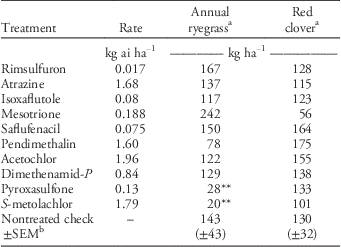
a Treatment means followed by double asterisk (**) are significantly lower than the nontreated check (P<0.05, Dunnett’s test).
b Standard error of mean for Dunnett contrasts. Annual ryegrass SEM based on untransformed data.
Herbicides that demonstrated potential compatibility with interseeding were evaluated at four mid-Atlantic locations in 2014 using reduced (0.5×) and standard (1×) label rates, and were tested in herbicide mixtures at 0.5× rates (Table 6). Pendimethalin applied at the standard rate (1.60 kg ai ha−1) and pendimethalin plus atrazine applied at 0.5× rates (0.71+0.56 kg ai ha−1) resulted in lower (P<0.05) annual ryegrass biomass compared to the nontreated check. No differences in annual ryegrass biomass were detected between the reduced and standard application rates of each herbicide treatment.
Effect of herbicide treatments on annual ryegrass and red clover late fall biomass in field trial replicated at four locations (Beltsville, MD; Landisville, PA; Rock Springs, PA; Aurora, NY) in 2014 growing season.

a Treatment means followed by double-asterisk (**) are significantly lower than the nontreated check (P<0.05 in Dunnett’s test).
b Standard error of mean for Dunnett contrasts. Annual ryegrass SEM based on untransformed data.
Analyzing study location as a fixed factor showed a strong study location effect on annual ryegrass biomass response to various herbicide treatments. At the BARC location, herbicide treatments that resulted in significantly lower annual ryegrass biomass compared to the nontreated check included pendimethalin at reduced (0.80 kg ai ha−1) and standard (1.60 kg ai ha−1) rates, pendimethalin plus atrazine at 0.5× rates (0.71+0.56 kg ai ha−1), saflufenacil at a standard rate (0.075 kg ai ha−1), and dimethenamid plus saflufenacil at 0.5× rates (0.35+0.02 kg ai ha−1). Pairwise comparisons detected no differences in annual ryegrass biomass between herbicide treatments and the nontreated check at other locations. Temperature (growing degree day) and precipitation before and after interseeding at the BARC location were not appreciably different than they were at other locations (Table 4). Consequently, we speculate that greater annual ryegrass injury resulted from the combination of loamy-sand soil texture and comparatively low organic matter (2.2%) and cation exchange capacity (5.8 meq per 100 g). These soil components and chemical properties lessen the affinity for herbicide sorption to soil, which increases the availability of herbicides in soil solution for plant uptake.
Single active ingredient herbicides (1×) and herbicide mixtures (0.5×) were further evaluated at Landisville, Pennsylvania, and Rock Springs, Pennsylvania in 2015 (Table 7). Pendimethalin, S-metolachlor, and S-metolachlor plus mesotrione plus atrazine reduced (P<0.05) annual ryegrass biomass 32%, 62%, and 37%, respectively, compared to the nontreated check. Finally, the effect of standard rate herbicides on annual ryegrass biomass was evaluated relative to the nontreated check using standardized site-level means (n=4 to 8). This analysis can be utilized as an indicator of the potential magnitude of cover crop injury and variability across a range of environmental conditions. In comparison to the nontreated check across site-years, S-metolachlor (1.79 kg ha−1), dimethenamid-P (0.84 kg ha−1), and pendimethalin (1.60 kg ha−1) reduced (P<0.05) annual ryegrass biomass (Figure 2). However, annual ryegrass biomass reduction averaged only 16% following dimethenamid-P applications, with a low level of variability across site-years. Consequently, we suggest that both acetochlor and dimethenamid-P may be used prior to interseeding annual ryegrass in corn systems.
Herbicide treatment effects on annual ryegrass and red clover late fall biomass. Dark circles represent mean estimates across site-years (n=4 to n=8), expressed as a proportion of the nontreated check (µ=0). Error bars represent 95% confidence limits for mean estimates. Confidence intervals overlapping with zero are not significantly different (one-sided t test) from the nontreated check. Shapes represent mean estimates for individual site-years: square. MD location; circles, PA locations; diamond, NY location.

Effect of herbicide treatments on annual ryegrass and red clover late fall biomass in field trial replicated at two locations (Landisville, PA; Rock Springs, PA) in 2015 growing season.

a Treatment means followed by double asterisk (**) are significantly lower than the nontreated check (P<0.05, Dunnett’s test).
b Standard error of mean for Dunnett contrasts.
In summary, the relative order of observed annual ryegrass injury among chloroacetamides was S-metolachlor>pyroxasulfone>dimethenamid-P>acetochlor. Both S-metolachlor and pyroxasulfone resulted in unacceptable levels of annual ryegrass biomass reduction (>75%) across years and locations whereas biomass reduction levels observed following use dimethenamid-P and acetochlor (<20%) might be acceptable to growers attempting to balance weed control and conservation goals. These observed trends are supported by previous studies on the relative differences in soil dissipation (Mueller and Steckel Reference Mueller and Steckel2011; Westra et al. Reference Westra, Shaner, Westra and Chapman2014) and soil sorption (Westra et al. Reference Westra, Shaner, Barbarick and Khosla2015) of chloroacetamide herbicides, which show greater potential for soil persistence of S-metolachlor and pyroxasulfone compared to dimethenamid-P and acetochlor. Our results also suggest that dimethenamid-P and acetochlor provide less risk for injury to interseeded annual ryegrass compared to pendimethalin, which resulted in highly variable levels of biomass reduction. Previous studies have demonstrated the potential for pendimethalin carryover injury to annual ryegrass. Tharp and Kells (Reference Tharp and Kells2000) reported 15% to 43% annual ryegrass injury when established 40 d after pendimethalin (1.68 kg ai ha−1) applications.
Interseeded Red Clover Injury
Mesotrione (0.188 kg ai ha−1) reduced red clover biomass 57% compared with the nontreated check (P=0.08) in initial evaluations (2013/2014) of single active ingredients at Rock Springs (Table 5). Reduced (0.5×) and standard (1×) rate herbicides that were identified as potentially compatible for interseeding, as well as in herbicide mixtures at 0.5× rates, did not affect red clover biomass compared to the nontreated check when analyzed across mid-Atlantic locations (n=4) in 2014 (Table 6). However, analysis by study location produced regional trends similar to interseeded annual ryegrass results. At the BARC location, saflufenacil (0.038 kg ai ha−1), dimethenamid-P (0.42 and 0.84 kg ai ha−1), dimethenamid-P plus saflufenacil (0.35+0.02 kg ai ha−1), rimsulfuron (0.017 kg ai ha−1), atrazine (0.56 and 1.12 kg ai ha−1), and pendimethalin plus atrazine (0.71+0.56 kg ai ha−1) reduced red clover biomass in comparison to the nontreated check (P<0.05). Pairwise comparisons detected no differences between herbicide treatments and the nontreated check at other study locations.
Mesotrione (0.188 kg ai ha−1) and S-metolachlor plus mesotrione plus atrazine applied at a 0.5× rate reduced red clover biomass >98% compared to the nontreated check (P<0.05) in experiments conducted at Landisville and Rock Springs in 2015 that further evaluated single active ingredient herbicides (1×) and herbicide mixtures applied at 0.5× rates (Table 7). Red clover biomass did not differ from the nontreated check in other herbicide treatments. In analysis of single active ingredients applied at standard rates across study locations (n=4 to 8), only mesotrione resulted in significant red clover biomass reduction (80%) compared to the nontreated check (Figure 2). Soil persistence of mesotrione is influenced by both soil pH and soil organic matter content (Dyson et al. Reference Dyson, Beulke, Brown and Lane2002), and field studies conducted across sandy- to clay-loam soils have reported mesotrione half-life values in the range of 32 to 50 d (Dyson et al. Reference Dyson, Beulke, Brown and Lane2002; Riddle et al. Reference Riddle, O’Sullivan, Swanton and Van Acker2013). Our results are supported by recent studies that have demonstrated carry-over injury to rotational crops following use of mesotrione (Riddle et al. Reference Riddle, O’Sullivan, Swanton and Van Acker2013; Soltani et al. Reference Soltani, Sikkema and Robinson2007).
In general, we expected to observe significant red clover injury following mesotrione applications, moderate levels of injury following atrazine applications, and minimal to no red clover injury following use of saflufenacil and rimsulfuron. Recent studies in clay loam to sandy clay loam soils have found minimal carry-over injury to rotational crops one year after saflufenacil (0.1 kg ai ha−1) applied alone (Robinson and McNaughton Reference Robinson and McNaughton2012) and minimal risk of injury to grass and broadleaf cover crops established 3 mo after saflufenacil/dimethenamid-P (0.735 kg ai ha−1) applications (Yu et al. Reference Yu, Van Eerd, O’Halloran, Sikkema and Robinson2015). Rimsulfuron is also generally considered to have limited soil residual activity due to rapid degradation under field conditions (Schneiders et al. Reference Schneiders, Koeppe, Naidu, Horne, Brown and Mucha1993). In our field trials, no red clover injury was observed following saflufenacil or rimsulfuron applications in silt loam soils across Pennsylvania and New York locations, but these herbicides as well as atrazine (0.5× and 1×) reduced interseeded red clover biomass by 50% at the BARC location, which had comparatively lighter-textured soil.
Conclusions
Results from our field trials suggest that caution is necessary on loamy sand and other lighter textured soils more indicative of the eastern shore of Maryland, Delaware, and Virginia, when cover crops are interseeded where PRE herbicides were applied. However, our results also suggest that several PRE herbicides may be used prior to interseeding in silt loam soils of Pennsylvania. Among herbicides used primarily for annual grass control, acetochlor and dimethenamid-P resulted in minimal injury (<20% mean biomass reduction) to interseeded annual ryegrass compared to S-metolachlor, pyroxasulfone, and pendimethalin applied at standard label rates. Among herbicides primarily used for broadleaf weed control, mesotrione resulted in significant injury to interseeded red clover, whereas saflufenacil, rimsulfuron and atrazine resulted in minimal injury at standard label rates. It is important to note that interseeding annual ryegrass monocultures would permit the use of mesotrione and interseeding red clover monocultures would permit the use of more persistent chloroacetamide herbicides, S-metoloachlor and pyroxasulfone, in weed control programs. Further research is needed to identify broad-spectrum weed control programs that are compatible with interseeding cover crop mixtures. Results from our field trials suggest that several reduced rate (0.5×) programs limit injury to interseeded cover crop mixtures, including acetochlor plus atrazine, acetochlor plus rimsulfuron, and saflufenacil plus dimethenamid-P. Given concerns regarding the evolutionary consequences of recurrent exposure of weeds to low herbicide doses (Neve and Powles Reference Neve and Powles2005), we are currently investigating whether these herbicide mixtures, or others, can be utilized with standard label rates in interseeded systems. Finally, further studies are also necessary to determine the ecological significance of herbicide injury to interseeded cover crops. Depending on the desired benefits from cover crops, low-level impacts on biomass production could reduce the utility and cost effectiveness of cover crops. Thus identifying herbicide options that overcome the trade-off between weed suppression and cover crop performance is important. In some cases, growers may be willing to accept moderate levels of cover crop injury in order to balance weed management and conservation goals.



