There is a long history of numerical theories about the music of Johann Sebastian Bach. Going back to writings by Wilhelm Werker, Arnold Schering, Martin Jansen and Friedrich Smend in the years 1922 to 1950, it has come to be a commonplace that Bach expressed himself in symbolic ways through numbers.Footnote 1 These theories, which have continued to proliferate, claim to reveal hidden relationships in Bach's music, usually by counting things (bars, notes and so on); and they offer symbolic interpretations of mathematical results that are said to have had meaning for the composer.
The latest of these hypotheses is the work of Ruth Tatlow, who has put forward a theory of ‘parallel proportions’ in Bach's music in articles and a book.Footnote 2 The theory claims that in his music ‘Bach created layers of 1:1 and 1:2 proportions, using the numbers of bars in the parts and sections of compositions’. It offers a method for analysis: ‘By comparing the numbers of bars in his early and later versions, or by tracing the changes he made as he compiled a new collection from pre-existing movements, one can see how Bach introduced the layers of perfect proportion’. And it suggests that the significance to Bach and to our understanding is that ‘harmonic proportions in the cosmos, in the world and in the measurement of the human being were understood to be a reflection of the “indescribable wisdom and perfection” of the Creator God’.Footnote 3
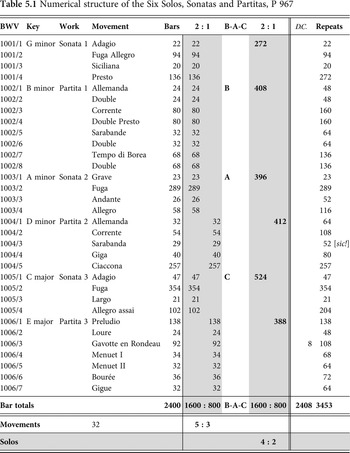
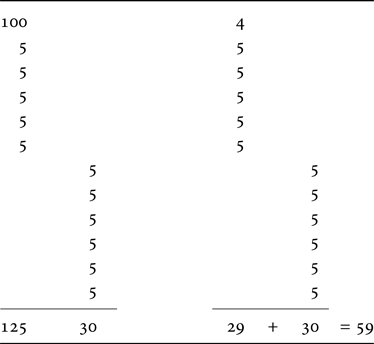
This striking theory is illustrated by examples from across Bach's musical output, including instrumental collections published and unpublished, as well as multi-movement vocal compositions. For example, Bach's Sonatas and Partitas for Solo Violin, bwv1001–1006, yield a table showing sums of bars in each movement that add up in 1:1 and 2:1 proportions – that is, movements are split into two columns that total the same number of bars (or twice the number in the case of 2:1 proportions), representing the theory's ‘parallel proportions’ in the music (Figure 1).
Table 5.1 from Ruth Tatlow, Bach's Numbers: Compositional Proportion and Significance (Cambridge: Cambridge University Press, 2015), 135. Used by permission

In many respects this theory is like its numerical predecessors, but it claims to be different in that it is said to be based on empirical observations – analytical data – rather than on interpretation. I am not certain that this distinction is entirely clear, but if we accept it for a moment then it makes sense to ask whether the empirical claims hold up – whether, that is, the bar tallies that are the basis of proportional claims are as factual as represented, and whether the proportional claims really result from the composer's deliberate choices. The answers are that they are not, and that they do not.Footnote 4
THE THEORY AND ITS PROBLEMS
The theory of parallel proportions seems to me to make three assertions:
1 numerical relationships are present in works by Bach – the numbers of bars in pieces or collections add up to create proportions;
2 Bach created these relationships through compositional choices; and
3 the relationships were understood to be meaningful in the eighteenth century.
The third claim is the subject of the opening chapters of the book, which argue for the centrality of harmonic and proportional thinking in the early eighteenth century and for its significance. This needs to be examined as a matter of intellectual history, and one writer has questioned – in harsh terms – the theory's interpretation of historical sources, its translation of key terms and its understanding of central principles of eighteenth-century musical signification.Footnote 5
But even aside from these problems, we do not know whether the claimed views were indeed expressed musically in the number of bars in pieces, or whether they informed composers’ thinking. There is no historical evidence for this – just analytical results according to the theory. Composers might have written pieces with features intended to project proportional thinking, but the claim that they did would have to be demonstrated by something more than simply showing numerical results. The fact that there are numerical relationships is not evidence that the composer put them there or that they were meant to be significant – it's just a restatement of the theory that there are proportional relationships. I do not think we can be comfortable with the assertion that a phenomenon was meaningful to the composer simply because it exists, at least not without further investigation. (We are free, without justification, to consider it meaningful to us, but that is a different matter.)
Interpretative claims need merely be plausible, and by that standard numerical relationships in Bach's music could be said to mirror symmetry in the world; a hermeneutic assertion like this is not subject to being disproved. But at the same time, without direct evidence of what Bach or his contemporaries believed about this it cannot be argued factually, either, and this is where the apparently objective nature of numbers in the theory of parallel proportions is potentially misleading. This is because the numbers presented do not fundamentally quantify features of works of music. They are rather the result of a series of analytical choices that are themselves part of the interpretative method.
The choice of how and what to count involves a large number of decisions on the part of the analyst, including (in the example of the violin music above) how to count repeats, da capos, and first and second endings in totalling up the bars. This is significant because one presumably has to count in the ‘correct’ way to get results. The theory acknowledges ambiguities in counting, but it is difficult, for example, to know what to make of this statement about the solo-violin works, which comprise twenty-one movements with repeats and one with a da capo indication: ‘Bach's score of the Six Solos has exactly 2400 bars. This becomes 2408 bars when the da capo bars are included and 3453 bars when all repeats are observed’.Footnote 6 We need to ask what it means that a score ‘has exactly 2400 bars’ but that they ‘become’ 2,408 when counted a different way, or 3,453 when totalled in yet a third. How ‘exact’ is 2,400 if there are at least two other possible tallies? Which is correct? These are probably not answerable questions, and we have to acknowledge that there are multiple ways to count. In fact there is no precise, objective number of bars in a work; the number of bars is an analytical result that stems from a series of choices by the analyst in all but the most trivial notated pieces.
This is crucial because the method of counting is essential to the subsequent analysis of numbers according to the theory. The way bars are counted is an important part of the method, not an objective path to facts on which to build analyses. Already the first claim – that the numerical relationships are present in Bach's music – is not factual but itself belongs to the realm of interpretation.
We particularly need to keep the interpretative character of counting in mind when we come across claims that notation itself proves Bach's intentions. In the violin solos, for example, the theory suggests that
the da capo [notation of one movement] . . . may be evidence of how Bach manipulated the score to achieve his perfect numerical plan. . . . Had Bach omitted the da capo indication and written out the final eight bars, the movement would have had 100 bars (108 with repeats) instead of 92 bars. This would have destroyed the perfect numerical plan.Footnote 7
There is apparently a presumption here of Bach's ‘perfect numerical plan’, and the evidence for that plan is that the numbers work out. But the working out of the numbers is the hypothesis, and the choice of how to count the da capo movement isn't evidence of its correctness – it is part of the analytical method, endorsed by the analyst because the numbers add up. The quoted argument implicitly acknowledges that at least two ways of counting were tried (with and without the da capo) and that the one that worked was selected.
It might be possible to describe this as a search for the correct or original method of counting (Bach's way), but the only argument for one over another is a satisfying result according to the theory. It borders on circularity to argue that analytical decisions themselves – the ones that yield results – are evidence in favour of the theory. The different counting of the da capo in the violin music is attributed to Bach, but it is as least as much an act of the analyst. The method rests on choices, and this is a problem because they present a large risk of selecting a counting method (for example) that validates the theory, and of tacitly eliminating many others that do not. And if there are multiple acceptable ways to count bars and movements according to the theory, that presents a greater likelihood that one of them will produce attractive results, especially if it turns out that chance plays a role. The more options, the more likely an appealing result.
And this points to a second problem. Even if we accept the analyst's choices – decisions about numbers of bars – the assertions of parallel proportions do not demonstrate Bach's intentional arrangements of the numbers, the theory's second claim. It is indeed often possible to arrange numbers of bars to add up to identical totals, as the theory suggests. But that does not prove that Bach set up these relationships, because it can be shown that if a few criteria are met there is a near-mathematical certainty that a set of numbers can be added to produce equal sums. The matching subtotals said to be evidence of compositional parallel proportions are actually a feature of the numbers, not of musical works or decisions made by the composer. It is not just that there is a good chance of these relationships arising randomly – there is an almost certain likelihood that they will. Chance and the properties of numbers almost entirely explain results that the theory interprets as symbolic gestures Bach deliberately composed into the music.
The two problems are related: the analyst's choices provide a set of numbers (or several of them) that all but guarantee a result. Methods of counting that do not or could not work are almost never presented, except in the negative light we have seen in the da capo example above. The theory chooses, in effect, an analytical representation of a piece that is mathematically all but certain to demonstrate a ‘parallel proportion’. The choice, together with inherent properties of the numbers, determines the result. In view of these problems we need to reconsider our interpretation of the meaning of numerical findings and ask whether a theory of parallel proportions indeed reveals anything about Bach.
ANALYTICAL CHOICES
The theory encompasses so many distinct claims that it is not possible to examine every aspect here. I will limit the examination to the central claim that Bach established 1:1 relationships among bar totals, and will focus on one composition that figures both in the book-length presentation of the theory and in an essay published before its appearance: Bach's so-called Dresden Missa, bwv232I, of 1733, the multi-movement Kyrie–Gloria setting that he would eventually incorporate into the Mass in B minor. It is transmitted both in an autograph score and in a set of original performing parts that Bach deposited with the Dresden court in hope of an appointment there (Staatsbibliothek zu Berlin (D-B), Mus. Ms. autogr. Bach P180; Sächsische Landesbibliothek – Staats- und Universitätsbibliothek (D-Dl), Mus. 2405-D-21), and those sources are useful in considering the theory's application to the work.
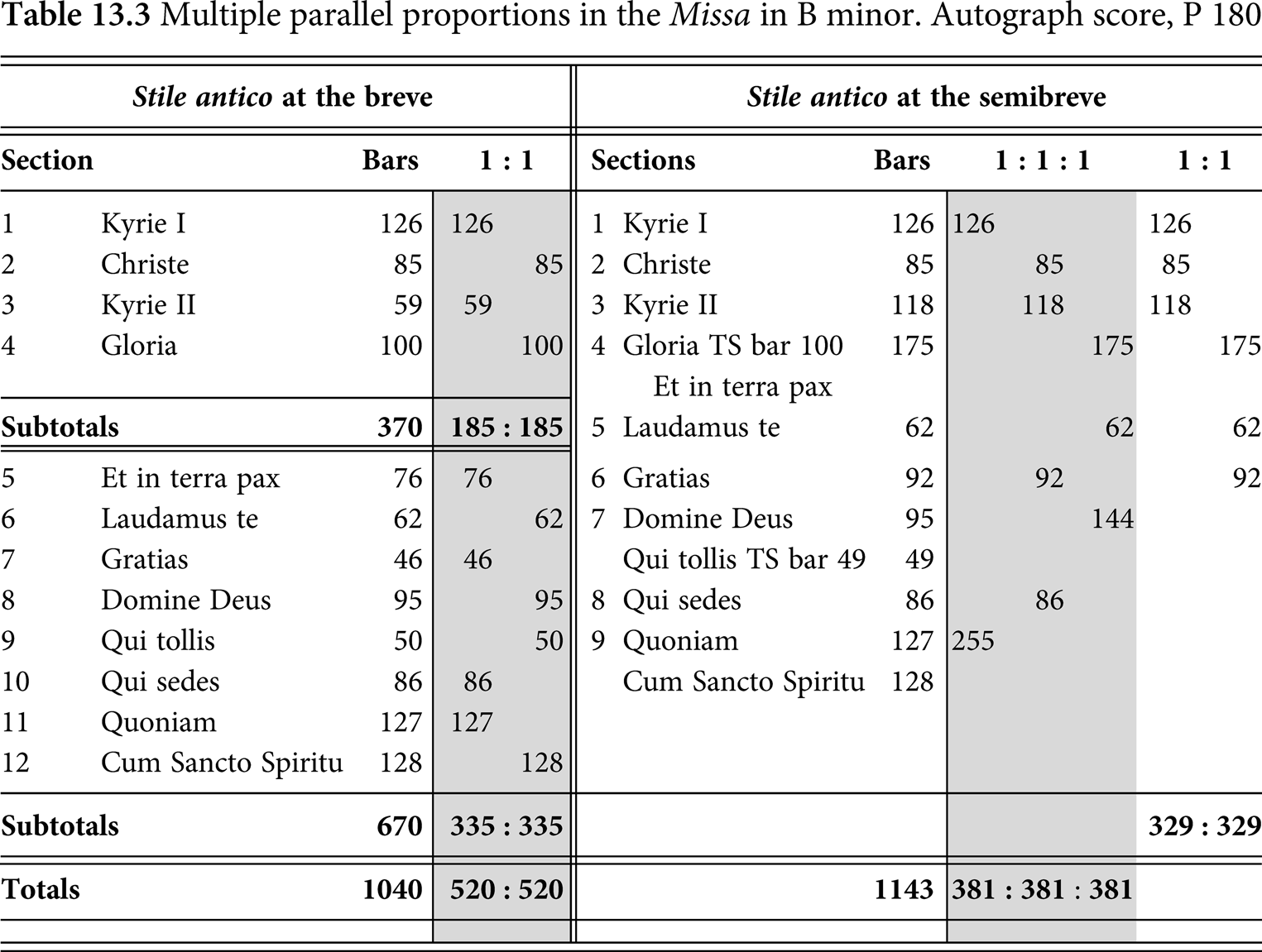
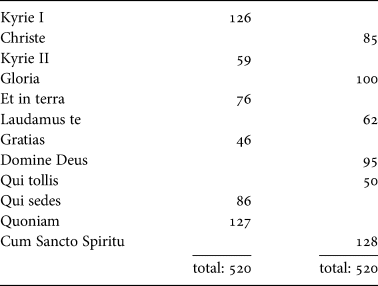
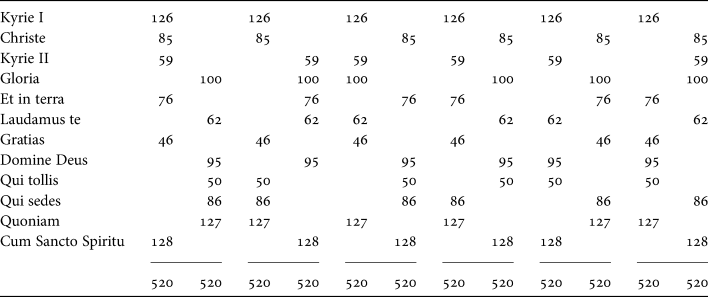
Figure 2 shows how parallel proportions in this work are represented in the book (the presentation in the article is similar). The principal claim – the one that links all the demonstrations of the theory – is represented on the left side of the table. The twelve movements of the Missa, totalling 1,040 bars, are divided into two groups of six, and the number of bars in each column is shown to add up to the same value (520); this is the 1:1 ‘parallel proportion’.
Table 13.3 from Tatlow, Bach's Numbers, 331. Used by permission

We can ask right away about the significance of the division – what it means that the first ‘Kyrie eleison’ is on the left, the ‘Christe eleison’ on the right and so on. The theory does not offer any insights into the distribution of movements, and we can wonder about an apparently arbitrary feature of the result. But we should probably ask some even more basic questions first. If the theory makes claims about the number of bars in each movement, we need to ask: ‘What is a bar?’ and ‘What is a movement?’ This is not just a matter of semantics, because the answers have a large effect – if the numbers add up, we should want to know that we are working with the right ones in the first place. The answers to these questions are not as obvious as one might expect, and they interact in significant ways.
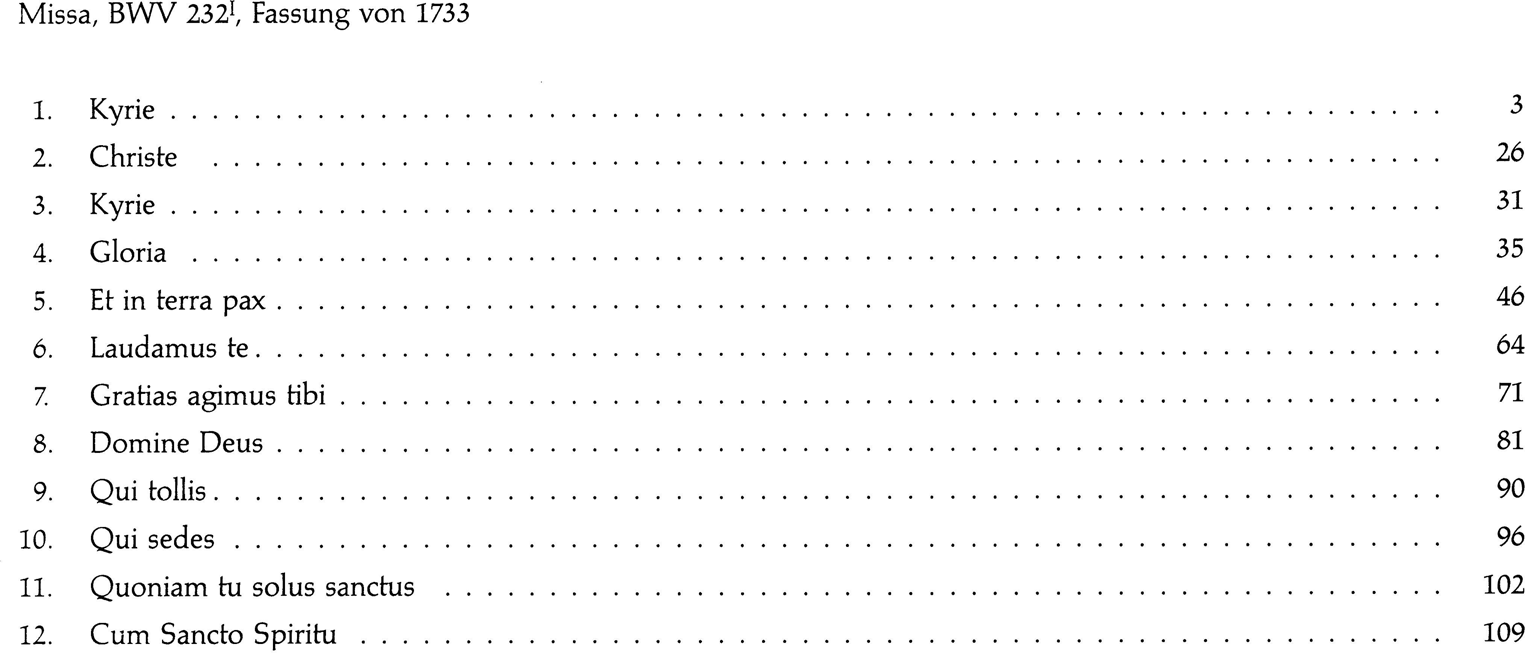
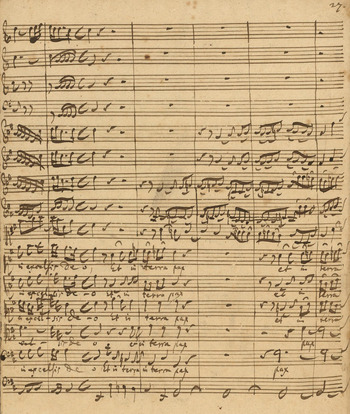
First, how many movements are there in the Missa? Almost every edition agrees on twelve (Figure 3), but is that what Bach thought? Consider the end of the ‘Gloria in excelsis’ and the ‘Et in terra pax’, typically numbered as movements 4 and 5 and considered distinct in the theory. In Bach's autograph score there is no double barline between them – not even a single barline – but rather just a change of metre (Figure 4). Each of the original performing parts is notated the same way, with no double barline. Bach's typical way of indicating the end of a movement, in contrast, is with a fermata and a clear double barline, as at the end of the ‘Et in terra pax’. Are the ‘Gloria in excelsis’ and ‘Et in terra pax’ distinct movements, or are they a single movement? Should we count their lengths separately or together?
Table of contents of Neue Bach-Ausgabe (NBA), series 2, volume 1a (Kassel: Bärenreiter, 2005)

J. S. Bach, Dresden Missa, bwv232I, ‘Gloria in excelsis Deo’ into ‘Et in terra pax’ in the autograph score. Staatsbibliothek zu Berlin (D-B) Mus.ms. Bach P 180. fol. 27r. Used by permission

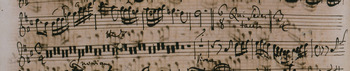
An even more telling spot is in the transition from the ‘Quoniam tu solus sanctus’ to the ‘Cum Sancto Spiritu’, regarded generally (and in the theory) as two movements. Once again the autograph score shows no division. In the parts, lines that participate in both (like the bass voice and basso continuo) are notated like the score, with just the word ‘Vivace’ to indicate the change (as in the basso continuo part; see Figure 5). But lines that are not heard in the ‘Quoniam tu solus sanctus’ are notated in the parts with 127 bars of rest, then the same ‘Vivace’ with no double bar (Traverso 1, as shown in Figure 6). That is, the ‘Cum Sancto Spiritu’ begins in bar 128, suggesting that Bach considered all this music part of the same ‘movement’. We can compare this notation to Bach's usual way of telling a singer or instrumentalist to sit out a whole movement – a tacet indication (‘Qui sedes tacet’ in the Traverso 1 part, Figure 6).
bwv232I, ‘Quoniam tu solus sanctus’ into ‘Cum Sancto Spiritu’ in the autograph basso continuo part. Sächsische Landesbibliothek – Staats- und Universitätsbibliothek (D-Dl) Mus. 2405-D-21, fol. 6r. Used by permission

bwv232I, ‘Qui sedes tacet’ and ‘Quoniam tu solus sanctus’ into ‘Cum Sancto Spiritu’ in the autograph Traverso 1 part. D-Dl Mus. 2405-D-21, fol. 3v. Used by permission

So are the ‘Quoniam’ and ‘Cum Sancto Spiritu’ one movement or two? And are there twelve movements in the Missa, or eleven, or ten if we also count the ‘Gloria in excelsis Deo’ and ‘Et in terra pax’ as one? The ambiguity is significant because the analyst has to choose, and this is the heart of the problem. There probably is no correct answer to the question of how many movements there ‘really’ are in the work, because this is an analytical choice – it is a feature of the analysis, not of the piece. And the existence of a choice offers multiple opportunities for a theory about numbers of bars to work out. Only one is presented in the table, and we have to ask why that choice was made.
There is actually a third transition like this in the Missa, between the ‘Domine Deus’ and the ‘Qui tollis peccata mundi’, notated just like the ‘Gloria’ / ‘Et in terra pax’. Once again the analyst faces the choice of considering this one movement or two. This one matters even more because if all three sets of paired movements count as one each, there are nine movements in the Missa. And that would not work, of course, because it is not possible to divide an odd number of movements into two equal groups. A choice has to be made to count each separately if the theory is to be applied in this way. This presents the same problem as before: the reason for the choice is ultimately that the numbers work out. This does not imply bad faith; if the method aims to find ways of counting that yield results, it will implicitly rule out ones that do not.
The theory accounts for this ambiguity in counting by a phenomenon it labels ‘TS’ for ‘Time Signature’, referring to the change that happens in two of these three transitions. In the table presented in the book, ‘TS’ marks places where the choice has been made (refer back to Figure 2). The table offers two alternative ways of counting these bars. It appears that each can yield the desired result. There are problems here we will return to, but even the theory's own analysis here acknowledges multiple ways to count.
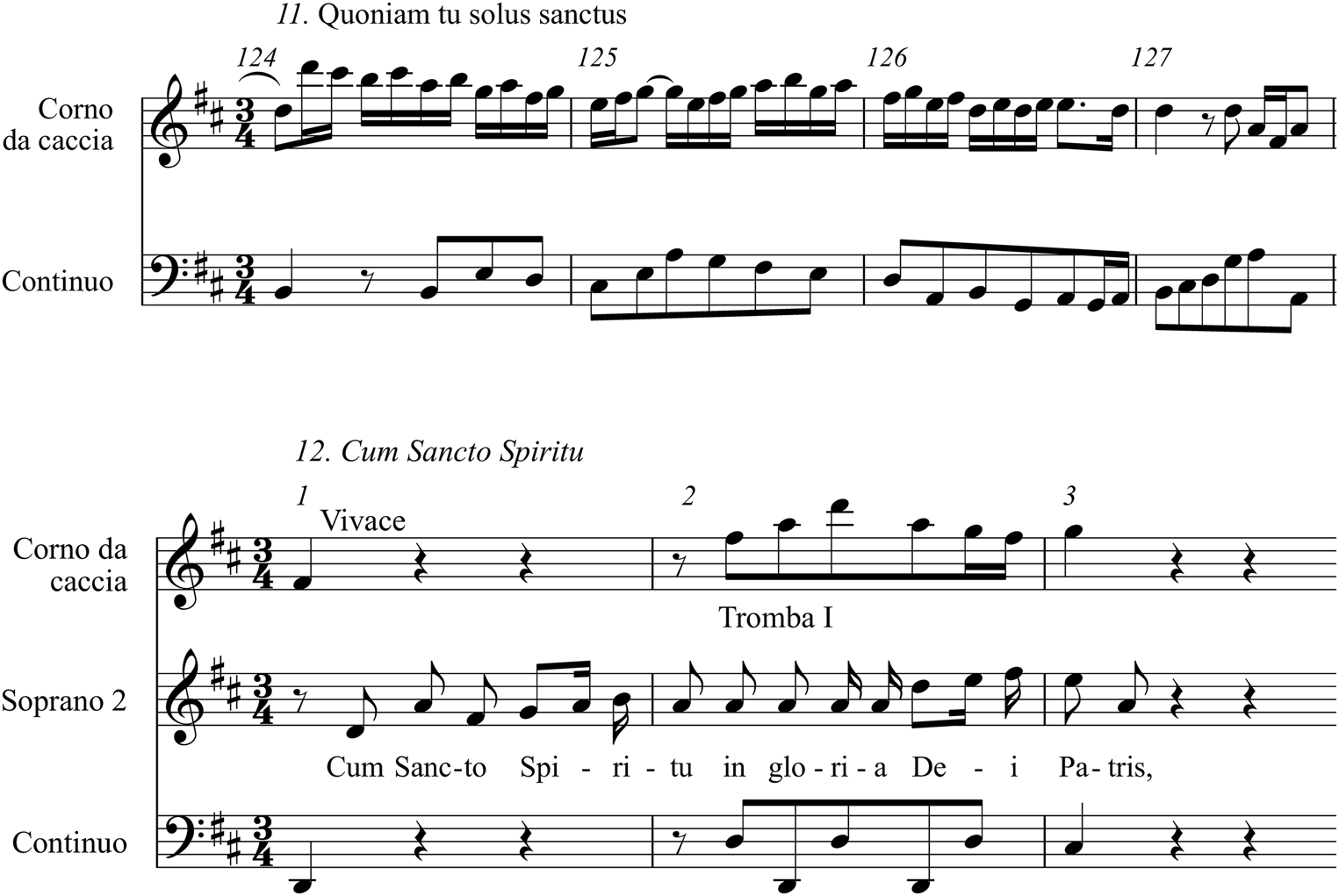
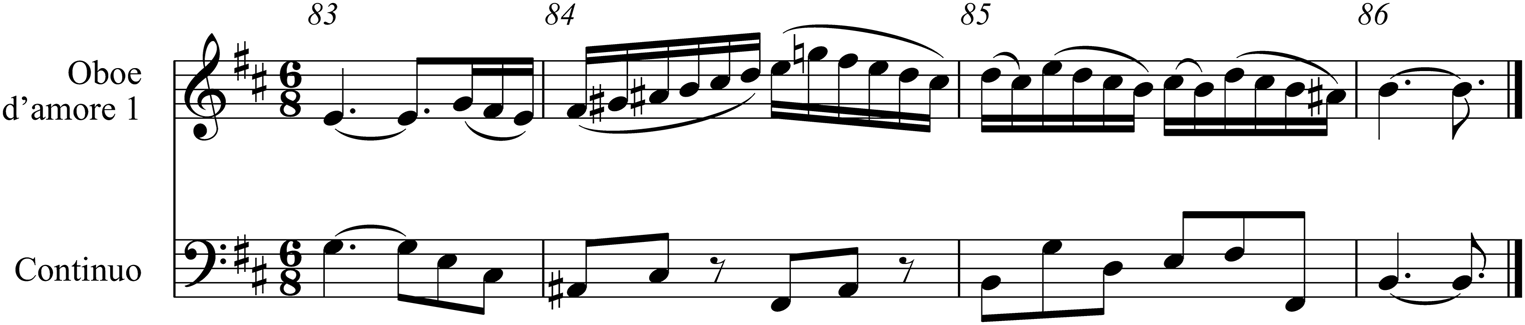
If the number of movements is a matter of interpretation, so, it turns out, is the number of bars in a movement. How many, for example, are in the ‘Quoniam tu solus sanctus’, which is part of the third transition? The numbered bars go to 127, and the cadential bar of the closing ritornello of the aria-like ‘Quoniam’ is also the first bar of the ‘Cum Sancto Spiritu’ (Example 1). According to the theory, that bar is counted only as part of the ‘Cum Sancto Spiritu’, but could we not also call the ‘Quoniam’ 128 bars long, counting its cadential bar, especially if we take the position that these are two distinct movements? After all, the previous movement, ‘Qui sedes ad dexteram patris’, has its cadential bar (with tonic resolution across the bar line) counted (Example 2). At the least, are there not alternatives from which one solution has been chosen?
bwv232I, ‘Quoniam tu solus sanctus’ into ‘Cum Sancto Spiritu’ as represented across a page break in NBA 2/1 (selected lines only)

bwv232I, end of ‘Qui sedes ad dextram Patris’ as represented in NBA 2/1

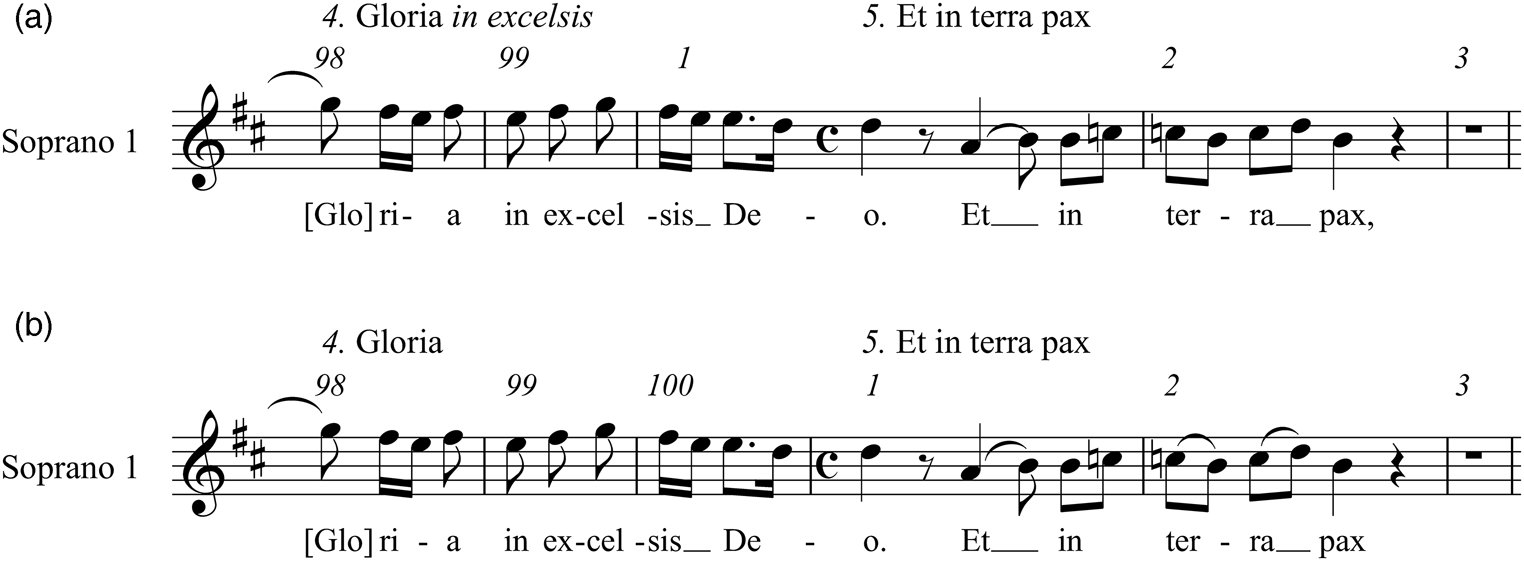
And if we regard the connected pairs as comprising two distinct movements, how do we number a transitional bar? Is the transition between the ‘Gloria’ and the ‘Et in terra pax’, for example, one bar long or two? Friedrich Smend's edition of the Mass in B minor in the Neue Bach-Ausgabe (NBA), series 2, volume 1, calls it one large bar and counts it as the first of the ‘Et in terra pax’. The ‘Gloria’ thus has 99 bars by his reckoning. But Uwe Wolf's NBA 2/1a (an edition of the 1733 Missa) counts this as two bars, one at the end of the ‘Gloria’ and another at the start of the ‘Et in terra pax’.Footnote 8 The length of the ‘Et in terra pax’ is unaffected, but this makes the ‘Gloria’ a bar longer than in Smend's count, totalling 100 instead of 99 (Example 3). Again, a choice has to be made from among at least two possibilities, and there is no firm basis for arguing that one way of counting is correct. This is an analytical decision, not subject to being right or wrong, except perhaps by the criterion of whether the result satisfies the theory.
bwv232I, ‘Gloria in excelsis’ into ‘Et in terra pax’ (Soprano 1 only); (a) as represented in NBA 2/1, ed. Friedrich Smend (Kassel: Bärenreiter, 1954); (b) as represented in NBA 2/1a, ed. Uwe Wolf (Kassel: Bärenreiter, 2005)

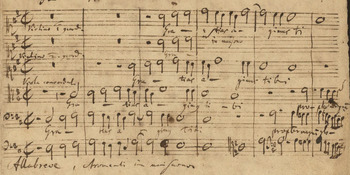
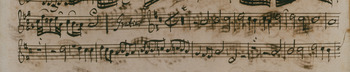
The need to count requires that we define ‘bar’ in the first place, and this too is more complex than it might seem. Consider the ‘Gratias agimus tibi’, a movement (at least at its start) in old-style alla breve counterpoint. Bach notates it in his score in double bars, often with a little stroke dividing each in half (Figure 7). (The second ‘Kyrie eleison’ is notated the same way, in big divided bars.) If we look, for example, at the Violin 1 line (top staff, doubling Soprano 1 and Soprano 2), we see two bars’ rest before it enters – two large bars, that is, in Bach's autograph score. But Bach's autograph performing part calls these four bars’ rest, counting them as half as long (Figure 8). Which is it? Do bars in the ‘Gratias agimus tibi’ span two minims or four, leading to counts of 92 or 46 in total? We have to decide, and of course this has the potential to affect the results according to the theory.
bwv232I, ‘Gratias agimus tibi’ in the autograph score. D-B Mus.ms. Bach P 180, fol. 47r. Used by permission

bwv232I, ‘Gratias agimus tibi’ in the autograph first copy of the Violin 1 part. D-Dl Mus. 2405-D-21, fol. 2r. Used by permission

This is the reason for the right and left sides of the theory's table, in which both ways of counting appear to work out (Figure 2). But it is essential to note the interaction of this choice with another: the ‘TS’ transition. The table finds parallel proportions when old-style movements are counted at the breve (fewer big bars) without the adjustment for movement transitions (‘TS’), but at the semibreve (more small bars) with that adjustment. It is possible to interpret this as demonstrating that the theory is correct either way, but I think it actually shows the opposite: that the theory works only when certain decisions are combined. There are multiple ways to assemble the various choices, but only the ones that work are presented; others are silently rejected.
There are additional problems when other sorts of compositions by Bach are analysed according to the theory. His instrumental works have repeats and first/second endings, and the occasional da capo, as we have seen. Concerted vocal music can introduce the problem of da capo indications, dal segno signs, and so on. All told there are many analytical choices to make in every application of the theory, and thus many opportunities in which potentially to find parallelisms.
The table for the Dresden Missa (Figure 2) also includes a 1:1:1 proportion, and a 1:1 relationship made up of first the six movements only. This is presented as evidence of Bach's creation of multiple parallelisms, but if the rules (the choices) change for each analysis – how many movements are counted, how many columns they are divided into, what proportions are said to be revealed – it becomes difficult to say precisely what is demonstrated. (Note also that some of the divisions require different choices in the counting of the same movements.)
We do not know how any of the results showing parallel proportions were arrived at analytically, but one might guess that the method was to try combinations and record ones that worked – it is difficult to see how else they would surface. And that brings us back to the problem of inherent circularity: the theory claims that the pieces work this way, but the evidence is that they do provided one makes the right choices from among many possibilities. I think we have to be cautious about accepting a result that stems from this approach.
PROBABILITY
Let us say, though, that we can agree on the number of movements and bars in a piece or collection. When we are presented with a division that indeed yields a 1:1 proportion, we need to consider the theory's second assertion, that Bach put these relationships there by careful work in planning, composing or revising. This is worth exploring, once again using the 1733 Missa as an example. The theory assigns a certain number of bars to each of twelve movements and shows a division into two columns that each add up to the same total. Does chance play any role in this? How likely is it that twelve numbers can be divided in this way? If it's improbable, that might point to the results’ having been worked out – by Bach, in this case. But if it is sufficiently likely, we might want to think carefully about crediting Bach for the relationship.
To test the likelihood, we can start by expressing our problem mathematically. We have twelve numbers representing the bar counts of each movement (Table 1). We choose any six for one column and the remaining six for the other. We add up the numbers in each column and compare them to see if the sum is the same.
A ‘parallel proportion’ in Bach's Dresden Missa

With twelve numbers there are many possible arrangements with six in one column and six in the other. This is what mathematicians call combination without repetition – n things taken r at a time, typically notated as nCr. This can be calculated for a given n and r by the formula  ${{n!} \over {r!\lpar {n-r} \rpar !}}$.
Twelve things taken six at a time (our case) yields 924 combinations – that is, 924 distinct ways to split twelve numbers into two columns of six. This actually overstates the total for our purposes, because putting six particular numbers (movements) in one column and the rest in the other is the same as putting those first six in the second column and the others in the first – we don't care about the order of right and left columns. This means that there are only half the number of possible combinations, or 462 ways to divide the twelve numbers as six and six.
First, we can note that there are some sets of twelve numbers that will never work – that we cannot divide into two equal-total columns. For example, if the numbers are very lopsided, there is no way six numbers on one side could ever balance six that include a very large number on the other; or if the total number of bars is odd, there is obviously no way to divide them to add to the same subtotal (Table 2).
Two impossible ‘parallel proportions’

But if the total number of bars is even, as in our first combination above, there might be a way to divide them. This set of numbers does have a solution; in fact it is the Dresden Missa counted according to the theory, and it can be divided to add to 520 on each side. But what about other numbers, like those in Table 3?
A potential ‘parallel proportion’

To know whether they can be divided we would need to try all 462 combinations – and we do need to test them all, it turns out. This is potentially a laborious task, but we can make the job a lot easier with a computational tool, a spreadsheet that rapidly tests all the combinations (its workings are described in the Appendix). One immediate result of applying the tool is that some combinations of twelve numbers turn out to have more than one solution that shows a ‘parallel proportion’ – that is, there are multiple ways to divide them six and six that yield the same total. The tool reveals that the Dresden Missa, for example, can be divided (once again, in the theory's count) not just in one way but in six different ways (Table 4). We need to ask what this means for the theory, why only one of the six is presented in the analysis, and why this one. At the least, this might suggest that the ability to divide numbers this way is more likely than we suspected.
Six ‘parallel proportions’ in Bach's Dresden Missa

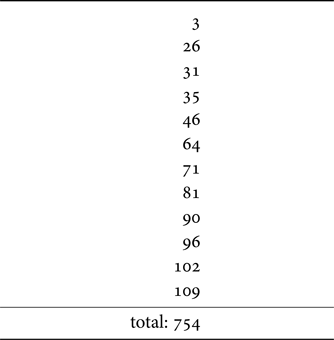
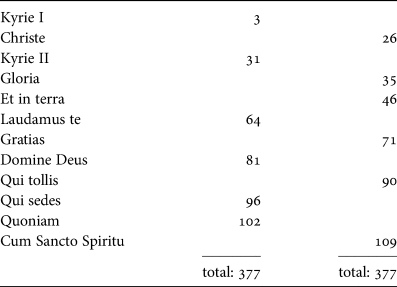
A little experimentation with the tool confirms, of course, that sets of numbers whose total is odd can't be divided, but also shows that most combinations with an even total can. In fact some surprisingly unmusical sets of numbers work. The figures in our unknown example above, for instance, are not numbers of bars in a composition but rather the page numbers of the Dresden Missa's movements in NBA 2/1a (Figure 3), and there is indeed one solution that divides them into two columns each totalling 377 – that is, there is a partition that shows a parallel proportion among the page numbers (Table 5).
A ‘parallel proportion’ in NBA 2/1a page numbers

And if we experiment with twelve random numbers between 31 and 130 (100 different values that encompass the movement lengths in the Missa), we quickly notice that twelve random numbers with an even total are a lot more likely to be divisible than not. In fact, almost every even total has at least one solution that shows a 1:1 proportion; rare is the even total that cannot be divided in this way. This should make us wonder how likely it is that twelve values can be divided evenly because that matters to a judgment of the theory's validity.
Given twelve random values in a certain range, what is the likelihood that they can be divided into two columns totalling the same? It is not clear that there is a mathematical answer to this question – this sort of problem is notoriously difficult to solve by proof. The alternative is to solve the problem computationally – by examining every possible set of twelve numbers to determine the likelihood that they can be divided equally, or by some more efficient algorithm that takes less time. This quickly becomes a very large undertaking. Let's say we want to test every combination of twelve numbers with values between 31 and 130. That means 100 different values in each of twelve positions, or 10012 = 1024 combinations – a 1 followed by 24 noughts. Even on the fastest computers, testing these is an almost impossibly large task.
Computer science has addressed precisely our problem: dividing a set of numbers into two groups with the same sum; this comes up in intensely computational areas like security and encryption. It is known as the partition problem, and it turns out that it falls into a category of problems (called NP-complete) for which no really efficient computational algorithm is known to exist, and for which it is suspected that none does.Footnote 9 Even with a good algorithm that avoids the brute-force testing of every possible combination, this is a huge challenge.
But we do not really need to test every possible combination of twelve values, because we are actually concerned only with arrays of numbers like the Dresden Missa, and with the question of how likely it is that a given combination of that general disposition can be evenly divided. We can get a sense by testing more limited sets of combinations; if we test a very large number of them, we can be reasonably sure of a good estimate of the probability. For example, we can start with the claimed lengths of the Missa movements and vary each by plus or minus two – that is, take every combination of five different values centred on the numbers from the Kyrie and Gloria, in every possible combination. That requires testing only 512 = 244,140,625 combinations.
This can be done with a mathematical modelling tool called MATLAB. A simple program works through sets of twelve values, testing every combination and reporting how many yield equal totals (and other information) – in other words, this is the spreadsheet test, automated. On an ordinary desktop computer the programme can test around 37,000 sets of twelve numbers a second, just by brute force – that's 462 checks on each set, 37,000 times a second, powerful enough to test our 244 million Missa-like possibilities in under two hours. The results are striking.
As shown in Table 6, of the 244 million sets of twelve numbers tested, about 119 million have at least one solution and about 125 million do not. That is, there is better than a 48 per cent chance that numbers like this can be divided to yield identical totals. But we should recall that only even totals are worth testing because odd totals cannot be divided equally under any circumstances. In the test, those 119 million successful divisions were out of 122 million combinations with even totals – more than 97 per cent of them. Put another way, if a set of twelve movements like the Dresden Missa adds up to an even number, there is a 97 per cent chance that they can be divided equally into a ‘parallel proportion’. Making small changes to the Missa numbers doesn't matter – almost every combination with an even total number of bars can be divided according to the theory.Footnote 10
Test of Dresden Missa lengths +/− 2

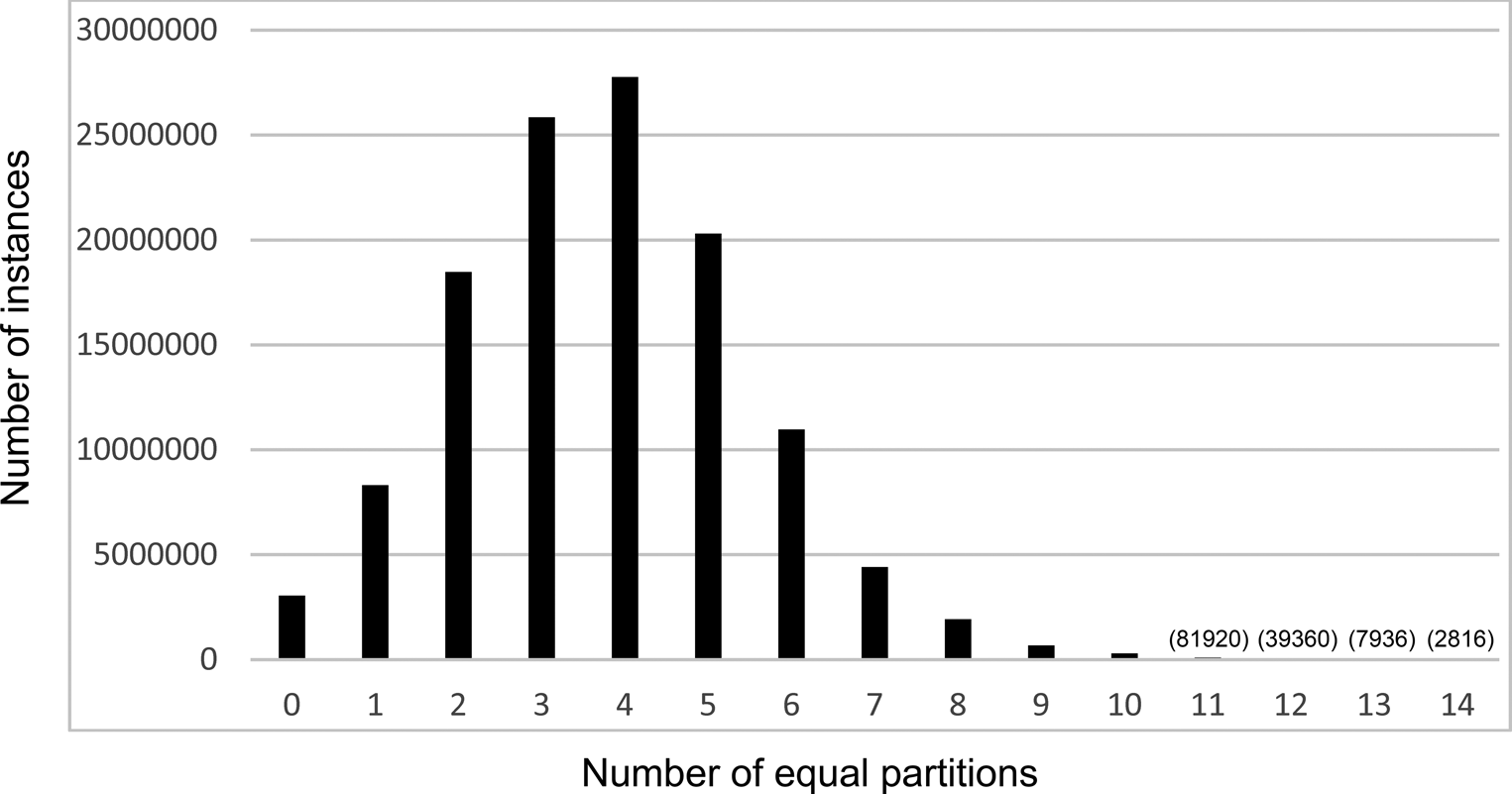
We can recall that our spreadsheet showed that there were six ways to divide the movements of the Dresden Missa – six distinct ways to divide them with even totals. It is very common, it turns out, for a set of twelve numbers to have multiple solutions – up to fourteen of them, in fact (Figure 9). A set of four is the most common, and 1–7 are each more common than none. At least by the evidence of this test, the ability to divide twelve numbers in this range evenly (and in multiple ways) is a property of the numbers, not their origin – and almost certain.
Number of partitions of Dresden Missa lengths +/− 2 (out of 122,070,313 even totals)

Another approach is to generate twelve random numbers in a given range and test them. Testing sets of random values from 31 to 130 (again, encompassing the lengths of Missa movements) 100 million times gives equally striking results (Table 7).
Test of random values from 31 to 130

Ninety-five per cent of random combinations of twelve numbers that add up to an even total can be divided, suggesting once again that the ability to partition them equally is a property of the numbers – they do not even need to resemble the lengths in the Missa all that precisely. For one more test, we can try a hybrid approach, starting with the Dresden Missa numbers and randomly adjusting each up or down by 1 to 10. One hundred million tests by that method yield equal totals more than 94 per cent of the time (Table 8).
Test of Dresden Missa lengths randomly adjusted +/− 10

In fact, a test of random numbers and the resulting high probability that they are evenly divisible most likely underestimates the susceptibility of Bach's Missa to partitioning. This is because the bar lengths in the work are not really random. Rather, they are greatly constrained in a way that make a parallel proportion even more likely. The movements of the Missa fall within a narrow range of lengths, and the narrower the span of allowable numbers, the more likely a match, both according to the theory of partitioning and tests with larger ranges of numbers.Footnote 11 And of course the lengths of mass movements are not entirely independent of each other. Pieces like the Missa tend to have large framing movements whose lengths can offset each other (that is, land in opposite columns), giving a better chance of a match. (We can note that in the six equal divisions of the Dresden Missa above, the ‘Quoniam’ and ‘Cum Sancto Spiritu’, comparably long movements, always end up in opposite columns.) Many of the constraints – features of bar counts that make them non-random – make a match even more likely than if these were random values. And of course the probability even for random values is very high to begin with.
Now we are in a position to understand the problem with the numerical interpretations of the Dresden Missa that choose between two different schemes of counting alla breve movements and two ways of counting overlapping (TS) movements. We saw that in the presentation of the theory these are linked to obtain parallel proportions: one way of counting alla breve movements is paired with one method of handling TS movements; other combinations of these methods are not explicitly considered. The analytical table of the Missa's movements presents this result in positive form, showing the two combinations that yield a result (breve counting/no TS adjustment versus semibreve counting/TS adjustment). But there are also combinations that do not work – counting at the semibreve and making no TS adjustment, for example, which yields an odd total number of bars – and they are not represented. This is a potentially invisible analytical choice that has selected one method and silently rejected the other.Footnote 12 We have seen that the likelihood that the one shown will work is around 95 per cent, because even totals can almost always be divided successfully. The left side of the table presents a workable analysis of the Missa, but it actually offers an almost inevitable result while implicitly suppressing another that does not conform. The table thus potentially presents a misleading demonstration.
IMPLICATIONS
As far as numbers of bars are concerned, we should not be surprised to find that totals in Bach's music can be made to match. In fact with an even number of bars it is almost dead certain that they can, given a sufficient number of movements, and this is a property of the numbers, not of the musical composition from which they derive. The divisions may look significant – they might appear to be intentional parallel proportions – but they are far more likely to be the product of the large number of possible combinations, not Bach's manipulations.
This sort of interpretative problem surfaces elsewhere, perhaps most famously in so-called bible codes. Many methods have been claimed to reveal hidden meanings in scripture – names, dates, predictions and so on. A common approach is to take every nth letter of scripture, and sometimes words are indeed revealed by doing this. But it has been demonstrated repeatedly that this is a product of chance, not intention. Given enough text and sufficient flexibility in choosing letters, apparently significant words are almost guaranteed to emerge from any text.Footnote 13 Bible codes of this kind are not demonstrations of hidden messages; they are creative interpretative methods with results more or less mathematically guaranteed by the law of large numbers.
Music theorist John McKay has made a similar argument for a certain kind of mathematical analysis of atonal music.Footnote 14 He examines Allen Forte's claim that Anton Webern's Op. 9 Bagatelles reveal their construction from octatonic collections (pitch-class set 6-Z13), and demonstrates convincingly that choices made by the analyst, combined with the many possible ways of grouping notes, makes an apparently meaningful result almost inevitable. What seems to be a constructive principle of the music is actually an artefact of the analytical method – it has no demonstrable connection with compositional intent.
This is a close analogy to the theory of parallel proportions: the analyst applying the theory makes a set of choices (number of movements, ways of counting bars, decisions about repeats and connected movements, and so on), always in a way that yields an even number of bars. The analytical result, however carefully it may be derived from original sources or with knowledge of eighteenth-century musical conventions, is drawn from a large array of potential bar counts. In effect the analyst pre-selects one that is capable of being divided equally – one with an even total number of bars. Probability then takes over, essentially guaranteeing a result.Footnote 15
To return to our starting-point, we can reconsider the three assertions made in the theory of parallel proportions. First, there is the claim that relationships are present – that the number of bars in pieces and collections adds up. We have seen that this depends largely on how we define movements, bars and counting. There are multiple possibilities and significant flexibility, because each piece or collection is typically examined idiosyncratically.
Second, the theory claims that Bach intentionally created these relationships in his works through compositional choices. In fact, the results do not appear to rely on Bach. The ability to divide bar counts into equal subtotals – to find parallel proportions – is a feature of the numbers, tallied under constraints and after analytical choices that make a seemingly meaningful result mathematically almost inevitable, at least for sets of numbers like those derived from the 1733 Missa.
Finally, there is the proposal that these results signify in eighteenth-century terms. They might, but given their near-statistical certainty and thus independence from compositional design, are we confident in regarding them as part of a composer's goals? If essentially any piece with a sufficient number of movements works, are the results meaningful? This does not mean that symmetry and proportion were unimportant to eighteenth-century thinkers, or that musicians were unaware of the concepts. But it is clear that the kind of numerical relationships treated by the theory are unlikely to represent composers’ deliberate expression of these ideas.Footnote 16
The theory of parallel proportions makes many claims about numbers in Bach's music, of which only some are illustrated and tested by our example of the Dresden Missa. But the methodology is fundamentally the same each time: numbers are analytically derived from a piece or collection, and the properties of those numbers are asserted to be significant. The lessons of our examples are twofold: first that we need to be aware of seemingly neutral analytical choices that can determine results, and second that we need to test whether a result might be the product of chance rather than compositional design before we consider its meaning. It is not self-evident what degree of chance should make us doubt the musical intentionality of a numerical relationship, but a 95 per cent probability that random numbers would produce the same result – which appears to be the case for large sets of numbers – is surely enough to cast grave doubt. Every claim needs to be examined for the nature of its counting and for the degree of mathematical inevitability before we should be comfortable in accepting it.
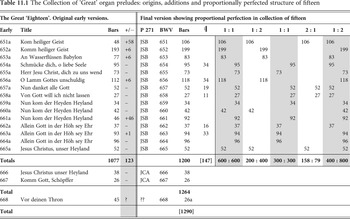
A few brief examples can illustrate the direction this reflection might take. Table 11.1 in the book lays out relationships among the first fifteen pieces in the so-called ‘Great Eighteen’ organ chorales, bwv651–668 (Figure 10). The left column indicating the number of bars corresponds to earlier versions of the works; no proportions are shown. The right columns show multiple divisions of the revised chorales said to demonstrate five different proportions Bach introduced. (As always, we would need to investigate the counting method.) I have not done the same sort of extensive statistical estimates as with the Dresden Missa, but with even more chorales in the set than movements in the Missa, it is profoundly likely that a set of numbers like those associated with the ‘Great Eighteen’ could be arranged to reveal proportions, whatever their origin.
Table 11.1 from Tatlow, Bach's Numbers, 278. Used by permission

And this suspicion is strengthened by a closer analysis of the particular numbers in the table of the ‘Great Eighteen’. We are offered five ratios of various kinds, but in fact all of them are present multiple times in these numbers, not just in the individual ways offered in the table:
1 there are thirty-four ways to divide all fifteen chorales in the ratio 600:600
2 there are four ways to select six that can be divided 200:400
3 there are seven ways to select nine that can be divided 300:300 (one in three different ways)
4 there are seven ways to select four with a 2:1 ratio
5 there are eleven ways to divide all fifteen chorales in the ratio 400:800.
This confirms that these ratios (and certainly many more, given that those demonstrated here – choosing six, nine or four – are apparently arbitrary) are an almost inevitable feature of a large set of small numbers like this. Fifteen numbers, or even a subset of them, yield so many combinations that seemingly meaningful relationships appear to emerge.
The table presents one example of each ratio, perhaps implying that they are rare and unique, but there are actually many proportions to be found. The table simply confirms that a sufficiently large set constrained in particular dimensions can almost always be organized to add up in desired ways. If this is true for sets of twelve numbers divided only as six and six (as in the Dresden Missa), it is even more certain for a set of fifteen with no requirement that they be divided in a particular way. Large sets of numbers are strongly subject to chance, and any Bach example that relies on them needs to be treated with caution because they present so many possible ways to generate a proportional division.
The multiple proportions in this table (and in many others) – representing the claim that there are multiple parallel proportions to be found in the set of compositions – might appear to strengthen the case that the mathematical results are significant. That would be because the likelihood of simultaneous events is the product of the probabilities of each event, getting smaller (through the multiplication of fractions) with each additional proportion. What is the chance, it could be asked, that a work would demonstrate multiple parallel proportions? The more of them it shows, the less likely it would seem that they would occur together randomly and the more compelling the demonstration.Footnote 17
But this is greatly misleading. We can calculate probabilities and their combinations (how likely it is that certain outcomes will happen together) when, first, we are sure of the independence of the individual events and, second, we know the entire range of possible outcomes.Footnote 18 In seeking parallel proportions in Bach's music we cannot be certain of the first because all the claimed proportions in a table derive from the same set of analytical counting choices; they are not independent. And we don't know the second because there is an enormous universe of possible divisions – taking all of the pieces in a collection or subsets of various sizes, making equal divisions or unequal ones, dividing into two or three columns and so on. A table that shows multiple ways to derive proportions has implicitly chosen the ones it shows – and only those – from a huge number of possibilities. We have seen that the mathematics is in favour of each of their working, and if we have multiple choices the likelihood approaches certainty that more than one will. The existence of multiple proportions does not strengthen the argument for significance.
The ‘Great Eighteen’ chorales should also make us think about the role of Bach's revisions in producing proportions. The table shows proportions among the revised lengths of the chorales, but also offers pre-revision lengths on the left. No proportions are indicated there, but in fact the pre-revision lengths are not devoid of relationships: there are eight ways to divide them as nine and six to yield 2:1 proportions; there are three ways to choose six for a 400:200 proportion, and so on. In other words, it may be possible to create proportions from revised lengths, but it is also possible to do so with the pre-revision numbers, even though the table does not show these divisions.
Before we ascribe meaning to Bach's revisions here or elsewhere, we need to look carefully at both the old and the new versions of any work or collection. This applies to the Dresden Missa; the theory suggests that Bach added introductory bars (the declamation ‘Kyrie eleison’ before the start of the ritornello) ‘to perfect the structure of the Missa’. But its movements can indeed be divided in a 1:1 proportion with four fewer bars in the first ‘Kyrie eleison’ (122 rather than 126).Footnote 19 This feature did not rely on a revision.
Proportional claims become more difficult to evaluate when there are smaller numbers of movements or pieces – when the number of possible arrangements is smaller. With fewer ways to arrange a set of bar lengths comes a smaller likelihood of finding proportional totals randomly. The theory addresses this problem of chance. For example, of Partita No. 3 in E major, bwv1006, we read: ‘As numerous combinations of seven random numbers between 24 and 138 can create a 1:1 proportion, this result with 194:194 bars could easily be dismissed as arithmetical coincidence’.Footnote 20 The chance that seven random numbers over that span (one way of counting bars in the partita's seven movements) can be divided proportionally is once again too large to calculate exhaustively, but the same statistical method used for the Missa suggests, in fact, that approximately 10 per cent of random combinations of seven numbers in that range yield at least one 1:1 proportion.
With figures like 10 per cent we are in the realm of judgment. If only one out of ten random sets of numbers can be divided in this way, is this a matter of chance or is it evidence of the compositional design of a musical work? Of course we need to consider how the bars are counted, and we have seen that there are many choices with the violin solos. Favourable counting would increase the likelihood that proportions can be found, and in this case ten distinct counting methods would provide great certainty that at least one of them would produce numbers that can be proportionally divided. We have to decide as individual analysts whether we think a result like this points to Bach's intentions in any particular work.
If it is difficult to decide about a 10 per cent likelihood of a result by chance, other instances are even more challenging. On the violin solos overall, for example, the theory argues: ‘Without deliberate design, the bar totals of any six works within a range of 272 and 524 bars . . . are highly unlikely to form an exact double 2:1 proportion’.Footnote 21 This probability too can be estimated: approximately 4.5 per cent of random combinations of six numbers in this range whose total is divisible by 3 yields a 2:1 proportion; approximately 1.5 per cent of all random combinations (any total) do. Whether a result like this would arise randomly is again a matter of interpretation, though of course the likelihood is higher if one is trying different methods of counting and alighting on one that works. Claims about small numbers of bar lengths need to be examined closely; they cannot be dismissed out of hand, but also should not be accepted without reflection.
It is not just individual analyses we need to be concerned about. The theory makes an implicitly broad claim in discussing the seven movements of bwv1006 and their relationship: ‘As 1:1 and 1:2 proportions formed in this way are seen repeatedly in Bach's scores, this proportion may also have been planned’.Footnote 22 This is potentially very problematic. We have seen that proportions can arise almost inevitably in some cases, particularly when a large number of movements is involved. The existence of these randomly arising proportions does not make cases like the seven movements of bwv1006 any more likely or plausible. If proportions in certain sets of numbers are inevitable, they do not document Bach's tendency to create relationships. Interpretations of individual works need to stand on their own, and are not reinforced by the near certainty that underlies random results.Footnote 23
The question of what role chance might play raises a significant methodological point. Good scientific method requires the crafting of a hypothesis and its writing-down before testing. There is a protocol for that, beginning with the formulation of a so-called null hypothesis, one that typically asserts that the results supposedly explained by the hypothesis are instead the result of chance. The experimenter then attempts to disprove this null hypothesis, and to show that the original hypothesis explains things better than chance, to a statistically significant degree.Footnote 24
The theory of parallel proportions in Bach's music invites this kind of scrutiny because it is presented in quantitative terms; it gives the impression of being scientific and exact. If it is, we are justified in applying the standards of hypothesis testing to it, and it falls short in two ways. First, the hypothesis – that Bach's music displays parallel proportions – is expressed in very general terms; indeed, each example takes a slightly different approach to counting and to the finding of proportions of different kinds among varying numbers of movements or pieces in a set. The hypothesis is that there are parallel proportions somewhere in this music, but this leaves enormous latitude in working with the numbers. It is never stated in specific enough terms to allow meaningful testing.
The book's presentation of the Dresden Missa illustrates this. The left side of the table shows results counting old-style movements at the breve. We have seen a problem with its presentation, but the right side is even more problematic. It counts at the semibreve and also makes TS adjustments, which yields an odd total number of bars. That, together with the counting of nine movements rather than twelve (by combining the three pairs of joined numbers) makes it impossible to make a partition with an equal number of movements on each side, or to create a 1:1 proportion at all. This is presumably why the table instead presents a 1:1:1 proportion, and a 1:1 proportion among only six movements whose total is even. We have to ask whether this really does demonstrate a parallel proportion in the same way as on the left side of the table. The decision to take the joined movements into account has required a change in the nature of a parallel proportion, and it is difficult to know how to hold the argument to a strict testable standard.
Second, and perhaps more importantly, there is no thorough scrutiny of the possibility that chance could account for the results. This is briefly addressed; for example, the idea is entertained that a particular result ‘could easily be dismissed as arithmetical coincidence’.Footnote 25 But the frequency with which parallel proportions are found is said is to suggest that Bach indeed created them. The true role of chance is never evaluated, and this would appear to skip an essential step. The analysis presented here suggests, of course, that chance explains almost everything.
It must be acknowledged, though, that this way of looking at the theory – as a scientific hypothesis in need of rigorous testing – is not fully relevant. This is because the theory of parallel proportions is less a scientific hypothesis than an interpretative method. As such, it does not lend itself to a mathematical standard of significance. There is little point in insisting on a threshold of significance calculated by p-value or other statistical means (the usual sort of test for evaluating a hypothesis), because the appropriate standard here is not some statistically supported truth, but rather plausibility in the judgment of the interpreter. This is true of any interpretative method, and it is not quantifiable.
There is no real possibility of disproving the theory of parallel proportions because it is ultimately about meaning – it claims that Bach intended his music to project a particular idea. Strictly speaking, this can't be demonstrated to be false; the question is whether we are certain enough to attribute mathematical relationships and their putative meaning to Bach. For me, the answer is no, given the large number of analytical choices that must be made and the often overwhelming likelihood that chance fully explains what we find. This is scholarship that deserves close and respectful attention, but I do not think that its results can be taken at face value, however attractive they appear.Footnote 26
APPENDIX
A spreadsheet tool
Testing the properties of a given set of twelve numbers is something a computer can do fast, and a simple spreadsheet suffices.Footnote 27 We need to divide our twelve numbers into two groups in every possible way, and we can model this by making a sequence of twelve numbers, each a 0 or a 1, for example 011100011010. Then we can align this sequence of 0s and 1s against our twelve bar lengths separating the numbers that line up with each to generate a combination (Table A1).
Partitioning twelve numbers

And if we do this in turn with every sequence of 0s and 1s that contains exactly six of each, we will have tested each of the 462 possible combinations of twelve numbers taken six at a time (eliminating the redundant complementary sequences).
For this we need every sequence that contains exactly six 1s and six 0s; this can also be described as all the combinations of twelve 1s taken six at a time, so, predictably enough, there are 924 such sequences that represent all the ways of dividing our bar counts into two columns. If we eliminate the duplicates (the ones that are identical except for swapped columns), we end up with 462 sequences representing every combination by the placement of their 0s and 1s.
Sequences of 0s and 1s are, of course, just binary numbers, and we can generate this list of every possible combination of six 0s and six 1s by starting with all the binary numbers from 000000000000 to 111111111111 (that's 212 −1 = 4,095), then choosing those that contain precisely six 0s and six 1s (and removing complementary duplicates.)
Now we can use each sequence to test our numbers of bars and how they add up. We line up each sequence of 0s and 1s with the bar counts and multiply down (Table A2).
Testing twelve numbers

Positions with a 0 drop out, and positions with a 1 pass through. We add the totals across; in our example, the numbers selected by 1s add up to 520 (and so do those selected by 0s), which is half the total of 1,040 we get by adding all the numbers. This division, represented by our binary number 011100011010, separates the twelve bar counts into an even division – a solution in line with the theory. This should be no surprise, because these are the numbers claimed for the Dresden Missa, and this binary number represents the division proposed in the theory.
The spreadsheet implements this with a table of 462 binary numbers representing the possible divisions of twelve elements into two groups, and performs the addition. It reports the total and half sums, and the number of solutions, if any. Any twelve numbers can be tested, and random values can be repeatedly generated.