INTRODUCTION
Nudibranchs are brightly coloured shell-less marine molluscs, with high species diversity, wide distribution range, occurring in coral reefs, seagrass beds, mangroves, sandy, muddy and rocky habitats. Kuwait lies in the north-western Arabian Gulf between latitudes 28°32′N and 30°00′N, characterized by hot and arid climatic conditions. It has an approximately 170 km long coastline with shallow marine habitats (Carpenter et al., Reference Carpenter, Harrison, Hodgson, Alsaffar and Alhazeem1997). Kuwait has nine islands: Warba, Bubiyan, Miskan, Failaka, Awhah, Umm Al-Namil, Kubbar, Qaru and Umm Al-Maradim (Al-Yamani et al., Reference Al-Yamani, Bishop, Ramadhan, Al-Husaini and Al-Ghadban2004) of which the last three are surrounded by coral reefs, which is an important nudibranch habitat. In Kuwait, nudibranch diversity and distribution is poorly documented: a literature review indicates that studies on the nudibranch fauna of Kuwait are limited to two, Glayzer et al. (Reference Glayzer, Glayzer and Smythe1984), and Jones (Reference Jones1986). Hence, a baseline study was initiated to further research nudibranchs of Kuwait. This study presents new records of nudibranchs collected and/or photographed in situ in Kuwait between 2006 and 2011. A preliminary checklist of nudibranchs of Kuwait has been prepared based on the current records and previous literature records with revised nomenclature.
MATERIALS AND METHODS
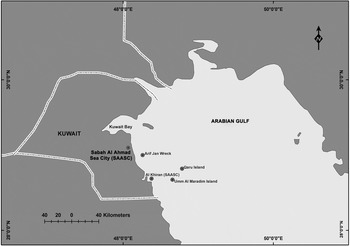
The present study includes opportunistic data collected during biodiversity assessment surveys, by the environmental monitoring team of Sabah Al Ahmad Sea City (SAASC) Al-Khiran (a major coastal township development with a series of man-made lagoons and islands), members of the Kuwait Turtle Conservation Project (KTCP) and recreational divers/underwater photographers during 2006–2011. Specimen collections were carried out by SCUBA diving in SAASC, Al-Khiran (28°41′4.80″N 48°22′25.20″E); while other surveys are photographic records from the ‘Arif Jan’-wreck diving site (28°59′55.98″N 48°15′36.74″E), Qaru (28°49′4.20″N 48°47′6.60″E) and Umm Al-Maradim Islands (28°4021.40″N 48°39′28.42″E) (Figure 1). All underwater photographs were taken using a Panasonic Lumix-DMC TZ7, 12 megapixel (SAASC team) and a Canon-G12, 10 megapixel (KTCP team) with underwater housings. Collected specimens (to distinguish between uncollected but photographed individuals) were relaxed in 1% MgCl2 solution and preserved in 70% alcohol. Locations with photographic records had very few live specimens; hence no collection was carried out since most species were well known and clearly identifiable. Identification was based on descriptions given in Rudman (Reference Rudman1973), Jones (Reference Jones1986), Yonow (Reference Yonow1989, Reference Yonow2008) and Brunckhorst (Reference Brunckhorst1993). Systematic classification is based on the classification of MacDonald (Reference McDonald2006). Collected material was identified and held in the reference collection of the SAASC environmental laboratory. A preliminary checklist of Kuwait nudibranchs (Table 1) is presented including present records, literature records (Glayzer et al., Reference Glayzer, Glayzer and Smythe1984; Jones, Reference Jones1986; Yonow, Reference Yonow2008, Reference Yonow2012) and internet sources (http://www.nudipixel.net and http://www.seaslugforum.net).
Nudibranch survey sites in Kuwait (2006–2011), Arabian Gulf.

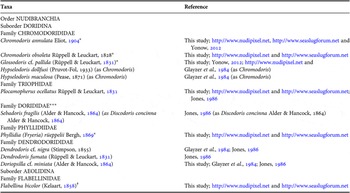
Preliminary check list of nudibranchs of Kuwait.

*, new record to Kuwait; † , new record to Arabian Gulf; ***, Glayzer et al. (Reference Glayzer, Glayzer and Smythe1984) also recorded two other species of dorids, which are not included in this list due to lack of identity.
RESULTS
The current study (2006–2011) recorded seven species belonging to five genera and five families (Table 1). Of these the flabellinid Flabellina bicolor (Kelaart, Reference Kelaart1858) is a new record to the Arabian Gulf, whereas the chromodorids, Chromodoris annulata Eliot (Reference Eliot1904), Chromodoris obsoleta (Rüppell & Leuckart, Reference Rüppell, Leuckart, Rüppell and Leuckart1828), Glossodoris pallida (Rüppell & Leuckart, Reference Rüppell, Leuckart, Rüppell and Leuckart1831) and the phyllidiid, Phyllidia (Fryeria) rüeppelii Bergh (Reference Bergh1869) are new records to Kuwait (Figures 2–8). The checklist shows 12 species belonging to nine genera, six families and one order.
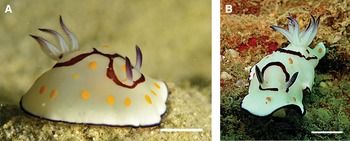
(A) Chromodoris annulata, Qaru Island with a median joining two circles to form spectacle like pattern (photograph: Ali Alhafez, Kuwait Turtle Conservation Project); (B) Chromodoris annulata from Arif Jan, Kuwait showing colour form without the median line joining two circles (photograph: Islam Basuny).

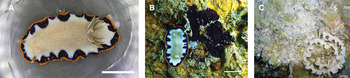
(A) Chromodoris obsoleta, Al-Khiran–Sabah Al Ahmad Sea City (SAASC) (photograph: Radoslaw Pelczynski, SAASC); (B) Chromodoris obsoleta feeding on purple colour sponge, Chelonaplysilla? spp., Al-Khiran–Sabah Al Ahmad Sea City (photograph: M. Balamurugan); (C) suspected egg ribbon of Chromodoris obsoleta attached to a subtidal rock, Al-Khiran–Sabah Al Ahmad Sea City (photograph: M. Balamurugan). Scale bar: 1 cm

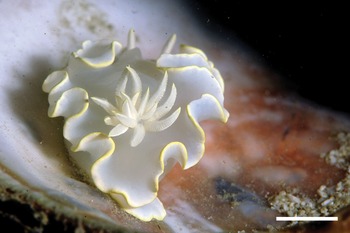
Glossodoris cf. pallida, Umm Al-Maradim Island (photograph: Samantha Jane Howlett, Kuwait Turtle Conservation Project). Scale bar: 1 cm

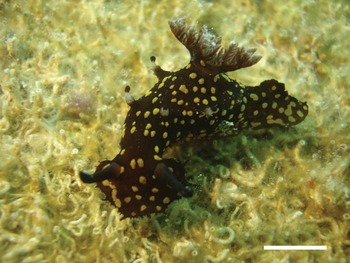
Plocamopherus ocellatus, Al-Khiran–Sabah Al Ahmad Sea City (photograph: Andy Wilson, Dive Caroline). Scale bar: 1 cm

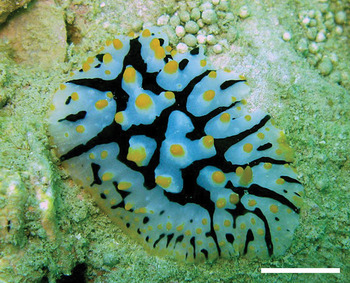
Phyllidia (Fryeria) rüeppelii, Qaru Island (photograph: Nancy Papathanasopoulou, Kuwait Turtle Conservation Project). Scale bar: 1 cm.

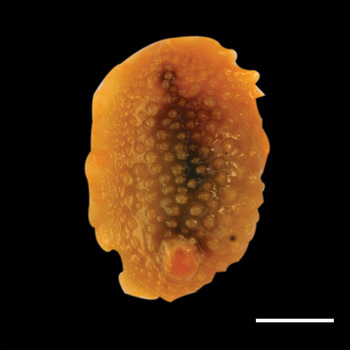
Doriopsilla cf. miniata, Al-Khiran–Sabah Al Ahmad Sea City (photograph: Abdul Hameed Kashif). Scale bar: 1 cm.

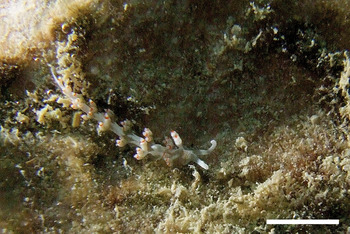
Flabellina bicolor, Qaru Island (photograph: Mohammed Al-Saleh, Kuwait Turtle Conservation Project). Scale bar: 1 cm.

SYSTEMATICS
OPISTHOBRANCHIA Milne Edwards, 1848
NUDIBRANCHIA Blainville, 1814
DORIDINA Pelseneer, 1894
Family CHROMODORIDIDAE Bergh, 1891
Genus Chromodoris Alder & Hancock, 1855
Chromodoris annulata Eliot, Reference Eliot1904
(Figure 2 A)
MATERIAL EXAMINED
Qaru Island (28°49′4.20″N 48°47′6.60″E): 15 May 2011, 1 individual 30 mm in length, photographed at 5 m depth in coral reefs. ‘Arif Jan’ (28°59′55.98″N 48°15′36.74″E): 23 July 2009, 1 individual 30 mm in length, photographed at 5–6 m depth from a ship wreck.
DESCRIPTION
Body white with raised yellow-orange spots, mantle with purple border; two purple rings enclose gills and rhinophores; at times these two rings are joined by a median purple line (Figure 2A); rhinophores and gills white with purple edges and tips.
DISTRIBUTION
Arabian Gulf (Yonow, Reference Yonow2012) and Indian Ocean (Rudman, Reference Rudman1999a; Yonow, Reference Yonow2000, Reference Yonow2008).
REMARKS
New record to Kuwait. Found on coral reefs, subtidal rocks and ship wrecks. Chromodoris annulata is also known from Abu Dhabi, United Arab Emirates (UEA) (Hardy, Reference Hardy2001), Bahrain (Arora, Reference Arora2005) and Qatar (MacDonald, Reference MacDonald2004a). The current record extends the distribution into the northern part of the Gulf. According to Rudman (Reference Rudman2002), C. annulata has a unique colour pattern in the Gulf, with two purple ring-like markings surrounding the rhinophores and gills joined by a median purple line (Figure 2A). However, recent underwater photographs by recreational divers posted in ‘http://www.seaslugforum.net’ prove that this variation exists in specimens recorded from western Thailand (Neal, Reference Neal2010), albeit rarely. Another individual without a median line joining the purple rings (Figure 2B) photographed from ‘Arif Jan’, confirms that both colour forms exist in the Gulf, similar to the observation of MacDonald (Reference MacDonald2004b) from Qatar.
Chromodoris obsoleta (Rüppell & Leuckart, Reference Rüppell, Leuckart, Rüppell and Leuckart1831)
(Figure 3A)
MATERIAL EXAMINED
Al-Khiran, SAASC (28°41′08.72″N 48°22′42.10″E): 13 May 2009, 2 specimens 25 mm in length, collected at 3 m depth from the surface of subtidal rocks by Hamdie Farrag Hussain, reg. no. SAASC/E/153; 1 June 2011, 1 specimen, 30 mm in length, collected at 3 m depth from subtidal revetment rocks by M. Nithyanandan, reg. no. SAASC/E/159; 10 December 2011, 2 individuals (juvenile and adult), 0.8–10 mm and 2.2–2.5 mm in length, photographed at 1.5 m depth from artificial reefs.
DESCRIPTION
Milky white dorsum with yellow-orange reticulated pattern, dorsal margin orange with a blue sub-marginal border; rhinophores tinged with orange, translucent white-edged lamellae, pale green gills, and white foot extending beyond mantle.
DISTRIBUTION
Northern Indian Ocean: Red Sea and Arabian Gulf only (Eliot, Reference Eliot1911; Yonow, Reference Yonow1989, Reference Yonow2008; Rudman, Reference Rudman2004).
REMARKS
Mostly found on coral reefs and subtidal rocks. In the eastern Arabian Peninsula states, C. obsoleta is known from Bahrain (Arora, Reference Arora2005), Qatar (Reavill, Reference Reavill2004), Saudi Arabia (Morgan, Reference Morgan2007) and Abu Dhabi, UAE (Mokhtar, Reference Mokhtar2008). The present record is new to Kuwait, which further extends the distribution of the species into the north of the Arabian Gulf. According to Rudman (Reference Rudman2005) this is a poorly known species. On 10 December 2011, two individuals were photographed (one adult and one juvenile) feeding a purple coloured sponge, Chelonaplysilla? spp. (Figure 3B), and also a pale brown coloured egg ribbon was found nearby, attached to an adjacent rock (Figure 3C), probably laid by C. obsoleta. As invertebrate colonization progresses at SAASC, it is expected that more specimens of this species will be recorded.
Genus Glossodoris Ehrenberg, Reference Ehrenberg1831
Glossodoris cf. pallida (Rüppell & Leuckart, Reference Rüppell, Leuckart, Rüppell and Leuckart1831)
(Figure 4)
MATERIAL EXAMINED
Umm Al-Maradim Island (28°40′21.40″N 48°39′28.42″E): 1 February 2007, 1 individual 30 mm in length, photographed at 7–8 m depth in coral reefs.
DESCRIPTION
Translucent body, yellow with white markings in the midline; yellow mantle margin with a white sub-marginal border (Figure 4), mantle margin has several wavy folds, rhinophores tentacles and gills tipped with yellow and a white foot with yellow margin extending beyond mantle.
DISTRIBUTION
Indo-West Pacific (Yonow, Reference Yonow1989, Reference Yonow2008, Reference Yonow2012; Rudman, Reference Rudman1999b).
REMARKS
New record to Kuwait. In Arabian Gulf it is also recorded from Jubail, Saudi Arabia, Dhawat and Daffi (Yonow, Reference Yonow2012).
Family TRIOPHIDAE Odhner, 1941
Genus Plocamopherus Rüppell & Leuckart, Reference Rüppell, Leuckart, Rüppell and Leuckart1831
Plocamopherus ocellatus Rüppell & Leuckart, Reference Rüppell, Leuckart, Rüppell and Leuckart1831
(Figure 5)
MATERIAL EXAMINED
Al-Khiran, SAASC (28°40′33.60″N 48°21′26.81″E): 23 July 2006, 1 individual 25–30 mm in length, photographed at depth 1.5 m from a marina wall covered by tubiculous polychaetes.
DESCRIPTION
Body black with yellow spots, four branched gills black with few yellow spots on the outside, rhinophores black (Figure 5), posterior part of dorsal midline possess a ‘keel’, two pairs of conical and elongated latero-dorsal processes located between rhinophores and gills and one pair behind the gills, tips rounded, white distally, black basally with a round black spot at the end.
DISTRIBUTION
Red Sea and Mediterranean Sea (lessepsian migrant) (Yonow, Reference Yonow2008) and Arabian Gulf: there are no records of this species in the eastern Arabian Peninsula states other than the one reported by Jones (Reference Jones1986) from Kuwait. The current record is the second from Kuwait in 20 years. Recently, Moradi (Reference Moradi2010) reported this species from Iran, Arabian Gulf.
REMARKS
A rarely reported species originally described from the Red Sea.
Family PHYLLIDIIDAE Raffinesque, 1815
Genus Phyllidia Cuvier, 1797
Phyllidia (Fryeria) rüeppelii Bergh, Reference Bergh1869
(Figure 6)
MATERIAL EXAMINED
Qaru Island (28°49′4.20″N 48°47′6.60″E): 19 June 2011, 1 individual 40–50 mm in length, photographed at 7 m depth in coral reefs.
DESCRIPTION
Dorsum blue-white with thick black lines tapering towards the yellow-orange mantle margin, uniformly scattered tubercles with a large yellow apex (Figure 6), rounded in profile with a circular white base; usually tubercles at mantle margin yellow-orange with white semicircles; rhinophores yellow-orange, oral tentacles conical, yellow-orange at tips with short lateral grooves; ventral anus located posteriorly.
DISTRIBUTION
Red Sea (Yonow, Reference Yonow1988, Reference Yonow2008; Brunckhorst, Reference Brunckhorst1993), Gulf of Aden (Yonow, Reference Yonow2008), Gulf of Oman (Bento, Reference Bento2008) and Arabian Gulf, from Iran (http://www.nudipixel.net/species/phyllidia rueppelii).
REMARKS
A new record to Kuwait.
Family DENDRODORIDIDAE O'Donoghue, 1924
Genus Doriopsilla Bergh, 1880
Doriopsilla cf. miniata (Alder & Hancock, Reference Alder and Hancock1864)
(Figure 7)
MATERIAL EXAMINED
Al-Khiran, SAASC (28°40′33.60″N 48°21′26.81″E): 11 January 2009, 3 specimens 30–35 mm in length, collected at 1–2 m depth from a marina wall by M. Nithyanandan, reg. no. SAASC/E/152.
DESCRIPTION
Body orange-yellow with uniformly scattered granular projections on the mantle (Figure 7); margin of the mantle with closely clustered small granular projections; no white markings. Median portion of the dorsum has a brownish tinge. Rhinophores and gills orange-yellow.
DISTRIBUTION
Tropical and subtropical Indo-West Pacific (Rudman, Reference Rudman2000).
REMARKS
Another rarely reported species in Arabian Gulf. Collected specimens were thriving in water temperature of 14.4°C and salinity of 41.4‰. Their morphological features were similar to the record of Jones (Reference Jones1986). Reticulated white lines on the mantle were absent in our specimens; however, a similar specimen reported from the Gulf of Kutch, Gujarat, India bears those lines (Deepak et al., Reference Deepak, Bhave and Parasharya2010).
AEOLIDINA Odhner, 1934
Family FLABELLINIDAE Bergh, 1889
Genus Flabellina Voigt, 1834
Flabellina bicolor (Kelaart, Reference Kelaart1858)
(Figure 8)
MATERIAL EXAMINED
Qaru Island (28°49′4.20″N 48°47′6.60″E): 25 July 2009, 1 individual 20–22 mm in length, photographed at 7 m depth in coral reefs.
DESCRIPTION
Small aeolid, translucent body with white markings, 8 pairs of ceratal clusters, 1–4 cerata each, with orange rings sub-terminally, perfoliate rhinophores with pale orange; long white oral tentacles and white metapodium.
DISTRIBUTION
Red Sea, Indian Ocean to East Pacific (Gosliner & Willan, Reference Gosliner and Willan1991; Yonow, Reference Yonow2000, Reference Yonow2008).
REMARKS
New record to the Arabian Gulf. Found in coral reefs on rocks or dead corals covered with turf algae. Present record extends its distribution from the Indo-West Pacific into the Gulf.
CONCLUSIONS
In this study on nudibranchs, one new record for the Arabian Gulf and four new records for Kuwait are reported with a preliminary checklist (Table 1). The list indicates the occurrence of 12 species belonging to nine genera and six families; while this does not represent the true diversity, it does form a baseline. This list is a work in progress and incomplete, inviting more research on nudibranch diversity and distribution in Kuwait and the rest of the Arabian Gulf states.
ACKNOWLEDGEMENTS
I thank the owner of La Ala Al Kuwait Real Estate Co. K.S.C., Mr Fawaz Al Marzouq for his financial support and permission to use the data, and ‘Total Foundation’ for granting financial support to KTCP; Nancy Papathanasopoulou (KTCP Project Manager) for the photographs of nudibranch records from Qaru and Umm Al-Maradim Islands; Islam Basuny (Palms Dive Center) for ‘Arif Jan’ records; Drs Nathalie Yonow (University of Swansea), Bill Rudman (Australian Museum) and Sree Raj (Zoological Survey of India, Andaman and Nicobar Islands) for identification and valuable literature; and an anonymous referee for critical comments on the manuscript. I also extend my thanks to Erickson Dayrit (Media Department, SAASC) and Priya Adikesavan (Zoology Department, Madras Christian College, India) for their assistance in preparing the photographs and map.