I. INTRODUCTION
The martensitic transformation behavior of steels shows strong dependence on chemistry, austenite grain size and morphology, applied cooling rate (CR), and the residual or applied stress state.Reference Nishiyama, Fine, Meshii and Wayman1 The rate of formation of martensite as observed upon cooling can be either (macroscopically) continuous, exhibiting one transformation-rate maximum, or (macroscopically) discontinuous, showing multiple maxima of the transformation rate. The appearance of multiple transformation-rate maxima, upon the transformation of a (considerable) portion of the parent phase as expressed in a measurement signal, which can be experimentally resolved on the time–temperature scale, is quite typical for martensitic transformations, e.g., described as “bursts”Reference Machlin and Cohen2,Reference Brook and Entwisle3 and “avalanches”Reference Amengual, Manosa, Marco, Picornell, Segui and Torra4–Reference Niemann, Kopeček, Heczko, Romberg, Schultz, Fähler, Vives, Mañosa and Planes7 in case of the formation of plate martensite. This effect can be attributed to the military nature of the martensitic transformationReference Mittemeijer8 and the occurrence of autocatalysis.Reference Machlin and Cohen2
Recently, a train of transformation-rate maxima was revealed by use of high-resolution dilatometry (DIL) and differential thermal analysis (DTA) for the formation of lath martensite in a Fe–Ni–Co–Mo maraging steel upon slow cooling with constant CRs, exhibiting a more or less regular spacing of the rate maxima on the temperature scale.Reference Loewy, Rheingans, Meka and Mittemeijer9 Similar observations were also made very recently for Fe–Cr–Ni–Cu and Fe–Cr–Ni–Al stainless steels.Reference Villa, Pantleon, Reich, Kessler and Somers10,Reference Villa, Hansen, Pantleon and Somers11 As opposed to the typical random, discontinuous transformation behavior of plate martensite, the series of transformation-rate maxima observed for the formation of lath martensite stretched over a much larger time–temperature range and was found to be reproducible for different specimens.
To find out whether the unusual multistep transformation is a general feature of lath martensite formation upon slow cooling, in the present work, the previously investigated Fe–18.5 wt% Ni–9 wt% Co–5 wt% Mo steelReference Loewy, Rheingans, Meka and Mittemeijer9 was replaced by a binary Fe–Ni alloy. The Fe–Ni system is one of the most intensively investigated systems with respect to martensitic transformations (e.g., Refs. Reference Nishiyama, Fine, Meshii and Wayman1 and Reference Kaufman and Cohen12–Reference Marder and Marder14). For Ni contents up to 27 wt%, the formed martensite shows a lath morphology, whereas for Ni contents in the range of 27–33 wt%, a plate morphology occurs (e.g., Refs. Reference Nishiyama, Fine, Meshii and Wayman1 and Reference Floreen15). In Refs. Reference Tsuzaki, Maki and Tamura16 and Reference Tsuzaki, Fukiage, Maki and Tamura17, the martensitic transformations in Fe–15 wt% Ni and Fe–18 wt% Ni were investigated by isochronal cooling and isothermal annealing. Upon slow cooling, transformation-rate maxima, similar to the ones discussed above, were observed, but they were left undiscussed. Later, work indicated that the transformation in Fe–15 wt% Ni actually is a bainitic one.Reference Wilson, Allen and Butler18,Reference Wilson, Shtansky and Ohmori19 Thus, to ensure that the transformation in Fe–Ni definitely is a martensitic one leading to lath morphology, a Ni content larger than 15 wt% was chosen for this work. To realize the same Fe-alloying element ratio as for the previously investigated Fe–Ni–Co–Mo steel, a Fe–Ni alloy with 22 wt% Ni content was investigated.
II. EXPERIMENTAL
Cylindrical alloy rods with a diameter of 10 mm were prepared by induction melting from elemental Fe (4N) and Ni (3N6) with a Ni content of 21.80 ± 0.20 wt% (determined by inductively coupled plasma optical emission spectrometry). The carbon content was determined by a combustion method and is less than 0.005 wt% and thus is negligibly small. The cast rods were subjected to a homogenization treatment under argon atmosphere at 1327 K for 24 h, followed by hammering to reduce the diameter and to destroy the cast microstructure. After a second homogenization treatment at 1327 K for 24 h, of the thus treated material, cylindrical specimens of 10 mm in length and 5 mm in diameter were machined for DIL, and disk-shaped specimens with 5 mm diameter and a height of approx. 1.5 mm were prepared for DTA measurements and microstructural investigations.
Dilatometric measurements were performed employing a DIL 802 high-resolution dilatometer (Bähr Thermoanalyse GmbH, Hüllhorst, Germany) with a length change resolution of ±10 nm under constant argon flow, using a quartz measurement system with a polycrystalline Al2O3 specimen as reference.Reference Liu, Zhang, Sommer and Mittemeijer20 The temperature scale was calibrated for each CR as described in Ref. Reference Liu, Sommer and Mittemeijer21 by measuring the Curie temperature of pure Ni, which is close to the martensite start temperature. Starting from room temperature, the specimens were heated up to 1323 K at 15 K min−1 and annealed for 1 h, to ensure complete transition into the austenite phase and to remove any (deformation) effects from specimen manufacturing. Then, the specimens were cooled down from 1323 to 623 K (above M s) with a CR of 5 K min−1: applying an identical CR for all specimens down to just above M s (here M s ≈ 513 K; see below) ensures an identical thermal history before the onset of the martensitic transformation. Further cooling was performed with CRs of 1.0, 0.5, 0.2, and 0.1 K min−1.
DTA measurements were performed employing the same temperature program as for the dilatometric measurements with a CR of 0.1 K min−1 during martensite formation. Experiments were performed on a Netzsch DSC 404C apparatus (Netzsch GmbH & Co. Holding KG, Selb, Germany) with a heat-flux differential scanning calorimeter measuring head and with Pt pans diffusion bonded on the specimen stage.Reference Baumann, Leineweber and Mittemeijer22 For calibration and thermal desmearing of the DTA signal, nickel and sapphire were used as reference substances applying the procedure described in Ref. Reference Kempen, Sommer and Mittemeijer23. The transformed fraction f M, with 0 ≤ f M ≤ 1, as measured by DIL and DTA, was determined as described in Ref. Reference Loewy, Rheingans, Meka and Mittemeijer9.
For investigation of the microstructural evolution, several specimens were heated up to 1323 K, annealed for 1 h at this temperature, and cooled down to 623 K, as described above. Then, one specimen was directly quenched into ice water, whereas two other specimens were cooled to room temperature with a CR of either 0.1 or 5 K min−1. Then cross sections were prepared, ground, and polished, applying an oxide polishing suspension as final stage. Electron back-scatter diffraction (EBSD) was performed with a Zeiss LEO 438 VP SEM (acceleration voltage 20 kV; Carl Zeiss AG, Oberkochen, Germany) equipped with a high-speed camera. Three different areas, each with lateral dimensions of 800 μm × 800 μm, were recorded from the specimen cross sections by EBSD applying 1 μm step size. The grain size and the grain shape aspect ratio were extracted using the analyzing software OIM 5.31 (Ametek EDAX/TSL), excluding the unindexed points (i.e., the pixels for which the crystallographic orientation could not be determined) without application of a “cleaning” procedure (i.e., interpolation on the basis of the neighboring pixels was not performed).
III. RESULTS AND DISCUSSION
A. Concerted, periodic formation of martensite blocks
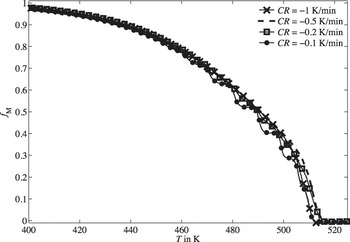
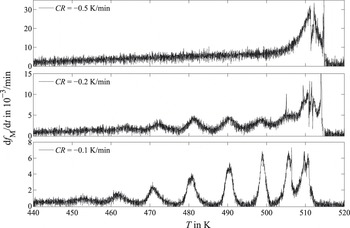
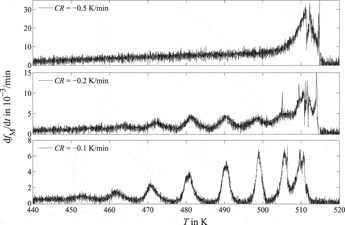
The martensite start temperature M s of Fe–22 wt% Ni determined by the dilatometer measurements (Fig. 1) ranges between 511 and 515 K without any systematical dependence on the value of the CR; the same holds for the martensite finish temperature. Thus, for the range of applied CRs (0.1–1.0 K min−1), the onset of martensite formation appears to be predominated by the provision of the chemical driving force necessary for nucleation, i.e., the degree of undercooling. For the lowest CRs, the curves of transformed fraction versus temperature (Fig. 1) exhibit pronounced steps: the corresponding curves of transformation rate versus temperature (Fig. 2) show a train of distinct transformation-rate maxima. Hence, the transformation indeed proceeds discontinuously/stepwise also for the present, simplified binary model alloy upon slow cooling. Remarkably, the rate maxima appear for all CRs at nearly the same temperatures, i.e., at the same degrees of undercooling.
Transformed fraction versus temperature, derived from dilatometric measurements of Fe–22 wt% Ni cooled with (1, 0.5, 0.2, and 0.1) K min−1. With lower CRs, the discontinuous nature of the transformation becomes more pronounced.

Transformation rate versus temperature, as derived from the dilatometer measurements of Fe–22 wt% Ni with CRs of (0.5, 0.2, and 0.1) K min−1. Upon slower cooling, the transformation-rate maxima become higher and sharper.

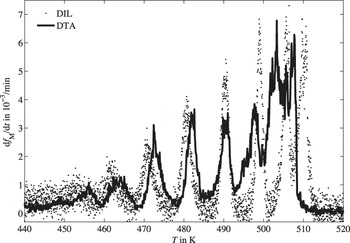
Comparison of the transformation rate versus temperature curves obtained by DTA and DIL reveals that the transformation seems to start earlier in the DTA experiment (see Fig. 3). This might be caused by a heat transport phenomenon in the DTA experiment, which cannot be corrected completely by the applied desmearing procedure.Reference Kempen, Sommer and Mittemeijer23 In the further progress of the transformation, the series of maxima measured with DTA and DIL become quite similar.
Transformation rate versus. temperature as derived from the dilatometric measurements (dots) and the DTA measurements (line) of Fe–22 wt% Ni, both performed with a CR of 0.1 K min−1.

The modulation of the transformation rate, as first observed in Fe–Ni–Co–Mo maraging steel in Ref. Reference Loewy, Rheingans, Meka and Mittemeijer9 can be explained by a peculiar formation behavior/mode of the highly hierarchical microstructure of lath martensite,Reference Kitahara, Ueji, Tsuji and Minamino24,Reference Morito, Huang, Furuhara, Maki and Hansen25 where initial austenite grains are subdivided into several packages of parallel blocks, each block consisting of sub-blocks of multiple martensite laths with only very small mutual misorientation (see Ref. Reference Loewy, Rheingans, Meka and Mittemeijer9). Upon formation of lath martensite, one block grows in width (by successive nucleation and growth of single laths) until the transformation-induced elastic and plastic deformation energy balances the release of chemical energy, and growth of the block is halted. Then, by provision of additional chemical driving force, i.e., by a higher degree of undercooling, the nucleation of the next block of a package, with a distinctively different lath orientation preferred by associated (partial) compensation of the anisotropic transformation strain,Reference Morito, Huang, Furuhara, Maki and Hansen25 becomes possible, etc. The appearance of a macroscopically measurable modulation of the transformation rate is explained by a (more or less) simultaneous formation of subsequent martensite blocks in all packages in all austenite grains.Reference Loewy, Rheingans, Meka and Mittemeijer9 Now the question arises why subsequent block formation should occur simultaneously in all martensite packages. This is discussed next.
Macroscopically, the development of the transformed fraction as function of temperature (Fig. 1) appears to be more or less independent of the applied CR, i.e., the overall transformation kinetics in the present case (and in Ref. Reference Loewy, Rheingans, Meka and Mittemeijer9) are evidently controlled by the provision of chemical driving force for transformation (the degree of undercooling). Such transformation behavior is classified “athermal”, in contrast to “thermally activated time-dependent” (e.g., Ref. Reference Thadhani and Meyers26). However, the CR does influence the transformation kinetics: the rate maxima become more and more distinct with decreasing CR and cannot be observed for CRs above a critical value, here 0.5 K min−1. Consequently, this specific dependency on CR, and thus also on time, implies that the transformation must involve a time-dependent, thermally activated mechanism, as well. This thermally activated mechanism can be the time-dependent local relaxation of transformation strain in the austenite next to the just formed block of martensite. The local relaxation can be completed the better, before the next block forms at the location considered, the lower the CR. In that case, for sufficiently low CRs, a more or less completed local relaxation has been realized for all earlier-formed blocks in the specimen leading to identical local transformation conditions for the subsequent blocks in all packages in all austenite grains. Then, the same amount of chemical energy (undercooling) is necessary for formation of all next blocks in the entire specimen. Thereby, the concerted nature of the formation of the next blocks of martensite is realized. This simultaneity of “next block formation” will be enhanced, and thus the transformation-rate maxima become sharper, the lower the CR, as observed.
Simultaneity of transformation does not hold for the very first blocks formed in the austenite grains: At the very beginning of the transformation, the transformation-rate curves (Fig. 2) show sharp, irregular peaks and are not reproducible for different CRs and for different specimens. This behavior is ascribed to the more or less statistical, random formation of the first block of a martensite package at already present potential nucleation sites.Reference Loewy, Rheingans, Meka and Mittemeijer9 Then, as directly follows from the above reasoning, provided the CR is sufficiently low so that all local deformation strain has relaxed, the formation of the subsequent blocks then occurs at practically the same (additional) undercooling for all next blocks.
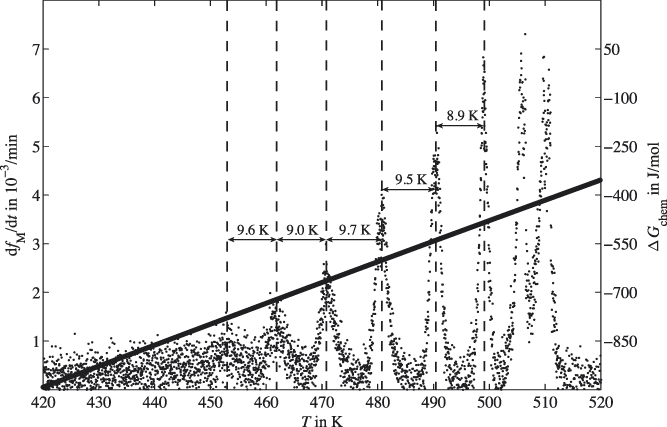
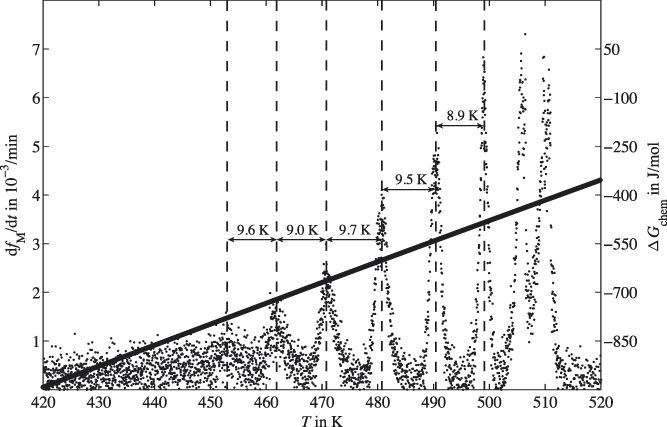
The temperature difference ΔT between two neighboring transformation-rate maxima is more or less constant with ΔT ≈ 9–10 K (see Fig. 4; omitting the very beginning of the transformation, see discussion above). The chemical Gibbs energy change for the fcc → bcc transformation, ΔG chem, was calculated as a function of temperature using Thermo-Calc and the TCFE7 data base (see Fig. 4). In the temperature range where the transformation-rate maxima can be observed, ΔG chem shows a linear dependency on the temperature. From the above, it follows that the formation of each new block (simultaneous with blocks in all packages in all austenite grains), over the temperature range of the transformation, requires the same amount of additional driving force, generated by the same amount of additional undercooling. The linear dependence of ΔG chem on temperature in the temperature range of the transformation then causes the periodic nature of the transformation maxima.
Transformation rate versus temperature (dots) as derived from DIL measurements of a Fe–22 wt% Ni specimen cooled with 0.1 K min−1 showing that the series of rate maxima is practically regular: ΔT is more or less constant. The difference in chemical Gibbs energy of fcc and bcc Fe–22 wt% Ni, ΔG chem, is shown as a function of temperature (continuous line). ΔG chem is linear in the temperature range of the transformation.
B. Microstructural development as function of the CR
For investigation of the microstructural evolution upon martensite formation, the block sizes of differently cooled specimens of Fe–22 wt% Ni were determined by EBSD: One specimen was subjected to cooling with 0.1 K min−1, a CR for which the train of transformation-rate maxima can be observed. A second specimen was cooled at 5 K min−1, a CR which is already too high to observe the transformation-rate maxima. A third specimen was quenched in ice. The area of a martensite block was defined as the region having misorientation angles less than 15° (a misorientation ≥ 15° is taken to represent a high-angle grain boundary).
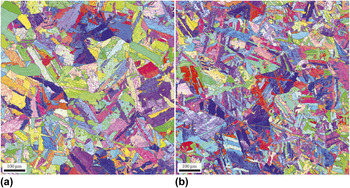
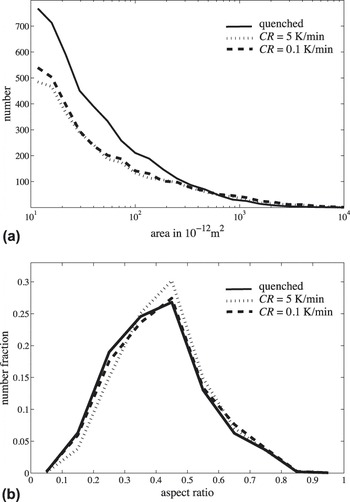
The EBSD orientation map (Fig. 5) indicates that quenching leads to a finer martensite microstructure as cooling with a rate of 0.1 K min−1. This is corroborated by the corresponding block-size distributions, shown in Fig. 6, which reveal that larger numbers of smaller blocks occur for the quenched specimen as compared to the slowly cooled specimens. The aspect ratio, i.e., the quotient of block length and block thickness, is practically the same for the three specimens [Fig. 6(b)]. Hence, as compared to quenching, the blocks grow larger upon applying a slow CR. The refinement of the martensite microstructure with (considerably) faster cooling agrees with observations reported in Refs. Reference Morito, Igarashi, Kamiya, Ohba and Maki27 and Reference Tsuzaki and Maki28, where packet and block sizes of different Fe–Ni alloys were found to decrease with increasing CR. The influence of the CR on the microstructure thus indicates the occurrence of an overall thermally activated process, which may be related to the thermally activated process involved in the modulated transformation behavior (see above). In earlier work where a thermally activated (contribution to the) kinetics of martensite formation was proposed, either nucleation was conceived as the time-dependent process, whereas growth was assumed to occur instantaneously (e.g., Refs. Reference Cech and Turnbull29–Reference Ghosh and Olson33), or it was thought that nucleation was athermal, and the growth was thermally activated.Reference Liu, Zhang, Sommer and Mittemeijer20,Reference Kim, Lee and de Cooman34,Reference Villa, Hansen, Pantleon and Somers35 In the present case, “nucleation” is considered as the initiation of a new martensite block. If the nucleation of blocks would be the dominantly thermally activated (i.e., time-dependent) part of the transformation in Fe–22 wt% Ni, a lower CR would lead to the activation of more nucleation sites in a certain temperature range, and a refinement of the microstructure would ensue. This contrasts with the current, reverse observation (see above). Hence it is concluded that the thermally activated part of the overall martensite formation kinetics derives from the growth mechanism, in agreement with the discussion in Sec. III. A, where it was shown that growth is influenced by thermally activated local stress relaxation.
(a) EBSD orientation map of a specimen cooled down with a rate of 0.1 K min−1 and (b) a specimen, which was quenched in ice water. Block boundaries are drawn for a misorientation angle ≥15°. The martensitic microstructure is finer for fast cooling.

(a) Block-size distribution of transformed Fe–22 wt% Ni; after quenching and after slow cooling with 0.1 and 5 K min−1, respectively: the number of martensite blocks is plotted versus the area occupied by each block. Larger numbers of small blocks occur for the quenched specimen as compared to the specimens, which was cooled down slowly (b) number fraction versus aspect ratio of the martensite blocks. The block shape does not depend on CR.

Recently, a modulated rate of martensite formation upon cooling was also observed for a Fe–Cr–Ni–Cu stainless steel and a Fe–Cr–Ni–Al steel.Reference Villa, Pantleon, Reich, Kessler and Somers10,Reference Villa, Hansen, Pantleon and Somers11 In that case and in contrast with the above interpretation, the modulated martensite formation was related to the appearance and stepwise growth of transformed regions, termed “clusters”, extending over a large number of austenite grains. The occurrence of a series of successive transformation-rate maxima was explained by acceleration of the transformation by autocatalytic formation of martensite and the subsequent deceleration of cluster growth as a consequence of the development of misfit strain and interfacial energies (this interpretation parallels the one given in Refs. Reference Liu, Sommer and Mittemeijer36 and Reference Liu, Sommer and Mittemeijer37 for the massive γ → α transformation). Thus, the transformation mechanism postulated for the Fe–Cr–Ni–Cu stainless steel and the Fe–Cr–Ni–Al steelReference Villa, Pantleon, Reich, Kessler and Somers10,Reference Villa, Hansen, Pantleon and Somers11 differs strikingly with the one given above for the Fe–22 wt% Ni and for Fe–Ni–Co–Mo maraging steel in Ref. Reference Loewy, Rheingans, Meka and Mittemeijer9: stepwise cluster growth versus concerted formation of martensite blocks. The martensite formation mechanism of the Fe–Cr–Ni–Cu stainless steel may indeed be different: no change of martensite block size in the microstructure of Fe–Cr–Ni–Cu stainless steel was observed in Ref. Reference Villa, Pantleon, Reich, Kessler and Somers10 upon varying the CR, whereas in the present study, distinct microstructural refinement was found to occur upon increasing the CR, as discussed above.
IV. CONCLUSIONS
(1) A train of austenite → martensite transformation-rate maxima was observed by both high-resolution DIL and DTA applied to Fe–22 wt% Ni alloy upon applying low-CRs.
(2) These rate maxima become more distinct with decreasing CR, indicating the involvement of a thermally activated process in martensite formation.
(3) The simultaneity of subsequent block formation in the entire specimen becoming more prominent upon decreasing CR suggests that the thermally activated process involves the strain relaxation in the austenite adjacent to the just formed blocks.
(4) The block size decreases with increasing CR (while the block aspect ratio remains constant), thereby ruling out that nucleation may be significantly thermally activated.
(5) All experimental data thus indicate that the martensite growth is influenced by a thermally activated mechanism, which can be identified as local strain relaxation.
ACKNOWLEDGMENTS
The authors thank Dr. M. Villa (Technical University of Denmark) for critical reading of the manuscript and helpful discussions and Dr. E. Bischoff (Max Planck Institute for Intelligent Systems) for performing the EBSD (electron backscatter diffraction) measurements.