Introduction
In its most general sense, independence in older age denotes self-reliance or autonomy.Reference Agich1 Promotion of ‘successful ageing’ often includes the idea that independence is essential to good physical, emotional and cognitive health. In addition to improved life expectancy, life satisfaction and psychological health, the main constituents of healthy ageing relate to independence including personal growth, physical functioning, psychological perceptions and social participation.Reference Bowling and Dieppe2
The value placed on independence in older age is rooted in the ideology that individuals should have responsibility for their own wellbeing. However, this does not preclude appropriate intervention (social and medical) to facilitate or enhance that wellbeing. Indeed, many older people require encouragement to assert their rights to health care and social benefits.
Successful ageing – in terms of autonomy and wellbeing – can occur in people who are very dependent on others for daily living. Ageing takes place most successfully in the context of strong social engagement,Reference Rowe and Kahn3 and social interdependence has been identified as a desirable element of successful ageing.Reference Breheny and Stephens4
Causes of reduced independence
The onset of disability in activities of daily living performed by older people in their daily lives is one of the greatest threats to the ability of older adults to live independently.Reference Reynolds and Silverstein5 The determinants of functional decline, disability and reduced independence have been studied extensively. In a systematic review of 78 longitudinal studies published between 1985 and 1997, Stuck et al. assessed the strength of risk factors for functional decline on the basis of the number of studies and the effect size.Reference Stuck, Walthert, Nikolaus, Büla, Hohmann and Beck6 The highest strength of evidence was for risk factors relating to co-morbidities, physical and psychosocial health, environmental conditions, social circumstances, and nutrition and lifestyle.Reference Stuck, Walthert, Nikolaus, Büla, Hohmann and Beck6 Updating this review to 2001, Spiers et al. emphasized the link between depression and cognitive impairment, and subsequent functional decline.Reference Spiers, Matthews, Jagger, Matthews, Boult and Robinson7
Ayis et al. studied the predictors of rapid global deterioration in mobility over one year in people aged 65 years and older in a UK Office of National Statistics Omnibus survey.Reference Ayis, Gooberman-Hill, Bowling and Ebrahim8 The incidence of this ‘catastrophic decline’ was one in twenty people per year. Predictors of decline were older age, previous self-report of deterioration including hearing loss, low functional reserve (stamina, muscle strength and flexibility), psychological problems and low social engagement.
Specific determinants of reduced independence and unifactorial interventions
Co-morbidities
In the 2002 UK General Household survey, 53% of adults aged 75 years and older had a long-standing illness that limited their activities.Reference Rickards, Fox, Roberts, Fletcher and Goddard9 Older people frequently have more than one clinical condition and the extent of activity limitations increases with the number of co-morbidities.Reference Verbrugge, Lepkowski and Imanaka10 In an Australian population aged 75 years and older, 60% reported one and 33.4% had two or more health problems.Reference Williams, O'Doherty, Mitchell and Williams11 More recently in data from the Kungsholmen Project population, Marengoni et al. looked at patterns of co-morbidity in people aged 77 years and older.Reference Marengoni, Rizzuto, Wang, Winblad and Fratiglioni12 The authors observed that in older age some co-morbidities exist in clusters centred on vascular diseases, dementia, diabetes and malignancy.
Conditions that contribute to disability and impact on independence are numerous and include coronary heart disease, stroke, cognitive impairment, affective disorders, respiratory conditions, and musculoskeletal conditions. Treatment, rehabilitation and secondary prevention of all these clinical conditions is beyond the scope of this review. However, as the leading cause of disability in older people, the importance of identification and management of musculoskeletal conditions is discussed briefly.
Musculoskeletal conditions
In the UK Office of National Stastistics 1996 cross-sectional study of disability in 8683 people, Adamson et al. found that musculoskeletal diseases lead to the largest number of people being disabled in the UK.Reference Adamson, Beswick and Ebrahim13 In an older population in the MRC-CFAS study, Spiers et al. explored risk factors for disability in 7913 people followed up for two years.Reference Spiers, Matthews, Jagger, Matthews, Boult and Robinson7 In people who reported no disability at baseline examination, arthritis was the most important predictor of incident disability with a population attributable risk of 11.4%. In the prospective US Health and Retirement Study of 7758 adults aged 65 years or older, Song et al. concluded that 24% of new cases of disability were due to arthritis.Reference Song, Chang and Dunlop14
In older people, mild symptoms of osteoarthritis are managed and treated in the community through the provision of education, assistive devices, exercise, weight loss advice and other lifestyle modifications.Reference Zhang, Moskowitz, Nuki, Abramson, Altman and Arden15 However, in more advanced cases of osteoarthritis, use of analgesics, physiotherapy and joint replacement surgery may be required. When surgery is identified as the only treatment option remaining for the alleviation of symptoms, the timing of the intervention is crucial, as the severity of pre-operative joint symptoms is highly predictive of pain reduction and restoration of functional ability after surgery.Reference Fortin, Clarke, Joseph, Liang, Tanzer and Ferland16 Although generally considered an effective intervention for alleviating joint symptoms, joint replacement is not a success for all patients, with up to 30% of patients continuing to experience chronic joint pain and disability after surgery.Reference Nikolajsen, Brandsborg, Lucht, Jensen and Kehlet17, Reference Wylde, Dieppe, Hewlett and Learmonth18
Appropriate prescribing of medication
In older people, prescribing of medication for specific conditions is problematic. Evidence for effectiveness of new treatments in older populations is frequently limited due to under-representation of older people in trials, inadequate reporting of age in trials, or delay in the conduct of appropriate trials. Examples include heart failure,Reference Costantino, Rusconi, Duca, Guzzetti, Bossi and Del Medico19 cardiovascular disease prevention,Reference Bartlett, Doyal, Ebrahim, Davey, Bachmann and Egger20 Parkinson's disease,Reference Mitchell, Sullivan and Lipsitz21 Alzheimer's disease,Reference Schneider, Olin, Lyness and Chui22 cancerReference Murthy, Krumholz and Gross23, Reference Jennens, Giles and Fox24 and depression.Reference Giron, Fastbom and Winblad25 Older people have complex medical conditions with treatment strategies that require several medications, and this is further complicated in those with multiple conditions. Specific classes of medications are associated with orthostatic hypertension and an increased risk of falling. However, it has been shown that co-morbidity, rather than polypharmacy, is the more important factor for both conditions in older British women.Reference Lawlor, Patel and Ebrahim26
Potentially serious implications for the older person arise from prescribing of medications with a high risk of adverse events or those with no appropriate clinical indication, misprescribing pertaining to frequency and duration of treatment, interactions with other medications, and the non-prescribing of effective treatments.Reference Gallagher and O'Mahony27 However, there is no ideal measure of appropriateness of prescribing or evidence from randomized controlled trials for effectiveness of particular strategies.Reference Spinewine, Schmader, Barber, Hughes, Lapane and Swine28
Geriatric conditions
As with clinical co-morbidities there is an association between geriatric conditions and disability. In the US Health and Retirement Study of 11,093 people aged 65 years and older, Cigolle et al. studied a range of geriatric conditions specifically: falls, incontinence, low body mass index, dizziness, impaired vision, impaired hearing and cognitive impairment.Reference Cigolle, Langa, Kabeto, Tian and Blaum29 Individually all geriatric conditions with the exception of hearing impairment were related to disability in cross-sectional analysis. Even after adjusting for chronic diseases, people with more than one geriatric condition had higher risk ratios for disability that ranged from 2.1 for one condition, to 3.6 for two conditions and 6.6 for three or more conditions. The authors concluded that geriatric conditions have a similar prevalence to chronic diseases in older people and in some cases a comparable impact on disability.
Physical activity
Nusselder et al. analysed two prospective studies conducted in the Netherlands (GLOBE) and USA (Longitudinal Study of Aging) including 8513 people aged 50–80 years with self-reported leisure time physical activity measured at baseline and follow-up at two yearly intervals.Reference Nusselder, Looman, Franco, Peeters, Slingerland and Mackenbach30 In people with no initial disability, moderate physical activity was associated with a reduced incidence of disability. The authors concluded that moderate physical activity extends the number of years lived free of disability and reduces the number of years lived with disability. In the AHEAD cohort of 4228 people aged 70 years or older, Reynolds et al. noted reduced onset of disability in people who had participated in vigorous physical activity regularly.Reference Reynolds and Silverstein5
There is debate on the amount and intensity of exercise required to prevent decline in physical function and associated loss of independence. Chin A Paw et al. conducted a systematic review of exercise interventions aiming to improve physical function in frail older people.Reference Chin, Paw, van Uffelen, Riphagen and Mechelen31 Although some studies, mainly in the frailest individuals, showed no benefit, the authors concluded that regular exercise can improve the functional performance of older people with different levels of abilities. However, the authors did not consider the evidence sufficient to define the best type, intensity, frequency or duration of exercise.
The benefit of exercise may be on an individual's balance. In a Cochrane systematic review, Howe et al. concluded that exercise programmes in older people were associated with short-term improvements in balance.Reference Howe, Rochester, Jackson, Banks and Blair32 However, only the trial of Wolf et al. reported a long-term follow-up.Reference Wolf, Feys, De Weerdt, van der Meer, Noom and Aufdemkampe33 The authors noted that improvement in balance persisted for at least one month after completion of a 4–6 week exercise programme, but no benefit was seen at one year.
Rehabilitation
Community-based physical and occupational therapy interventions are potentially valuable in maintaining independent living by older people. In a systematic review of occupational interventions, Steultjens et al. identified training of skills and the instruction of assistive devices as effective measures in improving functional ability in older people.Reference Steultjens, Dekker, Bouter, Jellema, Bakker and van den Ende34 In a more general overview Ryburn et al. concluded that multi-component restorative approaches resulted in improved function and reduced need for home and community care services.Reference Ryburn, Wells and Foreman35
Falls
Falls are an important cause of disability and reduced independence in older people. Widely quoted figures for the incidence of falls in people aged 65 years or older are 29 and 35%, and in those aged 75 years or older 32%.Reference O'Loughlin, Robitaille, Boivin and Suissa36–Reference Tinetti, Speechley and Ginter38 Although the majority of falls identified in these studies did not result in serious injury, the psychological sequelae can be significant. In people aged 70 years and older multiple falls are associated with increased risk of functional impairment.Reference Dunn, Rudberg, Furner and Cassel39
The incidence of more serious falls can be assessed according to the involvement of a general practitioner or attendance at an accident and emergency department. Data reported by Gribbin et al. from The Health Improvement Network (THIN) primary care database show a rise in fall incidence recorded in UK general practice from 1.6 per 100 person years in the age group 65–69 years, to 6.2 in people aged 80–84 years.Reference Gribbin, Hubbard, Smith, Gladman and Lewis40 To determine accident and emergency attendance after a fall, Scuffham et al. extracted data for 1999 from the UK Home Accident Surveillance System and Leisure Accident Surveillance System.Reference Scuffham, Chaplin and Legood41 The fall incidence rates identified in these data sets were 2.9 per 100 person years for people aged 65–69 years, rising to 9.5 per 100 person years in people aged 75 years or older.
In a prospective study of risk factors for falls in older people, two-thirds of falls were attributed to multiple risk factors.Reference Campbell, Borrie and Spears42 Individual risk factors differed between men and women but included low physical activity, specific clinical conditions, impaired gait and body sway, medication, postural hypotension and muscle weakness. In a study in people aged 85 years and older, van Bemmel found that hazards in the home environment were associated with increased risk of falling even in those who had not fallen before.Reference van Bemmel, Vandenbroucke, Westendorp and Gussekloo43
Fragility fractures
The sequelae of relatively minor falls may be particularly serious in older people with osteoporosis and other less common conditions. ‘Fragility fractures’ in older people commonly affect the hip, femur and forearm, and the incidence of these fractures increases markedly with age.Reference van Staa, Dennison, Leufkens and Cooper44 Fractures of the hip are particularly common and are associated with a high risk of death, nursing home admission and disability. In a US case-control study, one-year mortality in older people with hip fracture was twice that in the unaffected group, and nursing home admissions were three times more likely.Reference Leibson, Tosteson, Gabriel and Ransom45
Early identification of osteoporosis by measurement of bone mineral density and treatment with antiresorptive or bone anabolic agents, calcium and vitamin D, and exercise may be effective in reducing the risk of fracture.46
Fall prevention
In a systematic review of interventions to prevent falls, Gillespie et al. concluded that multiple-component exercise interventions are effective in reducing falls.Reference Gillespie, Robertson, Gillespie, Lamb, Gates and Cumming47 Sherrington et al. reached a similar conclusion in their systematic review of 44 trials with 9603 participants.Reference Sherrington, Whitney, Lord, Herbert, Cumming and Close48 However, they observed greater benefits in exercise programmes that targeted balance and in those with a higher dose of exercise. No benefit was evident in those that included a walking programme. Indeed, in a randomized trial of brisk walking in women who had fractured their upper arms, an increased risk of falling was found, which was interpreted as evidence of adherence to the intervention.Reference Ebrahim, Thompson, Baskaran and Evans49 Notwithstanding the importance of greater intensity physical activity, more moderate physical exercise including walking may have benefits to an older individual beyond reduction of fall risk.
Social factors
The association between social engagement and disability is not straightforward. Cross-sectional studies show reduced disability in those with greater social engagement.Reference Mendes de Leon, Glass and Berkman50 However, Mendes de Leon et al. found only a weak effect of disability on social engagement in longitudinal studies. They suggested that losses in physical function and ability of a person to care for themselves lead to reduced social engagement, and that this in turn accelerates functional decline.
Mental health
In the AHEAD study in people aged 70 years or older, Reynolds and Silverstein found that affect and cognition were associated with an increased likelihood of future disability.Reference Reynolds and Silverstein5 Onset of disability may be delayed by early diagnosis and treatment of depressive symptoms.Reference Reynolds, Haley and Kozlenko51
Further areas for consideration in preventive strategies
Numerous areas of potential value in preventive strategies have been reported. These include foot and leg problems,Reference Barr, Browning, Lord, Menz and Kendig52 dental health,Reference Avlund, Holm-Pedersen and Schroll53 nutrition and obesity,Reference Milne, Avenell and Potter54, Reference Reynolds, Saito and Crimmins55 lifestyle,Reference Wannamethee, Ebrahim, Papacosta and Shaper56 home environment,Reference van Bemmel, Vandenbroucke, Westendorp and Gussekloo43, Reference Gitlin57 vaccinations,Reference Arthur, Matthews, Jagger, Clarke, Hipkin and Bennison58 continence,Reference Chiarelli, Mackenzie and Osmotherly59 eyesightReference Ayis, Ebrahim, Williams, Jüni and Dieppe60, Reference Jagger, Spiers and Arthur61 and hearing.Reference Jagger, Spiers and Arthur61
Interventions to support independence
Unmet needs. In surveys conducted among older people in Scotland in the early 1960s, Williamson et al. noted the large extent of unmet needs in primary care.Reference Williamson, Stokoe, Gray, Fisher, Smith and McGee62 They concluded that a preventive strategy was required, targeting older people based around identification and treatment of diverse risk factors.
Following a series of randomized controlled trials, the American College of Physicians recommended that primary care practitioners incorporate within their routine medical management of people aged 75 years and older procedures for measuring functional deficits and identifying dependency needs.Reference Almy, Nevins, Beck, Godfrey, Law and Lynn63 Promoting and supporting independence among older people is an explicit goal of UK health and social care policy through endeavours including health promotion and intermediate care services.64 In the UK a requirement for multidimensional assessments of physical and cognitive health for people aged 75 years and older was introduced into the terms of service for general practitioners in 1989.65 More recently a targeted approach to the care of older people with long-term conditions has been favoured, typically with a case management-style approach.Reference Gravelle, Dusheiko, Sheaff, Sargent, Boaden and Pickard66
Barriers and facilitators of independence. In a series of focus groups, Belle Brown et al. looked at the barriers and facilitators of independence reported by older people, carers and health care providers.Reference Belle Brown and McWilliam67 Key issues in maintaining independence related to the attitudes and attributes of older people, service accessibility, communication and co-ordination, and continuity of care.
The effectiveness of complex interventions in maintaining independence in older people: an update
Simple unifactorial interventions in controlled conditions may help prevent disability and support independence in older people. However, preventive strategies with multifactorial assessment and management, considered here as ‘complex’ interventions, have potential value that exceeds the unifactorial approach.
According to the UK Medical Research Council framework a complex intervention has a number of interacting components, a number of behaviours and level of difficulty required by those delivering or receiving the intervention, a number of groups or organizational levels targeted, a number and variability of outcomes, and a degree of flexibility or tailoring of the intervention permitted.Reference Craig, Dieppe, Macintyre, Michie, Nazareth and Petticrew68
Numerous systematic reviews reporting on the effectiveness of multifactorial preventive interventions have been published. These have focused on community and frail older populations,Reference Stuck, Siu, Wieland, Adams and Rubenstein69–Reference Beswick, Rees, Dieppe, Ayis, Gooberman-Hill and Horwood76 older people discharged from hospital,Reference Hyde, Robert and Sinclair77, Reference Shepperd, Doll, Angus, Clarke, Iliffe, Kalra, Ricauda and Wilson78 and older people at risk of falling.Reference Gillespie, Robertson, Gillespie, Lamb, Gates and Cumming47, Reference Hill-Westmoreland, Soeken and Spellbring79–Reference Gates, Fisher, Cooke, Carter and Lamb82
The need for another review
Our previously published systematic review of the effects of complex interventions on health of older people reviewed data from 1966 to 2005.Reference Beswick, Rees, Dieppe, Ayis, Gooberman-Hill and Horwood76 This is known to be a highly active field of research and at the time of our previous searches there were several protocols for randomized controlled trials published.
Our previous review differed from others in that it considered interventions in a range of settings. While other reviews evaluated geriatric assessment and management in community or frail older populations, multifactorial interventions targeting fall prevention, or care for patients being discharged from hospital, each addressed issues of preventive visits for older people with care based on assessment of medical and social need. Each can be considered as a complex intervention largely sharing the goal of maintained independence through identification and treatment of diverse risk factors. The development of risk factors in an individual, time spent in hospital and being at risk of falling represents the common experience of many older people. For example, in the Health Survey for England 2000, 16% of men and 13% of women aged 65–79 living in private households reported that they had been a hospital in-patient in the previous year.83
Only our review and that of Huss et al. have considered the large MRC trial of assessment and management of elderly people in the community. This included over 43,000 older people randomized into a trial with a cluster trial design. We included the trial in our review, whereas Huss et al. did not on the grounds of lack of a control group receiving no assessment and management and inadequate level of nursing follow-up according to their inclusion criteria. Certainly, in the context of contemporary anticipatory care for older people no review can ignore this important trial.
Outcomes
In this review we have chosen six outcomes relating to independence. An issue in successful ageing and maintenance of independence is the desire to continue living ‘at home.’ Home is strongly linked to independence,Reference Haak, Fänge, Iwarsson and Dahlin Ivanoff84 and for older people and their carers, the home is the preferred residence in which to grow old.Reference Gitlin57 We used the outcome living at home (reported as ‘not living at home’ for consistency in effect direction) at follow-up as a simple measure of major loss of independence. It is an outcome potentially available for all participants in a trial and in practical terms reported as an outcome or reason for loss to interview follow-up in many studies.
The components contributing to not living at home are nursing home, skilled nursing facility or institutional residence at follow-up, and death. Reduction in mortality is occasionally the stated objective of an intervention and is frequently reported as an outcome. However, over-emphasis of this as an outcome is likely to mask potential benefits from interventions relating to their primary objectives of maintaining independence. Other outcomes relevant to older people and widely reported in studies relate to hospital admissions, falls and physical function.
What constitutes a complex intervention in the context of maintaining independence in older people?
In the context of this review a complex intervention comprises a preventive strategy with multifactorial assessment and subsequent active management, referrals or recommendations.
In a typical intervention, an older person receives a home visit for assessment of health and social needs. As a participant in a trial they may be above a specified age, have been discharged from hospital, have recently fallen, or have some reason to be considered frail or functionally limited. The assessment may be conducted by a nurse, health visitor or member of research staff, or an interdisciplinary team may be involved with direct contributions by a geriatrician, nurse, physiotherapist and other health professionals. The assessment may be a one-off examination or may be conducted annually or more frequently.
Specific areas covered in the assessment vary between studies but may include aspects of:
• medical assessment collecting information on chronic conditions and their treatment, review of medication and immunizations, and measurement of blood pressure and blood tests.
• vision, hearing, dental health, foot health and continence.
• physical function to include balance and transfer skills, walking and joint problems and any appropriate aids and appliances.
• mental function including depressive symptoms and cognitive function.
• social conditions to include social contacts, housing problems and financial difficulties.
• lifestyle including smoking habit, diet and alcohol consumption.
• a home safety assessment to cover hazards, access, lighting, and aids and appliances.
On the basis of these assessments and sometimes a multi-disciplinary conference, advice and recommendations are given and referrals made – in some studies there is active management with contributions from specific designated professionals.
Referrals may be to the general practitioner or a geriatric clinic, or to other healthcare professionals including occupational therapists and physiotherapists, pharmacists, social workers and other relevant specialists. There may be an invitation to education and exercise classes, and there may be occupational therapist input with assistance with aids and home safety
Methods
Criteria for considering studies for this review
We included randomized controlled trials of at least six months duration with parallel group design. People in trials were randomized by individual or by group (for example by general practice).
Participants
Study populations had a mean age of 65 years or older and participants were living at home or preparing for hospital discharge to home. They can be considered as community populations with a wide representation of older people, or may be more selected populations considered frail, having recently fallen or being discharged from hospital into the community. We did not search for studies conducted in people living in nursing homes.
Types of interventions
We looked for community-based multifactorial interventions with control groups receiving ‘usual care.’ Studies were not excluded on the basis of whether specific outcome measures were reported.
Search strategy
The original search up to January 2005 was conducted in Cochrane CENTRAL, MEDLINE, EMBASE, CINAHL, PsycINFO, and ISI Science and Social Science Citation Index. Updates to June 2009 were based on citation searches of systematic reviews and key trials (including recent ones) as described previously.Reference Beswick, Rees, Dieppe, Ayis, Gooberman-Hill and Horwood76 The literature database was stored in Endnote version X2.
Data abstraction and analysis
For the updated searches, titles and abstracts obtained were screened by one reviewer (ADB) to eliminate those studies that were definitely not relevant to the review. Potentially relevant articles were obtained and data extracted from studies fulfilling the inclusion criteria by one reviewer (ADB). Information was recorded on an Excel spreadsheet and all data included in the final review was checked against source publications independently by another reviewer (VW).
Authors of all studies in the update of the review were contacted and given the opportunity to provide additional relevant data and to check outcome data.
Categorical variables were expressed as relative risks with 95% confidence intervals and combined in fixed effect meta-analysis except where there was significant heterogeneity of effects when a random effects analysis was also undertaken using the method of DerSimonian and Laird.Reference Higgins and Green85
For the continuous variable we extracted, data were summarized as the standardized mean difference. As described in the original review, fixed effects meta-analysis was chosen a priori as we reasoned that the complex interventions we studied have common characteristics and aims. Heterogeneity was explored by sensitivity analysis and meta-regression.
The I2 statistic measures the percentage of total variation across studies that is due to heterogeneity rather than chance. It ranges between 0 and 100%, with lower values representing less heterogeneity. In this review we considered I2 greater than 50% as significant heterogeneity.
Analyses were conducted using Stata version 11 and Review Manager version 4 statistical software.
Outcomes
The outcomes we studied were living at home (reported as not living at home for consistency), death, people with a nursing home or hospital admission, or fall during follow-up, and physical function at follow-up. If not living at home was unavailable, the sum of deaths and nursing home admissions was used. This may count people twice who were admitted to a nursing home and who subsequently died. Analyses were done with or without estimates. For nursing home admissions outcomes reported were permanent admission or individuals living in a nursing home at follow-up. Results were analysed combined and separately.
Several measures of physical function were reported and we classified these as pertaining to severity of disability such as limitations in activities of daily living or generic physical function. Differences in activities of daily living and generic physical function at follow-up were analysed separately and combined.
If standard deviations were unavailable from the published reports or after contact with authors, we used values calculated as described in the Cochrane handbook for systematic reviews of interventions,Reference Higgins and Green85 baseline values, or those from a trial in a similar population or from appropriate population statistics. Scales were re-coded such that high values indicated poor physical function.
Funnel plots were inspected at all stages of the review to identify possible publication bias.
Potential sources of heterogeneity
We used ‘losses to follow-up’ as our indicator of methodological quality. Clear description of an adequate randomization process was also checked.
For the updated review we amalgamated studies into three new contexts of intervention: community populations, frail older people, and older people who had fallen. This removes the community-based care after hospital discharge category and makes a clear category of interventions looking at secondary prevention of falls.
Several sources of heterogeneity were explored as in the original review: context of intervention (geriatric assessment in community or frail older populations, community-based care after hospital discharge and fall prevention), randomization by individual or cluster, quality of studies (losses to follow-up and clarity of randomization process), mortality rate, date of recruitment commencement, mean age, intervention intensity and control group activity.
In the original review group education and counselling was used as a context of intervention. This is often a component of other interventions and as few studies of this type have been identified, we assimilated them into the appropriate category of community or frail older population.
For this update we have included two additional sources of heterogeneity that concerned intervention conduct. These reflect the suggestion that active management in response to assessment may be more effective than referral or recommendations,Reference Tinetti86 and comments on the original review relating to the extent of clinician input.Reference Stott, Langhorne and Knight87
Results
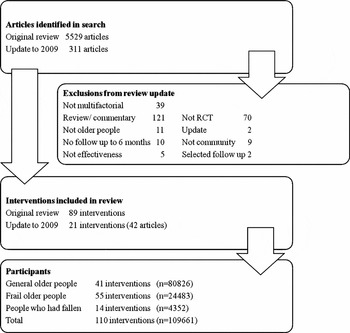
The review process is summarized in Figure 1. The updated search identified 311 articles, of which 19 studies reported 21 interventions relevant to the inclusion criteria.
Review flow diagram.

Interventions identified
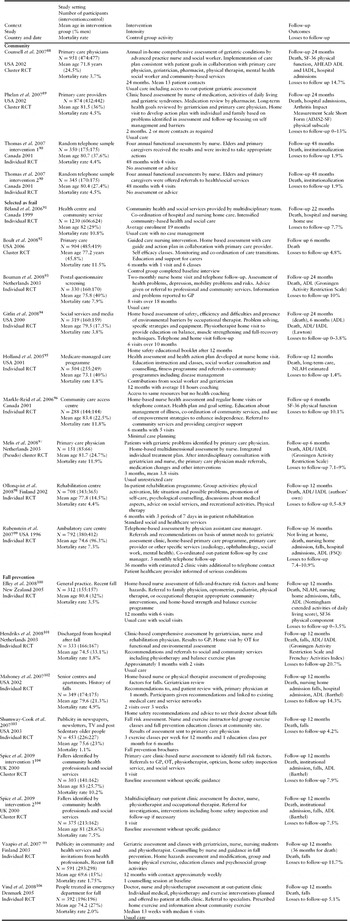
In the updated review 19 studies evaluated 21 interventions. These are described briefly in Table 1. Four interventions were applied in community populations of older people,Reference Counsell, Callahan, Clark, Tu, Buttar and Stump88–Reference Thomas, Worrall, Elgar and Knight90 nine interventions targeted frail older people,Reference Béland, Bergman, Lebel, Clarfield, Tousignant and Contandriopoulos91–Reference Rubenstein, Alessi, Josephson, Hoyl, Harker and Pietruszka99 and eight interventions specifically included people who had fallen (or in one study were sedentary).Reference Elley, Robertson, Garrett, Kerse, McKinlay and Lawton100–Reference Vind, Andersen, Pedersen, Jørgensen and Schwarz106 Overall, these recent studies included 10,854 people to give a total of 108,838 people randomized into 110 trials of complex interventions. In three studies two interventions were evaluated with a shared control group, giving a total of 109,661 participants in randomized groups. Trials ranged in size from 54 to 43,219 people randomized with a median of 375 in the update and 350 overall. Randomization in trials was by individual or household in 96 interventions evaluated and by cluster in 14. The mortality rate across all trials was 6.5% per year.
Characteristics of randomized controlled trials included in the systematic review update

ADL, activities of daily living; IADL, instrumental activities of daily living; NLAH, not living at home.
One randomized controlled trial evaluating a multifactorial intervention in older people identified in the search was excluded as only random samples of people allocated to study groups were followed up in the report.Reference Shannon, Wilber and Allen107
Details of all trials included in the original review are available in Beswick et al.Reference Beswick, Rees, Dieppe, Ayis, Gooberman-Hill and Horwood76
Outcomes
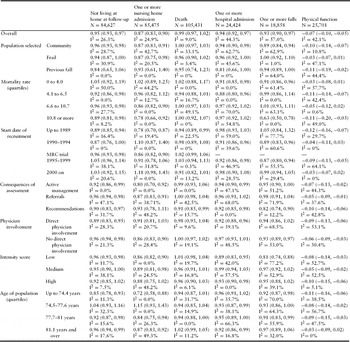
Results are summarized in Table 2.
Relative risk (95% CIs) of outcome by intervention grouping (standardized mean difference for physical function) and I2 statistic

Note: results for one or more falls from a random effects model are: 0.93 (0.87, 0.99).
Not living at home. Not living at home was available for 72 out of 110 interventions (65%) with a total of 84,627 people randomized. There was an overall benefit for interventions, relative risk 0.95 (95% CI: 0.93–0.97) that was identical to the original review. Excluding the large MRC trial the relative risk was similar at 0.94 (95% CI: 0.91–0.98).
Death. As with not living at home as an outcome, the risk of death was similar in original and updated reviews and showed no benefit for interventions in 106 studies (96%) with 105,431 people randomized, relative risk 0.99 (95% CI: 0.97–1.02). Omitting the large MRC trial the relative risk of death was 0.97 (95% CI: 0.93–1.01).
Nursing home admission. There was an overall benefit of reduced nursing home admission in intervention groups (64% of trials reporting outcome with 85,475 people), relative risk was 0.87 (95% CI: 0.83–0.90) and again this was similar to that seen in the original review. The magnitude of the benefit was somewhat reduced after exclusion of the MRC trial, relative risk of nursing home admission was 0.91 (95% CI: 0.84–0.99).
Hospital admissions. Data on admission to hospital were available in 51 studies with 24,424 people randomized. Admissions were reduced in intervention groups, relative risk of one or more hospital admission was 0.94 (95% CI: 0.92–0.97).
Falls. The incidence of one or more falls in participants was available in 32 studies with 18,858 people randomized. Falls were reduced in intervention groups, relative risk was 0.93 (95% CI: 0.90–0.97).
Physical function. Physical function as an outcome was available in 54 studies with 25,701 people randomized and with follow-up data. The standardized mean difference between intervention and control groups was –0.07 (95% CI: –0.10 to –0.05), suggesting better physical function at follow-up in intervention groups.
Possible sources of heterogeneity and subgroup analyses
Given the diversity of trials included in this review, results for both fixed effects and random effects models were compared. Substantial heterogeneity was apparent for the outcome of falls (I2 = 57.0%). However, the reduction in events in intervention groups was still apparent in random effects meta-analysis with a relative risk of 0.93 (95% CI: 0.87–0.99). Results for other outcomes were similar for both fixed effects and random effects models. Fixed effects meta-analysis was chosen a priori because the complex interventions for older people we have defined had common characteristics and aims.
Study quality. Using clarity of randomization, adequacy of allocation concealment or extent of losses to follow-up as markers of study quality, there was little difference in effect sizes in studies of different quality. Similarly, studies with a control group that received some form of intervention activity showed similar effects to those with none.
Cluster or individual randomization. Ideally in meta-analysis we would have considered cluster size and cluster variability and presented summary statistics adjusted appropriately. This information was not generally available and we looked at the effect of clustering with sensitivity analysis.
The main implication of exclusion of studies with cluster randomization was the loss of the MRC trial from the analysis. Outcomes were reasonably similar in trials with individual compared with cluster randomization unless the MRC trial was excluded when the benefit for most outcomes was lost in cluster trials.
Population. Looking at the studies including a community population of older people there were benefits for all outcomes except death. Nursing home admission was reduced in those considered frail. Other categorical outcomes showed trends for benefit in intervention groups but in all cases confidence intervals included unity. Physical function was better at follow-up in intervention groups in community older populations and in those with a previous fall, but not in frail populations.
Mortality rate. Benefits for not living at home and nursing home admission were apparent in populations with highest mortality rates. However, there was little difference in deaths in intervention compared with control groups at any mortality rate. Hospital admissions were only lower in intervention groups in the two lowest quartiles of mortality rate but heterogeneity was high in the highest mortality rate groups.
Falls were reduced in intervention groups in studies with lowest mortality rates. Although few studies with higher mortality rates reported falls as an outcome there was a suggestion of benefit based on three studies.
There was no consistent trend in benefit for the outcome physical function across mortality rates.
Intensity. As described in our previous review we classified interventions according to an intensity score based on multidisciplinary input, number of scheduled visits and duration. There was little to suggest improved outcomes in those interventions with highest intensity.
Physician involvement. Interventions were classified by extent of direct medical input. In 42 studies (38%) direct contact between patients and a geriatrician, physician, general practitioner or primary care provider was reported as part of the intervention. There was no suggestion of specific benefit for interventions with this physician input.
Consequences of assessment. We classified studies according to whether the results of the assessment were followed up with active management, referrals or recommendations. There was no suggestion of particular benefit with active management or any format of follow-up care.
Age of participants. Studies were divided into quartiles by the mean age of the intervention group. There was a trend for greater benefit for physical function in younger populations. In other outcomes there were no consistent trends but living at home was improved in youngest intervention groups.
Date of study. It was not possible to divide studies into equal groups according to the start date of recruitment as many studies shared the same dates. An attempt was made to divide studies by significant dates in the evaluation of geriatric assessment and management. Thus ‘1989 and earlier’ represents the period leading up to the American College of Physicians recommendations on routine medical management of people aged 75 years and older,Reference Almy, Nevins, Beck, Godfrey, Law and Lynn63 and the requirement for multidimensional assessments for people aged 75 years and older in the Terms of service for general practitioners in the UK.65 1990 to 1994 was the period leading up to the start of the UK MRC trial (considered separately in this analysis). From 1995 there was an awareness of the issue of geriatric assessment after several widely reported trials and the first meta-analysis, and also a developing interest in multifactorial fall prevention. Trials conducted from 2000 onwards are mainly new studies not included in our previous review.
For the outcome of not living at home, meta-regression confirmed that the benefit was apparent in the earliest studies but not in studies with more recent recruitment dates. Similarly, meta-regression indicated that only the earliest studies showed any effect for reduction in deaths, hospital admissions, and nursing home admissions in the intervention groups. Physical function outcomes showed no trend with date.
Only three studies reporting the falls outcome started recruitment before 1990 and there was substantial heterogeneity. Considering only those studies recruiting people from 1990 there was a suggestion that interventions in earlier studies were effective in preventing falls but there was no benefit apparent in those recruiting from 2000 onwards.
Discussion
The interventions that we include in our review share the common aim of providing combinations of interdisciplinary teamwork for health and social problems. They aim to limit decline in, preserve or improve independence in older people through the identification and treatment of risk factors including predisposition to falling.
Overall the benefit of complex interventions in helping older people to live at home that was observed in the original review is still apparent across all trials, relative risk of not living at home being 0.95 (95% CI: 0.93–0.97). This is largely due to reduced nursing home admissions rather than deaths in those receiving interventions. Community populations and those considered frail were less likely to be admitted to a nursing home in those who received intervention.
In this review frailty is a broad term including people with limitations in activities of daily living, chronic conditions, and those considered to be at risk of functional decline or hospital admission. Mortality rate in the study populations may be a better indication of health status of the population. Benefits for not living at home and nursing home admission were most evident in populations with highest mortality rates. There was also some suggestion that studies including younger people had more favourable outcomes for living at home, nursing home admission and physical function.
As previously noted, studies with greater multidisciplinary input, duration and number of visits were not associated with improved outcomes. Neither was the direct involvement of a physician in the intervention, or active management compared with referral or recommendations.
Benefit for living at home was largely restricted to earlier studies and the trend for reduced benefit over time was confirmed by meta-regression. Benefits for reduced nursing home admission and death were limited to earlier studies and in the case of nursing home admission the MRC trial as well. Interventions in those who had fallen showed improvements in physical function but no overall benefit for reduction in number of people with one or more fall.
The overall effect size reflecting benefit for interventions is small. However, it has been argued that in the context of complex interventions this may be an underestimate because adherence may be poor in some trials and because control groups may have received some components of the intervention, particularly in recent trials.Reference Stott, Langhorne and Knight87
A simple explanation for why more recent studies do not show benefit is that early trials were comparing a new intervention with a control group receiving no anticipatory care whatsoever. Subsequently, in the light of early randomized controlled trials, systematic reviews and the incorporation of their findings into guidelines, usual care has included features of assessment and management. For example, the control group in the MRC trial of geriatric assessment and management received a brief assessment and for those participants with three or more health problems or serious symptoms, a detailed examination by a nurse.Reference Fletcher, Price, Ng, Stirling, Bulpitt and Breeze108 In the context of geriatric care in the UK after introduction of the GMS terms of service for general practitioners in 1989 this targeted assessment control group is about as little care as any older person could ethically receive in a trial in the UK in 1995, and in this review represents a true ‘usual care’ control group.
As described in the MRC trial, on ethical grounds it would not be possible to have an untreated control group in more recent trials. Therefore later trials may reflect alternative provision of care with the primary aims of reducing costs and improving professional and patient compliance with care. The experience of the control patients in a trial may frequently reflect optimal current practice and adherence. In this review the possibility that the benefit in trials was limited by a ‘Hawthorne effect’ is unlikely as little difference was seen in effects in trials where no activity occurred in control groups compared with those where assessments or interventions were conducted.
The trends in trial effects over time may reflect a growing improvement in the care of older people in primary and secondary care with diffusion of traditional ‘geriatric medicine’ approaches to management. However, in the UK uptake of regular assessment and management of older people has been patchy. Fletcher et al. noted that annual assessments as promoted in the UK were poorly implemented during the course of their study.Reference Fletcher, Price, Ng, Stirling, Bulpitt and Breeze108 However, even in a population where the implementation of health assessment was estimated at only 20% the uptake of influenza vaccination was 80%,Reference Williams, O'Doherty, Mitchell and Williams11 suggesting the delivery of some anticipatory care. In a survey in an Italian population Piccoliori et al. noted a mean of 6.4 out of 7.8 health or social problems identified were known to the general practitioner.Reference Piccoliori, Gerolimon and Abholz109
This latter study also shows that older people still have some unmet needs. While most problems were known, the general practitioner was unaware of a mean of 1.4 problems per individual and about two-thirds of these were of significance to the general practitioner or patient.Reference Piccoliori, Gerolimon and Abholz109
The value of assessment and individualized care was highlighted in the focus group study of Belle Browne et al.Reference Belle Brown and McWilliam67 The authors explored the barriers and facilitators of independence reported by older people, carers and health care providers. Lack of knowledge about services and resources was identified as a major barrier to independence. Key potential facilitators of independence were a co-ordinated system of health care and continuity of care.
Multidimensional fall prevention
The systematic reviews of Gillespie et al. from 2003, Hill-Westmoreland et al., Chang et al., Campbell and Robertson, and Beswick et al. concluded that multifactorial falls interventions were effective in preventing falls.Reference Beswick, Rees, Dieppe, Ayis, Gooberman-Hill and Horwood76, Reference Hill-Westmoreland, Soeken and Spellbring79–Reference Campbell and Robertson81, Reference Gillespie, Gillespie, Robertson, Lamb, Cumming and Rowe110 However, several more recent trials have been included in the review of Gillespie et al. from 2009, which suggests that multifactorial interventions are not effective in reducing the risk of falling.Reference Gillespie, Robertson, Gillespie, Lamb, Gates and Cumming47 This was largely a consequence of the ineffectiveness of interventions in more recent trials. Gates et al. found only limited benefit for multifactorial fall prevention programmes in their review.Reference Gates, Fisher, Cooke, Carter and Lamb82 In the present review, interventions in people who had previously fallen were not significantly associated with a reduction in number of people with a fall, relative risk being 0.94 (95% CI: 0.89–1.00). This was consistent with the relative risk of 0.92 (95% CI: 0.87–0.97) in the previous review of trials classified as fall prevention.Reference Beswick, Rees, Dieppe, Ayis, Gooberman-Hill and Horwood76
Authors of recent trials discussed the lack of benefit reported. Elley et al. attributed the lack of effectiveness of their multifactorial fall prevention intervention to lack of adherence to diverse interventions.Reference Hendriks, Bleijlevens, van Haastregt, Crebolder, Diederiks and Evers100 They noted the need to make all aspects of a multifactorial intervention work and recognized the possible value of personal preferences in improving adherence by participants. The ineffectiveness of the intervention evaluated in the trial reported by Hendriks et al. may have been explained by lack of adherence.Reference Mahoney, Shea, Przybelski, Jaros, Gangnon and Cech101 Looking at process factors in this trial, Bleijlevens et al. found that there had been few referrals resulting from medical assessment and poor uptake of these by participants.Reference Bleijlevens, Hendriks, van Haastregt, van Rossum, Kempen and Diederiks111 The population mortality rate was 1.8% compared with 11.6% in a previous randomized trial of the intervention model in the UK.Reference Close, Ellis, Hooper, Glucksman, Jackson and Swift112 In this earlier evaluation Close et al. recruited people between 1995 and 1996 and reported substantially reduced falls and better physical function in people who received the intervention. However, there was little difference between intervention and control groups in numbers of people living at home, admitted to nursing home or who had died.
In their systematic review of randomized controlled trials of falls interventions, Campbell and Robertson compared trials with an intervention targeting more than one falls risk factor with trials evaluating a single intervention.Reference Campbell and Robertson81 The six trials with a multifactorial intervention showed similar benefit for reduced falls as recorded in patient diaries (rate ratio 0.78, 95% CI: 0.68–0.89) to the ten trials reporting a single intervention (rate ratio 0.77, 95% CI: 0.67–0.89). The authors concluded that targeting single interventions is an acceptable and achievable approach for community-based fall prevention. They also speculate that there may be interactions within a multifactorial intervention, which leads to reduced effectiveness of each component. This may be due to conflicting advice on the level of activities recommended for home safety compared with strength and balance training, or the imposition of too much change to an older person's lifestyle and environment.
In another meta-analysis of recent research in fall prevention, Petridou et al. identified ten studies published between 2004 and February 2008.Reference Petridou, Manti, Ntinapogias, Negri and Sczerbińska113 Their conclusions were similar to those of Campbell and Robertson and they reported that interventions comprising exercise alone were considerably more effective than multifactorial interventions. The authors discussed the protracted nature of multifactorial interventions and compared them unfavourably with shorter term small group interventions. They also suggested that older people may understand the potential value of exercise interventions and thus be more willing to participate. In interventions such as home modification there may be less opportunity for active participation and less potential for enhancement of self-efficacy.
Tinetti noted that in the trials of Elley et al. and Hendriks et al. the adherence to referrals and completion of recommended interventions was left to the participants and the health care providers.Reference Tinetti86 She concluded that fall risk assessment with referral alone was ineffective in reducing fall risk and that active management was required.
However, it is also noteworthy that the lack of effectiveness of more recent multifactorial falls interventions is consistent with the limited apparent overall benefit of complex interventions in more recent studies identified in the present review. This may be a consequence of improved general health and social care for older people. A further possibility is the better educational attainment, social circumstances (e.g. central heating) and fitness of more recent generations of older people which is improving their resilience in the face of environmental challenges.
In the present review we have included the fall-related outcome ‘people with one or more falls during follow-up.’ Clearly in a focused review considering any form of fall prevention intervention a wider range of outcomes would be studied including time to first fall, total falls, injurious falls, falls with hospital attendance, and falls with fracture. Here we have considered more severe sequelae of falls and undertreatment of risk factors, specifically not living at home, nursing home or hospital admission, and death. The number of these events are generally low in the studies of fall prevention which, with the exception of the study reported by Spice et al., were evaluated in relatively healthy people. In total, trials targeting secondary prevention of falls contributed 4.0% of people and 1.2% of deaths to the analysis.
Selection of relatively healthy populations for evaluation of these methods is reasonable as the opportunities exist to intervene in a truly multifactorial sense with exercise classes incorporating strength and balance training, as well as home safety, and lifestyle modification. Populations for fall prevention programmes may be too highly selected and for interventions to be applicable more generally there may be need for incorporation of patient choice and more tailored interventions.Reference Gill, DiPietro and Krumholz114 Furthermore, Gillespie et al. suggest that differences in healthcare systems may explain difficulties in developing and replicating methods.Reference Gillespie, Robertson, Gillespie, Lamb, Gates and Cumming47
Campbell and Robertson highlighted the potential overloading of older people with information and intervention. Weerdesteyn et al. reported good compliance and willingness to participate in low intensity exercise interventions of short duration.Reference Weerdesteyn, Rijken, Geurts, Smits-Engelsman, Mulder and Duysens115
Bunn et al. identified 24 quantitative and qualitative studies exploring participation in fall prevention programmes.Reference Bunn, Dickinson, Barnett-Page, McInnes and Horton116 They identified a number of issues described by patients that influenced participation, specifically: denial, fatalism, self-efficacy, past exercise habits, fear of falling, general health and functional ability, health expectations, under-estimation of personal risk of falling, stigma, embarrassment, and the inconvenience of assistive devices. Methods to improve participation and adherence in fall prevention programmes related to social support and engagement, lower intensity exercise including walking, and education. The authors conclude that better understanding of older people's attitudes towards fall prevention and methods to promote participation will improve effectiveness of strategies.
In a recent UK survey in people aged 54 years and older, Yardley et al. explored willingness to engage in fall prevention activities.Reference Yardley, Kirby, Ben-Shlomo, Gilbert, Whitehead and Todd117 They found that only 22.6% of people surveyed would definitely attend strength and balance training classes and that 60% would maybe not or definitely not attend. Home safety modifications were more acceptable, with 57.6% reporting that they were willing to consider them. On this basis the recent trials reporting low levels of adherence to fall prevention measures may represent a realistic pragmatic evaluation.
Future research in complex interventions
With such a wealth of high quality trial data showing the effectiveness of complex interventions in older people in maintaining independence, it seems reasonable that all older people are given the opportunity to receive appropriate preventive strategies. In those people with specific morbidities the challenge is to establish effective monitoring and to incorporate a more general approach to assessment and management. Similarly for those with disabilities in activities of daily living, social and medical care, if delivered appropriately, may be effective.
For those older people with no specific indication for health and social care the challenge is to identify those likely to develop problems or in the early stages of frailty, the ‘pre-frail’ stage.Reference De Lepeleire, Iliffe, Mann and Degryse118 One-off or yearly assessment is probably not frequent enough to monitor the onset of frailty. De Lepeleire et al. suggest the potential value of case-finding strategies in primary care.Reference De Lepeleire, Iliffe, Mann and Degryse118 However, the acceptability of approaches that lead to greater ‘medicalization’ of generally healthy older people will require further research.
For pragmatic reasons we included outcomes in our review that were widely available in published trials. However, these may not be the best outcomes to describe effectiveness of interventions. For example, in some situations prevention of nursing home or hospital admission and maintenance of living at home can be an unfavourable situation for the individual and carer. This point is important, since if independence comes at a price, such as loneliness, there may be negative implications for older people's health.Reference Victor, Scambler, Bowling and Bond119 In addition, the value placed on independence and its definition is constrained by cultural norms. For instance, studies in African-Caribbean or South Asian communities living in the UK indicate that relationships of informal care and a degree of dependence on younger relatives are valued highly.Reference Adamson and Donovan120 In future reviews sufficient data may be available from trials to consider other independence-related outcomes that are important to each older person.
Randomized trials are underway or planned to evaluate new assessment tools including the PRO-AGE study of health risk appraisal, feedback and personalized education,Reference Stuck, Kharicha, Dapp, Anders, von Renteln-Kruse and Meier-Baumgartner121 and the Evercare case management model.Reference Kane, Keckhafer, Flood, Bershadsky and Siadaty122 Several screening tools to identify older people at risk of falling are available including HOME FAST,Reference Mackenzie, Byles and D'Este123 and they may have value incorporated into a multifactorial intervention.
Interventions that provide support and education to general practitioners and other healthcare professionals in conducting effective assessment and management may lead to improved care for older people. Vass et al. used this approach in their study of structured home visits to older people.Reference Vass, Avlund, Kvist, Hendriksen, Andersen and Keiding124
In all the interventions included in the review there is individualized assessment. There may also be some degree of individualization in treatment and management. In numerous studies shared decision-making has been shown to improve patient satisfaction and health outcomes,Reference Kiesler and Auerbach125 and the need for health and social care services to ‘treat older people as individuals and enable them to make choices about their own care’ is a standard in the National Service Framework for Older People in England.64 More options and different formats of care may lead to better uptake and adherence by older people and address some of the problems described in recent studies. Future evaluations and synthesis of evidence would benefit from assessments of cost-effectiveness, which is increasingly recognized as an important element of policy making and implementation of evidence in health services.
Declaration of interests
None of the authors has any conflicts of interest to declare.
We are fortunate to be able to include such a large number of high quality studies in our review. We particularly thank all the authors who were able to provide additional data for our meta-analysis.