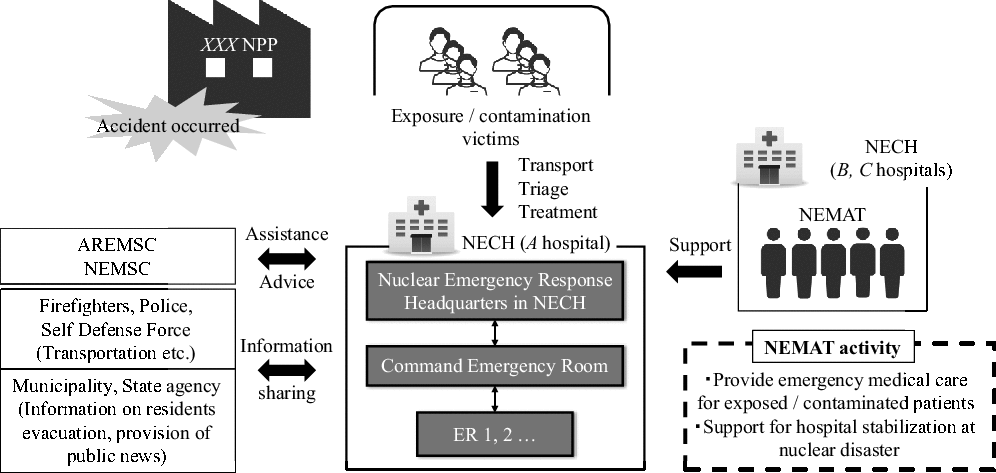
Based on the accident of Tokai village JCO in 1999 and Fukushima Daiichi Nuclear Power Plant in 2011, the Japan Nuclear Regulation Authority (NRA) has organized the nuclear disaster medical system, derived from the Nuclear Emergency Preparedness Measures Law and the Nuclear Emergency Response Guidelines (NERG).Reference Tsujiguchi, Yamamura and Kashiwakura1 In particular, as a result of the revision of NERG in 2015, the nuclear disaster medical care system has been greatly reconfigured and has developed into its current form.Reference Tominaga, Sagara and Hachiya2 Since 2015, Nuclear emergency core hospitals (NECH) have been specified as being located mainly in prefectures with nuclear facilities, and advanced radiation emergency medical support centers (AREMSC) have been designated to support dose assessment and medical treatment for seriously contaminated/exposed patients. Nuclear emergency medical support centers (NEMSC) and nuclear emergency medical assistance teams (NEMAT) are designated to provide information/medical care at nuclear disasters nationwide (Figure 1). NEMSC and AREMSC are providing training services, such as radiation emergency medicine and patient reception training, in various regions and medical institutions.
The Nuclear Disaster Medical System in Japan and the Role of NEMAT. When a nuclear disaster occurs, exposure/contamination victims are transported to NECH. If they were taken to “A hospital,” NEMAT of the other NECH (“B, C hospital”) will come to “A hospital” for medical provision and hospital support. The NEMAT activities are shown inside of the dashed square.

According to the NEMAT Activity Guidelines issued by the Japan NRA in March 2017,3 the main role of NEMAT during nuclear disasters is to support activities in NECH in the affected areas. This task is defined as providing emergency medical care to victims suffering from exposure/contamination and transportation to AREMSC or NEMSC. Therefore, it is necessary to develop an educational program that considers not only basic knowledge of radiation measurement, protection, effects of radiation on the human body, and emergency medical science, but also hospital support during the acute phase of a disaster.
To overcome the abovementioned problems, the present study developed and implemented an educational program.
METHODS
Active Learning Material Development
To develop active learning materials that can comprehensively help medical responders learn about radiation measurement, radiation protection, hospital support during the acute period after a nuclear disaster, and treatment of the injured or sickened, we established a working group with experts and faculty staff from a Hirosaki University’s NEMSC. The working group members specialize in fields such as emergency medicine, disaster medicine, radiological technology, and radiation measurement. They are medical doctors, nurses, logistics experts, and radiological technicians, and all of them had taken specialized training related to disaster-related medical care and radiation emergency medical care. When conducting training for NEMAT members, the NRA recommends using textbooks that they have published.4 Therefore, rather than lecture-style teaching materials, we created active learning materials with the following titles: “Contamination Inspection and Decontamination in Medical Institutions,” “Curing Medical Equipment and Personal Protection,” and “Hospital Support and Control of Contamination/Radiation Patients in the Acute Phase of a Nuclear Disaster.”
The lectures dealing with basic disaster and emergency medicine were excluded from teaching materials because the registered NEMAT members already had learned those topics.
Training and Questionnaire Evaluation
In July 2017, a single-day practical training module for NEMAT was conducted at a NECH in Aomori prefecture, Japan. There were 33 trainees in total, consisting of 6 medical doctors (5 males and 1 female), 10 nurses (3 males and 7 female), 7 radiological technologists (7 males and 0 female), and 10 clerical workers (9 males and 1 female). After completing all lectures and training, we conducted a questionnaire survey on active learning materials, which we had devised for trainees. Finally, we evaluated the satisfaction levels based on the collected questionnaire responses. We received approval from the ethics committee of the Graduate School of Health Sciences, Hirosaki University, to use the questionnaire and conduct the survey.
RESULTS
Contents of Active Learning Materials
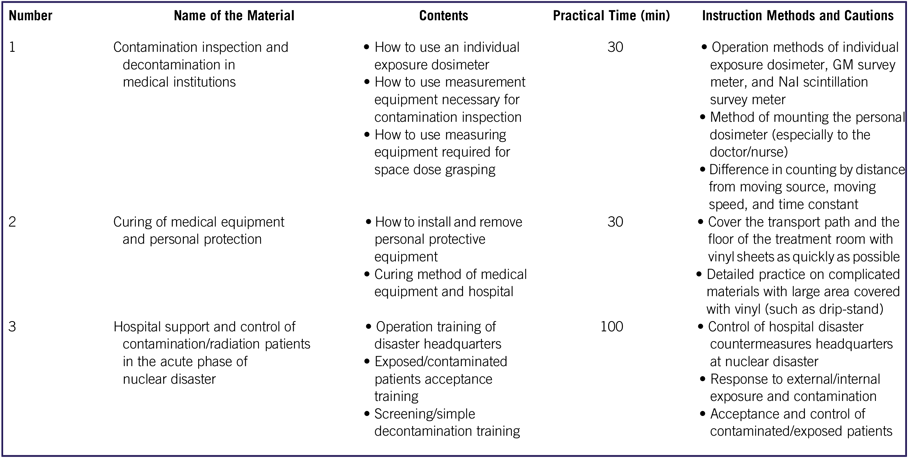
Table 1 shows the contents of the completed educational program. First, in teaching materials on radiation measurement, we developed a program to learn how to use individual exposure dosimeters, an NaI scintillation survey meter, and a Geiger–Mueller (GM) survey meter. We explained to doctors and nurses how to install an individual dosimeter. In addition, we instructed radiological technologists on how to check contamination using a GM survey meter, how to choose time constants, and how the distance between the contaminated part and the detection surface is related to the counting. In addition, by having medical responders actually measure the sealed radioactive source, the program allowed them to experience how slowly the detection surface of the survey meter should be moved and how much distance to keep between the detection surface and the contaminated surface. Subsequently, we created a program to encourage medical institutions to use medical care materials and practical teaching materials that provide information about curing the in-hospital delivery route and the floor of the treatment room with curing vinyl sheets as quickly as possible. In particular, with regard to the curing of the treatment room, we devised methods so that the study participants could practice using complicated materials such as the zoning size of the “hot zone” while treating the patient and the extensive curing area, such as the drip-stand.
Created Active Learning Materials – Contents and Instruction Methods

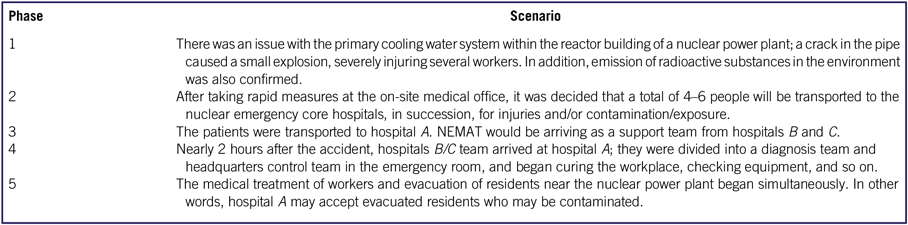
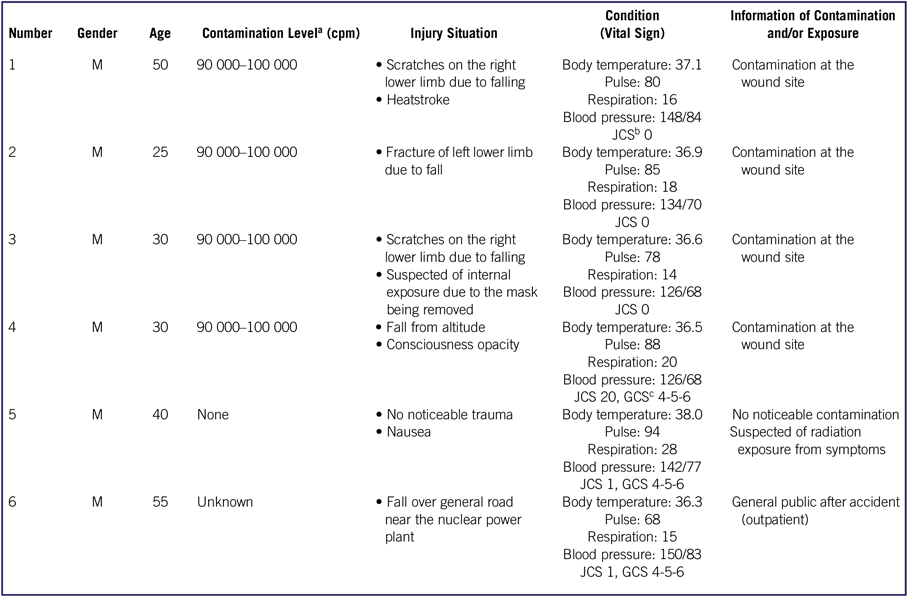
Finally, in regard to active learning related to hospital support and the treatment of victims’ injuries, we created contents to help medical responders practice “control of disaster countermeasures at headquarters when multiple victims are injured and contamination/acceptance of radiation-affected people.” Specifically, the contents to be controlled by the trainees, accident/disaster scenarios, and patient assumptions are shown in Tables 2 and 3. In the simulation, 1 team of the trainees played the role of the “supervising team” of the NECH closest to the nuclear power disaster site. Based on the assumption that the other trainees were dispatched from other hospitals, the intention was to stabilize the exposure/contamination victims who were being transported. The patient assumption was created by combining radiation information (contamination and external/internal radiation exposure) and physiological information. The exercise also realistically simulated the disaster situation by using dolls. Because it is legally difficult to obtain and use unsealed radioactive materials for the practical training, we devised a way to confirm the degree of decontamination by using black light and applying fluorescent paint to the “wound.”
Created Active Learning Materials – Scenario of Training (in Active Learning Material No. 3)

Created Active Learning Materials – Patient Assumption (in Active Learning Material No. 3)

a Using GM survey meter with detection area of 20 cm2.
b JSC: Japan Coma Scale.
c GCS: Glasgow Coma Scale.
Implementation of Active Learning Materials and the Questionnaire Results
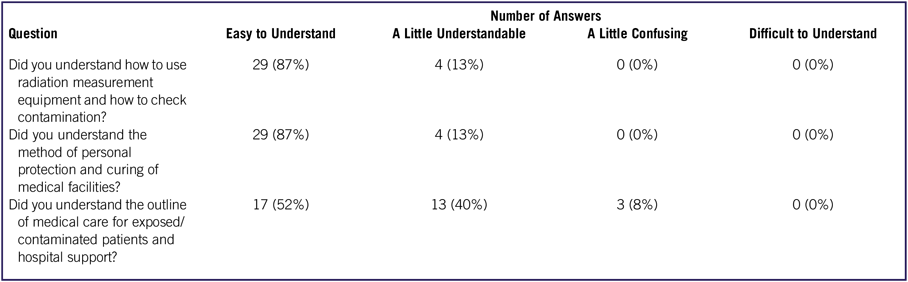
The results of the trainee questionnaire are summarized in Table 4. An analysis of the questionnaire showed that all of the trainees answered, “easy to understand” and/or “a little understandable,” for the simulation related to radiation measurement and the curing of hospital/medical materials, and over 92% answered “easy to understand” and/or “a little understandable” about the hospital support and medical provision simulations. The trainees who answered, “a little confusing,” cited the difficulty of additional triage, taking account of exposure information, carrying out communication while wearing protective clothing, and standard triage (such as simple triage and rapid treatment [START]) for exposure/contamination patients, because they were afraid of their own secondary exposure and contamination transfer.
Questionnaire Resultsa

a The subjects of the questionnaire were 33 trainees, and the questionnaire collection rate was 100%.
DISCUSSION
NEMAT is mainly composed of medical doctors, nurses, radiological technologists, and clerical workers. Even medical staff who may act as NEMAT, which is expected to contribute in the acute period after the occurrence of nuclear disaster, are anxious about nuclear disasters and/or rumor damage.Reference Tominaga, Sagara and Hachiya2, Reference Akashi, Kumagaya and Kondo5 So, we developed a program that incorporates practical training on hospital control and support to exposure/contamination patients, usage of radiation measurement equipment, and personal protection methods. Through the questionnaire results of the trainees – because all trainees (100%) answered that the operation of the radiation measurement instrument and the personal protection method were “easy to understand” or “a little understandable” – we were able to confirm the effect of the developed teaching materials. On the other hand, regarding practical training on hospital control and support to exposure/contamination patients, some trainees were afraid about secondary exposure from patients and contamination expansion. In order to mitigate such anxiety as much as possible, NEMAT members need to quickly determine whether the patient is contaminated and implement quick standard triage and decontamination. In other words, it is important to practice such practical training repeatedly to build knowledge, which may alleviate anxiety about secondary exposure and contamination transfer. In addition, NEMAT has to understand decontamination criteria and additional triage methods with exposure dose information. In Japan, the criteria for decontamination of the patient and the reference value for evacuation are indicated in the Operational Intervention Level of the NERG, and the criterion for patient decontamination is 40 000 cpm (measured by a 20 cm2 GM survey meter).6 In addition, although the frequency of occurrence of exposure patients is rare, it is necessary to consider additional triage methods that take exposure doses into account.Reference Coleman, Weinstock and Casagrande7 A NEMAT member needs to have relevant knowledge in order to judge the extent of the exposure of the injured person based on the nuclide and count. In addition, the chromosomes and DNA double-strand breakage, which is the standard of biodosimetry, cannot be used promptly in hospitals during the acute phase of a disaster.Reference Sullivan, Prasanna and Grace8–Reference He, Gui and Matthews10 Furthermore, in Japan, because the “dose limit (guideline)” is not defined in the NEMAT member activities, during actual activities at a time of emergency, it is assumed that the activities should be performed by the control or individual teams. The development of human resources capable of solving such problems and the setting of standards are thus indispensable.
CONCLUSIONS
The active learning materials developed in this research had an educational effect. Additionally, the questionnaire results of the trainees demonstrated the necessity of improving the triage system and protocols in order to help both the patients and responders.
Funding Source
This study was financially supported by Hirosaki University grant, Strategic Theme 3: International Education and Research Project based for Safety and Security on Radiation Medicine.
Acknowledgements
The authors would like to thank the clerks of Hirosaki University Center for Radiation Support and Safety for their technical assistance with the training.