Introduction
In both the past and the present, movement is a ubiquitous and important part of everyday life for most people. It is usually taken for granted that it is possible to move freely through an urban area in order to undertake the complex range of activities that form an essential part of people's lives. Through such travel we also encounter, often on a daily basis, a range of city spaces and environments. Together, these form a landscape that becomes part of everyday life itself. There has been extensive research on mobility, environment and the city in a contemporary context, often employing ethnographic research methods,Footnote 1 but investigating these features for past societies is much more problematic. Because such movement is for most of the time both mundane and taken for granted, it is rarely recorded.Footnote 2 Moreover, those occasions that are noted may be recorded because they were unusual. This can give a misleading perspective on mobility in the past. In this article, I seek to uncover some aspects of the experience of everyday mobility in a selection of English towns and cities in the nineteenth and early twentieth centuries, focusing especially on the ways in which urban travellers interacted with some of the spaces through which they passed. There are two principal aims: first, to demonstrate the strengths and weaknesses of using diaries as a source for examining mobility in nineteenth- and twentieth-century Britain; and, second, to explore the nature and complexity of individual interactions with the urban environment that were generated during travel. I argue that existing evidence about urban mobility and engagement with urban space often comes principally from literary and elite sources.Footnote 3 While not negating the value of such evidence, I suggest that the use of diaries written by non-elite authors, with no intention of publication or wider circulation, can provide a rather different and more nuanced perspective. The sources used in this analysis are a series of personal diaries that have been analysed specifically for their content on mobility, how it relates to urban space and the ways in which it constructs the diarists’ everyday lives. To date, such sources have only rarely been used to examine urban mobility of any kind.Footnote 4
There are many different ways of approaching this subject matter, and this article does not attempt to review them in detail. Five key themes are briefly discussed to provide context and illustrate the range and scope of research.Footnote 5 Urban ecologists working in the USA in the early twentieth century have been a key influence on studies of urban space and society. As Robert Park stated: ‘The city is not. . .merely a physical mechanism and an artificial construction. It is involved in the vital processes of the people who compose it.’Footnote 6 In this sense, the work of Park and his co-authors laid the foundations for later examinations of the ways in which urban populations interact with the spaces through which they pass, and in turn help to construct the character and nature of such spaces. A second important research strand has drawn heavily on the work of Kevin Lynch, who demonstrated the ways in which people identify, and utilize, different features of the townscape to navigate and inform their everyday lives.Footnote 7 Lynch emphasized what he called the ‘legibility’ of the city: the ease with which urban residents could read, understand and relate to different features of the city. He argued that such legibility should be a core part of modern city planning. Much research on urban space and society has been informed by various types of Marxian analysis, often drawing heavily on the seminal work of David Harvey.Footnote 8 In such analyses, urban space is a key part of a set of processes that are engaged in the production and reproduction of the systems of capitalism that create and perpetuate social and spatial inequalities within the city. Space is not neutral, but different urban spaces necessarily take on characteristics and functions that enable the inequalities inherent in the capitalist city to be formed and reinforced. Those with least power in the capitalist urban system are inevitably forced into the least desirable spaces and often experience negative externalities generated principally by more fortunate city dwellers. Humanistic approaches to space and place are also relevant, especially through the work of Yi-Fu Tuan. He explored the ways in which people developed emotional and affective ties to particular places and landscapes and, in turn, demonstrated how such perceptions of space could influence and constrain everyday activities.Footnote 9 Similar themes have more recently been explored in the context of ‘psychogeography’: a concept that is not in itself particularly new but has become increasingly common currency among some academics and writers in the twenty-first century.Footnote 10 Although interpreted in a variety of different ways by various authors, psychogeography focuses primarily on the ways in which people relate to the environment through which they pass (often, though not exclusively, when walking) and emphasizes the emotions generated by our full range of senses including feelings of nostalgia, fear, attachment and sense of place. This article is informed by all these approaches, but also seeks to develop a practical framework within which our understanding of how past urban residents engaged with urban spaces can be analysed.
Drawing loosely on the work of Lefebvre, I structure the article around selected ‘practices’ and meanings associated with the spaces through which people travelled in the past.Footnote 11 I identify five sets of interactions or meanings associated with the uses of urban space, and illustrate them with accounts of everyday travel in English cities from the 1840s to the 1940s drawn from life writing. The concepts I use can be summarized as:
-
• Emotional spaces: urban spaces to which people feel a particular attachment or with which they identify specific feelings, be that (for example) feelings of love, fear, alienation or wonder. These may be generated either by the space itself or the activities undertaken (or some combination of the two).
-
• Spaces of discovery: environments or localities which are particularly associated with fresh experiences, new discoveries and the acquisition of knowledge. These might include institutions dedicated to the provision of knowledge (museums, libraries, etc.) or locations and events that expose the traveller to something new.
-
• People in spaces: people are present in almost all urban spaces, but this aspect focuses specifically on the ways in which people and their activities influenced the reactions of those travelling through the city.
-
• Constraining spaces: those spaces that either directly restrict access (for instance, by legal constraints and/or physical barriers), or from which some people feel excluded and in which they would feel uncomfortable, and thus do not attempt to enter them.
-
• Utilitarian spaces: those spaces that are associated primarily, though not only, with the most mundane necessities of everyday life, such as homes, workplaces and routes regularly travelled.
Each of these concepts is not mutually exclusive, and they interact with each other. For instance, a particular location may provide both utility and emotional attachment (the home), other spaces may generate feelings of fear and thus also constrain access and the characteristics and activities of other people will to a degree influence all spaces. However, I suggest that this framework provides a useful structure within which to analyse the ways in which people engaged with urban space as they traversed the city. The nature and extent of one's reaction to particular characteristics of urban space would also have been influenced by other factors. These may include some combination of the mode of transport used, the journey purpose, travelling companions, weather at the time of the journey, characteristics of the environment and the novelty of the trip. For instance, in almost any environment the experience of walking alone at night will be different from that of travelling by car or with companions by day. In this article, selected examples are drawn from a range of diaries to illustrate these themes and, especially, to examine the extent and complexity of potential meanings associated with even mundane journeys.
Sources and methods
Contemporary research on mobility mostly uses a range of qualitative and ethnographic techniques, including accompanied journeys, to explore the experiences of everyday travel.Footnote 12 However, this is clearly not possible for historical research. For the more recent past oral history techniques may be used, but otherwise we must rely on any written evidence that survives. While some evidence may be gained from sources such as newspapers, travel memoirs or visual representations, these are either not produced by the traveller themselves, or usually represent rare trips such as holidays or other excursions. Life writing forms one important source that can provide insights into the experience of everyday travel, with personal diaries that are written frequently (preferably daily) providing the closest equivalent to an historical ethnography. However, there are many problems inherent in using personal diaries as evidence, some generic to most life writing and some that apply more specifically to the study of mobility.Footnote 13 First, diary writers are not representative of the entire population. They come from those with the time, literacy and inclination to keep a diary and, moreover, we can only read those that survive. By definition, diaries come disproportionately from the more privileged portion of the population. Second, diaries can only reveal those things that the diarist chooses to relate. There is no way of gauging what is left out or how material included is selected. On occasion, a diary may contain passages that were later crossed through but which remain at least partially legible. This can raise ethical problems about whether the researcher should attempt to use material that the diarist clearly attempted to remove. There is some evidence that men and women engaged in different forms of life writing, with men more likely to write autobiographies and women more likely to keep diaries. Autobiographies and life histories are likely to be rather less reliable as indicators of everyday activities as they will have been written later in life as memory fades and often have a strong message of self-justification for the life led.Footnote 14 For this reason, I use only personal diaries in this article.
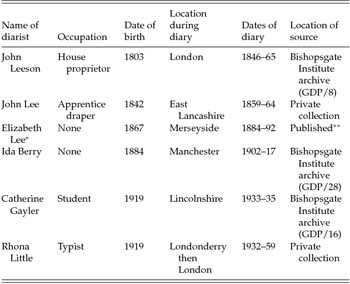
Because everyday mobility is a taken-for-granted and mundane activity it is unlikely that all such movement will be recorded in a diary. There is a tendency for diaries to focus on those aspects of daily life that are different from the norm, rather than relating every detail of a daily routine. Thus, there is a real risk that the picture we get of mobility from any life writing is one that focuses disproportionately on the unusual or problematic, rather than on the routine and everyday. As with most historical research, there is little that we can do about these source constraints other than being fully aware of them during analysis and interpretation of the data. This article arises from a long-term project that is using a range of different types of life writing to examine both residential migration and everyday mobility in the past. In total, I have so far examined some 30 items of life writing (mainly diaries but also including life histories and letters), but for this article I draw on six diaries written during the century after 1840 to examine some of the ways in which urban travellers engaged with the spaces through which they passed. These diaries have been selected because they cover a range of times and locations, and because they all contain reasonably rich material on urban mobility. Basic characteristics of the diarists are given in Table 1. The diarists travelled through a range of English towns with varied characteristics. Two (Leeson and Little) lived mostly in London, already a city of over two million people in 1851, and offering a wide variety of travel options.Footnote 15 Manchester in north-west England was a city of over half a million people when Ida Berry lived there (in suburbs to the south of the town) in the 1880s, but Burnley in East Lancashire where John Lee lived in the 1850s was a town of only some 20,000 people at the time, though he also travelled through much larger cities such as Leeds, Bradford and Liverpool in northern England. Elizabeth Lee lived in a semi-rural suburb of Prenton on Merseyside, adjacent to the town of Birkenhead (around 100,000 population in 1891) but she was a frequent visitor to the neighbouring large port city of Liverpool, reached either by ferry or (from 1886) by rail. Finally, Catherine Gaylor lived in a village close to the small market town of Grantham, Lincolnshire (population just under 20,000 in 1931). She would have had far fewer travel options than the diarists who lived in larger urban areas.Footnote 16
The diaries

*Daughter of John Lee.
**C. Pooley, S. Pooley and R. Lawton (eds.), Growing up on Merseyside in the Late-Nineteenth Century: The Diary of Elizabeth Lee (Liverpool, 2010).
Emotional spaces
A significant proportion of the contemporary literature on mobility focuses on the feelings and emotions that are generated while travelling, be that the attachment to landscape while walking, the kinaesthetic associations with speed while cycling or the feelings of power and control that may be generated when driving.Footnote 17 However, the diarists studied rather rarely specifically associated everyday travel with strong feelings or emotions. If such feelings were generated they were not felt of sufficient importance to be recorded. Diarists most often recorded their feelings on journeys that were unusual, surprising or which exposed them to new experiences. Unusual, or especially entertaining, travelling companions could also elicit stronger than usual feelings about a journey. Examples from three diarists illustrate the point. For instance, John Leeson, who did not keep his own carriage, especially enjoyed the opportunity to travel in a chaise, particularly as the ride (with friends) took him through parts of London that brought back fond memories:
I and Mrs Leeson dined with Mrs Salter and Mr Beasley Mr Carter and Mrs Salter at Hammersmith in afternoon. Mr B took me in his Chaise through Mortlake to Richmond on the Hill, through the Park, a wedding and home over suspension bridge – I much enjoyed the ride, and it called up old times, riding with Father in his Chaise.Footnote 18
Elizabeth Lee walked frequently around her suburban home in Prenton, Birkenhead, sometimes with friends and sometimes alone. Such walks gave her especial pleasure when she was with one of the (many) young men with whom she walked out, especially if he was the preferred suitor of the moment: ‘Went to Liverpool. Met Mr. Rigg. He came over to B'head with me. Saw Mr. Mackenzie tonight. had such a splendid walk with him. it is so nice to see him again. (time I did see him too) Could'nt have waited much longer.’Footnote 19
Similarly, in Manchester, Ida Berry frequently recorded walks that she enjoyed, but they generated extra pleasure when she was in the presence of her group of close friends (mainly, though not exclusively, male).
After Chapel at night I went for a long walk with Harry and Norman, it was a glorious moonlight night, and we did have some fun. Harry made us roar, we met Ruby and Sam down ‘Pine Road’ and then we all went together down the back streets of Didsbury, and then we lost them, and Harry and Norman brought me home.Footnote 20
Ida and her sister were also keen cyclists and frequently commented on the enjoyment generated by rides around south Manchester, especially relishing feelings of speed and recording that she ‘scorched home’.Footnote 21
The diarists studied recorded feelings of apprehension or fear even less frequently than they recorded particular pleasure, and few journeys of any sort led to serious mishaps, though routine missed trains or buses and delays due to weather were not uncommon.Footnote 22 Even when mishaps occurred, this did not seem to alter the travel behaviour of the diarists in that they invariably continued to travel in the same way. It is also hard to judge or compare the potential seriousness of an incident from the evidence available. For instance, John Leeson recorded in some detail his scary experience in a run-away fly (light carriage), recording ‘I have much cause to be thankful to God for preserving me as I might have been thrown out and killed or much hurt.’Footnote 23 Although this form of transport was never commonly used by Leeson, both he and his wife did travel by fly from time to time after the recorded incident, and it is hard to know if he was really in danger.
Similarly, when Ida Berry came off her bike on a busy road into Manchester (something that rarely happened), she got back on and rode again the same evening: ‘Maud and I cycled to All Saints. Coming back she was thrown off and hurt her knee. I was thrown off the previous evening. After tea I went for a ride by myself.’Footnote 24 Elizabeth Lee did occasionally record feelings of apprehension when travelling alone. For instance, on one occasion when travelling back from Liverpool late at night: ‘Louie came part of the way home with me, and I felt so frightened going the rest of the way by myself. Very tired’;Footnote 25 and on another when travelling alone by train from Long Preston to Liverpool: ‘Started home by the two o'clock train. Had'nt a very pleasant journey as a man frightened me.’Footnote 26 However, these were rare events and she travelled frequently in this way subsequently and did not register any further fears. Evidence from diaries and other accounts increasingly suggests that independent travel by women in nineteenth- and early twentieth-century Britain was not as uncommon or problematic as has sometimes been suggested.Footnote 27 The female diarists studied here certainly moved around the city with minimal constraints and difficulties.Footnote 28
When travelling through unfamiliar locations, none of the diarists studied so far expressed any real fear, only curiosity (see below). This could be because they mostly travelled through places in which they expected to be comfortable, but even when in totally unfamiliar territory apprehension and fear were not emotions that were recorded. Analysis of these diaries does not provide evidence that interactions with urban space by the diarists were largely free from emotional attachments, either of pleasure or apprehension, but it does suggest that such feelings were rarely felt to be sufficiently strong, important or unusual to be recorded in a diary. Where they were recorded, the emotional responses were often more to do with the company they kept than with the spaces through which they passed. They certainly did not seem to be one of the prime factors that structured movement around the city.
Spaces of discovery
Urban space can be viewed with new eyes in a variety of different ways. For the migrant, arrival in a fresh location obviously provides almost unlimited opportunities for exploration and discovery, but even for the long-term urban resident, new experiences were not uncommon. These could be generated by (for instance) specific one-off events, such as an exhibition; by visits to new locations; by trips to museums or galleries that educate; by a young diarist being given more freedom and autonomy during their teenage years; or by being with particular companions and thus viewing something familiar through new eyes. In this sense, the city provides almost unlimited opportunities for stimulation and discovery, and specific experiences may generate long-term memories that associate particular places and spaces with discovery and exploration. From diaries, there is no way of knowing if the events recorded did in fact make a lasting impression on the diarist, but the diaries do indicate that they were of sufficient import to be noted at the time. The notion of using a diary to record new discoveries is, perhaps, most obvious in the many travel diaries and associated travel writing that exist, and is one of the commonest contexts in which diaries were written.Footnote 29
In the summer of 1859, the 17-year-old John Lee, then living in east Lancashire, travelled from Leeds to Bradford for the first time and the impact of urban sprawl and industrial development made a significant impact on him:
Next went through the long scraggy suburb such as only a busy manufacturing town can create, to Kirkstall Abbey. . .I had expected to see the valley of the Aire sprinkled with the villa residencies of the merchants of Leeds; but the busy traders prefer to live in the town, and in all the nine miles on the way to Bradford, you have only a succession of factories, dye-works, and excavations, encroaching on and deforming, the beauty of the valley, while the vegetation betrays signs of the harmful effects of smoke.Footnote 30
While the young eyes of Lee saw industrial development in Yorkshire as unattractive, the much older John Leeson in London approved of the opening of new railway connections, noting the convenience of being able to travel more easily by rail across London.Footnote 31
Likewise, Elizabeth Lee was enthusiastic about the opening of the new railway tunnel under the river Mersey. This eased her regular travel from Birkenhead to Liverpool, though she continued to use the ferry from time to time as it ran all night, and allowed her to come home at any hour from parties and other events in Liverpool. Although many of Elizabeth's engagements in Liverpool were purely social, they could also be educational as she and friends usually visited major exhibitions and similar events. Thus, in 1886, she and one friend travelled by rail under the Mersey to visit the ‘Shipperies Exhibition’. Her diary entries demonstrate her enthusiasm for the exhibits and the way in which acquisition of some knowledge was linked with feelings of fun:
L. Sanchez and I went to the “Shipperies Exhibition. Got there at ½ past 3.p.m. We went by Lime St. Station. We had such fun and it was jolly. I liked the Viennese Lady's band as well as anything. They play splendidly and are all dressed in white with dark blue satin bodices. The grounds are very nicely laid out and there were some very good bands playing. Lizzie and I both bought a Geonoese silver bracelet in the Italy section. We did not go into the Indian Village. You have to pay 6d to go in, and they have all sorts of performances. We saw lots of Indians, but we think Lappo have gone as could'nt find them. We left about 9. p.m.Footnote 32
Sometimes, new discoveries were made by accident, as when Elizabeth Lee found a new music shop when she was temporarily lost in Birkenhead (normally quite familiar territory). She was clearly pleased with this new discovery, though there is no evidence in the diary that she ever deliberately returned to that location: ‘Lost my way coming down, and found such a nice music-shop, bought some music at a 1.d a piece.’Footnote 33
Special events that took the diarist to new locations, and provided new experiences, were most likely to stick in the memory. In the diary of Catherine Gayler, the 15-year-old schoolgirl described a school outing from Grantham (Lincolnshire) to Stratford on Avon in 1934. Both the journey and the play she saw (Twelfth Night) seemed to make an impression on her at the time: quite possibly a memory that remained with her:
We had an awful old ‘bus on June 30th, and as the relief was late getting into Grantham the Stratford ‘bus had to wait 20 mins for me. Stayed and had lemonade at Kenilworth Castle for more than an hour. Saw Ann Hathaway's Cottage, Shakespeare's birthplace and Grammar School. Had tea at a café in Stratford. Walked as far as Avon Bridge. Got home at about 11 (Carlton). Most of the girls liked Sebastian best. Sir Toby was very funny and Sir Andrew. Dorothy Black (Viola) also popular.Footnote 34
For the long-distance migrant, discovering a new urban location could be daunting, but crucial in establishing a routine and feeling secure in new surroundings. Rhona Little travelled from Londonderry (her term) to London to start work as a typist with the Inland Revenue in 1938. This was the first time she had left Northern Ireland and her diary recorded not only her reactions when arriving in the city, but also just a few months later the way in which she set about deliberately exploring the city. She meticulously recorded her travel around the city and found much to surprise and impress her. Presumably, some such experiences also provided lasting memories, especially as she invariably found new areas more attractive and interesting than she anticipated (though we do not know how much prior knowledge she had or how this was gained). Feelings of fear or apprehension were almost never recorded. These themes are explored more fully elsewhere.Footnote 35
We arrived at London at 12.15. It is very bleak looking (the station) and after the style of Belfast station, only bigger. Then we went in a bus to near Earl's Court. When we got off we had a good bit of walking, and my arm ached with holding my things. The road to Earl's Court was very interesting. Full of people, buses, cars and great big shops.Footnote 36
I then decided to do some exploring. I bought a 1/- tram ticket and went off to Hampstead Heath. I arrived at South End Road Gate. There was a Punch and Judy show. . .I had a good walk about the Heath. It is very nice but there are far too many people about it. The weather was somewhat cool. I ended out by coming out at the tram terminus at Highgate. I took a trip from there right past the East India Dock. The route there is most interesting and you do see some queer looking people. There is one place I noticed which was very Jewish. It was all not at all like what I thought the East End was. It is very nice indeed in parts. . .The roadways are all railed in in the East-end and there are only openings for crossings.Footnote 37
People in spaces
As some of the extracts above have already shown, it was not only the physical characteristics of urban spaces that made an impression on travellers, but also the people and activities that were found within them. Indeed, the same space could take on a different aspect and meaning depending on who was there and what was occurring. Such differences were also linked to the natural rhythms of the city with, for instance, night and day sometimes creating rather different feelings of association or apprehension, though even at night (as noted above) feelings of fear were very rarely expressed by any of the diarists.
In 1859, the 17-year-old John Lee travelled from Burnley to Liverpool (to stay with an aunt), and then later took an excursion by steamer to North Wales. Some of the most notable aspects of these journeys appeared to relate to the people he travelled with rather than the journeys themselves or the places through which he passed. Thus, he commented on the crowds on the trains to Liverpool, and the delay this caused: ‘Got up to go by the cheap trip to Liverpool. We had to wait nearly two hours at the station, there were so many people going they had to get extra trains.’Footnote 38 He also recorded the fact that most of his travelling companions on the journey to North Wales spoke only Welsh. He clearly found this strange and slightly off-putting, and was obviously not something he had encountered or considered before:
As we came near Mostyn nothing but the dingy chimney and smoke of a coal pit presented itself to our view. All the passengers along with myself rushed into the only public house there was to be seen and we had to stay there till the steamer went back again. They spoke nothing but the Welsh language both in the public house and on the steamer.Footnote 39
The young Elizabeth Lee also frequently travelled alone, mostly by train. She rarely commented on the places through which she passed but more often made observations about her travelling companions. For Elizabeth, it can be suggested, people were more important to her than places: she often seemed indifferent to her location. For instance, in 1885 (age 18) she travelled to visit relations in Long Preston (Yorkshire) but apart from saying the journey was ‘nice’ (a favourite commendation), the most notable aspect of the trip seemed to be her fellow passengers. Like John Lee at much the same age, she found people who were foreign to her as distinctive though, unlike John Lee, she found them comical rather than slightly off-putting: ‘Uncle George took me to the station today. Had a very nice journey. The carriage I was in was full of Americans and they were so comical. Arrived at L'preston about 5 p.m.’Footnote 40
As noted above, Elizabeth took great interest in the opening of the Mersey railway tunnel in 1886. She travelled through it by train (alone) on the day it opened and was particularly impressed not by the engineering work or the speed of crossing (though the lift was novel), but by the crowds of people and, especially, the men she encountered on the platform: ‘Such a lot of gentleman in the station. It was so jolly but I got nearly squashed to death.’Footnote 41
Over half a century later, Rhona Little similarly noted her travelling companions as she travelled from London back to Ireland for a family visit. Although they clearly made an impact, and enlivened her journey, in this case she was not especially impressed: ‘I found [a seat] in a compartment in which there were two lots of Irish people and I think two English or refined Irish men. The Irish people seemed very Irish to me. They seemed very low class to me.’Footnote 42
Sometimes places and activities that are routine and mundane, such as regular travel to and from school or work, or places that are part of the everyday rhythm of life, can take on extra meaning, and become worthy of particular note by a diarist if they are linked to either an unusual event or an enjoyable experience. Again, such experiences often related to the people encountered in a place rather than to the spaces of journeys themselves. For instance, Catherine Gayler travelled daily from her Lincolnshire village to school in Grantham and visited the town regularly for many mundane reasons. Her diary recorded many of these trips, but she seemed to note especially those that were particularly pleasant or unusual. Thus, in August 1934, she noted playing cricket with friends: ‘Afternoon biked to Grantham with Barbara and Dorothy. After tea played cricket in field with George, Norman, Barbara and Dorothy’,Footnote 43 and a little later the same year recorded the crowded bus to school and the fact she had to share the bus to the boys’ school: ‘Bus very crowded. Both boys and girls on one bus as other broke down at Frieston. Stayed to get hair done and came home on 5 bus.’Footnote 44 The presence of boys and girls on the same school bus was clearly an attractive novelty. It is likely that these otherwise routine journeys would be remembered for some time by Catherine because of the combination of people she encountered and events that occurred.
Constraining spaces
Those most likely to feel severely restricted and constrained in some urban spaces are also likely to be amongst the most marginalized and deprived members of the population. Those who feel unwelcome, or who are physically excluded from some urban spaces and places, are most likely to be outsiders as defined by the majority urban population. Such differences may be constructed by ethnicity, religion, poverty, age, gender or any other attributes that single them out as different and therefore make their presence unwelcome or uncomfortable.Footnote 45 As noted above, past diarists are most often drawn from the ranks of those with some education, time and resources, and thus are not fully representative of those members of society most likely to feel constrained by some aspects of urban space. However, that does not mean that the diarists never encountered constraints, and many poorer areas of the city would probably have been unknown territory for most middle-class diarists. Other constraints were related to age and gender: although as noted above all the female diarists studied travelled frequently, freely and often alone at most times of the day and night, there were also boundaries that could limit their movements.
Like most teenage girls, at times Elizabeth Lee found home, parents and domestic duties frustrating. For the most part, she was given a great deal of freedom, possibly because she was the eldest and her mother was preoccupied with her numerous younger brothers, and her domestic duties were relatively small, but she frequently complained when she was asked to do more, or if she felt her mother was not treating her fairly: ‘Have had a dreadful day baking and Ma going on to me all day about nothing. Saying we did no work whilst she was away and we did everything she wanted us too except wash 3 blankets.’Footnote 46
Elizabeth argued with her mother much more than with her father. He rarely interfered in her activities and only very occasionally sought to moderate her behaviour or restrict her movements. However, there were a few instances when Elizabeth was caught out, admonished for her behaviour and/or movements temporarily restricted. This occurred most frequently early in the diary when Elizabeth was still relatively young, as on this occasion in 1884 when she was aged 17 and stayed late at the house of a friend: ‘It was nearly 12 p.m. when I went home for we had all been talking about mesmerism. James was going to take me home but who should I meet but Pa when I got outside the gate, so he did'nt. Pa was angry at me stopping so late. Did enjoy myself.’Footnote 47
Although sometimes diarists moderated their travel behaviour due to the weather, this was usually of their own volition. However, on one occasion Elizabeth's mother intervened and prevented her daughter going out in bad weather, even though Elizabeth herself was obviously keen to go: ‘There was a short service tonight but Ma would not let me go as it was such a windy and bad night. I should have liked to have gone very much.’Footnote 48
Ida Berry experienced few restrictions: she travelled widely around south Manchester and used a great variety of forms of transport. Although occasionally she voluntarily stayed in due to the weather, she recorded no instances where her mother (a widow) restricted her movements. However, there was one short period during the diary when her mother had a suitor of whom Ida did not entirely approve. Whenever he visited, Ida and her sister absented themselves so, in this instance, home influences were generating unwanted movement rather than preventing mobility: ‘Mother had a pick-up in at 8 o'clock so Maud and I walked to All Saints and got there at 9.30, it was a lovely evening and we enjoyed the walk. We got on the top of the tram and arrived home about 10.30’;Footnote 49 and ‘That man came again, so afterwards we walked to Fallowfield and came back on the top of the tram.’Footnote 50
Rhona Little recorded few restrictions imposed by home before she left for London, but her attitude to home, and the value she placed on independent living in London, was stressed by diary entries she made in the run up to war in 1938. Although this was a major topic of discussion among her friends and colleagues, Rhona was adamant that she would stay in London. The implication is that she could not face returning to the more restrictive environment of a small town in Northern Ireland: ‘Nearly all the Irish and Scotch girls say that if there is a war they are going home. Did you ever hear of such a cowardly lot! There are, however, a few people like myself who would stay here’;Footnote 51 and the following day: ‘I wonder why all the girls here are simply dying to get home for good? I see only a very few advantages and a whole lot of disadvantages. The chief is, I think, that I would not be able to do exactly as I like.’Footnote 52
Even as war came closer, and restrictions imposed by the government began to impact on where people could go and what they could do, Rhona tended to view the situation with annoyance and frustration rather than any sense of real fear. The implication is that she had left home to avoid restrictions and found the new limitations imposed by impending war as annoying as constraints that might previously have been imposed by her parents.
The whole topic of conversation was war and what we would have to do and how exciting it would be but how uncomfortable too. At 4.20 L rang me up to tell me that we could not go swimming as owing to the National Emergency they had to work overtime. I felt jolly angry at the old crisis upsetting everything.Footnote 53
Even after the outbreak of war, Rhona remained in London throughout the blitz and despite the inconveniences and near misses often seemed to enjoy the excitement and camaraderie of fire watching and gathering in bomb shelters, though she did also welcome occasional breaks when visiting a friend in the country.
The male diarists studied recorded constraints to mobility, be it at home or in public spaces, even less frequently than the female diarists. Whether this is a real difference, or simply an unwillingness of male diarists to record such instances, is impossible to tell. The only experiences that could be interpreted as at all constraining tended to relate to the minor inconveniences encountered when travelling, blamed by the diarists on either the configuration of public space and/or on the number and composition of the people inhabiting those spaces.
Utilitarian spaces
It is perhaps not surprising that much analysis of mobility and travel focuses on those experiences that were unusual or memorable in some way. Indeed, the previous sections of this article have tended to do just that, seeking to link everyday travel to various types of emotions, feelings and experiences. The journeys described were very much everyday events, but were noted in more detail than was often the case because the diarist felt there was something worth recording. For the most part, however, the journey remained unproblematic. However, in all the diaries studied the vast majority of entries that relate to travel recorded nothing remotely eventful or memorable. The entry simply stated that the diarist travelled from one place to another, sometimes also with a note of journey purpose and companions. Three examples will suffice, but such entries dominate diary entries relating to everyday travel. For instance, from John Leeson ‘I went to see Mary at her new house, Lilford Road;’Footnote 54 from Elizabeth Lee ‘I went to Ada Purdie this afternoon. Cold weather;’Footnote 55 and from Catherine Gayler ‘Went to Grantham on 4 ‘bus with M.Came back on 6 ‘bus. Had my hair cut. Bought a penknife and comb.’Footnote 56
The six diaries analysed in this article were, in part, selected because they did contain some more detailed information on mobility alongside the frequent mundane entries such as those listed above. In the larger sample of diaries consulted so far many only contain simple factual information about movement and thus, it can be suggested, further support the argument that most everyday journeys were unremarkable, or at least were not thought sufficiently interesting to record more than the fact that the journey occurred. However, the fact that a journey was mundane and uneventful does not necessarily mean that it was unimportant. It is the everyday utilitarian trips that we all make regularly that allow us to carry out our lives, and the fact that they are not recorded in a diary (or are only briefly noted) does not necessarily mean that they did not have significance. Thus, to understand more completely everyday mobility in the past using diary evidence (the only evidence that is available in most cases), it is important to recognize and to seek to interpret the absences as well as the presences. The vast majority of routine journeys may generate only sparse factual entries in a diary, but without such travel the diarists could not have lived their lives, and in turn had the experiences that were recorded in more detail.
Conclusions
It is not possible to draw broad or generalized conclusions from the analysis of just six diaries in one short article, and I do not intend to do so. It is also difficult to make comparisons between the six diarists: they are simply six individuals writing at different times, in different contexts and with varied personal characteristics and experiences. In this sense, analysis of material of this sort may be seen as frustrating, or of limited value. Arguably, even if a much larger sample of diaries was included, exactly the same constraints would apply. However, all historical research must operate within the constraints of the sources that are available, and I am not aware of any other means of even beginning to examine the personal experiences of everyday mobility in the past. While other sources can be used to study aspects of mobility (for instance, newspapers, surveys and some twentieth-century censuses),Footnote 57 none of these provide personal testimonies that match evidence found in diaries that have been written mainly on a daily basis, and most focus only on travel to and from work.
What this analysis does demonstrate is that these six personal diaries can yield some information about everyday mobility and that, as today and unsurprisingly, such travel could generate a wide variety of experiences and emotions. The framework outlined at the start of the article has also proved useful in identifying different interactions with urban space, although there are overlaps between the categories used. Obviously, the technologies and opportunities for travel changed over time in tune with much wider changes in economy, society and culture; but responses to everyday travel (as recorded in these diaries) remained much the same over time, between men and women, in different social classes and locations. All the diarists lived in or near urban areas and regularly travelled through towns and cities. However, they also ventured out of urban areas and there is little to suggest that responses to everyday travel changed markedly when they did so.
What these six diaries also demonstrate is that, for these travellers, interactions with urban space only rarely generated a strong response, and that most everyday travel was unremarkable. This was true for both the male and female diarists studied, and for all locations and time periods examined. This is not to argue that travellers never developed or experienced strong attachments to urban space, or encountered situations that were difficult when travelling. Some of these have been outlined above. But based on the evidence of these diaries, and others not cited in which almost all entries about travel are purely factual, such occasions were very rare or, at least, rarely recorded. It may not be very interesting to claim that nothing much happened and that engagement with urban space (in these diaries at least) was mostly mundane and utilitarian, but from the limited information available that does seem to be the case. Although the diarists did react to the places and people they encountered when travelling, and were sometimes inconvenienced by the situations in which they found themselves, such events did not seem to be the defining features of their lives, and rarely shaped or influenced future travel. On this basis, I argue that we should be cautious about ascribing too many meanings to the everyday interactions with urban space that were undertaken in the past. This is important because it provides a counterpoint to evidence drawn from more literary and cultural sources that often places greater emphasis on both negative and positive interpretations of interaction with urban space.Footnote 58 This may also seem to contradict evidence from those, also mainly literary writers, who deliberately employ ‘psychogeography’ to explore urban space through walking,Footnote 59 but such specific explorations are very different from the myriad everyday journeys that most people routinely undertake. It is such journeys that this article has been concerned with, and for the most part these appear to have been both unremarkable and unremarked upon.