On December 15, 1909, the Australian prime minister Alfred Deakin and his wife, Pattie, arrived at the impressive new Bryant & May, Bell & Co. Ltd. match factory in Richmond, Melbourne. Mrs. Deakin was to be instrumental in the opening ceremonies, as the Herald reported: “[She] simply turned a lever, and instantly the various machines began to hum, and matches by the hundreds of thousands were produced.”Footnote 1 Alfred Deakin himself made a lengthy speech, in which he positioned the factory as a reflection of “not only the soundness of the country, and of the services of the protectionist policy, but [of] confidence in our own people.”Footnote 2 The presence and actions of these senior dignitaries reveal the national importance attached to the inauguration of this subsidiary of a British-based manufacturing enterprise. Yet the prime minister also looked outward, seeing opportunities for Australia to engage in a global export market.
For the British owners, meanwhile, the new factory was an expression of their own success at “home” in London: “‘We claim,’ said Mr Clarence E. Bartholomew (the Managing Director), ‘that our factory is the most up-to-date building of its kind in Australasia… Our machinery for making wooden matches is the product of the best ideas gathered by [an] exhaustive series of experiments by the home firm.’” Still, they were aware of local nationalist politics: Bartholomew emphasized that the factory “had been designed and built by Australian skill and labor, and the desire of the company was to make it wholly an Australian industry.”Footnote 3 The pageantry of the factory opening, within a decade of Australian federation, connected the economic activities of one company to broader discourses of nation and empire, modernity, and the global economy. The difficult balancing act between “British” and “Australian” interests, and the ways in which this was understood and communicated with reference to one particular company, is a key theme in the following analysis.
The story of Bryant & May in Australia is revealing of the role of human agents, acting in and across very specific social, cultural, and political contexts, in the establishment and daily operation of multinational enterprise (MNE). Individual human agency is too often missing from the MNE literature.Footnote 4 Scholars have expended significant energy developing theoretical frameworks to explain precisely why firms engaged in the expensive and risky project of establishing overseas subsidiaries.Footnote 5 However, as Jones argued in 2002, it is important to ask how multinational firms engaged in cross-border economies, as well as why. Footnote 6 Case studies of individual firms, using the archival methods of historians, continue to be important in illuminating the role and influence of MNEs in geographic and historical context beyond the moment of entry.Footnote 7 This study of Bryant & May focuses less attention on the initial reasons for its Australian investment (which appears to have been prompted by the implementation of the federal tariff of 1908), emphasizing instead the implementation of this decision by individual actors and how it was represented and understood within and beyond the company.
Bryant & May qualifies as one of the “early pioneers in multinational manufacturing” identified by Fitzgerald as adopting “marketing-seeking strategies in developed economies.”Footnote 8 Following the work of Mira Wilkins, British foreign direct investment (FDI) before 1914 has been characterized as dominated by the “free-standing enterprise” (with the “home” company often no more than a brass-plated office serving as a source of capital for one overseas venture).Footnote 9 Bryant & May was certainly ahead of the interwar trend for direct manufacturing by British subsidiaries behind empire tariff walls.Footnote 10 As Bryant & May was one of the early entrants into FDI in Australian manufacturing, company managers had relatively little prior local experience to draw on. We examine the challenges and opportunities this posed for the firm and its workers.
The prevailing narrative of British firms using empire markets as a “soft touch” before 1914 has been convincingly challenged. Thompson and Magee point out that “far from being easy victories, overseas colonial ventures were frequently the ‘fruit of heavy risks knowingly undertaken.’”Footnote 11 Even within the white settler dominions, characterized by cultural and administrative “closeness” to Britain, manufactured items still needed to be differentiated for local markets.Footnote 12 Bryant & May, for example, produced different matchbox designs for different colonial consumers.Footnote 13 Ville and Merrett deliberately classify British investment in Australia before 1914 as “foreign,” noting that “neocolonial relationships exist along a continuum not always dependent upon formal annexation.”Footnote 14 We analyze just how representatives of the Bryant & May company tackled the “hard work” of empire investment, including by strategically harnessing discourses of imperial connection and of “local” Australian enterprise according to their needs.Footnote 15
Bryant & May’s international expansion has received surprisingly limited treatment from business historians.Footnote 16 Dunning and Archer mention the company in an overview piece, and there are published official company histories, but these do not provide detailed critical engagement.Footnote 17 This neglect is not a consequence of limited records; we exploit a rich range of archival material from both Britain and Australia. By systematically bringing together the British and Australian histories of this firm, we move beyond a focus solely on the multinational parent company having an “impact” on local spaces to explore the ongoing interrelationship between parent and subsidiary. We consider how the individual people who inhabited the physical spaces of the Bryant & May factories, and who sometimes traversed the very real geographic distance between them, utilized the ideas of empire and nation to understand their own roles in the enterprise. We ask not just why and how the company chose to establish an Australian factory, but also how this was understood and communicated at the time, individually and collectively, both internally and externally, across two countries. This entails paying close attention to the local and global contexts in which the company was operating: London and Melbourne, Britain and Australia, “home” and “empire.”Footnote 18
We begin by providing a brief overview of the history of Bryant & May in England, before exploring how the firm came to commence Australian operations: first through selling agents and later by establishing its own Melbourne factory. We relate the building of the Empire Works factory, revealing how Bryant & May managers and workers conceptualized their “local” and “global” positions in relation to this site and how the structure was understood in the Australian context. The following two sections consider, first, the nature of transnational management and, second, the role of individual managers and skilled workers in the daily operations of the Melbourne subsidiary. Finally, we examine some key moments of friction: from negotiating a strike, to interventions in tariff politics, ending with the Interstate Commission of 1914. This five-year period from 1909, before the war altered the economic, political, and social landscape, is key to understanding how a British-based firm, with its obvious associations with the “mother country,” operated in the early years of Australian federation.
Background: The Match-Making Industry in Local and Global Perspective
The company of Bryant & May originated in the partnership of two Quakers, William Bryant and Frances May, formalized in 1843. Operating initially as London provision merchants, their association with matches began in the 1850s through contact with the Swedish producers Carl and Johan Lundström. Bryant and May became the sole importers of Lundström matches from 1854 and later put capital into the Swedish business in an effort to increase production to cope with unmet demand in Britain. They were to benefit from their Swedish association in a more long-lasting way, when in 1855 they were able to purchase a patent on the safety match invented by Johan Lundström. This match could be struck only on a special surface, avoiding the dangers (for both consumers and workers) of matches that could ignite in the air. When Lundström was unable, or unwilling, to produce sufficient safety matches for the British market, Bryant and May went into production. They built new factory premises in 1860 on Fairfield Road, Bow, in the East End of London. Still visible today as the fashionable Bow Quarter, the Bryant & May factory became not just a local landmark but gained international recognition as a model industrial site. The building itself was the product of transnational networks; impressed by the design of the Swedish Lundström factory at Jönköping, the partners employed Johan Lundström to produce the plans.Footnote 19
From the 1860s until the turn of the century, Bryant and May continued to expand, increasing production capacity and developing new advertising strategies to combat competition from cheap foreign imports. They also continued to act as agents for Swedish matches. In 1884 they reorganized as a public company with capital of £300,000. Wilberforce Bryant became chairman, with his three brothers (Charles, Frederick, and Theodore) as fellow directors.Footnote 20 Although there had been major changes to the factory plant in 1874, under Wilberforce the company still relied on unskilled labor, mainly young women, employed on piece rates. The directors left discipline to the discretion of factory foremen, and workers were subjected to fines and charges for materials.Footnote 21 The firm did little to combat the debilitating “phossy jaw” (caused by the use of phosphorous in wax matches). Bullying by foremen, low wages, and long and irregular hours in unsafe conditions resulted in the famous match girls’ strike of 1888.Footnote 22
At the conclusion of the strike, the firm, under a new managing director, Gilbert Bartholomew, introduced a number of welfare measures. Both Fitzgerald and Arnold argue that these made little improvement to low wages, piecework, and casual employment.Footnote 23 Challenges from the U.S. Diamond Match Corporation, which set up a continuous process factory in Liverpool in 1895, forced more meaningful change. This firm ate into Bryant & May’s sales, and by 1901 Bryant & May had entered into amalgamation with its American-owned rival. Bryant & May paid £480,000 to buy out the British Diamond Co., and Diamond received 54.4 percent of Bryant & May shares. The British and American arms of the business divided up territory between them, with the American Diamond Corporation agreeing not to interfere in British Empire markets (except in the West Indies) and Bryant & May agreeing not to manufacture in North America and to limit exports.Footnote 24 The deal had the desired effect of making Bryant & May competitive through giving access to improved technology: in 1904 new continuous process machinery was installed at Fairfield, and in 1909 the works were transferred to a new building at Bow.Footnote 25
From 1912 George Paton, from the Diamond Match Company in Liverpool, took over as chairman.Footnote 26 Under Paton’s leadership the labor policies of the firm became more cooperative toward workers. Continuous process machinery increased the firm’s reliance on steady employment at each stage of the manufacturing process, as a closure in one part of the works could bring the whole to a stop. Welfare measures evolved over the first two decades of the twentieth century, extending from the provision of sporting facilities and canteens to a system of profit sharing. Bryant & May’s success enabled it, in 1914, to buy back the shares that had been acquired by Diamond.Footnote 27
So, by the time Mrs. Deakin put the Melbourne machinery in motion, Bryant & May already owned factories both nationally and within the empire—from London and Liverpool to Cape Town—and was itself the product of transnational capital. Its national identity as a firm was thus “ambiguous,” which makes the cultural construction of corporate “national” identity intriguing.Footnote 28 The company continued to rely on imports, including of match splints from Sweden, even as it resisted foreign competition in Britain. Moreover, it was exporting within a global marketplace where it competed against match manufacturers from Europe, the United States, and Asia. The Australian subsidiary needs to be placed within this business framework, as well as within the broader context of expanding global integration, which nation-states sought to control for their own ends.Footnote 29
An Australian Adventure
Bryant & May had a long involvement in Australia, beginning sales operations there in 1885. At the time, the Australian colonies, not yet federated into one nation, were still clearly a part of the British Empire. Although exports were dominated by pastoralism, Butlin emphasized that in the 1880s the Australian colonies were highly urbanized, and the major cities supported small manufacturing enterprises.Footnote 30 Despite a population at the turn of the century of only 3.8 million, a disproportionately high consumption of matches made this a lucrative market. A New Zealand newspaper reported in 1910: “New Zealand and Australia use more matches per head of population than any other country in the world.” This was attributed to the “out-door life” but also to the “larger proportion of men than women in these colonies.”Footnote 31 Given these favorable trading conditions, why did Bryant & May not move into manufacturing at an earlier stage—as fellow British company, and future partner, R. Bell & Co. had done? While the company could still make a reasonable profit on imports, the expense and risk of establishing a factory were simply not discussed. The tariff situation was monitored closely after federation, with the directors’ minutes of April 3, 1902, recording that the “tariff has been fixed at 6d per gross boxes on Wax and Wood matches; this was considered favorable and likely to assist the Company’s business.”Footnote 32 Wooden safety matches were key to the import trade, as they were not yet manufactured in Australia.
Bryant & May formed the Australasia Ltd. Trading Company in partnership with R. Bell & Co. and others in 1907. It was an astute decision. The Bryant & May London minutes recorded a net profit of just over £9,045 in the first year, “of which one half belongs to this Company.”Footnote 33 However, with the introduction of preferential tariffs in 1908, the directors finally decided to set up their own factory within Australia. This was presented publicly as an act of benevolence by the firm and connected to direct economic benefits for ordinary workers. Early in 1909, Clarence Edward Bartholomew—the son of Gilbert—told the Sydney Morning Herald: “We decided that we should rather pay that 6d in wages than in Customs duties, and decided to manufacture our own wooden matches in Australia.”Footnote 34 The Age later reported on the new enterprise as “another of the many excellent illustrations of the value of a protective policy.”Footnote 35 The U.S. firm, Kodak, faced with even higher tariffs, was similarly convinced that the time had come to invest in local production through a merger with the Australian firm of Baker & Rouse.Footnote 36 From the Australian perspective, these companies brought both jobs and new technology to the national economy. Such arguments became more potent in the early years of World War 1.Footnote 37
This shift from relying on selling agents, to establishing a sales branch, to direct investment in manufacturing, represents a common pattern of multinational investment.Footnote 38 The timing of, and motivations for, this development are nonetheless context specific, and the shift between stages is far from clear-cut. One further stimulus to Bryant & May manufacturing directly in Australia appears to have been the forthcoming ban on phosphorous matches (associated with the debilitating phossy jaw). To use Dunning’s terms, this gave Bryant & May a clear “ownership advantage” in the Australian market, an opportunity to exploit existing expertise in making wooden safety matches. It is an advantage that was as much a construction of the Australian government as of the firm itself.Footnote 39 Yet, as we demonstrate later, it proved difficult for the subsidiary to exploit in the early years, with wooden matches continuing to be imported from England.
Having decided to manufacture directly in Australia, British managers were faced with a number of crucial decisions: the most pressing of which was where to base their factory in order to have easy access to necessary materials, to manufacture efficiently at a sufficient capacity, to gain access to an appropriate (largely female) workforce, and to maximize their potential market. Although an early entrant into multinational manufacturing in Australia, the firm became part of a broader international business community in the region (the precise contours of which have only just begun to be outlined). Ville and Merrett have identified at least 477 multinationals in existence in 1914, with 74 percent claiming a British head office (though they include sales offices as well as local manufacturing in this total).Footnote 40 FDI in Australia—British or otherwise—was not necessarily problematic or noteworthy it seems; as we explore, it became so at particular historical moments.Footnote 41
The Empire Works: The Importance of Place and Space
“Location” was framed by Dunning as a key variable in establishing a multinational enterprise.Footnote 42 In studying the actions of Bryant & May in Australia, however, decisions about location based on economic advantage, or disadvantage, cannot be disentangled from social interactions framed by an imperial dimension, the post-federation socioeconomic landscape, or the cultural weight attached to place and space. Bryant & May chose not to acquire an entirely new site for its Australian enterprise. Instead, it bought the existing factory and land used by fellow London-owned match company R. Bell & Co. in Richmond, Melbourne. Thus its early entry into direct manufacturing investment built on an even earlier British–Australian venture and seemingly took advantage of national as well as imperial business relationships. The American firm Eastman Kodak adopted a similar approach, choosing to develop the existing Abbotsford factory site of its Australian agents, Baker & Rouse, in 1908. The “new” Kodak factory was, however, slower to materialize.Footnote 43 Bryant & May had ambitious designs, which included demolishing the old factory—a former brewery—and building a new one to suit precisely its own purposes. The company also purchased additional adjoining land and was granted approval to remove a road, allowing it an entire block.
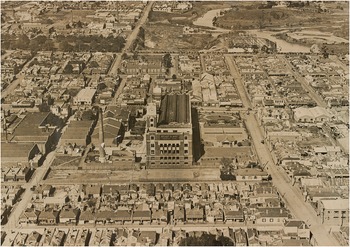
The grandeur of the Australian Bryant & May factory (still standing today) is striking, dominating the local skyline (see Figure 1). Sections of the press quickly claimed it as a victory for the federal tariffs policy. It was heralded by the Bulletin as “a striking monument to the virtues of Protection… The pile is so big that it occupies a whole block, and faces a public thoroughfare on all four sides.”Footnote 44 The Herald described it as conveying “the idea of a residential mansion rather than a factory.”Footnote 45 Designed by the Australian architect William Pitt and built by the Australian Clements Langford (who had built the earlier Bell’s match factory at Burnley fifteen years earlier), it may be understood in part as an expression of national pride and confidence. However, that Bryant & May was prepared to invest so heavily in the construction of this impressive structure—the tender was for £24,000—suggests both the current financial success of this British-based company and a confidence in future profits “at home” and overseas.
Aerial view of the Bryant & May factory in Melbourne, looking east from Green St. Richmond, the Yarra River in the background.
Source: Airspy Photographer, ca. 1930, H2012.195/29, State Library of Victoria, Melbourne.

The year 1909 was a time of general expansion for the firm. At the same time as the chief engineer Charles Rennie was dispatched to supervise the installation of machinery in Melbourne (most of which had been imported from Britain), tenders were coming in for new factory buildings in London.Footnote 46 The naming of the Australian factory as the “Empire Works” must reflect in part the imperial vision of the British firm. Yet it simultaneously allowed for Australian ownership of this vision. When the Glasgow branch of Bryant & May was christened “the Empire Works,” it was constructed as honoring the Australian branch.Footnote 47
Beyond the sheer scale of the building, contemporary observers were impressed by the attention to worker welfare and by its embodiment of modern design principles.Footnote 48 Even before construction began, the Herald reported that this “bold and handsome elevation to Church street” would include “fine large, well-lighted and well-ventilated work-rooms…, spacious dining-rooms for both male and female operatives, lavatories, cloak rooms, and other conveniences.” There would be “electric lifts, fire-proof stairs, and general up-to-date fittings” and a “tower fitted with sprinkler installation for fire extinction.”Footnote 49 In his opening speech, Deakin identified (even as he attempted to close down) possible negative readings of the “big, strong and substantial” building as being similar to “the great buildings of the medieval period … associated with the expression of rule by … tyrannical force and even injustice.” Deakin carefully constructed an image of “dark and confined” interiors “absolutely wanting in all the elements which made for healthy, physical living,” and “the existence of dungeons, which told sorrowful tales of suffering.” This narrative device threw into sharper focus the modern industrial design of the Empire Works:
Here, to-day, they found a condition of things which satisfy the soul of every hygienist in the company. There was light and air, stateliness and cleanliness, and every convenience for the pleasant pursuit of the industry which was now to be carried on.Footnote 50
That the factory was equipped with modern welfare facilities from the start made it notable in Australian industrial development.Footnote 51
As observed in the introduction to this article, Deakin claimed the factory as evidence of national success. He linked Australian modernity intimately to the development of a certain kind of manufacturing. However, this again needs to be placed in a transnational framework of industrial welfarism. Developments in the United States had been picked up but transformed by managers in Britain and were then reimagined when these managers engaged in both imperial and global enterprise that demanded locally specific approaches (themselves influenced by circulating discourses of welfarism). The Melbourne factory adopted the continuous process machinery of its British parent and followed the new industrial welfare then being trialed in London.Footnote 52 Discourses of “modernity” were here linked to an “Empire Works,” rather than, as Ville and Merrett suggest, being “associated with the emerging global power of the United States” and being “contrasted with the older modes … of British imperialism.” If there were “changing loyalties and moods in the wake of [federation],” these were not yet far advanced.Footnote 53 To understand early British manufacturing investment in Australia, we need to look beyond the purely economic decisions made by managers at the center. These decisions were made in social and cultural contexts and through negotiation with a range of individual agents in both the empire and beyond.
Establishing and Sustaining Transnational Management
The success of the Australian subsidiary was ultimately the responsibility of the London-based directors of Bryant & May, and of Bell & Co. (who maintained direct ownership but with Bryant & May the dominant partner). These men needed to establish methods of managing at a distance of some 12,000 miles, including implementing procedures for processing correspondence and accounts. They were, in Fitzgerald’s terms, individual actors making the “actual choices … replete with difficulties.”Footnote 54 An Australian Advisory Committee was set up on October 28, 1909, with Gilbert Bartholomew in the chair (Bartholomew had joined Bryant & May in the 1880s from a London competitor). The first meeting was held at the London offices of Bell & Co., with Bell’s chairman J. Browne-Martin and managing director C. R. E. Bell in attendance alongside George Paton from Bryant & May. Initially, the committee acted in the capacity of managing directors in the absence of a local Australian board. One of its first jobs was to confirm the expenditure to date of £30,950.Footnote 55 These roles had to be renegotiated in order to empower managers in Melbourne, particularly Clarence E. Bartholomew in the first instance, and by November 16, 1909, the title of “Governing Directors” had been adopted explicitly for the London committee members.Footnote 56 The governing directors retained ultimate authority but passed the day-to-day running of the factory into local hands. Bryant & May thus followed the broad pattern Fitzgerald illuminates of adapting to “host market contexts” with “high levels of [local] autonomy.”Footnote 57
In the first few years after the Melbourne branch became operational, the Australasia Advisory Committee met regularly at the Bryant & May Fairfield Works in London, actively handling and commenting (sometimes extensively) on all correspondence, production reports, and minutes from the directors in Australia. This seems to have been a transitional measure; later years reveal only perfunctory entries to record that correspondence and reports from Australia have been received and processed. At the level of management, then, the problems of distance were not insurmountable—although they did require a large measure of trust. The “Advisory” title is significant, for the committee members did not attempt to overturn decisions of the Australian board outright, even where there was clear disagreement. This will become clearer when the crisis years of 1912–1913 are examined. However, an early example of the careful relationship formed between London and Melbourne can be found in negotiations over the name of the firm. While the suggestion of the “Empire Works” had been accepted as the name for the factory, Clarence E. Bartholomew advised against renaming the company “Australian Matches Ltd,” in favor of keeping the old company names to the fore: Bryant & May, Bell & Co. (Pty) Ltd. This hints at existing loyalty to the company brand, which Clarence felt to be more important than attempting to capitalize on nascent Australian nationalism.Footnote 58 The minutes simply record that “it is still felt that if the name ‘Australian Matches Limited’ with the names of the old firms below in brackets, could be found acceptable, this Committee would be glad.”Footnote 59 The directors were not going to force the issue, allowing local managers to take the key decision, but they put their feelings on record. This cautious and somewhat reluctant delegation of responsibility was to characterize future dealings between the committee and the Melbourne board.
The first Australian board in Melbourne consisted of representatives from both the British parent firm and from Australian industry. Clarence E. Bartholomew became a key figure early on, not only becoming one of the first directors but playing a crucial role in establishing the Melbourne business. Employed by Bryant & May from October 1901, he had already traveled widely in the service of the company: first visiting the Diamond Match Co. in America (at the time major shareholders in Bryant & May) in the early twentieth century.Footnote 60 In 1904 he was granted power of attorney to handle the company’s interests in the formation of a South African operation. He left for Australia and New Zealand in October 1908 and was welcomed back to the “Home” firm in April 1909: “The Board expressed their gratification at the safe return of their colleague … from Australia and desired to record their sense of the admirable and successful way in which he had conducted and terminated the negotiations for the establishment of a business there.”Footnote 61 An award of £250 was made in recognition of his services.
By December 1909, Clarence was back in Australia, taking up the appointment of the first managing director of the firm.Footnote 62 This was clearly an interim measure until Australian directors learned the match-making business. Clarence wrote to his father (Gilbert) from Melbourne in 1910 to emphasize that he was “not likely to forget that London is home and headquarters” and that he was “eager to get there” as soon as possible. For Clarence, his business and personal lives were inextricably linked, a situation exacerbated by the demands of his transnational role as he reported back to his father on both the company and his domestic life (including the search for a house back in London): “I’m afraid I have rather muddled up strictly private and personal matters with business things.”Footnote 63 This is a rare and fleeting insight into the everyday performance, by one individual man, of the transactions of an early MNE in Australia.
Present with Clarence E. Bartholomew at the first Australian Board meeting in Melbourne on December 7, 1909, were: John Melbourne Joshua, Robert W. B. Mackenzie, Herbert F. Parsons, and S. W. Philips. Little is known about the background of these men. Before joining the Australian board, Joshua was a wine merchant, Mackenzie was an accountant, and Parsons was a merchant. The only Australian board member with experience in the match business was Philips, who was employed by Bryant & May’s Sydney selling agents. None of the local directors had a financial input into the new firm, and they were each allocated one preference share and 400 ordinary shares to permit them to sit on the board. This nominal shareholding was later cited by critics as evidence that power really lay in London or, even worse, in Chicago through the ownership of the Diamond Match Co. Yet these local directors did not turn out to be local yes-men. The minutes clearly show that that the driving force on the Australian board was Joshua. His influence expanded when Clarence E. Bartholomew returned to London in September 1910.Footnote 64 Notably, Joshua had appeared to give evidence for the distilling industry at the 1905 Tariff Commission, presenting his vision for ensuring better “public appreciation of local spirit.” He used examples from the Canadian distilling industry that had resulted in “hardly any whiskey” being imported.Footnote 65 Bryant & May in Australia was thus being guided by a man with clear ideas about “national” branding of commodities supported through tariffs and government guarantees.
Lower-Level Management and Skilled Workers as Local Agents of Global Capital
Although the local directors may have had experience in the commercial worlds of Melbourne and Sydney, they had no manufacturing or engineering experience. The successful establishment of the local plant depended on men and women sent from England. Plans for the Melbourne factory included the use of modern continuous process techniques, a novelty in Australian manufacturing in the early twentieth century. In June 1909, Charles Rennie was sent out to supervise the building and erection of machinery in Melbourne. Referred to as the “man from the Clyde,” he brought wide experience of the match industry. On his return to London after nearly two years overseas, “The Directors expressed their warm appreciation of Mr Rennie’s devotion and services and it was unanimously resolved that he be paid the sum of Two hundred and fifty pounds as extra remuneration in consideration thereof.”Footnote 66
More important in managing the long-term success of the plant was Andrew F. Ney. With traveling expenses to Australia provided for himself and his family, he was appointed as the first works manager. Ney possessed wide experience in match-making, having been employed by the Diamond Match Co. in Germany, Liverpool, London, and South Africa. He joined Bryant & May when the two companies merged. Ney settled in Australia, moving to the middle-class suburb of Kew. He was to be instrumental in managing the engineering side of the Melbourne firm for almost three decades, until his retirement.
The decision to locate the factory in South Richmond was a rational one in providing access to readily available local labor: skilled and unskilled women and men and juvenile workers. In the 1880s, the southern and lower-lying areas of Richmond had been suburbanized as working-class housing. By 1911 just over a third (34.9 percent) of the households in the south ward of Richmond were headed by unskilled labor, a further 16.9 percent were headed by women (often widows) and 28.5 percent by skilled workers (including engineers and printers, both essential in match-making). Recent historical research has shown that juvenile labor was an essential feature of manufacturing in Melbourne,Footnote 67 and by locating the factory in Richmond, Bryant & May could draw on a ready supply. An overwhelming 71.7 percent of the recruits to Bryant & May between the end of September 1912 and the beginning of November 1912 were recruited from the suburb. A further 11 percent were from the adjoining suburbs of Prahran and Hawthorn, and the remainder were from working-class suburbs of the inner city.Footnote 68
Despite the availability of local female labor, including experienced former employees of Bell & Co., Bryant & May supported (if not demanded) the migration of at least one woman worker from London. This skilled female match worker was tasked with the training of local women on the most up-to-date machinery. The labor migration of women factory workers is still relatively unexplored, despite the existence of a factory scheme within the British Women’s Emigration Society from 1904.Footnote 69 Joy Parr has established the assisted migration of skilled women textile workers to Canada between 1907 and 1928, and Cadbury-Fry-Pascall brought UK workers to its Hobart factory in the early 1920s, but intracompany migrations are typically discussed in reference to the post–World War II era, with women rarely taking part.Footnote 70 The Bryant & May archives offer little evidence of the migration of female workers from Britain; instead it is through the protest of the unhappy migrant herself, Miss Ellen McCarthy, that her existence becomes known. In March 1910, the Argus reported:
She had been engaged under agreement in London and was led to believe that she would earn in Australia double what she had been receiving. … She had to teach the other girls their business. … The firm then paid her 15/ a week. From this sum 3/ a week was deducted to meet … the cost of the girl’s passage money from England … Her board and lodging cost her 10/ a week, so that she had 2/ left with which to clothe herself and most other necessary expenses.Footnote 71
This supports Harper and Constantine’s conjecture that “some and perhaps many single women migrants from the UK felt that their expectations had been falsely raised by those who had recruited them, and complained.”Footnote 72 Clarence E. Bartholomew, the company director, quickly countered these accusations of unfair treatment. In defense of the company’s reputation, he claimed that most workers could earn £1 a week on piecework after only a short time and that the £8 advanced to the girl for her travel expenses had not yet been deducted.Footnote 73
Just days later, Bryant & May management in Australia publicly declared themselves in opposition to the employment of single women migrants from England. Joshua denounced any such scheme as “a blunder and a crime” that he would oppose “through thick and thin.” He continued, “In the interests of morality or decency girls should [not] be introduced into the country without relatives to protect them against the snares that surrounded all girls in that condition of life.”Footnote 74 The skilled male workers and managers who moved at the request of the company inspired no such anxiety.Footnote 75 Moreover, the company was prepared to support not just the men but their families in order to facilitate their resettlement. The stated concerns for female “protection” did not result in any similar levels of support. In the end Ellen McCarthy was a sojourner, and forewomen positions were rapidly given to locals.Footnote 76 From the Australian perspective, women factory workers were one of the least desirable categories of single female migration into the interwar period.Footnote 77 Bryant & May’s contradictory approach to single women migrants can be better understood in this context.
Early Challenges: Production, Insubordination, and Politicking
The optimism that had marked the grand opening of the Empire Works was soon tempered by the daily challenges of running a new manufacturing business in an unfamiliar and distant environment. It was not until March 1912, for example, that the wax department was working to full capacity.Footnote 78 The Australian climate caused (or was at least blamed for) unforeseen problems with both machinery and materials. The heat of the Australian summer mattered.Footnote 79 A letter received by the London governing directors in March 1911 complained, “Owing to the very hot weather which has prevailed the Machines have never had a fair chance to turn out a large product.”Footnote 80 The local board had protested as early as March 1910 that unsatisfactory output was due to poor splints and skillets (boxes) delivered from London. Substandard materials from London were criticized by the Melbourne board into the middle of 1911.Footnote 81
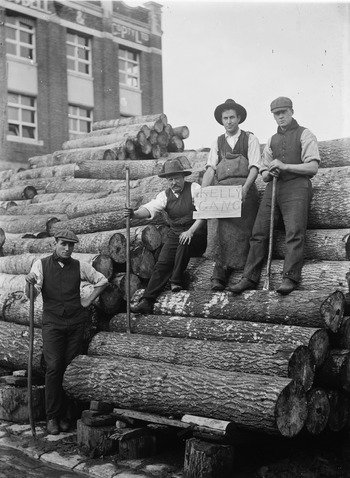
Bryant & May achieved no initial location advantages in acquiring raw materials by manufacturing in Melbourne. The production of the more modern wood matches for Australian consumers required supplies of soft wood, which was sourced from the Baltic (see Figure 2). In October 1911, the Melbourne board minuted a complaint about the quality of European timbers. In August 1912, samples of American white cedar were sent to the factory, and in May 1913, the board discussed the importation of 500 logs of aspen from Japan. The firm was slowly, and reactively, reorienting itself in its new geographic location, searching for alternative raw materials that were closer to hand. By the end of 1913, managers were investigating the use of Queensland hoop pine.Footnote 82 This proved to be a wise move, as the war would cut off supplies from Europe, and a shortage of shipping reduced supplies from Japan.
Four employees of Bryant & May holding crowbars and standing on stacked logs of wood, ca. 1909. Ned Kelly and his gang were notorious Australian outlaws in the 1870s.
Source: H91.20/2, State Library of Victoria, Melbourne.

In a meeting of the London board in July 1911, a serious discussion took place concerning the slow progress being made in Melbourne. The tone toward the Melbourne managers remained nonetheless supportive. Although the Australians were encouraged to “leave no stone unturned” to increase output, the minutes also record that the governing directors “urge[d] the Directors to call upon them for any and every assistance.”Footnote 83 By late 1911, it was clear that further, more direct, personal assistance was needed. The September minutes from Melbourne had attempted to explain the heavy production costs. This included higher costs for materials (cotton, stearine, glue); wages being higher all round (including more people employed); and vesta machines creating lots of waste.Footnote 84 C. R. E. Bell sailed to Australia in early November to advise. While he was still en route, London received notice that fans had been installed in the factory, and this appears to have helped the situation. Before he arrived, the Melbourne directors were congratulated on increased wax vesta production.Footnote 85 By January 1912, Bell was able to send a cablegram to the London directors to reassure them that it would not be necessary to send out a director “from home”—it seemed that the fortunes of the factory were turning around and the governing directors maintained their confidence in the Melbourne managers.Footnote 86 In April 1912, Joshua was appointed chief executive officer, and from this date the Australian manufacturing works appear clearly in local hands.Footnote 87 This was most evident in labor matters and political maneuvers around the tariff.
The factory manager Andrew Ney was a key actor in overcoming technical problems. He took control of the purchase of new machinery and skillfully adapted it to local conditions. He was also an inventor, and the company patented several of his designs for filling machines. In November, the Melbourne board acknowledged the importance of his “personal efforts” and minuted that he would be the subject of “substantial recognition.” At the last meeting of the year, they voted he receive a £50 bonus. When intense work took its toll on his health in 1912, the board provided him with a free trip to Queensland and a gift of £20 for his personal expenses.Footnote 88
The establishment of an overseas manufacturing subsidiary did not mark the end of imports from Britain, whatever the claims made in the opening ceremonies. In response to lower than expected production rates in the first three years, particularly of wooden safety matches, the company’s Sydney-based selling agents (Philips and Pike) turned to the home firms to fulfill local orders. The governing directors were indignant at the expectations placed on their London factories to produce for the Australian market. While the directors in London were generally very careful to maintain good relationships with their fellow directors in Melbourne, the board position of Philips—one of their Australian selling agents—was a source of more overt tension. In July 1911, Philips and Pike complained that profits were being lost due to London failing to fulfill orders sent from Melbourne. The London minutes record rising frustration at being held to blame in this manner: the governing directors “resent this unnecessary comment and put on record the fact that orders sent home have been abnormally heavy … and that shipments from home have been heavier than ever before.” Moreover, the British directors were quick to remind the agents of their place and of the responsibilities of the subsidiary: “The Melbourne Company does not exist to send orders home for Matches, but to produce and supply the requirements of the Market […] if [there is] any failure to make profits it is Melbourne’s fault.” Still, they tempered their critique by reassuring their Melbourne colleagues that they would be very patient in judging delays with production.Footnote 89 Rather than a straightforward transition between selling agency, branch selling, and direct manufacturing, we can see here the sometimes fraught overlapping of different modes of operating in Australia.
The difficult relationship with the agents, especially with Philips as a Melbourne board member, continued into August 1911. Joshua was expected to discipline them when they lowered prices without consultation. A cable from London recorded an unusually angry outburst: “Extremely disappointed annoyed Selling Agents defiance […] We require you call upon Selling Agents admit breach, accept full consequence.”Footnote 90 In reply, Joshua urged the governing directors to reserve judgment until he had looked into the matter personally.Footnote 91 By December 1911, apparently as the result of some urging from London, the “retirement” of Philips as a company director was accepted (though he continued in his role as selling agent).Footnote 92 Even with a local factory site and local directors, the management of selling agents continued to involve an element of uncertainty and risk and no doubt depended on the quality of personal as well as professional relationships.Footnote 93
Alongside production challenges, and frustrations with selling arrangements, workplace relations were far from straightforward. The agency of “ordinary” workers and workplace activists as influencing, and being influenced by, MNE operations is too often missing from the literature.Footnote 94 With the establishment of this major new company, a meeting soon took place at the Melbourne Trades Hall to begin organizing match-making workers for the very first time. On February 21, 1910, the Argus reported, “A largely-attended mass meeting of employees engaged in the matchmaking industry was held … on Friday evening last.” A resolution to form a union was passed unanimously and “[a] provisional committee, consisting of Mr. C. Gray, chairman, Mr. M. Strahan, secretary, Mr. G. Webber, and four girls employed at the industry, was appointed to draw up rules.”Footnote 95 According to the Age, they held their first full meeting on March 2, “and there was a large attendance of girls and young women”. At this point, Gray was elected president and Webber of Richmond became secretary, with “other offices being filled by female members.”Footnote 96 The Victorian Match Workers Union remained in existence until it was absorbed by the Manufacturing Grocers Union in 1920.Footnote 97
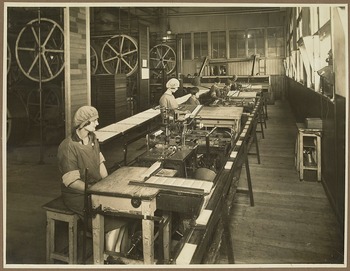
Initially the firm had difficulties with labor discipline. Most young Australian workers were unused to operating continuous process machinery on piece rates (see Figure 3). Turnover was high. A surviving engagement book, dating from January 1910 to November 1912, reveals 38 percent of women left the works within a year of recruitment.Footnote 98 As a backdrop to these labor problems, Alfred Deakin’s government was defeated at the 1910 general election and a new Labor government took office. Deakin had been the father of the “New Protection” policy, under which tariffs would be contingent on the payment of “fair and reasonable wages.” This was undermined in 1908 when the High Court disallowed generous wage increases at the Sunshine Agricultural Implement works of H. V. McKay. Despite Deakin’s pronouncements at the opening of the Bryant & May factory, he made little effort to push “New Protection” before his defeat. The incoming Labor government, with a majority in both the House of Representatives and the Senate, was more determined, and from 1910 industrial relations became a key issue of federal politics.Footnote 99
Women working at machinery to pack matches, Bryant & May, Melbourne, ca.1910–1930.
Source: H92.401/354, State Library of Victoria, Melbourne.

Late in 1911, just as Ney was finally able to report improved production,Footnote 100 a group of female shoulder hands went on strike in protest against their piece rate. Their work entailed placing a white inner cardboard ring within the plaid ring of the wax match box. The existing piece rate was 1s 8d per crate and the shoulder hands demanded 2s—a 20 percent increase. The secretary of the Australian Matchmaker’s Union, G. Webber, interviewed Ney, who in turn asked that the matter stand over for a month. The shoulder hands rejected this and struck on Saturday, November 24, optimistic that in a buoyant labor market they could win their demand. They were indignant at company assertions they could earn 35 shillings per week; at 1s 8d per crate of 4,100 boxes, the strikers claimed “most could not earn more than 23s … and that the majority could earn only 15s to 17s per week.” When the company offered a compromise of 1s 10d, the shoulder employees refused to accept.Footnote 101
The optimism of these workers was misplaced. The company was having difficulty selling all the stock it had on hand and could hold out for three months. In a drive to cut costs, new machinery had been ordered to reduce the labor of shouldering. While only 40 women went on strike, the strikers dislocated other workers who were laid off, and many feared that 400 employees would be stood down. Webber, in negotiations with Ney, undoubtedly learned of the plans to further mechanize the process, and faced with the hostility of other employees, he negotiated a compromise that would accept the rate of 1s 10d per crate. An attempt would be made to find employment for those displaced by the new machinery, and the women would be guaranteed £1 per week as they learnt to work with the new plant. The shoulder hands agreed to call off the strike on Thursday, December 7.Footnote 102 Although they had not achieved all their objectives, these women had demonstrated their capacity to act in defense of their own interests and to disrupt, even if only temporarily, the workings of global capital.
This strike brought into the open the difficulties the local manufacturers faced in selling their matches. The culprit was readily identified as unscrupulous foreign competitors exploiting the preferential tariff by partially manufacturing in England, alongside the inadequacy of the existing tariff. As early as July 1911, the union had sought a joint deputation with the Bryant & May directors to the minister of trade. Although the directors initially rebuffed this offer, in February 1912 the union pointed out that it had “great influence with the [Labor] government” and pushed again for a meeting with the minister. The company acceded to this request under the proviso that discussion would only relate to what “additional hands could be employed and what increases in rates of wages (if any) could be paid by the Company under a Protective Tariff that enabled them to work their plant to its full capacity.” This meeting was held in May and the minister, Frank Tudor, agreed to put the matter to cabinet.Footnote 103
As the year progressed, the company minutes became shriller in condemning “foreign” competition. Through the winter of 1912, many workers faced the harsh reality of unemployment. In February, the average weekly workforce numbered 368; this had been reduced to 227 by July and to 156 by September. In October, the works was essentially closed with an average of only fifty-seven men and women engaged in care and maintenance. As they took this action, the Melbourne directors also resolved that a “policy of utmost possible frankness should be observed in negotiations with the Minister” and accounts and balance sheets were presented to him.Footnote 104 Critics accused Bryant & May of playing politics and castigated the directors for attempting to force the minister’s hand, with an election due in 1913. While this may have been unfair, there is no doubt that the reduction in hands was used as a bargaining tool to renegotiate wage logs. Employees were only gradually rehired; as late as March 1913, only 140 were employed, and it was not until June and July that the size of the workforce became comparable to the pre-lockout complement.Footnote 105
If the directors intended to exert pressure on the Labor government’s tariff policy, they were unsuccessful. They were informed that there could be no revision of the tariff in the current session of parliament. This would have to await an investigation by the Interstate Commission.Footnote 106 Industrially, the lockout was more successful, and all wage logs were renegotiated to the detriment of workers.Footnote 107 In January 1913, the directors observed “that while now [with the Interstate Commission meeting] the time is not yet ripe for any sort of public announcement, the reduction of wages is having an excellent effect in more than one direction.”Footnote 108 The following March, the directors expressed their satisfaction in the “more favourable ratio between the numbers of girls employed and the quantity of vestas produced as compared with previous records.”Footnote 109 The language of “ratios” reveals little of the toll this increased production might have taken on the women workers themselves.
Interstate Commission and Tariffs
The Labor government passed an act late in 1912 to establish an Interstate Commission to investigate industries seeking tariff protection. The commissioners, however, were not appointed before the defeat of Labor in April 1913. When commissioners were appointed by the new Liberal government, rival manufacturers met under the auspices of the Chamber of Manufacturers to set agreed new tariff rates. The commissioners agreed to examine their case in December 1913.Footnote 110 After a visit to the Bryant & May factory, public hearings commenced in February 1914. Both Joshua and Ney gave evidence, suggesting their level of influence in the business community.
Joshua asked the commission for a doubling of the general tariff from 1s to 2s per 144 boxes containing 100 matches and requested that the preferential tariff on the same volume of matches should be raised from 6d to 1s 8d (a tripling of the tariff). He was keen to present the Melbourne works as a viable local industry despite challenging conditions. He argued that improved machinery had reduced production costs. While the number of women operating each machine had been reduced since 1909, the company still employed more than three hundred women, and these young women could earn twice as much on piecework as in other industries. Female factory workers were thus deployed as evidence of the economic benefits of the company. Joshua also argued that the Australians faced greater costs than foreign competitors for timber and testified that they had sought ways to overcome this using Queensland supplies.Footnote 111 Ney, in his evidence, emphasized the higher rates of wages paid by Australian manufacturers—three times the rate prevailing in Germany or England. Noting his wide experience in the industry at home and abroad, he claimed the Richmond works was the “best and most efficient” he had seen.Footnote 112 Ney and Joshua did not go unchallenged, and their rivals raised the suspicion that Bryant & May was not truly an empire works, with real control located in Chicago. Press reports from the fiercely protectionist Age enthusiastically took up insinuations of American interference.Footnote 113
The Interstate Commission released its report on July 7, 1915, determining that the preferential tariff would increase to 80 percent; the tariff for non-empire goods would be 160 percent. The existing tariffs had been 40 percent and 105 percent. This was less than the preferential tariff of 135 percent and general tariff of 210 percent requested by local manufacturers. The commission concluded that the business of Bryant & May and Bell & Co. was principally owned by London interests with Continental shareholders. The implication was clearly that this was not a “local firm” and the local directors were dismissed as “small shareholders who seem to have acquired their shares merely to qualify for the position of director.” There remained the lingering suspicion that real financial control lay with the Diamond Match Co. of the United States, so that decisions about the local operations might be made in “Chicago or London” and “not particularly to the interests of the Australian factory.”Footnote 114 This was not in fact the case, as this article has shown, and the commission still accepted the need for higher tariffs to protect the “local” match industry, which would be to the direct benefit of the Bryant & May subsidiary. Debates over the national identity of firms seem to have been strategic and tactical, given both the complex nature of firm ownership and the lack of any sustained resistance to FDI in Australia before World War I.
Conclusion
The richness of the Bryant & May archives, in both the British and Australian collections, allows us to explore the interaction of the parent and subsidiary firms across time and distance in the five years before the outbreak of war. These years were a period of experimentation in the setting up of a horizontal manufacturing multinational before such practices became commonplace. The transition from relying entirely on selling agents for imported products to producing and selling through a local subsidiary was neither smooth nor complete in this early period. While the cultural, social, economic, and political ties of the British Empire could help to mitigate the very real challenge of geographic distance, a number of challenges still had to be overcome: the operation of factory plant in a hot climate; the difficulties of sourcing appropriate materials; interpersonal tensions between management and agents playing out transnationally; the inexperience and later active resistance of local workers; and a competitive market.
By the time the Interstate Commission published its report, the war had changed the Australian economic and political landscape and reduced imports. This would be to the great advantage of Bryant & May, who saw its sales soar. Annual sales by the Melbourne factory rose from £69,968 in 1913 to £276,239 in 1918.Footnote 115 Foreign firms that had continued to rely on selling agents found themselves rapidly losing ground to “local” manufacturers (including established multinational subsidiaries). Although Bryant & May could not have predicted the war, it fortuitously found itself in an ideal position to deal with the imposed isolation from imports of both raw materials and competing finished goods. The actions of local managers, despite suspicions of American influence, had convinced the Interstate Commission to increase the tariffs in favor of this “local” concern. Even as tariffs were negated by wartime conditions, the authority that the local managers now possessed, coupled with the prewar structures they had developed for sourcing of local supplies of timber and chemicals, placed them in a strong position to run the company successfully through and beyond the conflict. Ironically, the company faced its strongest criticism over “foreign” interference at a moment when its local credentials had improved; it was the closing down of the global economy that allowed this early manufacturing multinational to flourish.
By adopting the methods of cultural history, we have explored how contemporary actors conceptualized the process of establishing Bryant & May in Melbourne through both broadly circulating familiar imperial narratives and the developing discourse of a newly federated nation establishing its economic and political credentials. That the celebrated “Empire Works” could be simultaneously, and relatively unproblematically, conceived as a “local” Australian concern suggests the malleability of the multinational in its broader cultural, social, and political meanings. This was not a “soft” empire market, and company representatives had to work hard to succeed, drawing on the cultural resources at hand to create both a profitable product and a successful corporate identity for the Melbourne branch. Factory workers, organizing themselves into unions, brought their own demands to bear on the operations of the subsidiary, against a backdrop of “new protectionism” that had explicitly linked international tariffs to domestic wages. If we concentrate only on the economic decisions of parent firms in setting up international subsidiaries, we miss how individual managers and workers, politicians, the legal profession, journalists, and the wider community of both “home” and “host” nations, influenced and interpreted the day-to-day operations of MNEs over the longer term.