Implications
Genetic selection to improve growth can lead to earlier sexual maturity in ewes. We assessed whether this affects milk production and growth of their first progeny. Contrary to common belief, we demonstrated that milk production and composition are independent of growth attributes in young ewes and stay within the range reported elsewhere for mature ewes. However, parental genetic merit can result in lambs that are heavier at birth, grow faster and are heavier at weaning. These findings are of great relevance for the sheep industry because they challenge the dogma that Merino ewes lambing at 1 year of age perform poorly.
Introduction
Ewe lambs usually achieve puberty when they attain 50% to 70% of their mature live weight (Hafez, Reference Hafez1952), so phenotypic and genetic factors that improve the rate of growth can advance sexual maturation and subsequent reproductive performance (Rosales Nieto et al., Reference Rosales Nieto, Ferguson, Macleay, Briegel, Martin and Thompson2013a and Reference Rosales Nieto, Ferguson, Macleay, Briegel, Wood, Martin and Thompson2013b). Variation in the rates of accumulation of muscle and fat also affect the outcomes of mating at puberty. Rosales Nieto et al. (Reference Rosales Nieto, Ferguson, Macleay, Briegel, Martin and Thompson2013a and Reference Rosales Nieto, Ferguson, Thompson, Briegel, Macleay, Martin and Thompson2015) observed that an extra 1 mm of eye muscle depth (EMD) was associated with 5.5 extra foetuses per 100 ewes mated, whereas an extra 1 mm of fat was associated with 1.2 extra foetuses per 100 ewes mated.
Breeding ewe lambs at 7 to 9 months of age has a number of advantages (Kenyon et al., Reference Kenyon, Thompson and Morris2014); however, industry adoption of early mating is inhibited by the common belief among sheep producers that ewes should not be mated at 1 year of age because they perform poorly in milk production and lamb rearing ability, and their future reproductive performance will be compromised (Corner et al., Reference Corner, Mulvaney, Morris, West, Morel and Kenyon2013; Edwards and Juengel, Reference Edwards and Juengel2017). Rapid weight gain to puberty is thought to impair mammary gland development, and therefore milk production, because fewer alveoli and increased fat pad area are formed in the mammary gland (Umberger et al., Reference Umberger, Goode, Caruolo, Harvey, Britt and Linnerud1985; McCann et al., Reference McCann, Goode, Harvey, Caruolo and Mann1989). Ewes giving birth for the first time produce less milk than older ewes (Bencini and Pulina, Reference Bencini and Pulina1997), but this could simply be because heavy ewes produce more milk than light ewes (Bencini and Pulina, Reference Bencini and Pulina1997). Therefore, any improvement in the rate of accumulation of muscle and fat in young ewes, leading to early first mating, could also improve their milk production in their first lactation. On the other hand, there is a negative relationship between milk quantity and quality (Bencini and Pulina, Reference Bencini and Pulina1997), so improvements in growth might adversely affect milk fat and protein concentrations.
These are important considerations in our quest to accelerate the onset of puberty by increasing the rate of muscle accumulation. Milk production is an important component of the rearing ability of ewe and a major limiting factor in the productivity in breeds with low milk-producing potential such as the Merino (Snowder and Glimp, Reference Snowder and Glimp1991). The genotype of the lamb has also been shown to affect the amount of milk produced by their mothers, possibly due to a relationship between lamb birth weight and maternal milk production (Pulina et al., Reference Pulina, Bencini and Rassu1996). As has been previously shown, lambs that are heavier at birth growth faster are consequently heavier at weaning (Rosales Nieto et al., Reference Rosales Nieto, Meza-Herrera, Moron Cedillo, Flores Najera, Gámez Vázquez, Ventura Pérez and Liu2016). However, the expression of their genetic potential for growth can be influenced, independently of their sex, birth and rear type, by external factors such as environmental conditions and the plane of nutrition of the dams (Kenyon et al., Reference Kenyon, van der Linden, Blair, Morris, Jenkinson, Peterson, Mackenzie and Firth2011; Corner-Thomas et al., Reference Corner-Thomas, Hickson, Morris and Kenyon2014).
In addition to restricting lamb growth, failure to produce sufficient high-quality milk, in extreme cases, can cause lamb mortality, with twin-born lambs being at most risk (Coop et al., Reference Coop, Clark and Claro1972). After the 1st month, lambs increasingly consume solid foods (Lane et al., Reference Lane, Baldwin and Jesse2000), but milk continues to be important and can determine as much as 70% of their growth up to 12 weeks of age (Doney et al., Reference Doney, Smith, Sim and Zygoyannis1984), although post-weaning compensatory growth can overcome some set-backs in twin-reared progeny (Thompson et al., Reference Thompson, Ferguson, Campbell, Gordon, Kearney, Oldham and Paganoni2011). It is therefore not surprising that there is a strong genetic correlation between maternal milk production and the growth rate of the progeny (Afolayan et al., Reference Afolayan, Fogarty, Morgan, Gaunt, Cummins and Gilmour2009a).
We tested whether in ewes lambing at 1 year of age, milk production and composition and the growth of their first progeny, are influenced by their phenotypic and genotypic values for growth and accumulation of muscle and fat (EMD, fat depth (FAT), post-weaning weight (PWT), post-weaning depth of eye muscle (PEMD), post-weaning fat (PFAT)) in their first parity.
Material and Methods
Experimental location and animals
The Merino ewe lambs (n=136) were born on a commercial farm (‘Moojepin’) in August to September 2009 to dams that had been sourced from two Western Australian ram breeding flocks (‘Merinotech WA’ and ‘Moojepin’) and mated to sires with a wide range in Australian Sheep Breeding Values (ASBV) for growth, muscle and fat.
The ewe lambs were transported to Medina Research Station (32.2°S, 115.8°E) in February 2010 where the experiment was conducted. When they were 164 days old (range 134 to 176) and 251 days old (range 221 to 263), we measured the depths of the longissimus dorsi muscle and subcutaneous fat at a point 45 mm from the midline over the 12th rib using ultrasound (Medison SA600V®; Samsung Medison, Seoul, Korea). The probe was placed at the C-site (45 mm from the back line), at the 12th to 13th rib, and perpendicular to the eye muscle. The probe therefore generated a cross-sectional image of the muscle, the cross-section of which was used to generate phenotypic values for ‘EMD’ (range 20 to 33 mm), in addition to a measure of FAT (range 2 to 8 mm). The data were also submitted to MERINOSELECT (Brown et al., Reference Brown, Huisman, Swan, Graser, Woolaston, Ball, Atkins and Banks2007) for estimation of ASBVs at PWT (range 0 to 9 kg), PEMD (range 0 to 2.6 mm) and PFAT (range 0 to 1.2 mm).
Animal management and feeding
On May 4, when the ewes were 249 (range 219 to 261) days old and weighed 41±0.5 kg, they were given a 1 ml intramuscular injection of supplement of vitamins (vitamin A 500 000 IU; vitamin D3 75 000 IU, vitamin E 50 IU/ml; VetADE®, Bayer, Auckland, New Zealand) and were allocated to nine management groups of 15 (3×7 m indoor pens), on the basis of live weight and prospective mating sire. They had ad libitum access to clean water and to dietary pellets that contained barley, wheat and lupin grains, cereal straw and hay, canola meal, minerals and vitamins and had been formulated to provide 11.5 MJ of metabolizable energy per kg dry matter, 15% CP and minerals to meet the daily requirements for maximum growth (Macco Feeds, Australia). An experienced Merino ram was introduced into each group and was removed after 47 days. Merino sires were selected with a wide range in ASBV for growth (PWT 3.0 to 6.7), muscle (−0.9 to +2.9) and fat (0 to 1.3) from seven different sources across Australia. The number of individual sires from each source varied from 1 to 4. This diversity in genetic merit is reflected in the range in ASBVs of the progeny.
Progeny and milking
Pregnancy and number of foetuses were confirmed by ultrasound scanning 60 days after the rams were removed and non-pregnant ewes were removed from the pens. Thus, pregnant ewes were allocated within the 15 pens (5 to 6 ewes/pen). During October, 82 ewes lambed and we recorded birth type (single or twin), birth weight and sex of the lambs within 24 h. In November, 75 ewes of the 82 lambing ewes were allocated to four milk sampling groups, on the basis of lambing date, to determine milk production and composition. The rest of the lambing ewes were not milk sampled due to the age of their lambs (<20 days of age). In order to not compromise the growth and development of the progeny the dams were milked near the peak period of lactation in Merino (Bencini and Purvis, Reference Bencini and Purvis1990; Bencini et al., Reference Bencini, Hartmann and Lightfoot1992) on a single occasion when the lambs were on average 20 days old using the method developed by McCance (Reference McCance1959) and refined by Bencini (Reference Bencini1995). In brief, the ewes were drafted from the lambs, penned separately and then walked onto a mobile milking platform that accommodated eight ewes at a time. Whilst on the platform, they were offered pellets ad libitum. To elicit milk let-down, the ewes were given an intramuscular injection of 1 IU synthetic oxytocin (Ilium Syntocin, Troy Laboratories, Australia) and, after 1 min, they were milked with a DeLaval bucket milking system (DeLaval Australia) operating at a vacuum pressure of 40 kPa and a pulsation rate of 100/min. The time of the first milking was recorded. The ewes remained in their group of eight and were re-milked ~4 h later, in the same order as the initial milking, following the same protocol. The weight of the milk collected at the second milking and the time between milkings were recorded to obtain an estimate of milk production per day. A sample (10 ml) of milk from each ewe was preserved with 0.6 mg/ml potassium dichromate and then frozen until analysis of milk composition. After the second milking, the lambs and the ewes were reunited in their pen. Milk composition was determined using a Milko Scan 133 (Foss Electric, Hillerød, Denmark) that had been calibrated for sheep milk.
Ewes and lambs remained at Medina until the lambs were on average 40 days old when they were moved to the university farm near Pingelly (32.2°S, 115.8°E) were they had access to clean water and were provided with ad libitum oaten hay (9 MJ/kg and 9% protein) plus sheep pellets (11.5 MJ/kg and 15% protein). Lambs were weighed weekly from birth to weaning (at 10 weeks of age) and the live weight data were used to calculate the live weight gain.
Data analyses
Data for estimated daily milk production and milk composition (fat, protein, lactose, total solids) were analyzed using linear mixed model procedures and estimation technique of restricted maximum likelihood (PROC MIXED) using SAS v. 9.3 (SAS Institute, 2010). Fixed effects were age and source of the dam of the mothers, birth type of the mothers, and birth and sex type of the progeny. Depth of eye muscle, FAT, PWT, PEMD, PFAT of the mothers, PWT, PEMD, PFAT of the sire of the mothers, milk fat, protein, lactose and total solids were included independently as covariates. The identity of the sire of the mother was used as a random effect.
Progeny birth weight and weight at weaning were analyzed using the linear mixed model procedures and estimation technique of restricted maximum likelihood (PROC MIXED). Fixed effects were age and source of the dams of the mothers, birth type of the mothers, and birth and sex type of the progeny. Depth of fat and EMD of the mother of the progeny, PWT, PEMD and PFAT values of the mother and sire of the progeny were included independently as covariates. The identity of the sire of the progeny was used as a random effect.
Maternal live weight change during pregnancy and live weight gain from birth to weaning was determined for each ewe/lamb using a random coefficient regression including a cubic smoothing spline for time (TRANSREG). Live weight gain data were analyzed using linear mixed model procedures and the estimation technique of restricted maximum likelihood (PROC MIXED). For maternal live weight change, fixed effects were age and source of the dam of the mothers, birth type of the mothers, and birth and sex type of the progeny. For the progeny live weight gain, fixed effects were sire of the progeny and birth and sex type of the progeny. Birth weight, FAT and EMD of the mother of the progeny, PWT, PEMD and PFAT values of the mother or sire of the progeny were included independently as covariates. Identity of the sire of the progeny was included as a random effect.
All two-way interactions among the fixed effects were included in each model and non-significant (P>0.05) interactions were removed from the final model.
Results
Milk production and composition
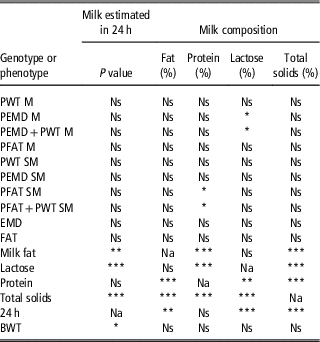
The amount of milk produced by mothers suckling lambs born and reared as singles was ~30% lower than that produced by sheep with twin lambs (P<0.05), but there was no difference in production between mothers suckling ewe lambs and ram lambs (P>0.05; Table 1). Milk production was positively associated with the concentrations of milk fat (P<0.01), lactose (P<0.001) and total solids (P<0.001), and was negatively associated with the birth weight of the progeny (P<0.05), but not associated with the milk protein concentration, EMD, FAT, PWT, PEMD and PFAT of the mother, nor the PWT, PEMD, PFAT of the sire of the mother (P>0.05; Table 2).
Milk production and composition for Merino sheep that nursed single or twin lambs and female or male lambsFootnote 1

1 Time point for estimation of milk production and composition was 20 days after birth.
2 For the number of lambs nursed, data are combined for males and females.
3 For sex of lambs, data are combined for single-born reared and twin-born reared.
*P⩽0.05; Ns P>0.05.
Positive and significant relationships between genotype (PWT, PEMD, PFAT) and phenotype (EMD, FAT) of the mother (M) or sire of the mother (SM) and birth weight (BWT) of the progeny, and milk production and milk composition, as revealed by fitting mixed-effect models to the dataFootnote 1

PWT=post-weaning weight; PEMD=post-weaning eye muscle depth; PFAT=post-weaning fat depth; EMD=eye muscle depth; FAT=fat depth; Na=not applicable.
1 Milk production and composition were estimated 20 days after birth; weight (PWT of the mother or sire of the mother) was included in the statistical analyses.
*P⩽0.05; **P⩽0.01; ***P⩽0.001; Ns P>0.05.
The average concentration of fat in milk was 4.05±0.14%. This did not differ between mothers born as singles or twins (P>0.05; 4.13±0.2% for singles and 3.85±0.3% for twins) or for mothers suckling single or twin lambs (P>0.05), or suckling ewe or ram lambs (P>0.05; Table 1). Milk fat concentration was positively associated with milk protein (P<0.001), total solids (P<0.001) and milk production (P<0.01), but milk fat concentration was not associated with the PWT, PEMD, PFAT, EMD and FAT of the mother, nor the PWT, PEMD, PFAT of the sire of the mother, nor the birth weight of the progeny (P>0.05; Table 2).
The average concentration of protein in milk was 4.1±0.04%. It did not differ between mothers born as singles or twins (P>0.05; 4.12±0.05% for single and 4.1±0.08% for twin), between mothers suckling single or twin lambs (P>0.05) or mothers suckling ewe or ram lambs (P>0.05; Table 1). Milk protein concentration was positively associated with milk fat (P<0.001), lactose (P<0.001) and total solids (P<0.001), and negatively associated with PFAT of the sire of the mother (P<0.05), but not related to EMD, FAT, PWT, PEMD and PFAT of the mother, or PWT and PEMD of the sire of the mother, or the birth weight of the progeny (P>0.05; Table 2).
The average concentration of lactose in milk was 5.47±0.03% and it did not differ (P>0.05) between mothers born as singles (5.47±0.03%) or twins (5.48±0.06%), or between mothers suckling single or twin lambs (P>0.05) or between mothers suckling ewe or ram lambs (P>0.05; Table 1). Lactose concentration was positively associated with milk production (P<0.001), protein (P<0.01) and total solids (P<0.001) and negatively associated with the PEMD of the mother (P<0.05). Lactose concentration was not affected by milk fat, PWT, PFAT, EMD and FAT of the mother, or PWT, PEMD and PFAT of the sire of the mother, or the birth weight of the progeny (P>0.05; Table 2).
The average total solids content was 14.39±0.17% and, as with the other milk components, it did not differ for mothers born as singles or twins, mothers suckling single or twin lambs, or mothers suckling ewe or ram lambs (P>0.05; Table 1). Total solids were positively associated with milk fat (P<0.001), lactose (P<0.001), protein (P<0.001) and milk production (P<0.001), but not associated with PWT, PEMD, PFAT, EMD and FAT of the mother, nor the PWT, PEMD and PFAT of the sire of the mother, nor the birth weight of the progeny (P>0.05; Table 2).
Maternal live weight change and progeny performance
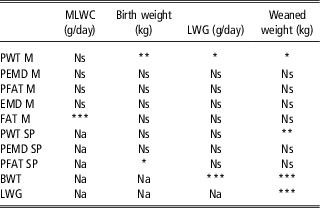
The average maternal live weight change during pregnancy was 93±3 g/day (range 18 to 201). Maternal live weight change during pregnancy was not affected by the sex or birth type of the progeny (Table 3). Maternal live weight change during pregnancy did not influence milk production or composition (fat, protein, lactose, total solids) or birth weight, live weight gain and weaning weight of the progeny (P>0.05). Maternal live weight change during pregnancy was positively associated with greater values for FAT (P<0.01), but not associated with the PEMD, PFAT, PWT and EMD (P>0.05; Table 4).
Maternal live weight change during pregnancy and development from birth to weaning (birth weight, live weight gain and weaning weight) in lambs born and raised as singles (1-1), born and raised as twins (2-2) or born as female or male

1 Data are combined from male and female lambs.
2 Data are combined for single and twin birth-rear types.
**P⩽0.01; ***P⩽0.001; Ns P>0.05.
Positive and significant effects of genotype (PWT, PEMD, PFAT) and phenotype (EMD, FAT) of the mother (M) or sire of the progeny (SP), and progeny birth weight (BWT) and live weight gain (LWG), on maternal live weight change during pregnancy (MLWC), birth weight, live weight gain (LWG) and weaned weight of the progeny, as revealed by fitting mixed-effect models to the data

PWT=post-weaning weight; PEMD=post-weaning eye muscle depth; PFAT=post-weaning fat depth; EMD=eye muscle depth; FAT=fat depth; Na=not applicable.
*P⩽0.05; **P⩽0.01; ***P⩽0.001; Ns P>0.05.
The average birth weight of the progeny was 4.5±0.09 kg (range 2.7 to 7 kg). On average, at birth, singles were about 1 kg heavier than twins (P<0.001) and ram lambs were about 0.5 kg heavier than ewe lambs (P<0.05; Table 3). Birth weight of the progeny was positively associated with their mothers PWT (P<0.01), but not associated with PEMD, PFAT, EMD and FAT of the mother, nor the PWT, PFAT and PEMD of the sire (P>0.05; Table 4).
The average live weight gain of the progeny was 205±5 g/day (range 77 to 340 g/day). On average, lambs born and reared as singles grew 28% faster than those born and reared as twins (P<0.001) and ram lambs grew 6% faster than ewe lambs (P>0.05; Table 3). Live weight gain of the progeny was positively associated with birth weight (P<0.001), with greater values for PWT (P<0.05) in both the mother and the sire of the mother (P<0.05), but not associated with the PEMD, PFAT, EMD and FAT of the mother, nor the PEMD and PFAT of the sire of the mother (P>0.05; Table 4).
The average weaning weight of the progeny was 24±0.6 kg (range 13 to 39). Lambs that were born and reared as singles were heavier than lambs born and reared as twins (P<0.001) but, at weaning, ram lambs were not heavier than ewe lambs (P>0.05; Table 3). Weaning weight of the progeny was positively associated with birth weight (P<0.001), live weight gain (P<0.001), and values for PWT of the mother (P<0.05) and of the sire of the mother (P<0.01). However, the weaning weight of the progeny was not associated with the PEMD, PFAT, EMD, FAT of the mother, or with the PEMD and PFAT of the sire of the mother (P>0.05; Table 4).
Discussion
Ewes with greater values for their own weaning weight produced lambs that were heavier at birth, gained weight faster and ended up with a heavier weaning weight. For the progeny of the young ewes, a heavier birth weight was positively associated with faster live weight gain and heavier weight at weaning. In addition, we expected the phenotypic and genotypic values for body mass accumulation to affect the milk output of young, primiparous Merino ewes, but the amount of milk produced and the milk concentrations of fat, protein, lactose and total solids were not related to any of the maternal phenotypic and genotypic factors for growth or accumulation of muscle or fat. This is very relevant to the sheep industry due to the fact that heavier ewe lambs attain puberty sooner and are more fertile than lighter ewe lambs (Rosales Nieto et al., Reference Rosales Nieto, Ferguson, Macleay, Briegel, Martin and Thompson2013a and Reference Rosales Nieto, Ferguson, Macleay, Briegel, Wood, Martin and Thompson2013b). Therefore, our results clarify the dogma and perception of most producers that Merino ewes should not be mated at 1 year of age; because our findings indicate that milk production and composition and lamb growth are not affected by genetic selection for rapid growth or more accumulation of muscle and fat and early mating in Merinos.
The quantity of milk produced by the young mothers in the current experiment was within the range observed in mature Merino ewes (Bencini and Purvis, Reference Bencini and Purvis1990); but milk production and composition did not differ with phenotype or genotype for growth and muscle and fat accumulation. A lack of difference in milk composition among phenotypes and genotypes has been reported previously (Torres-Hernandez and Hohenboken, Reference Torres-Hernandez and Hohenboken1980; Bencini and Purvis, Reference Bencini and Purvis1990; Snowder and Glimp, Reference Snowder and Glimp1991). The maternal breeding values used in the present study included genetic as well as phenotypic components, and, for the detection of genetic differences, large data sets are often necessary so the present study could have been handicapped by sample size. The sample size in the present experiment smaller than planned because fertility was lower than expected and lambing dates were not fully predictable. Nevertheless, for the variables tested, 75 animals seems to have been sufficient, judging from observations (reported below) of the effect of breeding values for growth in the parents on the performance of their progeny. On the other hand, we should interpret the outcomes with caution until the completion of another study with more experimental animals.
Although, maternal live weight change during pregnancy did not influence milk production or composition, we did observe an increase in milk production and in the concentrations of critical milk components with selection of ewe lambs for merit for rapid growth and accumulation of muscle and fat; therefore, these two milk-related variables are not reduced by improvements in growth.
These results extend the results observed by Snowder and Glimp (Reference Snowder and Glimp1991), Bencini and Pulina (Reference Bencini and Pulina1997) and Paten et al. (Reference Paten, Pain, Peterson, Lopez-Villalobos, Kenyon and Blair2017) indicate that heavy ewes produce more milk than do their lighter counterparts. However, our results are in disagreement with Umberger et al. (Reference Umberger, Goode, Caruolo, Harvey, Britt and Linnerud1985) and McCann et al. (Reference McCann, Goode, Harvey, Caruolo and Mann1989) who observed that accelerated growth affected mammary development and milk production in ewes lambing at 13 months of age. Indeed, the maternal live weight change reported in this study in Merino ewe lambs on average was 92 g/day; whereas Umberger et al. (Reference Umberger, Goode, Caruolo, Harvey, Britt and Linnerud1985) in Suffolk and crossbred ewes reported maternal live weight change up to 200 g/day and McCann et al. (Reference McCann, Goode, Harvey, Caruolo and Mann1989) in Suffolk and Dorset ewes reported maternal live weight change up to 369 g/day. It is evident, that despite the genetic selection for growth or accumulation of muscle and fat, breed differences in growth and mammary development exists. Nevertheless, our results indicate that Merino producers can select animals for rapid growth and mating at 1 year of age without compromising milk production and composition. Moreover, ewe lambs that display greater genetic merit for rate of muscle accumulation present better carcasses as well as early puberty and greater fertility (Rosales Nieto et al., Reference Rosales Nieto, Ferguson, Macleay, Briegel, Martin and Thompson2013a, Reference Rosales Nieto, Ferguson, Macleay, Briegel, Wood, Martin and Thompson2013b and Reference Rosales Nieto, Ferguson, Thompson, Briegel, Macleay, Martin and Thompson2015).
There are few and contrasting reports on the effect of number of lambs suckled on the composition of the milk. Our results confirmed that the composition of milk did not differ between ewes suckling singles and ewes suckling twins as previously observed (Snowder and Glimp, Reference Snowder and Glimp1991; Afolayan et al., Reference Afolayan, Fogarty, Morgan, Gaunt, Cummins, Gilmour and Nielsen2009b). Moreover, several reports indicate a variation in the composition of the milk among genotypes rearing single or twin lambs (Gardner and Hogue, Reference Gardner and Hogue1964 and Reference Gardner and Hogue1966; Snowder and Glimp, Reference Snowder and Glimp1991). This could be explained by the negative relationship between production and composition of milk (Bencini and Pulina, Reference Bencini and Pulina1997). Hence, the results obtained in our experiment may be due to the fact that samples were collected in early lactation, whereas the differences between ewes suckling singles and ewes suckling twins increases as lactation progresses.
Despite the lack of effects on milk production and quality, the breeding values for growth in the parents affected progeny performance. Superior breeding values for birth weight and growth in both dam and the sire are likely to improve their progeny in terms of birth weight, live weight gain and weaning weight, as reported previously (Yates and Pattie, Reference Yates and Pattie1970; Oldham et al., Reference Oldham, Thompson, Ferguson, Gordon, Kearney and Paganoni2011; Paganoni et al., Reference Paganoni, Ferguson, Kearney and Thompson2014). It is clear that the major factors affecting lamb growth in the first 8 weeks are birth weight and genetic background, in addition to the milk produced by the mother and the solid feed (Lane et al., Reference Lane, Baldwin and Jesse2000) that may be consumed after the 4th week of age, but, probably, not the quality of the milk produced (Rosales Nieto et al., Reference Rosales Nieto, Meza-Herrera, Moron Cedillo, Flores Najera, Gámez Vázquez, Ventura Pérez and Liu2016). Hence milk composition, whether it is fat, protein, lactose or total solids may not be a limiting factor to lamb growth, whereas the whole amount of milk and genetic background are important for lamb growth.
We are aware that there are many different factors affecting milk production and composition (e.g. stage of lactation; Casoli et al., Reference Casoli, Duranti, Morbidini, Panella and Vizioli1989; see Bencini and Pulina, Reference Bencini and Pulina1997; Oravcová et al., Reference Oravcová, Margetín, Peškovičová, Daňo, Milerski, Hetényi and Polák2007) and that our choice of measuring milk production only once at day 20 in the course of the lactation, near the peak of lactation (Bencini and Purvis, Reference Bencini and Purvis1990; Bencini et al., Reference Bencini, Hartmann and Lightfoot1992), may have compromised our results. However, a single milk sampling still provided an indication on the potential for milk production and quality of a breed, the Merino, that has low milk production merit and ewes that lambed for the first time aged 1 year. For logistical and financial reasons it was not possible to conduct regular milk sampling in these ewes and up to now, neither a single time point nor multiple time points have been reported for estimation of milk production and composition in Merino ewes that lambed for the first time aged 1 year. The fact that single and ram lambs grew faster and were heavier at weaning than twin and ewe lambs suggests that the chosen timing of the milking (20 days postpartum) did not truly reflect the amount of milk available to the lambs from birth to weaning. Moreover, lambs will start to nibble on solid food soon after birth; therefore, it is possible that the growth and live weight gain of the lambs may have been influenced by differences in the consumption of solid food on which we have no data. However, Lane et al. (Reference Lane, Baldwin and Jesse2000) reported that lambs consuming solid feed grew faster than lambs consuming milk replacer after 49 days of age, but no differences were found before this age (49 days). Nevertheless, attention to the quality and quantity of solid food available will be a key factor to ensure maximum lamb growth, especially in twin bearing ewes, because the milk available to each twin suckling lamb is less than that available to single suckling lambs.
In conclusion, our results provide some evidence to challenge the dogma that ewes should not be mated at 1 year of age because ewes selected for growth and accumulation of muscle and fat mated at 1 year of age did not seem to have lower milk production or worse milk composition in their first lactation. The genetic merit of the ewe resulted in lambs that were heavier at birth, grew faster and were also heavier at weaning suggesting that, ewes can lamb at 1 year of age without affecting the objectives of the Merino sheep industry.
Acknowledgements
César A. Rosales Nieto was supported by CONACyT (the Mexican National Council for Science and Technology) during his doctoral studies. The research was funded by the Department of Agriculture and Food of Western Australia, the Cooperative Research Centre for Sheep Industry Innovation, and the UWA School of Animal Biology.
Declaration of interest
The authors declare that they have no conflict of interest.
Ethics statement
This work was done in accordance with the Australian Code of Practice for the Care and Use of Animals for Scientific Purposes (NHMRC, 2004) and was approved by the Animal Ethics Committee of the Department of Agriculture and Food, Western Australia (09KA03).
Software and data repository resource
The data presented in the manuscript are not deposited in an official repository.