Introduction
Auditory verbal hallucinations (AVHs) of spoken speech or ‘voices’ are reported by 60–80% of persons with schizophrenia (Mueser et al. Reference Mueser, Bellack and Brady1990; Andreasen & Flaum, Reference Andreasen and Flaum1991). AVHs are associated with high levels of distress (Nayani & David, Reference Nayani and David1996; Birchwood et al. Reference Birchwood, Gilbert, Gilbert, Trower, Meaden, Hay, Murray and Miles2004; Trower et al. Reference Trower, Birchwood, Meaden, Byrne, Nelson and Ross2004), functional disability (Olfson et al. Reference Olfson, Lewis-Fernandez, Weissman, Feder, Gameroff, Pilowsky and Fuentes2002) and behavioral dyscontrol (Hersch & Borum, Reference Hersch and Borum1998; Swanson et al. Reference Swanson, Swartz, Van Dorn, Elbogen, Wagner, Rosenheck, Stroup, McEvoy and Lieberman2006), and remain poorly or incompletely responsive to currently available treatments in approximately 25% of cases (Shergill et al. Reference Shergill, Murray and McGuire1998).
A more precise characterization of experiential characteristics of AVHs may provide insights into underlying mechanistic processes. For instance, previous surveys of patients' experience of AVHs concluded that the sensation of hearing was a crucial feature (Aggernaes, Reference Aggernaes1972; Leudar et al. Reference Leudar, Thomas, McNally and Glinski1997; Garrett & Silva, Reference Garrett and Silva2003), with components of sound perception such as loudness, vividness and acoustic clarity contributing to their felt sense of reality (Hustig & Hafner, Reference Hustig and Hafner1990; Leudar et al. Reference Leudar, Thomas, McNally and Glinski1997). These observations support models of AVHs postulating activation involving the auditory cortex or adjacent cortical areas (David, Reference David, David and Cutting1994; Dierks et al. Reference Dierks, Linden, Jandl, Formisano, Goebel, Lanfermann and Singer1999; Hubl et al. Reference Hubl, Koenig, Strik, Garcia and Dierks2007), or corollary discharge failures causing disinhibition of sensory qualities of inner speech (Feinberg & Guazzelli, Reference Feinberg and Guazzelli1999; Ford et al. Reference Ford, Roach, Faustman and Mathalon2007). Phenomenological surveys have also found that AVHs are often (though not inevitably) cast in speaking voices of specific, non-self speakers with distinct gender and timbre (Nayani & David, Reference Nayani and David1996; Leudar et al. Reference Leudar, Thomas, McNally and Glinski1997; Garrett & Silva, Reference Garrett and Silva2003). These additional sound features may also prompt patients to label these experiences as voices (Hunter et al. Reference Hunter, Griffiths, Farrow, Zheng, Wilkinson, Hegde, Woods, Spence and Woodruf2003). AVHs are often experienced as occurring involuntarily (Aggernaes, Reference Aggernaes1972; Garrett & Silva, Reference Garrett and Silva2003), which is consistent with ectopic activation models (Hoffman & McGlashan, Reference Hoffman and McGlashan1993, Reference Hoffman and McGlashan1997; David, Reference David, David and Cutting1994) or misattribution explanations of AVHs, where ordinary inner speech or verbal thought are mislabeled as non-self (Johns & McGuire, Reference Johns and McGuire1999). Distinctive verbalized content may also be important in characterizing AVHs. Along these lines, Nayani & David (Reference Nayani and David1996) reported that voices often express characteristic content such as dialogues about the patient, and commands and vulgarities that are not typical of his or her ordinary verbal thought. Mechanistic models of AVHs based on attractor states co-opting language neurocircuitry (Hoffman & McGlashan, Reference Hoffman and McGlashan1993, Reference Hoffman and McGlashan1997) and pathological retrieval of verbal memories (Copolov et al. Reference Copolov, Seal, Maruff, Ulusoy, Wong, Tochon-Danguy and Egan2003) predict that verbal content of these hallucinations will be repetitive across instances, which may be another experiential feature used by patients to identify verbal representations as voices.
The present study was designed to address questions raised by these phenomenological considerations. First, at times we seem to experience our own thought content as having sound characteristics. For instance, one can willfully imagine verbal imagery ‘cast’ in a louder voice or in a non-self speaking voice. Therefore, sensory characteristics may not necessarily differentiate voices from ordinary thought. Second, it is unclear whether involuntariness is a significant factor in identifying voices, given that much of our ordinary verbal thought seems to occur spontaneously rather than being specifically intended (Hoffman, Reference Hoffman1986; Dennett, Reference Dennett1991). Moreover, some patients may be able to exert at least partial control of their voices (Nayani & David, Reference Nayani and David1996). Third, the degree to which verbal content is distinct from ordinary self-talk or inner speech is also uncertain, given that the content of AVHs can consist of commentary regarding ongoing actions that suggests the self-monitoring of ordinary inner speech (Leudar et al. Reference Leudar, Thomas, McNally and Glinski1997). Fourth, it is possible that verbal thoughts of patients with schizophrenia also tend to repeat content. Fifth, it remains possible that some patients report experiencing voices simply because they rarely experience thoughts in a verbal form (as ‘words’); the few instances when their thoughts assume a verbal form may then come to be labeled as voices. In light of these questions, we administered a survey to systematically question patients with schizophrenia-spectrum disorders regarding their proneness to differentiate their voices from their everyday thoughts and the experiential features they used to make this distinction.
Method
Fifty patients with AVHs diagnosed with active schizophrenia or schizo-affective disorder based on SCID-I/P (version 2.0; First et al. Reference First, Spitzer, Gibbon and Williams1995) criteria were administered a questionnaire pertaining to the voices they reported hearing. All patients experienced at least five AVH events per day. The questionnaire was administered as an interviewer-guided patient self-report in the sense that the patients themselves selected responses following a discussion of each question. The questionnaire was a component of a larger assessment battery administered for patients enrolled in clinical trials of repetitive transcranial magnetic stimulation (rTMS) at the Yale site (n=45; Hoffman et al. Reference Hoffman, Gueorguieva, Hawkins, Varanko, Boutros, Wu, Carroll and Krystal2005, Reference Hoffman, Hampson, Wu, Anderson, Gore, Buchanan, Constable, Hawkins, Sahay and Krystal2007), or as part of a medication trial at the National Institute of Mental Health (NIMH; n=5). All patients gave written, informed consent to participate in these studies.
For all patients, the purpose of the questionnaire was described as one of the ways researchers might come to better understand the nature of voice experiences and how these experiences differ from ordinary verbal thought or ‘self-talk’. The questionnaire is reproduced in the Appendix.
Patients were first asked for an open-ended description of the voices they heard. Data gathering focused on frequency of voices, characteristic phrases and/or sentences, and verbatim examples whenever possible. Next were two questions to determine: (a) whether patients could distinguish the voices from their own ordinary thoughts and (b) to what degree their thoughts were composed of words.
Patients were subsequently asked to respond to scaled items regarding the importance of six characteristics in telling the difference between their voices and their ordinary verbal thoughts. The first characteristic was the sound of the speaking voice. Our expectation was that ordinary verbal thought either has no acoustic voice characteristics or is ‘cast’ in the speaking voice of the self (David, Reference David, David and Cutting1994), whereas AVHs are often reported to have speaking voices of non-self speakers. The second and third characteristics were subjective loudness and clarity of AVHs. Our expectation was that subjective ratings of loudness and clarity of ordinary thought would be very difficult to determine reliably in an absolute sense. Therefore, we asked only if loudness and clarity of voices were greater than ordinary verbal thought. The fourth characteristic was sense of control. The fifth characteristic was verbal content. The sixth characteristic was degree of repetition of verbal content.
After administering the questionnaire to the first few patients, we noted that it was useful to have patients describe their first experience of ‘voices’, which could often be provided in detail, in order to better determine how these experiences departed from ordinary verbal thoughts. Additional questions were added to the questionnaire to survey the initial ‘voice’ experience to determine how accessible the memory was and the level of emotional response that accompanied that experience. Among persons who could not remember the first experience of voices, we sought to determine whether the absence of recollection could be accounted for by gradual onset, suggesting that voices and thoughts for these individuals ran along a continuum.
Our assumption, based on prior reports, was that the internal versus external location of the ‘source’ of voices was of secondary importance in distinguishing them from thoughts because externalization of the former tends to be endorsed by less than half of patients with these hallucinations (Junginger & Frame, Reference Junginger and Frame1985; Nayani & David, Reference Nayani and David1996). This was confirmed using a diagrammatic method for locating sources of voices that we used for the last 35 patients enrolled in the study. Our prediction was that higher levels of sensory characteristics attributed to voices would be statistically associated with externalization because temporal regions responsible for locating sound in external space are adjacent to the primary auditory cortex (Hunter et al. Reference Hunter, Griffiths, Farrow, Zheng, Wilkinson, Hegde, Woods, Spence and Woodruf2003), which is responsible for registering sensory characteristics of acoustic input and has been found to be active during AVHs (Dierks et al. Reference Dierks, Linden, Jandl, Formisano, Goebel, Lanfermann and Singer1999; Hubl et al. Reference Hubl, Koenig, Strik, Garcia and Dierks2007).
A small number of respondents had difficulty formulating answers to some of the questions, thereby modestly reducing the corresponding n. Unless specifically stated, significance tests were non-parametric due to the ranked nature of the data, and two-tailed.
Results
Subjects' tendency to differentiate AVHs and verbal thoughts
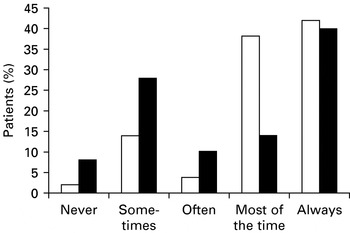
The distribution of patients relative to their tendency to differentiate their voices from their thoughts is illustrated in Fig. 1. Eighty per cent of the sample reported that they were able to differentiate AVHs from their usual verbal thoughts most of the time. One patient stated that she was unable to differentiate voices from thought because AVHs were experienced continuously during wakefulness. Consequently, she described not being able to experience any spontaneous thought distinct from her hallucinations.
Data based on the full sample of 50 patients. □, Patients able to differentiate auditory verbal hallucinations and thoughts; ■, patients experiencing thoughts as words.

The distribution of patients who experience their thoughts in a verbal form relative to the estimated frequency range of the questionnaire is also shown in Fig. 1. There was no statistical relationship between the tendency to experience thoughts as words and the likelihood of differentiating voices from thoughts (Spearman rank ρ=0.20, p=0.17). Three patients stated that their spontaneous thoughts were solely visual; that is, that they did not experience any verbal thought.
Data from these three patients and the patient who was unable to ever differentiate voices from thoughts were excluded from the analysis of responses to the questions described below.
‘Sensory’ features of AVHs
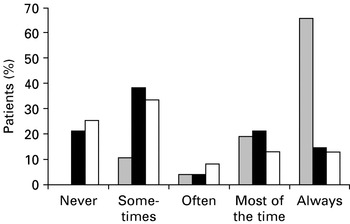
Self-assessments of ‘sensory’ characteristics of voices relative to ordinary thought are presented in Fig. 2. A high percentage of patients reported that the voices were acoustically cast in a voice other than their own speaking voice; 79.1% of patients reported that the voice did not ‘sound’ like their own speaking voice either most of the time or all of the time. Smaller percentages of patients reported that subjective loudness and clarity of the AVHs were greater than that of their own verbal thoughts either most of the time or all of the time (Fig. 2). Among ‘sensory’ features, speaking voice was found to be significantly more important in distinguishing AVHs from thoughts compared to subjective loudness (Wilcoxon signed rank test, p=0.021) and clarity (Wilcoxon signed rank test, p=0.005).
Based on those patients who could differentiate auditory verbal hallucinations (AVHs) and verbal thoughts at least sometimes, and who provided answers to questions 3a (n=46), 4a (n=46) and 5a (n=43).  , AVHs cast in non-self speaking voice; ■, AVHs louder than verbal thoughts; □, AVHs clearer than verbal thoughts.

Distinctiveness and repetitiveness of content of voices
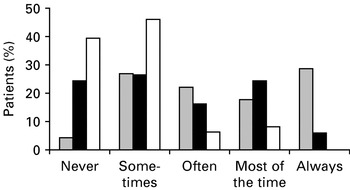
Although there was a range of responses, many patients reported a relatively pronounced tendency for voices to reflect verbal content that was distinct from their ordinary verbal thoughts (Fig. 3); 46.7% of respondents reported that verbal content of voices was distinct from verbal thought either most of the time or all of the time. With regard to repetitiveness of content, respondents described robustly greater rates for voices compared to thought (Fig. 3; Wilcoxon signed rank test, p=0.003). However, distinctiveness of content was rated as much more important than repetitiveness of content in differentiating voices from thoughts (Wilcoxon signed rank test, p=0.001).
Reponses to ‘content’ questions for those patients who provided answers to questions 6a (n=44), 8a (n=45) and 8b (n=44). , Content of voices not characteristic of verbal thought; ■, voices produce repetitive content; □, thoughts produce repetitive content.

Involuntariness of voices versus thoughts
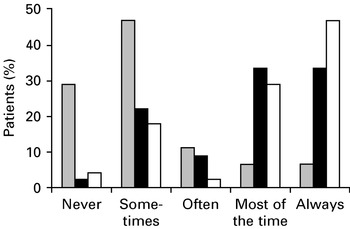
Voices tended to be rated high in terms of experienced lack of control, whereas ordinary thought tended to be rated as being under at least partial control (Fig. 4). The difference in experienced level of control for the two types of experience was highly significant (Wilcoxon signed rank test, p=0.001).
Responses to ‘control’ questions for those patients who provided answers to questions 7a (n=44), 7b (n=44) and 7c (n=44). , Do you have control of your voices?; ■, do you have control of your own thoughts?; □, do you have more control of yout thoughts than your voices?

Comparing importance of experiential factors in distinguishing voices and thought
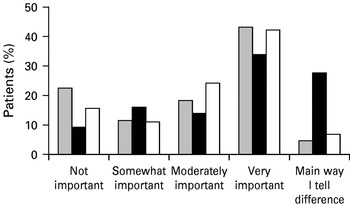
The three highest ranked factors identified by respondents in terms of importance in distinguishing voices and thought were compared to each other (Fig. 5). The percentage of respondents rating distinctiveness of verbal content as being ‘very important’ or ‘the main way I tell the difference’ in identifying voices was 61.4%. The percentage of respondents rating inability to control voices as being ‘very important’ or ‘the main way I tell the difference’ in identifying voices was 50.9%. The percentage of respondents reporting that non-self speaking voice was rated as being ‘very important’ or ‘the main way I tell the difference’ in identifying voices was 47.7%. The importance of distinctive content was rated significantly higher than the non-self speaking voice in identifying voices (Wilcoxon signed rank test, p=0.029) whereas the importance of distinctive content compared to diminished sense of control was not statistically different (Wilcoxon signed rank test, p=0.16).
Responses to ‘importance’ questions for those patients responding to questions 3b (n=43), 6b (n=43) and 7d (n=44). , Importance of speaking voice; ■, importance of distinct content; □, importance of inability to control.

Localization of voices in space
As anticipated, perceived source of voices coming from outside the head did not appear to play a significant role in identifying voices. Among the subgroup of patients surveyed regarding this factor, only 26.5% reported that the voices seemed to emanate exclusively from outside the head. We assessed whether the self-rated level of importance of perceptual features (loudness, vividness and speaking voice) in distinguishing voices from thoughts was correlated with externalization of AVHs. These correlations were non-significant (Spearman rank ρ's ranging from −0.12 to 0.27). A surprising finding was that a large percentage of patients who located the source of the voices as inside their heads indicated one or more relatively discrete localizations of these sources within the head itself according to their markings on a spatial outline of the head. Seventeen out of 24 respondents (70.8%) with ‘internal voices’ produced these responses, most commonly locating the voice source as arising close to the right or left ear. The mean±s.d. percentage of source locations identified according to these patients that lateralized to the right side of the head was 31.0±26.0%. The corresponding statistic for source locations lateralized to the left side of the head was nearly identical (28.0±25.0%).
First experience of voices
A relatively high percentage of patients were able to recall their first experience of a ‘voice’ even though this event took place on average many years in the past. Of the 45 patients surveyed, 71.1% reported affirmatively, with 47.5% of patients reporting remembering their first ‘voice’ experience either with many details or vividly, and 61.5% of patients recalling being at least moderately upset by this experience. The difference between the current age of the subject and the age of onset was not statistically different for those who could remember their first voice experience (mean±s.d.=15.9±9.7 years) and those who could not (mean±s.d.=12.3±10.5 years, t=1.1, p=0.29). Among the 13 subjects who could not recall the first occurrence of a voice, six subjects recalled that their voices had a gradual onset.
Discussion
A majority of patients surveyed in this study reported being able to readily distinguish AVHs from their own thoughts. The tendency to make this distinction fairly sharply was also reflected by the fact that most patients could recollect their first experience of a ‘voice’, even if occurring a decade or more previously, often with many details and a description of the accompanying emotional reaction. No single experiential characteristic clearly differentiated the two experiences across subjects. Instead, it appears that two or more experiential features came into play, with combinations that varied among the subjects. Data nevertheless demonstrated some noteworthy patterns.
First, verbal content emerged as a particularly important factor in distinguishing voices from ordinary thought. This factor has not been specifically highlighted in prior reports as a crucial experiential feature distinguishing voices from thoughts. Second, patients reported experiencing much less control over their voices relative to their own thoughts and rated this as an important factor in distinguishing the two experiences. This finding confirms previous phenomenological surveys highlighting the importance of absent control as an important experiential characteristic of AVHs (Aggernaes, Reference Aggernaes1972; Nayani & David, Reference Nayani and David1996; Garrett & Silva, Reference Garrett and Silva2003). Third, the non-self ‘sound’ of the speaking voice played a relatively prominent role in differentiating voices from thoughts, although self-ratings of the importance of this feature were somewhat less than for distinct verbal content in differentiating these two experiences. Surprisingly, patients as a group rated loudness and clarity of verbal imagery as less important in distinguishing AVHs from thoughts compared to the characteristic non-self ‘sound’ of the speaking voice. Nonetheless, for a small percentage of patients these experiential factors did appear to be very important in drawing this distinction.
What are the neurocognitive implications of our phenomenological data? The importance of diminished sense of control in differentiating AVHs and everyday thoughts is suggestive of ectopic activation or an intrusive verbal memory model (Hoffman & McGlashan, Reference Hoffman and McGlashan1993, Reference Hoffman and McGlashan1997; David, Reference David, David and Cutting1994; Copolov et al. Reference Copolov, Seal, Maruff, Ulusoy, Wong, Tochon-Danguy and Egan2003), where verbal representations arise irrespective of information processing in larger neural systems. Source monitoring impairment (Frith & Done, Reference Frith and Done1986; McGuire et al. Reference McGuire, Silbersweig, Wright, Murray, Frackowiak and Frith1996; Shergill et al. Reference Shergill, Bullmore, Simmons, Murray and McGuire2000, Reference Shergill, Brammer, Fukuda, Williams, Murray and McGuire2003) or corollary discharge failures during inner speech generation (Feinberg & Guazzelli, Reference Feinberg and Guazzelli1999; Ford et al. Reference Ford, Roach, Faustman and Mathalon2007) can also account for sense of absent control if it is assumed that verbal images labeled as non-self are secondarily experienced as involuntary. The importance of distinctive content in identifying voices is again suggestive of ectopic activation models or intrusive verbal memory models. However, misidentification models are also consistent with this finding insofar as distinctive content may interact synergistically with mislabeling tendencies to prompt patients to identify some verbal thoughts as voices (cf. Johns et al. Reference Johns, Rossell, Frith, Ahmad, Hemsley, Kuipers and McGuire2001). The fact that sensory attributes of loudness and clarity played a secondary role in differentiating voices and thoughts appears to challenge a pure corollary discharge explanation of AVHs insofar as these models postulate that mislabeling of inner speech arises from disinhibition of sensory representations (Feinberg & Guazzelli, Reference Feinberg and Guazzelli1999; Ford et al. Reference Ford, Roach, Faustman and Mathalon2007). These findings also challenge mechanistic theories postulating activation in primary auditory cortical areas as a central process (Dierks et al. Reference Dierks, Linden, Jandl, Formisano, Goebel, Lanfermann and Singer1999). That AVHs are generally cast in specific, non-self speaking voices suggests neural activation incorporating temporal regions responsible specifically for voice identification based on sound characteristics (Hunter et al. Reference Hunter, Griffiths, Farrow, Zheng, Wilkinson, Hegde, Woods, Spence and Woodruf2003). Two studies of patients with schizophrenia indicated that source monitoring mislabeling may selectively attach to verbal imagery of non-self speakers rather than ordinary inner speech (McGuire et al. Reference McGuire, Silbersweig, Wright, Murray, Frackowiak and Frith1996; Shergill et al. Reference Shergill, Bullmore, Simmons, Murray and McGuire2000). The selectivity of source monitoring findings in these studies might explain the high rates of non-self speaking voice associated with AVHs. However, source labeling models do not readily explain why the brains of patients with frequent AVHs produce an abundance of verbal imagery cast in recurrent, non-self speaking voices bundled with distinctive content.
Patients rated voices as expressing more repetitive content than their own thoughts. However, this factor was not rated as important in distinguishing voices from ordinary thought as the factors discussed above. This finding challenges mechanistic models based on pathological attractors in receptive language neurocircuitry (Hoffman & McGlashan, Reference Hoffman and McGlashan1993, Reference Hoffman and McGlashan1997) and intrusive verbal memory models (Copolov et al. Reference Copolov, Seal, Maruff, Ulusoy, Wong, Tochon-Danguy and Egan2003), as both models predict highly repetitive verbal content for AVHs. Higher levels of recurrent content for AVHs compared to ordinary thoughts found in this study are suggestive of a prior semantic analysis of AVH verbal content based on written patient logs showing statistically robust evidence of common themes and semantic categories across hallucination instances for individual subjects, but not high levels of word/phrase repetition per se (Hoffman et al. Reference Hoffman, Oates, Hafner, Hustig and McGlashan1994).
Drawbacks of this study include the limitations of introspective reporting. It may be difficult for subjects to differentiate the importance of different experiential factors. For instance, it is possible that aberrant verbal content of AVHs prompts patients to infer that these experiences are not under their control (Hoffman, Reference Hoffman1986). It may also have been difficult for patients to differentiate loudness and clarity of auditory imagery as distinct experiential factors. In addition, our questionnaire may have omitted other important factors that prompt identification of experience as voices. One such factor was suggested by diagrammatic portrayals of perceived ‘location’ of the voices provided by individual patients. Although many of our patients reported that the voices were experienced internally, 70% of these patients appeared to identify specific internal locations for these experiences, such as behind the forehead or near the right or left ear, which replicate an earlier finding by Nayani & David (Reference Nayani and David1996). Thus it is possible that voice experiences are somehow localized in a physical space that could include the head itself, a phenomenological feature not ordinarily associated with the experience of self-talk or inner speech (Nayani & David, Reference Nayani and David1996). Another limitation of the questionnaire is that it was not designed to systematically assess how verbal content of AVHs differed from than their ordinary verbal thoughts. In the present study, content of voices was often described as critical, frightening, commanding or encouraging. Typical comments provided by our patients were that they would never have thought of the things that the voices said, or that the words ‘heard’ seemed to reflect another ‘personality’. How these conclusions were drawn by patients remains uncertain, however. One clue is provided by Leudar et al. (Reference Leudar, Thomas, McNally and Glinski1997), who reported that AVH content often takes the form of coherent dialogic interactions with the patient (conversations, question/answer exchanges, etc.), or directives or evaluative comments addressing the patient. However, we did not ask our patients how often their own thoughts reflect an internal dialogue, questions and answers, directives or evaluative comments, which might be difficult to estimate in any case. We also did not seek information about patients' beliefs regarding the origin or objective reality of the voices. This choice was deliberate insofar as this study focused on the experience of voices, not beliefs associated with them. However, it is possible that beliefs regarding the origin of voices (for instance, that they arise from some malevolent agent) could reinforce a sense of absent control. Finally, psychometric properties such as test–retest reliability of our questionnaire data were not formally assessed.
Might there be another model that better accounts for our findings? Retrospective studies have suggested that persons destined to develop schizophrenia demonstrated marked increased social isolation prior to the emergence of active illness (Moller & Husby, Reference Moller and Husby2000; Tan & Ang, Reference Tan and Ang2001). Based on these reports, Hoffman (Reference Hoffman2007) has proposed that pre-illness social withdrawal sets into motion a high-level equivalent of deafferentation reorganization in neurocircuitry components responsible for social meaning in vulnerable individuals. In this model, the ‘social brain’ produces spurious social meaning in the form of delusional ‘plots’, self-referential interpretations of environmental stimuli, and AVHs seemingly generated by actual speakers or beings, all in the service of filling in the ‘blank slate’ due to withdrawal from the world. Neurobiological processes producing these ‘pseudo-social’ experiences could be analogous to neuroplastic shifts arising from sensory deafferentation following loss of an arm or leg producing phantom limb hallucinations, or visual hallucinations following vision loss. This hypothesis predicts that distinctive content, non-self speaking voice, and lack of control will be crucial components of AVH experience because such features together suggest distinct, non-self speakers or agents. This view would account for the often intimate and seemingly personal relationship patients report having with their voices.
Our findings illustrate the utility of phenomenological findings in guiding mechanistic studies of psychosis (see also Uhlhaas & Mishara, Reference Uhlhaas and Mishara2007). Although no particular hypothesis was unequivocally supported, our results suggest that an adequate model will need to account for recognizable non-self speaking voices, distinctive verbal content, and absent sense of control as experiential features differentiating AVHs from everyday verbal thought. The range of importance of alternative experiential factors in discerning AVHs across individuals suggests that subtyping this syndrome using our questionnaire approach may be helpful when conducting neuroimaging or experimental intervention studies.
Appendix. Voices questionnaire
Summary of auditory hallucination verbal content in the present (frequency, characteristic phrases and sentences; use verbatim examples if possible):
Please mark location of voices relative to your head: 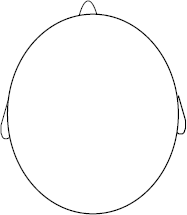
Differentiating voices and thoughts currently
1. Are you able to tell the difference between your own thoughts and the voices?
0=never
1=sometimes
2=often
3=most of the time
4=always
2. Do you experience your thoughts as words that you ‘say’ to yourself?
0=never
1=sometimes
2=often
3=most of the time
4=always
Voices may have specific characteristics, such as tone, or they may ‘sound’ like specific male or female speakers.
3a. Do the voices sound different from your own speaking voice?
0=never
1=sometimes
2=often
3=most of the time
4=always
3b. How important is ‘sound’ in telling the difference between the voices and your own thoughts?
0=not important
1=somewhat important
2=moderately important
3=very important
4=the main way I tell the difference
10=cannot tell difference between voices and thoughts
Now I will ask you to consider other ways that the voices may differ from your thoughts. These include: volume, clarity, content, control, and repetition. Please rate how important these are in helping you to know the difference between the voices and your thoughts.
4a. Are the voices louder than your own thoughts? If yes, how often?
0=never
1=sometimes
2=often
3=most of the time
4=always
4b. How important is ‘loudness’ or volume in telling the difference between the voices and your own thoughts?
0=not important
1=somewhat important
2=moderately important
3=very important
4=the main way I tell the difference
10=cannot tell difference between voices and thoughts
5a. Are the voices more vivid or clearer than your own thoughts? If yes, how often?
0=never
1=sometimes
2=often
3=most of the time
4=always
5b. How important is vividness or clarity in telling the difference between the voices and your own thoughts?
0=not important
1=somewhat important
2=moderately important
3=very important
4=the primary way that I distinguish voices from thoughts
10=cannot tell difference between voices and thoughts
6a. Do the voices say things that you would not ordinarily think to yourself? If yes, how often?
0=never
1=sometimes
2=often
3=most of the time
4=always
6b. How important is verbal content (i.e. the actual words or phrases that you ‘hear’) in telling the difference between the voices and your own thoughts?
0=not important
1=somewhat important
2=moderately important
3=very important
4=the main way I tell the difference
10=cannot tell difference between voices and thoughts
7a. Do you have control over the voices? If so, how often?
0=never
1=sometimes
2=often
3=most of time
4=always
7b. Do you have control over your own thoughts? If so, how often?
0=never
1=sometimes
2=often
3=most of time
4=always
7c. Do you have less control over the voices than over your own thoughts? If so, how often?
0=never
1=sometimes
2=often
3=most of time
4=always
7d. How important is your sense of control in telling the difference between the voices and your own thoughts?
0=not important
1=somewhat important
2=moderately important
3=very important
4=the main way I tell the difference
10=cannot tell difference between voices and thoughts
8a. Do the voices repeat words, phrases, or sentences? If so, how often?
0=never
1=sometimes
2=often
3=most of time
4=always
8b. Do your own thoughts repeat words, phrases, or sentences? If so, how often?
0=never
1=sometimes
2=often
3=most of time
4=always
8c. How important is repetitiveness in telling the difference between the voices and your own thoughts?
0=not important
1=somewhat important
2=moderately important
3=very important
4=the main way I tell the difference
Do you remember the actual experience of hearing the voices for the first time?
Yes □ No □
If the answer to the above question is no, did the voices come on gradually (over weeks, months, or years)?
Yes □ No □
If the answer to the above question is yes, how vivid is the memory of the onset of the voices?
1=can't remember at all
2=vaguely recall the event but no details
3=can recall a few details
4=can recall many details
5=can vividly recall circumstances and details
If the answer is yes, how upset were you by the onset of voices?
1=not upset
2=mild
3=moderate
4=very upset
5=extremely upset
Acknowledgments
This study was supported by a Dana Foundation grant, a NARSAD Independent Investigator Award, Peterson 50th Anniversary Research Partner, NMH grants R21MH63326, R01MH067073, NIH/NCRR/GCRC Program Grant RR00125 and the Department of Mental Health and Addiction Services of the State of Connecticut through its support of the Abraham Ribicoff Research Center at the Connecticut Mental Health Center.
Declaration of Interest
None.