Introduction
Herbicide-resistant weeds are a major concern across U.S. cropping systems. Indiana alone has 18 unique, herbicide-resistant weed biotypes, and Illinois has weed species with multiple-resistance to five different herbicide sites of action (Heap Reference Heap2020). To help combat herbicide-resistant weeds, the agrichemical industry developed and released soybean varieties that are resistant to dicamba (Behrens et al. Reference Behrens, Mutlu, Chakraborty, Dumitru, Jiang, LaVallee, Herman, Clemente and Weeks2007). Acres planted to dicamba-resistant soybeans increased from 20 million in 2017 to more than 60 million acres in 2019 (Hettinger Reference Hettinger2019).
The herbicide label for dicamba products used in dicamba-resistant soybean requires buffer areas where dicamba cannot be applied. Counties that contain endangered plant species require a 17.4-m buffer around the entire soybean field (Anonymous 2020a, 2020b). Buffers up to 30.5 m wide are required for sensitive areas (Anonymous 2020a). A sensitive area is considered a body of water or uncultivated, nonresidential area (Anonymous 2020a).
Cover crops are an option to supplement weed control within buffer areas where dicamba applications are not permitted. In addition, cover crops may be a weed control option outside of buffer areas and reduce the selection pressure for herbicide-resistant weed species. Properly managed cover crops have shown potential to suppress weeds, especially when used in tandem with an appropriate herbicide program (Davis et al. Reference Davis, Gibson, Bauman, Weller and Johnson2007; Loux et al. Reference Loux, Dobbels, Bradley, Johnson, Young, Spaunhorst, Norsworthy, Palhano and Steckel2017; Wiggins et al. Reference Wiggins, McClure, Hayes and Steckel2015). Loux et al. Reference Loux, Dobbels, Bradley, Johnson, Young, Spaunhorst, Norsworthy, Palhano and Steckel2017 reported that herbicides controlled redroot pigweed (Amaranthus retroflexus L.) and Palmer amaranth (A. palmeri S. Watson) 100% and 96%, respectively, at the end of the season compared to cover crops that provided 49% and 29% control, respectively.
Horseweed suppression by cover crops has been evaluated across many regions. Davis et al. (Reference Davis, Gibson, Bauman, Weller and Johnson2007) reported that a winter wheat (Triticum aestivum L.) cover crop provided similar horseweed suppression 4 months after in-crop applications, compared to a spring or fall residual herbicide across 2 years in Indiana. Pittman et al. (Reference Pittman, Barney and Flessner2019) reported that horseweed densities in late March were similar or lower in roller-crimped cover crops compared to fall residual herbicide applications in Virginia. Christenson (Reference Christenson2015) reported that horseweed suppression with winter rye (Secale cereal L.) at soybean R1 and R6.5 was similar to all herbicide treatments; however, winter wheat and winter barley (Hordeum vulgare L.) were not as effective at suppressing horseweed in Kansas. Cholette et al. (Reference Cholette, Soltani, Hooker, Robinson and Sikkema2018) reported that annual ryegrass [Lolium perenne L. spp. multiflorum L. (Lam.) Husnot] alone or in combination with crimson clover was the most consistent cover crop out of 17 species and mixtures for suppressing horseweed in Ontario, Canada. Cholette et al. (Reference Cholette, Soltani, Hooker, Robinson and Sikkema2018) also reported cover crop ground cover and biomass were correlated with horseweed density (0.17 and 0.21, respectively) and biomass (0.30 and 0.40, respectively); however, these correlations were considered weak and the authors suggested this could be due to the inherent variability of weed emergence patterns.
Although cover crops are beneficial in reducing horseweed densities and biomass (Wallace Reference Wallace, Curran, Mortensen, Wallace, Curran and Mortensen2019), the results can be variable with other weed species, such as Lamium and Stellaria species, and some research has shown cover crops are not as effective as a fall herbicide program of glyphosate + 2,4-D + sulfentrazone + chlorimuron-ethyl, which provided 99% control of winter annual weed emergence compared with the nontreated control (Cornelius and Bradley Reference Cornelius and Bradley2017). In addition, Creech et al (Reference Creech, Ferris, Faghihi, Westphal, Santini and Johnson2008) and Mock et al. (Reference Mock, Creech, Ferris, Faghihi, Westphal, Santini and Johnson2012) showed that annual ryegrass increased the number of winter annuals present, compared with a nontreated control.
As cover-crop acreage increases, cover crops will be integrated with technological advances in grain crops with herbicide-resistant traits. Using cover crops within buffer areas of dicamba-resistant soybeans can benefit producers from a weed control standpoint. Furthermore, using cover crops can reduce selection pressure on herbicide-resistant weeds, allowing for a more sustainable weed management strategy that will be needed in tandem with future technologies to manage problematic weeds.
The purpose of the present study was to evaluate cover crop use in dicamba-resistant soybean systems. The specific objectives were (1) to determine the effectiveness of cover crop species, termination timing of cover crops, and herbicide strategy on weed control; (2) observe whether cover crops can replace dicamba for weed suppression within label-mandated buffer areas; and (3) evaluate the effects of cover crop species, termination timing, and herbicide strategy on soybean yield.
Materials and Methods
Site Description
This experiment was conducted over two growing seasons. Cover crops were seeded in the fall of 2017 through soybean harvest in 2018 and seeding was repeated in the fall of 2018 through soybean harvest of 2019. Field experiments were conducted at the Throckmorton Purdue Agriculture Center (TPAC) near Lafayette, IN (40.29°N, 86.91°W); the Southeast Purdue Agriculture Center (SEPAC) near Butlerville, IN (39.03°N, 85.53°W); and the Davis Purdue Agricultural Center (DPAC) near Farmland, IN (40.26°N, 85.16°W). Soil in the TPAC location was primarily a Toronto-Octagon complex in 2018 and a Toronto-Millbrook complex in 2019. These soils had 2.6% organic matter, and had a pH of 6.3 and a CEC of 10.6 mEq 100 g−1. The TPAC site historically undergoes tillage as a form of weed control. SEPAC is a no-till location where the soil is a Cobbsfork silt loam with 1.7% organic matter, pH of 6.1, and a CEC of 5.6 meq 100 g−1. The DPAC location is also no-till; has 3.6% organic matter, a pH of 6.0, and CEC of 15.8 meq 100 g−1; and is primarily a Pewamo silty clay loam. The SEPAC location had more winter annual species and a more diverse weed community when compared with the TPAC and DPAC locations.
Experimental Design and Herbicide Treatments
The experimental design at each site was a split plot. The main plots were the following cover crop systems: (1) cereal rye, (2) crimson clover, and (3) a cereal rye and crimson clover mixture seeded at 80:20 by weight and hereafter referred to as “mix.” Each main plot (cover crop) contained a factorial arrangement of two main factors—termination timing and herbicide strategy–and each of those had three subfactors. The three termination timings were (1) before planting (BP), (2) at planting (ATP), and (3) after planting (AFP), with four replications. Field plots were 3 m wide and 9 m long. The DPAC location in 2018 only had two replications, because of saturated soil conditions that resulted in failed cover-crop establishment in half of the trial area. Planting dates for each location are listed in Table 1. Cereal rye was seeded at 101 kg ha−1, crimson clover at 20 kg ha−1, and the mix was seeded at 78 kg ha−1.
Date of cover crop planting, termination times, planting, POST application, and harvest at all three trial locations.

a Abbreviations: AFT, after planting; BP, before planting; DPAC, Davis Purdue Agriculture Center; SEPAC, South East Purdue Agriculture Center; TPAC, Throckmorton Purdue Agricultural Center.
b Cereal rye at SEPAC in 2019 was reseeded because of poor emergence resulting in two cover crop planting dates.
c The BP termination was much longer than originally intended due to adverse weather condition in the spring of 2019 causing an extended delay in planting time.
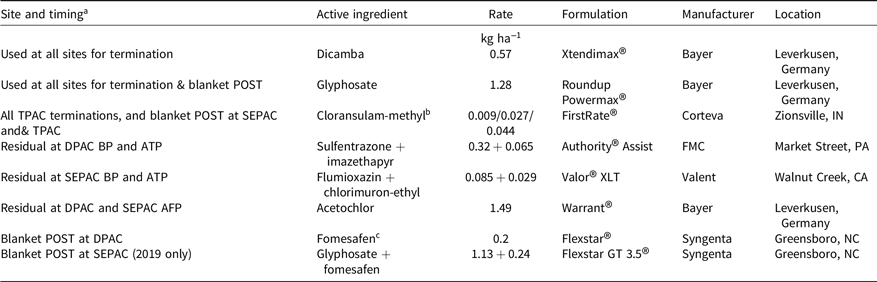
One herbicide strategy to terminate the cover crops used glyphosate alone to simulate weed control within label-mandated buffer areas where dicamba is not allowed (Table 2). Buffer areas are required by dicamba herbicide labels to be treated with Roundup Ready 2 Xtend® (Monsanto Co., St. Louis, MO) to reduce the possibility of damage caused by off-target movement. The other two herbicide strategies were used to simulate weed control outside of buffer areas; one used glyphosate + dicamba, and the other used glyphosate + dicamba + a residual herbicide. The residual herbicide used was determined on the basis of the primary weed species at each location. The residual herbicide used at the SEPAC and DPAC locations changed for the AFP termination timing, because of label restrictions regarding the residual herbicide used for the previous two timings. Rates of each herbicide and the residual herbicide used at each location are listed in Table 2. Soybeans were planted at 350,000 seeds ha−1.
Herbicides used and rates applied on the three cover crop termination timings and the blanket POST application.

a Abbreviations: AFT, after planting; ATP, at planting; BP, before planting; DPAC, Davis Purdue Agriculture Center; SEPAC, South East Purdue Agriculture Center; TPAC, Throckmorton Purdue Agricultural Center.
b Three different rates of cloransulam-methyl were used in this experiment. The 0.044 kg ha−1 rate was used at the two earliest terminations at TPAC, the 0.027 kg ha−1 rate was used as the blanket POST application at SEPAC, and the 0.009 kg ha−1 rate was used at the late termination timing and the blanket POST applications at TPAC. This was done to follow maximum use rates determined from the label.
c Fomesafen was added to the blanket POST application in 2019 at the SEPAC location, due to waterhemp being much more prevalent than in the previous year.
Termination of cover crops via herbicide applications were made with a 3-m long CO2-pressurized backpack sprayer calibrated to deliver 140 L ha−1 at 143 kPa with nozzles spaced 38 cm apart. The nozzles used were those recommended by the dicamba herbicide label (TTI11003; Teejet Technologies, Wheaton, IL) and AIXR 11003 (Teejet Technologies) for POST glyphosate applications. The primary weed species at SEPAC were a wide variety of grasses; the approximate composition included barnyardgrass [Echinochloa crus-galli (L.) P. Beauv.] (2%), large crabgrass [Digitaria sanguinalis (L) Scop.] (2%), annual bluegrass (Poa annua L.) (8%), fall panicum (Panicum dichotomiflorum Michx.) (34%), and foxtail species (Setaria spp.; 54%); and glyphosate- and acetolactate synthase (ALS) inhibitor–resistant horseweed in 2018 and glyphosate- and ALS inhibitor–resistant waterhemp [Amaranthus tuberculatus (Moq.) J.D. Sauer] in 2019. At the TPAC location, giant ragweed (Ambrosia trifida L.) and grasses were the main weed species; the approximate composition included large crabgrass (2%), smooth crabgrass [Digitaria ischaemum (Schreb.) Schreb. ex Muhl.] (3%), fall panicum (15%), barnyardgrass (17%), and foxtail species (67%). The DPAC weed flora was primarily glyphosate-, ALS-, and protoporphyrinogen oxidase–resistant common waterhemp and a mix of grass species; the approximate composition included smooth crabgrass (1%), large crabgrass (4%), foxtail species (18%), barnyardgrass (32%), and fall panicum (45%).
An additional blanket POST herbicide application was made when weeds were an average height of 10 to 15 cm. This POST application contained glyphosate in addition to a residual herbicide. The specific herbicides and rates used are listed in Table 2.
Data Collection
The aboveground biomass of weeds and each cover crop was measured before terminating cover crops in the spring from a 0.25-m2 quadrat out of at least five plots from within each of the three main cover crop blocks. The objective of this sample collection was to determine the effect of each cover crop type on early-season weed control, as well as to track the growth of cover-crop biomass between the three termination timings. Cover crop seeding, cover crop termination, soybean planting, blanket POST application, and soybean harvesting dates are listed in Table 1. Densities of the primary weed species were recorded from two quadrats out of every plot before the application of a blanket POST treatment over the entire trial area for maintenance. The quadrats used were either 0.25 or 1 m2, depending on the density of weeds at the time of data collection. The plots were harvested using a small-plot combine and yields were adjusted to 13% moisture.
Statistical Analysis
Correlations between cover-crop biomass and early-season weed biomass were determined using the SAS, version 9.4, PROC CORR procedure; all other data were analyzed using the PROC GLIMMIX procedure (SAS Institute, Cary, NC). The densities of individual species were analyzed using a log transformation to normalize the data and gain constant variance. Data were back-transformed for presentation. Random variables were cover crop, cover crop × replication, and cover crop × replication × termination time. Random variables were used to describe the split-split-plot error, and fixed variables included termination timing and herbicide strategy. Cover crop was a random variable because it was the main block within the trial design. A Satterthwaite denominator degree of freedom was used to produce an accurate approximation of F statistic. Analysis was similar to that described by Yang (Reference Yang2010) for balanced split-plot designs. Although a log transformation was used to analyze data for clarity purposes, untransformed data are presented. All means were separated using the Tukey Honest Significant Difference test at α = 0.05. Because of differences in soil type and predominant weed species, all sites were analyzed separately. Years were separated due to crimson clover winter killing in 2019. Orthogonal contrasts were used to further analyze specific treatment comparisons.
Results and Discussion
Cover Crop and Weed Biomass Before Cover-Crop Termination
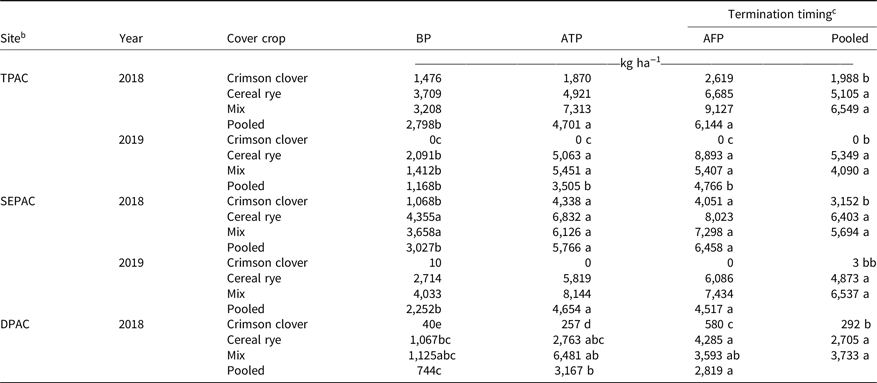
Cover crop biomass increased as termination timing was delayed from before soybean planting to at soybean planting, and when cereal rye or the mix was used (Table 3). The DPAC location in 2019 was removed from the evaluation of weed suppression by cover crops, because the cover crop stand was poor due to winter kill. Two-way interactions of cover crop by termination timing occurred at all site-years except for TPAC in 2018 and SEPAC in 2019. This interaction occurred because cover crops had two additional weeks to grow as a result of delayed termination timing from before soybean planting to at soybean planting. However, cover crop biomass usually did not increase when delayed from at soybean planting to after soybean planting, due to cover crops transitioning from the vegetative to reproductive growth stages and damage from the planting equipment. Cover crop biomass at TPAC in 2019 was at least 59% greater when a cover crop of cereal rye or mix was terminated at or after soybean planting compared to other treatments (P < 0.0001) (Table 3). Similarly, SEPAC in 2019 and TPAC in 2018 had at least 61% more cover crop biomass by using a cereal rye or mix cover crop (P < 0.0001 for both) (Table 3). Delaying termination until at or after planting resulted in at least 40% more cover crop biomass compared with the timing before soybean planting termination. At SEPAC in 2018, crimson clover terminated before soybean planting had at least 71% less biomass compared to all other treatments (P = 0.0433). Using cereal rye or mix terminated at or after soybean planting resulted in the greatest cover crop biomass. This result is consistent with what Haramoto and Pearce (Reference Haramoto and Pearce2019) showed in Kentucky in that delaying termination from 6 weeks before planting to 3 weeks before planting resulted in a 35% increase in a wheat monoculture biomass.
Influence of cover crop and termination timing on cover crop biomass before termination in the spring at three sites in Indiana in 2018 and 2019.

a Abbreviations: AFT, after planting; ATP, at planting; BP, before planting; DPAC, Davis Purdue Agriculture Center; SEPAC, South East Purdue Agriculture Center; TPAC, Throckmorton Purdue Agricultural Center.
b Data were log transformed before analysis; however, untransformed mean values are presented on the basis of the interpretation of the transformed data.
c Means followed by the same letter within each site-year and pooled data are not different according to Tukey honest significant difference test (P ≤ 0.05). No LSD letter separations are shown if the factor or interaction was not significant at the 0.05 level.
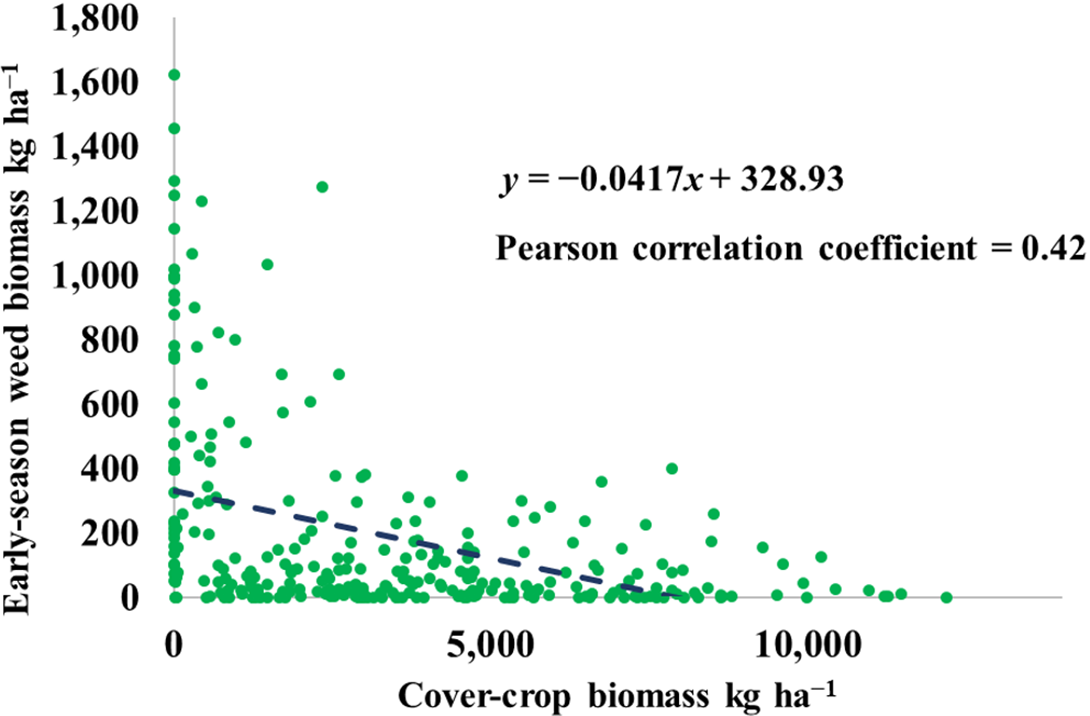
Using cover crops that contain cereal rye that is terminated at the time of soybean planting resulted in early-season weed suppression both outside and within buffer areas in dicamba-resistant soybean production systems. This is supported by the correlation between cover crop biomass and early-season weed biomass of 0.42 (P < 0.0001; Figure 1). The correlation also provides evidence that as cover crop biomass increases, the variability in early-season weed biomass tends to decline. Baraibar et al. (Reference Baraibar, Mortensen, Hunter, Barbercheck, Kaye, Finney, Curran, Bunchek and White2018) also reported that cover crop biomass was one of the most important variables for predicting spring weed biomass along with cover crop type and the number of growing degree days accumulated in Pennsylvania. Rosario-Lebron et al. (Reference Rosario-Lebron, Leslie, Yurchak, Chen and Hooks2019) showed that earlier terminations resulted in less residue coverage by the cover crop, resulting in higher weed densities—primarily large crabgrass, goosegrass, and white clover (Trifolium repens L.), which was similar to our results.
Correlation of early-season (April and May) weed biomass by cover crop biomass across three sites in Indiana in 2018 and 2019. Cover crop biomass data collected at termination and weed biomass data collected when the POST herbicide treatments were applied. Sites included the Throckmorton Purdue Agricultural Center (Lafayette, IN), the South East Purdue Agricultural Center (Butlerville, IN), and the Davis Purdue Agriculture Center (Farmland, IN).

Horseweed Densities Before Blanket POST Herbicide Application
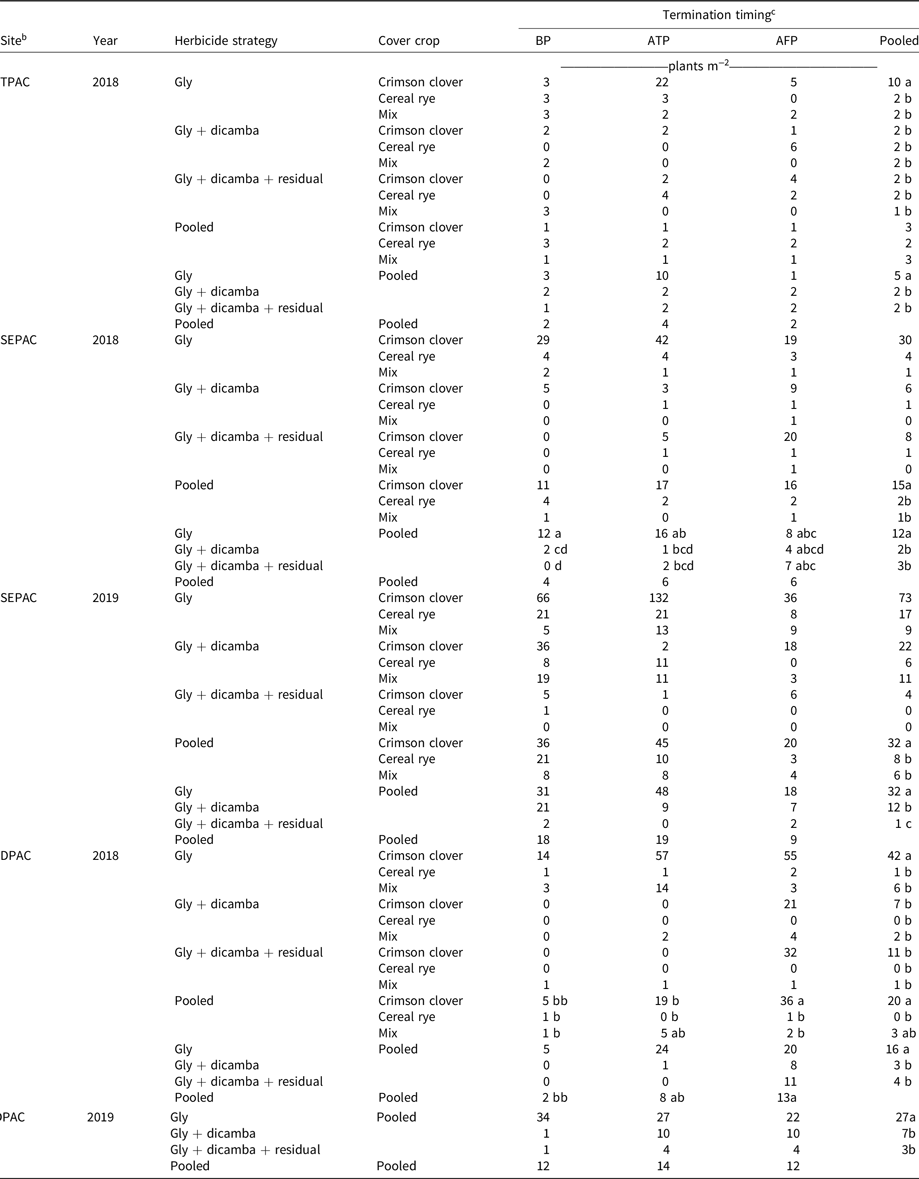
Horseweed was evaluated at five site-years (Table 4). The horseweed was a glyphosate-resistant biotype. Cover crops containing cereal rye had up to 75% less horseweed compared with those containing crimson clover. In this study, crimson clover did not provide horseweed control at all locations, presumably due to lower biomass or winterkill. Using cereal rye usually resulted in the lowest horseweed densities within each termination timing. Terminating the cover crop before soybean planting with a herbicide strategy that used glyphosate and dicamba resulted in at least an 88% reduction in horseweed density compared with using glyphosate alone at or before soybean planting. The use of dicamba in the herbicide strategy tended to be beneficial across all timings in reducing glyphosate-resistant horseweed densities.
Influence of cover crop, termination timing, and herbicide strategy on early-summer horseweed density before a POST application at three sites in Indiana in 2018 and 2019.

a Data were log-transformed before analysis; however, untransformed mean values are presented on the basis of the interpretation of the transformed data.
b Abbreviations: AFT, after planting; ATP, at planting; BP, before planting; DPAC, Davis Purdue Agriculture Center; Gly, glyphosate; SEPAC, South East Purdue Agriculture Center; TPAC, Throckmorton Purdue Agricultural Center.
c Means followed by the same letter within site-year and pooled data are not different according to Tukey honest significant difference test (P ≤ 0.05). No LSD letter separations are shown if the factor or interaction was not significant at the 0.05 level.
Wallace et al. (Reference Wallace, Curran, Mortensen, Wallace, Curran and Mortensen2019) reported that cover crops containing cereal rye provided suppression of horseweed and reduced horseweed size before being exposed to an herbicide application. In our research, cereal rye suppression of horseweed was somewhat variable across site-years. At TPAC in 2018, horseweed densities were similar except for the crimson clover terminated with glyphosate only, which resulted in 81% higher horseweed densities. In 2018, DPAC had 94% less horseweed in cereal rye and the mix terminated after soybean planting compared with crimson clover. Similar variability in horseweed control occurred in a winter wheat cover crop compared with fall and spring residual herbicide programs in Indiana, with differences occurring over 2 years (Davis et al. Reference Davis, Gibson, Bauman, Weller and Johnson2007).
Horseweed densities were reduced by using a cover crop containing cereal rye, delaying termination of the cover crop, and using a herbicide strategy with glyphosate in combination with dicamba and a residual herbicide, compared to terminating a crimson clover cover crop early with glyphosate alone. Delaying termination of cover crops was not as effective at reducing horseweed densities as selecting the appropriate cover crop species and herbicide strategies.
In dicamba label–mandated buffer areas, the best results were in cereal rye or mix terminated at planting to optimize horseweed suppression and limit any reductions in soybean yield. In addition, findings in the cereal rye cover crop between a glyphosate-only herbicide strategy versus a glyphosate + dicamba herbicide strategy showed that the two herbicide strategies provided similar horseweed suppression at four of five site-years at 0.05 level of significance. Cereal rye was beneficial for horseweed suppression to replace dicamba use in buffer areas at four of five site-years evaluated.
Waterhemp Densities Before Blanket POST Herbicide Application
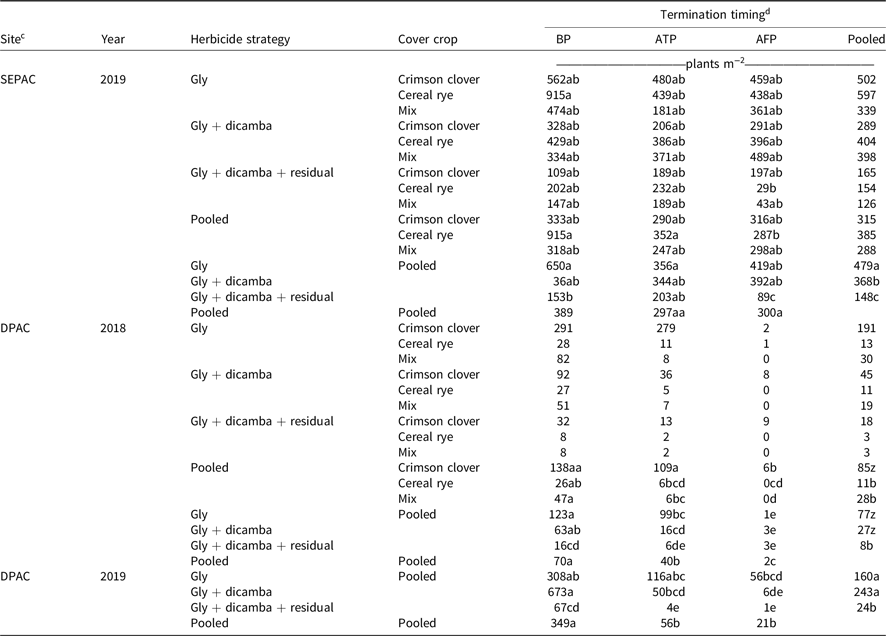
Waterhemp was evaluated at three of the six site-years. Delaying termination until after soybean planting reduced waterhemp densities by at least 30% compared with other termination times; however, an interaction with herbicide strategy did occur frequently (Table 5). Terminating with a herbicide strategy that contained glyphosate + dicamba in addition to a residual herbicide reduced waterhemp densities by at least 70%.
Influence of interaction among herbicide strategy, termination time, and cover crop on early-summer waterhemp densities before a POST application at two locations in Indiana in 2018 and 2019.ab

a Data were log-transformed before analysis, however untransformed mean values are presented based on the interpretation of the transformed data.
b Waterhemp was only evaluated at SEPAC in 2019.
c Abbreviations: AFT, after planting; ATP, at planting; BP, before planting; DPAC, Davis Purdue Agriculture Center; Gly, glyphosate; SEPAC, South East Purdue Agriculture Center; TPAC, Throckmorton Purdue Agricultural Center.
d Means followed by the same letter within site-year and pooled data are not different according to Tukey honest significant difference test (P ≤ 0.05). No LSD letter separations are shown if the factor or interaction was not significant at the 0.05 level.
Cereal rye cover crops have also been evaluated prior to glyphosate- and glufosinate-resistant soybeans with appropriate herbicides. Cereal rye reduced Palmer amaranth densities by 50% compared with other cover crops or a nontreated plot in the absence of herbicides (Loux et al. Reference Loux, Dobbels, Bradley, Johnson, Young, Spaunhorst, Norsworthy, Palhano and Steckel2017). We report similar results in that cover crops with higher biomass reduced waterhemp densities, and the use of a residual herbicide resulted in lower densities in all three site-years. However, we report that in dicamba-resistant soybeans, the use of a residual herbicide in cover crops provided 60% more control of waterhemp than using an herbicide strategy of glyphosate + dicamba or glyphosate alone. Mirsky et al. (Reference Mirsky, Curran, Mortensen, Ryany and Shumway2011) also observed that total weed densities could be reduced by as much as 33% when delaying termination of cover crops in the spring in Pennsylvania. Using a cover crop with dicamba-resistant soybean technology and when terminated with glyphosate in combination with dicamba and a residual herbicide improved waterhemp control by 69% compared with early terminations with glyphosate alone. The use of a herbicide strategy with glyphosate in combination with dicamba and a residual herbicide increased waterhemp suppression by 78% at the two earlier timings terminated with glyphosate alone both years at DPAC.
Cover crops were not as effective in reducing waterhemp densities as they were in reducing horseweed densities. This is because waterhemp has an emergence pattern that generally peaks after termination of the cover crop. Horseweed has an emergence pattern the coincides with establishment and rapid vegetative growth of cereal rye (Davis et al. Reference Davis and Johnson2008). In dicamba label–mandated buffer areas, a cover crop of cereal rye, terminating at soybean planting, and including residual herbicides would be the best option for waterhemp suppression and reduce the chance of soybean yield reductions due to competition with the cover crop.
Soybean Yield
Soybean yields in 2018 were reduced 10% to 31% at all site-years when termination was delayed to at or after soybean planting (data not shown). However, in 2019, no yield reductions were observed (data not shown). Soybean yield tended to be lower when cereal rye or the mix were terminated at or after soybean planting. The mix terminated at or after soybean planting and cereal rye terminated after soybean planting resulted in yield reductions of 18% to 24% compared with the cereal rye terminated at planting or earlier.
Termination timing is becoming more relevant as producers are increasingly terminating cover crops after planting to obtain more cover crop biomass (CTIC 2017). Ruffo et al. (Reference Ruffo, Bullock and Bollero2004) reported that when cereal rye was terminated before planting soybeans in Illinois, reductions in yield were not observed, similar to our results in 2018. However, in a different study in Illinois, reductions of up to 31% were observed in cereal rye terminated at soybean planting, compared to conventional treatments, which is similar to what we observed (Liebl et al. Reference Liebl, Simmons, Wax and Stoller1992).
Cereal rye tissue-nutrient analysis was conducted on cover crop biomass in 2019 because of yield reductions we observed in 2018. Because termination of cover crops was delayed past planting, carbon and nitrogen in cereal rye aboveground tissue increased by at least 40% and 68%, respectively, at the TPAC location (data not shown). Delayed termination of cover crops has potential to cause nutrient deficits in the cash crop. We report that negative impacts on yield can occur if cover crops are terminated after soybean planting, which has rarely been documented. Although using cereal rye and delaying termination would be beneficial from a weed management standpoint within buffer areas for horseweed and waterhemp, it may have negative impacts on soybean yield in some years by reducing soybean yield as much as 31%, compared with early termination times.
The use of a cereal rye or mix terminated at or after soybean planting generally resulted in reduced weed densities for horseweed, with cereal rye or mix providing 75% more control than did crimson clover at two of four site-years. Waterhemp densities were reduced by 80% when terminating at or after planting with cereal rye or the mix, compared with earlier terminated crimson clover or mix at only one of three site-years. However, reductions in soybean yield ranging from 10% to 31% did occur at three of six site-years, due to delaying termination timing.
If cover crops are implemented outside of buffer areas, a cereal rye or mix cover crop terminated at soybean planting and combining the termination herbicide program with a residual herbicide would be the most effective approach for suppressing most weed species and optimizing soybean yields. Residual herbicides should always be implemented to reduce the number of individual weeds that are exposed to POST applications of glyphosate and dicamba. As herbicide-resistance issues continue to rise globally, farm operators will need to implement additional integrated weed management strategies to prevent reductions in cash-crop yields. Integrated weed management strategies like cover crops will also allow for a more sustainable use of dicamba-resistant soybean technology.
Acknowledgments
This research received no specific grant from any funding agency or the commercial or not-for-profit sectors. No conflicts of interest have been declared.