Certainly the process of political evaluation is carried on by most citizens, and this process leads to more or less predictable organization of behavior. If ideology in a sophisticated sense is not widespread in the population, there must be surrogates for ideology that bring large aggregates to act as though propelled by ideological concerns.
—Angus Campbell, Philip E. Converse, Warren Miller, and Donald Stokes, The American Voter ([1960] Reference Campbell, Converse, Miller and Stokes1965, p. 125)It remains commonplace, if not axiomatic in sociology, political science, and communications research, to assume that candidate preferences, issue positions, and voting behavior are determined in a largely “top-down” manner by party elites, political advertising, media coverage, and other institutional factors (e.g., Delli Carpini and Keeter, Reference Delli Carpini and Keeter1996; Fiorina et al., Reference Fiorina, Abrams and Pope2006; Graber Reference Graber2004; Layman and Carsey, Reference Layman and Carsey2002; Poole and Rosenthal, Reference Poole and Rosenthal1997; Sniderman and Bullock, Reference Sniderman, Bullock, Saris and Sniderman2004; Stimson Reference Stimson2004; Zaller Reference Zaller1992). There can be little doubt that these factors are powerful determinants of electoral and other political outcomes. But there is good reason to think that the “institutional” story is by no means the whole story.
“BOTTOM-UP” PROCESSES AFFECTING POLITICAL OUTCOMES
As we will show in this article, there are also “bottom-up” social and psychological processes associated with personality, interpersonal relationships, and political orientation (or ideology), but these are often given short shrift in the voluminous literature on public opinion. For example, in an extremely influential monograph entitled The Nature and Origins of Mass Opinion, John Zaller (Reference Zaller1992, p. 23) stated simply that “sources of variability in individuals' political predispositions [were] beyond the scope of [his] book” and “the academic literature on personality and opinion is problematic.” Contemporary texts on public opinion and voting behavior are notably silent, if not openly wary, about psychological research on individual differences in personality, temperament, and ideological proclivities and their relations to preferences for specific candidates, parties, and policies. This state of affairs is unfortunate, given the plethora of recent research suggesting that “bottom-up” factors are indeed linked—sometimes quite strongly—to political preferences (see Jost et al., Reference Jost, Federico and Napier2009, for a review).
THE “AUTHORITARIAN PERSONALITY” REVISITED
Part of the scholarly resistance to “bottom-up” factors is historical, insofar as the earliest psychological research on the connection between personality and political orientation began with the publication of The Authoritarian Personality by Theodor Adorno et al. (Reference Adorno, Frenkel-Brunswik, Levinson and Sanford1950; see also Lane Reference Lane1962; McClosky Reference McClosky1958; Tomkins Reference Tomkins and White1963). Although work on the authoritarian personality represented a profound synthesis of sociological and psychological (especially psychodynamic) theory and research (e.g., see Allport Reference Allport1954; Brown [1965] Reference Brown, Jost and Sidanius2004), it was attacked relentlessly on largely ideological grounds, and its authors were accused (hyperbolically and therefore unjustly) of equating political conservatism with authoritarianism and, in so doing, “pathologizing” conservatism (e.g., Shils Reference Shils, Christie and Jahoda1954; Martin Reference Martin2001; see also Roiser and Willig, Reference Roiser and Willig2002).Footnote 1 For these reasons and others, as Alan Wolfe (Reference Wolfe2005) noted, by the 1960s, “The Authoritarian Personality was treated as a social-science version of the Edsel, a case study of how to do everything wrong.”
Personality, Ideology, and Ethnocentrism
The basic theoretical argument advanced by Adorno et al. (Reference Adorno, Frenkel-Brunswik, Levinson and Sanford1950) is in fact more reasonable, more measured, and, as it turns out, more empirically sound than critics allow. The authors of The Authoritarian Personality proposed that personality, which they described as “essentially an organization of needs,” is a “determinant of ideological preferences” (Adorno et al., Reference Adorno, Frenkel-Brunswik, Levinson and Sanford1950, p. 5). Because of certain socialization experiences and unresolved intrapsychic conflicts (e.g., with parental and other authority figures), some individuals develop an “ideological receptivity” toward belief systems that are authoritarian, pseudoconservative, rigid, hostile, and intolerant of others (Adorno et al., Reference Adorno, Frenkel-Brunswik, Levinson and Sanford1950, p. 9). Although the specific causes of authoritarian personality styles in childhood and beyond are still not well understood, subsequent research has backed up Adorno et al.'s (Reference Adorno, Frenkel-Brunswik, Levinson and Sanford1950) claims that individual differences in authoritarian tendencies are measurable and observable and that they predict intolerant, ethnocentric social and political attitudes in general (e.g., Altemeyer Reference Altemeyer1996, Reference Altemeyer and Zanna1998; Cunningham et al., Reference Cunningham, Nezlek and Banaji2004; Duckitt Reference Duckitt2001; Feldman and Stenner, Reference Feldman and Stenner1997; Napier and Jost, Reference Napier and Jost2008; Rokeach Reference Rokeach1960; Scheepers et al., Reference Scheepers, Felling and Peters1990; Sidanius and Pratto, Reference Sidanius and Pratto1999; Stenner Reference Stenner2005). In other words, it is now a widely accepted fact of social science that, as Adorno et al. (Reference Adorno, Frenkel-Brunswik, Levinson and Sanford1950) put it, “A man [or woman] who is hostile toward one minority group is very likely to be hostile against a wide variety of others” (p. 9). It is also the case that political conservatism is correlated with authoritarianism (e.g., Altemeyer Reference Altemeyer1996; Bonanno and Jost, Reference Bonanno and Jost2006; Saucier Reference Saucier2000; Sidanius and Pratto, Reference Sidanius and Pratto1999) and with hostility and prejudice toward racial and ethnic minorities (e.g., Sears et al., Reference Sears, van Laar, Carrillo and Kosterman1997; Sidanius et al., Reference Sidanius, Pratto and Bobo1996).
Parental Influences
Parents' influences on the social and political attitudes of their offspring are considerable (e.g., Altemeyer Reference Altemeyer1988; Davies Reference Davies1965; Niemi and Jennings, Reference Niemi and Jennings1991; Sears and Levy, Reference Sears, Levy, Sears, Huddy and Jervis2003; Sidanius and Ekehammar, Reference Sidanius and Ekehammar1979). The role of harsh child-rearing practices, theorized by Adorno et al. (Reference Adorno, Frenkel-Brunswik, Levinson and Sanford1950) to significantly affect the development of an authoritarian temperament, is somewhat more controversial, but even here there is some evidence that child-rearing goals and practices differ as a function of parents' political and religious belief systems (e.g., Boshier and Izard, Reference Boshier and Izard1972; Danso et al., Reference Danso, Hunsberger and Pratt1997; Ellison et al., Reference Ellison, Bartkowski and Segal1996; Eisenman and Sirgo, Reference Eisenman and Sirgo1991; see also Wilcox Reference Wilcox1998). In any case, the voluminous literature on political socialization (see Sears and Levy, Reference Sears, Levy, Sears, Huddy and Jervis2003, for a review) casts at least some doubt on the assertion made by Judith Rich Harris (Reference Harris1999) and echoed by Steven Pinker (Reference Pinker2003) that parental influences on the attitudes and behaviors of their children are a trifling matter. Not only are correlations between the social and political attitudes of parents and offspring positive and robust (e.g., Jennings and Niemi, Reference Jennings and Niemi1981), experimental research demonstrates that simply priming thoughts of a conservative (or liberal) parent is enough to shift adult children's political attitudes in the direction of that parent's ideology (see Jost et al., Reference Jost, Ledgerwood and Hardin2008a).
Authoritarianism and Voting Preferences
Since at least the early 1960s, when the Democratic Party first took a strong leadership role on the issue of civil rights for African Americans (e.g., Carmines and Stimson, Reference Carmines and Stimson1989; Frymer Reference Frymer1999; Petrocik Reference Petrocik1989; Zaller Reference Zaller1992), participants who score relatively high on various dispositional measures of authoritarianism tend, on average, to favor conservative (and Republican) over liberal (and Democratic) candidates for president. That is, studies show that authoritarianism was positively correlated with support for Barry Goldwater over Lyndon Johnson in 1964 (Higgins Reference Higgins1965), Richard Nixon over Robert Kennedy in 1968 (Byrne and Przybyla, Reference Byrne and Przybyla1980) and George McGovern in 1972 (Hanson and White, Reference Hanson and White1973), Ronald Reagan over Jimmy Carter in 1980 (Byrne and Przybyla, Reference Byrne and Przybyla1980) and Walter Mondale in 1984 (McCann and Stewin, Reference McCann and Stewin1986), as well as Robert Dole over Bill Clinton in 1996 and George W. Bush over Al Gore in 2000 (Kemmelmeier Reference Kemmelmeier2004). These studies and many others suggest that authoritarianism continues to play a significant role in the political life of the United States (see also Dean Reference Dean2004, for a popular treatment).
The Upshot
While it is true that much of the research evidence produced by Adorno et al. (Reference Adorno, Frenkel-Brunswik, Levinson and Sanford1950) would fail to satisfy contemporary methodological standards, several of their basic theoretical claims have been substantiated by studies that do satisfy those standards (e.g., see Altemeyer Reference Altemeyer1996, Reference Altemeyer and Zanna1998; Duckitt Reference Duckitt2001; Feldman and Stenner, Reference Feldman and Stenner1997; Napier and Jost, Reference Napier and Jost2008; Scheepers et al., Reference Scheepers, Felling and Peters1990; Stenner Reference Stenner2005). Unfortunately, however, the damage was done long ago, and several generations of social scientists have dismissed the notion that personality characteristics (including authoritarianism) reliably predict specific social and political attitudes. The intellectual backlash against The Authoritarian Personality led some commentators to go so far as to deny that individuals possess meaningful ideological proclivities at all. Edward Shils (Reference Shils, Christie and Jahoda1954), for example, was moved in his searing critique of the Adorno et al. (Reference Adorno, Frenkel-Brunswik, Levinson and Sanford1950) work to declare that the left-right distinction itself was “rickety,” “spurious,” and “obsolete” (pp. 27–28).
THE “END OF IDEOLOGY” REVISITED
In the 1950s and 1960s, an influential band of sociologists and political scientists (e.g., Aron [1957] Reference Aron and Waxman1968; Bell Reference Bell1960; Lipset Reference Lipset1960; Shils Reference Shils, Christie and Jahoda1954) advanced the provocative claim that in the aftermath of the Second World War, Western society had witnessed the “end of ideology”—and that there were few if any important differences of substance or style that remained between leftists and rightists (see Jost Reference Jost2006, for an extended discussion). This position gained steam following Philip Converse's (Reference Converse and Apter1964) empirical study of public opinion, which suggested that most U.S. survey respondents in the 1950s showed little or no understanding of basic ideological concepts such as liberalism and conservatism. As recently as 2004, a cultural critic writing for the New Yorker noted:
Forty years later, Converse's conclusions are still the bones at which the science of voting behavior picks.
Converse claimed that only around ten per cent of the public has what can be called, even generously, a political belief system… .
… [And] concluded that “very substantial portions of the public” hold opinions that are essentially meaningless—off-the-top-of-the-head responses to questions they have never thought about, derived from no underlying set of principles. These people might as well base their political choices on the weather. And, in fact, many of them do
(Menand Reference Menand2004, pp. 92–94).Many prominent social scientists continue to argue that most U.S. citizens are largely “innocent” of ideology and that their political preferences are, as a rule, fleeting and artificial (e.g., Fiorina et al., Reference Fiorina, Abrams and Pope2006). However, this skeptical position has increasingly come under attack, as evidence of bona fide ideological differences and political conflict has mounted in recent years (e.g., Abramowitz and Saunders, Reference Abramowitz and Saunders2008; Barker and Tinnick, Reference Barker and Tinnick2006; Erikson et al., Reference Erikson, MacKuen and Stimson2002; Jost Reference Jost2006; Rathbun Reference Rathbun2007; Stimson Reference Stimson2004).
In contemporary U.S. society, most survey respondents—especially those who are college educated—can and do identify themselves as relatively liberal, moderate, or conservative. Contrary to the claims of the skeptics, these identifications do predict a large number of the individuals' thoughts, feeling, and behaviors, including voting intentions (see Jost et al., Reference Jost, Federico and Napier2009, for a review). The fact of the matter is that liberals vote overwhelmingly for Democratic presidential candidates and conservatives vote overwhelmingly for Republicans (e.g., Jost Reference Jost2006; Stimson Reference Stimson2004). Furthermore—just as Adorno et al. (Reference Adorno, Frenkel-Brunswik, Levinson and Sanford1950) proposed—ideological preferences are indeed grounded in the personality characteristics of individual citizens (e.g., see Block and Block, Reference Block and Block2006; Carney et al., Reference Carney, Jost, Gosling and Potter2008; Gerber et al., Reference Gerber, Huber, Raso and Ha2008). One of the most important differences between liberals (or leftists) and conservatives (or rightists) concerns the extent to which people are open versus resistant to novelty and change and, relatedly, the extent to which they differ in “system justification motivation”—that is, whether they are motivated to challenge or support the societal status quo (see Jost et al., Reference Jost, Banaji and Nosek2004; Jost et al., Reference Jost, Nosek and Gosling2008b). These and other characteristics can be understood in terms of the most prominent taxonomy used by contemporary personality psychologists, namely the Five Factor Model (e.g., McCrae and Costa, Reference McCrae, Costa, Pervin and John1999), discussed next.
THE FIVE FACTOR MODEL OF PERSONALITY AND ITS RELATION TO POLITICAL PREFERENCES
The Five Factor Model (FFM) of personality has emerged, after decades of conceptual analysis and factor analytic research, as the most widely used framework for classifying and measuring the major dimensions of personality in a wide range of languages and cultures (e.g., Goldberg Reference Goldberg1992; John and Srivastava, Reference John, Srivastava, Pervin and John1999; McCrae and Costa, Reference McCrae, Costa, Pervin and John1999; Wiggins Reference Wiggins1996). The model suggests that there are five (largely nonoverlapping) dimensions that people (more or less everywhere) use to distinguish their own personalities and the personalities of others, and that these dimensions are captured, however imperfectly, by the acronym OCEAN. Individuals who are high on Openness tend to be creative, imaginative, abstract, curious, deep thinkers, inventive, and appreciative of arts and aesthetic experiences compared with low scorers, who tend to be relatively conventional, concrete, traditional, and to favor the known over the unknown. Conscientious people are thorough, dependable, reliable, hardworking, task focused, efficient, and good planners, whereas people who are low on conscientiousness tend to be disorganized, careless, and impulsive. High scorers on Extraversion are generally talkative, energetic, enthusiastic, assertive, outgoing, and sociable, whereas low scorers (i.e., introverts) are characterized as being relatively reserved, quiet, and shy. People scoring high on Agreeableness tend to be helpful, selfless, sympathetic, kind, forgiving, trusting, considerate, and cooperative, in contrast to the people at the low end of the dimension who, at the extreme, are often described as quarrelsome, critical, harsh, aloof, and blunt. People who are high in Neuroticism tend to be anxious, worried, easily upset, and moody compared with low scorers, who are relatively calm, relaxed, emotionally stable, and able to handle stress well.
Although no studies (to our knowledge) have directly addressed the implications of the FFM for voting behavior in the United States (but see Rentfrow et al., Reference Rentfrow, Jost, Gosling, Potter, Jost, Kay and Thorisdottir2009, for a psychological analysis of regional voting patterns), some studies have examined the extent to which these five dimensions are correlated with various measures of political orientation. The strongest and most consistently observed finding is that liberals generally score higher than do conservatives on various measures of Openness to New Experiences (e.g., Barnea and Schwartz, Reference Barnea and Schwartz1998; Carney et al., Reference Carney, Jost, Gosling and Potter2008; Ekehammar et al., Reference Ekehammar, Akrami, Gylje and Zakrisson2004; Gosling et al., Reference Gosling, Rentfrow and Swann2003; Jost et al., Reference Jost, Glaser, Kruglanski and Sulloway2003, Reference Jost, Napier, Thorisdottir, Gosling, Palfai and Ostafin2007; McCrae Reference McCrae1996; Riemann et al., Reference Riemann, Grubich, Hempel, Mergl and Richter1993; Sidanius Reference Sidanius1978; Stenner Reference Stenner2005; Trapnell Reference Trapnell1994; Van Hiel and Mervielde, Reference Van Hiel and Mervielde2004). Such findings led Robert McCrae (Reference McCrae1996) to conclude that “variations in experiential Openness are the major psychological determinant of political polarities” (p. 325). Furthermore, Gian Vittorio Caprara et al. (Reference Caprara, Barbaranelli and Zimbardo1999) found that center-left voters in Italy scored higher than center-right voters on Openness, and Peter J. Rentfrow et al. (Reference Rentfrow, Jost, Gosling, Potter, Jost, Kay and Thorisdottir2009) found that U.S. citizens living in Democratic-leaning states scored higher on Openness than did citizens living in Republican-leaning states.
The second most common finding is that conservatives score somewhat higher than do liberals on Conscientiousness (Caprara et al., Reference Caprara, Barbaranelli and Zimbardo1999; Ekehammar et al., Reference Ekehammar, Akrami, Gylje and Zakrisson2004; Gosling et al., Reference Gosling, Rentfrow and Swann2003; Mehrabian Reference Mehrabian1996; Stenner Reference Stenner2005; Van Hiel et al., Reference Van Hiel, Mervielde and De Fruyt2004)—especially when it comes to the “need for order” facet (Carney et al., Reference Carney, Jost, Gosling and Potter2008; Jost Reference Jost2006). Consistent with this observation, Dana Carney et al. (Reference Carney, Jost, Gosling and Potter2008) found that, compared with those of liberals, conservatives' living spaces tended to be neater, cleaner, fresher, and to include more organizational items, such as calendars and postage stamps. Gian Vittorio Caprara et al. (Reference Caprara, Barbaranelli and Zimbardo1999) found that center-left voters in Italy scored higher than center-right voters on Agreeableness, whereas center-right voters scored higher than center-left voters on Energy (or Extraversion), but these patterns have not been replicated in the United States (e.g., see Carney et al., Reference Carney, Jost, Gosling and Potter2008; Jost Reference Jost2006; Rentfrow et al., Reference Rentfrow, Jost, Gosling, Potter, Jost, Kay and Thorisdottir2009; Stenner Reference Stenner2005). There is no evidence that political orientation is consistently related to Neuroticism (or Emotional Stability).
THE U.S. PRESIDENTIAL ELECTION OF 2008: OBAMA VERSUS MCCAIN
The election of 2008 provided an exceptionally interesting political context in which to examine personality and ideological determinants of candidate preferences for several reasons. First, although there was no incumbent running for president, in many ways the election was a referendum on the Bush presidency and conservative domination of the U.S. government for the better part of eight years. Thus, one would expect that ideological factors, including authoritarianism and system justification, would carry considerable weight (see also Abramowitz and Saunders, Reference Abramowitz and Saunders2008; Jost Reference Jost2006). The fact that the election also pitted a relatively young African American candidate, Barack Obama, who happened to be a liberal Democrat, against a much older, more conservative European American candidate, John McCain, meant that attitudes and stereotypes concerning race and age were likely to play a significant role. Such attitudes, we know from previous research, are correlated with ideological factors (including liberalism-conservatism, authoritarianism, and system justification) as well as personality characteristics such as Openness and Conscientiousness (e.g., Jost et al., Reference Jost, Glaser, Kruglanski and Sulloway2003, Reference Jost, Banaji and Nosek2004, Reference Jost, Federico and Napier2009; McCrae Reference McCrae1996). In the present study, then, we sought to determine the characteristics of young American voters who were moved to vote for the nation's first African American major-party candidate. Specifically, we sought to identify the personality and ideological factors that predicted the likelihood of “Obama conversion,” and how these personality and ideological factors were related to one another.
OVERVIEW OF RESEARCH
In the epigraph to this article, from The American Voter, Angus Campbell et al. ([1960] Reference Campbell, Converse, Miller and Stokes1965) suggest that “there must be surrogates for ideology” that lead citizens to act “as though propelled by ideological concerns.” This view suggests that voters are not genuinely ideological, despite the fact that their behavior makes it seem as if they are. In this article and elsewhere (e.g., Carney et al., Reference Carney, Jost, Gosling and Potter2008; Jost Reference Jost2006; Rentfrow et al., Reference Rentfrow, Jost, Gosling, Potter, Jost, Kay and Thorisdottir2009), we propose another view that may not be wildly discrepant from that of Campbell et al. ([1960] Reference Campbell, Converse, Miller and Stokes1965), but that is different enough to merit discussion. We assume, as did Adorno et al. (Reference Adorno, Frenkel-Brunswik, Levinson and Sanford1950), that a relatively close connection exists between the individual's personality characteristics, on one hand, and his or her political ideology, party affiliation, and candidate preferences, on the other (see also Jost et al., Reference Jost, Glaser, Kruglanski and Sulloway2003). One might even refer to these connections as “elective affinities” to emphasize the ways in which individuals “choose” ideologies, parties, and candidates and, conversely, the ways in which ideologies, parties, and candidates “choose” individual supporters (see also Jost et al., Reference Jost, Federico and Napier2009).
Thus, from one perspective, personality may operate as a kind of “surrogate” for ideology, insofar as potential voters may possess political preferences that they do not (for whatever reason) associate with explicit ideological goals. These preferences may even appear to be somewhat idiosyncratic and attached to the individuals' general or diffuse personality characteristics rather than to their beliefs and opinions. Nevertheless, as Campbell et al. ([1960] Reference Campbell, Converse, Miller and Stokes1965) suggest, “This process leads to more or less predictable organization of behavior,” and it may end up looking quite a bit like ideological (voting) behavior. But to the extent that certain personality characteristics may lead one to gravitate toward one ideological pole rather than to the other, one might just as easily suggest that ideology is a “surrogate” for personality, and that ideology is the “glue” that (over time) binds certain would-be voters to specific parties, policies, and candidates.
With all of this as conceptual and theoretical background in place, we are now in a position to advance several more specific hypotheses. First, we predicted that certain personality characteristics of potential voters, namely Openness and Conscientiousness, would be associated with support for Obama and McCain, respectively (see also Caprara et al., Reference Caprara, Barbaranelli and Zimbardo1999; Carney et al., Reference Carney, Jost, Gosling and Potter2008; Jost Reference Jost2006; Rentfrow et al., Reference Rentfrow, Jost, Gosling, Potter, Jost, Kay and Thorisdottir2009). Second, we predicted that ideological factors, including liberalism-conservatism and authoritarianism, would also be associated with voting intentions and candidate preferences in the 2008 election (see also Byrne and Przybyla, Reference Byrne and Przybyla1980; Jost Reference Jost2006; McCann and Stewin, Reference McCann and Stewin1986; Kemmelmeier Reference Kemmelmeier2004; Stimson Reference Stimson2004). Specifically, we expected that liberalism would be positively correlated with support for Obama, whereas conservatism and authoritarianism would be negatively correlated with support for Obama (or positively correlated with support for McCain). Evidence in support of this prediction would be a surprise only to those intellectual descendants of the “end-of-ideology” tradition who remain suspicious of the notion that meaningful differences (including differences in authoritarianism) exist between political voters (and/or candidates) of the left and right or—if those differences do exist—that the average voter is able to detect them and map them onto specific candidates accurately (see also Jost Reference Jost2006; Jost et al., Reference Jost, Federico and Napier2009).
Third, in light of work addressing political socialization and relational motives underlying ideological commitments, we also hypothesized that students whose parents were relatively liberal would be more inclined to support Obama, in comparison with students whose parents were relatively conservative, even after adjusting for these students' own political orientations (cf. Altemeyer Reference Altemeyer1988; Jost et al., Reference Jost, Ledgerwood and Hardin2008a; Sears and Levy, Reference Sears, Levy, Sears, Huddy and Jervis2003). Fourth and finally, we predicted that the effects of Openness and Conscientiousness on voting preferences would be mediated (or statistically explained) by differences in liberalism-conservatism, insofar as ideology is the “glue” that binds personality to political behavior (see also Adorno et al., Reference Adorno, Frenkel-Brunswik, Levinson and Sanford1950; Carney et al., Reference Carney, Jost, Gosling and Potter2008; Gerber et al., Reference Gerber, Huber, Raso and Ha2008; Jost et al., Reference Jost, Glaser, Kruglanski and Sulloway2003, Reference Jost, Napier, Thorisdottir, Gosling, Palfai and Ostafin2007, Reference Jost, Federico and Napier2009; Lane Reference Lane1962; Tomkins Reference Tomkins and White1963). These hypotheses were assessed using linear growth curve modeling in the context of a longitudinal study involving several hundred U.S. college students before, during, and after the 2008 presidential contest between Barack Obama and John McCain.
METHOD
Participants
Data were collected in the context of an introductory psychology class taught at a large public university in the southwestern United States (in a predominantly Republican state) during the fall 2008 semester (a period that included the 2008 presidential election). Data were collected as part of an ongoing series of online and in-class exercises and demonstrations. The students were provided with regular individual and group-level feedback based on their responses. The students were not required to participate in the exercises, but most of them chose to do so. The number of students completing the study materials varied somewhat from week to week. The final sample analyzed here consisted of 734 undergraduate students (40% men, 60% women); 15.6% were Asian or Asian American, 51.7% were Caucasian, 22.5% were Hispanic, 5.6% were African American, and 4.5% identified as Other (i.e., Pacific Islander, Native American, or “Other”).
Measures
Candidate preferences
Participants indicated their candidate preferences (Who do you plan to vote for?) on a 5-point scale (definitely Obama, probably Obama, not sure/neither, probably McCain, definitely McCain) at six different time periods during the semester (August 28, 2008; September 9, 2008; September 25, 2008; October 9, 2008; October 23, 2008; October 30, 2008). On November 25, 2008, participants also indicated whether they had voted in the election on November 4 and, if so, whom they had voted for. Thus, candidate preferences were assessed at seven different time points spanning approximately three months.
Political party affiliation
Party affiliation was assessed once on the basis of responses to the open-ended item, Which political party do you affiliate with? Responses were coded as Republican, Democrat, or Other (i.e., Green, Libertarian, Independent, Other). Of those who chose to respond to this item (n = 535), 33.8%, 42.4%, and 23.7% indicated their affiliation as Republican, Democratic, and Other, respectively.
Political orientation
Past research shows that single-item measures of political orientation (ranging from left/liberal to right/conservative) are remarkably effective at predicting other thoughts, feelings, and behaviors (e.g., Jost Reference Jost2006). Therefore, participants located themselves on a 5-point scale of political orientation ranging from 1 (very liberal) to 5 (very conservative). The mean political orientation score was 2.80 (SD = 1.02), very close to the scale midpoint.
Social versus economic liberalism-conservatism
To gauge social and economic forms of liberalism-conservatism, participants also located themselves on 5-point scales ranging from 1 (very liberal) to 5 (very conservative) in response to the following two questions: In terms of social and cultural issues, where would you place yourself on the scale? (social liberalism-conservatism) and In terms of economic issues, where would you place yourself? (economic liberalism-conservatism). The mean scores were 2.54 (SD = 1.09) and 3.12 (SD = 1.04), respectively, and the two items were positively correlated at 0.38, p < 0.001.
Parental political orientation
Parental political views were assessed by asking participants, Overall, where would you place your parents' political views? Participants located their parents' political orientation on a 5-point scale ranging from 1 (very liberal) to 5 (very conservative). The mean score for the sample was right of center: 3.46 (SD = 1.17).
Political system justification
Participants indicated their degree of ideological support for the political system by indicating (on a 5-point scale) their agreement or disagreement with each of seven items taken from a longer scale administered by John T. Jost and colleagues (Reference Jost, Liviatan, van der Toorn, Ledgerwood, Mandisodza, Nosek, Kay, Bobocel, Zanna and Olsonin press) to measure system justification in the political sphere. The items were: The American political system is the best system there is; the system of checks and balances insures that no one branch of government can ever pursue unreasonable or illegal activities; radical changes should be made in order to have a truly democratic political system in our country (reverse scored); in general, the American political system operates as it should; the political system lacks legitimacy because of the power of special interests (reverse scored); the two-party electoral system is democracy at its best; and the political system is unfair and cannot be trusted (reverse scored). An overall index was calculated by taking the mean of responses to all seven items following recoding (α = 0.72).
Right-wing authoritarianism
We assessed participants' Right-Wing Authoritarianism (RWA) based on their responses to six items originally taken from Robert Altemeyer's (Reference Altemeyer1996) RWA scale and administered by George A. Bonanno and John T. Jost (Reference Bonanno and Jost2006). Participants indicated their agreement with each item on a 5-point scale (1 = disagree strongly; 5 = agree strongly). The items were: What our country really needs, instead of more “civil rights” is a good dose of law and order; some of the worst people in our country nowadays are those who do not respect our flag, our leaders, and the normal way things are supposed to be done; we should treat protestors and radicals with open arms and open minds, since new ideas are the lifeblood of progressive change (reverse scored); people should pay less attention to the Bible and the other old traditional forms of religious guidance, and instead develop their own personal standards of what is moral and immoral (reverse scored); the situation in our country is getting so serious, the strongest methods would be justified if they eliminated the troublemakers and got us back on our true path; it is wonderful that young people can protest anything they don't like, and act however they wish nowadays (reverse scored). An overall index was calculated by taking the mean of responses to all six items following rescoring (α = 0.65).
Big Five personality dimensions
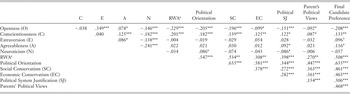
We assessed the Big Five personality dimensions using the Ten Item Personality Inventory (TIPI; Gosling et al., Reference Gosling, Rentfrow and Swann2003). The TIPI includes two items, one positively worded and the other negatively worded, for each Big Five dimension. Participants rated the extent to which each item (e.g., dependable, self-disciplined) applied to them on a 5-point scale (1 = disagree strongly, 5 = agree strongly). Scores on the TIPI are highly correlated with scores on longer Big Five measures. The TIPI shows strong test-retest reliability as well as convergent and discriminant validity (Gosling et al., Reference Gosling, Rentfrow and Swann2003). Correlations among major study variables (including personality dimensions, ideological factors, and final candidate preferences) are listed in Table 1.
Correlations between Major Study Variables

Note: For political orientation and parents' political views, higher values indicate greater conservatism. For candidate preferences, higher values indicate stronger support for McCain (or weaker support for Obama).
a RWA = Right-wing authoritarianism
†p < 0.10;
* p < 0.05;
** p < 0.01;
*** p < 0.001
RESULTS
Data Analytic Strategy
Given that voting intentions (i.e., candidate preferences) were measured at multiple time points, we conducted a series of linear growth curve analyses to examine the extent to which linear changes in voting intentions were moderated by personality and ideological factors. To adjust for the nonindependence of time points nested within individuals, data were analyzed using the MIXED procedure in SPSS. In each model, variances in the intercepts, slopes, and intercept covariance were included as random effects (the covariance type was unstructured). Time was centered at the chronological midpoint of the study. (Note that this analytic strategy can yield fractional degrees of freedom.)
We first examined the overall trajectory of voting intentions using a model in which only time was treated as a predictor at the level of the fixed effects (i.e., an unconditional growth model). Results from this analysis reveal a significant linear change such that respondents became more favorable toward Obama (and less favorable toward McCain) over time, t(620.74) = −4.26, p < 0.001. In addition, significant variance in the intercepts (Wald Z = 17.29, p < 0.001), the slopes (Wald Z = 12.38, p < 0.0001), and the slope-intercept covariance (Wald Z = 9.32, p < 0.001) was observed, indicating that sufficient variance exists to investigate moderators of candidate preferences (or voting intentions) as well as changes over time.
The remaining results are summarized in relation to three sets of models. The first set of models examines Big Five personality dimensions as predictors of overall and linear changes in voting preferences. The second set of models examines ideological predictors of overall and linear changes in voting preferences. Finally, in the third set of models, we include both personality and ideological factors and consider the possibility that the effects of some (but not all) personality dimensions on candidate preferences are mediated by ideological factors.
Personality Determinants of Candidate Preferences
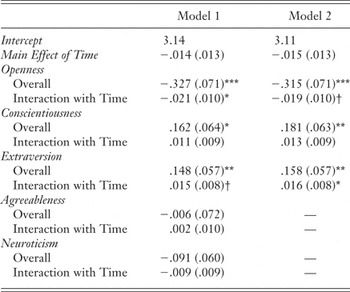
In Model 1, we estimated the main effects of the Big Five factors of Openness, Conscientiousness, Extraversion, Agreeableness, and Neuroticism and their interactions with time as predictors of candidate preferences. As can be seen in the left column of Table 2, Agreeableness and Neuroticism failed to predict overall voting preferences or changes in preference over time, and so we analyzed a second model (Model 2) in which these effects are trimmed. In both models, we adjusted for gender and ethnicity. The results for Model 2 are presented in the right column in Table 2. Overall effects were observed for Openness, Conscientiousness, and Extraversion on candidate preferences, indicating that the more conscientious and extraverted participants saw themselves as, the more they intended to vote for McCain; whereas the more open they saw themselves as, the more they intended to vote for Obama (throughout the entire time period). In addition, Openness and Extraversion both interacted with time to predict linear changes in candidate preferences.
Personality Variables as Predictors of Candidate Preferences

Note: Coefficients are unstandardized (with standard errors in parentheses).
† p < 0.07;
* p < 0.05;
** p < 0.01;
*** p < 0.001
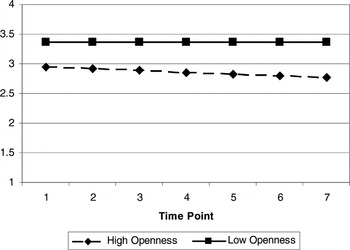
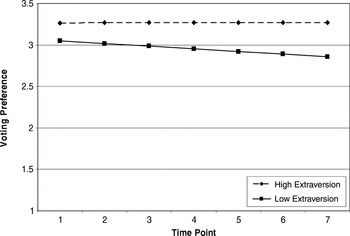
Figure 1 displays the results for individuals who are high (1 SD above the mean) and low (1 SD below the mean) on Openness. Respondents who were high on Openness (i.e., 1 SD above the mean) increasingly gravitated toward Obama, t(618.44) = −3.76, p < 0.001, whereas those low on Openness demonstrated no change over time, t(604.86) = 0.002, p = 0.99. That is, the latter group simply stuck with McCain throughout the campaign season. As illustrated in Figure 2, respondents who were high on Extraversion did not change throughout the study, t(604.62) = 0.09, p = 0.96—they consistently showed a stronger preference for McCain. However, respondents who were relatively low on Extraversion became more favorable toward Obama over time, t(614.63) = −2.43, p = 0.016.
Openness as a Predictor of Candidate Preferences

Extraversion as a Predictor of Candidate Preferences

Ideological Determinants of Candidate Preferences
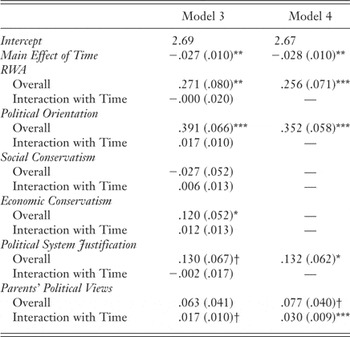
In a second set of models, we examined the degree to which respondents' overall political orientation, social and economic liberalism-conservatism, right-wing authoritarianism (RWA), political system justification, and their parents' political views predicted overall candidate preferences and changes in preference over time. We adjusted for gender, ethnicity, and political party affiliation in these models. In Model 3, we included the main effects of these measures and their interactions with time.
As can be seen in Table 3, main effects were observed for RWA, political orientation, economic liberalism-conservatism, and political system justification, but no effect was observed for social liberalism-conservatism. The analysis yielded a marginal interaction with time for parents' political views. However, no other variables interacted with time to predict candidate preferences. Therefore, consistent with the strategy followed for the personality models, we estimated an additional model in which we trimmed all effects of social conservatism, and all interactions with time for the other measures, with the exception of parents' political beliefs. The results of Model 4, which are consistent with those for Model 3, are summarized in the right-most column in Table 3.
Ideological Variables as Predictors of Candidate Preferences

Note: Coefficients are unstandardized (with standard errors in parentheses).
† p < 0.10;
* p < 0.05;
** p < 0.01;
*** p < 0.001
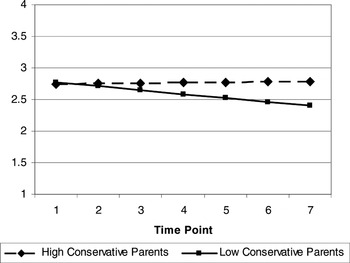
Respondents who scored higher on RWA and political system justification and who identified themselves as more conservative, both generally and on economic issues, demonstrated a stronger preference for McCain over Obama throughout the course of the study. Respondents who indicated that their parents were more conservative also preferred McCain in general, but this variable also marginally interacted with time (p = 0.057). As illustrated in Figure 3, participants who believed that their parents were high on conservatism (1 SD above the mean) consistently preferred McCain over Obama, and this effect did not change throughout the course of the study, t(371.80) = 0.482, p = 0.63. However, for participants who saw their parents as low on conservatism (1 SD below the mean), there was a significant change over time such that the strength of their preference for Obama increased, t(371.69) = −4.19, p < 0.001. Interestingly, at the beginning of the study there were no apparent differences in voting intentions as a function of parental political orientation. Rather, the significance of this variable came into play later, as respondents who perceived their parents as relatively liberal were more likely to exhibit “Obama conversion.”
Parents' Political Views as a Predictor of Candidate Preferences

Do Ideological Factors Account for the Effects of Personality on Candidate Preferences?
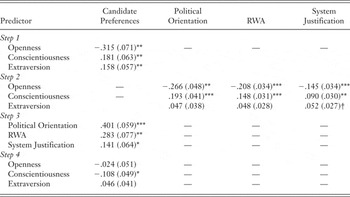
In a third set of analyses, we examined the extent to which the effects of personality dimensions of Openness, Conscientiousness, and Extraversion on candidate preferences (see Table 2) could be statistically explained by the relationship between personality and ideological factors, such as political orientation, right-wing authoritarianism, and system justification tendencies (see Carney et al., Reference Carney, Jost, Gosling and Potter2008; Jost Reference Jost2006; Jost et al., Reference Jost, Nosek and Gosling2008b). To investigate this possibility, we conducted a mediational analysis in which the three personality variables were treated as predictor variables, the three ideological variables were treated as mediators, and candidate preference was treated as the outcome variable. We followed the four steps outlined by Reuben Baron and David Kenny (Reference Baron and Kenny1986; see Table 4). Because the three ideological factors did not interact with time to predict candidate preference, we only examined the degree to which they mediated the overall personality effects (i.e., across the trajectory).
The Effects of Openness and Conscientiousness on Candidate Preferences are Mediated by Political Orientation, Right-Wing Authoritarianism, and Political System Justification

† p < 0.10;
* p < 0.05;
** p < 0.01;
*** p < 0.001
We know from Table 2 that Openness, Conscientiousness, and Extraversion all predicted candidate preferences, adjusting for other factors. Thus, the total effects of the three personality variables are statistically significant (i.e., Step 1 is satisfied). In Step 2, the three personality variables were treated as predictors of political orientation, RWA, and system justification. As can be seen in Table 4, Openness was significantly and positively associated with political liberalism and negatively associated with RWA and system justification; these findings are consistent with the results of prior research (e.g., Carney et al., Reference Carney, Jost, Gosling and Potter2008; Duckitt and Sibley, Reference Duckitt, Sibley, Jost, Kay and Thorisdottir2009; Jost Reference Jost2006; Jost et al., Reference Jost, Nosek and Gosling2008b). Conscientiousness was significantly and positively associated with political conservatism, RWA, and system justification. Extraversion was positively associated with political system justification, but it was not associated with RWA or liberalism-conservatism.
In Steps 3 and 4 (which are estimated simultaneously), we treated the personality variables and the three ideological variables as simultaneous predictors of preferences for Obama versus McCain (adjusting for sex, ethnicity, and party affiliation). Consistent with prior research (e.g., Jost Reference Jost2006), political orientation significantly predicted voting preferences, t(335.50) = 6.80, p < 0.001, as did RWA, t(335.58) = 3.70, p < 0.001, and political system justification, t(335.85) = 2.19, p = 0.029 (see Table 4). Thus, people who were more conservative, more authoritarian, and more likely to justify the political system preferred McCain over Obama.
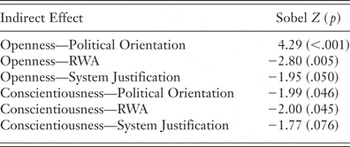
With political orientation, RWA, and political system justification in the model, the effect of Conscientiousness on candidate preferences remained significant, t(335.63) = −2.19, p = 0.03, but the effect of Openness did not, t(335.74) = −0.48, p = 0.63. Results of Sobel tests for each of the indirect effects involving Openness and Conscientiousness are summarized in Table 5. All of the indirect effects were significant, with the exception of the indirect effect from Conscientiousness to system justification, which was marginal. In sum, then, the results reveal that all three of the ideological variables independently mediated the effect of Openness on candidate preferences and voting intentions and two of them (political orientation and RWA) mediated the effect of Conscientiousness. None of the ideological variables significantly mediated the effect of Extraversion on candidate preferences.
Sobel Tests for the Effects of Personality Variables on Candidate Preferences Mediated by Ideological Variables

GENERAL DISCUSSION
For several decades, social scientists and laypersons alike have exuded skepticism concerning the notion that citizens' personality characteristics and ideological commitments play a significant role in political behavior. It is frequently assumed that elections are won and lost largely on the basis of campaign fundraising, message discipline, political advertising, mass media coverage, and other institutional or “top-down” processes. These factors are obviously important, but it would be foolhardy to assume that increased candidate exposure will have the same (presumably beneficial) effects on citizens who differ greatly from one another in terms of personality and ideology. Our research demonstrates that there are general predispositions that link political and nonpolitical predilections, and these do indeed predict candidate preferences over time, especially as citizens' familiarity with the major candidates grows as the election approaches.
What are the distinctive characteristics (or predispositions) of those college students in our study who were drawn to Barack Obama? In terms of general personality traits, they were relatively high in Openness, low in Conscientiousness, and (perhaps surprisingly, given Obama's apparent gregariousness) low in Extraversion. The effects of Openness and Conscientiousness (but not Extraversion) increased in strength with the election's proximity, suggesting a possible interaction between “top-down” processes of mass communication and “bottom-up” processes associated with citizens' personality characteristics. The finding that high Extraversion was associated with support for McCain was somewhat anomalous, given the research literature as a whole (see Carney et al., Reference Carney, Jost, Gosling and Potter2008). Possibly it reflects a “context effect,” given that the study was conducted in a strong Republican state. One might expect that in a strong Democratic state, high Extraversion would be associated with support for the more liberal candidate.
In terms of ideological factors, Obama supporters tended to be liberal and to score relatively low on measures of authoritarianism and system justification. Based on the current study, it is difficult to determine the extent to which Obama's racial background played a major role in attracting or repelling students based on their ideological characteristics, but the fact that authoritarianism (even after adjusting for political conservatism and other ideological variables) was associated with decreased support for his candidacy is suggestive of the possibility that intolerance may have played some role. Interestingly, students who saw their parents as relatively liberal increasingly gravitated toward Obama over time, whereas students whose parents were described as conservative were relatively constant in their support for McCain. It is important to point out that this effect of parental ideology was independent of students' own self-reported liberalism-conservatism, despite the fact that self- and parent ratings of political orientation were significantly correlated (r = 0.44).
Previous research has shown that Openness and Conscientiousness predict both political orientation in general (e.g., Carney et al., Reference Carney, Jost, Gosling and Potter2008) and voting behavior in particular (Caprara et al., Reference Caprara, Barbaranelli and Zimbardo1999), but no extant study has (to our knowledge) demonstrated, as we have, that the effects of personality on voting preferences are statistically mediated by individual differences in political ideology. The results of this study, therefore, add substantially to the growing evidence that left-right bipolar conceptions of ideology are indeed useful for understanding political behavior and that ideological differences appear to be grounded in basic psychological processes (see also Jost Reference Jost2006). The fact that political orientation, right-wing authoritarianism, and political system justification each contributed independently and significantly to candidate preferences and that they also mediated the effects of personality on candidate preferences suggests that, at least to some extent, they are tapping into distinctive (but correlated) ideological constructs.
Of course, there are limitations to what can be concluded on the basis of this study alone. For one thing, although the study sample was quite large, it was not a nationally representative sample, but rather a sample of students attending a large public university in a Republican-leaning Western state. Furthermore, although the longitudinal design of the study allowed us to investigate changes in individuals' candidate preferences over time (i.e., Obama conversion), we do not know what specific exogenous factors (in terms of campaign strategy, media coverage, and so on) interacted with the students' predispositions to bring about change in candidate evaluations over time. For instance, it is conceivable that the individual's degree of Openness affected his or her susceptibility to certain kinds of persuasive messages that Obama successfully communicated. It remains a task for further research, in other words, to discover more precisely how “top-down” and “bottom-up” processes “meet in the middle” (see also Jost et al., Reference Jost, Federico and Napier2009).
In The American Voter, Campbell et al. ([1960] Reference Campbell, Converse, Miller and Stokes1965) distinguished between “personal forces, which move individuals selectively without reference to the larger social categories to which they belong, [and] social forces, which move large sections of the population more or less simultaneously” (p. 88). Although it would be unwise to extrapolate on the basis of our study to the voting population of the United States as a whole, the results presented here suggest that, at least for the young people who participated in our study, Barack Obama succeeded not in winning over huge sections of the population as a whole but rather those individuals who—on the basis of their personal and ideological characteristics—were potential “converts.” In our sample at least, he appeared to do this more effectively than did his opponent, John McCain. The research reported here also suggests that some “personal forces” are by no means idiosyncratic, unpredictable, or randomly determined. On the contrary, they may well reflect unifying cognitive and motivational structures within the individual that are not merely “surrogates” for ideology but may in fact constitute the underlying causes of ideological predispositions. Campaign advisors and researchers of political behavior, it seems to us, embrace considerable risk and uncertainty when they continue to ignore forces such as these.