Introduction
Spousal loss in later life is a common event and has been conceptualised as part of the normative ageing process (Chambers Reference Chambers2005). The risk of widowhood increases with age, and is particularly prevalent in the fourth age (85 years and older). In Australia, over three-quarters (76.6%) of women and one-third (35.9%) of men aged 85 years and older are widowed (Australian Bureau of Statistics 2012). Individuals experiencing widowhood in later life face additional challenges relating to the ageing process which may adversely impact upon their ability to cope successfully with spousal bereavement (Carr Reference Carr, Carr, Nesse and Wortman2006; Feldman, Byles and Beaumont Reference Feldman, Byles and Beaumont2000). Despite the increased prevalence of spousal loss associated with advancing age, there has been no dedicated research to date focusing on the experience of widowhood in the fourth age.
It is important that research exploring widowhood in later life differentiates between the third and fourth ages (Baltes Reference Baltes1998; Baltes and Smith Reference Baltes and Smith2003). The third age (65–84 years) has been associated with improved physical and cognitive wellbeing for successive cohorts. The fourth age, however, remains a period of decreasing reserves and plasticity, with greater inherent risks of functional loss and co-morbidity. The oldest-old are more likely to experience physical and cognitive health issues, functional loss, financial strain and the shrinking of social networks compared to older adults in the third age (Baltes and Smith Reference Baltes and Smith2003; Carr Reference Carr, Carr, Nesse and Wortman2006). Furthermore, as a consequence of physical limitations and decreasing social networks, ageing has also been associated with an increased risk of diminishing social resources (Martin et al. Reference Martin, Poon, Kim and Johnson1996). Given the additional health and social challenges frequently faced in the fourth age, it is important to understand the lived experience of widowhood for the oldest-old, and in particular their social and personal support needs.
A widowed older adult's social relationships, their sense of identity and ability to manage daily living are greatly impacted upon by spousal bereavement (Lieberman Reference Lieberman1996). The ability to access and mobilise social resources – close relationships, support and opportunities for social participation – in widowhood has been associated with better psychological and physical wellbeing (Balaswamy and Richardson Reference Balaswamy and Richardson2001; Janke, Nimrod and Kleiber Reference Janke, Nimrod and Kleiber2008; Zettel and Rook Reference Zettel and Rook2004). Therefore, access to social resources to assist in cushioning the impact of spousal loss is important during late-life widowhood (Brown, House and Smith Reference Brown, House, Smith, Carr, Nesse and Wortman2006; Lang Reference Lang2001; Ong, Bergeman and Boker Reference Ong, Bergeman and Boker2009). Without sufficient resources, widowed older adults living alone would be forced to rely on community services as they age, increasing pressure on already stressed aged-care systems (Department of Health and Ageing 2012). Hence, understanding the potential role social resources have in protecting older adults from the strain of widowhood and in promoting successful ageing is imperative.
Previous research exploring social resources in late-life widowhood has typically focused on individuals in the third age or younger (e.g. Balaswamy, Richardson and Price Reference Balaswamy, Richardson and Price2004; Bennett et al. Reference Bennett, Stenhoff, Pattinson and Woods2010; Guiaux, van Tilburg and van Groenou Reference Guiaux, van Tilburg and van Groenou2007; Janke, Nimrod and Kleiber Reference Janke, Nimrod and Kleiber2008; Riggs Reference Riggs1996). Widowhood studies which have involved participants from the fourth age have tended to include mid-life adults in the same sample without considering the potential heterogeneity of these different age cohorts (Bennett Reference Bennett2007, Reference Bennett2010; Li Reference Li2007; Lund et al. Reference Lund, Caserta, van Pelt and Gass1990; Stevens Reference Stevens2002). Furthermore, the majority of this research has been quantitative and focused on individual outcome measures, e.g. changes in the composition of the social network, frequency of social contact, the receipt of emotional or instrumental support. Meanwhile, qualitative studies exploring social resources in late-life widowhood are much smaller in number. With the exception of research examining re-partnering choices (Davidson Reference Davidson2001, Reference Davidson2002; Stevens Reference Stevens2002), male friendships (Riggs Reference Riggs1996) and instrumental independence (Bennett et al. Reference Bennett, Stenhoff, Pattinson and Woods2010), qualitative studies have focused on the broader experiences of widowhood during the third age, rarely the fourth, with scant specific emphasis on social resources.
Spousal bereavement leads to considerable flux in social resources in the third age and mid-life, particularly in early widowhood. Contact with, and support from, the social network typically increases prior to spousal loss, returning towards pre-loss levels later in widowhood (Guiaux, van Tilburg and van Groenou Reference Guiaux, van Tilburg and van Groenou2007; Isherwood, King and Luszcz Reference Isherwood, King and Luszcz2012; Lund et al. Reference Lund, Caserta, van Pelt and Gass1990; Stroebe et al. Reference Stroebe, Zech, Stroebe and Abakoumkin2005). Access to, and the mobilisation of, social resources may be different in the fourth age. Indeed, longitudinal studies exploring social resources in recent widowhood (with samples primarily in the third age) have suggested that advancing age is associated with increased dependence on children (Ha et al. Reference Ha, Carr, Utz and Nesse2006), lower levels of emotional and instrumental support provided to the social network (Guiaux, van Tilburg and van Groenou Reference Guiaux, van Tilburg and van Groenou2007), reduced contact with the social network (Guiaux, van Tilburg and van Groenou Reference Guiaux, van Tilburg and van Groenou2007), decreased social engagement (Bennett Reference Bennett2005; Isherwood, King and Luszcz Reference Isherwood, King and Luszcz2012) and lower rates of volunteering (Donnelly and Hinterlong Reference Donnelly and Hinterlong2010). Hence, as older adults in the fourth age are at risk of possessing fewer social resources, the experience of widowhood is likely to be particularly challenging.
To date then, there have been no previous studies exploring social resources during widowhood in the fourth age. This qualitative study sought to address this gap by aiming to understand the particular experience of social relationships, support and activities in the lives of widowed men and women in the fourth age. Three specific research questions were addressed. Firstly, how is access to, and the mobilisation of, social resources experienced in widowhood during the fourth age? Secondly, is this experience different for older adults who are bereaved in the third and fourth ages? Thirdly, what role do social resources play in successful adjustment to widowhood in the fourth age?
Method
In-depth interviews were conducted with widowed participants from the Australian Longitudinal Study of Ageing (ALSA). The ALSA is a multi-wave longitudinal study which began in 1992 with 2,087 participants aged 65 years and older. Conducted in Adelaide, by the Flinders Centre for Ageing Studies, the ALSA aims to enhance understanding of biological, social and psychological factors associated with age-related changes in the health and wellbeing of older people. The current cohort of the ALSA is now aged 85 years and older, and has thus reached the fourth age. The qualitative interviews were therefore able to provide a unique understanding of the lived experience of widowhood in the fourth age.
Sampling strategy and recruitment
At the time of recruitment for this study, ALSA participants had last been interviewed approximately six months previously for Wave 11 of the main study. To be eligible for the current qualitative study, potential participants had to have been widowed for at least six months and be of sound cognitive function. Cognitive function was assessed at Wave 11 using the Mini-Mental State Examination (MMSE; Folstein, Folstein and McHugh Reference Folstein, Folstein and McHugh1975). Participants with an MMSE score of less than 24 were excluded from the study (as lower scores may indicate the presence of possible cognitive impairment; Folstein et al. Reference Folstein, Anthony, Parhad, Duffy and Gruenberg1985).
Study participants were selected using a stratified purposeful sampling methodology. Purposeful sampling is used in qualitative research to select cases which are ‘information rich’ and thus able to provide information regarding their experiences to aid understanding of the research topic (Patton Reference Patton2002). Sampling was stratified on key attributes in order to facilitate comparison between groups of participants (Miles and Huberman Reference Miles and Huberman1994). As the exploration of potential gender differences in the experience of social resources in widowhood in the fourth age was a particular focus of the study, men were over-represented in the sample (compared to the general population) and two primary strata were constructed comprising equal numbers of male and female participants. Participants were selected within these strata for maximal variation in terms of their current age and length of widowhood.
The current ALSA participant database was explored to identify participants who met the eligibility and sampling criteria described above. A letter of invitation and information sheet were sent to eligible participants. A telephone call was then made to potential respondents to provide more information regarding the qualitative interview and ascertain interest in participation. Written informed consent for participation was obtained prior to the interview.
Participants
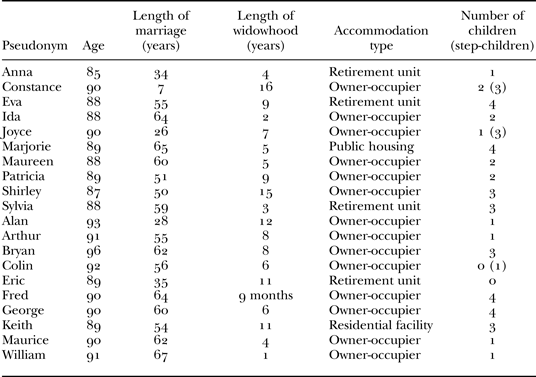
Twenty participants were interviewed in total (ten men and ten women). To maintain confidentiality a pseudonym was given to each participant. Information regarding the participants (including pseudonym, age, length of marriage and widowhood, accommodation type and number of children) is outlined in Table 1. Participants ranged in age from 85 to 96 years, and the average length of marriage prior to widowhood was 50.7 years. The participants had been widowed for between nine months and 16 years, with seven participants (five men and two women) having been widowed during the fourth age. Three of the female participants had been widowed in an earlier marriage, subsequently re-married and had again experienced spousal loss; the focus of these interviews was on their most recent period of widowhood.
Characteristics of the participants

Fourteen of the participants owned and lived in private houses in the community. A further four participants lived in retirement units, one in rented public housing and one participant had recently moved to a residential aged-care facility. Except for one participant who shared her home with her son, the participants lived alone. All participants, except one, reported having at least one child or step-child.
Data collection
Semi-structured interviews were conducted with participants, with a duration of 45 minutes to two hours. An interview guide was formulated that outlined the main issues to be covered, but opportunity was allowed for individual perspectives and unanticipated themes to emerge. Participants were asked about their current social networks – who were the most important people in their lives, how close they lived to family and friends, and the frequency and type of contact with the network. The interviews also examined the frequency, types and sources of social support that was received and provided to others. Participants were asked how they typically spent their time, including their social participation and activities in the home. The respondents' satisfaction with their social resources was also explored, in particular any changes that they wished to see in how they spent their time, their relationships with others, and the support they gave and received. Finally, the role that these social resources had played in assisting with the challenges of widowhood in the fourth age was also examined.
Data analysis
The interviews were audio-recorded and transcripts entered into NVivo 10 to assist in the management of the interview data. The data were analysed using framework analysis, a form of thematic analysis. The framework analysis methodology follows five key stages: familiarisation with the data, the identification of a thematic framework, indexing, thematic charting, and the mapping and interpretation of the data (Ritchie and Spencer Reference Ritchie, Spencer, Bryman and Burgess1994; Ritchie, Spencer and O'Connor Reference Ritchie, Spencer, O'Connor, Ritchie and Lewis2003).
Familiarisation with the data, through the repeated reading of the transcripts, assisted in the identification of important ideas and recurring topics. A thematic framework, which contained a list of emergent categories and codes, was subsequently developed and agreed upon by the research team. This framework was applied to several of the transcripts and, in order to better fit the data, was refined accordingly. The thematic framework was then systematically applied to the transcribed data. This process of ‘indexing’ was performed using NVivo, with the coding of interview data into hierarchical nodes. Thematic charting was then undertaken, whereby a matrix was created which included each node identified in the thematic framework. Participants were allocated a row in the thematic matrix and their respective data for each individual node was summarised. The data were then interpreted and patterns within the data were found and key themes and sub-themes established.
Ethical considerations
As the purpose of the qualitative interviews was to discuss the accessibility and mobilisation of social resources in widowhood in the fourth age, the focus of the interviews was not directly on the experience of bereavement. However, the risk remained that the interview could raise upsetting memories for participants. Studies exploring the impact of participation in bereavement research (Beck and Konnert Reference Beck and Konnert2007; Buckle, Dwyer and Jackson Reference Buckle, Dwyer and Jackson2010; Dyregrov Reference Dyregrov2004; Hynson et al. Reference Hynson, Aroni, Bauld and Sawyer2006; Seamark et al. Reference Seamark, Gilbert, Lawrence and Williams2000) have found that while participants may become upset during the interview when discussing their loss, there is no detrimental impact on subsequent wellbeing. Participating in research exploring bereavement issues may actually lead to beneficial outcomes and participants have reported finding the experience of being able to talk about their loss constructive and positive (Buckle, Dwyer and Jackson Reference Buckle, Dwyer and Jackson2010; Hynson et al. Reference Hynson, Aroni, Bauld and Sawyer2006).
The current study followed guidelines established for ethical bereavement research (Buckle, Dwyer and Jackson Reference Buckle, Dwyer and Jackson2010; Cook Reference Cook, Stroebe, Hansson, Stroebe and Schut2001; Hynson et al. Reference Hynson, Aroni, Bauld and Sawyer2006; Parkes Reference Parkes1995). Only widowed adults who were at least six months post-bereavement were eligible to participate. Also, in order to provide the least intrusive approach, potential participants were contacted initially with a sensitively written letter and allowed time to consider their participation. Additionally, participants were provided a ‘no-questions-asked’ opt-out option and given information regarding avenues for professional support. Finally, the interviews were conducted by an experienced qualitative researcher with a background in mental health social work, were informal in tone and allowed the participant as much time as they needed. All respondents coped well with the experience of participating in an in-depth interview; while some tears were shed when talking about their spouse, no participants became overly distressed.
Results
From the analysis of the interview data, four themes relating to social resources in widowhood in the fourth age emerged. The first theme, ‘the changing social network’, explored losses experienced in social networks during widowhood in the fourth age and how the remaining network members compensated for this. A second theme, ‘ageing, health and social support’ described how, as a consequence of ageing and deteriorating health, participants began to require and receive increasing levels of support during the fourth age. A third theme, ‘perceptions of support’, explored satisfaction with current social support and how participants strove to preserve independence in the face of increasing support needs. The final theme, ‘living a socially engaged widowed life’, examined the role that social resources play in the attainment of a fulfilling widowed life in the fourth age.
Theme 1: The changing social network
The social networks of the widowed participants had undergone substantial change as they had aged. The size of these networks had diminished considerably with the loss of friends, siblings and, in some circumstances, adult children. In order to compensate for these diminishing networks, the children of participants were increasingly important as key sources of social contact and support.
Losses to the social network
The loss of friends from the social network through serious illness and death was a recurrent topic raised by all participants. The reaching of the fourth age had been accompanied by the deaths of many close friends, and this loss was lamented. As a consequence, potential avenues for social contact and support during widowhood declined in the fourth age. While all participants reported experiencing reduced social networks due to the death of friends, the friendship networks of the male participants had been particularly compromised. Indeed, half of the male participants reported that they currently had no living friends.
The sad part about getting old is that some of your friends pass away before you do and that was what was happening. We were finding that our circle of friends was getting smaller, we'd outlived them. (Arthur, widowed eight years)
Losses were also experienced within the families of participants during the fourth age; as well as the death of the spouse, many siblings had passed away. Additionally, for three of the participants, the devastating death of an adult child had been experienced. Maureen's son and husband were both seriously ill at the same time and sadly died within one year of each other.
I had [my son] – he was older than the other two – but he unfortunately got this multiple myeloma and he lasted about six or seven years after he got it. [He] was only 56 when he died but he'd done a terrific lot in that 56 years … I got through his death, my husband died a year after and I kept very strong. (Maureen, widowed five years)
The growing importance of children
The shrinking of social networks experienced by participants in the fourth age led to social contact and informal support becoming increasingly centred on close family in widowhood. In particular, relationships with adult children were typically perceived by participants as being the most important within their social networks.
I value my family more than I ever have; before I never did … I do realise that family care for you whereas your friends are concerned but they don't really … But I mean I can rely on my children. See I value them and before I never did because I realise that I am dependent on them and I haven't really been dependent upon them before. (Shirley, widowed 15 years)
Theme 2: Ageing, health and social support
As well as coping with the changes brought about by spousal bereavement, all the participants in the study were faced with additional challenges (such as poorer health, relocation and driving cessation) which were related to the process of ageing during widowhood in the fourth age. These concurrent issues impacted upon the participants' ability, and need, to access and mobilise their social resources to address increasing support needs.
An increasing need for social support
Many of the widowed participants experienced health issues (such as chronic pain, cardiac disease, stroke, cancer, mental illness, mobility limitations and sensory impairments) which impacted them on a daily basis. There was, however, great variety with regard to the impact of health on participants' lives in the fourth age. Over a third of participants (mostly males) considered themselves very healthy for their age. In contrast, a fifth of the participants (predominantly females) were considerably disabled by their health conditions. Overall, an increased need for support was reported in the fourth age due to worsening health and functional capability.
As a consequence of these health issues, living alone had become increasingly difficult for some participants following spousal loss. A third of participants had relocated to new accommodation either in preparation for, or since, becoming widowed: to retirement units, smaller private houses or a residential aged-care facility. One participant had also begun co-residing with her son following spousal loss and several participants were currently questioning the possibility of leaving their marital home. Accessibility of informal care from children, due to a heightened need for support, was a primary driver for relocation.
I came here three years ago [to a retirement unit] when I sold my unit and I came here because my daughter was so close. It's a beautiful area here and it's close to the bus, close to everywhere. My own unit with two bedrooms was too big for me and I decided to come here and my daughter lived here so she can walk over. (Anna, widowed four years)
A further issue was the cessation or limiting of driving. This led to an increased reliance on family members for assistance with transportation to social events and appointments, and for shopping or the running of errands. Concerns about health issues and driving ability during widowhood in the fourth age had led to the cessation of driving for a third of participants. Those who continued to drive tended to impose self-limits on their driving behaviour, for example driving only within their local area or at certain times of the day. Driving cessation was perceived (particularly by men) as being a major barrier to independence which made the continuation of previously valued social and instrumental activities very difficult and prompted greater dependence on members of the social network.
I decided at 89 that the traffic seemed to be going a bit faster and the hills were getting a little bit steeper, so I thought now's the time to give it up … I usually say to [my step-son] ‘look, while you're doing your shopping, because you've got the car will you do mine as well and bring it up for me on Sunday?’ (Colin, widowed six years)
Receiving social support
Most participants reported requiring support with at least one practical or personal care task; only two of the participants considered themselves to be completely independent. Levels of required support varied considerably among participants, with most receiving a mixture of formal and informal support. No gender differences were observed in either the frequency or type of received social support.
Ongoing informal support was almost exclusively provided to participants by their adult children. Hence despite experiencing diminishing friendship networks in widowhood in the fourth age, support needs were typically being met by the children of participants in conjunction with formal services from aged-care providers. As the support needs of participants had increased with advancing age and poorer health during widowhood, social contact with children was often combined with the receipt of instrumental support. Bryan described how this interaction between social support and contact operated between him and his children.
My daughter, [I see] once or twice a week. My son, once a week unless there's work to be done then he comes whenever. At the moment he normally comes on a Wednesday. He does my paperwork, does my filing and all that sort of thing … any maintenance that needs to be done he tends to, and we go out and have a dinner at the hotel then come back and we have coffee. (Bryan, widowed eight years)
A traditional gender split was seen in the type of support offered by daughters and sons to their widowed parents. Daughters tended to provide support with shopping, meals and transportation, while sons typically gave assistance with household maintenance and gardening.
One of them [my daughters] started doing my shopping two or three years ago because I couldn't stand and lift things … We've come to a compromise with what I can do so, no, I think it's just been a gradual changeover because of my declining debility, declining health … They can see I haven't been well enough to do things, they've just sort of taken over … I know I found it very difficult to start with, to just sit down and not be doing everything. Everybody does things differently so I just shut my eyes. (Constance, widowed 16 years)
As well as the receipt of ongoing support, almost three-quarters of participants discussed the importance of knowing that people were available to them in an emergency situation. While not typically providing regular ongoing support, neighbours were seen as an important source of emergency support during widowhood, especially if family were not living in close proximity. A reciprocal neighbourly arrangement to ensure safety when living alone in the community had been initiated by some participants (particularly those with elderly neighbours) since the loss of their spouse.
I'm very close to my neighbour. The week we moved here his wife suddenly died, she had an aneurism, and consequently he's in the same spot as me … We have an arrangement that if I go away I leave my keys, my son's phone number and he has a son and I do the same for him. If perchance he should see my paper out there late in the day he would be a bit concerned, he would ring the bell and if he didn't get any answer he'd ring my son. (William, widowed one year)
Theme 3: Perceptions of support
Despite needing and receiving increasing levels of social support in widowhood in the fourth age, a desire to maintain independence was expressed by many participants. Strategies utilised by the older widowed adults in this study to maximise their independence were identified. Furthermore, satisfaction with current informal support was found to be highly dependent upon whether this assistance was considered by participants to be wanted and necessary.
A desire for independence
While acknowledging an increasing need for social support in the fourth age, over half the participants reported a desire to maximise their independence. This need for independence during widowhood was deemed particularly important by male participants. The maintenance of independence in the face of increasing support needs was negotiated through three strategies: doing as much as possible for oneself, the giving of support to others and upholding a positive attitude towards the receipt of support.
Participants keenly stressed that they did as many tasks for themselves as possible in order to continue to be self-sufficient in the fourth age.
The people at the back are well prepared to run me anywhere in their car but I don't like to use them too much so in the fine weather I use the gopher [mobility scooter]. I've been independent all my life, right through. If you've been through life dependent on people you're going to be in trouble aren't you? (Alan, widowed 12 years)
Linked to this desire to maintain independence was a wish not to over-burden others in their social network. The female participants, in particular, felt that their children should not be obligated to provide care for them in advanced age.
I've never been one to just live and expect my children to look after me. I've been so independent, that's my trouble. I don't like being a burden to anybody and … my son used to say ‘mother accept things graciously and don't fight anybody to do things’. I was sort of ‘no, I'll do it’ … You've really got to stand on your own two feet and think ‘well, I've got to make a go on my own and not expect them to do it’. I mean if they do it well, that's lovely, but I haven't ever expected them to be at my beck and call. (Maureen, widowed five years)
For some participants, reciprocity of support was seen as an important aspect of maintaining independence in later life. Although with advancing age decreasing amounts of assistance were provided to others, social support was still perceived as an exchange process which was reciprocal in nature. Only three participants, due to health restrictions or small social networks, did not currently provide assistance to others. While social support was given primarily to adult children, limited instrumental support (assistance with shopping and medication, transportation, and the provision of meals and companionship) was also provided to friends, particularly on a short-term basis during times of ill-health. Daughters received a greater degree and wider-ranging support from their widowed parents (companionship, emotional and financial support, assistance with household maintenance and gardening), while more limited support in the form of financial assistance and companionship was provided to sons.
Further gender differences were also observed in the type of support offered by the widowed men and women to their familial networks. Both male and female participants reported the giving of companionship, and assisting with shopping and gardening. Female participants also described providing emotional support and advice to family members, while males – where functional ability permitted – helped with household maintenance tasks. The giving of financial support to children (or the promise of a future inheritance) was also perceived by male participants as an important form of reciprocity.
My daughter will go and get them [my medications] for me if it's real wet weather; it's not that much out of her way. I mean I look after her. If she wants any money or anything I see her right so she owes me. (Keith, widowed 11 years)
Satisfaction with social support
The majority of participants were satisfied with the levels of support they currently received. However, the acceptance of support during widowhood in the fourth age depended a great deal upon whether the support was perceived to be necessary or wanted. Feelings of being appreciated and cared for were experienced by many of the older widowed adults through the receipt of informal support from their children. Furthermore, participants conceded that their current levels of support were needed as a consequence of their ongoing health and mobility issues. For some, the acceptance of instrumental support entailed more personal freedom. By receiving support to address her care needs, Constance was able to maintain the energy required to pursue valued social activities.
Since I got into big trouble – that was about 12 months ago – I had the district nurse come in and shower me in the morning, and actually I could struggle to shower myself although I have to have this to lean on to get out of the shower and sit down and everything but then I'm a bit worn out. If I just have a bit of help to get going I can manage for the rest of the day. (Constance, widowed 16 years)
However, instances were also described when informal support had been provided by family and friends which was not wanted and unnecessary. Male participants, and particularly those who had been widowed during the fourth age, were most likely to report the receipt of support from their children which was not necessary for physical health reasons. A perceived duty of care led to daughters (or daughters-in-law) frequently insisting on providing household support to their widowed fathers. Ida expressed a common viewpoint held by the female participants that older men were less able to cope with the practicalities of spousal loss than women and therefore required more assistance during widowhood.
I mean you're used to running a house; that's why a lady is better off than a man, unless he's a really domesticated man … My life doesn't change as a widow in that I've got to get the meals, I've got to think of the shopping, I've got to do this and I've got to do that, where a man is just left with nothing. (Ida, widowed two years)
While some of the participants were grateful for the additional help provided to them by their children, others viewed unnecessary support as being an imposition and hindering independence. Despite these concerns, participants seemed reluctant to raise objections to this assistance. Bryan, in spite of his severe visual impairment, enjoyed cooking for himself and disliked being provided meals by his daughter-in-law.
She comes down and he [my son] carts in an esky [cool box] and it's full of frozen meals. Open the freezer and I've got more food than I know … It just happened, I didn't make any arrangements for it. It's been going on for three or four years now. I don't know why they did but she reckons it's no trouble, when they have a meal she cuts an extra one off and puts it in the freezer. I sometimes wish they wouldn't … I've had to be pretty independent all through my life and it's stuck with me I suppose. I don't really think I need any more [help]. I don't want to accept anything else if I can do it myself. (Bryan, widowed eight years)
Theme 4: Living a socially engaged widowed life
Despite facing challenges and constraints associated with widowhood and advancing age, most of the participants lived happy, fulfilling lives. Great resilience had been demonstrated in the ability to rebuild lives following spousal bereavement. For many, the ability to access and mobilise their social resources during widowhood had strongly contributed to this positive adaptation. Being with others and keeping busy were identified as important factors that had enabled the construction, or continuation, of a socially engaged and meaningful widowed life in the fourth age.
Being with others
The primary importance of close ties with family and friends during widowhood was highlighted by most participants. As described above, decreasing friendship networks and a need for increased social support had led to relationships with adult children often becoming the closest and most important within the social network. Geographically close, but not co-residing, parent–child relationships with frequent face-to-face contact were the norm. The frequency of social contact with children, however, was found to differ according to gender, with female participants reporting more frequent contact than males. While most participants were content with the level of current social contact they had with their children, three-quarters of participants described barriers which prevented more frequent contact. Participants acknowledged that their children lived busy lives with work and their own family responsibilities. Arthur recognised that his daughter's caring commitments prohibited more frequent contact.
Her daughter's got a young family and she's very often – she's a grandmother and grandmothers got to do grandmother jobs. She works part-time two days a week and then of course the other times she tries to help out with her grandchildren and that. She hasn't got so much free time now because she's got to look after her own place of course and she's got her washing to do and her husband's still working. No, she's got her time that's pretty well taken up like that … I try not to encroach on their lives. (Arthur, widowed eight years)
Although most participants reported having good relationships with their children, some tensions were acknowledged and a desire to have more frequent contact expressed. Alan described a distant relationship with his son:
He thinks a phone call is a wonderful thing to do but an offer to cut the lawn or something like that, no. He's the direct opposite to me. He wouldn't know what end of a hammer to pick up. (Alan, widowed 12 years)
As discussed in Theme 1, with advancing age the loss of long-standing friendships had been experienced by all participants. Remaining friends were regarded as being an integral part of the social network in widowhood in the fourth age, and the emotional support engendered through these relationships was perceived as being of great value following spousal loss by female respondents. The maintenance of current friendships was increasingly challenging in the fourth age, however, due to ill-health and mobility restrictions. Where possible, participants arranged regular social activities with their friends. When face-to-face meetings became impossible, telephone contact was established by participants and friends visited when unwell.
I made a great friend; her husband was in the same nursing home [as my husband] and we used to have afternoon tea together every day. We just clicked and I used to go [to her home] every Saturday morning and have morning tea with her. She wasn't in very good health and eventually she had to go into a nursing home and I visited her every Saturday just the same up there until she died. (Joyce, widowed seven years)
Gender differences were reported in the level of social contact participants had with friends in widowhood during the fourth age. Male participants were especially disadvantaged in the frequency of contact with friends; only two male participants reported having large current friendship networks which had formed through involvement with the church and veteran community, respectively. Compensation for the absence of these networks was facilitated in various ways, including enhanced contact with children and other family members (e.g. siblings and grandchildren). Additionally, two male participants had met new (and considerably younger) partners during the fourth age and these relationships provided an important source of social contact and intimacy.
I've got a lady partner I see a couple of times a week; we have dinner a couple of times a week in a pub somewhere. Oh it gives me something to do, to occupy your mind. If you go out somewhere it's nice to have someone that you can rely on to talk to … Her husband cleared out and left her at the same time [my wife] died so I filled in for her and she filled in for me, just like that. She doesn't do anything for me. She doesn't wash or anything for me, I do it myself. But it's good to have someone to fall back, rely on. (George, widowed six years)
In contrast, the widowed women in this study universally expressed a disinterest in establishing new intimate relationships at this stage in their lives. While missing the companionship of marriage, the female participants described positive aspects of being single, such as having personal freedom and not having to look after a partner.
Now I'm on my own and I've got over the worst of it you do get a little bit selfish about being on your own … If I don't want to do anything I don't have to but to have another person in the house that I had to look after, well I don't think I could do it now … I've some [male] friends and we all meet up but I wouldn't even consider it. Friends, yes, but not moving in with one another, I mean I'll leave that to the young ones. I do think it's easier when you're older, up to the point that you're not looking for company – men's company, like for the sex side of it. (Maureen, widowed five years)
Keeping busy
Keeping busy was identified as a further key strategy to assist in coping with the stresses and demands of widowhood in the fourth age.
I've got a friend who has just lost his wife and I saw him this morning in the shops and – dare I say he's not quite so strong as I was at the time. He tends to tell you how bad it is and he doesn't have to tell me, I know, but I try to help him and say ‘Look, face up to it. It's happened and pull yourself together and get busy’. Well that's the main thing, keep busy. I advised him to join a couple of things too. (William, widowed one year)
Health issues had commonly impacted upon the ability to participate in social and leisure activities and therefore engagement with family and friends decreased. Despite this, almost all of the participants were determined to keep active and, where possible, reduce the effect that health issues had on their lifestyles. However, three-quarters of participants acknowledged that they were unable to go out as much as before, had had to give up more taxing social activities, and needed to pace themselves and work within the constraints of their physical capacity.
Oh you've got to limit it. You get tired and you limit what you can do. Years ago I used to play tennis and football and cricket but you can't do that at bloody 90, so you've got to slow down and carry on. I know my capabilities; work within your capabilities and you've got no problems. (George, widowed six years)
Although a reduction in the level and type of social activities participated in during the fourth age was therefore common, almost all participants maintained some form of informal social activity at least weekly. Visits by family and friends to the participant's home or going out to see others, attending cultural events and playing cards were popular social pastimes. Participation in formal activities (such as church services, community groups and seniors clubs) was also valued, with two-thirds of participants currently attending at least one formal activity each month. Furthermore, despite advancing age, almost half the participants (and particularly the males) were involved in voluntary work, including assisting at church activities, visiting patients in hospitals and nursing homes, making crafts for charities, running groups at senior centres and retirement villages, and involvement in veteran groups or conservation work. Helping others was therefore considered important in creating meaning in widowhood and this perspective continued into the fourth age. Arthur, for example, maintained an active involvement in his local church community: helping with church services, organising luncheon groups, assisting with shopping, providing transportation to appointments and visiting parishioners who were sick.
Wherever I can help out I try to help people if I can … We have a 9.30 service but I leave home at eight o'clock in the morning and somehow or other I've landed the job of getting the morning tea ready and putting the urn on and opening the church up and making sure that everything's working properly. Quarter to nine I start going out and picking [people] up in my car … Then of course I've got the job of taking them all home again and if I've got a full car I've got to do it in two or three trips. (Arthur, widowed eight years)
Keeping busy in widowhood also involved being adequately occupied at home with solitary leisure activities or household duties. This was particularly important during the fourth age as increasingly, due to health and functional constraints, participants spent more time alone at home. The male participants especially, in part owing to their smaller social networks, were faced with more time alone to occupy. The use of daily and weekly routines by some male participants enabled free time to be structured and managed. Others (particularly those who were most socially isolated) maintained ‘working hours’, filling their days with activities around the home to keep busy. Apart from a weekly visit from his step-son, Colin spent his remaining time alone.
My step-son I suppose would be the only one I see casually, apart from that I don't see anyone … In the morning I do my breakfast and then if I have to go to the bank or something like that I go and do that, or I go out in the garden and potter around all day. I do a crossword puzzle or play with the computer for a while, see what I can find on the internet. I get up and do something if I start to get tired of my own company. The winters I don't like so much because they immobilise me. (Colin, widowed six years)
Participants widowed during the fourth age were more likely to experience social isolation and express feelings of loneliness. They were also less likely to be currently involved in voluntary work. In order to address their social isolation, participants widowed in the fourth age relied more heavily on their children as a primary source of companionship. Also opportunities for formal social participation in seniors clubs were more likely to have been pursued or were currently being planned by the more recently widowed. William had been widowed for 18 months and, finding that he had too much free time, was looking to commence voluntary work and join a club. For William the joining of a social club would also potentially fulfil a desire for female companionship.
Really I do have a lot of time on my hands … I am about to join Probus, I've just got to find the right one; there's three in this area. The fellow I was talking to, I said ‘is yours mixed?’ ‘No’, he said, ‘ours is men only but there are mixed ones’. I said ‘well, I'll join a mixed one, you never know your luck!’ I would like to have female company in particular … I have just registered with the council to do volunteering. It'll be, I hope, one-to-one meeting people who we suspect are not getting company themselves and don't know what is available through the council … I'm quite happy to do a fair bit. (William, widowed one year)
Although mostly satisfied with how they currently occupied their time, participants reported barriers which prevented more social activity. Accessibility was identified as a major obstacle for social participation by half the respondents; in particular driving cessation, self-placed restrictions on driving and difficulty using public transport limited access to activities. Additionally, health issues, the death of friends and a perceived lack of suitable activities had also decreased opportunities for social engagement. Intrapersonal factors such as being a loner, the possession of negative perceptions of ageing and having less motivation to participate were highlighted as further barriers to active social participation.
The last year or so I'm not going out anywhere near as much as what I used to. I just muck around now and garden. [It's because of] fewer people I've got contact with. Also to a degree it's lack of interest. I think I can't be bothered doing that and so I don't. If I don't want to do anything now I don't do it. (Shirley, widowed 15 years)
Conversely, being able to access activities (either independently or with support from family or community services), pacing oneself and having a positive attitude to life were seen as enabling continued social engagement into the fourth age.
I've seen so much in the [retirement] village of people sitting in their units and brooding and that doesn't do one any good at all. That would make me very depressed because I still miss [my husband] so much. Usually somebody who's just been widowed or a man who has just lost his wife and they sit in their units and brood and don't mix and they just seem to go downhill. I mean it's just not in my nature to be like that. (Sylvia, widowed three years)
Discussion
This study provided the first examination to date of the lived experience of accessing and mobilising social resources – relationships, support and social participation – in widowhood in the fourth age. With advancing age, losses are increasingly experienced in social, biological and psychological domains (Baltes and Baltes Reference Baltes, Baltes, Baltes and Baltes1990). The fourth age has been associated with markedly poorer health, functional loss, decreasing reserves and plasticity than the third age (Baltes and Smith Reference Baltes and Smith2003). Our study found a strong inter-relationship between widowhood, ageing, health and social resources in the fourth age.
The model of selective optimisation with compensation (SOC) proposes that older adults can compensate for these age-related losses and facilitate successful ageing by focusing their efforts on alternative valued goals in later life (Baltes Reference Baltes1987; Freund and Baltes Reference Freund and Baltes1998). According to SOC mechanisms, activities and relationships are reviewed and prioritised selectively so that by the use of compensatory behaviours or attitudes, experiences can be optimised and wellbeing maintained. SOC strategies were frequently utilised by the widowed participants in this study as a mechanism for maintaining social engagement in the fourth age. Physically manageable social activities were prioritised and the acceptance of support (with personal care needs, household tasks and transportation) to compensate for functional decline assisted with the maintenance of social contact and activity with close friends and family.
In the context of SOC, Carstensen (Reference Carstensen, Schaie and Lawton1991, Reference Carstensen1992) developed socio-emotional selectivity theory which proposes that reductions in social contact and activity occurring in later life are partially an effect of the prioritising of emotionally rewarding relationships. Through this prioritisation, social interactions are optimised so that meaning and satisfaction is derived from them. In contrast, the current study showed that reduced social contact in widowhood in the fourth age was typically involuntary; a lack of social engagement was primarily a consequence of losses to the social network and personal functional decline. Males and those widowed during the fourth age were at most risk of social isolation and loneliness. Despite these challenges, the maintaining of relationships and social participation was of great importance to the widowed older men and women in this study.
Social engagement centred on existing circles of family and friends; the development of new intimate relationships was not pursued by many of the participants during widowhood in the fourth age. In particular, this study confirmed that the establishment of new partnerships is not a normative choice for older widowed women (Davidson Reference Davidson2001; Stevens Reference Stevens2002). Previous research has shown that widowed men in mid-life and the third age are considerably more likely to seek a new intimate relationship following spousal loss (Lopata Reference Lopata1996; van den Hoonaard Reference van den Hoonaard2010). However, only a minority of the male participants in the current study had repartnered during the fourth age, suggesting that widowed men bereaved at a later age or in poorer health are less likely to develop new intimate relationships.
Given the importance of social engagement to successful adjustment during widowhood, community-based programmes which promote continued social involvement following spousal loss should be developed. In addition, as older widowed adults showed a strong preference for contact with their remaining circle of friends and family, community support services which enable continued social contact with existing networks in widowhood are likely to be valuable. For widowed adults with limited social networks, services which promote social engagement with others in the local community (including those addressing the specific needs and interests of older widowed males) would enable new relationships to develop. The potential barriers to continued social engagement in widowhood in the fourth age will, however, require particular attention. For example, transportation to enable attendance at community-based activities would need facilitation, and for housebound older adults, options for companionship in the home could be provided.
Deteriorating health and mobility issues were found to be commonplace among participants, and widowhood in the fourth age was associated with the need for increased levels of both formal and informal support. Bennett, Hughes and Smith (Reference Bennett, Hughes and Smith2003), in a study exploring gender differences in widowhood for mid-life and older adults, identified that males receive greater levels of support than females. However, in the current study, gender differences were not identified in either the overall level or type of support received during widowhood in the fourth age. This finding suggests that physically demanding tasks, regardless of whether they are considered a traditionally male or female responsibility, become more difficult to manage as one ages.
As a consequence of diminishing friendship networks and increasing functional needs in the fourth age, children became an increasingly important source of social contact and support. There may, however, be limitations to the extent and type of care which widowed adults are both willing and able to accept from their children. A division between the types of support received from children as opposed to those from formal services was evident; personal care and household cleaning was exclusively provided by community aged-care providers. Reluctance by older adults to accept certain forms of support from their familial network may account for this differentiation between informal and formal service provision. Our study also showed that intergenerational family and work responsibilities impacted upon the ability of adult children to provide adequate social contact and support to their widowed parents. Informal support from the social network plays a vital role in enabling older adults to remain living in the community (Australian Productivity Commission 2011). Aged-care policy and direct service provision should attend to the needs of children caring for their parents during late-life widowhood to enable the continuation of family assistance and discourage reliance on formal aged-care services.
This study presented strong evidence of continuing reciprocity in the exchange of support with children during widowhood in the fourth age. Reciprocity is a general societal norm in which the exchange of support between two social partners is expected to be balanced (Gouldner Reference Gouldner1960). In aged parent–child relationships reciprocity has primarily been viewed over the long-term with balance in the exchange of support being achieved across the lifecourse (Leopold and Raab Reference Leopold and Raab2011; Silverstein et al. Reference Silverstein, Conroy, Wang, Giarrusso and Bengston2002). However, short-term reciprocity (Leopold and Raab Reference Leopold and Raab2011) was also evident; where health, functional and material ability permitted, widowed parents continued to provide instrumental, financial and emotional support to their adult children. In addition, widowed older adults may be reluctant to accept too much assistance from their children as excessive support can be perceived as violating the norms of reciprocity traditionally associated within parent–child relationships (Silverstein, Chen and Heller Reference Silverstein, Chen and Heller1996; Thomas Reference Thomas2010).
Furthermore, the current study indicates that a desire for independence and autonomy, even in the face of escalating health concerns, is prevalent for both widowed men and women in the fourth age. Male participants were particularly vocal in their desire to maximise independence and this need for continued independence in later life may be driven by traditional masculine societal norms (Bennett Reference Bennett2007; van den Hoonaard Reference van den Hoonaard2010). Community aged-care services which respect and support self-sufficiency would assist in facilitating the desire of widowed older adults to remain as independent as possible as they age and thus discourage premature dependence.
The model of optimal matching (Cutrona and Russell Reference Cutrona, Russell, Sarason, Sarason and Pierce1990) advocates that the social support received following bereavement should ideally match the needs of the widowed individual. This study found, however, that despite a desire for maximal autonomy, widowed men (and especially those widowed in the fourth age) frequently reported the receipt of unnecessary support from their children. Prevalent stereotypes portraying older men as being less capable of performing domestic tasks in widowhood (Bennett, Hughes and Smith Reference Bennett, Hughes and Smith2003) may contribute to this provision of additional informal support. Our study highlighted that assistance given when unwanted can be perceived by older widowed men and women as being an imposition and hindering independence. However, a reluctance to raise objections to, or reject unnecessary support, and thereby potentially cause conflict in these relationships was found. Perhaps, therefore, in the fourth age with shrinking friendship networks, increasing health concerns and the subsequent heightening importance of the parent–child tie, there is more reluctance on the part of older widowed adults to criticise support received from children lest the ongoing delivery of needed support (either now or into the future) is jeopardised. In order to avoid situations of ambivalence or potential conflict regarding unwanted support, adult children should first discuss with their widowed parents whether the provision of particular types of assistance is needed or considered acceptable.
While many similarities in the experience of widowhood were found for those widowed in the third and fourth ages, some differences were also observed. Participants widowed during the fourth age were more likely to receive unnecessary instrumental support from their children, perhaps reflecting a stronger perceived filial duty of care towards parents widowed at a more advanced age. Also social isolation and loneliness were more commonly experienced by those participants widowed in the fourth age. These participants were consequently more likely to rely on the companionship of their children or to join formal social activities. Experiencing spousal bereavement at a later age therefore appears to adversely impact upon opportunities for social engagement and the ability to embed strong friendship networks following spousal loss.
By focusing on the experience of social resources in widowhood in the fourth age, the current study enhanced understanding of a previously neglected research area. However, as widowed adults in the third age were not also interviewed, it is uncertain as to whether the qualitative findings exclusively describe the experience of widowhood in the fourth age or could be generalised to some younger individuals. Furthermore, without a comparison with still-married participants, the results reported here may be to some extent linked to ageing rather than widowhood per se. Some caution should also be used when extrapolating the results of this study to the general population. The current cohort of the ALSA are ‘survivors’ who due to better health and functioning have remained with the ALSA throughout its 20-year history. It is possible, therefore, that the widowed participants in our study may exhibit greater traits of resiliency following spousal loss than the wider population. Additionally, the interviews were conducted with English-speaking participants from Australian and European backgrounds. The findings may not, therefore, be reflective of the experience of older adults from more culturally and linguistically diverse communities.
This study provided a unique examination of the experience of social resources for widowed men and women in the fourth age. Widowhood during this time was associated with concurrent challenges relating to health and the ageing process which impacted upon social networks, support and activities. Despite these additional challenges, many of the widowed older adults in our study, with the mobilisation of social resources accumulated across the lifecourse, continued to lead fulfilling, socially engaged lives.
Acknowledgements
This work was supported by the Australian Research Council (DP-0879152). Ethical approval for the study was obtained from the Social and Behavioural Research Ethics Committee at Flinders University (Project Number 5076).