Implications
The cost of feeding represents approximately 60% of the total cost of egg production. Sequential feeding is a technique that alternates on-farm locally produced whole cereals with a separate protein–mineral concentrate diet. It is proved to reduce feed intake without reducing egg production, thereby, leading to lower feed cost and increased feed efficiency. The technique also decreases the amount of energy required for grinding and transportation. This work compared sequential feeding of whole v. ground wheat. Results showed similar efficiency of feed utilization between the two forms although egg weight was reduced with ground wheat. Efficiency with sequential feeding was therefore improved compared to conventional feeding.
Introduction
Sequential feeding is a feeding management technique that alternates two nutritionally contrasted diets (usually whole cereals and a protein–mineral concentrate (balancer diet)) over a given period or cycle. In laying hen, this technique improved the efficiency of feed utilization by 5% when compared to the conventional feeding of a complete compounded diet (Umar Faruk et al., Reference Umar Faruk, Bouvarel, Meme, Rideau, Roffidal, Tukur, Bastianelli, Nys and Lescoat2010). This is because it reduced the total feed intake, due to a decrease in wheat intake, without lowering egg production and weight. In addition, sequential feeding allowed for a direct utilization of on-farm grown cereals, thus reducing the cost of energy required for grinding and transportation of whole cereals.
Other techniques can be employed to offer whole grains and a balancer diet to poultry (Noirot et al., Reference Noirot, Bouvarel, Barrier-Guillot, Castaing, Zwick and Picard1998). They can be fed simultaneously in different containers (choice feeding) or mixed together and fed in single container (loose-mix). Choice of feeding whole cereals is accompanied by an improvement in feed utilization because it allows a degree of feed selection by the animal, even though this selection could lead to increased heterogeneity between individuals. It presents, however, the inconvenience of having more than one feeding trough to contain different diets. As such, it is less practical. Very recently, sequential feeding was reported to improve the efficiency of feed utilization by 10% compared to loose-mix (Umar Faruk et al., Reference Umar Faruk, Bouvarel, Meme, Rideau, Roffidal, Tukur, Bastianelli, Nys and Lescoat2010) when laying hen were fed whole wheat and a balancer diet either sequentially or in loose-mix.
Earlier work on sequential feeding revealed conflicting results in terms of feed intake, egg production and egg weight. Leeson and Summers (Reference Leeson and Summers1978), Robinson (Reference Robinson1985) and Lee and Ohh (Reference Lee and Ohh2002) reported reduced feed intake when hens were given access to different diets sequentially. The first two studies reported reduced egg production and egg weight while the latter reported similar egg production with reduced egg weight compared to conventional feeding. Thus, this approach does not improve the efficiency of feed utilization. In the opposite, Blair et al. (Reference Blair, Dewar and Downie1973) reported increased feed intake without any effect on egg production and weight, thereby, deteriorating the efficiency of feed utilization.
Among the factors leading to the improved feed efficiency in the work of Umar Faruk et al. (Reference Umar Faruk, Bouvarel, Meme, Rideau, Roffidal, Tukur, Bastianelli, Nys and Lescoat2010) above, are the control of the daily feed supplied (restricted or ad libitum) to the birds and the diet composition, especially the level of contrast in terms of energy and protein between the two alternating diets. Improved efficiency can also be a result of an appropriate timing of the daily nutrients supply in connection with egg formation cycle. Therefore, the origin of the effect of the sequential feeding is not clear: is it linked either to the time of nutrient supply (alternating v. continual) or to the wheat physical form? Feed particle size modifies hen feeding behaviour (Portella et al., Reference Portella, Caston and Leeson1988) and to a large extent, gizzard function (Nir et al., Reference Nir, Melcion and Picard1990). A more developed gizzard leads to greater digestion of nutrients (Amerah et al., Reference Amerah, Ravindran, Lentle and Thomas2007). Deaton et al. (Reference Deaton, Lott and Simmons1989) compared with the performance of laying hens fed corn ground using a hammer mill or a roller mill, resulting in different feed particle size. They reported no effect of feed particle size on feed intake and performance over three consecutive trials. However, Scott and McCann (Reference Scott and McCann2005) used diets obtained from wheat ground using different screen sizes (2, 5 and 8 mm), observed higher feed intake for the hens receiving diets containing large particle (8 mm) compared to those fed the smaller ones (2 mm). Egg weight was higher for birds receiving the 2 mm particles compared to 8 mm, and egg production tended to be reduced with diets containing the 8-mm size particles. Therefore, the form of cereals in sequential feeding needs to be investigated.
Umar Faruk et al. (Reference Umar Faruk, Bouvarel, Meme, Rideau, Roffidal, Tukur, Bastianelli, Nys and Lescoat2010) have reported that sequential feeding using wheat as the main cereal results in lower energy intake than the conventional feeding. According to Blair et al. (Reference Blair, Dewar and Downie1973), sequential feeding of a mixture of whole wheat and a pelleted balancer diet gave similar energy intake compared to conventional feeding. However, decreased energy intake was observed (Robinson, Reference Robinson1985) when whole oats and a protein concentrate are fed sequentially. The sequential feeding of high energy and a protein concentrate diet (Leeson and Summers, Reference Leeson and Summers1978; Reichmann and Connor, Reference Reichmann and Connor1979; Lee and Ohh, Reference Lee and Ohh2002) reduces energy intake and performance relative to conventional feeding. It is therefore of interest to evaluate the effect of energy reduction when comparing conventional to sequential feeding.
The objective of the present work was to investigate the effect of wheat physical form (whole v. ground) in sequential feeding. To achieve this objective, two treatments were fed with either whole or ground wheat sequentially distributed with a balancer diet. Another objective was to compare the effect of energy reduction in conventional feeding with sequential feeding. For this objective, a second control diet containing lower energy than the normal control was fed conventionally as treatment.
Material and methods
Birds and housing
All the birds used in the experiment (328 ISA-Hendrix Brown growing hens) were acclimatized to sequential feeding from 16 to 18 weeks of age. They were given access to whole wheat in the morning followed by a protein–mineral concentrate ‘balancer diet growing’ in the afternoon (Table 1). The birds were housed in wired-bottomed cages designed to accommodate five hens per cage (550 cm2/bird). Temperature was maintained at 22.0°C ± 0.5°C. Photoperiod was 12L : 12D at week 16 and reached 16L : 8D at week 18 (Light-on at week 16 was from 05 to 1700 h and from 04 to 2000 h at week 18). Birds were given ad libitum access to feed and water throughout the acclimatization period.
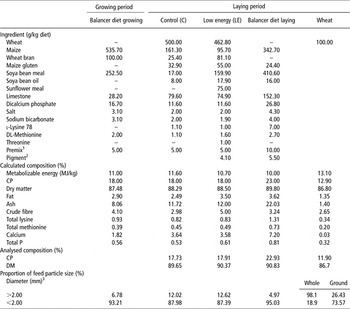
Dietary composition, nutrient content (as-fed) and particle size distribution of the experimental diets

1Vitamin and mineral premix supplied the following amounts per kilogram of premix: vitamin A 1 600 000 IU; vitamin D3 480 000 IU; vitamin E 2000 mg; vitamin K3 400 mg; vitamin B1 109 mg; Zn 11 000 mg; Mn 12 000 mg; Cu (sulphate) 1200 mg; Fe 4000 mg; I 200 mg; Se 60 mg; DL Methionine 120 g; Canthaxanthine 200 mg.
2Pigment contains per kilogram: canthaxantine (E161g) 300 mg; luteine (E161b) 1633 mg; zeaxantine (E161h) 91 mg; cryptoxanthine (E161c) 36 mg.
3Particle size was determined using the sieving method in dry conditions adapted from Melcion (Reference Melcion2000).
The birds were treated according to the European Union’s Council Directive of 24 November 1986 (86/609/EEC) throughout. All procedures described here fully comply with French legislation on research involving animals. The experimental period was from week 19 to 46 of age. 320 birds were randomly selected and divided into four groups. Each group contained 80 birds divided into 16 cages as replicates. Each replicate contained five birds. Birds were allotted to replicates on the basis of body weight (BW) such that as homogenous BW as possible was obtained within each cage and treatment. Birds were housed in the same poultry house and kept in the same cages that were used during the acclimatization period.
Experimental treatments
The experiment consisted of four treatments. The composition of the diets fed in adaptation and experimental period is described in Table 1. To test the effect of wheat physical form (whole v. ground) in sequential feeding, two treatments received diets alternating either whole (SWW) or ground (SGW) wheat in the morning (0830 h) and the protein–mineral concentrate ‘balancer diet laying’ in the afternoon (1530 h). The balancer diet contained 23% protein. It was optimized for a 50% wheat intake for the birds to have similar nutrient intake as those given the control complete diet (C). The control (C) corresponded to a complete ground diet containing 11.6 MJ/kg and 18% crude protein. This diet contained 50% wheat ground and mixed with other protein and mineral ingredients. To test if reducing metabolizable energy (ME) intake in conventional feeding will result to similar performance as sequential feeding, another control diet (LE) containing lower energy (10.7 MJ/kg) but similar protein (18%) to the normal control treatment (C) was fed conventionally.
Each bird received 121 g of feed distributed twice daily. This quantity represented 105% of the theoretical intake of 115 g/bird per day (ISA Hendrix Genetics, 2007). In sequential feeding, 50% of the daily fed diet was either whole or ground wheat. In conventional feeding, half of the diet was fed in the morning and the remaining half in the afternoon. Feed left over from previous distribution was always removed before the next distribution. Water was fed ad libitum during all periods.
Parameters measured
Feed intake and production
Feed intake was recorded weekly. In sequential feeding, the intakes of wheat and balancer diet were measured separately. The profile of feed particle size for the experimental diets was determined using the dry sieving method adapted from Melcion (Reference Melcion2000). A sample of 100 g of feed was sieved during 3 min in a an electric shaker (Restch AS 200 didgit) having sieves with diameters of 3.15, 2, 1.18, 0.6 mm and bottom tray (<0.6 mm). The profile of feed particle size contained in each of the experimental diets is given in Table 1.
The birds’ ME requirement was estimated over two periods corresponding to (i) peak of egg production (week 25 to 31) and (ii) end of the experimental period (week 40 to 46). The estimation was done using the predictive equation of Sakomura (Reference Sakomura2004);

where ME = metabolizable energy requirement (Kcal/b per day), T = Temperature (°C), WG = weight gain (g/bird per day), EM = egg mass (g/bird per day) and W = body weight (kg).
Energy exported in the egg (EE) was calculated according to Larbier and Leclercq (Reference Larbier and Leclercq1992):

where Yw = Yolk weight (g), Aw = Albumen weight (g),
The ratio between the EE and the energy intake was then calculated as EE/ME.
BW was recorded at week 19, 26, 37 and 46. Egg production was recorded daily and egg weight was recorded twice weekly by weighing all the eggs produced on the measuring day. The weights of egg yolk, albumen and shell were determined on all eggs at an interval of 4 weeks starting from week 21 of age. For these measurements, the albumen and the chalazae were separated from the yolk using forceps. Egg shells were washed and dried for 12 h in an oven at 70°C, and then weighed. All measurements were taken to the nearest 0.01 g.
The weights of the proventriculus, gizzard, pancreas, spleen and liver were recorded at the end of the experimental period using eight birds per treatment. The birds were randomly selected, weighed and euthanized by the injection of Na Pentobarbital solutionFootnote 1 (1 ml/kg). The intestine was removed and divided into different segments: duodenum, jejunum and ileum. The intestinal segments were emptied and dried using a paper towel before weighing. The proventriculus and the gizzard were placed in an iced container (−4°C) for 3 h to facilitate the removal of the surrounding fat before being emptied and weighed. Jejunal segments were collected and histological and enzymatic measurements were performed.
Histological measurements
A 1.5 cm segment taken at the middle part of the jejunum was opened longitudinally, rinsed with cold saline (NaCl 9 g/l) and fixed in a buffered formalin solution overnight. It was then rinsed in distilled water and stored in ethanol/water (70/30, v/v) at 4°C until further analysis. The jejunal samples were prepared as described by Goodlad et al. (Reference Goodlad, Levi, Lee, Mandir, Hodgson and Wright1991). The measurements were made using an optical microscope (Leitz, Laborux), a camera (CFW 1308C, Scion Corporation, Frederick, MD, USA) and image analysis software (Visilog 6.3, Noesis). The length and width of 10 villi and crypts were measured from each bird. The surface area was calculated for each villus and crypt. An average value was calculated for each bird. Villus to crypt length and surface ratios was then calculated.
Enzymatic activity
The jejunal scraping extract were analysed for enzymatic activity of alkaline phosphatase (AP; EC 3.1.3.1) and leucine aminopeptidase (LAP; EC 3.4.11.2). The middle part of the jejunum (one third) was split longitudinally, rinsed with cold saline, wiped on a paper towel and the mucosa scraped off before freezing in liquid nitrogen and stored at −70°C. Samples taken from the frozen intestinal tissues were homogenized at a ratio of 50 mg/ml in phosphate buffer saline (pH 7.4) using an Ultra-turrax® (IKA) for 3 × 10 s and centrifuged (10 000×g, 15 min, 4°C). The supernatants were stored at −70°C until further analysis. Before the enzyme analysis, the samples were diluted 1/3. A continuous method with 96-well micro-plates was used for each enzyme tested.
For the measurement of AP activity, a 0.1 ml of the diluted homogenate was mixed with 0.2 ml of substrate (8.8 μm of p-nitrophenyl phosphate (Sigma N 4645; Sigma-Aldrich Corp., St. Louis, MO, USA) per millilitre of glycine buffer 93 mM containing 50 mM MgCl2, pH 8.8). Readings were carried out at 2-min intervals for 30 min with a multi-scan spectrophotometer (TECAN Infinite M200)Footnote 2 at 405 nm (37°C) using a standard curve with p-nitrophenol (Sigma N 7660).
To measure the LAP activity, a 0.03 ml of the diluted homogenate was mixed with 0.25 ml of substrate (1 μm of l-leucine p-nitroanalide (Sigma L 2158) per millilitre of phosphate buffer 0.1 M, pH 7.2). The plate was read at 405 nm (37°C) at 2-min intervals for 10 min p-Nitroaniline (Sigma N 2128) was used for the standard curve. The results were noted as Units (U)/mg of the weight of intestinal mucosa, one unit corresponding to one nanoMole of the product of the enzymatic reaction (p-nitrophenol for PA and p-Nitroaniline for LAP) per time unit (mn).
Statistical analysis
Average values from cages were analysed using StatView (version 5, SAS Institute Inc., Cary, NC, USA). A one-way ANOVA was performed using the below GLM model to test treatment effect on all the measured parameters. Results were considered different if P < 0.05, and Bonferroni–Dunnet multiple comparison test was used to compare differences between treatment means.

where Yij = measured variables for treatment i and cage j, Ti = treatment effect (i = C, LE, SWW and SGW) and j being the cage j in treatment i, and εij = residual.
Results
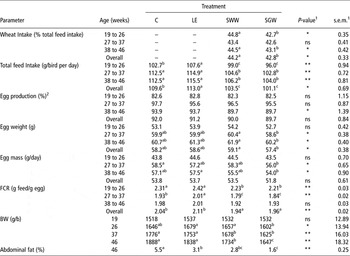
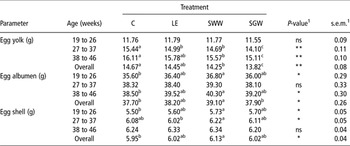
Significant reduction in the total feed intake (P < 0.05) was observed with SWW and SGW compared to C and LE (Table 2). Lower energy level elicited higher feed consumption in LE diet compared to C diet. In sequential feeding, wheat form did not affect the overall total feed intake, which was similar between SWW and SGW. However, wheat intake was higher (P < 0.05) with SWW compared with SGW. No difference in egg production and EM were observed among all the treatments. Egg weight was higher (P < 0.05) for SWW compared to SGW but similar to C and LE. Feed conversion (FCR) ratio was similar between SWW and SGW, but lower than C and LE (P < 0.01). The final BW was heavier (P < 0.01) for birds fed SWW than SGW, but the two were lower (P < 0.01) than C and LE. The heaviest abdominal fat weight was obtained with C, while the lowest was obtained with SGW (P < 0.01). The latter was similar in abdominal fat weight to SWW. LE had lower abdominal fat than C, but it was similar to SWW and higher to SGW. Egg yolk weight was higher (P < 0.01) for SWW than SGW, but the two were lower than C (Table 3). LE was similar in yolk weight to SWW and C, but higher to SGW (P < 0.01). Egg albumen weight was similar between SGW and C, but lower than SWW (P < 0.05). LE was similar to all treatments in albumen weight. Eggshell weight was similar between SWW, SGW and LE. However, it was higher for SWW compared to C (P < 0.05).
Treatment effect on feed intake and performance of birds fed either normal (C) or reduced (LE) energy diet conventionally, or whole (SWW) or ground (SGW) wheat sequentially with a protein–mineral balancer diet from 19 to 46 weeks of age

FCR = feed conversion ratio (feed intake/egg mass).
1s.e.m. = standard error of the mean; **P < 0.01; *P < 0.05; ns (non-significant) P > 0.05; values within a row with no common letters (a, b, c) differ significantly using Bonferroni–Dunnet test at 5% significance level.
2Egg production for week 38 to 46 was significantly different between treatments (ANOVA P < 0.05), but it was similar on pair-wise comparison Bonferroni–Dunnet (P > 0.05).
Treatment effect on egg yolk, albumen and shell weights of birds fed either normal (C) or reduced (LE) energy conventionally, or whole (SWW) or ground (SGW) wheat sequentially with a protein–mineral balancer diet from 19 to 46 weeks of age

1s.e.m. = Standard error of the mean; **P < 0.01; *P < 0.05; ns (non significant) P > 0.05; Values within a row with no common letters (a, b, c) differ significantly using Bonferroni–Dunnet test at 5% significance level.
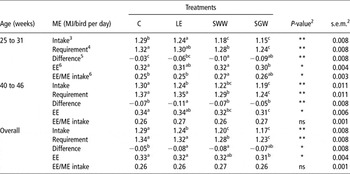
A significant reduction in the overall ME intake was observed with SGW and SWW compared to C and LE (Table 4; P < 0.01). ME intake was lowered with LE compared to C (P < 0.01), which had the highest ME intake. The overall ME requirement was higher for C compared to SWW and SGW (P < 0.01). It was lower for SGW than for SWW (P < 0.01). The relative difference between ME intake and requirement was lower for C and higher for SWW and LE (P < 0.05), while SGW was similar to all treatments. The amount of EE for egg production was similar between SWW and C or LE, but lowered with SGW (P < 0.05), although the latter was similar to SWW. However, there was no difference in the ratio of the exported energy for egg production and ME intake between treatments.
Estimated metabolizable energy (MJ/bird per day) intake, requirement (MJ/bird per day) and the ratio of EE and ME intake of birds fed either normal (C) or reduced energy (LE) diet, or whole (SWW) or ground (SGW) wheat sequentially with a protein–mineral balancer diet from 19 to 46 weeks of ageFootnote 1

EE = energy exported in the egg; ME = metabolizable energy.
1 Estimation was done over two periods corresponding to (1) peak of egg production (week 25 to 31) and (2) end of the experimental period (week 40 to 46).
2 s.e.m. = standard error of the mean; **P < 0.01; *P < 0.05; ns (non-significant) P > 0.05; values within a row with no common letters (a, b, c) differ significantly using Bonferroni–Dunnet test at 5% significance level.
3 ME intake was calculated by multiplying the quantity of diet consumed and the calculated ME content of the diet (Table 1).
4 ME requirement was calculated according to Sakomura (Reference Sakomura2004). The temperature values used were the actual values recorded for each period (week 25 to 31 = 21.90°C; week 40 to 46 = 22.57°C).
5 Difference between ME intake and ME requirement was calculated as (ME intake – ME requirement).
6 EE was calculated according to Larbier and Leclercq (Reference Larbier and Leclercq1992) and the ratio of EE and ME intake was calculated as EE/ME intake.
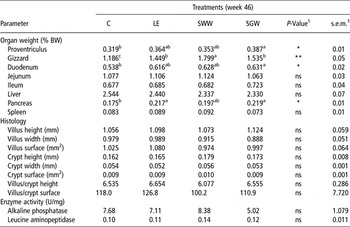
At the end of the experimental period (week 46), proventriculus weight was similar between LE, SWW and SGW (Table 5). However, C was similar to LE, SWW, but lower than SGW in proventriculus weight (P < 0.05). Gizzard weight was heavier for SWW relative to SGW (P < 0.01). The latter was similar to LE. The lowest gizzard weight was observed with C (P < 0.01). Duodenum and pancreas were heavier for SGW and LE than for C (P < 0.05), while SWW was similar to all treatments. No difference in the weights of jejunum, ileum, liver and spleen was observed between all treatments. Histological measurements of the jejunum showed no difference in the height, width and surface of villus and crypt. Equally, the enzymatic activities of AP and LAP were similar among the four treatments.
Treatment effect on weight of digestive organs (% BW), histology and enzyme activity of Jejunum at week 46 of birds fed complete (C) or reduced energy (LE) diet classically or a protein–mineral balancer diet sequentially with whole (SWW) or ground wheat (SGW) from 19 to 46 weeks of age

1s.e.m. = standard error of the mean; **P < 0.01; *P < 0.05; ns (non-significant) P > 0.05; values within a row with no common letters (a, b, c) differ significantly using Bonferroni–Dunnet test at 5% significance level.
Discussion
The current work confirms that sequential feeding improved feed efficiency and reduced BW as recently shown by the authors (Umar Faruk et al., Reference Umar Faruk, Bouvarel, Meme, Rideau, Roffidal, Tukur, Bastianelli, Nys and Lescoat2010). In addition, it demonstrated that the form of wheat presentation in sequential feeding have limited influence on the positive effect of sequential feeding. Feeding whole or ground wheat in sequential feeding had no significant effect on the overall total feed intake, egg production, EM and FCR. However, hens fed ground wheat had lower wheat intake (about 5%) compared to those fed whole wheat, and this may be associated to larger particles size of whole compared to ground wheat. Laying hens prefer larger particles to smaller ones (Portella et al., Reference Portella, Caston and Leeson1988; Umar Faruk et al., Reference Umar Faruk, Dezat, Bouvarel, Nys and Lescoat2008). They preferentially consume feed particles sufficiently large to be picked up efficiently by their beaks (Picard et al., Reference Picard, Melcion, Bouchot and Faure1997). Thus, whole wheat, due to its larger particle size, is easier to pick than ground wheat.
Ground wheat reduced egg weight, egg yolk and egg albumen weight compared to whole wheat. Equally the hens fed ground wheat had lower final BW compared to those fed whole wheat. This can be associated to slightly lower wheat intake leading to a numerical lower energy intake. This trend was observed during the whole experimental period, but was never statistically significant. Egg weight is known to be dependent on energy and protein intakes of the birds (Fisher, Reference Fisher1969; Morris and Gous, Reference Morris and Gous1988). Birds fed diet containing 3% reduced dietary ME and protein had lower egg weight than those fed the control (Novak et al., Reference Novak, Yakout and Remus2008). This is confirmed regarding the energy intake in the present work, as the slight reduction in ME intake of birds fed ground wheat led to low egg weight. Although the daily ME supply was close between the two diets, there was a strong difference in final BW after 27 weeks of experiment, and this was accompanied by a numerical difference in the abdominal fat content.
The difference in performance observed (egg and BW) between the two wheat forms in sequential feeding could not be explained only from the digestive functions point of view. Except that gizzard weight was higher for birds fed whole wheat, no modification of the villus and crypt morphology was observed. The morphology of intestinal villi and crypts in poultry has been associated to intestinal function and bird growth (Sun, Reference Sun2004). Adverse changes in the content of the digesta due to alimentation could lead to changes in the surface of intestinal mucosa, because of their close proximity. A lower villus height/crypt depth ratio has been associated with the presence of toxins, poor nutrient absorption and increased secretion in the gastrointestinal tract, diarrhea, reduced disease resistance and lower overall performance. A large crypt indicates a fast tissue turnover and a high demand for new tissue (Xu et al., Reference Xu, Hu, Xia, Zhan and Wang2003). In this study, there was no modification of the villus and crypt morphology due to treatment and this suggests that sequential feeding had no effect on these parameters. These results agreed with Wu et al. (Reference Wu, Ravindran, Thomas, Birtles and Hendriks2004) who found that the inclusion of whole wheat either before or after pelleting in the diet of broilers did not affect the villus height or the crypt depth.
In the present experiment, LAP, a brush border enzyme and AP used as an indicator of enterocyte maturity (Weiser, Reference Weiser1973) were tested to see if the improvements of FCR might be partly explained by an increased enzymatic activity. It was, however, found that the activities of these enzymes were not different between treatments, thus, cannot be used as an explanation. Gabriel et al. (Reference Gabriel, Mallet and Leconte2003) reported the reduced level of LAP in the duodenum when feeding whole wheat, and they also found reduced levels of AP in the duodenum and maltase in the ileum. However, they also found that the inclusion of whole wheat resulted in larger crypt related to an increase of the cellular renewal, which is not the case in this study.
Another aim of this study was to determine if reducing the energy intake in conventional feeding, through the reduced dietary energy content and limited amount of the offered diets, will give similar performance as sequential feeding. It is clear that birds fed LE had reduced energy intake compared to C. They also consumed more ME than those fed sequentially and this is associated to the increased feed intake (+9.5 g/bird per day) of birds receiving the low energy complete diet compared to the sequential treatments. This was not surprising as hens adjust their feed intake to the energy content of the diet as shown by Sohail et al. (Reference Sohail, Bryant, Roland, Apajalahti and Pierson2003), who observed an increase in feed intake of 4.8 g/bird per day for a decrease of 1 MJ/kg. Egg production, egg weight and EM were similar between LE and the sequential treatments. However, an improved FCR was observed with birds fed sequentially compared with those fed the low energy diet. Therefore, reducing the energy density of the complete diet did not lead to similar FCR ratio as sequential feeding.
Birds fed sequentially had lower hen BW compared to conventional feeding and this agreed with Umar Faruk et al. (Reference Umar Faruk, Bouvarel, Meme, Rideau, Roffidal, Tukur, Bastianelli, Nys and Lescoat2010). These authors hypothesized that the reduced feed intake in sequential feeding combined with eventual similar performance to conventional feeding suggests that body fat deposition would be lowered to balance the energy requirement for egg production (Scanes et al., Reference Scanes, Campbell and Griminger1987). When birds consume more energy than is required for maintenance, growth and egg production, the excess energy is deposited as fat, which in turn increases BW (Smith, Reference Smith1973). The results of the relative weight of the abdominal fat observed in the present work supported this hypothesis with sequentially fed birds having lower abdominal fat than those fed conventionally although this is more relevant for the SWW than with SGW. Another hypothesis leading to the improved feed utilization in sequential feeding was a more efficient digestive system. The observation that gizzard weight was heavier for birds fed whole wheat sequentially supports the hypothesis. This was expected, since feed particle size was known to influence poultry digestive organs (Nir et al., Reference Nir, Melcion and Picard1990) and digestive efficiency (Amerah et al., Reference Amerah, Ravindran, Lentle and Thomas2007). The gizzard is the main retention organ of the solid component of the diet. Its purpose is to make them suitable for intestinal digestion by muscular activity. Vergara et al. (Reference Vergara, Ferrando, Jiménez, Fernandez and Gonalons1989) observed that the larger the size of the feed particles, the longer the period of their retention in the gizzard. The retention time is particularly important in regulating the rate at which these comes in contact with the digestive enzymes and absorptive surface (Hill and Strachan, Reference Hill and Strachan1975). Owing to the presence of wheat grains in the sequential treatment, a longer retention time could be assumed. This eventually led to a more efficient digestion and absorption of nutrients thereby improving the performance of these birds.
The low feed intake in sequential feeding was a result of low whole wheat intake, although similar quantity (60.5 g/bird per day) of each of the two fractions was offered. No statistical difference in balancer diet intake was observed (result not shown). These birds were expected to increase their balancer diet intake according to the generally agreed daily feed intake pattern in laying hens, as well as the nutritional composition of this diet. The pattern of daily feed intake in laying hens is influenced by the egg forming cycle and by photoperiod (Nys et al., Reference Nys, Sauveur, Lacassagne and Mongin1976; Choi et al., Reference Choi, Namkung and Paik2004). Thus, hens consumed more diet in the afternoon (Keshavarz, Reference Keshavarz1998; Dezat et al., Reference Dezat, Umar Faruk, Lescoat, Roffidal, Chagneau and Bouvarel2009), to account for calcium required in eggshell formation (Mongin and Sauveur, Reference Mongin and Sauveur1974). However, the protocol used in the present experiment might limit the birds from overconsuming the balancer diet since this diet was fed in a limited quantity.
It was concluded that the use of ground wheat has no better benefit compared to whole wheat in sequential feeding since it was shown to have a negative effect on egg and bird weights. The experimental period was limited to 47 weeks of age. Further investigations are therefore needed on the observed negative effects of such feeding system on BW as it might negatively affect the sustainability of this technique on a longer production period. This required an investigation on the energy budget in the laying hen under sequential feeding, so as to understand the ranking between the metabolic functions, that is, growth, maintenance and egg production. Nonetheless, sequential feeding improved feed efficiency and allows the use of whole cereals with minimum processing. This is of particular interest in situations where the availability of a complete diet impedes production, or where whole cereals are locally available. The use of other types of cereals in sequential feeding is another area requiring attention, as this will allow for an extensive application of this promising technique in a large range of climatic or economical conditions.
Acknowledgements
The authors wish to thank Michel COUTY of INRA, UR83 recherches avicoles, Nouzilly, France, for his technical assistance as well as his full commitment in the data collection. We thank Maryse LECOMTE and Nathalie MÊME both of INRA, UR83 recherches avicoles, Nouzilly, France, for their technical help in the histological analysis. The financial assistance of the following organizations is highly appreciated: France AgriMer, 12 Henri Rol-Tanguy 93555, Montrueil sous bois cedex France; CNPO, 28 rue du rocher 75000, Paris, France; INZO°, 1 rue Marebaudière, 35760, Montgermont, France.