1. Introduction
Economists recognize that there are two forms of market failure that need correction if the challenge of climate change is to be successfully met. The first failure is free use by emitters of the scarce atmospheric commons. The second is insufficient reward for carbon-reducing innovation, whereby much of the commercial benefits leak away from the firm or individual who created the innovation, to the benefit of competitors. For the first market failure, economists have an elegant and effective solution: price the external cost at a rate that reflects the marginal social damage imposed; this comprises the spine of their advocacy. For the second, most of the economics research has focused on understanding the extent to which pricing has induced innovation, assessed using patent evidence. There is little assessment of the policy prescriptions that would correct for the policy failure.
Correcting for this analytical asymmetry is important because it is clear that carbon pricing on its own is unlikely to be sufficiently extensive or at a high enough level to drive the changes needed. Innovation at scale is going to be required; with the emphasis on social and institutional innovation, taking a small step towards improving our understanding as to how this can be achieved is the purpose of this paper. Datta and Somanathan (Reference Datta and Somanathan2016) make the interesting point that, if the returns to innovation are to be fully internalized, then the innovator must hold a monopoly on his patent, but that then gives rise to monopoly power that creates a distortion over and above the environmental externality.
This paper is a small accretion to the scholarship that has gone before. Rennings (Reference Rennings2000) is a very important paper at a few levels: for the first time, the contributions of the neoclassical and evolutionary approaches to the theory and practice of what he calls ‘eco-innovation’ are clearly articulated. Three particularities – the double externality problem, the regulatory push/pull effect, and the importance of social and institutional innovation – are formally recognized, and a convincing case is made that both understanding of innovation and (more implicitly) the design and delivery of effective policy needs to integrate these three strands if innovation policy is to be successful.
Important evidence in support of the third of these particularities – social and institutional innovation – is a particular contribution of work that is anchored by scholars based mainly in Italy. This Italian School interrogates Italian and EU-wide evidence from the manufacturing sector that informs the interface between policy, eco-innovation and organizational and network effects. A particularly unique contribution is the extent to which, inter alia, there are agglomeration and network effects, whereby eco-innovation is a product of learning, interaction and collaboration within and between sectors (Corradini et al., Reference Corradini, Costantini, Mancinelli and Mazzanti2014; Borghesi et al., Reference Borghesi, Crespi, D'Amato, Mazzanti and Silvestri2015b; Barbieri et al., Reference Barbieri, Ghisetti, Gilli, Marin and Nicolli2016; Ghisetti et al., Reference Ghisetti, Mancinelli, Zoli and Mazzanti2017).
In addition to the peer reviewed journal literature, international institutions have made important contributions. The OECD has invested significant effort in understanding the underpinnings of green growth, how to measure it, and how to engender it.Footnote 1 The European Environment Agency (EEA, 2020) has examined the fiscal and related challenges in Europe of simultaneously addressing the demographic (where the aging population will put increasing demands on public funds) and the green transition, where the former could tend to crowd out the R&D and growing investment needs of the latter. The EEA (2020: 36) notes that: ‘In 2018, gross domestic expenditure on R&D across all sectors in EU countries was EUR 336 billion, corresponding to 2.1 per cent of gross domestic product (GDP), a figure well below the 3 per cent target of the Europe 2020 strategy’. A normative implication is that new ways of securing funding will be needed if the green transition is to succeed. The United Nations Industrial Development Organization (UNIDO, 2015) provides a useful global perspective, making the point that the role of innovation varies across countries depending on the stage of development, and policies need to be customized accordingly.
Untangling the overlapping strands of history, and understanding the nuances that explain transformative climate-relevant innovation requires a very detailed interrogation of evidence, complemented by many interviews, best suited to a book-length publication. Nemet (Reference Nemet2019) does this very effectively as regards tracing the path to inexpensive solar energy. His narrative begins in the US in 1954 (theoretical foundation, research and development, and first application) followed by the US Federal technology-push in the 1970s, followed in turn by the evolution of niche markets in Japan in the 1980s, and its roof top programs in the 1990s. Germany's €200 billion demand-pull program in the 2000s was followed by a scale up of manufacturing in China from 2001 which dramatically reduced costs of PV, followed in turn by secular falls in the costs of installation in the 2010s. The cost-reducing progress in China was accelerated by research and capacity building at the University of New South Wales, Sydney.
The contribution which this paper aspires to add to this literature is to provide an exclusive focus on the role of innovation as it has evolved to reduce greenhouse gas emissions from the energy supply sectors, by looking back at what seems to have worked in the past in key geographies in terms of delivering emissions reduction at scale, with a view to informing choices for the future. It tries in particular to identify, at the macro level, some understanding of the interdependent elements of the innovation ecosystem – analogous to what Rennings calls ‘social and institutional innovation’ – that enable carbon-reducing innovation at scale.
The paper is organized as follows. First, I draw on the evidence compiled by the World Bank, and recent developments in France, to make the case that, so far, there has been a ceiling on the level of direct carbon prices that most societies will willingly accept. Next, I use a review paper by Hepburn et al. (Reference Hepburn, Pless and Popp2018) to distill insights as to what the literature tells us about the ‘how’ of generating carbon-reducing innovation. Thirdly, I dip into experience in the US (interesting because, even though there is no carbon price at the Federal level, it is nevertheless a leading source of innovation), followed by a more cursory look at developments in China (with a special focus on the role of innovation in driving down PV costs) and an outline of emerging policy in the European Union (with a focus on innovation in wind energy in Denmark). However, although policy is designed and delivered mainly at the geographic level, a key lesson of what follows is that achieving innovation at scale is, above all, a global enterprise. Each jurisdiction succeeds in large part because it benefits from complementary policies and actions elsewhere. This is followed by some preliminary conclusions as to how to mobilize innovation at scale as a pillar of climate policy.
2. The carbon ceiling – pricing
In an interview with the Financial Times (Giles, Reference Giles2007), Jeffrey Sachs opined that global warming is easily solvable because the costs of doing something about carbon emissions are exaggerated – so people will soon realize that they can cut carbon emissions without much pain, and that all the US needed to do is offer an aid, trade and climate change deal to the rest of the world and a solution is within reach.
Nothing could be further from the truth.
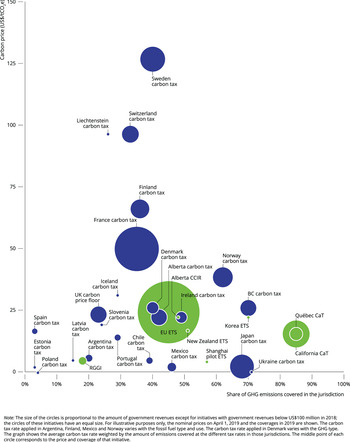
It is hellishly difficult to ‘solve’ climate change, to get a carbon price enacted that is inclusive in its coverage and high enough to drive step changes in carbon-reducing innovation. We are very unlikely to get economy-wide carbon prices that on their own are high enough to reduce emissions in the volume and at the speed required to prevent dangerously high global warming. The point is not to disparage carbon pricing – carbon prices help advance the effectiveness of all other policies and, even at low levels, encourage and enable and accelerate innovation – but to recognize that experience indicates that we cannot depend on achieving coverage at a level sufficient to drive major step changes in the reduction of emissions (Borghesi et al., Reference Borghesi, Cainelli and Mazzanti2015a).
We have one example at scale of carbon prices that have been very high, and very effective, namely fuel taxes on road transport in Europe. Sterner (Reference Sterner2007: 3195) is the main documenter of this case. He concludes that: ‘Had Europe not followed a policy of high fuel taxation but had low US taxes, then fuel demand would have been twice as large.’ Transport fuel taxes in Europe were imposed after the Second World War to manage fuel scarcity, and to raise revenues, but had the collateral benefits of reducing consumption and therefore greenhouse gas emissions.
The levels of excise duties now imposed are typically on the order of equivalent to over €250 per ton of CO2. But as incomes rise, numbers of cars and distances travelled increase, as do greenhouse gas emissions in most jurisdictions. And we observe resistance to further increases. Marlowe (Reference Marlowe2018) wrote about the grass roots revolt in France to high fuel prices, which are blamed on the carbon tax. She reports that the ‘gilet jaunes’ (yellow high-vis vests) have organized at least 630 protests, animated by a web site (http://www.blocage17novembre.com) designed by an 18-year-old student.
The government response has been to freeze the carbon tax rate at €44.60, instead of raising it to €55 as planned. A grand debate has been organized, followed by a citizen convention. Over a year later, the next steps are still to be decided.
The few small countries that do have high carbon taxes, such as Sweden, do not apply them to major emitters that have exposure to international competition, which are ‘covered’ by the European Union Emissions Trading System (EU ETS).
The World Bank (2019) reports on all programs that generate a carbon price either via a tax or levy, or emissions trading. Figure 1 in the report provides the detail. In over 50 per cent of cases, the price is less than US$10 per ton of CO2e.
Carbon-reducing innovation as the essential policy frontier - towards finding the ways that work. Source: World Bank Group (2019), p. 16.

Both California (with very inclusive coverage in its emissions trading system) and the EU have legally binding commitments to reduce emissions by 40 per cent by 2030.Footnote 2 Depending on how quickly low-cost solutions to reducing emissions are developed, these tightening caps may begin to see real growth in allowance price.
We need to keep pressing for the introduction and expansion of carbon prices, but, as a profession, we need to widen our reach and our advocacy to embrace a hybrid policy world, and overtly add carbon-reducing innovation to our policy instrument mix.
3. Innovation as the second instrument
In this section, I identify a few key insights from a very helpful review of what research and the literatureFootnote 3 has to offer us in terms of the design and implementation of a greenhouse gas reducing innovation strategy. There is a useful framing of the full portfolio of issues that should be addressed in shaping overall climate policy (which includes innovation) provided by Harvey and Segafredo (Reference Harvey and Segafredo2014).
Hepburn et al. (Reference Hepburn, Pless and Popp2018) provide a closely argued case for what it takes generally to support emissions reduction innovation. They use the research literature to underpin and support their conclusions so that their findings are much more nuanced than is evident from the summary points below.Footnote 4 They recommend that low carbon innovation policy prioritize the following five actions:
(1) Correct for natural capital pricing market failure
This includes implementing more stringent environmental regulations and policies that address environmental externalities and interventions that increase the prices of dirty products, processes, and services.
(2) Support environmentally friendly R&D
Clean energy research performed at government institutions plays an important role in linking basic and applied research. The high value of government-conducted research on clean energy is different from what is found in other sectors, where university research tends to produce the most highly cited work. Advances in wind turbines were aided by US Department of Energy- sponsored innovation on multiple turbine components, which complemented private sector efforts and allowed for feedback between public and private sector researchers.
(3) Judiciously support early-stage deployment
While economists tend to focus on government support for R&D, there are situations in which support for early-stage deployment of specific technologies is also warranted. These include help to reduce first-of-a-kind costs incurred by the first mover in a new technology.
Followers gain the benefit of the lessons learned by the leader, including technical experience, training of personnel (who can be subsequently hired), financial structures and better-educated banks, and improved legal and market arrangements.
(4) Support collaborative R&D arrangements
Networks that result from R&D cooperation can help transfer knowledge and drive innovation. There is also emerging evidence that collaborative research can produce higher-quality research output, which in turn can translate into innovation. For example, research shows that teams of researchers tend to produce more highly cited and higher impact outputs than individuals; for alternative energy technologies, both scientific articles and patents with authors from multiple types of institutions, e.g., universities and corporations, are cited more frequently, suggesting that collaborations may have positive impacts on research quality.
(5) Reduce barriers to private sector financing
One common constraint on innovation is the cost of external financing, which discourages private sector investment in R&D. Private sector financing for environmentally friendly technologies includes the conventional menu of financing options. Early-stage private financing is often equity based, with angel and seed finance (increasingly including crowdfunding methods) being suitable for embryonic ideas, venture capital being suitable for early-stage technologies, and private equity being suitable for the scale-up phase. Once technologies reach a degree of maturity, debt-based financial options come into play – corporate finance, project finance, green bonds, and other crowd-based financing platforms.
While it is not the role of government policy to provide private finance to firms, policymakers can carefully monitor the ability of the financial ‘ecosystem’ to provide access to private sector funds for environmentally friendly innovation. By reducing barriers to these various forms of private finance, governments can help to facilitate the later stages of the innovation process. Options include creating tax schemes that target these later stages of innovation (such as the venture capital trusts in the UK) and providing patient capital (i.e., capital that does not require a very fast payback period) through low-interest loans. Furthermore, direct grants can help alleviate barriers to finance.
Recent research on small firms in the United States shows that grants to small firms increase a firm's chance of receiving private venture capital investment from 10 to 19 per cent and nearly double the probability of firm survival and successful exit. The implication for policy is that reallocating support from larger, later-stage grants to more numerous small, early-stage grants to younger firms may achieve better outcomes and help smaller firms move new ideas from the initial research stage to technology commercialization
The first two of these (pricing and supporting R&D) are familiar, but the others (support early stage development, collaborative R&D, and reduce barriers) are new.
4. Insights from the US
4.1 Two important phenomena
The US experience with innovation is especially rich, and there are lessons to be learnt from this experience, and in specific regard to carbon reduction. As regards innovation in general, it is the global leader in the mobilization and use of private venture capital to finance innovation. However, its first wave of experience with this approach to revolutionize the US energy system was a spectacular failure; lessons have been learnt, and these are of world-wide relevance. The US is also the world's leading incubator of innovation hubs – specific geographies where talent, research enterprise and capital co-locate, which occasionally results in hugely disruptive and commercially successful innovation. In the first part of this section, I will dwell briefly on these two related phenomena, and then turn to the interface between innovation and progress in fracking of natural gas and renewables.
4.1.1 Venture capital
When venture capital (VC) funds make 10 to 20 investments, they expect that most investments will fail, a few may break even, and one or two might succeed wildly, justifying investments across the portfolio. Gaddy et al. (Reference Gaddy, Sivaram and O'Sullivan2016) document how venture capitalists (VCs) in the US invested US$25 billion into Clean Tech over the 2006–2011 period, and lost half of it. The returns were dramatically lower than those yielded over the same period by VC investments in medical and software technology. Typically, VC investments operate on a ten-year cycle, with the expectation that, within the first five years, those that have commercial prospects will be purchased by large, cash rich companies (typical in the pharma and IT world) or issue an initial public offering of shares. They found that ‘cleantech companies developing new materials, hardware, chemicals, or processes were poorly suited for VC investment because they required significant capital, had long development timelines, were uncompetitive in commodity markets, and were unable to attract corporate acquirers’ (Gaddy et al., Reference Gaddy, Sivaram and O'Sullivan2016: 2).
They argue for a ‘more functional ecosystem for cleantech innovation’ and end on an optimistic note:
‘Led by Bill Gates, a group of wealthy investors known as the Breakthrough Energy CoalitionFootnote 5 have pledged funding for early-stage cleantech companies. Their investments will complement a concurrent effort by twenty countries around the world who have signed on to the Mission Innovation pledge to double public R&D funding to $30 billion by 2020’ (Gaddy et al., Reference Gaddy, Sivaram and O'Sullivan2016: 3).
In October 1957, the Soviet Union launched the world's first satellite, Sputnik 1, and this was seen as a security threat to the US. One of the key responses was to dramatically increase funding for defense-related research, which inter alia involved establishing the Advanced Research Projects Agency (ARPA) in February 1958. This produced many outcomes of very wide-ranging impact and import, including launching the first dedicated weather satellite (TIROS) in April 1960, inventing the digital protocols that gave birth to the Internet, and the creation of GPS.
In 2009, Congress authorized the creation of an Advanced Research Projects Agency within the US Department of Energy (DOE) – ARPA-E – with an annual budget on the order of US$300 million annually.Footnote 6
The support for research hubs to drive innovation at scale tends to be politically bi-partisan, and this is an important institutional feature in the US policy landscape.
4.1.2 Innovation hubs
The most striking thing about contemporary economic activity in the US is its geography and character. The dynamic economic growth centers today are what Moretti (Reference Moretti2012) calls ‘brain or innovation hubs’ – places that attract and hold a lot of smart people, who generate new and sometimes very disruptive ideas, a small percentage of which are converted into commercial ventures at scale. Success breeds success, a virtuous circle whose growth becomes self-sustaining. And there are huge advantages to incumbency – once an innovation hub gets going, the economic gap between itself and the rest widens.
Successful innovation hubs share three characteristics:
• ‘Thick’ labor markets (lots of very specialized skills). Because thick markets are better at matching workers and employers, innovation clusters have an enormous advantage in attracting even more high-tech employers and workers.
• A supportive innovation ecosystem, including access to venture capital and its support and mentoring, and providers of specialized services that are important to innovative firms, such as advertising, legal support, technical and management consultancy, shipping and repair, and engineering support.
• Knowledge spillovers – new ideas arise in mysterious and unpredictable ways from free and unstructured interactions. Being around smart people tends to make us smarter, more creative and ultimately more productive.
I spent a day in Palo Alto and the surrounding district with Pat Burt, a former mayor of Palo Alto, a venture capitalist with a very thoughtful view as to what explains Silicon Valley. Graduates of the local university (Stanford) anchored many of the successful big ideas – Larry Page and Sergey Brin (Google), Jerry Yang and David Filo (Yahoo), Len Bosack and Sandy Lerner (Cisco Systems), Damon Horowitz (Aardvark), William Hewlett and David Packard (Hewlett Packard), and Vinod Khosla, Andy Bechtolsheim and Scott McNealy (Sun Ecosystems) are the tip of a very large iceberg. He noted that many of the new wave of start-ups are led by recent immigrants, with India, China and Europe well represented. And what are now serial entrepreneurs and venture capitalists constantly scan the ideas horizon to see what can be brought to commercial fruition. And they understand the law of large numbers – many relative failures must be absorbed if a few large successes are to be realized. He took me to where many of the ideas are pitched, and deals done, when innovators, venture capitalists and IP (intellectual property) lawyers meet over breakfast (buttermilk pancakes are a favorite) in an unpretentious restaurant with many booths and tables called Bucks, in nearby Woodside.
Citigroup is a good source of both what is happening in the world of innovation, and reflections as to what it means for business, finance and policy (Citigroup, 2016). It shares the same views as Moretti and Burt above as to what characterizes a successful innovation hub, but admits uncertainty as what explains the emergence of these dynamics.
Citigroup estimates that the top 15 regions in the world accounted for a total venture capital investment of US$63.9 billion in 2014, distributed as follows (percentage of total in parentheses): US (64 per cent), China (15 per cent) Europe (12 per cent), Other (India, Canada, Israel) (5.5 per cent). Citi also show the number of patents being filed, by region. They mirror where venture capital is being spent, with one notable exception. Japan does not feature in the top 15 locations for venture capital investment, but was the global leader in number of patents filed, with (global ranking in parentheses): Tokyo (1), Kanagawa (5), Aichi (11), and Osaka (14) in the top 15, presumably a product of the fact that incumbent firms rather than start-ups are the main source of innovation there (Citigroup, 2016: 8).
Regarding energy, Citi sees big data as a new frontier – ‘big data analytics would make producing oil/gas faster and cheaper, renewables forecasting more accurate, and the transport- generation-storage model more integrated’ (Citigroup, 2016: 4).
4.2 Innovation as the key to progress – renewables and fracking (natural gas)
The US at the Federal level has no cap on emissions, no trading scheme and no tax or levy on emissions to reflect the scarcity value of the atmosphere's capacity to absorb more greenhouse gasses. CO2 emissions from the power sector increased over the period 1990–2005, peaked soon after; by 2015, they had declined by 20 per cent compared to 2005.
What explains the decline? Mohlin et al. (Reference Mohlin, Camuzeaux, Muller, Schneider and Wagner2018) use decomposition analysis to conclude that the two main factors (percentage attribution in parentheses) driving the CO2 emissions decrease were: (1) natural gas substituting for coal and petroleum (60 per cent); and (2) large increases in renewable energy generation, primarily wind (30 per cent). They find that the reasons underlying these outcomes were the following:
(1) Natural Gas
The innovation revolution (‘fracking’) reduced production costs, increased supply and lowered prices to consumers, thereby crowding out coal.
(2) Wind
(a) The innovation revolution reduced costs and improved reliability,
(b) Nature – advantageous (mainly wind) conditions – on shore and now offshore (NE),
(c) Federal tax credits for renewables, and
(d) State policies – renewable portfolio standards, feed in-tariffs, net metering etc.Footnote 7
The consequence is that progress at reducing CO2 emissions in the US power sector can be attributed to a very significant degree to carbon-reducing innovation.
The fracking revolution was enabled by federal research and development but was brought to commercial fruition by George Mitchell, who, beginning in 1981, spent over a decade and a half experimenting with different extraction approaches in the Barnett shale in Texas before producing commercial gas in 1997 (Gertner, Reference Gertner2013; Gold, Reference Gold2014).
Innovation was also at the heart of the contribution of renewables to the fall in emissions. Denmark was a pioneer in the research and development of wind technologies, followed by commercialization, while Germany and others created demand at scale by heavily subsidizing renewables (feed-in tariff); the US supported successful innovation on improvement of multiple turbine components, Texas was an early mover in creating demand (portfolio standards), and at the Federal level a tax credit was provided; these were complemented by large economies of scale in production of solar power in China, all of which combined to achieve dramatic cost reductions (Wagner et al., Reference Wagner, Kåberger, Olai, Oppenheimer, Rittenhouse and Sterner2015).
In addition to the emissions reductions achieved by these innovations, they have yielded co- benefits and costs. Co-benefits: Where natural gas and wind and solar substitute for coal and oil, they reduce air pollution. Co-Costs: Wind power generates opposition on aesthetic and wildlife protection grounds.
Fracking generates opposition based on concerns about pollution of ground water, especially for communities whose supplies are met by wells drawing directly from this source (Muehlenbachs et al., Reference Muehlenbachs, Spiller and Timmins2015), and there is methane leakage (averaging 2.4 per cent) across the supply chain which weakens its net impact on greenhouse gas emissions (Alvarez et al., Reference Alvarez, Zavala-Araiza, Lyon, Allen, Barkley, Brandt, Davis, Herndon, Jacob, Karion, Kort, Lamb, Lauvaux, Maasakkers, Marchese, O'Mara, Pacala, Peischl, Robinson, Shepson, Sweeney, Townsend-Small, Wofsy and Hamburg2018).
4.3 Support for renewables as indirect carbon price
The early subsidies for renewables were substantial; in the EU, subsidies for wind (€10 billion) and solar (€15 billion) totaled €25 billion in 2012 (Ecofys, 2014, figure S-2). If the only metric applied was to deliver abatement at minimum cost, in the short run, this was an expensive solution. If it is regarded as a necessary front end cost to provide the scale and experience necessary to find new and better ways of reducing future costs by learning by doing, then the question is, was this the least cost means of inducing the innovations?
4.4 Provisional conclusions from the US
Provisional conclusions one can draw from the US experience would be along the following lines:
• Government plays essential roles, including funding the basic research which is the pre- requisite step on which progress depends (ARPA and the internet and GPS; Federal research providing the underlying science that enabled fracking; wind turbine design from Denmark); facilitating in-migration of talent (the innovation hubs will not thrive without attracting and holding the best); providing a policy framework (incentives, regulations, information) to nudge and encourage progress (feed-in tariffs for renewables in Germany).
• Although there has never been a carbon price at the Federal level, provisions in the tax code have been important: tax credits for renewables were valued by investors, and Yergin (Reference Yergin2012: 328) points out that Mitchell's fracking endeavors also benefitted from a provision in the 1980 windfall profits tax bill that provided a federal tax credit for drilling for unconventional natural gas.
• As we shall see later on, supportive policy at the state level, and in particular renewables policy in California (which included tax incentives), can be crucial (this was crucial in enabling the scaling up of the wind energy business in Denmark in the 1970s).
• The private sector plays key roles in taking on a lot of risk, a willingness to conceive the unimaginable and find the ways to make it work, and take time to convert promise into performance (e.g., George Mitchell's 16 years of endeavor before his first commercial success). The willingness and ability to absorb losses (US$12.5 billion of venture capital invested in clean energy in 2006–2011) and move on is a distinctive feature.
• Scaling is critical. As will be discussed later, Germany played a key role in creating demand for renewables at scale; in the case of PV, China played a key role in manufacturing at a scale that sharply reduced costs.
• Creating an innovation ecosystem where all the pieces of the jigsaw – entrepreneurs, funders, lawyers, and the range and depth of technical skills and talents needed to advance a new frontier to commerciality – are to hand and are mutually supportive, and having a political and social culture that is welcoming of the surprise is essential.
5. Insights from China
There are many reasons why China could be the most important global force in the generation of carbon-reducing innovations in the future. These include: political commitment to be a global leader in climate policy, and an associated planning system (inclusive five year plans), which helps integrate the various strands that can convert promise into performance; an ambition to transform the economy to be high value added, innovation-led and environmentally sustainable and climate-responsible; air quality challenges that could be mitigated as a co-benefit of climate policy; a global reach – via the Belt and Road initiative – that could accelerate progress outside China's borders; ability and willingness to shape both supply and demand (consumer behavior) to advance their climate and commercial ambitions. Trend is not necessarily destiny: we have seen that, at the Federal level, the US and Brazil have reversed their previously progressive and ambitious policies. As regards climate-relevant innovation, progress in China as regards research and development are noted, and the roles of China in advancing solar PV are outlined.
5.1 Existing commitments to research & development and innovation
A commitment to R&D and innovation is seen as a key to the success of economic transformation including those aspects that are directly relevant to addressing climate change successfully.
‘Red Moon Rising – will China dominate science?’ is the lead story in a recent issue of The Economist (2019). It documents the change in expenditure on R&D, rising from 0.89 per cent of GDP in 2000 to 2.07 per cent in 2015 and the associated positive changes on performance, including growth in high-level, peer reviewed publications; rise in numbers and quality of research staff; working with state of the art equipment; and breakthroughs in genomics and other areas. Much of this rapid expansion in R&D is applied to practical challenges, where breakthroughs would be of huge economic and environmental benefit; the work is cited of the team led by Zhang Human, of the Dalian Institute of Chemical Physics, an arm of the Chinese Academy of Science, based in Zhuanghe, Liaoning province. This team is working collaboratively with Danian Rongke Power, with the aim of finding low-cost ways to build batteries big enough to store energy on a scale useful for large grids. If this succeeds, it will help to hugely address the intermittency challenge of renewables, thereby improving their competitiveness with fossil fuels. The Institute is also working on the use of perovskites (which account for over 40 per cent of the highest impact publications) – materials with application in both batteries and solar cells – so that the resultant layers will absorb wavelengths the normal cells cannot, resulting in more efficient solar panels.
I have no basis for knowing what the prospects for this research are, but China sees R&D addressed to the key challenges which need to be overcome as a priority. If China, as planned, implements a well-designed and delivered emissions trading scheme and the other mitigation policies, and mobilizes research and innovation at scale to advance its emissions reduction agenda, there will be complete synergy between its innovation ambitions and the suite of other climate policies.
5.2 China's contribution to the delivery of low-cost solar power
What follows in this section is drawn from Nemet (Reference Nemet2019). China played the crucial role of reducing the costs of PV to the point where, under certain circumstances, it is competitive with fossil fuel alternatives.
This step has been crucial in opening up the real prospect of decarbonized electricity supply, heat and transport. The following elements were essential in enabling this transition. Universities at their best fulfil a number of functions, including: pioneering the synthesis of existing knowledge, and the development of this knowledge frontier; networking with the best minds around the world, and ensuring that evidence is sifted and challenged so that truth continues to progress, and that the whole is more than the sum of the parts; building capacity in their students and post-docs so that they continue and multiply the learning and the knowledge; bringing their learning down to where things are done. In 1974, Martin Green founded the Solar Voltaic group at the University of New South Wales in Sydney, and became a world leader in silicon solar cell efficiency, published widely, including a book (Green, Reference Green1982) which became a reference text. His early reputation was established by setting world record efficiencies in crystalline silicon. He also travelled widely, including to China, to spread the word about his research and the potential for solar power. From 1980, he began to attract PhD students from China, most of whom subsequently became the entrepreneurial fulcrum of the PV industry in China.
In 1994, Green founded Pacific Solar, to commercialize the silicon thin film technology. Zhengrong Shi was one of those who did his PhD with Green, and then went to work for Pacific Solar. He decided that there was a business opportunity to produce PV in China. Suntech was established in Wuxi in 2001; the city and local investors had decided to support the venture. The company succeeded for a number of reasons: although there was not much support at the national level for solar energy in China, a 1994 tax reform allowed municipalities to retain a much larger portion of tax revenues generated by companies within their jurisdictions which made Wuxi and other cities keen to attract new growth enterprises. (Municipalities offered free land, easy permitting in industrial parks, and low-priced electricity; helped with training and recruitment; and provided local tax credits, and a small amount of local financial investment.)
A focus from the beginning was to minimize the costs of production and keep them falling – costs per watt which were US$3.00 in 2000 had fallen to US$1.50 by 2011; by 2018, the highly automated plants in China were producing at a cost of US$0.20. Cost minimization initially involved: scouring the world to access second-hand equipment; attracting and keeping talent and continuous investment in training (3 evenings a week) and recruiting the best, and continuing research and development (the field was evolving rapidly – and staying at the frontier of developments was essential if costs were to be minimized); luck – the German market took off in 2004; international certification – this was crucial to gain acceptance in this market; and speed – there is an unrivalled organizational capacity in China to go very rapidly from concept and design to operation and output.
China introduced a feed-in tariff in 2011, and by 2017, over half of the new solar capacity (50 GW) was installed in China. By 2018, there were several companies (many by Chinese alumni of Green's program at the University of New South Wales) competing in China in the PV market. Entrepreneurship always carries risk. Suntech went bankrupt in 2013, because it had taken an 80 per cent share in an Italian company (GSF) which collapsed.
As costs of the hardware fell, so too did costs of installation, including search, finance, insurance and marketing. These ‘soft costs’ amount now to about 80 per cent of the total, but they fell by 48 per cent between 2010 and 2017.
6. Insights from Europe
The European Union has the world's largest and most comprehensive portfolio of climate policiesFootnote 8; legally binding caps (divided between an EU-wide emissions trading scheme which covers the power sector and heavy industry, and national caps for the rest of the economy) have been fixed for 2030, and comprise a minimum reduction of 40 per cent from a 2005 base. This builds on progress between 1990 and 2016, when energy use was reduced by almost 2 per cent, greenhouse gas emissions by 22 per cent while GDP grew by 54 per cent. These achievements build on the following key policies: At the EU level, emissions trading has ensured that emissions from the power sector and heavy industry continued to shrink, and regulation of CO2 emissions from new cars is accelerating the emergence of an electric car economy. As noted above, at the member state level, the heavy subsidization of renewables – estimated to amount in 2012 to €10 billion for wind and €15 billion solar – has, via learning by doing, helped reduce the costs dramatically (Ecofys, 2014). It has also been a leader in the evolution of policy. An important innovation in policy design has been the use of reverse auctions to ‘discover’ least cost means of meeting renewable and energy storage targets (Lackner et al., Reference Lackner, Koller and Camuzeaux2019).
The European Commission has proposed in a communication (European Commission, 2019) that the EU adopt a European Green Deal, which is the signature of the incoming Commission, led by President Ursula von der Leyen. This has the following elements: climate ambition, including carbon zero emissions by 2050; supply clean, affordable and secure energy; mobilizing industry for a clean and circular economy; building and innovating in an energy and resource efficient way; zero-pollution for a toxics-free environment; preserve and restore ecosystems and biodiversity; from farm to fork – fair, healthy and environmentally-friendly food systems; accelerate the shift to sustainable and smart mobility. Achieving these ambitions will require ‘mobilizing research and fostering innovation,’ finance for the transition, to be done in ways that are just.
This set of ambitions complement a communication by the Commission in 2018 proposing that the EU achieve carbon neutrality by 2050 (European Commission, 2018). The stage is now set for debate and negotiation by the European Parliament and the member States (the Council) who decide on what will be the ambition, the extent to which they will be mandatory, and the instruments that will be mobilized at the EU level to deliver them. A core tension to be managed will be reconciling the perspectives of west and east, the former member states generally pressing for more ambition, and the latter (being poorer and more fossil-fuel dependent) arguing for less, and resolution involving transfers of resources from west to east.
One thing is clear. The ambition for the 2030–2050 period will have to increase significantly relative to the rates of decline in emissions mandated over the 2020–2030 period.
6.1 The role of carbon-reducing innovation
The EU has long had a commitment to greening its industrial economy, supported by a carbon price, and individual member states rank highly in the Global Cleantech Innovation Index compiled annually by the Cleantech Group and the World Wildlife Fund for 2017. These are based on four equally weighted performance indicators, two inputs (general innovation drivers, clean tech specific drivers) and two outputs (emerging innovation, commercialized clean tech innovation). The results for 2017 show that seven of the 10 top positions are held by European countries; the ranking from 1st to 10th are: Denmark, Finland, Sweden, Canada, US, Israel, UK, Germany, Norway, Switzerland (Cleantech Group, 2017).
There are two things missing from this analysis. The first gap is a focus on innovation in the achievement of greenhouse gas emissions reduction. We have no sense as to who are the innovation leaders in this space, their achievements and prospects. The second is scale and impact. The final output indicator is commercialization rather than millions of tons abated.
If it is reasonable to use venture capital shares as an indicator of new entrant engagement, the US and China are in effect looking to new entrants to drive change, while Europe (and also Japan) are depending on incumbents to be the main source of innovation. And within Europe, the UK is the largest source of venture capital. It is not clear where the balance should lie between new entrants and incumbents as a source of innovation, but it may be that changes at scale are more likely to come from new entrants. There is a welcome recognition of this in the mandate of Mariya Gabriel, the new Commissioner (2019–2024) for innovation, research culture, education and youth, namely: Ensuring investment flows for disruptive research and breakthrough innovations, including through the European Innovation Council (European Commission, n.d.).
6.2 The innovation fund
InFootnote 9 2012, a decision was made to set aside 300 million allowances from the New Entrants' Reserve (NER) of the EU ETS operating in the 2013–2020 period, to fund what was called NER300. An assessment of the operation and performance of this fund has been completed by the European Court of Auditors. It concludes that the fund failed in regard to stimulating carbon capture and storage, but had some success in regard to off-shore wind.
It has now been decided to renew the existing NER300 facility. Now called the Innovation Fund, its scope will provide support for: innovative low-carbon technologies and processes in energy intensive industries, including products substituting carbon intensive ones; carbon capture and utilization (CCU); construction and operation of carbon capture and storage (CCS); innovative renewable energy generation; and energy storage. It will be funded by sales of 450 million allowances, with the total revenue depending on their price, but over the 2020–2030 period, there is likely to be available in the range of €10 billion. A key criterion determining success is likely to be the extent to which it funds ‘disruptive research and breakthrough innovations’.
6.3 The development of wind power in Denmark
Wind power developed slightly ahead of solar, the original impetus coming from Denmark, where necessity was an important driver. At the time of the oil embargo in 1973, the country was 90 per cent dependent on imported oil, so there was a big incentive to find more secure alternatives. Peder Hansen and his son Finn in the 1960s were manufacturers of hydraulic cranes, who turned their attention to wind turbines. In 1978, their company (Vestas) produced its first wind turbine.
Development was fostered by research and by policy. The Risø National Laboratory, which was founded with the aim of furthering the peaceful use of atomic energy, shifted its research to wind, which included understanding the kinetic power of wind, preparing an atlas of wind resources, and testing alternative designs. The Danish government put very generous incentives in place to encourage the development and use of alternative energies. The state of California used tax and other incentives to provide a market at scale in the 1970s and 1980s. At this time, Vestas was the only company producing wind machines that were sufficiently durable and reliable to stay standing in California's conditions. Jim Dehlen (Zond) purchased 150 of them. Access to this market made a very valuable contribution to the company's commercial viability.
Later on, market support in Europe was crucial. With the passage of the Feed-In Law in 1991 (which was followed by the much more ambitious Renewable Energy Law, 2000), Germany emerged as the key global market for renewables. Feed-in prices for suppliers of renewables were much higher than those accruing to supplies from fossil fuel sources, and this resulted in a rapid growth in the share of renewables. In 2012, the EU subsidies for wind power totaled €11 billion (Ecofys, 2014: 23). Geography matters: Danish progress was accelerated by interconnection to neighboring countries, including Norway, Sweden and Germany, which is especially critical to enabling the system to balance.
Since 1978, costs per unit have fallen dramatically; in the US, the levelized median costs per kWh fell from US$0.38 in that year to US$0.06 in 2013.
7. Key points and conclusions
Innovation is always enormously challenging. It takes a lot of courage, because it means taking on a lot of risk and uncertainty, when most prefer safety, and going against the grain – being original in a world where most prefer the tried and true – and it means taking on incumbents, who fight fiercely and often ruthlessly to protect their interests. It is particularly difficult where the market untrammeled does not reward reducing emissions, or sufficiently reward innovation. Leading the correcting of these twin failures is the job of government. The case for such action is especially pressing when, as is the case with greenhouse gas emissions, there is a compelling public interest in rapidly slowing down the rate of emissions towards zero, but the private interest is low. For many very good reasons, most economists prescribe as a solution a tax on carbon emissions that is sufficiently large to incentivize the reduction of emissions to the point where the costs are internalized by the emitter – the tax is set at a rate which reflects the marginal costs a unit of emissions imposes on the public. Many economists also recognize that there is an innovation market failure which needs to be addressed in parallel, but – apart from investing much more in R&D – the ‘how’ of doing so is parsimoniously addressed, if at all. The ideal tax would be imposed globally, thereby solving what in practice is the most salient constraint to national taxation, namely the leakage of business away to jurisdictions that decide not to impose the tax. However, a global carbon has so far commanded little if any attention, and while the carbon taxes and allowance prices (in the case of trading schemes) that are imposed are generally sufficient to incentivize emissions' reductions by a combination of fuel switching (in the case of electricity generation) and existing abatement measures (including increased efficiency) that are cost effective, they are insufficient on their own to generate much innovation at scale.
This paper is about looking back to distil insights from the innovation ecosystems that have delivered step changes in the decarbonization of energy supply, and from the wider innovation systems literature. It is directed mainly at policy makers, defined as those in: government (politicians, administrators and their technical staffs who support the design, delivery and implementation of policy at national, regional and local levels), but is relevant also for academe, who do the research, build intellectual capacity, provide advice, and lean into where things are done; enterprises and their leaders and founders, without whom nothing happens; the general public and their communities whose support as consumers and voters is the essential pre-requisite for action.
7.1 Comments to policy makers
Perhaps the most important decision you need to make is to recognize that innovation is a crucially important policy instrument for climate policy, which needs recognition and fostering. If you miss out on this first step, then your country, city or region is likely to also miss out on the key ingredient of a successful carbon-reducing strategy. The next is to understand as best you can what are your most important needs for innovation, what are the requirements you can help put in place to maximize the prospects of success, and what needs to change if your innovation ecosystem is to be fit for purpose. Your needs will depend on your local circumstances, and what needs to be the priority if you are to reduce emissions. Thirdly, your task is to nurture your innovation ecosystem by identifying and then removing critical constraints, learning by doing, and adapting accordingly. Large national scale helps in that the depth of talent and resources can be greater, and markets can be shaped to provide large scale domestic demand for carbon-reducing technologies and products. However, it is not essential. Demark (population 5.8 million) and Australia (population 25.5 million) have been crucially important in advancing wind and solar power respectively.
If you are a poor country or city, then the most important step is to ensure that you are open to, and welcoming of, innovation from outside your jurisdiction. UNIDO (2015: 18) suggests that:
‘Progress lies not in the creation of new knowledge, but in the adoption and adaptation of knowledge from abroad. Poor countries tend to have high potential for rapid growth, represented by the reservoir of global technological knowledge that is available for them to tap into.’
This is true in general, but may not apply in the particular; there may be no interest in generating innovation in richer countries that is relevant for your needs. If there is no ‘reservoir of global technological knowledge to tap into’, you will need to look inwards to find innovations that work and that meet your needs. For all countries, it is clear that maintaining porosity to new talent and ideas, and to as free as possible movement of people, funds, good and services, is essential to maximize the prospects of carbon-reducing innovation at scale. As this is being written (August 2020) there is great rancor between many countries around trade, competitiveness, national security, and migration. It remains to be seen whether the often toxic and nihilistic rhetoric of insularity and nationalism translates into higher barriers that endure. If it does, then we need to make every effort to mitigate the damage by seeking exemption for innovation processes that hold the prospect of being carbon-reducing.
As regards the requirements that are needed to maximize the prospects of success, you will first need to understand the baseline, the innovation ecosystem which is either part of your country, region or city, and/or can be accessed and mobilized to advance your innovation agenda. Institutions, incentives, investment, information and cultural impulses are all part of this ecosystem.
Institutions include government agencies that fund and foster innovation, and state labs that do basic and applied research, and universities that are key sources of intellectual capital and capacity building. These can be in-country, or outside (the key entrepreneurial impulse for solar in China came from PhDs who had graduated from the solar power technology lab, University of New South Wales, Sydney, which is about 8,000 km from Shanghai). Governments can, consciously or otherwise, favor incumbents in the design and delivery of policy in general. It is important not to do so in regard to innovation. New entrants are often the source of the most powerful innovations.
Incentives are essential to correct for the two market failures (environment and innovation) that inhibit investors. If you can get a carbon price or levy enacted, in addition to its incentive effects, it will provide a flow of income to the Exchequer, and help drive emissions reduction and (up to a point) innovation. You will need other incentives, and you have a wide range from which to choose. Tax credits were very important in helping George Mitchell continue to spend 16 years spending his company's money chasing what most thought was a chimera – finding a way of extracting gas from shale that would be commercially viable. Guaranteed payments for renewable electricity that were above the market prices for fossil fuel output were the key to attracting very large volumes of investment quickly, first in California, then in Germany and other parts of Europe, and more recently in China. Increasing the share of corporate taxes that accrued to municipalities was a key to encouraging cities to support new enterprises in China. In all of this, feasibility, value for money and fairness need to be underpinning considerations. As regards investment, the EEA (2020) documents how the rapid aging of Europe's population is likely to commensurately increase the demand for public funding for health and social support, which will squeeze availability of such funds for other purposes. This pattern is likely to emerge next in China, and thereafter in the US. Private investment at scale has been crucial for the success of both solar and wind. Maintaining and enhancing access to such funding will be a key responsibility of your policy system. Well designed and delivered grant schemes can have a significant multiplier effect.
7.2 Other key agents
Information that is timely and credible is essential. The research of the Italian School shows that informal networks of firms accelerate the flow of innovation-relevant information. It is important that these be both virtual and real. The innovation hub phenomenon in the US demonstrates that adjacent ‘fat’ labor markets and person-to-person interaction in the same place is an essential ingredient for success at scale.
A vibrant academic community is essential. Academics do not have to be told to go to where the best minds are. They do it automatically, irrespective of geography or nationality, and there is a tradition of presenting papers at conferences, publishing and sharing which helps ensure that hypotheses are subject to continuing scrutiny. Richard Feynman (Nobel Prize winner, Physics) captures the essence: ‘It doesn't make any difference how beautiful your guess is. It doesn't make any difference how smart you are, who made the guess or what his name is. If it disagrees with experiment, it's wrong. That's all there is to it’ (Feynman, Reference Feynman1964).
Green's solar power technology lab at the University of New South Wales epitomizes many of the essential qualities. It conducts cutting edge research, with an early focus on increasing efficiency, and thereby reducing costs, which both advanced the endowment of knowledge and addressed an essential need of the policy system – if costs are not reduced sufficiently, then innovation remains an interesting anecdote rather than a transformative event. It developed global networks, ensured that knowledge is state of the art, and its PhD program provided the first wave of entrepreneurs who developed PV enterprises at scale (who also undertook the associated R&D in China). it also provided a fulcrum for strategic knowledge as to where matters stand today, as a guide to where they may be going in the future (e.g., Green, Reference Green2020).
There are many important issues and hypotheses that come to mind from this paper, which cry out for testing. These include interrogating the past to learn lessons from: the successes and failures of innovation in regard to energy efficiency, carbon capture and storage (energy, industry, land based), energy storage, meat replacement products, enteric methane reduction – Nemet (Reference Nemet2019) provides a very useful template; how to maximize the role of universities in driving innovation – MIT and UNSW are two interesting case studies; making the transition from niche to scale; why the US leads in the development and delivery of disruptive innovation as scale; how can small – both poor and rich – countries position themselves to be significant contributors to carbon-reducing innovation (is Denmark and outlier, or one of many?); how to defend carbon innovation against the trend to build national moats against the flow of ideas, people, investment and markets?
As regards enterprise, an innovator is by definition a risk taker; finding the ways that work to deliver better and cheaper ways to reduce emissions is not for the faint-hearted. Those who try deserve fostering and admiration, and those few who succeed deserve to be celebrated.
As regards society at large, in Man and Superman, Shaw (Reference Shaw1903: ch. 3) observed that: ‘This creature man, who in his own selfish affairs is a coward to the backbone, will fight for an idea like a hero’. Giving our posterity a shot at an equable and fulfilling future is an idea worth fighting for; its realization will require some sacrifice, and new ways of thinking and doing as we find ways that work to better manage our climate commons.
Acknowledgements
This paper benefitted from very useful feedback when an earlier version was presented to the Climate Conference of the European University Institute, November 26, 2018, Florence, and a revised version was presented at the annual European Association of Environmental and Resource Economists (EAERE) hosted at the University of Manchester, June 2019. Dan Dudek (EDF) brought to my attention the potential importance of the departure of the UK from the EU (loss of venture capital) and the importance of soft (non-technology) innovation skills. Cameron Hepburn (Oxford) widened and deepened my understanding as to finding the ways that work if carbon-reducing innovation is to succeed. Kristine Johnson (Kingfisher) brought several insightful publications to my notice, and the fact that most successful innovation comes in well managed, small and incremental steps. Frank O'Sullivan (MIT) alerted me to the (sobering) insights from the experience with the US$25 billion invested by venture capitalists in clean energy over the 2006–2011 period. Christos Smyrnakis (EIB) introduced me to the literature on the Innovation Fund, and especially the Impact Assessment. The paper has benefitted very much from the assessment, advice, and additional references provided by anonymous reviewers. Finally, I am very grateful to Assistant Editor Dimi Xepapadeas, whose support and guidance helped convert the impenetrable to the accessible. The usual disclaimer applies – all errors of fact, interpretation and conclusions are mine alone.