Introduction
One of the main challenges children face in language acquisition is recognising words from the speech stream and giving them meanings. It is a gradual process starting in the first months of life. According to behavioural research studies, infants use a variety of cues in the speech stream to process words and associate them with meanings (e.g., phonological features, statistical probabilities and regularities, lexical and morphosyntactic features; Gout, Christophe, & Morgan, Reference Gout, Christophe and Morgan2004; Kedar, Casasola, & Lust, Reference Kedar, Casasola and Lust2006; Saffran, Aslin, & Newport, Reference Saffran, Aslin and Newport1996; Soderstrom, Seidl, Nelson, & Jusczyk, Reference Soderstrom, Seidl, Nelson and Jusczyk2003). In this study, we investigated how Italian children aged 12 and 20 months use the morphosyntactic cues of grammatical gender to identify words during an online comprehension task.
Italian is a rich morphological language and gender provides relevant information as it is marked several times in sentences. For example, nominal endings typically map onto a specific gender class. The majority of words ending in -a are feminine, while words ending in -o are masculine. While the -a and -o endings have high cue reliability, words ending in -e are opaque and can be either masculine or feminine. Some words are irregular, which means that the nominal endings encode a different gender than what would usually be expected (e.g., manoFEM – hand). Thus, the noun gender cannot always be inferred from the word form, and the regularity between gender and nominal endings can provide ambiguous (in the case of opaque nouns) or unreliable (in the case of irregular nouns) information about the noun gender (Caffarra, Siyanova-Chanturia, Pesciarelli, Vespignani, & Cacciari, Reference Caffarra, Siyanova-Chanturia, Pesciarelli, Vespignani and Cacciari2015; Vigliocco & Franck, Reference Vigliocco and Franck1999). Furthermore, in Italian, nouns must be preceded by an article, which can be definite or indefinite. Definite articles, or determiners, are used when the referent is specific, whereas indefinite articles are used when the referent is not specific. Both definite and indefinite articles in Italian are marked for gender (masculine or feminine) and number (singular or plural). For our study, we focused only on singular definite articles. While there is just one form of the feminine determiner (la), the masculine has two forms: il, the most frequent masculine determiner, and lo, which is used only in special phonotactic contexts (i.e., for nouns starting with z or sc) (see Caprin & Guasti, Reference Caprin and Guasti2009 for a complete description of the Italian article system).
As it can be seen in this brief overview of the Italian gender system, the gender information encoded in the articles represents a reliable cue, differently from the nominal ending that can be unreliable. This cue encoded in determiners may allow children to make predictions during syntactical processing: since determiners agree in gender with the related noun, articles might act as a filter for selecting possible nouns that could agree with them (Belacchi & Artuso, Reference Belacchi and Artuso2020). In this sense, awareness of agreement relationships could facilitate the processing of upcoming nouns. Here, we assume that, to understand a simple sentence, children build a syntactic representation while the speech stimulus is unfolding and use each segment of the phrase (e.g., the determiner) to anticipate or predict what they are going to hear next (e.g., the noun agreeing in number and gender with the determiner). Among different types of agreement configurations existent in Italian (i.e., Determiner – Noun, Subject – Verb, Clitic – Past Participle) ranked on a minimum to maximum complexity scale according to the underlying computational operations, Moscati and Rizzi (Reference Moscati and Rizzi2014) found that the determiner-noun agreement configuration was the easiest one: as early as age 3 years (the youngest age tested in their study), children show adult-like performance reflecting almost perfect knowledge of determiner agreement.
Thanks to behavioural online techniques that measure the process of comprehension while it is occurring without any need for overt responses by the child, some studies have demonstrated that comprehension and use of gender agreement in syntactical processing may occur even in children younger than 3 years of age. For example, French toddlers as young as 18 months track co-occurrence patterns of gender agreement between articles and nouns and use this information during speech perception, showing a preference in listening to a condition in which determiners agree in gender with nouns (or pseudo-nouns) (Cyr & Shi, Reference Cyr and Shi2013; van Heugten & Christophe, Reference van Heugten and Christophe2015). Interestingly, other findings reported that as soon as their second birthday, children can extract abstract features (i.e., gender) from function words or bound morphemes and use them to make a prediction (Arias-Trejo & Alva, Reference Arias-Trejo and Alva2012; Johnson, Reference Johnson2005; Lew-Williams & Fernald, Reference Lew-Williams and Fernald2007; Melançon & Shi, Reference Melançon and Shi2015; Smolík & Bláhová, Reference Smolík and Bláhová2019). For example, by means of Preferential Looking Paradigms (Golinkoff, Ma, Song, & Hirsh-Pasek, Reference Golinkoff, Ma, Song and Hirsh-Pasek2013), Shi and colleagues (Melançon & Shi, Reference Melançon and Shi2013; van Heugten & Shi, Reference van Heugten and Shi2009) found that French-speaking toddlers aged 25 and 30 months shifted their gaze more quickly to the target picture if its name was preceded by determiners that were informative in the referential context because of gender features. More recently, Ferry, Nespor and Mehler (Reference Ferry, Nespor and Mehler2020) demonstrated that, already at 12 months of age, Italian infants could understand the meaning of morphological regularities expressed by different cues (including articles and noun endings). In this study, the authors exposed infants to pairs of stimuli characterised by different biological gender. The analysis of eye movements showed that infants were able to identify the target picture by analysing gender features. However, there is no evidence yet on which morphosyntactic cue marking gender (nominal ending or article) infants rely on to make predictions at this age.
Importantly, it should be noted that the characteristics of language-specific gender systems have an essential role in the way children process and use gender information. In morphologically transparent languages, such as Italian, awareness of the gender and the agreement system is a crucial competence. In other morphologically more opaque languages, such as English, the role of gender is marginal and it does not offer a cue that could help children to anticipate the upcoming noun (Corbett & Fraser, Reference Corbett and Fraser2000). However, having a complex gender system could also create some difficulties and delay in language development (Brouwer, Sprenger, & Unsworth, Reference Brouwer, Sprenger and Unsworth2017; Johnson, Reference Johnson2005). For example, Dutch has a two-way gender system and makes a distinction between common and neuter gender. Moreover, in contrast to many Romance languages (e.g., Italian), there are no strong phonological predictors of noun gender in Dutch, and this cannot be predicted by the semantic properties of nouns (see Johnson, Reference Johnson2005 for further details on the Dutch gender system). Johnson (Reference Johnson2005) found that Dutch toddlers aged 28 months were able to extract and use gender features carried by determiners, but only to facilitate detection of the target word. Anticipation of the target picture based on such gender features was not possible until they mastered the neuter gender (at around 5 years of age, Brouwer et al., Reference Brouwer, Sprenger and Unsworth2017). The presence of irregular words in the gender system seems to be a further cause of difficulties (Arias-Trejo, Falcón, & Alva-Canto, Reference Arias-Trejo, Falcón and Alva-Canto2013; Belacchi & Artuso, Reference Belacchi and Artuso2020; Lew-Williams & Fernald, Reference Lew-Williams and Fernald2007). In Spanish as well as in Italian, both irregular forms of gender (i.e., nominal endings encode a different gender than usual) and unmarked nouns (i.e., characterised by opaque endings) do exist. Lack of complete transparency between the nominal ending and the encoded gender could lead to some difficulties in using gender as a cue to anticipate and/or facilitate language processing. For example, Spanish toddlers aged 30 months, when looking at two pictures, were correctly able to use gender-marked determiners to facilitate recognition of the target picture only with regular words, while it was seen that they could successfully perform the same task with irregular words only after 3 years of age (Arias-Trejo et al., Reference Arias-Trejo, Falcón and Alva-Canto2013; Lew-Williams & Fernald, Reference Lew-Williams and Fernald2007). Similarly, studies on Italian subjects found that adult participants were faster in categorising by gender words with a transparent ending than opaque or irregular words, when they were presented in isolation (Padovani & Cacciari, Reference Padovani and Cacciari2003). However, if words were preceded by a congruent article, reaction times overall decreased (Padovani & Cacciari, Reference Padovani and Cacciari2003). In a similar study, Belacchi and Artuso (Reference Belacchi and Artuso2020) found that 3-year-old Italian children were able to correctly categorise by gender words with an opaque ending, too, if they were preceded by a congruent article (Belacchi & Artuso, Reference Belacchi and Artuso2020).
Despite interesting findings, studies on early comprehension of determiner-noun gender agreement in Italian are limited (e.g., Ferry et al., Reference Ferry, Nespor and Mehler2020). In the present work, we investigated early comprehension in Italian toddlers aged 12 and 20 months, with particular attention given to the role of determiners. We used a naturalistic eye-tracking procedure. Specifically, we recorded looking behaviours during a classical Looking While Listening task (LWL, Fernald, Zangl, Portillo, & Marchman, Reference Fernald, Zangl, Portillo and Marchman2008). The LWL paradigm is an online paradigm intended to study early lexical and syntactic comprehension in real-time, by recording a subject’s eye movements in response to an auditory stimulus. Pictures (for example, a dog and a baby) are presented on a computer monitor while a pre-recorded voice encourages the subject to look at one of the two pictures (‘Where is the doggie? Can you find it?’, Fernald et al., Reference Fernald, Zangl, Portillo and Marchman2008). Since, as extensively described, Italian is a morphologically transparent language, awareness of the gender and agreement system is crucial. For this reason, we specifically investigated the role of determiner-noun gender agreement in facilitating and anticipating target word detection. Given the richness of the Italian gender and agreement system, we expected that 20-month-old Italian toddlers, and even toddlers under 12-months-old in some aspects, have already mastered the gender paradigm and are able to exploit it to detect the target word. Since, to date, only a few studies have applied online techniques to the investigation of early comprehension in Italian (e.g., Ferry et al., Reference Ferry, Nespor and Mehler2020; Suttora, Salerni, Zanchi, Zampini, Spinelli & Fasolo, Reference Suttora, Salerni, Zanchi, Zampini, Spinelli and Fasolo2017), our study might also provide interesting evidence on online word comprehension per se. Previous evidence in languages other than Italian has reported clear online lexical comprehension only after the age of 14-15 months (Bergelson & Swingley, Reference Bergelson and Swingley2012; Bion, Borovsky, & Fernald, Reference Bion, Borovsky and Fernald2013; Fernald & Marchman, Reference Fernald and Marchman2008; Hurtado, Marchman, & Fernald, Reference Hurtado, Marchman and Fernald2007) and, to date, these pieces of evidence have been replicated with Italian (Suttora et al., Reference Suttora, Salerni, Zanchi, Zampini, Spinelli and Fasolo2017). Based on this literature, we might expect that when the child can only rely on lexical comprehension because the determiner-noun gender agreement is not informative (i.e., when both target and distractor have the same gender) only 20-month-old children (and not 12-month-old infants) will recognise the target.
Method
Participants
The initial sample consisted of 33 children aged 12 months (M=12 months and 20 days, SD=17 days) and 26 children aged 20 months (M=20 months and 17 days, SD=12 days) recruited through two local hospitals for participation in a larger longitudinal study (Cantiani, Piazza, Mornati, Molteni, & Riva, Reference Cantiani, Piazza, Mornati, Molteni and Riva2019; Riva et al., Reference Riva, Cantiani, Mornati, Gallo, Villa, Mani and Molteni2018). Inclusion criteria were: (1) having native Italian-speaking parents, (2) gestational age ≥ 36 weeks, (3) birth-weight ≥ 2500 grams, (4) APGAR scores at birth at 1’ and 5’ ≥ 7 and (5) Bayley (Bayley, Reference Bayley2006) cognitive score measured at age 6 months ≥ 7 (scaled score). Infants with any first-degree relatives having a certified diagnosis of intellectual deficiency, language disorders or autism spectrum disorder (Cantiani et al., Reference Cantiani, Riva, Piazza, Bettoni, Molteni, Choudhury and Benasich2016; Riva et al., Reference Riva, Cantiani, Mornati, Gallo, Villa, Mani and Molteni2018) were excluded from the study. After full disclosure of the study’s methodology and duration, infants’ parents could declare their availability to take part in the study. Written informed consent was obtained from all parents prior to testing. The study was approved by the Ethical and Scientific Committee of IRCCS E. Medea.
Each child included in the study was presented with two lists of stimuli: a same-gender list in which object pairs shared the same grammatical gender and a different-gender list in which object pairs had a different grammatical gender. As the design was ‘within-participants’, we excluded from the analyses children who did not have suitable data in either one of the two lists. In the 12-month-old group, 16 children were excluded for the following reasons: failure to calibrate (n=6), number of accepted trials below the cut-off (fewer than 6 trials per list, n=7), fussiness/disinterest (n=3). In the 20-month-old group, 11 children were excluded for the following reasons: failure to calibrate (n = 3), number of accepted trials below the cut-off (n = 2), and fussiness/disinterest (n = 6).
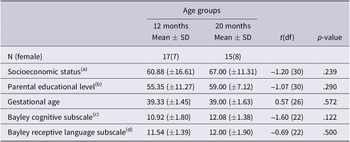
The final sample consisted of 17 children aged 12 months (M=12 months and 16 days, SD=13 days; 7 girls) and 15 children aged 20 months (M=20 months and 11 days, SD=15 days; 8 girls) with good data for both lists. To verify whether the given sample was sufficiently powered, we performed a post-hoc power analysis using the simr package in R (Green & MacLeod, Reference Green and MacLeod2016). It returned an estimated power of 100% with a significance level of α=.05 (CI: 99.63, 100) for the 12-month-olds and an estimated power of 97.10% with a significance level of α=.05 (CI: 95.86, 98.05) for the 20-month-olds. The demographic and clinical characteristics of the two age groups are reported in Table 1.
Descriptive Statistics of Demographic and Clinical Characteristics by Age Groups.

Note. (a) Socioeconomic status was scored according to Hollingshead 9-point scale, whereby a score ranging 10–90 was assigned to each parental job and the higher of two scores was used when both parents were employed (Hollingshead, 1975). Scores ranged between 10, corresponding to unskilled workers; 50, corresponding to sales workers; and 90, corresponding to major professionals. (b) Educational level was scored for each parent on an ad-hoc 9-point ordinal scale based on the Italian school system and then averaged between parents. Scores ranged between 10, corresponding to the fifth grade of primary school; 50, equivalent to a high-school diploma; and 90, corresponding to a post-doctoral degree. (c) The Cognitive subscale of the Bayley Scales of Infant Development (Bayley, Reference Bayley2006) was administered at 6 months of age; scaled score (M = 10, SD = 3). (d) The Receptive language subscale of the Bayley Scales of Infant Development (Bayley, Reference Bayley2006) was administered at 12 months of age; scaled score (M = 10, SD = 3).
Experimental stimuli
Stimuli for the experimental task consisted of 16 bisyllabic Italian words taken from the Italian adaptation of the McArthur-Bates CDI (Primo Vocabolario del Bambino – PVB; Caselli, Bello, & Rinaldi, Reference Caselli, Bello, Rinaldi and Angeli2016). Words were chosen according to their frequency in the vocabulary of toddlers ranging in age 18-30 months. According to the Child’s First Vocabulary database (Rinaldi, Barca, & Burani, Reference Rinaldi, Barca and Burani2004), the selected words had a mean frequency of 66.99 (SD= 9.86, corresponding to the percentage of children who produce each word in the age range 18-30 months), and imageability of 6.16 (SD= 0.37, on a 7-point scale where the more the value is high, the more the word is imageable). All the selected words were basic level nouns (8 feminine and 8 masculine nouns). All feminine nouns had the transparent ending –a. Out of the eight masculine nouns, five nouns had the transparent ending –o and three nouns had the opaque ending -e (cane-dog, sole-sun, fiore-flower). Although the Italian article system includes two forms of masculine determiners (il and lo), we selected only masculine nouns preceded by il for the present study because it is the most common determiner among the two forms (Belletti & Guasti, Reference Belletti and Guasti2015; Caselli, Leonard, Volterra, & Campagnoli, Reference Caselli, Leonard, Volterra and Campagnoli1993). Four nouns (two feminine and two masculine nouns) referred to animated objects (e.g., dog or girl) and twelve (six feminine and six masculine nouns) referred to inanimate ones (e.g., house or ball). For a complete list of stimuli see Appendix A. Each word was associated with a bright and colourful object picture. Pictures were 369x312 pixels (13cm x 11cm) high-resolution digitised photographs or drawings of objects presented on a grey background on a 24” LCD monitor with a resolution of 1366x768. The images were selected from freely available online stock photo databases. The pictures were edited so that their relative size and brightness were equivalent.
During each trial, two images were displayed side-by-side at a distance of 318 pixels. Each object served as a target (corresponding to the word being labelled) or distractor. For each trial, the target and distractor were matched for frequency of use and visual complexity/brightness. In addition, the target and distractor were not semantically related to each other (i.e., they belonged to different semantic categories) and they did not share the initial or final syllable. Animated objects were associated with animated objects and inanimate objects with other inanimate ones. For a complete list of pairs, see Appendix B.
Speech stimuli were produced by two native Italian speakers (females) and were digitally recorded at a sampling rate of 44.1 kHz (16 bit; mono). Recordings were performed in a sound-isolated room using a microphone. Target words were embedded in two carrier phrases: ‘Guarda (look at) + il/la (determiner) + target word’ and ‘Dov’è (where is) + il/la (determiner) + target word?’. In order to create the stimuli, the two speakers recorded multiple versions of the full phrases. They were instructed to produce the sentences in a neutral, naturally spoken manner. To ensure that speech stimuli were acoustically identical across conditions, the best recording of each token (‘Guarda’ (look at), ‘Dov’è’ (where is), il – (theMAS), la (theFEM) was used. All tokens were hand-edited to the same duration (‘Guarda’ and ‘Dov’è’ were edited to last 780 ms and determiners were edited to last 340 ms) and joined together to create the four carrier phrases: ‘Guarda il’, ‘Guarda la’, ‘Dov’è il’, ‘Dov’è la’ (Look at theMASC/FEM; Where is theMASC/FEM). Finally, these tokens were connected with the best recording of each target word (4 feminine and 4 masculine target words from each speaker). Target words were also edited to the same duration (880 ms). All sentences lasted 2 seconds. Visual and auditory stimuli were combined using VirtualDub software.
Experimental procedure
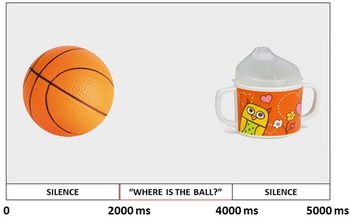
Participants were seated in a dimly lit and sound attenuated chamber. Eye movements were recorded using a Tobii x50 eye-tracker placed at approximately 60 cm from the child’s eyes. The experimenter controlled the experiment using Clearview software from an adjacent room. Children sat in a child car seat facing a 24″ LCD monitor. Speech stimuli were delivered by one forward-facing ~65 dB loudspeaker positioned centrally behind the screen. The caregiver seated on a chair behind the child and was instructed to remain in silence during the whole session. The eye tracker gathered eye-gaze data at a rate of 50 Hz. It was calibrated to the participants’ eyes using a nine-point infant calibration routine. The calibration process typically took 5 minutes. Once calibration was completed, stimuli were presented using a PC running Clearview software. Figure 1 shows one exemplary trial. The two pictures were displayed on the right and left sides of the screen for 5000 ms, corresponding to the total trial length. After 2000 ms from picture onset, the auditory stimulus (lasting 2000 ms) was presented, with a prerecorded female voice inviting the child to look at one of the two pictures. The trial ended after 1000 ms from the sentence offset. No other behavioural response was required. Two additional cameras were placed in the room to control and record the whole session.
Schematic representation of an exemplary trial.

Pairs of pictures differed according to conditions. By varying the grammatical gender of the two pictures, two lists corresponding to the two experimental conditions were created: a same-gender condition in which object pairs shared the same grammatical gender (pallaFEM vs. tazza FEM – ball vs. cup); and a different-gender condition in which nouns had different grammatical gender (palla FEM vs. treno MASC – ball vs. train). For a complete list of pairs divided by conditions, see Appendix B. Each list consisted of 16 pseudo-randomised trials. Each pair of pictures was repeated twice. The same carrier phrase never appeared more than three times in a row and the target picture was never on the same side for more than three times in a row. In addition, the same pair of pictures never appeared consecutively (repetition was allowed with at least two different trials in between). The two pseudo-randomised lists of stimuli created based on these constraints were loaded in ClearView software and were kept consistent across participants. At the end of each trial, a yellow face with a thumb up appeared at the centre of the screen, saying ‘Ehi’ or ‘Benissimo!’ (‘Well done!’) or ‘Grande!’ (‘Great!’). This reinforcing stimulus served to capture the child’s attention. The next trial was started manually by the experimenter when the child looked at the screen. All subjects were exposed to both conditions with the condition sequence being counterbalanced within subjects to reduce the effect of learning or tiredness (in the final sample, condition sequence did not differ between the two age groups, χ2(1, N=32) = 1.01, p = .32). The whole experiment lasted about 15 minutes, with a short break between the two conditions.
Data processing
Data were processed and analysed using the R package ‘EyeTrackingR’ (v. 0.1.8, Dink & Ferguson, Reference Dink and Ferguson2015). Fixations were recorded automatically every 20 ms for each trial from the images’ onset until the end of the task. Data were then filtered to include only 2220 ms following determiner onset until the end of the trial, for a total of 111 possible eye-tracking samples per trial. We analysed children’s eye movements using an Area of Interest (AOI) approach. Two 480x410-pixel AOIs were drawn by a human coder for the two objects presented on the screen. Children’s looking behaviours were quantified by measuring their proportion of looking to each AOI on each trial. Proportional looking data (= time spent looking at target/time spent looking at both target and distractor) served as the dependent measure. Proportional looking data were computed first for each trial and then averaged within each child. Offscreen looks and on-screen non-AOI looks (i.e., looking samples that did not land in one of the AOI) were treated as trackloss and discarded. We applied the EyeTrackingR ‘trackloss’ function setting an elimination criterion of 35% maximum permissible loss for a trial. It resulted in the removal of 246 trials or 24.02% of trials. In order to be included in the analyses, children should have at least 6 trials for each condition. The number of accepted trials did not differ between conditions within each age group (ps > .24), although it was overall higher for the 20-month-old group (12-month group same-gender, M =11.4, SD=4.3; 12-month group different-gender, M = 11.6, SD = 2.2; 20-month group same-gender, M =13.33, SD=1.68; 20-month group different-gender, M =14, SD =1.93).
Principles of cluster-based permutation analysis
To analyse the gaze data, we used the cluster-based permutation analysis (Maris & Oostenveld, Reference Maris and Oostenveld2007). Using this method, initially developed for EEG, we could identify contiguous clusters of statistically reliable effects, corresponding to time windows with a significant increase in looks toward the target picture. This type of analysis overcomes the disadvantages of traditional methods in several ways. First, preset time windows of interest are not needed; second, it preserves all information available in the time course of the trials; and finally, it corrects for multiple comparisons (Dautriche, Swingley, & Christophe, Reference Dautriche, Swingley and Christophe2015; Maris & Oostenveld, Reference Maris and Oostenveld2007). The cluster-based permutation analysis worked as follows. Data were filtered to include only the time window from the determiner onset until the end of the trial. At each time point, we conducted a single sample t-test on proportional looking at the target compared to the chance level (0.5). Means and variances were computed over subjects within each condition. Adjacent time points with a significant effect (t > 2; p < .05) were grouped together in a cluster. The size of each cluster was defined as the sum of all the t-values within the cluster. To exclude the possibility that a cluster of that size was observed by chance, we conducted 1000 simulations where conditions (target, chance) were randomly assigned for each trial. For each simulation, the clusters were created following the same steps described before. Clusters in the original data were taken as significant if the probability of observing a cluster of the same size or bigger in the simulated data was smaller than 5%, corresponding to a p-value of 0.05 (Dautriche et al., Reference Dautriche, Swingley and Christophe2015; Maris & Oostenveld, Reference Maris and Oostenveld2007).
Statistical analysis
To analyse gaze data, we conducted three cluster-based permutation analyses: one for each experimental condition (same-gender; different-gender) comparing average looking proportions toward the target to the chance level (0.5), and one comparing the looking proportions toward the target between conditions. These analyses were performed separately for the two age groups (12-month-olds and 20-month-olds) for a total of six cluster-based permutation tests in the time window from the determiner onset until the end of the trial.
To investigate if looking at the target picture (= time spent looking at target/time spent looking at both target and distractor) was significantly different from the chance level, we performed a cluster-based permutation analysis in which we compared the looking proportions toward the target in each condition to a matrix, of the same length of the trials, where we set the value of the proportion of looking at the target as the chance level (0.5). Then, we were interested in directly comparing the two experimental conditions to understand whether children identified the target picture faster in the different-gender condition than in the same-gender condition. Thus, we conducted two additional cluster-based permutation analyses, one for each group, in which clusters were based on paired t-tests comparing the looking proportions between conditions at each time point.
To verify that children had no preferences for the target picture during the two initial seconds of silence (baseline), we performed four different cluster analyses, one for each condition in each group. Specifically, we compared the proportions of looking at the target before the sound started to the chance level (0.5). We did not find any significant clusters, meaning that, on average, children explored both pictures equally.
Results
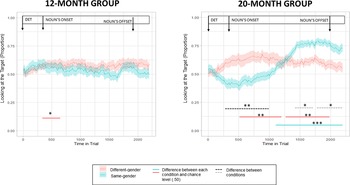
Figure 2 shows the time course of looking patterns for the two conditions (same-gender, different-gender) from the determiner onset to the trial end for the two groups separately. In the 12-month-old group, the cluster-based permutation analysis revealed that looking proportions at the target were significantly different from the chance level only for the different-gender condition (380-700 ms time window, p=.042, red line in Figure 2, left). In the 20-month-old group, looking proportions at the target were significantly different from the chance level for the different-gender condition in two separate time windows: from 560 ms to 1160 ms (p=.012, first red line in Figure 2, right) and from 1260 ms to 1920 ms (p=.005, second red line in Figure 2, right). In addition, looking proportions at the target were significantly different from the chance level for the same-gender condition from the middle to the end of the trial (from 1120 to 2220 ms, p < .001, blue line in Figure 2, right).
Proportion of looking at the target picture from the determiner onset till the end of the trial for the same-gender condition (blue line) and the different-gender condition (red line) in children at 12 months of age (on the left) and at 20 months of age (on the right). Lines represent the mean and the shaded area represents the standard deviation. Horizontal lines below the graphs show clusters of time where the fixations towards the target exceeded chance (* p < .05, ** p < .01, *** p < .001). Dashed black lines show clusters of time where the fixations towards the target differed between conditions (* p < .05, ** p < .01). For interpretation of the references to color in this figure legend, the reader is referred to the web version of this article.

Additionally, we investigated whether there was a difference between the two experimental conditions. In the 12-month-old group, we did not find any significant clusters. In the 20-month-old group, we found that the two conditions were significantly different in several time windows. First, looking proportions at the target were higher for the different-gender condition than the same-gender condition in the 260–980 ms time window (p= .018, dashed black line in Figure 2, right). Second, we found two other significant clusters towards the end of the trial, where the proportions of looking at the target were higher for the same gender-condition than for the different-gender condition: from 1400 ms to 1740 ms (p=.047, first dashed grey line in Figure 2, right) and from 1760 ms to 2220 ms (p= .041, second dashed grey line in Figure 2, right).
To sum up, results showed that the two age groups behaved differently based on conditions: toddlers at 20 months of age were able to identify the target picture just after hearing the determiner, if it was informative (different-gender list), or after hearing the name of the object if the determiner was not informative (same-gender). In contrast, infants at 12 months of age were not able to detect the correct picture if they did not have any cue from the determiner (same-gender list). However, when determiners included salient information, their looking proportions at the target raised significantly above the chance level.
Discussion
In the present study, we recorded children’s fixations to named pictures in an LWL procedure to investigate the role of determiners in early lexical comprehension at 12 and 20 months of age, focusing specifically on the role of gender features as a cue in linguistic input processing. Italian is a morphologically rich and transparent language, in which articles agree in gender and number with the following noun, a characteristic that allows the listener to make predictions, potentially facilitating language comprehension. Given the characteristics of the Italian gender and agreement system, it is possible to hypothesise that, in Italian, the determiner-noun gender agreement – still relatively unexplored in infants and toddlers – could be mastered and even used to detect target words very early in development. This hypothesis has been confirmed in the present study, revealing that 20-month-old Italian toddlers, and in some aspects even 12-month-old toddlers, can extract the gender feature carried by determiners and exploit it to enhance comprehension.
To better understand the effective advantage given by determiner gender in the identification of the target word, we first analysed whether children could identify the target picture in a ‘baseline’ condition: namely, when the determiner – and the carrier phrase preceding the noun – is uninformative (same-gender condition). Since, to date, only a few studies have applied online techniques to the investigation of early comprehension in Italian (e.g., Ferry et al., Reference Ferry, Nespor and Mehler2020; Suttora et al., Reference Suttora, Salerni, Zanchi, Zampini, Spinelli and Fasolo2017), findings relative to this ‘baseline’ condition can provide interesting evidence on early online word comprehension per se. We found that 20-month-old children were clearly able to recognise the target picture when this was named, and specifically when the full label was heard – approximately 740 ms after word onset. In the same condition, 12-month-old children never looked at the target picture for a significantly longer time than the distractor, suggesting that they were not able to associate the heard word with the right picture before the end of the trial. These data are in line with previous studies showing significant increases in the efficiency of online comprehension from age 15 to 25 months (Bergelson & Swingley, Reference Bergelson and Swingley2012; Fernald & Marchman, Reference Fernald and Marchman2008; Fernald, Perfors, & Marchman, Reference Fernald, Perfors and Marchman2006). Interestingly, these improvements were not correlated with a control measure designed to assess the speed of oculomotor responses during visual orienting in a non-linguistic task, suggesting that the developmental improvements in the linguistic LWL procedure reflected enhanced online comprehension rather than a more general increased speed in visual orienting (Fernald et al., Reference Fernald, Perfors and Marchman2006). More specifically, Bergelson and Swingley (Reference Bergelson and Swingley2012, Reference Bergelson and Swingley2013, Reference Bergelson and Swingley2015) reported that the observed development of online lexical comprehension was not linear, but was characterised by a boost in performance at around 14 months of age.
At this age, lexical comprehension has been demonstrated by converging evidence coming from different online techniques only under special conditions, such as having the participant’s mother articulating sentences that contain the target words (Bergelson & Swingley, Reference Bergelson and Swingley2012; Parise & Csibra, Reference Parise and Csibra2012) or when selectively considering infants with high early word production (Friedrich & Friederici, Reference Friedrich and Friederici2010). A few studies used similar procedures with Italian-speaking toddlers. Using an LWL procedure, Suttora and colleagues (Reference Suttora, Salerni, Zanchi, Zampini, Spinelli and Fasolo2017) tested a group of 15-month-olds and found that their identification of the target pictures was on average above the chance level. Moreover, the only Italian study preliminarily investigating the development of early online comprehension from 12 to 24 months of age showed that children could recognise the target picture starting at 18 months of age, but not at 12 months of age (Esposito, Reference Esposito2012). Our results fit perfectly with this empirical evidence: when there is no cue in the carrier phrase that may help children to predict the target picture (i.e., the gender feature of determiners) and they can rely only on the meaning of the noun, we found that only toddlers aged 20 months were able to identify the target, while infants aged 12 months could not.
Different results emerged when determiners were informative and represented a cue for correctly identifying the target word. Taking advantage of the fact that, in Italian, determiners agree in gender with the upcoming nouns, we created a condition in which the target and distractor were characterised by different grammatical gender, to explore whether the determiner-noun agreement relationship could help children in facilitating or even anticipating the choice of the target picture. A previous study on the acquisition of agreement configurations in Italian reported that the determiner-noun agreement is the easiest agreement to make and the first that children can master (Moscati & Rizzi, Reference Moscati and Rizzi2014). Our results show that toddlers at 20 months of age were able to understand and use gender determiner-noun agreement to predict the target picture. In this condition, the target picture was recognised before its full label was heard, approximately 560 ms after determiner onset. Toddlers continued to look at the target picture almost until the end of the trial, as shown by the two significant clusters found when comparing their performance to the chance level (560 ms to 1160 ms and 1260 ms to 1920 ms). However, their attention on the target picture decreased by the end of the trial, especially compared to the same time frame in the same-gender condition. We could argue that, whereas in the same-gender condition the target picture was recognised relatively late (1120 ms from determiner onset) and children’s attention on the target stayed high until the end of the trial, in the different-gender condition, the target picture was recognised earlier thanks to the informative determiner and children’s attention on the target decreased towards the end of the trial.
Interestingly, the 12-month-old group seemed to follow the same pattern: their identification of target pictures was on average above the chance level just after hearing the determiner, even though their responses seemed to be less robust than the 20-month-olds’ responses. However, the fact that 12-month-olds looked at the target picture for a significantly longer time than the distractor just after hearing the determiners suggests that they do not only detect the gender feature in determiners, but also use it as a cue that facilitates the prediction of upcoming words. This is surprising since, without such a cue, the same group of infants was not able on average to recognise the target picture in any of the investigated time windows. The fact that we found significant results in the 12-month-old group only with informative determiners suggests that children at this age may have access to grammatical traits. To our knowledge, there is no clear evidence of how and when children access grammatical traits (Bates, Devescovi, Hernandez, & Pizzamiglio, Reference Bates, Devescovi, Hernandez and Pizzamiglio1996; Caramazza, Reference Caramazza1997; Levelt, Reference Levelt1999) and the evidence is even sparser when comprehension is investigated. Theories on speech production agree that lexical-semantic and syntactic levels of representation of words are independently stored in separate networks and are accessed sequentially. Access to a lexical-semantic representation of a word does not guarantee access to its syntactic features (Caramazza, Reference Caramazza1997). Since there is no previous evidence suggesting that gender features might be accessible before meaning during development, more empirical evidence is needed. Along with this interpretation, we can hypothesise that 12-month-olds also rely on other cues (i.e., the probability of occurrence between the determiner and the noun) that are not relevant when determiners are uninformative. These additional cues, combined with gender information, could help infants identify the target picture. Studies report that infants are able to calculate the probability of occurrence between two speech parts, and this ability helps them segment the language into different components (Gomez & Lakusta, Reference Gomez and Lakusta2004; Saffran et al., Reference Saffran, Aslin and Newport1996; Saffran & Wilson, Reference Saffran and Wilson2003). We can hypothesise that, when infants are presented with two pictures with different gender, they can calculate the probability of occurrence between the determiner and noun and choose the one with a higher match probability. For example, when they saw a train (masculine in Italian) and a ball (feminine in Italian) and they heard the masculine determiner, they looked at the train because the probability of occurrence between the masculine determiner and the masculine word ‘train’ is higher than the probability of occurrence between the masculine determiner and the feminine word ‘ball’. Infants acquire this ability in the first months of life before they have access to the meaning of words (Aslin & Newport, Reference Aslin and Newport2012; Pelucchi, Hay, & Saffran, Reference Pelucchi, Hay and Saffran2009; Romberg & Saffran, Reference Romberg and Saffran2010).
To date, a similar use of gender features in determiners, pronouns or adjectives to facilitate and anticipate recognition of upcoming nouns has been reported in previous studies, but only in children after 23 months of age (Arias-Trejo & Alva, Reference Arias-Trejo and Alva2012; Arias-Trejo et al., Reference Arias-Trejo, Falcón and Alva-Canto2013; Lew-Williams & Fernald, Reference Lew-Williams and Fernald2007; Melançon & Shi, Reference Melançon and Shi2013; Smolík & Bláhová, Reference Smolík and Bláhová2019; van Heugten & Shi, Reference van Heugten and Shi2009). Some studies have demonstrated that, in some cases, these skills might be mastered even later. For example, children acquiring Dutch, a language characterised by a particularly complex gender system, cannot use gender features to anticipate the identification of the target picture until they master the full gender paradigm (including both common and neuter gender) at around 5 years of age (Brouwer et al., Reference Brouwer, Sprenger and Unsworth2017). Similar delays have been found in Spanish, with irregular and unmarked words: namely, when the noun ending encodes a different gender than usual or gives no information at all (opaque words). In an Intermodal Preferential Looking task, 30-month-old Spanish children could identify the target picture only with regular words, whereas only at age 36 months could they anticipate irregular words (Arias-Trejo & Alva, Reference Arias-Trejo and Alva2012). Beside gender, determiners are marked and agree with the upcoming noun in number, too. Awareness of this agreement could help children to anticipate and predict the target word in the same way as gender. Studies report that children around their second year of life understand number features in determiners or in verbal inflections and use them to process whether the upcoming noun is singular or plural and thus to predict it (Gambi, Gorrie, Pickering, & Rabagliati, Reference Gambi, Gorrie, Pickering and Rabagliati2018; Lukyanenko & Fisher, Reference Lukyanenko and Fisher2016; Robertson, Shi, & Melançon, Reference Robertson, Shi and Melançon2012). The use of such features (gender and number) to anticipate and/or facilitate the processing of upcoming words has never been demonstrated in children younger than two years of age. To date, several studies have reported that infants are sensitive to function words very early in life. For example, German learners aged 7 months can identify function words in continuous speech after being familiarised with them in isolation (Höhle & Weissenborn, Reference Höhle and Weissenborn2003) and French learners aged 11 months recognise real articles from non-real articles (Hallé, Durand, & De Boysson-Bardies, Reference Hallé, Durand and De Boysson-Bardies2008). At age 18 months, English-acquiring children use their knowledge of determiners and function words in sentence processing, orienting faster and more accurately to the visual target following the correct determiner (Kedar et al., Reference Kedar, Casasola and Lust2006) and using function words to categorise new words as nouns or verbs (Echols & Marti, Reference Echols and Marti2004). In addition, toddlers at 18 months of age can specifically understand gender agreement, preferring a match condition in which articles agree in gender with nouns (or pseudo-nouns, Cyr & Shi, Reference Cyr and Shi2013; van Heugten & Christophe, Reference van Heugten and Christophe2015). To our knowledge, the present study provides the first evidence that children at 20 months of age, and even at 12 months of age, do not only understand the gender feature in determiners, but also use it to recognise the upcoming target word. Using the ‘facilitation vs. anticipation’ distinction provided by Brouwer and colleagues (Reference Brouwer, Sprenger and Unsworth2017), we could speculate that, at 20 months of age, the gender features of determiners are used to anticipate the upcoming noun, since target recognition happens before the onset of the noun. At 12 months of age, the gender features of determiners are used to facilitate recognition of target words, which were not accurately recognised without the gender cue.
Very recently, another study has shown that Italian infants as young as 12 months of age are able to understand and extract gender features to identify the target picture (Ferry et al., Reference Ferry, Nespor and Mehler2020). In this study, Italian infants aged 12, 18 and 24 months were tested to investigate their understanding of gender and number features, marked both on the determiner and on the final vowel of the word. Using the LWL procedure, children were shown pairs of images of faces that differed either in number or gender and were asked to look at one of the images with morphology as the only distinguishing cue. Across all ages, the authors found that infants looked more to the labelled image, indicating understanding of gender and number morphological cues. Although these results represent an important background for our study, there are two important differences to be noted. First, Ferry and colleagues used only images of faces as stimuli, thus focusing on biological gender. In our study, instead, all items but two (boy and girl) were characterised by grammatical gender, in which gender is arbitrarily assigned and can be only derived by morphology. Second, Ferry and colleagues could not distinguish which of the marked features (determiners or final vowel of the noun) was used to identify the target picture. Since we found a significant increase in looking time at the target immediately after hearing the determiners in our 12-month-old infants, we can clearly rule out which morphological cue they use (i.e., gender features carried by determiners) to identify the target picture. Given these differences, we can argue that ours is the first study showing that, as early as 12 months of age, Italian infants can use the morphological feature of determiners to anticipate the identification of the target picture.
Two major limitations of the study should be noted. First, we did not accurately control the noun ending of masculine nouns as we included a few opaque nouns (ending with -e) together with nouns with regular masculine endings (-o). Although a recent Italian study has shown that opaque words that are preceded by a congruent determiner can be correctly categorised by gender by three years of age (Belacchi & Artuso, Reference Belacchi and Artuso2020), we cannot exclude that in our study opaque endings caused more difficulties in identifying the correct picture than transparent endings. A careful comparison of transparent vs. opaque morphology might be a starting point for future research. Second, we did not control through an offline task whether the words used in the LWL task were known to our participants. However, one of the aims and primary motivations of the present study was to investigate early comprehension by online methods to overcome the disadvantages of offline measures. Obtaining a behavioural response such as pointing to the image corresponding to the heard word from toddlers involves a high level of cooperation and might not be representative of their comprehension skills. We could have used parent-report measures to overcome this issue and obtain a more representative appraisal of children’s language skills. However, it is known that, in the case of younger children, parent reports of comprehension might be susceptible to differential reporting biases since making judgments about their children’s levels of understanding requires considerable subjective interpretation (e.g., Feldman et al., Reference Feldman, Dollaghan, Campbell, Kurs-Lasky, Janosky and Paradise2000; Frank, Braginsky, Yurovsky, & Marchman, Reference Frank, Braginsky, Yurovsky and Marchman2017). In line with this, using an LWL task, Fernald and colleagues (Reference Fernald, Perfors and Marchman2006) did not find any differences in the looking patterns between target words that parents reported as understood and target words that were reportedly not known.
In conclusion, the present study sheds light on early online lexical comprehension in Italian toddlers. Our results suggest that, as early as 12 months of age and with an improvement seen at 20 months of age, toddlers can extract and use the gender feature carried by determiners to make predictions about the upcoming target noun. Further and larger longitudinal studies are needed to delineate the developmental trajectories of online lexical comprehension more clearly and understand how abstract features such as gender or number carried by function words are used to enhance such comprehension. Overall, this study may open up new perspectives for early intervention: our findings suggest that, at very early ages, typically-developing toddlers are not only sensitive to function words, but also use abstract features carried by them to enhance comprehension; this could inform novel interventions for populations at high risk for language disorders.
Acknowledgements
The authors wish to thank the nursing and clinical staff of the Department of Gynecology & Obstetrics of the Manzoni Hospital of Lecco and of the Hospital of Desio and Vimercate (branch of Carate Brianza) and all infants and their parents participating in this study. We are also grateful to Prof. Maria Teresa Guasti for critically revising the manuscript and to Giulia Melesi and Roberta Bettoni for help in creating the task. Finally, we want to thank two anonymous reviewers for their constructive feedback. This research was funded by the Italian Ministry of Health (“Ricerca Corrente”).
APPENDIX A
List of stimuli presented in the task

APPENDIX B
List of pairs divided by conditions

Note. Target words are shown in bold.