Introduction
Mammalian sperm undergo a series of biochemical transformations in the female reproductive tract that are collectively known as capacitation (Austin, Reference Austin1951; Chang, Reference Chang1951). Capacitation has previously been correlated with changes in sperm plasma membrane fluidity, intracellular ion concentrations, metabolism and motility (Yanagimachi, Reference Yanagimachi, Knobil and Neill1994). Following capacitation, the sperm binds to the egg zona pellucida and undergoes the acrosome reaction, which allows the sperm to penetrate the egg. The signalling pathways involved in sperm capacitation have been characterised and current evidence indicates that cholesterol efflux (Davis et al., Reference Davis1981), pH (Breitbart et al., Reference Breitbart2002), Ca2+ (Parrish et al., Reference Parrish, Susko-Parrish and Graham1999), actin polymerization (Etkovitz et al., Reference Etkovitz, Rubinstein, Daniel and Breitbart2008), cAMP (Lamirande et al., Reference Lamirande and O'Flaherty2008) and tyrosine phosphorylation (Moseley et al., Reference Moseley, Jha, Björndahl, Brewis, Publicover, Barratt and Lefièvre2005; Hung et al., Reference Hung, Miller, Meyers and VandeVoort2008) are important regulatory components.
The process of capacitation includes the activation of sperm motility and hyperactivation, which usually occur at some point during the fertilization process in vitro (Ho et al., Reference Ho and Suarez2001). Following the activation of motility, the sperm flagella beat in almost symmetrical fashion, propelling the sperm in nearly linear trajectories (Ho et al., Reference Ho, Granish and Suarez2002; Kumar et al., Reference Kumar, Rangaraj and Shivaji2006; Suarez, Reference Suarez2008). In a hyperactivated state, the spermatozoa flagella beat vigorously, producing high amplitude, asymmetrical beat pattern. These motility changes assist the sperm in penetrating the oocyte zona pellucida and are essential for fertilization. Numerous earlier studies have reported the mechanism of hyperactivation, which is generally considered part of the capacitation process since sperm have been observed to hyperactivate while undergoing capacitation in vitro (Yanagimachi, Reference Yanagimachi, Knobil and Neill1994). Hyperactivation and capacitation have also been recognized as multifaceted phenomena involving associated increases in intracellular levels of calcium, ATP and pH (Suarez, Reference Suarez2008; Etkovitz, et al., Reference Etkovitz, Rubinstein, Daniel and Breitbart2008). The increased level of tyrosine phosphorylation in sperm proteins is mainly distributed within the flagellum (Naz et al., Reference Naz and Rajesh2004). The activity of pyruvate dehydrogenase A2, which induces tyrosine phosphorylation, has been positively correlated with hyperactivation (Kumar et al., Reference Kumar, Rangaraj and Shivaji2006). Capacitation phenomena may therefore be related to hyperactivation. However, there have been cautionary reports (Ho et al., Reference Ho and Suarez2001) advising that although activated motility has been related to capacitation, the precise capacitation status of activated sperm is still poorly understood.
In earlier reports, sperm were evaluated collectively as discrete groups, thus the capacitation state of each individual sperm could not be evaluated in detail (Marquez et al., Reference Marquez and Suarez2004; Kumar et al., Reference Kumar, Rangaraj and Shivaji2006; Etkovitz et al., Reference Etkovitz, Rubinstein, Daniel and Breitbart2008). Therefore, in the present study, we caught individual sperm by micropipette and investigated whether the capacitation state of activated sperm are related to the acrosome and fertility. Furthermore, when sperm activity was reduced by culturing sperm in media without energy (glucose and pyruvate), we demonstrated a defined change of capacitation pattern in activated sperm, in turn causing effect upon fertility, the acrosome reaction and the expression level of progesterone receptor (PRs).
Materials and methods
Oocyte collection and in vitro maturation
Bovine ovaries were obtained from an abattoir, placed in saline containing a 0.1% solution of antibiotic/antimycotic (Gibco Laboratories, AB) and transported to the laboratory within 1–3 h. Oocyte collection and in vitro maturation of oocytes were carried out as previously described (Saeki et al., Reference Saeki, Hoshi, Leibfried-Rutledge and First1990), with some modifications. Bovine oocytes were obtained from abattoir-derived ovaries. Oocytes with intact cumulus cells and evenly granulated cytoplasm were selected, washed and cultured in modified TCM199 (m-TCM199) for 22–25 h at 39°C under 5% CO2 in air with high humidity. m-TCM199 consisted of HEPES-buffered medium 199 (Gibco Laboratories) supplemented with 0.1% (w/v) polyvinyl alcohol (PVA; Sigma Chemical Co.), 0.5 mM sodium pyruvate (Nacalai Tesque Inc.), 1% AB, 0.02 AU/ml FSH (Antrin, Denka) and 1 μg/ml estradiol-17β (Sigma Chemical Co.).
Washing and pre-incubation of sperm
Sperm washing and pre-incubation (PI) was carried out described below. Frozen–thawed sperm were washed with a discontinuous percoll solution. The washed sperm (2.0 × 10⁸ cells/ml) were cultured in Brackett and Oliphant medium (BO) (Brackett et al., Reference Brackett and Oliphant1975) supplemented with 0.05% (w/v) PVA, 1% AB (BO·PVA) and methyl-β-cyclodextrin (MBCD) for 0, 2 and 4 h at 39°C under 5% CO2 in air with a high humidity. Sperm were pre-incubated and then used for insemination.
In vitro fertilization of bovine oocytes
Matured oocytes were inseminated with cultured sperm (2 × 10⁶ cells/ml) in BO·PVA. Oocytes were incubated with sperm for 18–20 h after insemination. All incubations were performed at 39°C under 5% CO2 in air at high humidity.
Assessment of fertilization
In order to determine the pronuclear stage during fertilization, subsets of oocytes after IVF were fixed on a slide with 3:1 acetic acid:ethanol and stained with 1% orcein. Oocytes considered to be fertilized were classified into three groups: ‘2PN’ (female pronucleus, male pronucleus and sperm tail; normal fertilization); ‘polyspermy’ (two or more sperm tails in the cytoplasm with condensed heads, or two or more decondensed heads in the cytoplasm); and ‘asynchrony’ with a condensed sperm head (female pronucleus and a condensed sperm head). The percentage of each category of fertilization was calculated from the total number of oocytes inseminated.
Analysis of sperm motility
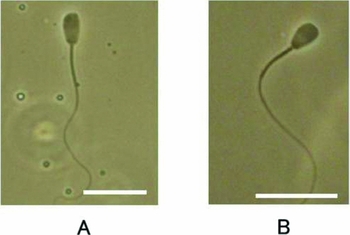
Sperm motility was categorized according to motility patterns as previously reported (Ho et al., Reference Ho, Granish and Suarez2002; Marquez, et al., Reference Marquez and Suarez2004). Treated sperm were examined in PVP solution in order to reduce sperm motility on an interference contrast microscope (Olympus, BH-2). Normal motility and activated motility were characterized by symmetrical beating of the flagellum (norma; Fig. 1A) resulting in a linear swimming trajectory (activated; Fig. 1B).
Sperm motility patterns of bovine spermatozoa cultured in BO·PVA supplemented with MBCD for 4 h. A) normal motility B) activated motility. Bars = 20 μm.

Activated motility sperm: chlortetracycline fluorescence assay
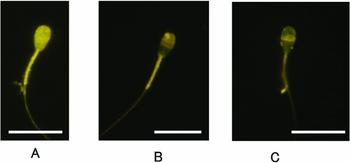
Normal and activated sperm were collected and examined at 0, 2 and 4 h after PI. Single sperm were collected by injection pipette immediately prior to CTC staining. Isolated sperm were injected in BO·PVA on a glass slide (Matsunami). The chlortetracycline (CTC) stain was used to evaluate capacitation status as reported by Fraser et al. (Reference Fraser, Abeydeera and Niwa1995). Precipitated sperm were mixed thoroughly with 750 μM CTC solution (Sigma Chemical Co.), 5 mM cysteine (Sigma Chemical Co.), 130 mM NaCl (Kanto Chemical), 20 mM Tris (Sigma Chemical Co., pH 7.8), fixed with 12.5% (w/v) paraformaldehyde in 0.5 M Tris–HCl (pH 7.4) and finally placed on a glass slide and covered with a coverslip. Those sperm were observed for CTC staining using a 400 to 440 nm filter and a DM455 dichroic mirror (U-MWBV2, Olympus) under a fluorescence microscope (BX-51, Olympus). CTC staining patterns were classified into three types according to the method described by Fraser et al. (Reference Fraser, Abeydeera and Niwa1995): F (uncapacitated)-pattern, bright fluorescence detected over the whole region of the sperm head; B (capacitated)-pattern, fluorescence detected on the sperm head but not over the post-acrosomal region; and AR (acrosome-reacted) pattern, weak fluorescence observed over the sperm head with a bright band sometimes present in the equatorial region (Fig. 2).
F, B and AR pattern. A) F (uncapacitated)-pattern, bright fluorescence detected over the whole region of the sperm head, B) B (capacitated)-pattern, fluorescence detected on the sperm head but not over the post-acrosomal region, C) AR (acrosome-reacted)-pattern, weak fluorescence observed over the sperm head with a bright band sometimes present in the equatorial region. Bars = 20 μm.

CTC staining of sperm in contact with cumulus cells
Sperm in contact with cumulus cells were stained by the CTC method described above. At 3–5 h after insemination, embryos were removed from BO·PVA, washed five times in BO·PVA and stripped of cumulus cells by vortexing. After vortexing, embryos were gathered and sperm in direct contact with the cumulus cells were collected by centrifugation of the BO·PVA and vortexing. Sperm collected were also stained by CTC staining.
Immunofluorescent studies of the progesterone receptor
Localization studies of the progesterone receptor in bovine sperm was carried out by indirect immunofluorescence using C-19 (sc-538: Santa Cruz Biotechnology Inc.) and rabbit anti-mouse IgG conjugated with FITC (RAM-FITC; Zymed). PR (C-19) is an affinity purified rabbit polyclonal antibody raised against a peptide mapping at the C-terminus of the PR of human origin.
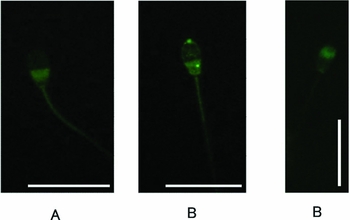
Following PI, 500 ml of sperm suspension was mixed with 500 ml 4% paraformaldehyde in PBS for 10 min. The sperm suspension was then centrifuged at 600 g for 6 min. After supernatant removal, fixed sperm cells were washed with 1 ml PBS and centrifuged at 600 g for 3 min to remove remaining aldehyde residues. The washing procedure was repeated twice. Following removal of the supernatant, the sperm pellet was incubated with primary antibody C-19 (diluted by 1:10) in PBS supplemented with 3 mg/ml BSA for 1 h at room temperature. The sperm suspension was then centrifuged at 600 g for 3 min. After removal of the supernatant, the sperm were washed twice as described above to remove unbound primary antibody. The sperm pellet was then incubated with RAM-FITC (diluted by 1:100) in PBS supplemented with 3 mg/ml BSA for 1 h at room temperature. The sperm suspension was then centrifuged at 300 g for 3 min. After removal of the supernatant, the sperm were washed twice as described above to remove unbound secondary antibody. Samples were then mounted and kept for up to one day at 4°C in the dark and examined by fluorescence microscopy (Olympus). Sperm were examined by fluorescence microscopy to identify positive progesterone receptor localization (Fig. 3).
Fluorescence pattern of sperm stained for progesterone receptor localization. A) Negative control (isotype control). B) Positive progesterone receptor localization. Bars = 20 μm.

Experimental design
Experiment 1
To investigate the effects of culturing sperm in BO·PVA supplemented with MBCD upon activated motility, fertility and the capitation/acrosome reaction (AR) of individual sperm with normal and activated motility, we incubated sperm in BO·PVA (control) and BO·PVA supplemented with 1.5 mM MBCD (BO·MBCD). Following sperm culture, individual sperm exhibiting normal and activated motility from the control and BO·MBCD groups were caught by micropipette and stained by CTC in order to determine the rate of activation and fertilization.
Experiment 2
To investigate how the presence of glucose and pyruvate acid in BO·MBCD caused effect upon activated motility, fertility, capitation and the acrosome reaction of activated sperm, we incubated sperm in BO·MBCD with glucose (G) and pyruvate acid (P) (PI+), without G and P(PI−), or BO·MBCD without G and P initially but supplemented with glucose and pyruvate acid after 2h PI (supplementation group). Following sperm culture, individual activated sperm from all groups were caught by micropipette and stained by CTC to determine the rate of activation and fertilization.
Experiment 3
In order to investigate the AR in sperm from the PI+ and supplementation groups at 4 h that were in contact with cumulus cells and PR localization of the sperm cultured in those media, we cultured sperm and inseminated in BO·PVA, respectively.
Statistical analyses
All experiments were replicated three to eight times. In Experiment 1 and 2, the rates of fertilization were evaluated for significance using the chi-squared test. In Experiment 1 and 2, the proportion of sperm exhibiting B and AR patterns and group and sperm motility (normal and activated motility) among each treatment were evaluated for significance using one-way factorial ANOVA with Fisher's PLSD post-hoc test. In Experiment 3, the proportion of immunopositive staining for the PR in sperm cells and the rate of sperm exhibiting hyperactivation, were evaluated for significance using the chi-squared test. In Experiment 3, the proportion of sperm exhibiting B and AR patterns between each treatment were evaluated for significance using the chi-squared test. In all analyses, p < 0.05 was considered significant.
Results
Experiment 1
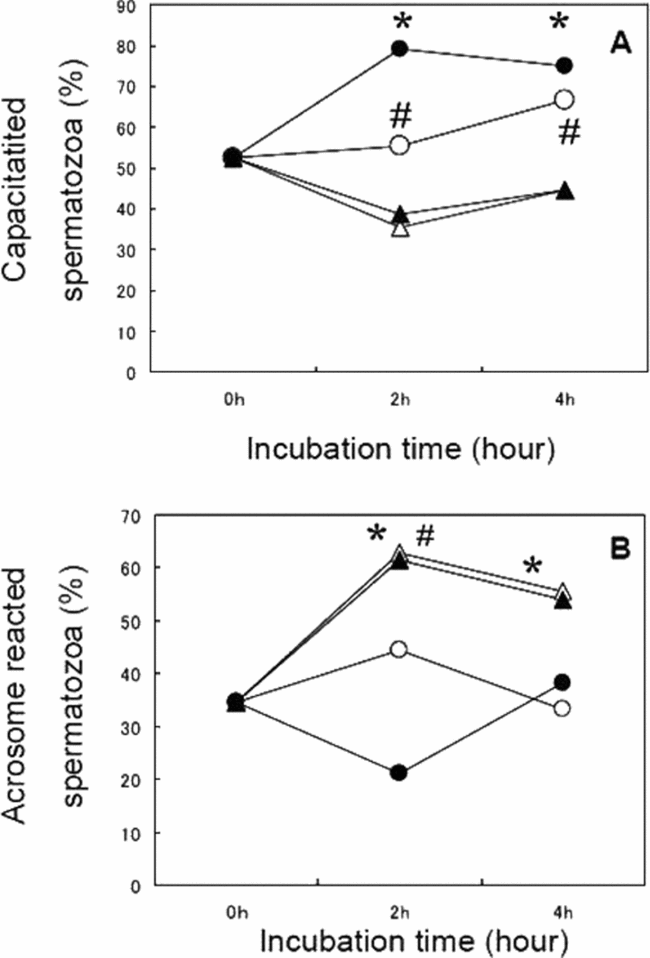
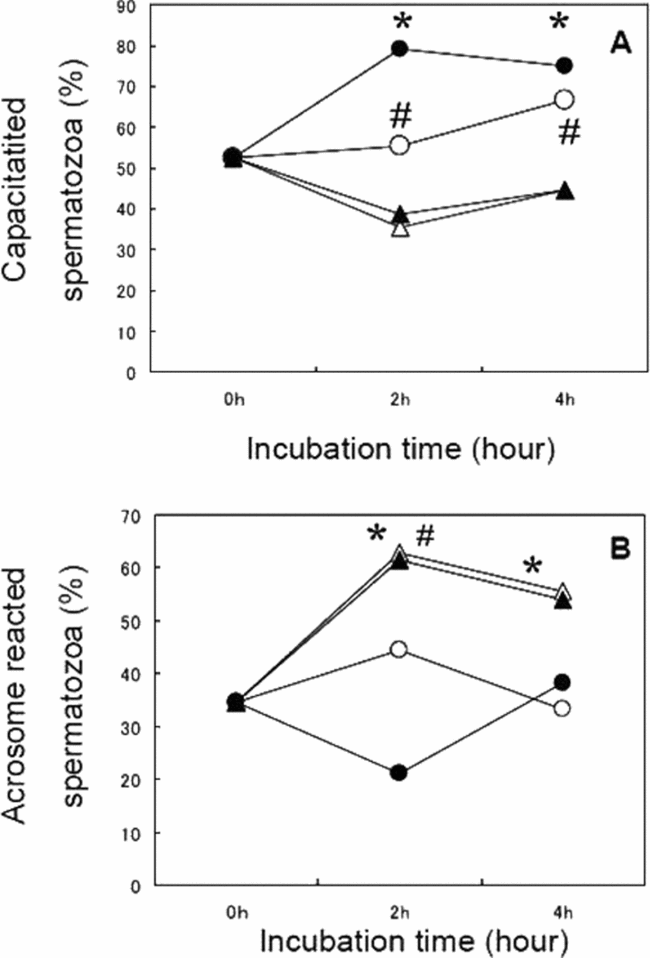
After 2 h and 4 h of PI, the proportions of individual activated sperm exhibiting patterns characteristic of capacitation were higher than that of sperm with normal motility in BO·MBCD and the control group (Fig. 4, p < 0.05, ANOVA). Conversely, the proportion of individual sperm with normal motility exhibiting capacitation patterns did not significantly change in BO·MBCD and control (p > 0.05, ANOVA).
A and B. Capacitation and acrosome reaction of activated sperm in pre-incubation media supplemented with MBCD (·, activated sperm in BO·PVA supplemented with MBCD; ▲, normal motility sperm in BO·PVA supplemented with MBCD; °, activated sperm in BO·PVA; △, normal motility sperm in BO·PVA) and the proportion of capacitated and acrosome reacted bovine sperm in vitro. * indicates significant differences between activated and normal motility sperm in BO·MBCD (p < 0.05), # indicates significant differences between activated and normal motility sperm in controls (p < 0.05) as determined by one-way ANOVA. Experiments were repeated 4–9 times.
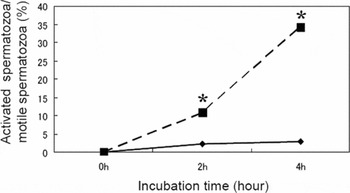
A time-dependent increase in the proportion of sperm displaying activated motility was observed in the BO·MBCD group (Fig. 5, p < 0.05, ANOVA). However, the proportion of activated sperm in the control group did not increase significantly with the length of time cultured (p > 0.05, ANOVA).
Effect of sperm cultured in BO·PVA supplemented with or without MBCD (◾: BO·MBCD, ◆: control for the motility of activation. * indicates significant differences between BO·MBCD and controls by one-way ANOVA. Experiments were repeated 6 times.

Normal fertilization rates in the BO + MBCD group (70.0% and 55.0%) were higher than that in the control group (26.2% and 18.1%) after 2 h and 4 h PI respectively (Table 1, p < 0.05, chi-squared test).
Effect of preincubation of sperm in media containing MBCD on fertility1

Statistical significance compared to control: a vs. b, p < 0.001 (chi-squared test).
1Repeat no. 5.
2No. of 2PN formation in oocytes /total oocytes.
3No. of 2PN, more than 3PN or sperm head in embryos/ total embryos.
Experiment 2
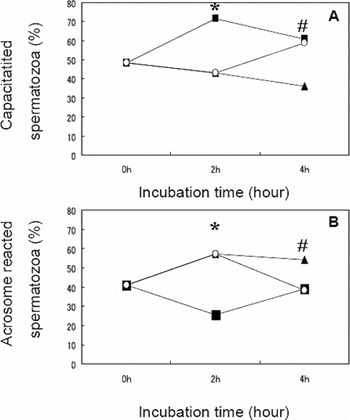
After 2 h and 4 h PI, the incidence of capacitation in activated sperm were 71.4% and 60.9% in PI+, 42.9% and 36.0% in PI− and 42.9% and 58.8% in the supplementation group (Fig. 6). After 2h PI, the incidence of capacitation in activated sperm in PI+ was higher than that of the other treatment groups (p < 0.05, ANOVA). After 4 h PI, the incidence of capacitation in activated sperm in PI+ and the supplementation group were higher than that of the PI− groups (p < 0.05, ANOVA).
Capacitation of activated sperm during PI in BO·MBCD with, without or supplemented (◾, PI+; ▲, PI−; °, supplementation) with glucose and pyruvate. *indicates significant differences among PI+, PI− and supplementation groups (p < 0.05), and # indicates differences among PI+, supplementation groups and PI− groups (p < 0.05) as determined by one-way ANOVA. Experiments were repeated nine times.

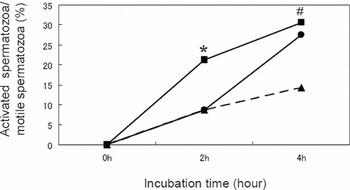
The incidence of normal motility in all treated groups was 31.0–41.6% and 21.0–32.1% at 2 h and 4 h, respectively (p > 0.05, ANOVA). The rate of activated motility in the PI+ group was higher than that in the other treatment groups after 2 h incubation (Fig. 7, p < 0.05, ANOVA). After 4 h PI, the rate of activated motility in the PI+ and supplementation groups were significantly higher than that in the PI− group (p < 0.05, ANOVA).
The proportion of activated sperm in BO·MBCD on the proportion of in vitro (◾, PI+; ▲, PI−; ·, supplementation) of glucose and pyruvate. * indicates significant differences among PI+, PI− and supplementation groups (p < 0.05), # indicates differences among PI+, supplementation groups and PI− groups (p < 0.05) as determined by one-way ANOVA. Experiments were repeated nine times.

After 2 h and 4 h PI, the normal fertilization rates were 70.2% and 56.5% in PI+, 55.4% and 16.4% in PI− and 55.4% and 32.4% in the supplementation group, respectively (Table 2). The rate of fertilization in PI+ was significantly higher than that of the other treatment groups (p < 0.05, chi-squared test) at 2h PI. After 4 h PI, the fertilization rate of PI+ was highest of all the groups (p < 0.05, chi-squared test). Fertilization rate in the supplementation group was lower than that in PI− (p < 0.05, chi-squared test).
Effect of glucose and pyruvate acid in BO·PVA supplemented with MBCD on fertility1

Statistical significance compared with 0 h: a vs. b, p < 0.01; c vs d p < 0.001; e vs f, e vs g, f vs g, p < 0.001; h vs i, h vs j, i vs j p < 0.003 (chi-squared test).
1Repeat no. 9.
2No. of 2PN formation in oocytes/total oocytes.
3No. of 2PN, more than 3PN or sperm head in embryos/total embryos.
Experiment 3
After 3–5 h of insemination, the proportion of sperm displaying the AR pattern of CTC staining in the PI+ groups (81.4%) was significantly higher than that in the supplementation group (65.2%) (p < 0.05: chi-squared test). The proportion of sperm in the PI+ group which were immunopositive for PR (42.7%: 70/164) was higher than the supplementation group (31.3%: 47/150) (p < 0.05, chi-squared test).
Discussion
In Experiment 1, activated sperm exhibited a pattern characteristic of capacitation in BO·MBCD (Fig. 4) and sperm cultured in BO·MBCD exhibited activated motility rates in vitro comparable to controls (Fig. 5). Activated sperm acquired hyperactivated motility (Ho et al., Reference Ho and Suarez2001). In a previous study, ram sperm exhibiting capacitation, as indicated by CTC staining, was correlated with tyrosine phosphorylation, a characteristic fundamental to sperm capacitation (Grasa et al., Reference Grasa, Cebrián-Pérez and Muiño-Blanco2006). In mouse and bull sperm, exposure to β-cyclodextrins increased the proportion of fertilization rates and the incidence of capacitation (Choi et al., Reference Choi and Toyoda1998; Dinkins et al., Reference Dinkins and Brackett2000). Tyrosine phosphorylation was induced during capacitation and hyperactivation (Hung et al., Reference Hung, Miller, Meyers and VandeVoort2008). We thus infer that in the present study, activated sperm induced capacitation in BO·MBCD.
In Experiment 1, sperm cultured in BO·MBCD exhibited higher fertility and activated motility rates in vitro compared with sperm cultured in the control group (Table 1 and Fig. 4). In the process of fertilization, cholesterol loss from the surface membrane of sperm is one of the molecular events of capacitation in vitro (Davis, Reference Davis1981; Moseley et al., Reference Moseley, Jha, Björndahl, Brewis, Publicover, Barratt and Lefièvre2005). When cholesterol is removed from the sperm cell membrane, the cholesterol:phospholipid ratio of the sperm plasma membrane decreases, the lipid concentration changes and the cAMP-signalling cascade is the first process of capacitation to activate, thereby allowing the sperm to fertilize (Witte et al., Reference Witte and Schäfer-Somi2007). Activated motility and hyperactivation are known to be regulated by the cAMP-signalling cascade which is stimulated by adenylyl cyclase, HCO3− and Ca2+ (Ho et al., Reference Ho and Suarez2001; Marquez et al., Reference Marquez and Suarez2008). These changes in motility may help sperm swim faster and generate enough force to penetrate cumulus cells and the zone pellucida during fertilization (WHO Health Organization, 1999). Increasing the proportion of activated sperm and the number of activated sperm exhibiting patterns characteristic of capacitation resulted in enhanced rates of fertilization. In the present study, we infer that activated sperm has undergone capacitation and therefore possess the ability to fertilize.
In Experiment 2, activated sperm in the PI+ groups at 2 and 4 h and the supplementation groups at 4 h, exhibited patterns characteristic of capacitation. This result could be explained by mitochondrial function. Gur & Breitbart reported that mitochondrial activity was related with the capacity of fertilization (Gur & Breitbart, Reference Gur and Breitbart2007). Mitochondria produce certain proteins that are essential for sperm function at fertilization, such as catsper, actin filaments and the progesterone receptor (Gur & Breitbart, Reference Gur and Breitbart2006). Mitochondrial activity is thus important in capacitation and the acquisition of fertilizing potential (Gur et al., Reference Gur and Breitbart2007). In Experiment 2, the rate of activated sperm exhibiting the capacitation pattern in the PI+ group was higher than the PI− group (Fig. 6). Activated sperm in the PI− group induced the acrosome reaction (Fig. 6). The acrosome reaction is known to be induced by an increase of Ca2+ in sperm cells (Parrish et al., Reference Parrish, Susko-Parrish and Graham1999). Actin polymerization occurs during mammalian sperm capacitation as a result of mitochondrial activity (Etkovitz et al., Reference Etkovitz, Rubinstein, Daniel and Breitbart2008) and the F-actin polymers are dispersed prior to the acrosome reaction (Brener et al., Reference Brener, Rubinstein, Cohen, Shternall, Rivlin and Breitbart2003). Actin filaments may create a barrier in Ca2+ channels and thus prevent the acrosome reaction in capacitated sperm. Thus, we infer that activated sperm in the PI− group did not undergo actin polymerization and thus influx into sperm cells resulted in the induction of the acrosome reaction.
In Experiment 2, sperm cultured in the PI+ group exhibited higher fertility rates in vitro compared with sperm cultured in either the PI− or supplementation groups (Table 2). Mitochondrial activity may be a factor related to increased rates of fertilization in the PI+ group. Sperm cultured in the PI+ group exhibited activated motility rates in vitro compared with sperm cultured in the PI− group (Fig. 6). Mitochondria produce ATP for tail motion (Hung et al., Reference Hung, Miller, Meyers and VandeVoort2008). It is well established that sperm cells become motile and travel to oocytes via tail motion. Activation and hyperactivation allow sperm to penetrate the cumulus and zona pellucida surrounding the egg (Ho et al., Reference Ho and Suarez2001; Suarez et al., Reference Suarez2007). Progressive motility is one of the most important criteria for the fertilization potential of sperm (WHO Health Organization, 1999). Increased mitochondrial activity may have resulted in the increased rates of fertilization in the PI+ group than the PI− group. Sperm cultured in BO·MBCD supplemented with only pyruvate (without glucose) increased the rates of fertilization and activated motility (data not shown). Thus, we infer that capacitation may require an energy source, such as glucose and pyruvate acid.
In Experiment 2, there were similar proportions of activated motility and sperm exhibiting capacitation patterns in PI+ and supplementation groups after 4 h PI. Motility and capacitation have been correlated with fertilization rate (Austin, Reference Austin1951; Chang, Reference Chang1951; Perl et al., Reference Perl, Qian, Chohan, Shirley, Amidon, Banerjee, Middleton, Conkrite, Barcza, Gonchoroff, Suarez and Banki2006). However, sperm cultured in our supplementation group exhibited lower fertility rates in vitro compared with sperm cultured in the PI+ group after 4 h PI (Table 2). These results suggest that the factors associated with low fertilization rates in the supplementation group were not motility and the capacitation state of activated sperm. In Experiment 3, we examined the identity of the factor responsible for the low fertilization rates in the supplementation group.
In Experiment 3, sperm cultured in the supplementation group exhibited lower rates of acrosome reaction and reduced immunopositivity to PRs (Table 2) in vitro compared with the PI+ group. During fertilization, progesterone is present at high levels in the cumulus oophorus cells (Osman et al., Reference Osman, Andria, Jones and Meizel1989). Progesterone is also known to induce the acrosome reaction (Witte et al., Reference Witte and Schäfer-Somi2007). Some earlier studies succeeded in identifying and further characterizing the sperm proteins that bind to progesterone, termed progesterone receptors (Tesarik, et al., Reference Tesarik, Mendoza, Moos, Fenichel and Fehlmann1992; Ambhaikar et al., Reference Ambhaikar and Puri1998; Gadkar et al., Reference Gadkar, Shah, Sachdeva, Samant and Puri2002). We infer that expressing progesterone receptors in the sperm membrane is essential for increased rates of acrosome reactivity and the acquisition of fertilizing ability.
In conclusion, individual activated sperm were caught and stained by the CTC stain. Captured sperm exhibited patterns characteristic of capacitation. Sperm cultured in a medium containing an additional energy source were able to induce the acrosome reaction and prepare progesterone receptors. During fertilization, activated motility closely correlates with capacitation and activated sperm were shown to be able to maintain capacitation, induce acrosome reactiveness and enhance fertility.
Acknowledgements
The authors thank Dr Yutaka Toyoda, Obihiro University of Agriculture and Veterinary Medicine, for critical advice of the manuscript, Genetics Hokkaido Co. Ltd for providing the frozen semen and Chikusei Meat Center and Nakao Chikusan Co. Ltd. for providing the ovaries used in this study.