Hepatitis B virus (HBV) is an enveloped DNA virus transmitted through percutaneous, mucosal, non–intact skin or sexual exposure to infectious blood or body fluids: cerebrospinal fluid, synovial fluid, pleural fluid, peritoneal fluid, pericardial fluid, amniotic fluid, semen or vaginal secretions.1, 2 HBV is concentrated most highly in blood, and percutaneous exposure is an efficient mode of transmission. However, hepatitis B is very infectious and may be transmitted in the absence of visible blood.Reference Ingerslev, Mortensen, Rasmussen, Jørgensen and Skinhøj3 HBV remains infectious on environmental surfaces for at least 7 days.Reference Bond, Favero, Petersen, Gravelle, Ebert and Maynard4 In studies of healthcare personnel (HCP) who sustained injuries from needles contaminated with blood containing HBV, the risk for developing clinical hepatitis if the blood was both HBsAg positive and HBeAg positive was 22%–31%, whereas the risk for developing clinical hepatitis from a needle contaminated with HBsAg-positive, HBeAg-negative blood was only 1%–6%. Routine hepatitis B vaccination of HCP and the use of standard precautions have resulted in a 98% decline in HBV infections from 1983 through 2010 among HCP.1
The key method of preventing healthcare-associated HBV infection among HCP is HBV immunization prior to beginning direct patient care of all HCP with potential blood or body fluid exposure. The Occupational Safety and Health Administration (OSHA) mandates that employers offer hepatitis B vaccination to all employees who have occupational risk and that postexposure prophylaxis be available following an exposure.5 Specific guidance for pre-exposure administration of HBV vaccine and postexposure management of HCP has been provided by the Advisory Committee on Immunization Practices1, 2 and the Centers for Disease Controland Prevention (CDC).Reference Bolyard, TAblan and Williams6 Pre-exposure prophylaxis consists of 3 doses of HepB (Engerix-B or Recombivax-HB), 3 doses of HepA-HepB (Twinrix), or 2 doses of HepB-CpG (Heplisav-B).Reference Schillie, Harris, Link-Gelles, Romero, Ward and Nelson7 Regardless of which vaccine or schedule is chosen, a complete series should be provided. The ACIP states that “to determine the need for revaccination and to guide postexposure prophylaxis, post-vaccination serologic testing should be performed for all HCP at high risk for occupational percutaneous or mucosal exposure to blood or body fluids.”2 Postvaccination serologic testing should be performed 1–2 months after administration of the last dose of the vaccine series; an anti-HBs titer ≥10 mIU/mL is considered protective.2 HCP who fail to respond to a complete HBV vaccine series should be provided a second vaccine series and then retested for immunity to HBV.2 HCP failing to respond to 2 complete series are labeled as “nonresponders,” and they should be offered hepatitis B immune globulin as postexposure prophylaxis if they have a percutaneous or mucosal exposure to blood or a body fluid from a HBsAg-positive source.2 The ACIP has also provided an algorithm for pre-exposure evaluation for HCP previously vaccinated with complete series of HBV vaccine who have not had postvaccination serologic testing.1 In addition, the ACIP recommends that HCP who do not have a protective concentration of anti-HBs after revaccination should be tested for HBsAg.1 If positive, the person should receive appropriate management for chronic hepatitis B.
The University of North Carolina (UNC) Hospitals is a 933-bed academic tertiary-care facility with ~12,000 employees (including trainees). Occupational Health services are provided by a department with 2 physicians, 1 family nurse practitioner, 3 nurses, and 3 clerks. All new employees are evaluated at the initiation of employment for immunity to vaccine preventable diseases recommended for HCP including mump, measles, rubella, varicella, and pertussis. HCP without written proof of hepatitis B immunization are encouraged to be tested for immunity (ie, anti-HBsAg ≥10 mIU/mL), although they are allowed to refuse testing by signing the OSHA declination form refusing hepatitis B vaccine.5 After recognition that some new HCP had chronic hepatitis B infection, the policy was changed to require all new HCP without written documentation of an anti-HBsAg titer to be tested for immunity per the ACIP algorithm, although nonimmune HCP could still refuse additional hepatitis B vaccine. Immunity to hepatitis B is evaluated for HCP with a potential exposure to blood or body fluids who do not have documented immunity to hepatitis B.
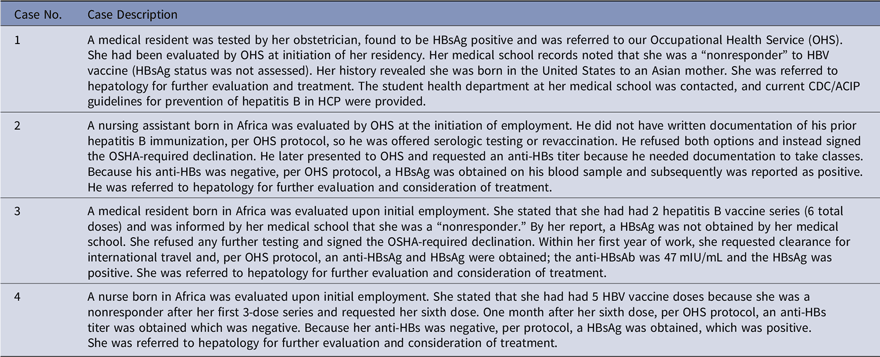
We report here a series of HCP who had recently been evaluated at the occupational health service of UNC Hospitals for immunity to hepatitis B and were found to have chronic hepatitis B infection (ie, HBsAg positive) as a reason for HBV vaccine nonresponsiveness (Table 1). For all cases, the most likely source for the chronic hepatitis B infection was perinatal transmission. All of the HCP described in the Table 1 were either born in Africa or to a mother from a country with a high rate of endemic hepatitis B infection.
Recent Cases in which Nonresponse to a Hepatitis B Vaccine Series Was Due to Chronic Hepatitis B Infection

Note. ACIP, Advisory Committee on Immunization Practices; CDC, Centers for Disease Control and Prevention; HBV, hepatitis B virus; HCP, healthcare personnel; OHS, Occupational Health Service; OSHA, US Occupational Health and Safety Administration.
Knowledge of chronic HBV infection is important as such HCP should be referred for management of their infection for consideration of HBV treatment. Further, for HBV chronically infected HCP who perform “exposure-prone procedures,” guidelines the Society for Healthcare Epidemiology of AmericaReference Henderson, Dembry and Fishman8 and the CDCReference Holmberg, Suryaprasad and Ward9 advocate the constitution of an expert panel to provide oversight of the infected healthcare provider’s practice. Review by an expert panel is also recommended by most but not all non-US guidelines.Reference Lewis, Enfield and Sifri10 Our cases demonstrate the importance of assessing HCP who are HBV vaccine “nonresponders” for chronic hepatitis B infection.