Recent research on the syntax of negation (see e.g., Haegeman & Zanuttini, 1996; Rowlett, 1998) distinguishes languages with negative concord, such as Italian or Middle English, from those without negative concord, such as Classical Latin or Modern Standard English. It is of interest to ask where in this typology of negation we should place Old English, where we find seemingly divergent cases, such as (1) and (2), which seem to make a uniform answer to that question problematic:

In (1) we have negative concord (henceforth NC) between the negative particle ne and the negated indefinite nanne (‘none’), whereas in (2) the negated indefinite næfre is not in an NC relationship.1
The co-occurrence in Midde English of the sentential negator ne and a secondary negator noht is often referred to as negative concord; in this article we discuss only the concord relation between the sentential negator ne and a morphologically negative indefinite, e.g., OE nan (‘none’). Further discussion of the replacement of ne by noht as the main sentential negator during the course of premodern English, after a period of co-existence in Early Middle English, is presented in Iyeiri (2001).
Variability in expressing syntactic negation has long been a focus of interest in the historical study of English, notably in Middle English (Iyeiri, 2001; Jack, 1978; Mazzon, 2004; Tieken-Boon van Ostade, 1994, etc.). Rather less empirical research has been carried out on the variable expression of syntactic negation in Old English. Van Kemenade's (2000, 2004) work on the structure of negated clauses, which is chiefly concerned with differential positioning of pronoun and full Noun Phrase (NP) subjects, argues for diachronic variation between early and later Old English, but is not concerned with dialectal differences. Levin (1958) proposed a dialectal difference in the use of negative contraction (e.g., nis, næbbe, for ne is, ne hæbbe) whereby consistent use of the contracted forms was identified with standard West Saxon, while the substantial use of uncontracted forms typified texts with non-West Saxon associations. Referring to his findings, Hogg (2004) has described negative contraction as perhaps the only well-substantiated Old English syntactic dialectal feature. Ogura (1999) investigated variation in glosses made in particular regions of England as regards the expression in OE of Latin negative clauses in the source texts. She found that reinforcement of the basic OE negative particle ne by a secondary negator, usually na, tends to characterize the West Saxon glosses, rather than those of Mercian or Northumbrian provenance. However, since the West Saxon glosses tend to be later than the others, this may be a diachronic development rather than a synchronic dialectal difference. Other than these important but necessarily restricted explorations of OE dialect syntax regarding the expression of negation, there has seemingly been little attempt to address the issue in recent decades.
As far back as the work of Einenkel (1912), however, a view has existed in the literature that further dialectal distinctions might be envisageable regarding the syntax of negation. Einenkel was among earlier scholars who established a distinction in Middle English between Southern dialects, which tended to retain ne in negation, and dialects from the Midlands and the North, which tended not to. On the basis of a small number of texts, he attempted to show analogues of this dialectal division in OE, distinguishing an ‘Anglian’ pattern which avoided NC and a ‘West Saxon’ pattern which regularly used it. However, his proposals in this regard seem not to have found general acceptance, as is indicated by Hogg's (2004) judgment cited earlier. One possible reason for this is his distinction between ‘verbal’ and ‘nominal’ negation, which has tended not to correspond with the analytic approaches of later researchers.2
Another reason could have been his classification of data sources. For example, Einenkel (1912:239) considered Wærferth's Dialogue a ‘Mercian’ text even though he chose to use the ms. C text, which is closer to standard West Saxon, in preference to ms. O, which, according to Vleeskruyer (1953), is particularly Mercian-influenced.
In this study we seek nevertheless to show that Einenkel's perception of a dialectal distinction in OE, as well as earlier ME, can be upheld in terms of variation in the form of NC. Although his work did not focus on this issue as such, by adapting his categories of analysis somewhat, it can be shown that OE texts provide clear evidence for a dialectal split in how NC was configured syntactically with negated indefinites, such as nan (‘none’) and næfre (‘never’). We find, however, that the divisions in OE prose are not where Einenkel located them, in terms of the simple presence or absence of NC, but rather in terms of two types of NC, which are differentiated by syntactic conditioning of the use of the negative particle ne.
Labov (1972:148ff) distinguished two syntactic types of NC in modern Non-Standard English (NSE), in one of which a postverbal negated indefinite (NI) is supported by the negative element -n't, as in:

A preverbal negative indefinite, however, does not co-occur with a negative particle in this variety. Rowlett (1998) indicated that in Cockney, NC occurs when the reduced negator -n't is present, but not otherwise; he did not, however, comment on whether there is an asymmetry regarding preverbal and postverbal negated indefinites.
In the other variety of NSE NC, which is found in some varieties of American NSE, the preverbal negator co-occurs, not only with postverbal, but also with preverbal negated indefinites (examples from Labov, 1972):

These two types broadly correspond to the pattern of NC found on the one hand in languages such as Italian, where an NI preceding a tensed verb precludes a negative particle non (Ladusaw, 1992)3
In premodern varieties of Romance, unlike contemporary standard varieties, the optional expression of a negative particle with a preverbal NI was possible (Martins, 2000).
No previous research provides the necessary breadth of information on the degree of attested dialectal variation regarding NC in Old English, however, so much of the present study consists of an empirical investigation of what is to be found across the available range of texts. Standard treatments of OE grammar, insofar as they allude to NC, indicate that OE was an NC language, but do not go much further. Andrew (1940:62–63) stated that ne was “always prefixed” to the verb, though occasionally omitted when conjoined negation would have produced a ne ne sequence. Mitchell's (1985:664) study of OE syntax quotes Davis's (1953) revision of Sweet's Anglo-Saxon Primer to the effect that “in a negative sentence the particle [sc. ne] is prefixed to every finite verb,” implying that where other elements, especially negated indefinites, negate the clause, ne is likewise obligatory. Jost (1950) confirmed this, reporting that West Saxon prose, the standard variety in which most texts have been preserved, avoided an indefinite such as ænig (‘any’) in the context of the negator ne and used an N-item such as nan (‘none’). Nevertheless, Mitchell (1985:665ff) observed that not all finite verbs in OE negative sentences are negatively marked. Anglo-Saxon verse in particular is known to have avoided the occurrence of negative indefinites with ne. Following Mitchell, Traugott (1992:268–269) summarized the position by stating that NC was common, especially in prose, but not obligatory, supporting this statement with examples from Alfred's Orosius of negated indefinites used respectively with and without ne.
In most standard accounts of OE, it has not been customary—beyond the common observance that NC is rare in verse—to comment on whether the omissibility of ne was random or whether it depended on stylistic factors or on syntactic structural ones, and in the latter event, whether dialectal factors might be at work. In this study we wish to consider whether the omissibility of ne involved dialect syntax. We shall ask first whether the available Old English prose material provides evidence that it did, and secondly, whether any such dialect differences persisted into Middle English. This article therefore takes the form of two linked studies, the first focusing on the syntax of Old English negative indefinites, and the second focusing on the same traits in Middle English.
STUDY 1: NC IN OLD ENGLISH
Identifying dialectal variation in Old English syntax gives rise to some well-known difficulties. The localization of Old English texts is in most cases problematic, not least because quite a number of them derive from non-West Saxon originals but have been through a process of copying and standardization by West Saxon scribes, which has resulted in the partial or total effacement of the original characteristics they may have had. Such texts, then, are hybrids, rather than true representatives of any single variety. Even when this has not happened, the place of composition of the text and the place of the manuscript's transcription are not usually both known. The Old English documents that do have some local means of identification tend to be charters and other official documents, though even here it cannot be affirmed for sure that the language variety in which the charter was drawn up faithfully represented the local language variety. Such documents were normally written by members of a relatively small literate group of clergy, who did not necessarily stay in the region whose language variety they had acquired as a native language. Even where these documents are to some extent associated with a particular area, they may, because of the text's discourse type and purpose, happen not to contain data regarding the linguistic trait of interest. With negation, this is often the case in charters, since they are usually concerned with setting down in writing what is the case, rather than what is not.
For the reasons given earlier, seeking to identify consistent Old English dialectal variation on the basis of the surviving Anglo-Saxon prose records is a hazardous undertaking. That said, the indirectness of the relationship between the textual evidence and regional origin should not be overstated. As demonstrated by Kitson (1990, 1993), some lexical variation in localizable charters, for example expressions for Present Day English (PDE) between, corresponds in a nonrandom way with variation in the literary prose texts. The latter can thus be said to embody a measure of dialect variation, at least as regards lexis. In this study we seek to add to this body of knowledge of localizable linguistic traits of OE with an examination of how variation in syntactic negation in OE is distributed in homogenous (i.e., standard West Saxon) texts versus “hybrid” ones, that is, those thought to have originated outside West Saxon scriptoria. Subsequently, ME texts with generally acknowledged geographical associations are analyzed for purposes of comparison with the OE texts studied.
A starting point for this enquiry was an observation concerning one of the OE texts studied by Einenkel (1912), the Life of St. Chad, which is one of the few extant texts that were not to some extent rewritten by West Saxon scribes. Here, two interesting differences from West Saxon (henceforth WS) practice regarding the expression of negation can be discerned. First, the negated indefinite nænig (‘none’) is preferred to nan (Jost, 1950). A further distinction not to our knowledge previously noted, however, is that ne or a n-prefixed verb such as næs/nes (ne + wæs) is always found if a negated indefinite (henceforth NI) follows the finite verb, for example:

But in the cases where the finite verb stands after an NI, all lack ne, for example:

We found similar cases to (9) in non-WS charters and other documents, for example:

This disparity, indicating a preference in these non-WS texts for the asymmetric type of NC, clearly called for further investigation. We set out to establish whether other texts with non-WS associations displayed the same pattern, and furthermore, if any such dialectal difference is identifiable in Middle English texts dating from before about 1350, after which some incipient standardization begins to appear (Wright, 2000). Our objective was to clarify whether the indications of preverbal ne-drop in such texts are instantiated more widely in texts of non-West Saxon provenance, and thus, once such texts are handled separately, whether the position taken by Andrew (1940) and others, that ne was essentially obligatory in OE, can be upheld for the West Saxon standard variety.
OLD ENGLISH SOURCE TEXTS
Traditional accounts of ME dialect variation distinguish Northern, East and West Midland, Southern, and Kentish. They are supported by a very substantial tradition of dialectal research culminating in the Linguistic Atlas of Late Mediaeval English (McIntosh et al., 1986) for later ME, and the research of Kristensson (1967, 1987, 1995) for earlier ME. As regards OE, however, there is no equivalent body of findings, although Toon's (1992) work provides a useful overview as regards phonology. The conventional terms ‘Mercian’, ‘Northumbrian’, ‘West Saxon’, and ‘Kentish’, which have long been used to designate regional varieties of OE, reflect the political boundaries of the early English kingdoms rather than linguistic isoglosses. For the purposes of the present study we have simply used the category labels ‘West Saxon’ and ‘non-West Saxon’ to differentiate OE varieties. By the former, we mean that the graphemic and lexical variables in a given text overwhelmingly accord with models set in West Saxon scriptoria such as that of

in Winchester (Gneuss, 1996), and/or with the practice of

(Kitson, 1993); by the latter, we mean that they diverge substantially from those models. It must be borne in mind that, especially in later Old English, the term ‘West Saxon’ need not be taken as implying geographical localization. The works of

discussed by Kitson seem to show connections with the Wessex area, and it is plausible to regard the features of this variety as having had roots in that area, but, especially in later OE, WS norms were observed outside that area too. Correspondingly, we acknowledge a lack of regional specificity for the term ‘non-West Saxon’. The texts falling into this category are often thought to have associations with Mercia, but we do not assume that such associations are proven. The origins of a particular text may lie, for example, in Northumbria. It will be enough for present purposes to take ‘non-West Saxon’ as implying a very broad source domain, equivalent to the traditional term ‘Anglian’. In general, while bearing in mind that we are not dealing with data from two pure sources, it is still possible to undertake some meaningful investigation, using on the one hand, texts with standard West Saxon graphemic and lexical choices, and on the other, those with clear evidence of non-West Saxon origin in their graphemic and lexical choices. The expression of negation in these two categories of texts can then be compared.
To exemplify West Saxon prose, we took a larger sample of texts than those considered by Einenkel (1912), including both early (Alfredian) prose and also later prose works in 11th-century manuscripts (mss). The texts selected were: Cura Pastoralis, Orosius,

Saints' Lives (I and XXIII), the Old English Gospels (Corpus ms.), the Benedictine Rule, Apollonius of Tyre, and the Enlarged Rule of Chrodegang. In the case of the longer Alfredian works, such as Cura Pastoralis and Orosius, we took samples rather than potentially biasing the results by using the entire work, which could over-represent their evidential status. In the case of the former, it is known that the later chapters were written by a different scribe, and may have been written earlier than the original of the first part. We therefore took 15 chapters from each of the two parts of the manuscript. With Orosius, we used parts I–IV only.
Texts with non-West Saxon traits were mostly identified as such in the manner of Vleeskruyer (1953). In addition to St. Chad, used by Einenkel (1912), they included a number which exist in manuscript versions likely to have been to some extent rewritten by West Saxon scribes using non-West Saxon originals: the Martyrology, Epistola Alexandri, the Bede translation, the Prose life of St. Guthlac, and Winfrith's letter. We also included Wærferth's translation of Gregory's Dialogues, used by Einenkel, except that we used the Otho ms., considered by Vleeskruyer and others to have more marked Mercian associations. In the case of the longer texts (the Bede translation and Wærferth's Dialogue), we took a long sample, as with the WS texts, and for the same reason. Our procedure, by which only a sample of a particular work was used, was to sample up to the end of the chapter or section in which we found 40 data points in the most common data category.4
Since we continued to the end of a chapter thus begun, we occasionally had slightly over 40 data points.
METHOD
The dependent variable in this study is the presence or absence of the Old English and early Middle English sentential negator ne. We wished to see whether its supply was conditioned by the dialectal associations of the texts, and/or by type of clause: those where a NI appeared preceding the finite verb, and those where it appeared following the finite verb. Occasional instances where NIs appeared in both positions in the same clause were excluded, since it could not be stated which of them might be influencing the appearance of ne. We also recorded instances of common nonnegative indefinites in possible NC contexts, that is, where use was made of ne + æfre or ne + ænig. We also excluded inverted structures with the verb preceding the subject, since in such cases it has been observed that ne was never omitted in OE, and we were concerned not to overstate the use of ne with postverbal NIs by including such contexts, especially since Fischer (1992) linked the inversion of verb and subject in negated clauses in ME to the presence of ne. We therefore analyzed only structures in which the subject preceded a finite verb. Main, coordinate, and subordinate clauses were used for this purpose.
OLD ENGLISH RESULTS
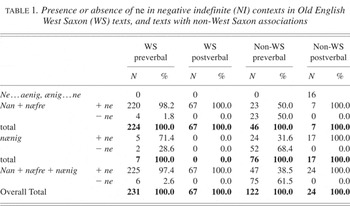
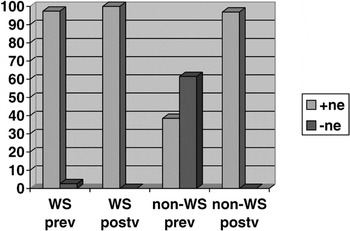
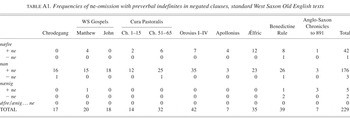
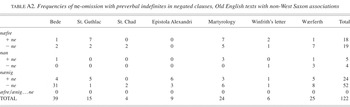
Table 1 shows the overall distribution of ne in preverbal and postverbal contexts, arranged according to the identity of the indefinite. For this purpose we have grouped together nan and næfre, but kept the non-WS indefinite nænig separate. In the West Saxon texts only four cases out of 224 (1.8%) show næfre/nan without ne. Even including the few contexts with nænig, where ne was dropped twice, the overall rate of ne-drop is only 2.6%. In the non-West Saxon texts, by contrast, 75 out of 122 overall (61.5%) lack ne. Furthermore, the relatively numerous occurrences of the Mercian ‘trademark’ item nænig show a very clear preference for dropping ne with this item, whereas with næfre and nan, ne was dropped just as often as it was expressed. However, ne-drop was found with preverbal NIs: in non-WS texts, ne use and ne-drop were equally common. The West Saxon versus non-West Saxon contrast regarding ne-drop with NIs is shown graphically in percentage terms in Figure 1.
Presence or absence of ne in negative indefinite (NI) contexts in Old English West Saxon (WS) texts, and texts with non-West Saxon associations


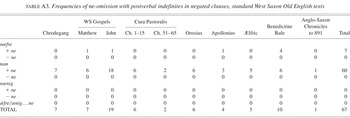
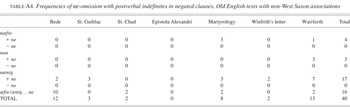
Percentage use of negator ne in clauses containing a negated indefinite in West Saxon and non-West Saxon OE prose texts (frequencies shown in Tables A1, A2, A3, and A4).
In postverbal contexts, absolute numbers are much lower than they are with preverbal NIs, because, as noted earlier, inverted constructions, in which negated indefinites would always be postverbal and accompanied by ne, were omitted. In addition, non-West Saxon texts sometimes avoided NIs in postverbal contexts and preferred the ne…aenig construction, with which ne is required for a negative interpretation to be obtained. Nevertheless, 67 postverbal NIs were identified in West Saxon texts and 24 in non-West Saxon texts. In these contexts, ne was never dropped, neither in West Saxon nor in non-West Saxon texts. In non-West Saxon sources, the obligatoriness of ne with postverbal NIs offers a strong contrast with the fairly high rate of ne-drop in the same texts when the NI is preverbal. Although the overall N of 24 is on the low side, it is in a sense artificially low. As will be recalled, postverbal NI cases were excluded from the analysis when the verb was preposed; such cases were highly frequent, so their inclusion would have multiplied the postverbal NI total several-fold. In this study we sought to proceed as far as possible on the basis of data that exclude intervening factors, such as the initial position of the verb in an OE negated clause, which, as we already knew, never tolerated ne-drop.
Let us now examine results from individual texts.

Lives of Saints consistently supplied ne. Apollonius of Tyre, the Matthew and John Gospels and the Anglo-Saxon Chronicle likewise have no examples of ne-omission. Isolated cases of ne-drop are found once in Chrodegang and once in the latter part of Cura Pastoralis, but not in the sample from Orosius. Of the six omissions of ne with preverbal NIs that we did find in West Saxon texts, the remaining four all came from the Benedictine rule. Although this text was included in the present study on the basis of its description (e.g., by Gretsch, 1974:149) as ‘late West Saxon’, it may contain elements from heterogeneous dialectal provenance, as suggested by the presence of nænig (see Appendix A, table A1), with which ne was dropped on two out of three occasions.
5The O ms., which has been localized at Bury St. Edmunds in Suffolk, and was contemporary with the A ms. used in this study, omits ne on all three of these occasions. Glein, who edited the text, was unable to identify the provenance of the A ms. of the Benedictine Rule, but it is possible that regional variation in scribal usage may have played some part here, as well.
In the non-West Saxon texts, the omission of ne with preverbal NIs was most common in the Bede translation and Wærferth, where ne was supplied less than a third of the time. The Martyrology, the other longer text, supplies ne just over half the time. The Prose Life of St. Guthlac, however, shows only a low level of ne-drop.
Clause type seemed to make little difference in the realization of ne in non-WS texts. Most of the relevant data in this study were found in subordinate clauses, as main clauses tended to have inverted structures, which we excluded from analysis. Omission and realization were commonly found in subordinate clauses, for example:

On the infrequent occasions where uninverted main clauses did provide contexts, variation was also found:

DISCUSSION OF OE FINDINGS
West Saxon texts display symmetrical use of ne in clauses containing a negative indefinite, regardless of whether the latter is preverbal or postverbal. However, in the texts with non-West Saxon associations, ne omission with preverbal NIs runs at over 60%, whereas with postverbal NIs omission of ne was nonexistent, just as in the West Saxon texts. There is thus a very sharp contrast between the two source categories regarding the use of NC, in which dialectal variation is sensitive to syntactic context. Users of OE not employing the West Saxon dialect (whether scribal or otherwise) would seem, on the basis of these results, to have had a NC variety in which negation could be expressed by a preverbal constituent, without a negative verbal particle. In this respect it accords with PDE NC varieties studied by Labov (1972), with present-day Romance (e.g., Italian) NC analyzed by Ladusaw (1992), and with early Romance NC (Martins, 2000). However, like these varieties, it required NIs standing after the verb to be supported by a negative particle, for example:

This variety was consistent with the characterization by Labov (1972) and by Ladusaw (1992) of certain modern NC dialects, in which NIs standing after the finite verb must be preceded by a negative element, typically a negative particle, whereas those standing before the finite verb do not require to be thus supported. The West Saxon variety, on the other hand, seems to belong to the type of NC language discussed by Progovac (1994), having symmetrical use of ne with both preverbal and postverbal NIs. Consequently, it appears that NC between ne and a negated indefinite was not generally a matter of free variation in OE. The variation in question should be recognized as having been between West Saxon prose and other varieties, concerning preverbal NIs. In West Saxon, NC between ne and the negated indefinite was as good as obligatory; in all varieties ne was obligatory with a postverbal NI. In non-WS varieties, ne was optional if the NI preceded the verb.
We should also mention a third pattern which seemingly made no regular use of NC with either preverbal or postverbal indefinites. This was found in the Bede translation, which according to Kuhn (1947) was based on a gloss made from the original Latin text. It presented essentially the same system of preverbal negated indefinites and postverbal any-words licensed by a verbal negator, as in modern English. Latin is a non-NC language, so it is tempting to suppose that the ne… ænig pattern found in Bede derived directly from its origin as a gloss. However, since uses of this pattern were found in other non-WS texts (St. Chad, Martyrology, Wærferth), it seems unlikely that the glossed origin of the Bede text is the sole factor responsible.6
Mention might also be made of NC in the work of Wulfstan (Bethurum, 1957), which we have not included in this study because Wulfstan's language seems to have been a hybrid of WS and other traits (Jost, 1950). There is also an issue as to which works are genuinely attributable to him. On the basis of those published in Bethurum (1957), we have observed informally that the WS pattern of obligatory ne seemed to prevail when an indefinite was preverbal in a negated clause, while the non-NC pattern found in Bede occurred when it was postverbal. We hope to return to this matter in forthcoming work.
Clearly there was variation within non-West Saxon texts as to how common ne-drop was with preverbal NI, though it is impossible to determine to what extent this depended on West Saxon revision of the text, and to what extent it might be token dialectal variation within Anglian/Mercian areas. Yet we find that this frequency variation did not affect clauses with postverbal NIs, which were always supported by ne, as in standard West Saxon.
One factor affecting the probability of ne-use with a preverbal NI is whether the NI in question was nan or nænig. We have already seen from table 1 how common nænig was in the non-WS texts, and how strongly it favored ne-drop with preverbal NIs. It was nænig, of course, which has been particularly associated with texts of Mercian origin (Jost, 1950; Vleeskruyer, 1953), suggesting that ne-drop with a preverbal NI was a feature of vernacular varieties, such as Mercian, and probably others, which used nænig. Where we see nan, we may reasonably suppose West Saxon scribal influence is present, and in the same texts (though numbers are small) there is no tendency to omit ne.7
STUDY 2: NC IN MIDDLE ENGLISH
As before, we begin our consideration of ME with one of the sources used by Einenkel (1912). In the Peterborough Chronicle Final Continuation (PC) (Clark, 1970), some initial evidence is available that the non-West Saxon OE pattern of NC continued into ME. In the same contexts as we used above for OE, ne seems optional with a preverbal NI:

With a postverbal N-item, however, the prefix ne is never dropped8
Note that in later Middle English it became normal to drop ne when noht (and its spelling variants) was used as the sentential negator (see Iyeiri, 2001 and references therein).

Relevant data tokens from the Peterborough Chronicle are unfortunately very few in number, especially with postverbal NIs, so it was decided to pursue this issue using a larger sample of Middle English.
Ideally, one would like to use prose data to investigate Middle English dialectal variation, as was done in Study 1 as regards Old English. Dialectal variation in Middle English presents a well-known limitation in prose data sources, however. Until the later 14th century, these sources are very unevenly distributed across dialect areas, with the bulk coming from the West Midlands, and with effectively no sizable texts representative of the West Saxon ‘heartland’ in the South and Southwest. Verse data offers much more extensive coverage of dialectal variation and does so from the later 13th century onwards, at least a century before the same can be said for prose. We analyzed the syntax of ME NC from manuscripts produced within the roughly 100-year span 1250–1350, in works whose composition date is conventionally thought to fall within that period.
We searched texts in which the oldest extant manuscript is not later than about 1350, or earlier than about 1250, and has been localized to a particular dialect area. The only exception was Cursor Mundi, in which the oldest Northern witness, the Cotton Vespasian manuscript, may be of a somewhat later date than 1350, perhaps later 14th century; given the well-known paucity of 14th century Northern manuscripts, there was little alternative if we wished to include a representative sample from this dialect area.
Five dialect areas of ME are conventionally distinguished: Kentish, Northern, East Midlands, West Midlands, and South/Southwestern. Kentish is exemplified by the Poems of William of Shoreham, which exist in a single manuscript thought to date from the second quarter of the 14th century. Northern English is exemplified by the Northumbrian Psalter, in a manuscript attributed to the first quarter of the 14th century, and as mentioned earlier by the Cotton Vespasian manuscript of the Cursor Mundi, a very long text from which we analyzed lines 1–4,000. The East Midlands texts used were Genesis and Exodus, the Bestiary and the Lay of Havelok, where the manuscript has been localized in the North-East Midlands/East Anglia area. The West Midlands were exemplified by La3amon's Brut, for which we used the Otho ms.,9
This was chosen in preference to the roughly contemporaneous Caligula ms. containing the original version probably composed in the first decade of the 13th century, in order to see whether the later revision exhibited more progressive ne-drop: In fact it did not. Had the Caligula ms. been used, we would not have known whether the absence of ne-drop was merely a reflection of the earlier date of composition of the work, often supposed to have been around the beginning of the 13th century. Cannon (1993) showed that the Otho version is a fairly complete reworking of the text, not merely a later retranscription. According to Cannon, it was comprehensively updated to bring it into line with contemporary stylistic preferences. Significantly, the reviser did not alter the symmetrical NC pattern, which we take to indicate that it was not perceived as an archaism, at least in his language variety.
We omitted those saints' lives also found in the earlier Laud ms. of the South English Legendary (SEL) (Horstman ed.), which is from outside this dialect area, since we wished wherever possible to eliminate works known to be possible later reworkings of texts that may originally have been from another dialect area.
Rather few texts from a roughly similar period11
We did not impose that condition on our OE samples. Choosing texts from a roughly similar period becomes crucial in ME, when sentential negation by ne gave way to not-negation in all areas of ME during the 14th century, whereas ne was consistently the principal negator throughout the OE period.
As before, only noninverted clause contexts were analyzed. This criterion, which required the presence of a subject constituent preceding the finite verb, was followed strictly, so that clauses presenting two apparent subjects—an impersonal there subject and a postverbal referential subject (Ingham, 2003a)—were excluded, as were subjectless clauses. The negative indefinites investigated were those corresponding to the OE forms in Study 1, that is, various spellings of items equivalent to PDE no/none and never. No successor form of OE nænig remained in these ME texts.
MIDDLE ENGLISH RESULTS
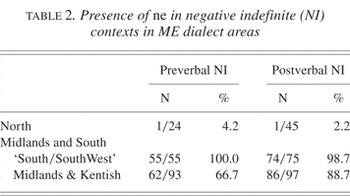
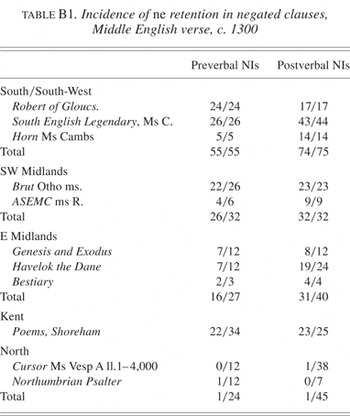
The overall results of our analysis of the eleven ME texts are given in Table 2. These results distinguish very clearly the three different dialectal types of negative syntax in ME. The area designated as ‘South/Southwest’ shows virtually complete retention of ne with preverbal as well as postverbal NIs. At the opposite extreme, the Northern area seems to have lost ne almost entirely, regardless of the position of the NI, a predictable finding in the light of previous research. In between, the Midlands/Kentish sources show a weak tendency to lose ne with postverbal NIs, and a considerably stronger one to do so with preverbal NIs. The figures in Table 2 are of course averages. Appendix B shows that in East Midlands texts this tendency was much stronger than in West Midlands texts.
Presence of ne in negative indefinite (NI) contexts in ME dialect areas

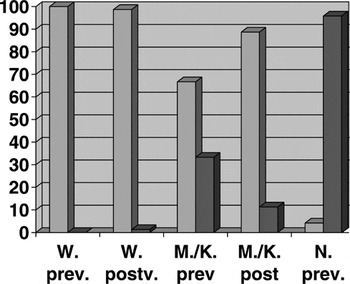
Figure 2 shows that in the period represented by our sources the texts from the South/Southwestern area (labelled ‘Wessex’ in Figure 2) retained asymmetric NC, while data sources from the Midlands and from Kent show a tendency to lose ne rather more with preverbal NIs than with postverbal NIs.

Percentage use of ne in three dialectal areas, Middle English verse, c. 1300 (frequencies shown in Table B1).
The breakdown for East Midlands versus Southwest Midlands and Kentish texts shown in Appendix B reveals that the asymmetry observed in the East Midlands Peterborough Chronicle was observed in the other East Midlands texts, which preserved ne reasonably well when the NI was postverbal, but less well when it was preverbal. Kentish, at least as regards our sole available verse exemplar, Shoreham, follows the same pattern.
The two Southwest Midlands sources show complete retention of ne with a postverbal NI, but the beginnings of ne-loss with preverbal NIs. On the other hand, they align themselves towards the South/Southwestern texts in terms of largely maintaining ne, despite this small hint of an NC asymmetry.
Comparing these results from around 1300 with NC in the OE West Saxon texts, we see no real reduction in the use of ne in verse data sources linked to the area corresponding to the Anglo-Saxon kingdom of Wessex, and thus to the presumptive source domain of West Saxon.12
OE verse is unlike standard WS in its patterns of negation (Einenkel, 1912; Mitchell, 1985) and is widely believed to have originated outside the West Saxon area (see e.g., Sisam, 1953).
In this connection, it may be noted that an earlier Midlands text, the Ormulum, exhibits ne almost without exception with preverbal NIs. This text is known to have been heavily influenced by metrical factors, however, see Trips (2002) and references therein.
Texts from the West and East Midlands regions that corresponded to the Anglo-Saxon kingdoms of Mercia and of the East Angles, prior to the establishment of the Danelaw, show the tendency towards asymmetric NC that we found in OE texts where Mercian associations have been argued for (e.g., by Vleeskruyer, 1953). It is interesting that Havelok, the East Midlands text with the highest imbalance in ne-drop between preverbal and postverbal NIs, may well have been composed in Lincolnshire, which formed the 8th–century Mercian earldom of Lindsay. Ne with a preverbal N-item also seems to have been declining in Kentish, on the strength of Shoreham. We have little syntactic evidence for Kentish OE, but it is known that Canterbury in particular came under strong Mercian influence (Toon, 1983) prior to the establishment of West Saxon dominance. If Mercian-influenced, the non-West Saxon variety of English used in Kent during that earlier period might well have exhibited the asymmetric NC found in Shoreham.
The finding of asymmetric NC in Kentish ME data as exemplified by Shoreham is intriguing, taking us beyond the traditional view that ne was lost because of contact with Scandinavian. Scandinavian settlement in Kent is usually thought to have been insignificant. Hence, the impact of Scandinavian on ME, though unquestionably quite substantial (see e.g., Thomason & Kaufman, 1988), may mask an indigenous pattern whereby, outside the former Wessex area, ne was dropped more often with a preverbal than with a postverbal negated indefinite. Indeed, it seems very unlikely that asymmetric NC can be attributed to contact influence. The language of the Scandinavian settlers in Northern and Eastern England has left little or no record, but it can reasonably be supposed that since the preverbal Germanic negator ne was rare in Old Norse verse, it had already largely dropped out of vernacular use also by this time (Ingham, 2003b). It may at that stage have been replaced by the Old Norse suffix -at (Eythórsson, 2002), and perhaps even by the postverbal particle eigi, which is used in Old Icelandic prose of the 14th century. If so, there would therefore have been no adstratal support from Scandinavian for ne to be retained selectively with a postverbal NI in Eastern dialects. This OE/ME asymmetric pattern, we propose, was not a contact phenomenon, but had roots in Old English, and specifically in the non-West Saxon asymmetric negation we have demonstrated earlier. It illustrates continuity in NC across the two conventionally demarcated periods of the language.
A question that arises, given Levin's (1958) and Hogg's (2004) discussion of dialectal differences in negative contraction, is whether the imbalance in ne-drop with preverbal versus postverbal NIs is a phenomenon in its own right, or whether it is derivable from the common avoidance of ne contraction in non-West Saxon areas. Hogg made the point that, rather than being contracted, ne in East Midlands ME was often dropped altogether. In other areas, contracted ne + verb forms survived longer than uncontracted ne, and contracted ne cases have been included in the count for ne retention. It is conceivable that contractible forms were not equally distributed between contexts with a postverbal NI and those with a preverbal NI. If their distribution happened to favor those with a postverbal NI, contractible forms would have the effect of keeping the rate of ne-retention higher with postverbal than with preverbal NIs. Then our finding of asymmetric NC would be an artefact of an unequal distribution of contracted negatives.
In fact, this concern can be laid to rest, since in the East Midlands texts, the main locus of ne-drop with preverbal NIs, contracted negation never took place in the data we analyzed (see also Iyeiri, 2001:ch. 7). In Havelok, contracted negation was found in none of 13 contractible contexts, for example:

In the Bestiary it occurred in none of three contexts, and in Genesis and Exodus it occurred in none of five contexts. Altogether, the three East Midlands texts provided 21 contexts, of which none showed contraction. Thus the clear disparity in ne use with preverbal versus postverbal NIs found in this area was quite unrelated to contracted negation. The dialect split regarding NC cannot be seen as an epiphenomenon of negative contraction, but stands as a distinctive trait that, we argue, was carried over from OE.
It should be noted that the evidence for ne-drop with preverbal NIs in OE came from texts that are likely to have been written in the West Midlands rather than the East Midlands area. St. Chad is associated with Lichfield, the Bede translation with the same area, and the Wærferth Dialogue ms. O with Worcester. There are no OE texts not heavily rewritten by West Saxon scribes that can be held to exemplify the East Midlands area. The reasons for this may be to do with the fact that from the later 9th century onwards the East Midlands formed part of the Danelaw and stood outside the main literary and religious movements in England promoted by the West Saxon kings (Toon, 1992), or it may have to do with the combined effects of warfare, time, and chance in an area that between the later 9th and early 11th centuries saw a good deal of military campaigning by the English kings and the Danes. However this may be, the textual record is virtually silent as regards the variety of English used in the East Midlands in the OE period (Toon, 1992). It offers nothing to confirm or contradict the continuity we have argued for between non-West Saxon OE and ME outside the Wessex area. Within this area, NC was symmetrical and survived as such to around 1300; outside it, the available sources show that asymmetric NC commonly occurred. A similar point made by Hogg (2004) in relation to Levin's (1958) findings may be interpreted in the same fashion.
A further issue we should address is that the texts we have used are clearly disparate in nature, since the OE texts are prose texts, very often translations from Latin, while the ME texts are verse, and either more or less original creations, as with Shoreham's Poems, or—as is most often the case—free adaptations rather than translations, as with Genesis and Exodus. In practice, we do not believe this disparity of genre has seriously affected the outcome, since the main finding has turned out to be largely one of continuity. Discrepant genres, to the extent that they might have skewed the results, could certainly have created differences that could not be taken as reliable guides to diachronic syntax. But when the result is, for example, that ME verse from the OE Wessex area shows much the same pattern of negation as OE prose from that area, we find it striking that this outcome is obtained despite the prose/verse genre difference. It surely cannot be artefactual.
We contend furthermore that the OE NC dialect difference shown in the surviving texts corresponded to a regional vernacular difference, and was not simply a scribal dialect. We see little merit in supposing that the scribes responsible for South/Southwestern ME texts around 1300 would have persisted in upholding OE symmetrical NC purely as a written norm, when in so many other respects, especially graphemic and morphological, they departed from what had been the standard Old English norms of their region. Such selectivity is implausible, especially since the scriptoria that are known to have maintained Old English longest lay in the West Midlands, especially Worcester, not the South/Southwest. Thus to hypothesize regional differentiation purely in terms of scribal habits, in the absence of regional differentiation in language use, would appear somewhat unsatisfactory. Just as the Peterborough Chronicle scribe is generally supposed (e.g., by Clark, 1970) to reflect aspects of the ambient language of the East Midlands, we would like to propose that his counterparts of 100–150 years later were doing much the same. Caution is naturally in order, because there can be no certainty as to whether the patterns of negation with ne in these texts reflect vernacular usage in that region in the later 13th century. However, building on the claim by Longobardi (2001) that “inertia”—no modification to a structural property—is the null hypothesis in syntactic change, we note that the NC patterns discernible in the NI data we have surveyed are straightforwardly accounted for on the basis that no change to them took place for a very considerable span of time. Though clearly it is impossible to be precise about the temporal extent of this period in terms of vernacular usage, we believe that underlying the usage of the surviving OE texts there is likely to have been a stable pattern of dialectal linguistic variation in NC with NIs, which remained unchanged for a span of time lasting beyond the Old English period.
CONCLUSIONS
When West Saxon and originally non-West Saxon texts are distinguished, NC in West Saxon Old English is seen to have been symmetrical, that is, the negative particle ne was obligatory regardless of the position of an accompanying negative expression, confirming the position taken by some earlier descriptions of Old English syntax (e.g., Andrew, 1940). NC in non-West Saxon texts was asymmetric. ME showed an apparent continuation of the OE asymmetry in NC in texts localizable outside the kingdom of Wessex area, indicating continuity between Old and early Middle English as regards the expression of negation. A further indicator of dialectal continuity is that the distinguishing properties of the two dialects follow the main distinguishing features of contemporary NC in NSE, according to Labov (1972), whereby some varieties have NC with preverbal NIs as well as with postverbal NIs; none are reported as having NC with preverbal but not with postverbal NIs.
Thus, references to NC in OE that suggest that it was variable (e.g., Traugott, 1992) are, it seems, registering dialectal difference between texts with, and texts without, WS associations. WS prose texts were largely invariant; the others showed substantial variation with NIs in preverbal position. We have argued that this dialectal difference persisting from OE into ME is unlikely to have been purely a matter of scribal conventions, since we know that standard OE scribal practice broke down well before 1300. What seems to us a plausible interpretation of the continuity observed in the textual evidence of ME NC is that it reflects properties of the natural language varieties used in the regions where the ME texts were produced. By extrapolating from them back into the OE period, it can then be considered that the dialect split found in OE texts was also underpinned by vernacular usage. Although both modern and premodern dialects exhibit a dialectal split in the expression of NC, there are two important respects in which premodern varieties differ from modern English NC. In the latter, in British NC dialects, a preverbal NI is not accompanied by the negative sentential particle, whereas in certain American English NS dialects it may be. In modern NC dialects, the split is thus over whether the negative particle is possible, rather than obligatory, with a preverbal NI. In premodern varieties, as has been shown here, the split was over whether it was obligatory (WS) or optional (elsewhere). Clearly, the implementation of the distinctive properties of the two NC varieties has shifted. This can perhaps be handled on a diachronic level of language variation in which a previously obligatory feature becomes optional, so that dialectal variation subsequently concerns whether or not it is realized at all. As regards syntax, Jonas (2002) exemplified this in two varieties of Faroese, with dialectal variation as to the possibility of verb-movement, which is no longer obligatory in either variety.
However that may be, what we have set out to do in this study is to investigate whether the properties of negative concord in OE and early ME texts are to be treated as features of literary dialects transcending geographical regions, or whether there is evidence for a regional differentiation in the expression of negation which underlay the major changes in written English between the late 9th and early 14th centuries, and was nevertheless maintained across the transitional OE/ME period. We have shown that there is indeed evidence for the latter position; negation once again reveals itself, as in the work of Hogg (2004) and Iyeiri (2001), to be a significant locus of syntactic dialect variation in premodern English.
KEY TO PRIMARY SOURCES
Old English

:

Lives of Saints, Vol. I, edited by W. Skeat, Early English Text Society Original Series 76, 1881.
‘Anglo-Saxon Chronical’: The Anglo-Saxon Chronicle: A Collaborative Edition, Vol. 3: The Parker Ms A, edited by J. Bateley, Breuer, 1986.
‘Apollonius’: The Old English Apollonius of Tyre, edited by P. Goolden, Oxford University Press, 1958.
‘Bede’: The Old English Version of Bede's Ecclesiastical History, edited by T. Miller, Early English Text Society Original Series 95 & 96, 1890.
‘Benedictine Rule’: Die angelsächsichen Prosabearbeitungen der Benediktinerregel. Bibliothek der Angelsächsigen Prosa, Vol. 2, edited by C. Grein, Leipzig: Wigands Verlag, 1885.
‘Chrodegang’: The Enlarged Rule of Chrodegang, edited by A. Napier, Early English Text Society Original Series 150, 1916.
‘Cura Pastoralis’: Gregory's Pastoral Care, edited by H. Sweet, Early English Text Society Original Series 45 & 50, 1871.
‘Epistola Alexandri’: Letter of Alexander the Great to Aristotle. In Three Old English Prose Texts, edited by S. Rypins, Early English Text Society Original Series 161, 1924.
‘Martyrology’: An Old English Martyrology, Early English Text Society Original Series 116, 1900.
‘Orosius’: King Alfred's Orosius, edited by H. Sweet, Early English Text Society Original Series 79, 1883.
‘St. Chad’: The Life of St. Chad: An Old English Homily, edited by R. Vleeskruyer, Amsterdam: North Holland, 1953.
‘St Guthlac’: Das angelsächsiche Prosa-leben des hl. Guthlac, edited by P. Gonser, Linguistische Forschungen 27, 1909.
‘Wærferth’: Bischofs Wærferth von Worcester Übersetzung der Dialoge Gregors des Grossen. (Bishop Wærferth of Worcester's translation of the dialogue of Gregory the Great). Bibliothek der Angelsächsigen Prosa, Vol. 5, edited by H. Hecht, Leipzig: Wigands Verlag, 1900.
‘WS Gospels’: The Old English Version of the Gospels, edited by R. Liuzza, Early English Text Society Original Series 304, 1994.
‘Winfrith's letter’: In Studies in the History of Old English Literature, edited by K. Sisam, Oxford University Press, 1953.
Middle English
‘ASEMC’: Anonymous Short English Metrical Chronicle, ms. Royal, edited by E. Zetl, Early English Text Society Original Series 196, 1935.
‘Bestiary’: An Old English Bestiary. In Selections from Early Middle English, edited by J. Hall, Oxford University Press, 1920.
‘Brut’: La3amon's Brut, Vol. 1, Otho ms., edited by G. Brook & R. Leslie, Early English Text Society Original Series 250, 1963.
‘Cursor Mundi’: Cursor Mundi (Ms. Cotton Vespasian version), edited by R. Morris, Early English Text Society Original Series 59, 1875.
‘Genesis and Exodus’: The Story of Genesis and Exodus, edited by R. Morris, Early English Text Society Original Series 7, 1865.
‘Havelok’: The Lay of Havelok the Dane, edited by W. Skeat, Early English Text Society Original Series 4, 1868.
‘Horn’: King Horn, Floriz & Blaunchefleur, Assumption of our Lady (from Cambs. ms. Gg 4, c. 1280), edited by R. Lumby, re-edited from the mss. by G. McKnight, Early English Text Society Original Series 14, 1901.
‘Northumbrian Psalter’: Anglo-Saxon and Early English Psalter, Vols. I–II, edited by ‘JS’, Surtees Society 16 & 19, 1845 & 1847.
‘PC’: The Peterborough Chronicle, edited by C. Clark, Oxford University Press, 1970.
‘Robert of Gloucs.’: The Metrical Chronicles of Robert of Gloucester, edited by W. Wright, Rolls Series 86, 1887.
‘Shoreham’: The Poems of William of Shoreham, edited by M. Konrath, Early English Text Society Extra Series 86, 1902.
‘SEL’: South English Legendary, Vol. I, edited by C. d'Evelyn & A. Mill, Early English Text Society Original Series 235, 1956.
APPENDIX A
Distribution of ne in OE clauses with negated indefinites: Breakdown by source text.
Frequencies of ne-omission with preverbal indefinites in negated clauses, standard West Saxon Old English texts

Frequencies of ne-omission with preverbal indefinites in negated clauses, Old English texts with non-West Saxon associations

Frequencies of ne-omission with postverbal indefinites in negated clauses, standard West Saxon Old English texts

Frequencies of ne-omission with postverbal indefinites in negated clauses, Old English texts with non-West Saxon associations

APPENDIX B
Distribution of ne in ME clauses with negated indefinites: Breakdown by region
Incidence of ne retention in negated clauses, Middle English verse, c. 1300