Introduction
Transcranial magnetic stimulation (TMS) is a non-invasive method to stimulate the brain (Barker & Jalinous, Reference Barker and Jalinous1985; George et al. Reference George, Lisanby and Sackeim1999). There have been over 25 sham-controlled studies of repetitive TMS (rTMS) in depression, most of which have targeted the left dorsolateral prefrontal cortex (DLPFC), an area associated with hypoactivity in major depression (Gershon et al. Reference Gershon, Dannon and Grunhaus2003; Loo & Mitchell, Reference Loo and Mitchell2005). Several meta-analyses have been reported, including a Cochrane Review, and have recently been reviewed (Loo & Mitchell, Reference Loo and Mitchell2005; Hermann & Ebmeier, Reference Hermann and Ebmeier2006). In general, these have found that rTMS has statistically significant but clinically modest effects. Most previous randomized controlled trials were underpowered, and used relatively non-intense stimulation parameters in the absence of a true placebo condition. In addition, very few reported meaningful follow-up data or assessed success of blinding. We conducted a placebo-controlled trial of adjunctive rTMS in routine clinical practice that attempted to address these issues and also followed up subjects for 4 months.
Method
Patients
Patients were recruited from the South London and Maudsley NHS Trust, London, UK, between March 2002 and August 2004. Eligible patients were over 18 years, right-handed and had a diagnosis of a major depressive episode, established by case-note review and confirmed by interview using the mood episodes module of the Structured Clinical Interview for DSM-IV Axis I Disorders (SCID) (First et al. Reference First, Spitzer, Gibbon and Williams1996). Exclusion criteria included: history of seizures; head injury with loss of consciousness; brain surgery; presence of metallic implants; dementia or other Axis I diagnosis; substance dependency or abuse within the previous 6 months; previous rTMS treatment; inability to provide informed consent.
Patients taking psychotropic medication were required to have been on a stable drug regimen for at least 4 weeks before study entry and to remain on the same medication throughout the allocated rTMS course. The study was approved by local research ethics committees within the South London and Maudsley NHS Trust. All subjects were provided with both verbal and full written information about the nature and purpose of the study and gave written informed consent to participate.
The trial was registered: International Standard Randomised Controlled Trial Number, ISRCTN70121208 (http://www.controlled-trials.com/ISRCTN70121208).
Design
The study was a parallel-group, randomized, placebo-controlled trial. To ensure allocation concealment, following baseline assessment by trained research workers (A.M., S.E.), patients were randomly assigned to receive a course of real or sham rTMS by an independent third party using a protected and concealed computer database containing the randomization list. Subsequent ratings were performed by other trained researchers (G.P., R.P.) blind to treatment.
Treatment was started within 3 days of baseline assessment. Patients had 10 treatment sessions on consecutive weekdays, starting Monday. Patients were blind to allocated treatment and only research physicians administering rTMS knew the treatment being delivered. To check blinding, both patients and assessors were asked to guess group allocation after the treatment course.
Real and sham rTMS treatments
Research physicians administered rTMS using a Magstim Super Rapid stimulator (Magstim Co., Whitland, UK) with a figure-of-eight coil kept cooled on ice as previously described (Grunhaus et al. Reference Grunhaus, Dannon, Schreiber, Dolberg, Amiaz, Ziv and Lefkifter2000; Eranti et al. Reference Eranti, Mogg, Pluck, Landau, Purvis, Brown, Howard, Knapp, Philpot, Rabe-Hesketh, Romeo, Rothwell, Edwards and McLoughlin2007). Interactions between research physicians and patients were kept to a minimum to maintain patient blinding. At the first session the resting motor threshold (MT) of the abductor pollicis brevis (APB) site in the left motor cortex was identified by visual inspection using a method of limits (Pridmore et al. Reference Pridmore, Fernandes, Nahas, Liberatos and George1998). Resting MT was defined as the lowest TMS stimulus required to effect visible movement of the APB muscle on three of six occasions when the hand was relaxed. The treatment site (i.e. left DLPFC) was defined as being 5 cm anterior to the APB site in the parasagittal plane. Research physicians administered TMS at 110% resting MT at frequency 10 Hz, in 5-second trains. Twenty trains were given each session with inter-train intervals of 55 seconds. Thus a total of 1000 TMS pulses were given per session and 10 000 per course.
Placebo rTMS was delivered in the same way but using a purpose-built sham coil (Magstim Co., Whitland, UK) that was visually identical to the real coil and made the same clicking sound but did not deliver a magnetic field to scalp or cortex. All patients underwent the real experience of cortical mapping and MT estimation after which the coil was changed to either the real or sham treatment coil. Patients were informed that, in contrast to their experience of undergoing cortical mapping, they might feel no scalp sensation when receiving rTMS treatment.
Outcomes
Baseline assessments were performed before randomization. Outcome measures were obtained about 48 hours after the fifth session (i.e. 1 week), 48 hours after the final rTMS session (end-of-treatment time-point) and at follow-up assessments 6 weeks and 4 months after the end of the allocated rTMS course. Additional baseline data obtained by patient interview and case-note review included age, sex, duration of current depressive episode, past history of depression and ECT, presence of psychotic symptoms (delusions and/or hallucinations as detected by SCID), number of medication treatment steps (i.e. adequate courses of antidepressants and augmentation strategies) for the current depressive episode, and current psychotropic medications.
Primary outcome measure was the 17-item Hamilton Depression Rating Scale (HAMD; Hamilton, Reference Hamilton1960) at the end of the rTMS treatment course plus rates for response (i.e. decrease in HAMD of ⩾50% from baseline) and remission (i.e. HAMD⩽8). The inter-rater reliability (intra-class correlation coefficient) for the primary outcome measure in this trial was 0.96. Secondary outcomes included depression self-ratings using the Beck Depression Inventory-II (BDI-II; Beck et al. Reference Beck, Steer and Brown1996) and aggregated Visual Analogue Mood Scales (VAMS; Nyenhuis et al. Reference Nyenhuis, Stern, Yamamoto, Luchetta and Arruda1997) plus Brief Psychiatric Rating Scale (BPRS; Overall & Gorham, Reference Overall and Gorham1962) for global psychopathology.
Measures for side-effects and cognition were also included as secondary outcomes. Subjective ratings for side-effect symptoms were obtained at baseline, mid-treatment, end-of-treatment and at 4-month follow-up using a modified version of the Columbia ECT Subjective Side Effects Schedule (CSSES) (Sackeim et al. Reference Sackeim, Ross, Hopkins, Calev and Devanand1987; Devanand et al. Reference Devanand, Fitzsimons, Prudic and Sackeim1995; Eranti et al. Reference Eranti, Mogg, Pluck, Landau, Purvis, Brown, Howard, Knapp, Philpot, Rabe-Hesketh, Romeo, Rothwell, Edwards and McLoughlin2007). This included items on headache, scalp tenderness, tinnitus and hearing problems, plus subjective cognitive complaints. Global cognition was assessed at baseline, end-of-treatment and at 6-week and 4-month follow-ups using the CAMCOG section of the CAMDEX interview (Roth et al. Reference Roth, Huppert, Tym and Mountjoy1988), which also included the Mini-Mental State Examination (Folstein et al. Reference Folstein, Folstein and McHugh1975). The CAMCOG provides a total score (maximum 107) and has been used previously to study cognition in depression (Brown et al. Reference Brown, Scott, Bench and Dolan1994). Attentional and psychomotor function were assessed at the same time-points using digit-span test and digit symbols modalities test from the WAIS-R (Wechsler, Reference Wechsler1981) plus grooved pegboard test (Lafayette Instruments, Indiana, USA).
Statistical analyses
Using data from a randomized trial of adjunctive rTMS (Garcia-Toro et al. Reference Garcia-Toro, Mayol, Arnillas, Capllonch, Ibarra, Crespi, Mico, Lafau and Lafuente2001), we estimated that 27 patients per treatment group would be required to give 90% power to detect a difference of 3.5 points in the 17-item HAMD between real and sham treatments, assuming a within-group pooled standard deviation of 3.9 and using a two-tailed t test at 5% significance level.
Analyses were performed on an intention-to-treat-basis. HAMD scores were compared between treatment groups using an analysis of covariance (ANCOVA) with HAMD scores at mid-course, end-of-treatment plus the 6-week and 4-month follow-ups as dependent variables and baseline HAMD included as a covariate. The model also included main effects of time and treatment plus their interaction. To account for correlations between four repeated measures per person, subject random intercepts were also included in the model. If treatment group×time interaction tested significant at 5% level, four post hoc comparisons were performed to compare treatment arms separately at mid-treatment, end-of-treatment and the two follow-up time points (Bonferroni adjusted significance level 1.25%). If interaction term was not significant then it was excluded from the model and the main effect of treatment was evaluated to estimate treatment effect.
Secondary outcomes were analysed using the same ANCOVA model. Binary outcomes at end-of-treatment (i.e. meeting criteria for response or remission) were compared between groups using Fisher's exact tests. Change scores from baseline to end-of-treatment for CSSES and HAMD were correlated using Pearson's correlation to assess the relationship between changes in self-reported side-effects and mood. Data were analysed using SPSS version 12.0 (SPSS Inc., Chicago, IL, USA) and Stata 8.0 (StataCorp, College Station, TX, USA).
Results
Enrolment
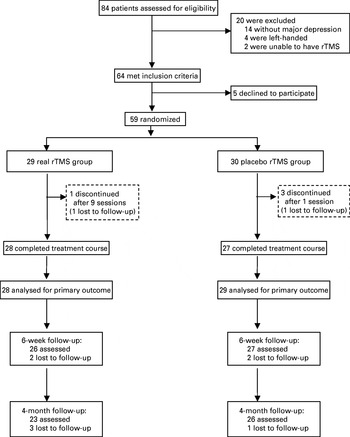
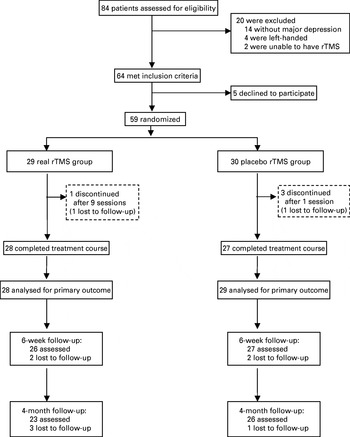
The trial profile (Fig. 1) illustrates enrolment and progress. Of 84 patients referred to the trial, 59 were randomized to real or sham rTMS. Four patients did not complete the full treatment course, of whom two were lost to follow-up. In the real rTMS group one subject, who received nine treatments, withdrew his consent from further participation after developing pneumonia. In the sham group three patients discontinued, all after only one session; two could not tolerate the treatment and the third was unable to regularly attend. In all, 57 of the original 59 patients were assessed at end-of-treatment, 53 at 6-week follow-up and 49 at 4-month follow-up. The only reason for non-follow-up was unwillingness to undergo further assessments. Seven patients initially randomized to sham rTMS were given a course of real rTMS after the 6-week follow-up assessment; these were analysed in the sham group in the intention-to-treat analysis.
Trial profile.
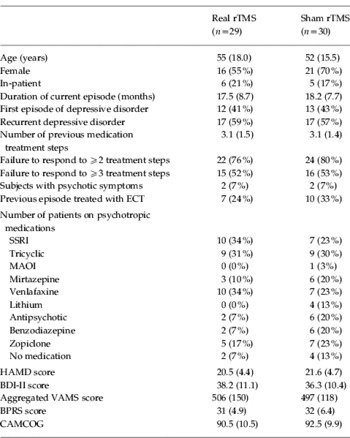
Participants' baseline characteristics are shown in Table 1. The groups were well-balanced on demographic and clinical variables. Apart from one patient with a bipolar depressive episode and randomized to have sham rTMS, all patients had unipolar depression. This was a treatment-resistant group with 78% of patients failing to respond to at least two treatment steps for the index depressive episode and 53% failing at least three steps. The mean MT was 55.9% (s.d.=8.0) of the Magstim Super Rapid's maximum output in the real rTMS group and 59.9% (s.d.=9.0) in the sham group.
Baseline characteristics
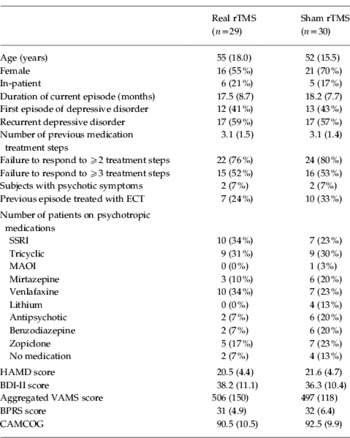
Data are number (%) of patients or mean (s.d.).
ECT, Electroconvulsive therapy; SSRI, Selective serotonin-reuptake inhibitor; MAOI, Monoamine oxidase inhibitor; HAMD, Hamilton Depression Rating Scale; BDI, Beck Depression Inventory; VAMS, Visual Analogue Mood Scales; BPRS, Brief Psychiatric Rating Scale; CAMCOG, Cognitive section of CAMDEX: the Cambridge Examination for Mental Disorders of the Elderly (Roth et al. Reference Sackeim, Ross, Hopkins, Calev and Devanand1988).
Primary outcome
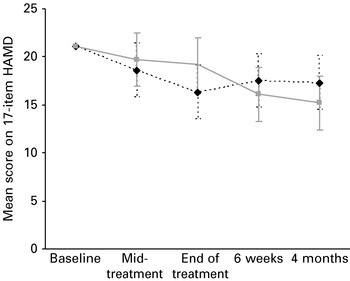
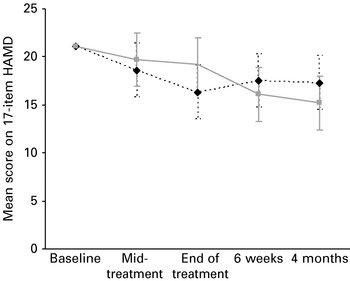
Fig. 2 shows the model for predicted HAMD scores at post baseline time-points. There was no significant interaction between treatment group and time (χ2=6.61, df=3, p=0.09). When the interaction term was removed from the model, there was no significant group main effect (z=−0.19, p=0.85). From the model, overall group mean difference was estimated to be a 0.3 point reduction in HAMD score for real compared with sham rTMS [95% confidence interval (CI) −3.4 to 2.8]. The group difference on raw change scores at end-of-treatment was 2.9 points reduction (95% CI −0.7 to 6.5). The mean values for treatment effects were therefore below the mean value deemed a priori to be clinically relevant, i.e. a difference of at least 3.5 points on HAMD.
Mean Hamilton Depression Rating Scale (HAMD) scores. The graph shows predicted mean scores (with 95% confidence intervals) per treatment arm, adjusted to sample average baseline values. - -♦- -, rTMS group (n=29);  , sham group (n=30).
It has been suggested that psychosis and older age may be negatively associated with rTMS response (Grunhaus et al. Reference Grunhaus, Dannon, Schreiber, Dolberg, Amiaz, Ziv and Lefkifter2000; Kozel et al. Reference Kozel, Nahas, DeBrux, Molloy, Lorberbaum, Bohning, Risch and George2000). In addition, benzodiazepine use can affect cortical excitability (Palmieri et al. Reference Palmieri, Iani, Scalise, Desiato, Loberti, Telera and Caramia1999) and may reduce TMS response. Therefore, analyses were performed to examine whether adding interactions between treatment group and psychosis, group and age, or group and benzodiazepine use had a significant effect on the model for primary outcome. There was no evidence of significant interaction between treatment group and psychosis (z=1.21, p=0.23), age (z=0.59, p=0.55) or benzodiazepine use (z=0.16, p=0.87).
As a robustness check, a received-treatment analysis was performed in addition to intention-to-treat analysis. This excluded four patients who did not receive a full treatment course and took into account seven patients who crossed over to real rTMS after the 6-week assessment. This analysis also found no effect of treatment group on the primary outcome.
At end-of-treatment, 9/28 (32%) of patients in the real rTMS group were classified as responders compared with 3/29 (10%) in the sham group (Fisher's exact test, p=0.06). In the real group 7/28 (25%) met the remission criterion compared with 3/29 (10%) in the sham group (Fisher's exact test, p=0.2).
BDI, VAMS and BPRS
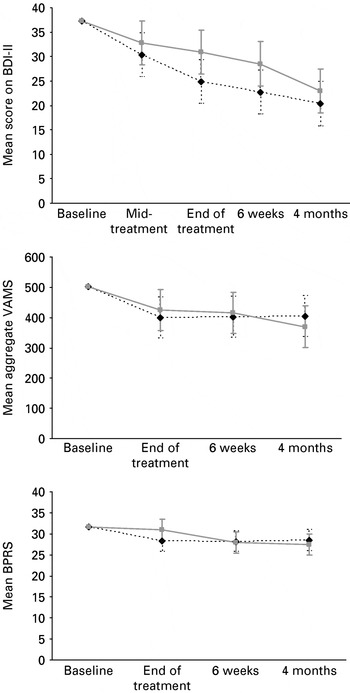
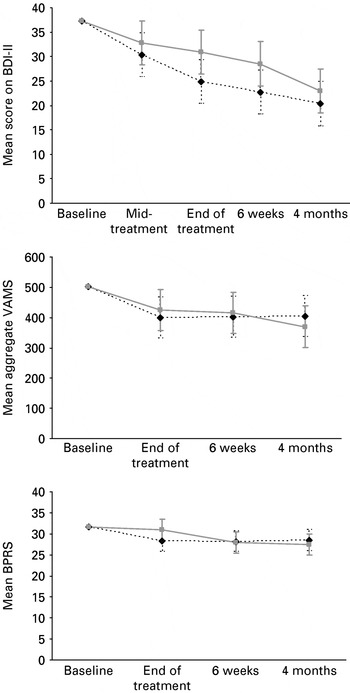
Fig. 3 shows changes in BDI-II, aggregate VAMS and BPRS scores over time. There was no significant group×time interaction for any of these measures (BDI-II: χ2=1.87, df=3, p=0.60; VAMS: χ2=2.02, df=2, p=0.36; BPRS: χ2=3.83, df=2, p=0.15). Nor was there a main effect of group when the interaction term was removed from the models (BDI-II: z=−1.63, p=0.1; VAMS: z=−0.08, p=0.94; BPRS: z=−0.46, p=0.65).
Mean Beck Depression Inventory (BDI), aggregate Visual Analogue Mood Scales (VAMS) and Brief Psychiatric Rating Scale (BPRS) scores. The graphs show predicted mean scores (with 95% confidence intervals) per treatment arm, adjusted to sample average baseline values. - -♦- -, rTMS group (n=29); , sham group (n=30) for all panels.
Cognitive measures
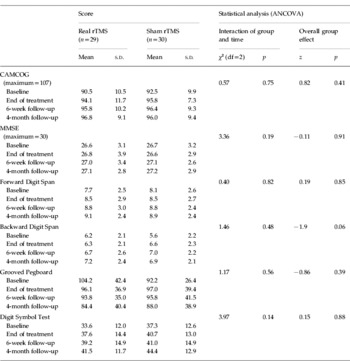
Cognitive scores at baseline, end-of-treatment and at both 6-week and 4-month follow-ups are shown in Table 2. There were no statistically significant group×time interactions for any of the tests, so any change over time was similar in both groups. When the interaction term was removed from the models there was no statistically significant group main effect for any cognitive measure.
Cognitive outcomes
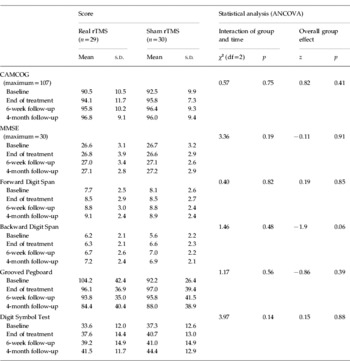
ANCOVA, Analysis of covariance; rTMS: repetitive transcranial magnetic stimulation; CAMCOG, Cognitive section of CAMDEX: the Cambridge Examination for Mental Disorders of the Elderly (Roth et al. Reference Sackeim, Ross, Hopkins, Calev and Devanand1988); MMSE, Mini-Mental State Examination.
Subjective side-effects
Treatments were generally well tolerated. No patient withdrew from the real rTMS group because of side-effects. Two patients in the sham group withdrew after one treatment because of perceived side-effects, namely tinnitus and dizziness. No seizures occurred in any of the real rTMS group. However, one patient in the sham group reported having a seizure in the community about 6 hours after his final treatment. No cause for this was found and he had no further seizure events. Whatever the cause or nature of this seizure event, it was not deemed to be related to sham rTMS.
There was no significant group×time interaction for the CSSES scores (χ2=1.7, df=2, p=0.43) nor was there a main effect of group (z=0.43, p=0.67) when interaction term was removed. There was a positive correlation between changes in HAMD and CSSES (Pearson coefficient=0.45, p=0.002), suggesting CSSES was also measuring symptoms of depression (Devanand et al. Reference Devanand, Fitzsimons, Prudic and Sackeim1995).
Maintenance of blinding
Of the 55 patients who completed a treatment course, 51 made a guess as to whether they received real or sham rTMS. Of these, 67% (34/51) correctly guessed their treatment. There was a significant difference (Fisher's exact test p=0.03) between groups: 70% (19/27) of patients in the real rTMS group guessed they were receiving real rTMS compared with 38% (9/24) of the sham group. Interestingly, 100% of the 12 patients who met the criterion for response (nine in the real rTMS group and three in the sham group) guessed they were receiving real rTMS compared with 41% (16/39) of non-responders (Fisher's exact test, p<0.001). Rater guesses were available for 52 patients and 36/52 (69%) were correct. Raters guessed that 20/27 (74%) in the real rTMS group and 9/25 (36%) in the placebo group were having real treatment (Fisher's exact test, p=0.01).
Discussion
This study is one of the largest to date of rTMS of the left DLPFC as adjunctive treatment for major depression. Also, to our knowledge, we have reported the longest and most complete follow-up of patients in an rTMS trial. The trial was powered to detect a mean difference of 3.5 points in the HAMD between real and sham treatments and found a difference less than this. Overall, there was no significant difference between real and sham rTMS groups. Similar results were also obtained using self-rated BDI-II and VAMS. To enhance the generalizability of this study and reflect routine practice, patients continued usual medications and received treatment as usual during the follow-up period. Benzodiazepines, age and presence of psychosis may affect therapeutic response to rTMS (Palmieri et al. Reference Palmieri, Iani, Scalise, Desiato, Loberti, Telera and Caramia1999; Grunhaus et al. Reference Grunhaus, Dannon, Schreiber, Dolberg, Amiaz, Ziv and Lefkifter2000; Kozel et al. Reference Kozel, Nahas, DeBrux, Molloy, Lorberbaum, Bohning, Risch and George2000) but could not be shown to affect the primary outcome in the present study.
Relation of findings to previous trials
Analysis of HAMD scores at end-of-treatment found non-significant trends for differences between real and sham groups for rates of response (32% v. 10%) and remission (25% v. 10%). It is possible that a true treatment effect was emerging and this would have become evident with either a more intensive protocol or by continuing rTMS beyond 2 weeks, which was the treatment duration considered reasonable for adjunctive rTMS when the present trial was initially designed. However, in another trial comparing electroconvulsive therapy (ECT) with 15 days of rTMS, as used in the present trial, we found a remission rate of only 17% for rTMS compared with 59% for ECT (Eranti et al. Reference Eranti, Mogg, Pluck, Landau, Purvis, Brown, Howard, Knapp, Philpot, Rabe-Hesketh, Romeo, Rothwell, Edwards and McLoughlin2007). Also, giving three times more stimuli over 10 days (i.e. total of 30 000 pulses at 110% of MT; n=38) has not resulted in better rates [based upon changes in Montgomery–Asberg Depression Rating Scale (MADRS) scores] for response (32% v. 16%) or remission (16% v. 11%) between real and sham groups (Loo et al. Reference Loo, Mitchell, McFarquhar, Malhi and Sachdev2007).
Combining an increase in treatment duration with more stimuli does not seem to make an appreciable difference either. Similar rates for response (i.e. ⩾50% decrease in HAMD that persisted for 1 week) and remission (i.e. HAMD<8 that persisted for 1 week), 31% v. 6% and 20% v. 3% respectively, were reported following 15 sessions of rTMS over 4 weeks (total of 24 000 pulses at 110% of MT) in another recent controlled trial with a larger sample size (n=68) (Avery et al. Reference Avery, Holtzheimer, Fawaz, Russo, Neumaier, Dunner, Haynor, Claypoole, Wajdik and Roy-Byrne2006). These response and remission criteria are slightly more stringent than in the present trial but the results are comparable, although reported as statistically significant. However, data were analysed using one-tailed, rather than two-tailed, tests, as it was assumed that real rTMS would be superior to sham treatment.
Achieving remission with antidepressant medications can take at least 6 weeks (Trivedi et al. Reference Trivedi, Rush, Wisniewski, Nierenberg, Warden, Ritz, Norquist, Howland, Lebowitz, McGrath, Shores-Wilson, Biggs, Balasubramani and Fava2006). Therefore, it would certainly be of great interest to establish if rTMS given daily, more intensively and for longer periods (e.g. ⩾4 weeks) under randomized and blinded conditions could meaningfully improve upon the above results. Although not yet published in the peer-reviewed literature, the results of an industry-sponsored, randomized trial (Neuronetics Inc., Malvern, PA, USA) have recently been submitted to the United States Food and Drug Administration and reviewed by its Neurological Devices Panel (FDA Neurological Devices Panel, 2007). In this large multi-centre study, patients with major depression were randomized to intensive real (n=155) or sham (n=146) rTMS of the left DLPFC (3000 pulses daily at 120% of MT); after 4 weeks of treatment (i.e. 60 000 stimuli) there was a marginal but not significant difference (p=0.057) between real and sham groups on the primary outcome measure, the MADRS. The majority of improvement occurred within the first 2 weeks of treatment with little further benefit in the second 2 weeks.
When comparing results from different studies, it has been suggested that it is more useful to examine the difference in response rates, rather than absolute rates, between real and sham groups, especially when studying treatment-resistant populations (Avery et al. Reference Avery, Holtzheimer, Fawaz, Russo, Neumaier, Dunner, Haynor, Claypoole, Wajdik and Roy-Byrne2006). In the present study this difference was 22%, similar to that (i.e. 25%) found by Avery et al. (Reference Avery, Holtzheimer, Fawaz, Russo, Neumaier, Dunner, Haynor, Claypoole, Wajdik and Roy-Byrne2006). Our results are also similar to a recent meta-analysis of 16 controlled trials (Burt et al. Reference Burt, Lisanby and Sackeim2002) that found a mean 23.8% improvement in depression scores following real rTMS and a 7.3% improvement with sham rTMS; in the present study the mean reduction in raw HAMD scores from baseline to end-of-treatment was 23% for real rTMS and 9% for sham. Our results are therefore consistent with data from both previous and recent rTMS trials of left prefrontal cortex.
Also consistent with previous findings, we found rTMS treatment to be well tolerated by patients and without adverse cognitive or other major side-effects (Loo et al. Reference Loo, Sachdev, Esayed, McDarmont, Mitchell, Wilkinson, Parker and Gandevia2001; Fitzgerald et al. Reference Fitzgerald, Brown, Marston, Daskalakis, de Castella and Kulkarni2003, Reference Fitzgerald, Benitez, de Castella, Daskalakis, Brown and Kulkarni2006; Hausmann et al. Reference Hausmann, Pascual-Leone, Kemmler, Rupp, Lechner-Schoner, Kramer-Reinstadler, Walpoth, Mechtcheriakov, Conca and Weiss2004; Avery et al. Reference Avery, Holtzheimer, Fawaz, Russo, Neumaier, Dunner, Haynor, Claypoole, Wajdik and Roy-Byrne2006). It has been suggested rTMS has a ‘late effect’ on depression that becomes apparent weeks later (Koerselman et al. Reference Koerselman, Laman, van Duijn, van Duijn and Willems2004). Our findings do not support this; both groups improved only slightly over time with no differences on either intention-to-treat or received-treatment analyses.
Blinding and placebo effects
Although there was no overall difference between groups in the present study, another possible explanation for the trend for increased responder rate in the real rTMS group at end-of-treatment may be an attribution bias in improved subjects deeming improvement to be a result of receiving real treatment. Alternatively, there may be an enhanced placebo response in those believing they received the real treatment. Compared with non-responders, a significantly greater proportion of patients classified as responders in the present study believed they received real rTMS (100% v. 41%) as has been found in other trials of rTMS which reported upon patient blinding (Avery et al. Reference Avery, Holtzheimer, Fawaz, Russo, Neumaier, Dunner, Haynor, Claypoole, Wajdik and Roy-Byrne2006; Fitzgerald et al. Reference Fitzgerald, Benitez, de Castella, Daskalakis, Brown and Kulkarni2006).
The nature of rTMS makes it difficult to ensure patients remain blind. To our knowledge only a few previous trials of real versus sham rTMS have reported the success of patient blinding while none has reported success of rater blinding (Fitzgerald et al. Reference Fitzgerald, Brown, Marston, Daskalakis, de Castella and Kulkarni2003, Reference Fitzgerald, Benitez, de Castella, Daskalakis, Brown and Kulkarni2006; Avery et al. Reference Avery, Holtzheimer, Fawaz, Russo, Neumaier, Dunner, Haynor, Claypoole, Wajdik and Roy-Byrne2006; Loo et al. Reference Loo, Mitchell, McFarquhar, Malhi and Sachdev2007). These are serious omissions in trial design and reporting. In our study patient blinding was slightly less than previously reported. In these studies, of those who made a definitive guess, the proportion who correctly guessed their treatment in the real rTMS group ranged from 48% to 64%, while 70% correctly guessed in our study; in the sham groups 50–75% correctly guessed treatment received as did 62% in our study. Although the large industry-sponsored study referred to above was blinded, the success of blinding for patients and raters was not determined (FDA Neurological Devices Panel, 2007). However, 35.8% of patients initially randomized to real rTMS complained of application site pain compared with only 3.8% in the sham group, again raising the possibility of an increased placebo response in the real rTMS group.
The choice of an appropriate sham coil is a difficult methodological issue. Most studies have involved tilting the real coil through 45–90° off the head in an attempt to reduce cortical stimulation while preserving the sensation of TMS. However, significant cortical stimulation may still occur (Loo et al. Reference Loo, Taylor, Gandevia, McDarmont, Mitchell and Sachdev2000; Lisanby et al. Reference Lisanby, Gutman, Luber, Schroeder and Sackeim2001). We used a real coil to determine MT and a purpose-built placebo coil that does not produce a scalp sensation for sham treatment. While this avoids the confounder of actually stimulating the brain, the lack of scalp sensation may have unblinded some subjects. Advances in sham coil manufacture should help improve future studies (Rossi et al. Reference Rossi, Ferro, Cincotta, Ulivelli, Bartalini, Miniussi, Giovannelli and Passero2007). It is noteworthy, nonetheless, that similar results were obtained on both observer-rated and self-rated mood scales.
How best to administer rTMS for depression is not known. In our trial patients received a total of 10 000 pulses at 110% MT over 10 sessions. As noted above, increasing number of pulses up to 60 000 or extending treatment to 20 sessions over 4 weeks appeared to make little difference (Avery et al. Reference Avery, Holtzheimer, Fawaz, Russo, Neumaier, Dunner, Haynor, Claypoole, Wajdik and Roy-Byrne2006; Loo et al. Reference Loo, Mitchell, McFarquhar, Malhi and Sachdev2007; FDA Neurological Devices Panel, 2007). Other trials have given various forms of rTMS for more than 4 weeks but results are difficult to interpret because either randomization was abandoned after 2 weeks and/or group sample sizes meant studies were under-powered (Fitzgerald et al. Reference Fitzgerald, Brown, Marston, Daskalakis, de Castella and Kulkarni2003, Reference Fitzgerald, Benitez, de Castella, Daskalakis, Brown and Kulkarni2006; Rumi et al. Reference Rumi, Gattaz, Rigonatti, Rosa, Fregni, Rosa, Mansur, Myczkowski, Moreno and Marcolin2005). Other potentially important aspects of rTMS administration are localization of DLPFC and estimation of stimulus intensity. By convention, DLPFC is located as being 5 cm anterior to the motor cortex APB site and stimulus intensity is based upon MT of the APB point. The former is clearly an estimate while the latter assumes scalp-cortex distances are identical at APB and DLPFC sites. These approaches do not take into account normal inter-individual variability or effects of age upon scalp–cortex distance (Kozel et al. Reference Kozel, Nahas, DeBrux, Molloy, Lorberbaum, Bohning, Risch and George2000). A neuronavigation approach, using neuroimaging before treatment to identify scalp landmarks and measure scalp–cortex distance, may help tailor rTMS to individual patients. Elegant use of this approach, however, does not appear to substantially improve response to rTMS beyond that reported in the present trial (Avery et al. Reference Avery, Holtzheimer, Fawaz, Russo, Neumaier, Dunner, Haynor, Claypoole, Wajdik and Roy-Byrne2006).
Conclusions
This study found real rTMS of the left DLPFC was not significantly better than sham rTMS as an adjunctive treatment after a 2-week course or during a 4-month follow-up period. It is clearly difficult to maintain patient blinding in rTMS trials and this may contribute to enhanced placebo effects, thereby accounting for minor but not clinically relevant differences previously reported for real rTMS when treating depression.
These findings do not support rTMS in routine clinical practice as adjunctive treatment for depression. Substantial improvements in an antidepressant effect of rTMS will be required for treating depression.
Acknowledgements
This study was supported by the Guy's and St Thomas' Charitable Foundation (R001126), the National Health Service Research and Development National Coordinating Centre for Health Technology Assessment (NCCHTA) (98/11/04), a 2003 Ritter Independent Investigator Award from the National Alliance for Research on Schizophrenia and Depression, and the Psychiatry Research Trust. The views and opinions expressed herein do not necessarily reflect those of any of these organizations.
Declaration of interest
None.