Traditionally, antibiotic stewardship has focused primarily on inpatient settings. However, worldwide increases in antibiotic resistance and Clostridioides difficile infection in the community shifted the focus toward ambulatory settings.Reference Younas, Royer and Weissman1,Reference Lessa, Mu and Bamberg2 In the United States, >60% of antibiotic expenditures occur in outpatient settings.Reference Suda, Hicks, Roberts, Hunkler and Danziger3 Previous studies have suggested that at least 30% of oral antibiotic prescriptions in the community are inappropriate, most of which are prescribed for acute respiratory infections.Reference Fleming-Dutra, Hersh and Shapiro4 The Centers for Disease Control and Prevention recently published the Core Elements of Outpatient Antibiotic Stewardship to provide guidance for antibiotic stewardship in outpatient settings.Reference Sanchez, Fleming-Dura, Roberts and Hicks5
Moreover, prior studies have indicated higher ambulatory antibiotic prescription rates in the southeastern United States as well as differences in antibiotic utilization by gender.6 Antibiotic prescription rates also increase during winter months, correlating with peak influenza virus seasons.Reference Durkin, Jafarzadeh and Hsueh7,Reference Suda, Hicks, Roberts, Hunkler and Taylor8 An examination of regional oral antibiotic prescription rates and trends are useful tools for guiding effective antibiotic stewardship initiatives. The objectives of this study were to determine the antibiotic prescribing practices in South Carolina and to assess the temporal trends and influences of age, gender, and rural versus urban location.
Methods
In this population-based cohort study in South Carolina, aggregated Medicaid and State Employee Health Plan pharmacy claims for outpatient oral antibiotics were used to estimate community antibiotic prescription fill rates, herein referred to as antibiotic prescription rates. Pharmacy claims were analyzed for individuals aged ≤64 years from January 1, 2012, to December 31, 2017. These data represent ~30% of the South Carolina population in that age group. Poisson regression or the Student t test was used to compare the following unadjusted antibiotic prescription rates: overall temporal trend, seasonal variation, and differences in mean antibiotic prescription rates across gender, age group (<18 years, 18–39 years, and 40–64 years), and member’s geographic location (rural versus urban). Member’s geographic location was defined using a zip-code approximation of rural–urban commuting area codes. An urban geographic location was defined as an urban-focused area (metropolitan). A rural geographic location was defined as a large rural-town–focused area (micropolitan) or a small and isolated rural-town–focused area. Taxonomy codes from the national provider index file were used to classify prescribers by type and specialty.9 All statistics were computed using SAS/STAT analytic products.Reference Cary10
Results
During the 6-year study period, the mean antibiotic prescription rate in South Carolina was 968 per 1,000 person years. Supplementary Table 1 (online) lists the antibiotic prescribing rate trends overall and by antibiotic class. Overall prescription rates decreased by 20% from 2012 to 2017 (1,127 to 897 per 1,000 person years, P < .0001). Decreases varied by antibiotic class, with the greatest decreases in macrolides (40%) and fluoroquinolones (38%). Lincosamides (clindamycin) was the only class in which the prescribing rate increased (24%). We detected significant seasonal variation in antibiotic prescription rates. Annualized rates were higher during the winter months (December–March) than during the rest of the year: 1,145 vs 885 per 1,000 person years (P < .0001) (Supplementary Fig. 1 online).
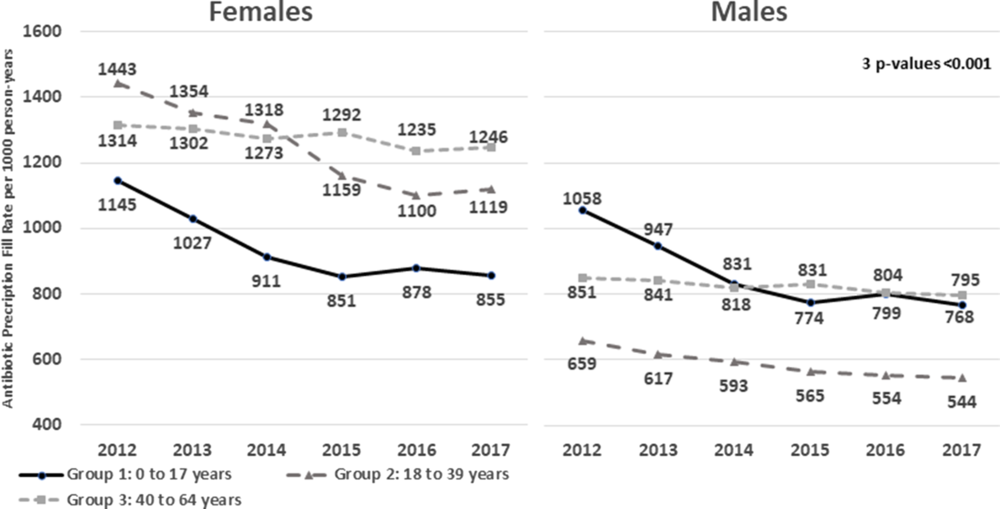
Antibiotic prescription rates decreased in all age groups and genders (Fig. 1 and Supplementary Fig. 2 online). However, the decreases were more noticeable in individuals aged <18 years (26%) and 18–39 years (20%) compared to those aged 40–64 years (5%; P < .001 for all). Overall prescription rates were 1,099 and 803 per 1,000 person years for men and women, respectively (P < .0001). Across all age groups, women had higher prescription rates per 1,000 person years than men: <18 years, 938 vs 856 (P < .0001); 18–39 years, 1,232 vs 585 (P < .0001); and 40–64 years, 1,276 vs 823 (P < .0001). Higher prescription rates were noted in rural communities than in urban communities: 1,032 vs 941 per 1,000 person years (P < .0001). However, similar decreases were seen in rural communities (1,206 to 955 per 1,000 person years, 21%) and in urban communities (1,090 to 873 per 1,000 person years, 20%).
Antibiotic prescription rates by gender and age group.

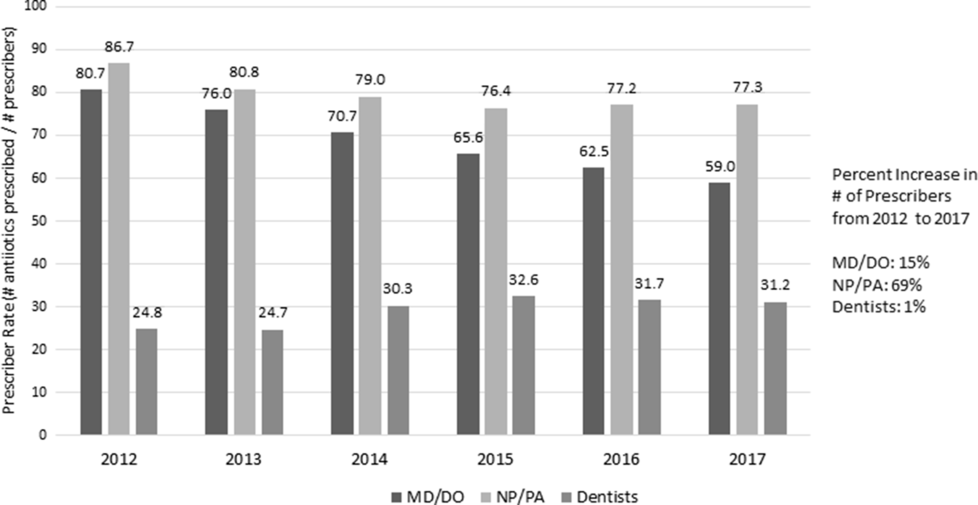
Figure 2 shows prescriber rates by year for doctors of medicine (MDs) or osteopathic medicine (DOs), nurse practitioners (NPs) or physician assistants (PAs), and dentists. Although MD/DO rates decreased each year, NP/PA rates began to increase slowly after 2015, and rates among dentists increased overall during the 6-year period, peaking in 2015. A subgroup specialty analysis revealed the largest decreases: family practice–general practitioner–internal medicine decreased 32.7%, emergency medicine decreased 32.1%, and pediatrics decreased 31.2%. Obstetrics/gynecology had the lowest decrease (11.8%). Although MDs/DOs had lower prescriber rates than NPs/PAs, MDs/DOs prescribe the majority of antibiotics, even though the percentage decreased from 71.7% to 60.6% over the study period. However, the prescriber rate for dentists is increasing, yet by 2017, dentists prescribed only 6.4% of all oral antibiotics. Supplementary Table 2 (online) shows the breakdown of antibiotics prescribed for various antibiotic classes based on prescriber type. Penicillins are the most commonly prescribed antibiotics by dentists (73.9%). Clindamycin comprises 14.8% of all antibiotic prescriptions by dentists, representing 35.5% of all clindamycin prescriptions.
MD/DO, NP/PA, and dentist prescriber rates from 2012 to 2017. Note. MD, doctor of medicine; DO, doctor of osteopathic medicine; NP, nurse practitioner; PA, physician assistant.

Discussion
Over a 6-year period, there was an overall decline in ambulatory antibiotic prescription rates, but trends were not consistent across all antibiotics, demographics, and prescribing providers. Macrolides and fluoroquinolones showed the largest decrease, and lincosamides was the only class that increased. This finding contrasts with data from the United States from 2006 to 2010, which did not show a significant decline in macrolides or fluoroquinolones.Reference Suda, Hicks, Roberts, Hunkler and Taylor8 This difference may indicate a recent trend toward decreased macrolide use, likely driven by reduced susceptibility of Streptococcus pneumonaie.Reference Zhang, Chen, Yu, Pan and Liu11 The decreased fluoroquinolone use may be due to the recent US Food and Drug Administration (FDA) safety alerts discouraging their use for minor infections.Reference Yarrington, Anderson and Dodds Ashley12
Antibiotic prescription rates were significantly higher in females, particularly in young adults in whom women received more than twice as many antibiotics, which is similar to previous reports.6,Reference Patrick, Marra, Hutchinson, Monnet, Ng and Bowie13,Reference Kristensen, Johnsen and Thomsen14 We postulate that the higher rates in women are due to higher healthcare utilization and certain infections (eg, urinary tract infections) that occur more often in females. This trend, unfortunately, leads to more community-onset C. difficile infections in women.Reference Younas, Royer and Rac15
The greatest decrease in antibiotic prescription rates was observed in children. This significant decrease (26%) is consistent with results of a recent study reporting significant decline in antibiotic prescribing for children from 2000 to 2014.Reference Finkelstein, Raebel, Nordin, Lakoma and Young16 One possible explanation is the impact of recent guidelines for management of otitis media, although without additional interventions this may have had only a modest effect.Reference Lieberthal, Carroll and Chonmaitree17,Reference Deniz, van Uum, de Hoog, Schilder, Damoiseaux and Venekamp18 Another potential factor is the increase in childhood vaccinations against S. pneumonaie, Haemophilus influenzae, and influenza leading to a reduction of common respiratory infections.Reference Morris, Moss and Halsey19–Reference Younas, Royer and Weissman21
During each year, the highest prescription rates were observed during winter months. This finding is similar to previously reported seasonal variations.Reference Suda, Hicks, Roberts, Hunkler and Taylor8,Reference Patrick, Marra, Hutchinson, Monnet, Ng and Bowie13,Reference Elseviers, Ferech, Vander Stichele and Goossens22,Reference Curtis, Walker, Mahtani and Goldacre23 These trends are likely due to increases in acute respiratory infections during winter, although many of these are viral. Educational campaigns for the general population and healthcare providers may be useful tools for improvement, but implementation in community settings remains challenging. Increased utilization of rapid diagnostics may also reduce antibiotic use.Reference Cals, Butler, Hopstaken, Hood and Dinant24,Reference Andreeva and Melbye25 These efforts are critical because seasonal variation in resistance rates has been associated with seasonality in ambulatory antibiotic prescriptions.Reference Hoberman, Paradise, Greenberg, Wald, Kearney and Colborn26,Reference Ramsey, Royer and Bookstaver27
The finding of higher antibiotic prescription rate in rural settings is consistent with previous results.Reference Curtis, Walker, Mahtani and Goldacre23,Reference Gonzales, Steiner and Sande28–Reference Barlam, Soria-Saucedo, Cabral and Kazis30 This finding may be partly due to concerns of patients’ long travel distance and difficulty returning to care if symptoms persist, making watchful waiting less applicable.Reference Chow, Benninger and Brook31 This phenomenon may explain overall high antibiotic prescription rates in the southeastern United States, where large proportion of residents live in rural communities.
This study demonstrates only 66.2% of all antibiotics are prescribed by MDs or DOs, which contrasts with the findings of a national study from 2005 to 2010, which found that 81% of antibiotics were prescribed by physicians.Reference Suda, Roberts, Hunkler and Taylor32 This shift toward less MD/DO prescribing and more NP/PA prescribing is multifactorial but is greatly influenced by increasing numbers of advanced practice providers (69% increase).
Unfortunately, prescriber rates did not decrease as much among NPs and PAs as among MDs and DOs. This difference may be due to disproportional numbers of NPs and PAs working in urgent care centers or retail clinics, which have been associated with increased antibiotic prescribing.Reference Palms, Hicks and Hersh33 This finding highlights the need to intervene to improve prescribing by NPs and PAs, who are not reached by typical medical societies or academic meetings. Dentists prescribed 5.9% of antibiotics, compared with 10.4% in the prior national study; however, dentist prescriber rates increased over the study period.Reference Suda, Roberts, Hunkler and Taylor32 Dentists prescribed more than one-third of all clindamycin. Because of this increase in antibiotic prescribing overall and for antibiotics with high risk of C. difficile infection, educational and clinical stewardship interventions tailored for dental providers are necessary and have been shown to be effective.Reference Deshpande, Pasupuleti and Thota34,Reference Gross, Hanna, Rowan, Bleasdale and Suda35
This study has several limitations. Antibiotic prescription is a surrogate for antibiotic use because prescription filled does not necessarily mean the medication was administered. Also, we did not assess indications to allow assessment of appropriateness. These data represent only 30% of the South Carolina population and may not be representative of other demographics. Individuals ≥65 years old are not represented due to lack of Medicare prescription claims.
In conclusion, ambulatory antibiotic prescription rates in South Carolina have decreased from 2012 to 2017. Understanding differences in prescribing rates with regard to patient and prescriber characteristics is an important tool to develop specific ambulatory antibiotic stewardship interventions to influence prescription behaviors for these populations. Statewide efforts are needed to further improve ambulatory antibiotic stewardship focused on older adults and acute respiratory infections during the winter months. Other states can take similar approaches to evaluate prescribing practices and designate regional interventions for improvement.
Supplementary material
To view supplementary material for this article, please visit https://doi.org/10.1017/ice.2020.70
Acknowledgments
The authors thank advisory board members of the Antimicrobial Stewardship Collaborative of South Carolina for facilitating the conduct of this study. This study was approved by the South Carolina Department of Health and Environmental Control (DHEC). The findings of this report are those of the authors and do not necessarily represent the official position of the South Carolina DHEC, South Carolina Revenue and Fiscal Affairs Office, South Carolina Department of Health and Human Services, or the South Carolina Public Employee Benefit Authority.
Financial support
This work was supported by a federal grant (Epidemiology and Laboratory Capacity Project K2) from the Centers for Disease Control and Prevention awarded to the South Carolina DHEC.
Conflicts of interest
P.B.B. served a research advisory board member of CutisPharma, Synthetic Biologics and on advisory board and speaker’s bureau of Melinta Therapeutics. He also received a grant from ALK Abello. All other authors report no conflicts of interest relevant to this article.