A substantial body of research maintains that corruption is still pervasive and has even worsened in China.Footnote 1 Considering rapid changes in China's economic and administrative environments over the last decade, one may ask a valid question: have the causes and trends of Chinese corruption changed accordingly?
The landscape of the Chinese economy in the 1990s was very different from that in the 2000s. In 1995, private enterprises only accounted for 5.3 per cent of the total national output, and there were so few private enterprises that the Chinese government did not officially collect their statistics.Footnote 2 However, the private sector has grown tremendously and, as of 2010, China has become the second largest economy in the world. In addition, the Chinese government has introduced comprehensive administrative reforms in the areas of taxation, auditing, procurement, administrative decentralization, and recruitment of civil and judicial officials. Given that these changes are closely related to the causes of Chinese corruption, it is relevant to ask whether they have had any effect on the levels of corruption.
More importantly, instead of being a nonchalant bystander to corruption, the Chinese government has actively implemented more than a thousand anti-corruption regulations and laws, and major anti-corruption policies. As of 1998, for example, around 249 laws and regulations were used to control bribery in China, and in 2007 this number increased to 542.Footnote 3 In addition, political and public awareness of corruption, aided by better access to the mass media and the internet, has continuously increased. Given such changes in the economy, administrative reforms and anti-corruption efforts, we cannot take it for granted that Chinese corruption has worsened in the last decade as it did in the 1980s and 1990s.
While the question “has corruption worsened in China?” seems simple, the answer will vary according to the definition of “corruption,” the interpretation of “worsen” and the ways of measuring corruption. Chinese corruption is not a monolithic entity but consists of many different aspects, such as embezzlement, misappropriation, bribery, profiteering, nepotism, neglect of duty, and violations of social and administrative norms.Footnote 4 Each type of corruption will not necessarily show the same trend. We also need to distinguish a mere increase in petty corruption from the intensification of corruption involving large amounts of money or high-ranking officials.Footnote 5 Together, these present a challenge to the appropriate and accurate measurement of corruption.
This article argues that the recent trends in Chinese corruption differ from the pre-1990s trends. Specifically, marketization, administrative reform and intensive anti-corruption efforts in China have alleviated the causes of corruption and, relatedly, affected its structural patterns. These new trends since 1998 are analysed by using a variety of official statistics compiled by the Central Commission for Discipline Inspection (CCDI), the Ministry of Supervision, the Procuratorate and the People's Court.
Definition and Typology of Chinese Corruption
The general definition of corruption, “abuse of public office for private gain,” is inadequate to account for the distinct public offices in the Chinese context such as “state functionaries” (guojia gongzuo renyuan 国家工作人员), the various types of abuses and the meaning of “private gain” in the Chinese context. In this article, a formal-legal standard is used to define Chinese corruption. While defining corruption based on “public interest” or “public opinion” suffers from the difficulty of determining a clear-cut boundary,Footnote 6 a formal-legal perspective is more operational and at the same time broad enough to cover all major forms of corruption. In the Chinese context, the formal-legal specification of corruption is based on the 1997 Chinese Criminal Law (CCL) which clarifies different types of corruption according to diverse actors, behaviours and motives.Footnote 7
The formal-legal definition is not limited to economic corruption. According to the CCL and the Law Yearbook of China, corruption can be categorized into economic and non-economic variants. Economic corruption includes embezzlement (tanwu 贪污), bribery (huilu 贿赂), misappropriation (nuoyong gongkuan 挪用公款), unauthorized dispersion of state properties (jiti sifen 集体私分), illegal gains (feifa suode 非法所得), tax evasion and resistance (toushui loushui 偷税漏税), counterfeit of trademark (jiamao shangbiao 假冒商标), and illegal speculation and profiteering (touji daoba 投机倒把). Non-economic corruption includes dereliction of duty (duzhi 渎职), including abuse of power (lanyong zhiquan 滥用职权), neglect of duty (wanhu zhishou 玩忽职守), nepotistic malpractice (xunsi wubi 徇私舞弊) and bigamy (chonghun 重婚). Some types of corruption peculiar to China, such as illegitimate feasting, feudal rites (cadres staging lavish, traditional-style weddings and funerals), and illegal imprisonment and torture, are also considered as non-economic corruption.Footnote 8 Non-economic corruption accounts for around 20 per cent of all corruption cases filed by the Procuratorate, while the other 80 per cent are related to economic corruption.Footnote 9
Causes and Trends of Chinese Corruption before the Late 1990s
The causes of Chinese corruption before the late 1990s most widely cited in the literature are marketization, fiscal decentralization, vestiges of the planned economy and state-owned enterprises, an underdeveloped civil service system, and poor institutionalization of anti-corruption laws and institutions.
The transition from a socialist to a market system has created the milieu of rampant corruption. At the early stage of market transition, the income of private sector employees increased significantly while that of public employees did not. This income gap caused a feeling of relative deprivation among the public employees, which gave them the incentive to use their power for personal benefit.Footnote 10 At the same time, public officials' control over scarce resources such as land, capital and business-approving power provided them abundant opportunities for rent seeking.Footnote 11 Some scholars also argue that in the context of marketization, moral decadence and degeneration of civil servants, privatizationFootnote 12 and a general weakening of the legitimacy of governmental institutionsFootnote 13 are also causes of endemic corruption.
Another cause proposed in the current literature is fiscal decentralization, which explains corruption in local governments.Footnote 14 To stimulate local-led growth, in the early 1980s the Chinese government adopted the fiscal sharing system, in which the central government gave local governments the authority to collect taxes and expend the revenues, while the local governments had to remit a contracted amount of money to the centre.Footnote 15 As a result, local governments could enjoy a considerable level of fiscal autonomy. For instance, local governments accounted for 71.7 per cent and 78 per cent of total government expenditures and revenues respectively as of 1993,Footnote 16 a level of fiscal decentralization higher than that in the United States.Footnote 17 To avoid the direct control and oversight of the centre, local governments raised huge amounts of extra-budgetary funds which were not controlled by the central government. Such fiscal decentralization without relevant supervision and management became the source of embezzlement and misappropriation of public funds. The central government did not have enough information to monitor and audit the local governments' tax collection and expenditure, especially before the 1994 tax reform.
The legacies of the planned economy and control over state-owned enterprises (SOEs) are counted as another cause of corruption in the literature. The dual-price system, adopted between the 1980s and 1992, created a gap between the market price and government-fixed price and gave cadres incentives and opportunities to use their discretion for private gain.Footnote 18 As Yan Sun notes, “managers in SOEs exploited price differentials and supply shortages as the primary means to acquire wealth.”Footnote 19 In addition, the ties between public officials and SOEs remained very strong during the early reform period. While the central government gradually expanded the autonomy of SOEs through “power-delegating” and “profit-sharing,”Footnote 20 local governments were reluctant to lose their control over SOEs as they were a major source of local governments' revenues and a primary tool of economic development. As economic development was a major indicator for evaluating the performance of local cadres, they still had incentives to control SOEs directly, which increased the risk of corruption.
The underdeveloped civil service system was also blamed as a cause of corruption. The Chinese civil service inherited an undisciplined, ineffective and arbitrary bureaucracy at the beginning of the reform.Footnote 21 In the early period of reform, no distinction was made between political appointees and civil servants.Footnote 22 The meritocratic system which can reduce opportunities for nepotism and increase professionalism was not adopted until the introduction of the civil service system in 1993. The concentration of power in the first-in-command (yibashou 一把手) is another challenge to the civil service. Decisions about the promotion of civil servants and use of financial resources rest with high-level authorities who are not sufficiently supervised.Footnote 23 In some situations, powerful cadres held top positions in the Party, civil service and SOEs at the same time, simply monopolizing the power. As Rose-Ackerman argues, such power concentration deters the development of a professional civil service and creates room for corruption.Footnote 24
Finally, laws and institutions for controlling corruption were not well developed. Reviewing the 1979 CCL, one finds that types of corruption and the level of punishment were not sufficiently specified. As a result, the Standing Committee of the National People's Congress had to promulgate the Supplementary Regulation on Suppression of Corruption and Bribery to clarify the sentencing guidelines in 1988. Moreover, as the functions of anti-corruption were not demarcated well between the Party and the state, the Chinese government integrated the functions of the CCDI and the Ministry of Supervision in 1993. These efforts were followed by addressing many regulatory standards since the mid-1990s whose results had not been satisfactory. In this context, political and ad hoc anti-corruption campaigns, rather than institutionalized efforts, were frequently used.Footnote 25
Against this backdrop, some existing literature claims that Chinese corruption intensified in the 1990s.Footnote 26 For example, according to Wedeman, with whom we concur, the intensification is manifested not merely in an increase of corruption cases but also in a qualitative shift from the prevalence of rank-and-file involvement to more senior officials' involvement in corruption.Footnote 27 Quade also finds a positive correlation between the timing of anti-corruption campaigns and macroeconomic austerity.Footnote 28
Changing Causes of Chinese Corruption
The aforementioned causes and the trends of corruption have not been time-invariant. We argue that because the Chinese socio-economic system has evolved over the last decade, causes of corruption have also altered significantly.
Above all, the role of the government in the market has changed. In the 1990s, market competition was very weak: SOEs enjoyed monopolistic power,Footnote 29 and the government decided and guided market prices and fully controlled the banking system. As Wu Jinglian and Hu Angang suggest, the monopolistic power of state agencies and their intervention in the market was the root cause of corruption in China.Footnote 30 These situations, however, changed along with China's economic growth, its affiliation to the World Trade Organization and intensified market competition. For instance, private companies' proportion of total national production increased from 5.26 per cent in 1995 to 53.7 per cent in 2006.Footnote 31 The affiliation to the World Trade Organization instilled the idea of “global standards” in the minds of policy makers and businessmen in China. Reflecting the growth of the market and its autonomy, the State Planning Commission (renamed the State Development Planning Commission in 1998) was transformed into the National Development and Reform Commission in 2005, placing more emphasis on macro rather than micro economic planning.
The institutional and administrative setting for an anti-corruption policy has also progressed. Students of Chinese corruption suggest that the old rules that collapsed were not replaced with new ones,Footnote 32 providing considerable opportunities for officials to be corrupt.Footnote 33 The 1979 CCL classified only three types of corruption – embezzlement (article 155), bribery (article 185) and neglect of duty (article 187) – without specifying the level of punishment according to the severity of the offence. In contrast, the 1997 CCL defines seven types of corruption and clarifies the punishment level according to severity, especially taking into consideration the amounts of money involved. In addition to the revised CCL, there are also ongoing discussions on making an independent anti-corruption law. Moreover, a number of important regulations were successively introduced, including Regulations on Report of Personal Important Events of Party and Government Officials (1997), Administrative Supervision Law of the People's Republic of China (1997), Regulations on Enforcing the Responsibility System of Construction of the Party Conduct and of a Clean Government (1998), and Provisions on the Real-name Personal Savings Account System (2000). Consequently, as of 2007, China has over 500 anti-bribery policies regulating government procurement, contracting in public programmes, supervision of cadre personnel, the releasing of land and administrative approval power.Footnote 34
The civil service system has notably improved over the last decade. In 1998, the Chinese government launched a comprehensive administrative reform. Compared to the previous reforms in 1982, 1988 and 1993 and even the later reform in 2003, the 1998 government reform sought greater downsizing of the government body. It reduced the number of ministries from 40 to 29 in an effort to streamline the bureaucracy. Many ministry-managed industries were abolished, making SOEs independent legal entities and subsequently leading to the emergence of professional managers.Footnote 35
The application of the merit system in recruiting civil servants has become a standard. While the civil service system replaced the cadre system in 1993, the country-wide civil service exam only began in 1997. Since then, the Chinese government has gradually expanded the application of the civil service exam system. The People's Court and People's Procuratorate also started to adopt the civil service exam system in 2003. Finally, since the establishment of the Civil Service Law in 2005, all applicants for positions below the section level (keyuan 科员) or its equivalent – meaning all entry-level jobs in the civil service – have to take the civil service exam, indicating a nationwide adoption of the exam system at both central and local levels.Footnote 36
The budgeting and accounting reforms implemented in 1998 have strengthened administrative supervision over the use of public funds. Some of the reforms aimed to enforce the budget law more strictly, standardize budget documentation and planning through departmental budgets, set up a single Treasury account system, and adopt a government-wide procurement system. In 2000, the central government officially adopted the departmental budget planning system, which is considered as the most important and most effective component of China's public budgeting reform in recent years. By 2007, every department of the central government had its own budget planning. In addition, the number of central government departments that submitted their budgeting plans to the National People's Congress increased from four in 2000 to 35 in 2007. The impact of this reform also reached local governments. For instance, in some provinces, such as Hebei, every department of the government was required to submit its own budget plan to clarify specific revenues and expenditures by 1998. By the end of 2007, all of the 36Footnote 37 provincial-level governments had established departmental budgeting planning.Footnote 38
In light of the severity of accounting fraud, the Chinese government has, since 1998, restructured public accounting firms by separating them from government agencies. In 1999, the accounting laws were revised, ushering in a nationwide uniform accounting system. After a series of regulations and initiatives launched in 2004, the new accounting systems were established and practised. All these measures helped the government standardize budgeting and accounting processes, which has increased manageability and transparency.Footnote 39
Fiscal recentralization is another notable change affecting trends in corruption. The 1994 tax reform simplified turnover tax into three types: business tax, VAT and consumption tax; all local governments were then asked to apply the same tax schedule.Footnote 40 As a result, the authority of decision-making over tax bases and rates is more centralized than before. Moreover, some local government tax bases are being gradually transferred to and shared with the central government. For instance, individual income tax which local government previously collected became a shared revenue source in 2003, with the central government taking 60 per cent of it.
The central government's increasing control over extra-budgetary funds (EBF)Footnote 41 has also reduced chances to embezzle and misappropriate public funds. Before the 1994 tax reform, local governments were assumed to have “complete authority over determination of tax rates and the amount of fees that fall into the categories of extra budgets.”Footnote 42 In addition, the collecting and spending of EBF were previously in the hands of the same bureau, which was subjected to minimal external supervision.Footnote 43 However, as a result of the 1998 government reform, local governments were asked by the financial department to open a “special bank account.” All extra-budgetary revenues of institutions and agencies have to be deposited in the special account, which has increased external control. In addition, each institution and agency with the authority to use EBF has to prepare an extra-budget plan to appropriate EBF from this special account. A new set of rules and regulations were issued to integrate off-budgetary funds into ordinary budgets in 1995.Footnote 44 Furthermore, the abolishment of the agricultural tax in 2006 reduced the room for local governments to collect EBF and other illicit local exactions.Footnote 45 As a result of these successive reforms, the proportion of extra-budgetary revenues to national revenues dropped from 52.6 per cent in 1996 to 13.3 per cent in 2006.Footnote 46
Summing up, the major causes of Chinese corruption have significantly changed since the mid-1990s. The scope of these changes leads logically to expectations about structural changes in Chinese corruption. In fact, some studies have suggested this linkage.Footnote 47 However, empirical research on how the changes have affected the actual level and types of Chinese corruption is rare. The following analysis is directed to answer this question.
Changing Patterns and Levels of Corruption
This section empirically reviews trends in Chinese corruption since 1998, after the introduction of comprehensive legal and administrative reforms.
Disciplinary, prosecution and court statistics
Corruption is known to be difficult to measure, and there is no single and complete measure of it. This article employs statistics from China's four anti-corruption institutions: the CCP's CCDI, the state's Ministry of Supervision, the Supreme Procurator's Central Anti-Corruption Bureau, and the People's Court.
We organize the data from each institution according to the processes of discovering and disciplining corruption. The CCDI is the chief investigatory and disciplinary organ of the CCP, regulating the Party cadres' misconduct and corruption. The Ministry of Supervision investigates misbehaviour by government officials. However, as most state cadres are also CCP members, the CCDI and the Ministry of Supervision cases overlap. To avoid duplication of duties, the two agencies' functions were merged in 1993–94.Footnote 48
Corruption investigation starts with allegations from internal and external information sources. The former, coming from the agencies' internal investigations, constitute a minority while the majority of accepted cases come from citizen's allegations.Footnote 49 Some statistics show that more than 90 per cent of corruption cases uncovered since 1980 originate from citizens' tips.Footnote 50 This number can approximate the level of corruption perceived by citizens, though we cannot assume that all involve corruption cases. Next, the CCDI and the Ministry of Supervision conduct their investigations, and if there is evidence of misbehaviour the cases are filed and further investigated. The number of filed cases depends on the quality of tipped-off information in the accepted cases, as well as the CCDI's organizational resources and will to investigate.
The filed cases are investigated according to the Disciplinary Regulations of the CCDI (Zhongguo gongchandang jilü chufen tiaoli 中国共产党纪律处分条例) and the Ministry of Supervision's Administrative Regulations (xingzheng jiancha tiaoli 行政监察条例). If the filed cases are minor, involving less than 5,000 yuan, then minor internal punishment (warning, demotion, expulsion with two-year probation) is levied on the investigated Party members and public officials. Serious cases involving more than 5,000 yuan are sent to the judicial system, that is, to the Supreme Procurator's Central Anti-Corruption Bureau. Around 6 per cent of all disciplinary cases are transferred to the Procuratorate every year.
The Supreme Procurator's Central Anti-Corruption Bureau, established in 1989, initiates the judicial process by investigating the serious disciplinary or supervisory cases sent by the CCDI and the Ministry of Supervision. It also accepts cases reported by citizens. According to the Supreme Procuratorate, between 2003 and 2008, 80 per cent of case clues were from the public.Footnote 51 Between 1988 and 2007, fewer than 25 per cent of the Procuratorate-accepted bribery cases were from the disciplinary agencies and around 75 per cent were reported by citizens.Footnote 52 Among these accepted cases, around 40 to 60 per cent were filed by the Procuratorate. After investigation of filed cases, the Procuratorate transfers those with sufficient evidence to the People's Court to prosecute and sentence corrupt officials in accordance with anti-corruption law.
The People's Court rules the prosecuted cases according to the CCL. Because of the ambiguity of the 1979 CCL, the sentencing guidelines for economic corruption (bribery, misappropriation and embezzlement) were unclear before the Standing Committee of the National People's Congress promulgated the Supplementary Regulations on Suppression of Corruption and Bribery and clarified the sentencing guidelines in 1988. They are more clearly specified in the 1997 CCL.
The CCDI and court data do not report all the corruption cases subsumed under each category. Hence, the examination of the intensification of corruption is mainly based on the prosecution data which show the level of corruption for each type (economic and disciplinary corruption) and severity (grand corruptionFootnote 53 and major corruptionFootnote 54 ) of corruption.
Finally, we control for the change in the number of public officials. There were 10.97 million public officials in 1998 and 12.91 million in 2007 (a 17.7 per cent increase). To reflect the real change in corruption level, we normalize the number of corruption cases by the number of public officials, and report the number of cases per 1,000 public officials.
Reliability of data
Scepticism about official statistics is common among Chinese corruption scholars. First, the impact of the changes of laws and rules on the official statistics should be examined. For instance, the CCDI and Ministry of Supervision reported 70,126 filed corruption cases in 1994 but this increased to 155,486 in 1995 (a 122 per cent increase) after the integration of the investigation functions of the two bodies in 1993–94. Another noticeable change is in the number of cases filed by the Procuratorate. This dropped by more than 50.2 per cent (from 70,477 to 35,048) between 1997 and 1998, mainly because of the revision of the CCL that increased the amount of money required for punishable corruption cases to twice that of the previous year.Footnote 55 However, after these we didn't find any significant changes that could have affected data collection methods between 1998 and 2007.
Next, one might claim that repeated political campaigns could influence the number of corruption cases. For example, Wedeman argues that political anti-corruption campaigns inflate the number of “revealed” corruption cases because most campaigns are highly publicized and increase the enforcement activities of anti-corruption agencies.Footnote 56 Indeed, anti-corruption campaigns produced notable peaks in law enforcement figures in the early 1990s.Footnote 57 However, since the Chinese government shifted from a campaign-based to an institutional approach in the mid-1990s, there have been no really major anti-corruption campaigns. While there was a high-profile anti-corruption campaign in 2005,Footnote 58 it was not comprehensive enough to cause an irregular change in official statistics of corruption between 1998 and 2007. And even if anti-corruption campaigns were to affect the number of detected corruption cases, the direction of the bias is to support the worsened corruption hypothesis.
We also need to consider political influence on official statistics of corruption. Sporadic political influence can directly influence the number of filed cases, particularly for grand and major corruption cases. While local government officials may attempt to manipulate the number of corruption cases, there is no evidence that the number of citizens' reports to anti-corruption agencies is affected by political pressure from the CCP. Therefore, the number of cases accepted by the CCDI can be useful to infer the trend in corruption if we want to control for distortion due to political pressure on anti-corruption agencies.
Another argument is concerned with the resource constraints of anti-corruption agencies, which limit the number of cases investigated. This bias is called the “hiddenness gap,” referring to the difference between actual and detected cases.Footnote 59 For instance, only 83 per cent of filed cases at the CCDI and Ministry of Supervision were investigated and closed in 1990. Nevertheless, the ratio of closed cases to filed cases has since improved; in 2007, it almost reached 100 per cent. Moreover, given the decrease in the absolute number of investigated corruption cases found in our following analyses, we can reject the criticism that the heavy workload of anti-corruption agencies causes an upward bias in measuring the trend in Chinese corruption.
Analysis of Results
Decline in overall levels of corruption
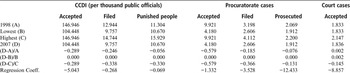
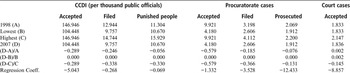
Using CCDI, prosecution and court data, Table 1 suggests a decrease in overall corruption levels from 1998 to 2007, while it remains a serious problem. On average, in 2007, 104 corruption cases per 1,000 public officials were reported by citizens to the CCDI. Of these, around 9.3 per cent were investigated. The percentage of public officials punished by CCDI was around 1.1 per cent of the total of 12.9 million public officials in 2007. In addition, around 1.91 out of 1,000 public officials are prosecuted annually for corruption. This rate is 38.8 times larger than that of the United States, where around 1,000 government employees out of 20.3 million were convicted at all levels in 2006.Footnote 60 Given that official corruption statistics tend to under-report the actual extent of corruption, we can infer the seriousness of corruption in China.
The Overall Trend in Corruption by Each Anti-corruption Jurisdiction (1998–2007)
Source:
Law Yearbook of China, 1999–2008.
Nevertheless, the overall level of corruption has decreased since 1998. As shown in Table 1, cases accepted by the CCDI from 1998 (A) to 2007 (D) measured by (D-A)/A decreased by 28.9 per cent. The number of cases accepted by the Procuratorate also decreased by 57.9 per cent. Considering that these two measures mainly reflect cases arising from direct allegations by citizens, it is unlikely that the overall downward trend in corruption is a result of weakened political will or a lack of resources of anti-corruption agencies.
The downward pattern is not because of the selection of the starting year, 1998. Even if we conservatively ((D-B)/B) or optimistically ((D-C)/C) measure the trend, it still shows a downward pattern. Also, regression analysis of the number of corruption cases on year also produces negative regression coefficients, which imply an average decrease in the number of corruption cases each year. Therefore, we can conclude that the overall trend in Chinese corruption is downward since 1998.
Economic versus non-economic corruption
The fall in the overall number of corruption cases does not necessarily mean that all types of corruption are decreasing. For a better understanding of variation among different types of corruption, we analyse the trends in economic and non-economic corruption.
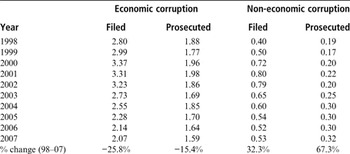
Table 2 shows an increase in non-economic corruption measured both by filed and prosecuted cases per 1,000 public officials in the period of 1998–2007. As discussed above, non-economic corruption refers to the ethical and moral deviation of public officials and is regarded as one of the important types of corruption regulated by the CCL. One might postulate that as non-economic corruption is a remnant of the Confucian culture in China, its importance, compared to economic corruption, may wane as the Chinese economy develops. Contrary to this postulation, Table 2 shows the increasing number of filed and prosecuted non-economic corruption cases in the prosecution data. The pattern is consistent with the court data which shows a 115 per cent increase in the number of cases accepted by the court between 1999 and 2007 (0.11 to 0.24 per 1,000 public officials).Footnote 61
Filed and Prosecuted Corruption Rates per 1,000 Public Officials (Economic and Non-economic Corruption)

Source:
Law Yearbook of China, 1999–2008.
Another noticeable pattern is the strong punishment of non-economic corruption offenders since 2003. While the filed cases of the Procuratorate increased by around 32.3 per cent, the increase rate of prosecuted non-economic corruption cases is 67.3 per cent. Given that the latter indicates the intensity of punishment of disciplinary corruption, we can conclude that the Chinese government punishes non-economic corruption more strictly than before.
Finally, the increase in non-economic corruption suggests a decrease in economic corruption, given that the overall number of corruption cases has decreased (Table 1). Table 2 shows that the filed and prosecuted economic corruption cases decreased by 25.8 per cent and 15.4 per cent respectively between 1998 and 2007. The downward pattern of economic corruption, however, should be carefully interpreted as it consists of two different categories: transactional corruption (bribery) and non-transactional administrative corruption (embezzlement and misappropriation).Footnote 62 The following section examines in detail the trends in economic corruption.
Bribery versus non-transactional corruption
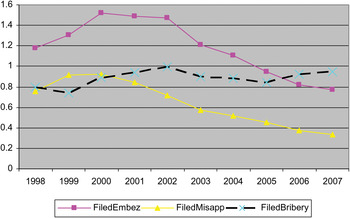
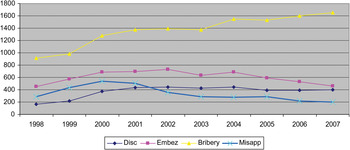
Figure 1 reflects different patterns of bribery and administrative corruption (embezzlement and misappropriation of public funds). It shows that while embezzlement was the most serious type of corruption before 2005, the number of bribery cases has surpassed the number of embezzlement cases since 2006. In contrast to the rise in bribery, the steep drop in misappropriation and embezzlement cases is notable. The filed embezzlement and misappropriation cases per 1,000 public officials have decreased 34.5 per cent and 56 per cent respectively from 1998 to 2007. This rapid fall may suggest that administrative reforms have positively affected the control of administrative corruption. A rival interpretation is that the result is due to the privatization of SOEs which makes Procuratorates unable to regulate corruption in the privatized companies directly. This problem is further discussed below.
Filed Bribery, Embezzlement and Misappropriate Rates per 1,000 Public Officials (Prosecution Data)

Bribery has intensified since 1998. As shown in Figure 2, the number of major bribery cases has steadily increased from 1998 to 2007 (270 per cent). Despite the drop in major embezzlement and misappropriation cases, the total number of major economic corruption cases increased by 102 per cent from 1998 to 2007 owing to the rapid growth of major bribery cases. Another noticeable pattern is the severity of embezzlement. Major embezzlement cases increased from 1998 to 2002, and while this turned into a decreasing pattern after 2002, the number of major embezzlement cases is still at a high level.
Major Bribery, Embezzlement and Misappropriation Rates per 1,000 Public Officials
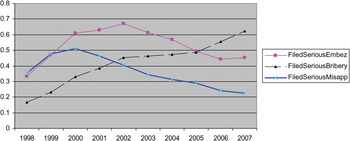
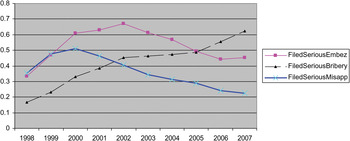
Finally, the overall trend in grand corruption cases reaffirms the previous findings. The examination of the trend in the high-rank-official-involved cases shown in Figure 3 also shows a steady increase in grand bribery cases, the constant level of grand non-economic corruption, and a decrease in the number of grand embezzlement and misappropriation cases. Because of the increase in grand bribery, the total number of grand corruption cases has increased by 49.5 per cent from 1998 to 2007. A similar aggravation of grand corruption is found in the court data. There was a 65.8 per cent increase in the number of grand corruption cases tried by the courts from 1998 to 2007.
Grand Corruption Cases by Corruption Type (Procuratorate Data)

In conclusion, we can state that the overall number of corruption cases has decreased mainly because of decreases in embezzlement and misappropriation cases. The intensity of these two types has lessened while embezzlement remains severe. Contrary to the decreasing pattern of the other types, bribery is widely dispersed and has worsened. The most ominous evidence concerns the rapid increase of major and grand bribery cases. Since 2005, bribery has become the most common and serious variant of corruption in China.
Interpretations
Our analysis shows a significant improvement in controlling non-transactional administrative corruption (embezzlement and misappropriation). The decrease in the rates of embezzlement is particularly important. Since embezzlement “involves a direct and often irreversible loss” of public funds, supervisory and prosecution agencies generally pay more attention to it than they do to misappropriation.Footnote 63
The reduction in non-transactional administrative corruption can be attributed to changes in opportunity. Fiscal recentralization with the adoption of better supervision and auditing systems, and civil service reform based on the merit principle, can explain its reduction. In imperial China, misappropriation of public funds was an acceptable practice because it was assumed that public officials had the right and public authority to do it. This tradition of personalized public power could be found even during the communist regime.Footnote 64 Such practices, however, have gradually decreased as the government has introduced more advanced accounting and budgeting systems. Particularly, as reviewed above, the extra-budgetary funds which give considerable discretion to local governments have been gradually reduced and managed through systematic processes. As a result, the central government can monitor the flow of public funds more easily by using information technology.
Of course, the decrease in embezzlement and misappropriation cases does not necessarily mean that they have become a minor problem. They remain the second largest type of corruption: 14,241 embezzlement and misappropriation cases were filed by the Procuratorates in 2007. Nevertheless, their reduction suggests that corruption can be controlled if administrative processes are appropriately designed and supervised.
Another important reason behind the decrease in embezzlement and misappropriation cases is the change in those involved in corruption as a result of SOE reform. According to reports of the Supreme People's Procuratorate, during the reform era a large proportion of embezzlement and misappropriation cases were committed by managers in SOEs. The privatization of SOEs, however, has changed the official position of these managers so that they are no longer under the jurisdiction of the Procuratorate. If this explanation is correct, then the decrease in embezzlement and misappropriation cases might simply mean a transition from public to private corruption rather than a true reduction in corruption. Nevertheless, the grand, non-transactional embezzlement and misappropriation cases, which are not affected by the privatization of SOEs, have also decreased. Therefore, we can conclude that administrative reforms have positively affected this reduction.
Our analysis also reveals that non-economic corruption has increased, as shown in Table 2. One possible explanation is the decay of public ethics and values. Rapid economic growth and the prevalence of capitalistic stories widen the gap between the idealistic image of altruistic state functionaries and the reality of self-seeking ones.Footnote 65 The weakening of state functionaries' ethical standards then encourages them to commit corrupt acts.Footnote 66 This interpretation is flawed because there is no evidence that any such ethical crisis was more serious in the 2000s than in the 1990s. In addition, the types of non-economic corruption that have increased between 1998 and 2007 are mainly abuse of power and neglect of duty (4.36 and 1.42 times increase, respectively). These are rarely considered to be a result of decay of administrative ethics.
Instead, the increase in non-economic corruption can be related to the CCP's increasing efforts to control the bureaucracy. In China, “every single aspect of both the private and the public lives of party cadres is now regulated by a legal maze of legal norms, administrative and disciplinary regulations.”Footnote 67 The CCP has repeatedly emphasized the severity of corruption and has introduced anti-corruption regulations which serve as a useful tool for controlling low-ranking bureaucrats. The emphasis on controlling corruption, however, is not equally applied to high-ranking bureaucrats because it could lead to political instability. In fact, the level of grand non-economic corruption shown in Figure 3 has been fairly constant since 2001 while minor discretionary corruption cases have increased. This implies that the political will to supervise and regulate low-ranking bureaucrats causes an increase in minor non-economic corruption cases.Footnote 68
The increase and intensification of bribery have made it the major challenging variant of corruption in China since 2005. Compared to administrative corruption, bribery involves a transaction between public and private parties who both benefit from it. As China's economy changed from a socialist planned economy to a market system, its private economy has grown significantly. Some scholars argue that rapid development of the private sector caused the rise of a new class whose members are willing to offer bribes to public officials with control over scarce resources and approval power, in exchange for their own benefits.Footnote 69
The ominous evidence of such a trend is also reflected in the steep increase of major and grand bribery cases.Footnote 70 On top of this problem, it becomes difficult to control grand corruption in which high-ranking officials are involved because of the absence of checks and balances on the CCP's political power. When bribery spreads widely among officials above county level and other higher levels, controlling bribery is likely to be a political game. Consequently, the aggravation of grand bribery cases in China cannot be simply cured by administrative reform. Instead, it should be considered and dealt with as an institutional and political problem. Bribery is a mixed result of the development of the market, increasing rent-seeking opportunities, public officials' low salaries, an absence of relevant anti-corruption laws, poor service delivery and red tape. In addition, anti-corruption agencies cannot easily investigate grand bribery cases given that they are not independent of political influence. Therefore, without relevant political mechanisms for controlling grand corruption, curbing bribery will become more difficult than controlling administrative corruption.
One might claim that the decrease in the overall number of corruption cases is not because of a real change in corruption levels but because of loosened enforcement activities by the CCDI, Ministry of Supervision and the Procuratorates. This seemingly plausible argument fails to explain the decline in the number of the CCDI's accepted cases, which mainly consist of citizens' allegations. Furthermore, as Table 1 shows, while filed cases of the CCDI and Procuratorate decreased by 24.6 and 18.5 per cent respectively, the number of punished people and prosecuted cases only decreased by 5.6 and 7.6 per cent each. Prosecuted non-economic corruption cases increased by 67.3 per cent compared to the 32.3 per cent increase in filed non-economic corruption cases. This suggests that the CCDI and the Procuratorates implement anti-corruption laws and rules very strictly, contrary to the claim that poor anti-corruption enforcement is causing the decrease in the number of corruption cases.
Conclusion
This article has argued that the causes used to explain corruption in the 1980s and 1990s have changed since the late 1990s. These changes include: progress of the market economy, advent of a merit-based civil service system, improvement of budgeting and auditing systems, fiscal recentralization and better monitoring of local governments' activities, and advancement of anti-corruption regulation and enforcement policies. Such changes have affected the overall patterns of corruption and the trends in its specific types. Non-transactional administrative corruption (embezzlement and misappropriation) has receded because of successive institution-building and administrative reforms. In contrast, transactional corruption, namely bribery, has steeply increased. In particular, the increase in major and grand bribery cases elevates the possibility of such variants of corrupt acts evolving into political conflicts among high-ranking officials.
Moreover, there is also evidence that the emphasis on non-economic corruption is likely to be used as a political tool. Given the ambiguity of the meaning of “abuse of power” and “dereliction of duty” as defined in the 1997 CCL, there is much room for politicians to use the CCL to control the bureaucracy. The political nature of anti-corruption policies in China seems more apparent in its efforts to combat non-economic corruption. Further studies are required to enable a better understanding of the political influence affecting the control of non-economic corruption.
Another implication is related to the design of anti-corruption policy. As has been shown, successive administrative reforms have contributed to the reduction of embezzlement and misappropriation of public funds. However, administrative reform is not sufficient to reverse the upward trend in bribery given that bribery involves both public and private parties. As China's market economy is still incomplete and the mutual dependence between public and private parties is high, bribery will not easily recede. Public–private partnerships between the government and the civil society, for example involving nongovernmental organizations and private organizations in designing and implementing anti-corruption policies, would be helpful to curb bribery.
This article does not provide the full picture of how certain new causes of corruption have emerged and affected the level and types of corruption in the 2000s. Factors such as land use, urban planning and infrastructure building which have recently become more important in explaining corruption in China, have not been discussed. Further research should be undertaken on the evolution of such causes and their effects on Chinese corruption.