INTRODUCTION
Realistic expectations to achieve fast ignition are promoted with reduced sizes of new types of lasers as fusion drivers. Particles can be accelerated in high gradient fields and used for various applications, including transmutation of cheep and hazardous materials of long-living radioactive wastes to valuable radioisotopes (Sadighi-Bonabi et al., Reference Sadighi-Bonabi, Irani, Safaie, Imani, Silatani and Zare2009a; Sadighi-Bonabi & Kokabee, Reference Sadighi-Bonabi and Kokabee2006; Sherlock et al., 2006). Propagation of intense short pulse lasers are discussed in various plasma conditions (Sadighi-Bonabi et al., Reference Sadighi-Bonabi, Habibi, Yazdani and Lotfi2009b, Reference Sadighi-Bonabi, Habibi and Yazdani2009c). Production of quasi-mono-energetic electron (Malka & Fritzler, Reference Malka and Fritzler2004; Glinec et al., Reference Glinec, Faure, Pukhov, Kiselev, Gordienko, Mercier and Malka2005; Ter-Avetisyan et al., Reference Ter-Avetisyan, Schnurer, Polster, Nickles and Sandner2008; Zobdeh et al., Reference Zobdeh, Sadighi-Bonabi and Afarideh2008; Singh et al., 2008; Sadighi & Sadighi-Bonabi, Reference Sadighi and Sadighi-Bonabi2009; Sadighi-Bonabi et al., Reference Sadighi-Bonabi, Rahmatallahpor, Navid, Lotfi, Zobdeh, Reiazie, Nik and Mohamadian2009d, Reference Sadighi-Bonabi, Navid and Zobdeh2009e), where electron beams with energies of GeV in a compact laser plasma accelerator are produced (Lifschitz et al,. Reference Lifschitz, Faure, Glinec, Malka and Mora2006; Maslova et al., Reference Maslova, Shvedunov, Tunkin and Vinogradov2008), and X-ray and ion bunches with compact femtosecond laser systems gave a new impetus to the initial fusion researches in recent years (Giulietti et al., Reference Giulietti, Galimberti, Giulietti, Gizzi, Labate and Tomassini2005; Bessonov et al., Reference Bessonov, Gorbunkov, Ishkhanov, Kostryukov, Bin, Lei, Yang, Huang, Yu, Yu and Tanaka2009). Recent consideration of KrF lasers for fusion test facility focuses more research work in applications of short wavelength lasers in fast ignition (Obenschain et al., Reference Obenschain, Colombant, Schmitt, Sethian and Mcgeoch2006). Deeper penetration of the ultraviolet (UV) photons in the higher density plasmas is giving the propriety to these lasers. This results in higher ablation pressure and higher hydrodynamic efficiency with lower laser plasma instabilities for the same laser intensities (Földes & Szatmari, 2008).
The target experiments with 265 nm from fourth harmonic generation of the Nd-glass lasers proved the advantages of shorter wavelengths (Cottet et al., Reference Cottet, Romain, Fabbro and Faral1984). The low conversion efficiency was the basic problem. Therefore, the 350 nm wavelength with higher conversion efficiency proposed by third harmonic generation (Payne et al., Reference Payne, Bibeau, Beach, Bayramian, Chanteloup, Ebbers, Emanuel, Nakana, Orth, Rothenberg, Schaffers, Seppala, Skidmore, Sutton, Zapata and Powell1998) is the most popular candidate for fusion. Since the 1980's, KrF lasers without the necessity of frequency conversion, were considered as possible candidates for initial fusion drivers. Ueda et al. (Reference Ueda, Nishioka, Kimura and Takuma1993) demonstrated compressed KrF pulses by Raman pulse compression in a transient Raman regime, and pulse compression in saturated amplifiers with saturable absorbers. Recent success in achieving over all efficiency of more than 7% for electron beam pumped KrF lasers (Hegeler et al., 2004) and the more advanced system of Obenschain et al. (Reference Obenschain, Colombant, Schmitt, Sethian and Mcgeoch2006) in introducing the hibachi structure and increasing the KrF laser shots up to 105 shots with repetition rates more than 5 Hz made these lasers more feasible for fusion applications. Obtaining intensities up to 1020 W/cm2 at 248 nm motivated the application of the KrF laser for the compressed pellet by electron acceleration experiments (Boyer et al., Reference Boyer, Borisov, Song, Zhang, Mccorkindale, Khan, Dai, Kepple, Davis and Rhodes2005).
KrF EXCIMER LASER
The Rayleigh-Taylor instability can be suppressed by high uniformity of short wavelength excimer lasers (Manheimer & Colombant, Reference Manheimer and Colombant2007) and introducing KrF as a suitable choice for the fast ignition approach (Tabak et al., Reference Tabak, Hammer, Glinsky, Kruer, Wilks, Woodworth, Campbell, Perry and Mason1994). For generating an energetic hot electron beam, much higher intensity is needed at short wavelengths due to the well known Iλ2 scaling of laser intensity. This was the main reason for ignoring excimer lasers as a possible candidate for fast igniters. Recently, due to deeper penetration of short wavelength (especially much better optical beam quality of the KrF laser due to lower distortion of the optical beam in its dominant noble gas laser medium), excimer lasers became very attractive as fast igniters. Generation of two orders of magnitude higher intensity with 248 nm than the 1.06 µm due to λ2 reduction and better focusing (due to superior beam quality of laser beam spot size with the same power), accelerated the realistic KrF facilities for fast ignitions. Following 75% e-beam energy deposition to the gas discharge and overall efficiency of more than 7% (Hegeler et al., Reference Hegeler, Rose, Myers, Sethian, Giuliani, Wolford and Friedman2004), the number of available shots increased up to 105 in the hibachi structure, and proposed to reach up to 108 shots required for inertial fusion drivers (Obenschain et al., Reference Obenschain, Colombant, Schmitt, Sethian and Mcgeoch2006).
A multiple beam fast ignition scheme, in which a high number of 1 ps duration pulses from KrF amplifiers are focused on the different parts of the fuel is suggested (Földes & Szatmari, 2009). These separately focused UV beams will accelerate electrons simultaneously with a total energy of 48 kJ, and the accelerated electrons will meet in a joint apex to ignite the fuel. For achieving such electron energy, the intensity of more than 1020 W/cm2 is needed. This suggestion faces a number of technical difficulties. These include the serious problems caused by the coherence of the KrF partial beams and arrangement among various electrons beam movement toward the fuel. Therefore, some other routes have been investigated including fast ion ignition by intense short pulse lasers (Hora, Reference Hora1991, Reference Hora2004, Reference Hora2007, Reference Hora2009; Roth et al., Reference Roth, Brambrink, Audebert, Blazevic, Clarke, Cobble, Cowan, Fernandez, Fuchs, Geissel, Habs, Hegelich, Karsch, Ledingham, Neely, Ruhl, Schlegel and Schreiber2005; Hoffmann et al., Reference Hoffmann, Blasevic, Ni, Rosmej, Roth, Tahir, Tauschwitz, Udera, Vanentsov, Weyrich and Maron2005; Yazdani et al., Reference Yazdani, Cang, Sadighi-Bonabi, Hora and Osman2009).
The important parameters in the ion acceleration are swelling time scale, laser pulse length, and target thickness. For efficient acceleration of ions, an optimum relation of these parameters is required (Sentoku et al., Reference Sentoku, Cowan, Kemp and Ruhi2003). Using a 248 nm KrF laser with durations of 400–500 fs and average intensities up to 5 × 10¹⁷ Wcm−2, with main to prepulse contrast ratio of 106 up to 108 a beam was focused onto Al targets and absorption measurements were performed. An energy fraction of up to 65% of incident energy was reportedly observed (Borghesi et al., Reference Borghesi, Mackinnon, Gaillard and Willi1999). The observation was varied with incidence angle and polarization. The results were interpreted as due to a combination of collision and resonance absorption effects.
SKIN LAYER PONDEROMOTIVE ACCELERATION
The driving of the plasma blocks is based on the nonlinear (ponderomotive) force interaction (Hora, Reference Hora1991) within the skin layers of the plasma. It is important that this skin layer receive the highest possible thickness of a large number of vacuum wavelengths of the laser based on dielectric increasing of the effective laser wave length in the plasma (Azizi et al., Reference Azizi, Hora, Miley, Malekynia, Ghoranneviss and He2009; Ghoranneviss et al., Reference Ghoranneviss, Malekynia, Hora, Miley and He2008; Holmlid et al., Reference Holmlid, Hora, Miley and Yang2009; Hora, Reference Hora2009; Hora et al., Reference Hora, Miley, Azizi, Malkynia, Ghoranneviss and He2009; Malekynia et al., Reference Malekynia, Ghoranneviss, Hora and Miley2009; Yazdani et al., Reference Yazdani, Cang, Sadighi-Bonabi, Hora and Osman2009). An increase of up to 20 vacuum wave lengths was reached by using initial electron density profiles following the analysis by Rayleigh (Hora, Reference Hora1991, see Fig. 10.18b). Application of undistorted thick blocks generated from ultra intense short pulse lasers at infrared wavelengths with high contrast ratio for advanced physical events such as inertial confinement fusion have been proposed (Yazdani et al., Reference Yazdani, Cang, Sadighi-Bonabi, Hora and Osman2009). Penetration of short wavelength radiation into the higher density plasmas results in higher hydrodynamic efficiency for the same irradiance, as well as reduced level of plasma instabilities. This allows the use of more intense radiation due to the well known λ−2 proportionality. The use of short wave-length lasers in fast-ignition has intrinsic advantages due to the following reason. The critical density scales follows:
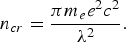
Therefore, for short wave-length lasers such as KrF, the critical density is placed close to the compressed fuel core, and the Iλ2 dependency of electrons temperature causes efficient coupling of particles to the compressed core (Borghesi et al., Reference Borghesi, Mackinnon, Gaillard and Willi1999, Reference Borghesi, Kar, Romagnani, Toncian, Antici, Audebert, Brambrink, Ceccheerini, Cecchetti, Fuchs, Galimberti, Gizzi, Grismayer, Lyseikina, Jung, Macchi, Mora, Osterholz, Schiavi and Willi2007).
In this work, we study the block generation by simulation in a genuine two-fluid code for the KrF laser UV pulses, and compare the capability of the produced plane (many Rayleigh lengths) undistorted plasma blocks to the blocks produced by Nd: glass lasers for use in fusion applications.
THE METHOD
Following the summarizing review by Hora (Reference Hora2009), a new option of laser driven generation of fusion energy (next to the highly mature spherical compression and heating scheme with nanosecond laser pulses) has been considered, where a side-on irradiation of solid state density or relatively modest compressed fusion fuel is ignited by the new type of petawatt (PW)-picoseconds (ps) laser pulses. The early results of Hora et al. (Reference Hora1991, Fig. 10.18b) showed that neodymium glass laser irradiation of 1018 Wcm−2 produced plasma blocks of up to 20 vacuum wavelength thickness within 1.5 ps laser interaction in deuterium plasma. Recently, KrF laser 248 nm UV pulses are motivated to use for fast ignition because of its deeper penetration in plasma, where there is a trade-off between its penetration length and velocity in the plasma, which should be optimized to satisfy the requirements of fast ignition in the fuel core design. Two mechanisms are developed to obtain the velocity of particles originated from the laser radiated side and accelerated in the forward direction. These mechanisms are laser radiation pressure (Denavit, Reference Denavit1992) and skin-layer ponderomotive acceleration (Badziak et al., Reference Badziak, Glowacz, Jablosnki, Parys, Wolowski and Hora2004, Reference Badziak, Glowacz, Jablonski, Parys, Wolowski and Hora2005; Badziak, Reference Badziak2007). In this work, both mechanisms are used to explain the block acceleration by for Nd-glass and KrF lasers. From radiation pressure approach the maximum energy of ions accelerated by the laser in the forward direction originated from the laser-radiated side will be equal to the ponderomotive potential as shown by Sentoku et al. (Reference Sentoku, Cowan, Kemp and Ruhi2003). In the sub-relativistic case, the maximum velocity becomes proportional to:
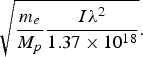
According to Eq. (2), the maximum velocities are 6.3 × 10⁷ and 1.5 × 10⁷ (cm/s) for Nd:Glass and KrF lasers, respectively, at the intensity of 1016 Wcm−2. Therefore, the maximum ion velocity is proportional to the wavelength. The units of the laser intensity and wavelength are Wcm−2 and µm, respectively, and m e and M p are electron mass and ion or proton mass, respectively. Using two-fluid scheme is a suitable method to observe the dominance of the nonlinear ponderomotive force against the thermo-kinetic forces in the sub-relativistic region. In the skin layer acceleration by nonlinear force (SLNLF), mechanism dielectric increase of the thickness under general conditions of irradiation of deuterium plasma with the wavelength of neodymium glass lasers in plane (one-dimensional) geometry has been simulated by two fluid plasma codes (Cang et al., Reference Cang, Osman, Hora, Zhang, Badziak, Wolowski, Jungwirth, Rohlena and Ullschmied2005; Glowacz et al., Reference Glowacz, Badziak, Jablonski and Hora2004, Reference Glowacz, Hora, Badziak, Jablonski, Cang and Osman2006).
The propagation of waves in plasma is defined with the solution of the ordinary linear differential equation for the spatial part of the electric field amplitude E(x) of the electric field E depending on the one dimensional spatial coordinate x combined with that of the magnetic field H by Maxwell's equations.

Where ω is the radian frequency of the laser, c is the vacuum speed of light, and n is the real part of the refractive index of the plasma, given by n(x)2 = 1 − (ω/ωp)2/(1 + iν/ω), using the plasma frequency ωp = (4πe 2n e(x)/m)1/2, and the spatially and temperature dependent collision frequency ν in the plasma. e is the charge, m is the mass, and n e is the density of the electrons in the plasma. For the general case of plasmas with spatial variation of the electron distribution, n e(x), special higher functions need to be used. In this situation, it was rather unique that Rayleigh (Reference Rayleigh1880) found a solution of Eq. (3) for an inhomogeneous medium, if the refractive index is given by n = 1/(1 + αx) with a constant α. The solutions were exactly expressed by elementary functions with amplitude E 0

Now the reflection between a homogeneous and an inhomogeneous Rayleigh medium could be solved exactly, and it was clarified by Hora (Reference Hora1991, see Chapter 7) that there are only two exact solutions in the inhomogeneous optical medium for a wave moving into the direction of +x and one to –x. There were no internal reflections as it was wrongly suggested from the many-layer approximation. The Rayleigh medium has special importance when studying the nonlinear (ponderomotive) forces generated by a laser field in plasmas. It was known from electrostatics that electrons can be moved by a ponderomotive force if there are gradients in the electric field E given by −∇E2. The force can be reduced and time averaged and with approximately using real part values of n

E v is the amplitude of the electric field of the laser in vacuum. The square of the electric field is increased by a swelling factor S = 1/n(x) within the plasma. Greater detail and the last results are summarized in Yazdani et al. (Reference Yazdani, Cang, Sadighi-Bonabi, Hora and Osman2009) for Nd-glass lasers. It was shown numerically that the ion energy ɛi in the compressing block parallel to the laser direction increased with laser intensity I up to I = 1018 Wcm−2 as ɛI = I 0.943 in full agreement with the measurement of Badziak et al. (Reference Badziak, Kozlov, Makowksi, Parys, Ryc, Wolowski, Woryna and Vankov1999), precisely confirming the correctness of the genuine two-fluid computation, and as well confirming the SLANF process.
Here we present the new computation using the genuine two-fluid plasma scheme similar to Yazdani et al. (Reference Yazdani, Cang, Sadighi-Bonabi, Hora and Osman2009) and exploring this dielectric increase of the thickness under general conditions of irradiation of deuterium plasma with the wavelength of KrF lasers in a plane (one-dimensional) geometry. In order to reduce the pulse reflection from the critical density, especially for the fine mesh size related to the short wavelength pulses; computations were performed with bi-Rayleigh type for the initial density including initial temperatures, and the time dependence interaction with the laser pulses. The initial plasma density given by the ion density n i (at time t = 0) depending on the plasma depth x (in cm) for bi-Rayleigh profile, it is increasing from x = −10 µm to x = 0 and decaying to x = 10 µm.
RESULTS AND DISCUSSIONS
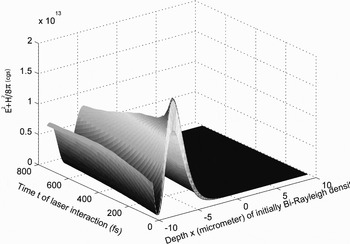
For the acceleration into the plasma, the amplitude of the laser field is taken as E 02S by using the swelling factor S, and E 0 is the vacuum amplitude of the laser field. Figure 1 shows the print-out of the development of the electromagnetic field energy density (E2 + H2)/8π of the laser in the plasma for initially bi-Rayleigh (α = 9.59 × 103 cm−1) deuterium plasma at 750 fs interaction time, with 100 eV initial temperature located between −10 and +10 µm at intensity of 2 × 10¹⁶ Wcm−2 produced by neodymium glass laser. The position of critical density can be realized from the position of the maximum of the laser field density, where the intensity starts to drop rapidly, and the ion blocks move toward the deuterium target.
Electromagnetic field energy density (E2 + H2)/8π in cgs of the laser Nd-glass laser with an initially bi-Rayleigh (α = 9.59× 103 cm−1) deuterium plasma with 100 eV initial temperature located between −10 and +10 µm at neodymium glass laser irradiation from the left hand side of 2 × 10¹⁶ W/cm2 intensity during the time between 0 and 750 fs.

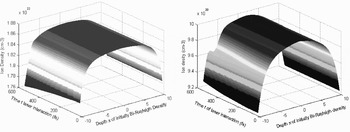
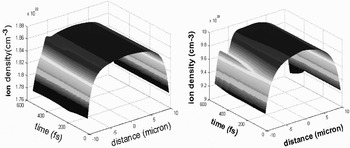
The density profiles have been shown in Figures 2 and 3 produced by 1.0 × 10¹⁶ Wcm−2 and 2.0 × 10¹⁶ Wcm−2 lasers, respectively. Comparison of the density profiles produced by 1016 Wcm−2 Nd-glass (right) and KrF (left) lasers in Figure 2 indicates less instability created by KrF excimer laser systems. It has more than 19 times the density created by the Nd-glass laser in the similar plasma and laser condition. This is in good agreement with the mentioned theory due to (λNd-glass/λKrF)2 = 19.03. In Figure 3, similar behavior is observed at higher intensities, and it is evident at higher intensities for KrF lasers in comparison to the Nd-glass lasers much smoother penetration is observed.
Comparison of the density profiles produced by 1016 Wcm−2 Nd-glass (right) and KrF (left) lasers. As we can see higher and much smoother penetration with the KrF excimer laser systems and it has almost 19 times more than the density created by Nd-glass laser at the same intensity.

Same as Figure 2 produced by 2 × 10¹⁶ Wcm−2 Nd-glass (right) and KrF (left) lasers. We can see less instability created with the KrF excimer laser systems and it has almost 19 times more than the density created by the Nd-glass laser. At higher intensities in comparison to the Nd-glass lasers, much smoother penetration is observed for KrF lasers.

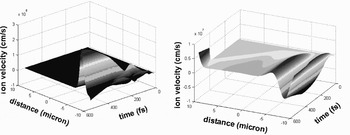
In Figure 4, for 20 µm plasma with bi-Rayleigh density profile, the undistorted ion blocks with 600 fs laser pulses produced by Nd-glass (right) and KrF (left) lasers are shown. We can see the ion block velocity for the 1060 nm of the Nd-glass laser is more than four times higher than the ion block velocity for 248 nm of the KrF laser. This is in good agreement with the above mentioned theory, where the produced block velocity at the skin-layer ponderomotive ion acceleration is proportional to the interactive photon wavelength λ; it is (λNd-glass/λKrF) = 4.27 for the parameters of the lasers used here. Therefore, the current density for shorter wavelengths will be higher than the current velocity for the longer wavelength lasers. As a consequence, there is a trade-off between ion velocity and current density, which is useful in choosing laser types. This is because the ion current is j = en crV i and substituting for n cr from Eq. (1), the ion current density will be proportional to 1/λ. Because ion velocity V i depends to the laser wavelength λ as indicated in Figure 4, where the critical density n cr, from Eq. (1) is proportional to λ−2.
The undistorted Ion blocks with 600 fs laser pulses produced by Nd-glass (right) and KrF (left) lasers. We can see that the ion velocity for the 1060 nm of Nd-glass laser is almost four times more than the ion velocity for 248 nm of KrF laser.

The superiority of Nd:glass infrared photons over UV wavelengths is for the generation of ions with higher velocities. For fusion applications, the current density criteria, and efficient coupling of particles to the compressed fuel core need the higher current density with optimum ion velocity, which does not need to be extremely high. This gives higher priority to the short wavelength for fulfilling the required condition of fast ignition. This is what we can prove from the data presented in this paper. Figure 4 shows that the generation of a plane undistorted ion block by a KrF laser with much higher current density in comparison to the previous works, which is moving several Rayleigh lengths, is one important step forward in achieving fast ignition requirements.
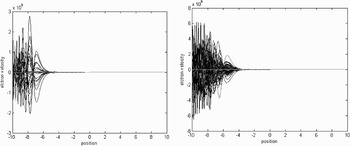
Similar behavior is expected for velocities of electrons generated by two different lasers. Figure 5 reports for the infrared 1060 nm wavelength of the Nd-glass laser, the velocity of electrons parallel to the laser direction, which is considerably higher than the velocity of electrons for UV 248 nm wavelength of the KrF laser, where the ratio is almost in the same order of their wavelengths. This electron motion is strongly oscillating as can be seen only by the used genuine two-fluid computation and results in very strong longitudinally oscillating electric fields during the interaction.
Electron velocity parallel to the laser direction profile for laser intensity 1016 W/cm2, plasma width 20 µm and initial temperature 10 eV for Nd-glass laser (right) and KrF laser (left) at the same conditions of Figures 2 and 4. The electron velocity produced by the Nd-glass laser is higher than the electrons obtained with the KrF laser almost in the same order of their wavelengths.

In applying the short wavelengths such as KrF lasers, the critical density is placed close to the compressed fuel core, and Iλ2 dependency of the electron temperature causes efficient coupling of particles to the compressed core. This gives higher priority to short wavelength lasers such as KrF to fulfill the required conditions of fast ignition. Application to hybrid laser systems (Zvorykin et al., Reference Zvorykin, Didenko, Ionin, Kholin, Konyashchenko, Krokhin, Levchenko, Mavritski, Mesyats, Molchanov, Rogulev, Scleznev, Sinitsyn, Tenyakov, Ustinovski and Zayarnyi2007) and ignition of neutron-lean fusion (Hora et al., Reference Hora, Miley, Azizi, Malkynia, Ghoranneviss and He2009) should be mentioned.
CONCLUSION
Using genuine two-fluid plasma hydrodynamics, the generated blocks here calculated thicknesses of a large number of vacuum wavelengths. The properties of the results of computations are compared with the expected theoretical values, confirming the detailed inclusion of plasma dynamics in the computations. We can summarize the properties of ion blocks generated by short wavelengths such as those of the KrF laser as follows: (1) Penetration deeper in the plasma to the higher density and closest distance to the source (with the square of the inverse of the ratio of wavelengths). (2) Production of higher ion current density (proportional to the inverse of ratio of the wavelengths). (3) Production of lower ion velocity (proportional to the ratio of wavelengths). These features of KrF systems with better focusing and optical quality makes it an attractive candidate for fast ignition. The longer wavelengths generations with higher velocity, but in the application of SLANF for fusion the higher current density is desired, which is the outstanding feature of KrF UV photons. This may give higher priority to the short wave-length for fulfilling the required condition of fast ignition.
ACKNOWLEDGEMENTS
The authors acknowledge the ministry of oil (IRI) for partial support of this work through contract No. 121 PT by Pars Oil and Gas Company, also the support by the research deputy office in the Sharif University of Technology.