INTRODUCTION
Cognitive limitations after moderate-to-severe TBI (msTBI) play an important role in overall functional disability, a reality for some 5.3 million Americans (Centers for Disease Control and Prevention, 2013). People with msTBI (PwTBI) continue to report cognitive problems at a high rate years after brain injury (French, Lange, & Brickell, Reference French, Lange and Brickell2014; Olver, Ponsford, & Curran, Reference Olver, Ponsford and Curran1996; Ponsford, Olver, & Curran, Reference Ponsford, Olver and Curran1995; Ruet et al., Reference Ruet, Bayen, Jourdan, Ghout, Meaude, Lalanne and Azouvi2019), suggesting that coping strategies acquired via either formal rehabilitation or experience living with TBI do not eliminate everyday cognitive challenges. Memory problems, in particular, are chronic complaints among PwTBI (Gardner, Langa, & Yaffe, Reference Gardner, Langa and Yaffe2017; Ruet et al., Reference Ruet, Bayen, Jourdan, Ghout, Meaude, Lalanne and Azouvi2019; Vallat-Azouvi et al., Reference Vallat-Azouvi, Paillat, Bercovici, Morin, Paquereau, Charanton and Azouvi2018). However, little is known about memory self-efficacy (MSE) – the confidence in one’s ability to successfully perform memory tasks – in PwTBI, and how this impacts not only their laboratory memory performance but broader health outcomes.
The construct of MSE encompasses both task-specific performance predictions (Berry, Reference Berry, Hess and Blanchard-Fields1999) and general beliefs about everyday memory ability (Hertzog, Dixon, & Hultsch, Reference Hertzog, Dixon, Hultsch, Stone and West1990). It has been studied most extensively in healthy older adults, who commonly experience age-related memory decline (e.g., Cherry et al., Reference Cherry, Lyon, Boudreaux, Blanchard, Hicks, Elliott and Jazwinski2019; Hultsch, Hertzog, Dixon, & Davidson, Reference Hultsch, Hertzog, Dixon, Davidson, Howe and Brainerd1988; McDougall & Kang, Reference McDougall and Kang2003; West, Robin Lea & Berry, Reference West and Berry1994). MSE is often viewed as an extension of Bandura’s self-efficacy theory (Bandura, Reference Bandura1977, Reference Bandura1997), which posits that negative beliefs about one’s ability influence performance outcomes by increasing task anxiety, reducing task persistence, and hindering strategic and focused task processing (for a discussion, see Berry, Reference Berry, Hess and Blanchard-Fields1999). Research in healthy elderly people indicates a small, but significant, relationship between MSE and objective memory performance, with an overall effect size of r = .15 estimated from meta-analysis of various neuropsychological measures of memory and MSE questionnaires (Beaudoin & Desrichard, Reference Beaudoin and Desrichard2011).
While MSE may be influenced by other aspects of “metamemory,” such as memory monitoring (metacognitive awareness of actual performance), these concepts are distinct (Hertzog, Reference Hertzog, Herrmann, Weingartner, Searleman and McEvoy1992; Hultsch et al., Reference Hultsch, Hertzog, Dixon, Davidson, Howe and Brainerd1988). Fundamentally, MSE is a social-cognitive construct (Berry, Reference Berry, Hess and Blanchard-Fields1999; Cavanaugh, Feldman, & Hertzog, Reference Cavanaugh, Feldman and Hertzog1998) that reflects self-schemas regarding one’s memory performance in the real world, and thus is shaped by emotional, personality, and situational factors in addition to prior experiences of memory successes or failures. In particular, studies in healthy aging consistently document interrelations between reduced MSE and psychological symptomology such as depression and anxiety (Dellefield & McDougall, Reference Dellefield and McDougall1996; McDougall & Kang, Reference McDougall and Kang2003; Zelinski & Gilewski, Reference Zelinski and Gilewski2004), suggesting that psychological distress may have stronger implications than metamemory monitoring for MSE judgments. More broadly, relationships between memory beliefs and objective memory performance in older adults are shown to be psychologically driven – constructed from implicit beliefs about memory and aging – rather than purely a reflection of metacognitive accuracy (Hertzog, Hülür, Gerstorf, & Pearman, Reference Hertzog, Hülür, Gerstorf and Pearman2018).
Self-efficacy theory predicts that memory beliefs may affect confidence and willingness to engage in everyday tasks where perceived memory demands are high (Pearman, Reference Pearman2020; Valentijn et al., Reference Valentijn, Hill, Van Hooren, Bosma, Van Boxtel, Jolles and Ponds2006; Vallet et al., Reference Vallet, Agrigoroaei, Beaudoin, Fournet, Paignon, Roulin and Desrichard2015). Decreased willingness to engage may, in turn, reduce participation in daily tasks and social roles, resulting in detrimental health consequences beyond reduced cognitive functioning. Support for this position comes from studies documenting positive associations between MSE and quality of life (QOL) ratings among both healthy elderly (Ramakers et al., Reference Ramakers, Visser, Bittermann, Ponds, van Boxtel and Verhey2009; Stephan, Caudroit, & Chalabaev, Reference Stephan, Caudroit and Chalabaev2011) and individuals with cognitive impairment (Kurasz et al., Reference Kurasz, DeFeis, Locke, De Wit, Amofa, Smith and Chandler2021; Langer et al., Reference Langer, O’Shea, De Wit, DeFeis, Mejia, Amofa and Smith2019), as well as a larger literature detailing the negative impact of memory complaints on QOL (Maki et al., Reference Maki, Yamaguchi, Yamagami, Murai, Hachisuka, Miyamae and Yamaguchi2014; Montejo, Montenegro, Fernández, & Maestú, Reference Montejo, Montenegro, Fernández and Maestú2012; Rotenberg Shpigelman, Sternberg, & Maeir, Reference Rotenberg Shpigelman, Sternberg and Maeir2019; Sohrabi et al., Reference Sohrabi, Bates, Rodrigues, Taddei, Martins, Laws and Martins2009). Due to the saliency of memory failures in daily life and their popular association with cognitive decline (Bouazzaoui et al., Reference Bouazzaoui, Follenfant, Ric, Fay, Croizet, Atzeni and Taconnat2016; Hurt, Burns, & Barrowclough, Reference Hurt, Burns and Barrowclough2011; Kessler, Bowen, Baer, Froelich, & Wahl, Reference Kessler, Bowen, Baer, Froelich and Wahl2012; Kinzer & Suhr, Reference Kinzer and Suhr2016; Norman et al., Reference Norman, Woodard, Calamari, Gross, Pontarelli, Socha and Armstrong2020), perceived memory ability may bear on one’s self-perceptions of functional status, leading to poorer engagement and/or greater avoidance of life activities and, ultimately, diminished life satisfaction (Farina, Bennett, Griffith, & Lenaert, Reference Farina, Bennett, Griffith and Lenaert2020; Verhaeghen, Geraerts, & Marcoen, Reference Verhaeghen, Geraerts and Marcoen2000).
Whereas there is considerable documentation of memory complaints after TBI, few studies in this area have investigated memory beliefs. Kit et al. (Reference Kit, Mateer and Graves2007) found that TBI of any severity was associated with reduced MSE and higher depression symptoms relative to healthy controls and that MSE mediated the relationship between TBI and depression. Memory performance was not examined in this study. In a later report (Kit, Mateer, Tuokko, & Spencer-Rodgers, Reference Kit, Mateer, Tuokko and Spencer-Rodgers2014), the same group probed the effect of stereotype threat on cognition in PwTBI, reporting that MSE was lower in those who were exposed to negative stereotypes regarding TBI-related cognitive impairment. This decreased MSE, in turn, was associated with poorer performance on memory and attention testing. However, there was no baseline measure of MSE, and the uniqueness of MSE-performance relationships could not be ascertained because contemporaneous psychological distress was not examined. To date, no study has evaluated the impact of MSE on post-TBI outcomes beyond laboratory cognitive performance.
MSE is thought to be a modifiable determinant of functioning and has been a target of memory interventions in aging (Hertzog, Pearman, Lustig, & Hughes, Reference Hertzog, Pearman, Lustig and Hughes2021; Lachman, Weaver, Bandura, Elliott, & Lewkowicz, Reference Lachman, Weaver, Bandura, Elliott and Lewkowicz1992; Pearman, Lustig, Hughes, & Hertzog, Reference Pearman, Lustig, Hughes and Hertzog2020; Vranić, Španić, Carretti, & Borella, Reference Vranić, Španić, Carretti and Borella2013; Robin L. West, Bagwell, & Dark-Freudeman, Reference West, Bagwell and Dark-Freudeman2008), stroke (Aben, Heijenbrok-Kal, Ponds, Busschbach, & Ribbers, Reference Aben, Heijenbrok-Kal, Ponds, Busschbach and Ribbers2014), and mild cognitive impairment (McDougall, McDonough, & LaRocca, Reference McDougall, McDonough and LaRocca2019). Self-efficacy treatments typically serve to enhance, not replace, compensatory skill training and often are also combined with psychoeducation and psychotherapy. Likewise, treatments to improve MSE may be an efficacious adjuvant to existing memory interventions for PwTBI, especially considering that there is limited evidence for the efficacy of restorative memory techniques in this population (Cicerone et al., Reference Cicerone, Goldin, Ganci, Rosenbaum, Wethe, Langenbahn and Harley2019; Velikonja et al., Reference Velikonja, Tate, Ponsford, McIntyre, Janzen and Bayley2014). However, there is little foundational work on the clinical correlates of MSE in PwTBI, its unique impact on memory performance, and its implications for broader health outcomes.
The current study aimed to provide an initial characterization of MSE in PwTBI to establish its relevance to objective and subjective health outcomes in this population. We utilized a sample of adults with chronic TBI who were at least 50 years old and one or more years post-injury at the time of study evaluation. It was reasoned that MSE would be most impactful on outcomes in these individuals “aging with TBI” (Batson-Magnuson, Reference Batson-Magnuson2014; Colantonio, Ratcliff, Chase, & Vernich, Reference Colantonio, Ratcliff, Chase and Vernich2004; Rabinowitz et al., Reference Rabinowitz, Kumar, Sima, Venkatesan, Juengst, O’Neil-Pirozzi and Dreer2021; Sendroy-Terrill, Whiteneck, & Brooks, Reference Sendroy-Terrill, Whiteneck and Brooks2010), who may be especially liable to report memory complaints due to the effects of both TBI and the natural aging process. Our principal research questions were: 1. What are the demographic and clinical correlates of MSE in PwTBI?; 2. What is the relation of MSE to general psychological distress and objective memory performance, and is there an independent contribution of MSE to memory performance in PwTBI?; and 3. Does a unique relationship exist between MSE and health-related QOL in PwTBI? Consistent with literature in healthy aging, we hypothesized that age and psychological distress are negatively associated with MSE and that MSE is predictive of memory performance beyond demographic and other clinical characteristics. Importantly, we anticipated a significant relationship between MSE and overall QOL not attributable to either psychological distress or memory performance, which would support the position that self-perceptions of memory ability have potentially far-reaching health consequences.
METHOD
Participants
Participants were adults 50+ years of age enrolled in a bi-center study on aging with TBI. Participants must have sustained a TBI at least 1 year prior to study entry of at least moderate (including radiologically defined moderate, i.e., “complicated mild”) severity, consistent with the TBI Model Systems definition of msTBI (Dijkers, Harrison-Felix, & Marwitz, Reference Dijkers, Harrison-Felix and Marwitz2010). Severity criteria included at least one of the following: Glasgow Coma Scale (GCS) score <13 (not due to intoxication/sedation) on admission to emergency care, documented loss of consciousness of at least 30 minutes, documented post-traumatic amnesia (PTA) of at least 24 hrs, or positive findings on neuroimaging. Individuals were excluded if they had a history of other neurologic or serious psychiatric conditions such as schizophrenia or bipolar disorder. Of 120 total participants, individuals with motor/sensory impairments that interfered with their ability to complete memory testing or who were otherwise unable to tolerate testing were excluded (n = 2, one with an existing dementia diagnosis and one who was nonverbal). An additional four individuals had non-systematically missing data for either the MSE or memory performance measures, yielding a final sample of 114.
Procedure
Study procedures were approved by the institutional review boards of Moss Rehabilitation Research Institute (Elkins Park, PA) and Pennsylvania State University (University Park, PA), and were in accordance with the Helsinki Declaration. Study recruitment and testing occurred between 03/2018 and 03/2020. Available acute injury information for each individual was abstracted from medical records at the time of enrollment. Testing was completed during a single session with each participant in an outpatient research laboratory setting, after which participants were compensated for their time.
Measures
Demographic and injury variables
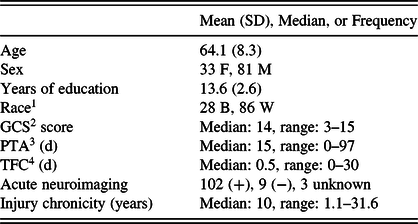
Age, biological sex, race, and years of education were collected from each participant at enrollment (Table 1). Injury chronicity was operationalized as the number of years from the injury-causing event to the date of study evaluation. Because not all injury severity variables were available for each participant, severity was determined using a classification system developed in the Veterans Affairs TBI Model Systems that considers the most severe indicator available among PTA duration (1–14 days = moderate, ≥15 = severe), best available GCS score within the first 24 hr (9–12 = moderate, <8 = severe), time to follow commands (length of coma; ≥1 day = severe), and acute neuroimaging (positive scan finding only=complicated mild) (Dillahunt-Aspillaga et al., Reference Dillahunt-Aspillaga, Nakase-Richardson, Hart, Powell-Cope, Dreer, Eapen and Silva2017; Ropacki, Nakase-Richardson, Farrell-Carnahan, Lamberty, & Tang, Reference Ropacki, Nakase-Richardson, Farrell-Carnahan, Lamberty and Tang2018). Although we conceptualize the sample overall as msTBI in accordance with TBIMS criteria, analyses included complicated mild (n = 21), moderate (n = 26), and severe (n = 67) TBI subgroups to retain greater resolution in the injury severity variable.
Demographic and injury characteristics of the full sample (N = 114).

SD = standard deviation. GCS = Glasgow Coma Scale score. PTA = post-traumatic amnesia. TFC = time to follow commands.
1 Self-identified as Black/African American (B) or White (W).
2 n = 89.
3 n = 99.
4 n = 89.
Memory self-efficacy (MSE)
The Cognitive Confidence subscale of the 30-item Metacognitions Questionnaire (MCQ-30; Wells & Cartwright-Hatton, Reference Wells and Cartwright-Hatton2004) was used as an index of MSE. The MCQ probes various metacognitive beliefs (e.g., beliefs about worry and its controllability and self-awareness of internal thoughts). The Cognitive Confidence subscale is unique in that it specifically queries beliefs related to memory functioning as opposed to general cognition. Six statements are rated 1–4 by the respondent (“Do not agree” to “Agree very much”) regarding confidence in general and specific memory abilities: I do not trust my memory; I have a poor memory; I have little confidence in my memory for actions; I have little confidence in my memory for places; I have little confidence in my memory for words and names; My memory can mislead me at times. The measure showed good internal consistency reliability in our sample (α = .85). For ease of interpretation, scores were multiplied by −1 before calculating inferential statistics so that higher values reflected stronger MSE.
Memory performance
Because the majority of extant literature has studied MSE in relation to verbal episodic memory (Beaudoin & Desrichard, Reference Beaudoin and Desrichard2011), we focused our analyses on functioning in this domain using the Hopkins Verbal Learning Test-Revised (HVLT-R; Benedict, Schretlen, Groninger, & Brandt, Reference Benedict, Schretlen, Groninger and Brandt1998) and the Story Recall subtest of the Repeatable Battery for the Assessment of Neuropsychological Status (RBANS Randolph, Tierney, Mohr, & Chase, Reference Randolph, Tierney, Mohr and Chase1998). The HVLT-R is a word list-learning paradigm while the RBANS Story Recall assesses narrative memory. We focused on delayed recall measures from each test protocol (number of words recalled after a 20- to 25-min delay, and number of story units recalled after an approximate 10-min delay) given evidence that they are more specific to episodic memory storage and retrieval than immediate recall, which may be influenced by various other processes including executive control (Casaletto et al., Reference Casaletto, Marx, Dutt, Neuhaus, Saloner, Kritikos and Kramer2017; Venkatesan, Margolis, Tremont, Festa, & Heindel, Reference Venkatesan, Margolis, Tremont, Festa and Heindel2020). Consistent with prior work (Venkatesan, Rabinowitz, Bernier, & Hillary, Reference Venkatesan, Rabinowitz, Bernier and Hillary2021), HVLT-R and RBANS Story delayed recall scores were age-corrected based on their respective test publisher norms (T and scaled scores [ss]), converted to equivalent z-scores, and averaged together to yield a composite memory score.
Psychological distress
The Global Severity Index (GSI) from The Brief Symptom Inventory-18 (BSI-18; Derogatis & Melisaratos, Reference Derogatis and Melisaratos1983) was included as a measure of overall level of psychological distress. The GSI summarizes symptom severity across three domains (somatization, anxiety, and depression) and is demonstrated to have excellent validity and reliability in msTBI (Meachen, Hanks, Millis, & Rapport, Reference Meachen, Hanks, Millis and Rapport2008). Sex-corrected T-scores based on publisher norms were used in data analyses.
Quality of life (QOL)
All participants were administered the Quality of Life after Brain Injury (QOLIBRI) questionnaire (von Steinbüchel, Wilson, Gibbons, Hawthorne, Hofer, et al., Reference von Steinbüchel, Wilson, Gibbons, Hawthorne, Hofer, Schmidt and Truelle2010), which was developed by an international panel of brain injury researchers. This instrument summarizes life satisfaction across six health domains, captured in non-overlapping subscales: Cognition, Self, Daily Life and Autonomy, Social Relationships, Emotional Functioning, and Physical Functioning. To capture the breadth of self-perceptions regarding health-related QOL, which reflects an inherently multidimensional construct, QOLIBRI authors recommend retaining individual scales as an alternative to computing a total score. The QOLIBRI questionnaire has shown to be a measure of QOL and disability adjustment in TBI that is distinct from individual measures of emotional and functional status (von Steinbüchel, Wilson, Gibbons, Hawthorne, Höfer, et al., Reference von Steinbüchel, Wilson, Gibbons, Hawthorne, Höfer, Schmidt and Truelle2010).
STATISTICAL ANALYSES
Spearman rank correlation coefficients and multivariable linear regression were used to describe relationships of demographic and injury variables (age, sex, race, years of education, injury severity, and injury chronicity) to MSE. Hierarchical linear regression was used to evaluate the incremental contribution of MSE – beyond demographics, injury severity, injury chronicity, and psychological distress – to memory performance. Associations between individual QOL domains (QOLIBRI subscales) and each of MSE, psychological distress, and memory performance were first assessed using bivariate correlations controlling for the false discovery rate (FDR) using the Benjamini-Hochberg procedure. We subsequently used multivariate linear regression to assess the unique influence of MSE on overall QOL (QOLIBRI subscale scores as a multivariate outcome), controlling for demographics, injury severity, injury chronicity, psychological distress, as well as memory performance. Two multivariate models were compared to evaluate the specific contribution of MSE to QOL: a base model consisting of all aforementioned demographic and clinical predictors except MSE, and an expanded model with base predictors plus MSE. Models were checked for normality (Shapiro-Wilk test) and homoskedasticity (Levene’s and Box’s M tests) and passed standard thresholds (ps > .05). Analyses were performed in jamovi version 1.2.27 (The jamovi project, 2020) and R (R Core Team, 2019), and evaluated significance at α = .05.
RESULTS
Sample Characteristics on Clinical Measures
Reported levels of MSE among PwTBI spanned the maximum possible score distribution (Cognitive Confidence median = 12.0, range = 6–24; average item-level endorsement of problematic memory between “Agree slightly” to “Moderately agree”). Participants endorsed clinically significant psychological distress (GSI mean T-score = 50.4, SD = 10.6). Participants also scored well below average on the individual memory measures (HVLT-R Delayed Recall mean T=34.9, z = −1.51 [SD = 1.17]; Story Memory Delayed Recall mean ss=7.27, z = −.91 [SD=1.13]) and on the memory composite (mean z = −1.21, SD = 1.05). QOLIBRI subscale means [SDs] were as follows: Cognition = 64.4[19.4], Emotions = 74.2[22.2], Physical problems = 62.6[25.3], Self = 63.6[22.0], Daily life & autonomy = 69.9[22.5], and Social relationships = 67.9[19.3].
Demographic and Injury-Related Correlates of MSE
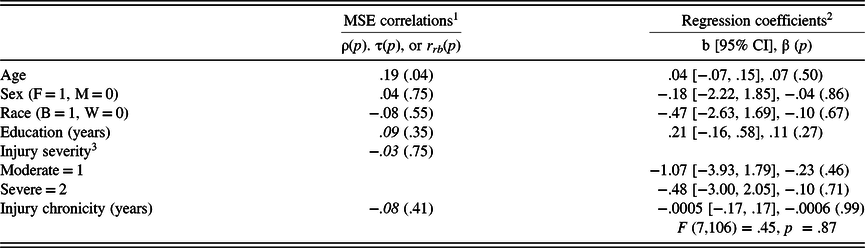
Of the demographic and injury variables considered, only age showed a statistically significant relationship with MSE, although this was not in the expected direction (i.e., a weak positive association). When MSE was modeled by all of these variables together, no significant predictors emerged (all predictor ps > .26). Table 2 presents full correlation and regression results for associations between MSE and demographic and injury-related variables. Memory performance was significantly correlated with all demographic and injury-related variables with the exception of injury chronicity (age: ρ = .21, p = .02; sex: r rb = .30, p = .01; race: r rb = −.32, p = .01; education: ρ = .36, p < .001; injury severity: τ = −.21, p = .004; injury chronicity: ρ = −.12, p = .19).
Relationship of memory self-efficacy (MSE) to demographic and injury-related variables (N = 114).

b, β = unstandardized, standardized regression coefficients. CI = confidence interval. B = Black. W = White.
1 Table values are Spearman correlations with the exception of associations with injury severity, which reflect the Kendall rank correlation (τ), and sex and race, which reflect rank-biserial correlations (r rb).
2 MSE as outcome.
3 Complicated mild (coded 0), moderate (1), or severe (2).
Relationship of MSE to Psychological Distress and Memory Performance
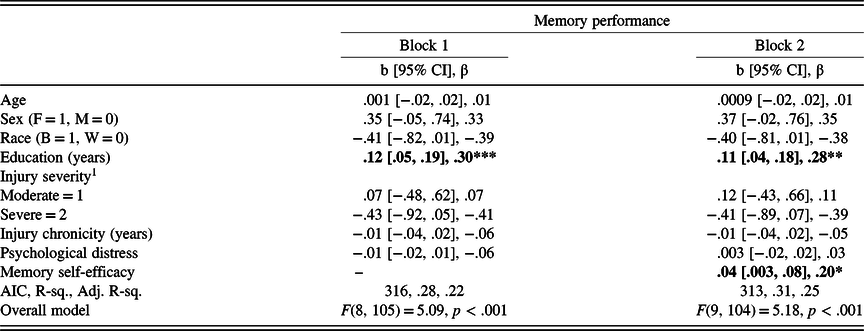
MSE was inversely associated with psychological distress (ρ = −.44, p < .001) and positively associated with memory performance (ρ = .25, p = .01). Hierarchical linear regression revealed a small (ηp 2 = .04) but significant contribution of MSE to memory performance after accounting for demographic and injury variables as well as psychological distress (Table 3).
Hierarchical regression of memory performance on memory self-efficacy (N = 114).

b, β = unstandardized, standardized regression coefficients. CI = confidence interval. B = Black. W = White. AIC = Akaike information criterion. Bold values are significant.
1 Complicated mild as reference group (coded 0).
* p < .05,
** p < .01,
*** p < .001
Contributions of MSE to QOL
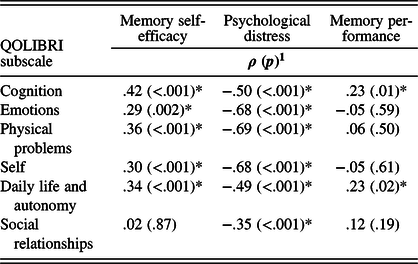
MSE and psychological distress were significantly correlated with almost all QOL domains, the exception being MSE and social QOL, while memory performance showed select relationships with QOL (Table 4). All initially significant correlations survived FDR correction.
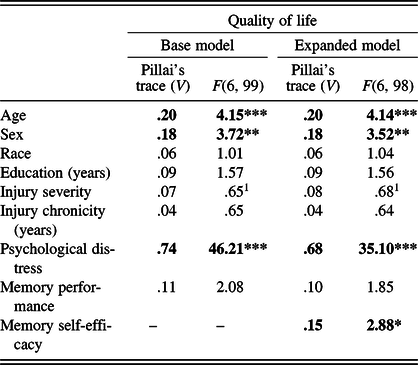
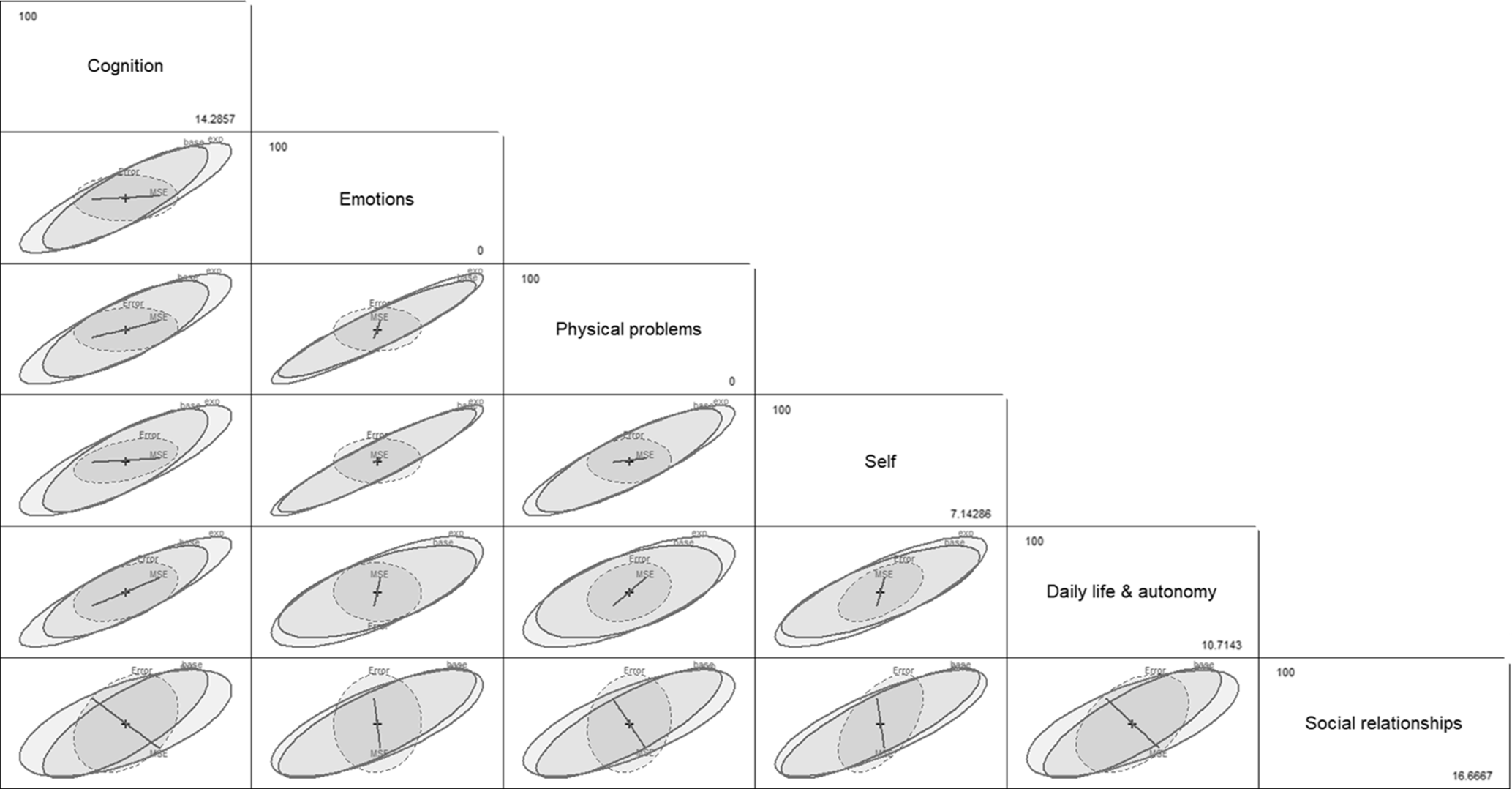
In the base multivariate regression model, only age, sex, and psychological distress showed a significant effect on overall QOL. The inclusion of MSE in an expanded model resulted in significantly better model fit (V = .15, F(6,98) = 6.48, p = .01), indicating that MSE makes a unique contribution to QOL after accounting for other predictors. Detailed results from the two models are provided in Table 5. For illustrative purposes, we deconstruct this multivariate effect graphically in Figure 1, using pairwise linear combinations of QOL domains for the base and expanded models. While the base model was significant for all QOL pairs, the addition of MSE increased the evidence against a null model for most pairs, but particularly those involving social aspects of QOL.
Relationship of memory self-efficacy, psychological distress, and memory performance to health-related quality of life (N = 114).

QOLIBRI = Quality of Life After Brain Injury questionnaire.
1 Table values are Spearman correlations.
* Significant after correction for the false discovery rate at α = .05.
Multivariate regression of quality of life on memory self-efficacy (N = 114).

Bold values are significant.
1 Df = (12, 198).
* p < .05;
** p < .01;
*** p < .001.
Multivariate effects of memory self-efficacy on quality of life*. Matrix of pairwise QOLIBRI (Quality of Life After Brain injury questionnaire) subscale scores depicting coverage of the linear hypotheses (base and expanded multivariate models; see text for details). Error ellipses shown are for the expanded model; because this model ellipse extends beyond the error ellipse in all instances, it is significant for all pairs at α = .05. Greater space coverage of a hypothesis ellipse relative to another provides stronger evidence against the null hypothesis. Where the line representing the MSE term penetrates the base model ellipse, MSE makes a significant contribution to that pairwise relationship beyond the base model at α = .05. This effect is most remarkable in pairs involving social aspects of QOL. *Note that this figure is provided for illustrative purposes only, and that primary analyses evaluated all 6 QOL domains together as a single multivariate outcome.

Relationship of Psychological Distress Subdomains to MSE and QOL
Although not an a priori hypothesis of the current study, we considered the possibility that certain aspects of psychological distress are more or less related to MSE and QOL. Exploratory analyses were performed to examine potential differential effects of depression, anxiety, and somatization (as measured by the individual BSI-18 subscales) on MSE and QOL. MSE was significantly correlated with each BSI subscale, with similar magnitudes (depression: ρ = −.35; anxiety: ρ = -.39, somatization: ρ = −.32; all ps < .001). All BSI and QOLIBRI pairwise subscale correlations were also significant (correlations ranging from −.21 to −.64). These results suggest that the relationships between psychological distress and MSE are generalized, and support our use of the summary distress score in primary analyses.
DISCUSSION
Healthy older individuals often report less confidence in their memory ability, which affects their memory performance and may influence broader health outcomes. The current study sought to examine these relationships in PwTBI, who frequently report memory problems well after acute injury recovery. In a sample of older adults with a chronic history of msTBI, we observed that levels of MSE varied across individuals and were not attributable to demographic and injury characteristics. In line with our predictions, MSE was related to general psychological distress, but was also associated with memory performance independent of this distress. Importantly, we found support for the hypothesis that MSE contributes to health beyond cognitive test performance, potentially biasing subjective reports of overall health and life satisfaction.
Our results indicate that there are meaningful individual differences in perceptions of memory ability among PwTBI. However, we did not find clear demographic or injury-related correlates accounting for these variations. Despite well documented age-related declines in MSE in the general population (Hertzog & Curley, Reference Hertzog and Curley2018; McDougall & Kang, Reference McDougall and Kang2003; Robin Lea West & Berry, Reference West and Berry1994), there was no evidence for this effect in our sample. In fact, slightly greater MSE was observed with increasing age, and this relationship disappeared when controlling for other demographics and injury variables. The absence of a unique relationship between age and MSE in these data could be ascribed in part to the restricted age range of our sample, but the possibility that self-efficacy judgments after TBI may be based on introspective anchors distinct from those used by healthy individuals cannot be excluded. Living with a TBI at any age is a complex experience, involving medical, psychological, social, and premorbid factors that shape self-schemas and beliefs about ability (Grace, Kinsella, Muldoon, & Fortune, Reference Grace, Kinsella, Muldoon and Fortune2015; Villa, Causer, & Riley, Reference Villa, Causer and Riley2020). In this multidimensional context, it is unsurprising that individual injury-related variables such as severity and chronicity – though known to be consequential for objective cognitive and functional outcomes (e.g., Ketchum et al., Reference Ketchum, Almaz Getachew, Krch, Banos, Kolakowsky-Hayner, Lequerica and Arango-Lasprilla2012; Ponsford, Spitz, & McKenzie, Reference Ponsford, Spitz and McKenzie2016; Senathi-Raja, Ponsford, & Schonberger, Reference Senathi-Raja, Ponsford and Schonberger2010) – were not associated with MSE. We suspect that MSE arises from a combination of experiential factors that comprise self-concept (Hilgeman, Allen, & Carden, Reference Hilgeman, Allen and Carden2017), which are not captured by individual demographic or injury characteristics.
The current results support the hypothesis that psychological distress is related to reduced MSE, indicating that at least some clinical correlates identified in healthy populations remain important in PwTBI. This may reflect a higher-order association between mental health and MSE, as the latter showed no apparent specificity to a particular type of psychological symptom constellation such as depression or anxiety. Our findings comport with previous work showing that psychological symptomology is associated with MSE in stroke survivors (Aben, Busschbach, Ponds, & Ribbers, Reference Aben, Busschbach, Ponds and Ribbers2008). The relationship between mental health and MSE may be particularly important in neurologic disorders such as TBI, which increases the risk for psychological distress (Bombardier et al., Reference Bombardier, Fann, Temkin, Esselman, Barber and Dikmen2010; Dikmen, Bombardier, Machamer, Fann, & Temkin, Reference Dikmen, Bombardier, Machamer, Fann and Temkin2004; Hoofien, Gilboa, Vakil, & Donovick, Reference Hoofien, Gilboa, Vakil and Donovick2001; Ponsford, Alway, & Gould, Reference Ponsford, Alway and Gould2018) and thereby may also bias self-judgments about ability. Conversely, reduced MSE may heighten depression symptoms: Kit and colleagues (Reference Kit, Mateer and Graves2007) showed through path analyses in cross-sectional data that reduced MSE relative to healthy controls leads to greater depression in PwTBI, and not the reverse. Nonetheless, it is difficult to identify the precise temporal relationship between MSE and mental health, and it is likely that these associations are bidirectional.
Notwithstanding its overlap with psychological distress, MSE appears to be a distinct conceptual entity in PwTBI. This is substantiated by our observation that MSE was associated with actual memory performance independent of psychological distress, which in fact did not show a significant association with performance. Remarkably, the effect size observed between MSE and memory performance (both with and without covariate adjustment) was slightly stronger than the estimate provided by Beaudoin & Desrichard’s (Reference Beaudoin and Desrichard2011) meta-analysis in healthy adults. One interpretation of this finding is that it reflects prior memory performance monitoring efforts. Although TBI may impair awareness of deficits (Chiou, Carlson, Arnett, Cosentino, & Hillary, Reference Chiou, Carlson, Arnett, Cosentino and Hillary2011; Flashman & McAllister, Reference Flashman and McAllister2002; Hart, Sherer, Whyte, Polansky, & Novack, Reference Hart, Sherer, Whyte, Polansky and Novack2004), some research specifically studying metamemory has found that PwTBI are able to reasonably appraise their memory performance, adjusting ability judgments based on task experience (Anderson & Schmitter-Edgecombe, Reference Anderson and Schmitter-Edgecombe2009; Krause & Kennedy, Reference Krause and Kennedy2009; Schmitter-Edgecombe & Anderson, Reference Schmitter-Edgecombe and Anderson2007). It is possible, then, that accumulative memory appraisals over time change self-perceptions of general memory ability (see Lane & Zelinski, Reference Lane and Zelinski2003; McDonald-Miszczak, Hertzog, & Hultsch, Reference McDonald-Miszczak, Hertzog and Hultsch1995). However, low MSE has been shown to impact task process behaviors, for example, decreasing time spent on a task (Beaudoin & Desrichard, Reference Beaudoin and Desrichard2017) and increasing on-task anxiety (Beaudoin, Reference Beaudoin2018; Lachman & Agrigoroaei, Reference Lachman and Agrigoroaei2012), which has downstream implications for memory performance. Therefore, it is unlikely that metamemory monitoring alone accounts for the observed relationship between MSE and performance (Hertzog et al., Reference Hertzog, Hülür, Gerstorf and Pearman2018).
A major objective of our study was to examine relationships between MSE and broader health outcome, based on the hypothesis that personal beliefs about memory ability are reflective of general concerns over health status. Bivariate correlations were consistent with our predictions, demonstrating that MSE is related to multiple distinct aspects of health-related QOL such as satisfaction with cognitive and physical functioning. These relationships can be confounded by general psychological distress, which is often a strong driver of QOL ratings and also contributes to MSE (both conceptually, as noted earlier, and in terms of common-method variance associated with self-report measures). However, our multivariate analyses confirmed that MSE contributes to overall QOL beyond the effects of general psychological distress and actual memory performance, providing evidence of a potential unique biasing effect of MSE on QOL. Our findings comport with prior studies in aging and mild cognitive impairment reviewed earlier, which document a positive association between MSE and QOL. In addition, Cicerone and Azulay (Reference Cicerone and Azulay2007) reported that among self-efficacy beliefs regarding various abilities, cognitive self-efficacy was most strongly related to QOL in PwTBI. In the current study, we identify beliefs about memory ability, in particular, as potentially salient anchors for cognitive self-efficacy judgments and, in turn, overall perceptions of health. This interpretation is also consistent with evidence of MSE’s positive associations with non-memory cognitive performance (Payne et al., Reference Payne, Gross, Hill, Parisi, Rebok and Stine-Morrow2017) and response to non-memory-based cognitive interventions (Payne et al., Reference Payne, Jackson, Hill, Gao, Roberts and Stine-Morrow2012), indicating that memory beliefs likely reflect more than self-perceptions of memory ability.
From a conceptual perspective, our findings suggest that subjective markers of aging and health decline in the general population also apply to PwTBI. MSE may play an especially potent role in subjective health outcomes of this group given their high rate of perceived memory problems. Therefore, MSE potentially represents an accessible intervention target for improving more distal functional outcomes in PwTBI, in that it may be a gateway to larger-scale restructuring of health-related beliefs impacting upon both perceived and actual everyday functioning. In this respect, it is noteworthy that memory interventions in aging often incorporate memory belief restructuring before introducing more traditional approaches such as internally-generated memory strategies and external compensatory aids (e.g., Hertzog et al., Reference Hertzog, Pearman, Lustig and Hughes2021; Lachman et al., Reference Lachman, Weaver, Bandura, Elliott and Lewkowicz1992; Vranić et al., Reference Vranić, Španić, Carretti and Borella2013). Our initial data suggest that this integrative approach may be promising for the treatment of functional memory problems in PwTBI.
Methodologically, our study demonstrates that univariate analyses may not capture the full impact of ability beliefs on health outcomes. Whereas zero-order correlations were significant between MSE and five of six QOL domains, we did not find such an association between MSE and the social QOL domain – the effect size was not only non-significant but very small in magnitude. This would seem inconsistent with the hypothesis that reduced MSE increases avoidance of memory-demanding situations, many of which can be social in nature (e.g., remembering details of a conversation). A possible explanation for this finding is that we queried satisfaction with social relationships and not engagement in social situations, which may be more directly affected by poor MSE. However, as shown in Figure 1, MSE contributed to social QOL when the latter was considered together with other aspects of QOL such as satisfaction with cognitive functioning and functional independence. Thus, there may be an emergent relationship between MSE and social functioning – for instance, in social situations that require a certain level of cognitive fluency for meaningful interaction.
The current study had limitations that reveal opportunities for future research. Our measure of MSE was a brief subscale of a larger instrument designed to measure various metacognitive beliefs. This measure has been used in prior work examining memory beliefs (Irak & Çapan, Reference Irak and Çapan2018; Jacobsen, Aasvik, Borchgrevink, Landrø, & Stiles, Reference Jacobsen, Aasvik, Borchgrevink, Landrø and Stiles2016), and it showed good reliability in our sample; however, it represents a more limited operationalization of MSE than what might be offered by other questionnaires (Berry, West, & Dennehey, Reference Berry, West and Dennehey1989; Dixon, Hultsch, & Hertzog, Reference Dixon, Hultsch and Hertzog1988; Gilewski, Zelinski, & Schaie, Reference Gilewski, Zelinski and Schaie1990). A comprehensive survey of memory beliefs and related concepts, such as perceived control over memory performance (Lachman, Bandura, Weaver, & Elliott, Reference Lachman, Bandura, Weaver and Elliott1995) and general beliefs about memory and aging (Lineweaver & Hertzog, Reference Lineweaver and Hertzog1998), would be instructive in efforts to elucidate nuanced relationships between MSE and health outcomes. Further, we used a theoretically motivated memory composite score to reduce measurement error, but this should not be considered a comprehensive representation of memory functioning. Relatively little is known about the relationship between MSE and nonverbal and non-episodic memory functions, and it would be interesting to evaluate whether personal memory beliefs can be leveraged in rehabilitation interventions targeting cognitive functions other than verbal episodic memory. We also caution that our largely null findings in analyses of demographic and injury variables with MSE were obtained in a restricted-demographic sample, that is, older individuals who typically present with less severe injuries than their younger counterparts. As noted earlier, MSE and memory functioning are of special relevance to individuals aging with TBI, but these effects could be consequential throughout the lifespan and should be clarified in more demographically and clinically diverse samples.
Although research suggests that metamemory monitoring and MSE are distinct concepts, we appreciate the role patient insight may have played in our findings, particularly with respect to the association between MSE and memory performance. It is possible that those with greater insight into their cognitive functioning report MSE more consistent with their actual memory ability than those with poorer insight; thus, the correlation between MSE and memory performance in the former group may be higher than what we observed. Future studies should consider including a measure of insight to capture this potential moderating effect. It would also be interesting to examine profiles of subjective and objective/semi-objective memory functioning (e.g., via functional memory assessment or collateral report) to discern individual variability in the accuracy of memory self-perceptions.
The cross-sectional, observational nature of our study does not allow for definitive conclusions regarding the causal pathway(s) linking MSE with objective and subjective health, which are important to explore if MSE is to become a candidate target for intervention. It is acknowledged that due to the multiple factors contributing to the formation of memory beliefs, MSE is difficult to manipulate, particularly within shorter time periods (Beaudoin & Desrichard, Reference Beaudoin and Desrichard2011). Some studies have attempted to experimentally modulate task-specific beliefs about memory ability (e.g., Beaudoin, Reference Beaudoin2018; Desrichard & Köpetz, Reference Desrichard and Köpetz2005; Gardiner, Luszcz, & Bryan, Reference Gardiner, Luszcz and Bryan1997; Iacullo, Marucci, & Mazzoni, Reference Iacullo, Marucci and Mazzoni2016), an approach that could also be utilized to study performance of individual, functionally relevant memory activities in PwTBI.
Drawing from self-efficacy theory and studies of health beliefs in aging, our study provides initial evidence for the relevance of self-perceptions of cognitive ability – specifically, memory functioning – to objective and subjective health in PwTBI. Patients’ interpretations of their own ability are relatively understudied compared to classical indicators of outcome like injury severity, but subjective views may take on greater importance in everyday functioning as patients recover from the acute neurologic effects of injury. Incorporating these personal perspectives in treatment – for example, through belief restructuring and instilling more adaptive thought patterns – may prove beneficial in enhancing the efficacy of memory interventions in PwTBI. Because content can be tailored to individual memory beliefs, interventions augmenting MSE represent personalized health approaches to improving treatment accessibility. That is, they may increase the receptiveness of the patient to memory interventions and the likelihood they will implement memory strategies in daily life. Although further research is needed, the potential biasing effect of memory beliefs on health perceptions suggests that individualized assessment and restructuring of memory beliefs could also lead to gains in functional behavior broadly for PwTBI.
FINANCIAL SUPPORT
This work was supported by a grant from the Pennsylvania Department of Health to ARR and FGH (#4100077082). The Department specifically disclaims responsibility for any analyses, interpretations, or conclusions.
CONFLICTS OF INTEREST
The authors have nothing to disclose.
ETHICAL STANDARDS
All research procedures were in accordance with the Helsinki Declaration and approved by institutional review boards at the study sites.