


Introduction
Our research is informed by a Vygotskian sociocultural theory of mind (e.g., Swain, Kinnear, & Steinman, forthcoming; Vygotsky, Reference Vygotsky, Reiber and Carton1987) which claims that the source of psychological development is social and cultural. The research question we sought to answer in our study was, What is the role of languaging in the emergence of zones of proximal development co-created by two adults: a resident in a long-term care facility (LTCF) and a researcher? Languaging is the shaping and organizing of higher mental processes through language use (Swain, Reference Swain and Byrnes2006, Reference Swain and Batstone2010). A zone of proximal development (ZPD) is an ongoing cognitive or affective activity in which learning and development occur as participants respond to each other. The ZPD process is mediated by languaging.
We describe the emergence of ZPDs, in which positive affect was established, thereby providing a context in which the LTCF resident (Mike) reclaimed lost expertise and took on new cognitive challenges. Outcomes for Mike included both cognitive development and enhanced self-esteem.
Languaging and the ZPD
Languaging
The literature in social psychology and gerontology has a great deal to say about communication. In general, communication is viewed as the sending and receiving of messages. The language of the messages has been studied from many perspectives. Some examples follow: (a) how gender or age is signaled in the message (Coupland, Coupland & Giles, Reference Coupland, Coupland and Giles1991); (b) how respect, disrespect, caring, or paternalism, for instance, is signaled in patient-doctor interactions (Candlin & Candlin, Reference Candlin and Candlin2003); and (c) how interactions take place between a cared-for person and a caretaker (Ryan, Giles, Bartolucci, & Henwood, Reference Ryan, Giles, Bartolucci and Henwood1986).
Research has documented the use of “baby talk” with infants and young children (Ferguson, Reference Ferguson1964); “foreigner talk” with non-native speakers of a language (Freed, Reference Freed1981); and “elderspeak” with older adults (Kemper, Reference Kemper1994; Williams, Reference Williams2006). Characteristics of elderspeak include simplified syntax, a slower rate of speech, and talking in the third person about an older adult who is physically present. This scholarly literature, both theoretical and empirical, contributes significantly to understanding the nature of communication among different groupings of individuals. However, none of this literature draws on the work of Lev Vygotsky (e.g., 1987), who identified an aspect of communication beyond the exchange of information. He demonstrated that language is a tool of the mind, a tool that mediates our higher mental processes. Vygotsky’s claims were based on microgenetic and ontogenetic analyses of the relationship between language and thinking in which he showed that the internalization of language dramatically, and over time, qualitatively changes an individual. When it is internalized, language takes on functions of organizing, planning, and monitoring, all of which mediate an individual’s cognitive/affective activity.
Languaging, as we have mentioned, is the use of language to mediate these higher mental cognitive and affective processes (Swain, Reference Swain and Byrnes2006, Reference Swain and Batstone2010; Swain & Lapkin, Reference Swain and Lapkin2008). If it were not for language, how would a person focus attention, consider the past, or plan for and imagine the future? When language is used for these functions, the individual is languaging. Language is a tool which “grows” meaning, completes thought, and gives voice to affect. If an individual is not given an opportunity to language, then the power to create meaning, to plan, to attend, to organize, and so on will dissipate. Thus, our study was designed to give older isolated adults the opportunity to once again engage in languaging. One way to encourage languaging is through engaging individuals in activities that are cognitively complex, necessitating the use of language to mediate thinking.
Zone of proximal development
Vygotsky described a ZPD as the difference between what an individual can do with the help of others (distributed cognition) and what that individual can do on his or her own (the internalization of what was formerly distributed). It is useful to think of a ZPD as actively created by two or more individuals engaged in a learning or teaching process in which a more knowledgeable person assists a less knowledgeable person through questions, prompts, and hints (Petrick-Steward, Reference Petrick-Steward1995). As Aljaafreh and Lantolf (Reference Aljaafreh and Lantolf1994) suggested, assistance given by the more knowledgeable person should be graduated, providing no more help than is necessary, thus allowing an individual still to exercise his or her agency. Assistance should also be contingent on the specific need of the learner and should be withdrawn as the learner internalizes the knowledge or process, thus developing from other-regulation to self-regulation. In recent theorizing about the ZPD, the relationships among participants during a ZPD can be that of peers, in which at varying times each takes on the role of the more- or less-knowledgeable person (Donato, Reference Donato, Lantolf and Appel1994; Swain & Lapkin, Reference Swain and Lapkin1998). In our study, the researcher and Mike often alternated as the more-knowledgeable peer.
The fact that interpersonal relationships play such an important role in cognitive growth suggests, by extension, that affective factors are implicated in learning and development. Vygotsky (Reference Vygotsky1962) referred to “the existence of a dynamic system of meaning in which the affective and the intellectual unite” (p. 8; see also Mahn & John-Steiner, Reference Mahn, John-Steiner, Wells and Claxton2002). Vygotsky’s recognition of the inseparable link between cognitive development and affect is clear in this assertion:
The separation of the intellectual side of our consciousness from its affective, volitional side is one of the fundamental flaws of all of traditional psychology. Because of it, thinking is inevitably transformed into an autonomous flow of thoughts thinking themselves. It is separated from all the fullness of real life, from the living motives, interests, and attractions of the thinking human.
(cited in Wertsch, Reference Wertsch1985, p.189)Goldstein (Reference Goldstein1999) drew on Noddings’ (1984) concept of caring to expand Vygotsky’s assertion that affect and cognitive growth are inextricably linked. Noddings’ ethic of caring model suggested interesting parallels with Vygotsky’s concept of interaction during a ZPD in which knowledge emerges as a result of interaction among participating individuals. In both carer and cared-for relationships and teacher-student relationships, the relationships’ affective qualities are what permit a ZPD to emerge and develop in any given situation (Goldstein, Reference Goldstein1999).
For Noddings (Reference Noddings1984), the term caring does not refer to a quality; rather, it is an act. In every interaction, there is the potential to engage in a caring relationship between a caring person and a cared-for person. In Noddings’ caring model, there is reciprocity between acts of caring and acknowledgement of them. Acknowledgement by the cared-for may take many forms (e.g., a simple smile or a thank-you), but it is an important aspect of the interaction because it validates the act of caring. This notion of caring is “contextually specific, rooted in the particularities of a specific pair of individuals in a concrete situation” (Goldstein, Reference Goldstein1999, p. 657), and it underlies teaching-learning contexts as well as health care encounters. This similarity provides a link between Vygotsky’s ZPD and Noddings’ caring encounters.
A Brief Literature Review
Literature in gerontology and psychology, although not informed by Vygotsky’s sociocultural theory of mind, lends support to our hypothesis that languaging mediates the cognitive/affective functioning of an older adult. This literature emphasizes the importance of sustaining a sense of well-being, of preventing loneliness, and of improving self-esteem in older people. These principles are inconsistent, however, with the practices of some caregivers. For example, in discussing communication between health care providers and older adults, Ryan, Meredith, MacLean, and Orange (Reference Ryan, Meredith, MacLean and Orange1995) noted lowered expectations on the providers’ part, the use of patronizing speech, a restricted range of conversation topics, and related phenomena. These factors can result in reduced self-esteem and possible withdrawal from stimulating activities on the part of the older adults (see also Lenchuk & Swain, Reference Lenchuk and Swain2010).
Cattan, White, Bond, and Learmouth (Reference Cattan, White, Bond and Learmouth2005) conducted a systematic review of 30 studies that analyzed the effectiveness of various interventions to prevent loneliness and social isolation in older adults. They found that programs which were educational or provided social support resulted in significantly reduced loneliness and social isolation. Activities such as group discussions of health-related topics, skill learning, or participating in a health education program were effective in reducing feelings of loneliness and in improving self-esteem. In the quantitative studies reviewed by Cattan et al., judgments of effectiveness were made based on measures such as the University of California at Los Angeles loneliness scale. Relatively few studies included a process evaluation. The researchers also noted the dearth of studies on socially isolated individuals. In contrast, the study we present in this article focuses on a socially isolated individual and on the process by which the individual once again becomes cognitively and affectively engaged.
The effective interventions outlined by Cattan et al. (Reference Cattan, White, Bond and Learmouth2005) shared two principal characteristics with our languaging project. First, a number of the programs utilized cognitively challenging activities including education and discussion about topics of interest to the participants involved. Most of the activities selected for our research interventions were similarly challenging and included life history reportage, discussions of classical music and newsworthy current events, crossword puzzles, and poetry composition and analysis. Second, the successful programs analyzed by Cattan et al. targeted specific groups (e.g., women, the widowed, the physically inactive), and members of these groups were given a certain degree of control over, or were consulted prior to, the intervention. This is significant because it suggests that group members were able to exercise a degree of agency. Similarly, in the present study, the participant was consulted and his needs and interests were considered in planning the sessions with the researcher.
In the one-on-one (relatively ineffective) interventions in the Cattan et al. (Reference Cattan, White, Bond and Learmouth2005) review, it appeared that simple visiting and “chatting” did not reduce social isolation and feelings of loneliness in older adults. In our study, interventions were based on languaging, a cognitively demanding form of language use by the cared-for intended to mediate cognitive/affective functioning that afforded opportunities for agentive action, cognitive development, and affective engagement.
Research Methodology
Setting and participants
The study took place in a long-term care facility that, for purposes of this article, we have named Magnolia Place (MP). It was built approximately eight years ago, with spacious common rooms and corridors, and self-contained units for each half-floor, each with its own modern dining room, TV room, and recreational room. All 350 residents have private rooms.
For the larger study, five participants were recruited from MP. We asked senior staff to use two criteria in recommending participants for the research team. One criterion for selection was that the resident show mild cognitive impairment. This was true of Mike, the focal participant of the present study (see below for a profile of Mike). He scored 26 on the Mini-Mental State Exam (MMSE; Folstein, Folstein, & McHugh, Reference Folstein, Folstein and McHugh1975), on the border between the lower end of normal and mild dementia, before the languaging intervention. (See Barkaoui, Swain, & Lapkin, in press, for a discussion of test scores and their limitations.)
The second criterion for participant selection was social isolation: staff recommended residents who rarely had visitors and who therefore had little opportunity for sustained conversation. These people are alone because family and friends live at a distance, are estranged, or have passed away. Such isolated individuals would have few opportunities to use language in a cognitively complex way, which, from the theoretical perspective taken in this study, could contribute to cognitive loss and impairment. In Mike’s case, his spouse (Anna) did visit almost daily, but her view was that their interaction had become routinized; she and MP staff reported that they usually sat in silence when they spent time together. In one of two conversations, Anna stated: “You know, you see married couples sitting in a restaurant and not a word is exchanged. That’s Mike and I now.”
The intervention
During the preparation for the multiple case study, our team of researchers met regularly and devised a set of languaging activities that could be undertaken with residents to stimulate cognitively rich conversations. Individual researchers chose among these activities based on what the residents found most appealing. Some of the researchers and residents chose to work in a sustained fashion on only a few activities (e.g., life history interview), while others (as in the case of Mike) attempted a greater variety of tasks, ranging from crossword puzzles to poetry writing.
Procedures and time frame
Each of five researchers visited his/her participant over a 6-12 week period, meeting approximately twice a week (in the spring, summer, and fall of 2006). The total number of meetings for each participant ranged from 10 to 12. Digital audio recordings were made which were subsequently transcribed. (Video recording was not possible under the terms of the ethical clearance we had received from our university.) In Mike’s case, 11 meetings were held over the period from late July to early September 2006, about twice a week, each lasting approximately 45 minutes. A 12th session involved going out to tea with Mike and his wife; during that time, the researcher had an opportunity to talk at length with Anna.
Three types of data were collected during the project to allow for triangulation of information: (a) the transcribed sessions between the researcher and Mike; (b) conversations with Anna (at the time of data collection and again one year later) and an interview with a personal care worker (also one year later);Footnote 1 and (c) the researcher’s log that consisted of notes taken immediately following each session with Mike.
Selection of excerpts for analysis
The activities that the researcher and Mike did together were drawn from the bank of activities developed by the project team as a means of engaging the participant in languaging (i.e., effortful and cognitively demanding talk). Activities were selected from this bank according to the participant’s interests. In Mike’s case, they included discussing a short story from Reader’s Digest on a musical theme, Mike’s life history, his ideas about life-altering events in history (e.g., the Second World War), his ideas about ground-breaking inventions (e.g., radar, television), the Residents’ Council at MP, poetry analysis and co-creating poems based on particular models, political events of the time, and so on. Each of these topics and activities resulted in languaging episodes that involved an intellectually challenging collaborative construction of meaning.
For the purposes of this article, we have selected representative excerpts which illustrate the changing relationship between Mike and the researcher and their emergent ZPDs. The representative excerpts include a set illustrating changes in affect on Mike’s part; one illustrating Mike in the role of expert, resulting in increased self-confidence; another involving the co-construction of a ZPD; and a final, extended excerpt presenting a fully enacted ZPD.
Method of analysis: Microgenesis
Wertsch and Hickman (Reference Wertsch, Hickman and Hickman1987) described microgenesis in a Vygotskian framework as “the study of the dynamic process of developmental change” (p. 252). By means of examples involving the interaction of a parent and child doing a complex puzzle, they demonstrated problem solving in progress, where the child moved from other-regulation to self-regulation. In Vygotsky’s conception of the ZPD, such movement can result from working with a more capable adult (in the case of a child), or with a more capable peer. In the microgenetic analyses of representative languaging excerpts that shortly follow, we describe turns the participants take, making evident the process of cognitive/affective change over time.
A Profile of Mike
Staff members at MP identified Mike as a participant for this study. At age 71, Mike had been in the LTCF since the wing he lived in opened two years earlier. Despite the daily visits of his spouse, Mike was considered to be socially isolated. Staff described him as a politically minded individual, who had been a community activist; in fact, he had lobbied against the construction of the very LTCF in which he now resided. In addition, we were told that Mike had originally been involved in the Residents’ Council (an advisory committee of residents of the LTCF who represent the interests of all residents to the administration) at some time before the study began; however, according to the activity coordinator, he had lost interest and was no longer participating actively when the languaging sessions began. Some of the staff referred to him as depressed, although we do not know whether he had received an official diagnosis to that effect. His MMSE score, as stated earlier, placed Mike at the border between the lower end of normal cognitive function and mild dementia. The test was administered by MP staff just before our intervention began.
First and foremost, Mike was a musician and a great lover of music; he could talk at length about particular musical genres and individual composers. In his youth, he studied the flute and the oboe, clarinet, tenor saxophone, and bassoon, “all reed instruments and all double reed instruments,” as he put it. He played in military bands and performed in Ottawa, Montreal, and Toronto. The radio in his room was always tuned to CBC Radio 2, the publicly funded national broadcaster. His spouse was also musical, and before his first stroke in 1996, they had played duets together.
Apart from his interest in music, Mike had worked as a social worker for many years and had had an exciting career working in Canada’s northern territories helping to establish First Nations’ artisan cooperatives. He had also been a vocational counselor, and although not a lawyer by profession, Mike had also been the director of a community legal clinic. With a first wife, he had five children, one of whom he saw once or twice a year, and a few grandchildren who lived some distance away and whom he did not see.
The transcripts illustrate the fact that Mike and the researcher forged a bond through a shared interest in music and similar political beliefs, and that Mike enjoyed and looked forward to the visits. Mike proved to be an interesting and pleasant individual, and generally took an active role in all of the tasks the researcher and he did together.
The Researcher
The researcher was an experienced applied linguist. Aged 61 at the time of data collection, she had been a professor at the University of Toronto for many years. Although she had considerable research experience, this project took place in a setting that was largely unfamiliar to her. Her knowledge of the elderly and LTCFs was limited for the most part to the reading and research she had done while co-writing the research proposal with the second author of this article and which resulted in the project receiving funding.
Overview of Data Analysis
In this section, we first provide four short excerpts taken from sessions 2, 4, 7, and 8 that are evidence of Mike’s changing affective stance towards the researcher from controlling to accommodating; from asserting power to sharing it. Then we present an excerpt from session 5 which illustrates Mike – at this point and on this topic (the atom bomb) – as a self-regulated expert. Next, we discuss a languaging excerpt from session 3 in which we see a ZPD enacted wherein the researcher and Mike together co-construct knowledge about the composer Vivaldi. In this excerpt, the intertwining of cognitive and affective processes is highlighted. Finally, we present two excerpts from session 8 during a lengthy interaction between Mike and the researcher (see Appendix A for complete episode) in which a ZPD is fully enacted. Starting from a model “diamond poem” about winter and summer in which the content and structure are discussed, Mike and the researcher apply what they have learned to the co-creation of a new poem. This example shows how, due to the caring relationship that has been established, Mike allows himself to be prompted, questioned, and pushed to do what he claimed he could not do. The outcomes are learning (of word types), development (transfer of learning to a new context as well as a movement from other-regulation to self-regulation), and positive affect.
Mike’s changing affective stance towards the researcher
In visiting Mike, it soon became apparent to the researcher that one way in which he could assert his agency was through the control of the radio. The volume was often high, but he initially refused to turn it down even during the conversations between him and the researcher. Over time, he became more concerned about accommodating the recording of the sessions and offered to lower the volume. This shift in their relationship is evident in excerpts 1 through 4 that follow.
Excerpt 1, Session 2

In session 2, the researcher was quite thrown by the radio’s loud volume. But Mike claimed (turn 18) that he had already turned it down. The researcher stated her preference for lowering the volume in turn 23, and yielded to Mike’s wishes (turn 25) when he balked at the idea.
A similar interaction occurs in session 4 (excerpt 2):
Excerpt 2, Session 4

In turn 115, the researcher asked to lower the radio volume, attenuating her request with the phrases “a little loud” and “lower it a bit” and offering to raise it again after the session. Mike refused, and she pointed out: “We did it the other day.” Finally, she acknowledged that Mike was “the boss” (turn 123), and the session took place without further reference to the matter.
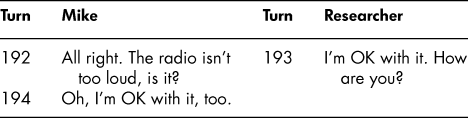
Over time, it became apparent that this issue around control over the radio volume reflected an affective change in the relationship between Mike and the researcher. In excerpts 3 and 4 below, Mike demonstrated his respect for the researcher and his desire to ensure her comfort.
Excerpt 3, Session 7
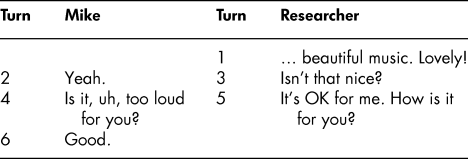
In excerpt 3, it was Mike who initiated an exchange dealing with the radio volume, asking in turn 4 if it was “too loud” for the researcher. On this occasion, she did not find the radio too loud, and they agreed to leave it as it was. The same type of interaction occurs in excerpt 4 in which Mike asked in turn 192 whether the volume was acceptable, and they agreed (turns 193 and 194) that it was.
Excerpt 4, Session 8
Languaging Excerpts
These excerpts, dealing with the radio’s volume, are not languaging, as languaging involves cognitively complex talk. These excerpts, however, can certainly be considered as negotiating the conditions for languaging. Next, we consider three representative examples of languaging, using microgenetic analysis to show how effortful, complex talk (a) demonstrates Mike’s expertise, (b) co-constructs knowledge during a ZPD, and (c) enacts a ZPD constituting learning and development.
Mike as expert
The goal of the researcher was to provide opportunities for Mike to language. Such opportunities often afforded Mike the chance to demonstrate his expertise. For example, on one occasion, during session 5, the researcher asked Mike to consider the most significant event to have taken place in his lifetime. Mike emphatically declared, “the Second World War.” When the researcher asked him to elaborate, he provided an account (excerpt 5, below) of atomic energy.
Excerpt 5, Session 5

A lengthy and detailed conversation ensued in which Mike discussed the political implications of having nuclear capabilities, the so-called “Atomic Club”, the historical and current contexts of nuclear weaponry, and how countries could disarm. These opportunities to language were important to Mike. He became engaged, interested, and keen to continue his discussions with the researcher.
Our claim is that through these opportunities to language as reflected in excerpt 5, Mike’s mood and self-esteem (affect) changed. These cognitively complex exchanges between Mike and the researcher served to help Mike re-establish himself as a self-regulated, actively engaged, knowledgeable individual.
Co-constructing knowledge: The intertwining of cognition and affect during a ZPD
Over the 11 sessions, the researcher and Mike engaged in conversation about many topics. Music was a recurring theme. In excerpt 6, from session 3, together the researcher and Mike re-constructed knowledge about the life of Vivaldi:
Excerpt 6, Session 3

The researcher had done some research online on Vivaldi and had come to the session with some printouts to help her remember the details. She chose some points of information to talk about (turn 111), and established that Vivaldi lived in the baroque period, making sure in turn 117 that Mike knew when the composer lived. She then asked, “Do you know that he was trained for the priesthood?” At this point in the conversation, Mike began to provide information. The transition from other- to self-regulation appears to occur at turn 120. In turn 120, Mike stated that Vivaldi was known as the “Red Priest”, and the researcher asked for more information.Footnote 2 Mike supplied more details such as, in turn 124, that Vivaldi worked in an orphanage, and the researcher, who had been unaware of this, confirmed from the reading material in turn 131 that Vivaldi did so starting in 1703. The outcome of this languaging episode is an understanding of Vivaldi that neither had at the start of their conversation.
It is apparent from this exchange that Mike was engaged in the conversation, and his tone of voice (the triumphant “Hey” in turn 132) suggested that he was pleased when the information he contributed to the discussion was later confirmed. The unfolding (microgenesis) of this episode demonstrates how inextricably linked Mike’s emotive and cognitive processes are in his efforts to recall aspects of Vivaldi’s life.
A fully enacted ZPD
In session 8, the researcher engaged Mike in poetry-writing activities. The first involved writing a poem that has a diamond shape on the page. She gave him the following poem as an example, printed in large, bolded font:
Winter
Rainy, cold
Skiing, skating, sledding
Mountains, wind, breeze, ocean
Swimming, surfing, scuba diving
Sunny, hot
Summer
Writing a diamond poem involves knowledge of the thematic content (e.g., winter and summer, as in the preceding poem), implicit or explicit knowledge of parts of speech (nouns, adjectives, verbs), and of the poem’s structure (number of words in each line). The researcher and Mike went through this poem, discussing what kinds of words (nouns, adjectives) were required in each line, the number of words in each line, and the content. Immediately following this, the researcher and Mike attempted to apply what they learned by writing a new diamond poem. Appendix A contains the entire text and accompanying notes on this lengthy languaging episode.
In the process of writing the new poem, Mike and the researcher worked towards a common goal, namely creating – in good spirits and respectfully – a diamond poem about music. A ZPD emerged through their languaging. During this ZPD, we observe that both Mike and the researcher learned (specific vocabulary) and developed (transferred knowledge learned from the previously discussed model).
To establish context, at the time the poem was written, Mike was in bed, and he had the original, enlarged diamond poem in front of him. As they constructed the new poem together, the researcher printed the text they were creating on a blank sheet of paper. They drew on Mike’s expertise in music and the researcher’s expertise in language, and accomplished this cognitively complex task successfully. A ZPD emerged in their interaction as indicated by the learning and development which took place. They went back and forth between the two poems to check the number and nature of words required per line. The activity began with the researcher’s suggesting that they write a diamond poem on the topic of music, one of their shared interests. The final poem that Mike and the researcher composed follows, and the process of languaging that poem is shown in its entirety in Appendix A.
Music
Playing, leading
Tonguing, conducting, blowing
Woodwinds, brass, strings, percussion
Conducting, leading, cleaning the instruments
Classical, instrumental
Quartet
In excerpt 7, the researcher challenged Mike to find nouns for the fourth line of their new poem on music that would parallel the model poem.
Excerpt 7, Session 8

The researcher tried to elicit the part of speech needed to fulfill the requirements of the fourth line of this diamond poem, asking Mike in turn 167 to name the category of words needed. He tried “verbs” (turn 172) and then “adjectives” (turn 174). She provided explicit help in turn 177 with “nouns”, and he agreed (turn 178). Quite a few turns later (turn 232; see Appendix A) he proposed “woodwinds”, finally understanding what was required. In the next excerpt, we find evidence of Mike’s learning.
Excerpt 8, Session 8

Excerpt 8 begins with the search for a final noun for the music diamond poem. When the researcher rejected Mike’s label of “descriptive” for the word summer in the original poem, she provided what Aljaafreh and Lantolf (Reference Aljaafreh and Lantolf1994) call “graduated and contingent” assistance when she said, “Well, it’s not an adjective, is it?” Mike then suggested “noun” in turn 328, about 150 turns after first hearing and accepting the label “noun” that the researcher used. (The researcher had used “noun” in turn 177 in excerpt 7 above, and in some intervening turns; see Appendix A.) This use of “noun” from the original context in turn 177 to Mike’s applying it in turn 346 is an example of transfer from the original poem to the poem being constructed. This transfer of localized knowledge is what Vygotsky would consider as constituting development.
When the researcher asked Mike in turn 341 what kind of music was playing on his radio, he responded by accurately describing it as baroque (turn 344). When she insisted on a noun, Mike used his newfound understanding of what a noun was to provide “quartet” (turn 346), evidence of his ability to apply newly acquired knowledge to the task at hand.
Evidence of the positive affect between the researcher and Mike can be observed in turns 333 to 337 where they shared a laugh when the researcher pointed out that she wanted Mike to do the thinking as they worked together. Finally Mike generated an appropriate noun (turn 346), “quartet”, and again exhibited confidence and expertise as he declared in turn 248, “Yeah, that’s very obviously a quartet” (referring to what was playing on the radio in his room).
Triangulated evidence for the benefits of languaging
The claims we have made in this article are based on three sources of evidence: (a) the transcripts of 11 sessions between the researcher and Mike, (b) the researcher’s log, and (c) the conversations and interviews with Anna and Patricia (the personal care assistant). We have argued that the researcher’s interactions with Mike showed changes such as enhanced self-esteem. This was evident not only to the researcher, through Mike’s engagement and enthusiasm, but was also confirmed by Mike’s spouse Anna who reported (in the conversation that occurred one year after data collection), “You [the researcher] made him, as I said … he regarded himself better when he was able to speak with you” and “he was always more himself when you’d been there because, he was made to feel that he was still a mensch [a decent, admirable person], because he felt good about himself.” Anna believed that Mike was more outgoing, talkative, and even more affectionate with her after the researcher’s visits with him. Despite visiting Mike on a daily basis, Anna felt that she herself rarely had the energy to engage Mike in stimulating conversation.
Evidence of Mike’s increasing affective and cognitive involvement outside his room comes from the research log that the researcher kept, making entries immediately after each of her 12 visits with Mike. Just before their ninth session, the researcher ran into a staff member who mentioned that Mike had begun attending the Residents’ Council meetings that he had given up before the data collection began. When the researcher remarked on this to Anna, she stated, “It’s a big change and I think part of it is due to talking to you and making him feel a little bit more valid. Valid as a person.” Anna also reported that her husband had resumed getting up for breakfast (she used to come to MP every morning to feed him) and taking part in activities he had avoided for two years.
Patricia, a long-term care aide, also noticed a change in Mike’s demeanor during the languaging project. In an interview that took place about one year after the data collection with Mike, the researcher asked her if she would have characterized Mike as depressed when the languaging intervention began. She replied:
Yes, it was accurate, but, um, I noticed since you were here he became more aware because he was looking forward to seeing you. And most times when you came, like when we’d tell him you were here, he was happy that you were here because he wanted to converse with you. He likes people to converse with, you know. He can hold a good conversation. So, I think at that time he was very happy.
Patricia also noted: “We [long-term care aides] would like to sit down and discuss something intellectual, but we don’t have the time.”
Discussion
We began with the question: what is the role of languaging in the emergence of a ZPD co-created by two adults: a resident in an LTCF and a researcher? To answer this question, we made use of Vygotsky’s concept of the ZPD during which learning and development intersect. Development is seen as the movement from other-regulation to self-regulation, and as the transfer of localized knowledge to new contexts, both of which have been illustrated in the excerpts we presented. The concept of the ZPD also entails an intertwining of cognition and affect. The act of caring as introduced by Noddings (Reference Noddings1984), and interpreted within a ZPD framework by Goldstein (Reference Goldstein1999), provides a basis for understanding the positive affect co-created by Mike and the researcher over time. In Noddings’ terms, the researcher enacted many acts of caring. In turn, Mike reciprocated for being cared-for by thanking the researcher on a number of occasions and by actively engaging in the tasks the researcher and he did together.
The researcher’s goal was to encourage Mike to language; however, pursuing this objective took into account Mike’s needs and interests. The researcher was intensely aware that she had entered Mike’s personal space and that he had graciously agreed to participate in the study. As a result, she accommodated him in any way she could. For example, she acquiesced when he insisted on keeping the radio volume up; she tried to find discussion topics that were of personal interest to him; and she searched out information he sought. Just as the individuals in the interventions reviewed by Cattan et al. (Reference Cattan, White, Bond and Learmouth2005) were interested in the topics they were learning about in their discussion groups, Mike was interested in both the topics he and the researcher discussed and in their joint activities. The researcher recognized that Mike would language more if she proposed topics and tasks that were of interest to him. When he was interested in a topic, he would language at length and would take pride in impressing her with his extensive knowledge.
We have showed that, over time, Mike’s need for control and asserting power shifted. We interpret this shift as being one outcome of the opportunities the researcher provided for Mike to language, thereby demonstrating himself to be a competent, knowledgeable, agentive person. The change in affect created the conditions for Mike to be willing to engage in activities that were cognitively complex for him. Languaging mediated the higher-order mental thinking he did, both to internalize new knowledge and to externalize emotions, prior knowledge, and new thoughts. By languaging, Mike re-created his lost self for others and for himself to experience.
Implementing languaging activities can be viewed as difficult and labour-intensive. To support and encourage languaging, the research team is developing a handbook for volunteers at long-term care facilities, to transmit the insights of its case studies. Our goal is to help volunteers (and LTCF staff) to understand the value of languaging by the cared-for, and to provide volunteers with ways to encourage languaging by the residents they assist. In this way, volunteers can help the older, isolated adults they visit to forestall cognitive and emotional deterioration; as well, they can help these adults rebuild self-esteem and regain a sense of control.



