Since the founding of the first colonial college in 1636, leaders in American higher education have sought funds for their institutions by soliciting wealthy individuals, conducting lotteries, enlisting subscribers, and other means. But national highly organized, multiyear campaigns run by paid staff first appeared early in the twentieth century. The initial such campaign in higher education in the United States was the Harvard Endowment Fund (HEF) drive, conducted by Harvard University between 1915 and 1925.Footnote 2 This effort raised the staggering total of some $14,000,000, spawned the first fund-raising consulting firm in higher education and inspired several hundred imitations over the next decade. The first campaign in legal education was the contemporaneous but independent drive that commemorated the 1917 centennial of Harvard Law School (HLS) and extended from about 1914 to 1920. This effort was a disaster, and no other law schools emulated it.
Though considered the most successful of the university's professional schools at the time, HLS raised scarcely a quarter of its goal from merely 2 percent of its alumni. As a result, the campaign failed to extricate HLS from the deep financial problems that the school had created in the early 1900s. Furthermore, the school paid the opportunity cost of being pushed to the end of the newly formed queue among Harvard's schools and departments seeking to raise money, thereby delaying its chance to try again. Ultimately, the campaign—which prepared and published The Centennial History of the Harvard Law School, 1817–1917—disappeared from memory.Footnote 3 But the first attempt at a national fund-raising campaign by a leading law school deserves attention. It raised provocative questions about the position of law schools within universities, about the financial model of legal education, and about the relationship between law schools and their alumni and the legal profession. Drawing upon the available archives, this essay presents a close examination and textured interpretation of this first effort to organize a national fund-raising campaign in legal education.
Prior to 1860 the economy of the United States did not produce enough surplus wealth to support significant benefactions, and most gifts to higher education were made for current use. Fueled by industrial capitalism, the great economic expansion between 1865 and 1920 led to an enormous increase in philanthropy, most of which flowed into the endowments of colleges and universities.Footnote 4 Notable early gifts included $500,000 from telegraph mogul Ezra Cornell to found a university in 1865, a total of $800,000 to establish Vassar College in 1868, and $7,000,000—the largest benefaction to that point in American history—bequeathed in 1873 by merchant Johns Hopkins to found a university and a hospital in Baltimore.Footnote 5 During the early 1890s the reported $20,000,000 given by railroad baron Leland Stanford to found a university in California and the $34,700,000 given by John D. Rockefeller to the University of Chicago (culminating in his pledge of $10,000,000 in 1910) attracted widespread publicity, as did many lesser gifts to other universities. Contemporary observers considered this late nineteenth-century wave of benefactions to be “one of the most striking phases of American educational history.”Footnote 6 By 1900 endowments in higher education totaled at least $165,000,000.Footnote 7
In the next two decades, the new foundations established by retiring industrialists enlarged the endowments of higher education even more. After selling his steel companies in 1901, Andrew Carnegie established the Carnegie Institution of Washington in 1902, the Carnegie Foundation for the Advancement of Teaching in 1905, and the Carnegie Corporation of New York in 1911. Meanwhile, Rockefeller endowed the Rockefeller Institute of Medical Research in 1901, the General Education Board in 1903, the Rockefeller Foundation in 1913, and the Laura Spelman Rockefeller Memorial in 1918. The General Education Board alone calculated in 1925 that it had committed some $60,000,000 to the endowments of colleges and universities, ultimately yielding about $200,000,000 in combination with the additional gifts on which it had “conditioned” its contributions.Footnote 8
All these developments prompted efforts to improve and expand upon traditional approaches to raising money through “people's philanthropy.”Footnote 9 In 1905 agents of the Young Men's Christian Association (YMCA) commenced the first highly organized public fund-raising campaigns and achieved great success at YMCA branches across the country. In two weeks in November 1913 they broke all records by raising $4,095,000 from the general public for the YMCA and the Young Women's Christian Association (YWCA) in greater New York.Footnote 10 Within higher education, Yale College canvassed its alumni near the turn of the century and raised nearly $2,000,000 to fund new buildings and other “special purposes” in honor of its bicentennial in 1901.Footnote 11 Four years later, Harvard College appealed to alumni through an informal, loosely organized campaign that netted nearly $2,500,000 for endowment.Footnote 12 In 1907 President Charles W. Eliot remarked that such efforts throughout Harvard had produced “a remarkable inflowing of gifts for several years.”Footnote 13 Within legal education, Dean Francis Wayland of Yale Law School succeeded in privately raising $150,000 for endowment by the time he retired in 1903.Footnote 14 At Columbia University, the president and trustees re-allocated $525,000 between 1905 and 1910 for a new building for its law school.Footnote 15
The law schools had good reason to pursue these initiatives. Through 1900, many, if not most, of the novitiates in the three strongest professions of theology, law, and medicine still acquired their professional training by reading or apprenticing with a practitioner, whereas the elite in these fields were increasingly drawn from graduates of professional schools at universities.Footnote 16 Commensurately, these university professional schools began to realize that financial resources determined their standing within their field. As early as 1878 Eliot called for funds “to place the Harvard Divinity School upon an equality with … Andover, Newton, Yale, Princeton.”Footnote 17
The same point held regarding the standing of these fields in relation to each other. In 1882 an appeal to HLS alumni complained that law was “The Worst Endowed of All the Great Departments of Professional Education” and noted that the law school's endowment fund was “a little over 48,000 dollars … the Divinity School fund at over 300,000 … and the Medical School fund … at nearly 119,000.”Footnote 18 Theological school endowments continued to lead for several decades. As of 1900 their aggregate endowment was about nine times larger than that of medical schools in the country and eighteen times larger than that of law schools.Footnote 19 By 1914 the aggregate endowment of theological schools was nearly $40,700,000 compared to $20,050,000 for medical schools and merely $2,276,000 for law schools. Medical schools had closed the gap considerably while law schools still straggled far behind, as the law deans of Yale and Harvard lamented in the mid 1910s.Footnote 20 Law schools were pushed further down in the 1920s, as the fledgling graduate schools of business began to receive significant gifts, which increased following World War II. As a result, in 1950, for example, the endowment of Harvard Business School, founded in 1908 in the basement of the Harvard administration building, passed the endowment of HLS, founded in 1817.Footnote 21
Consequently, their relatively low endowment meant that law schools depended heavily on tuition and needed large classes in order to maintain their revenue. Indeed, by the early 1900s even the best-endowed universities were adopting tuition dependence as policy for their law schools but not for other professional schools. In 1914, Yale president Arthur T. Hadley declared:
The best institutions of the United States are abandoning the practice of having professional schools supported by tuition fees alone. The need for this change is felt with different intensity in different lines. It is frequently possible to support a first-rate law school, taught by men of real eminence, from the fees of the students. This is partly because law students see a lucrative profession not far ahead, and can therefore afford to pay high fees for good instruction; and partly because law is a subject in which large classes can be taught almost as well as small ones, so that a single efficient teacher can command the fees of a large number of interested pupils.Footnote 22
At Harvard, during the first two decades after his inauguration in 1869, Eliot consistently advocated endowing the law school, because “the Law School is very inadequately endowed, and is therefore somewhat dependent … upon the number of its students. It is this deplorable dependence which debases so many of the professional schools of this country.”Footnote 23 Then, after the school began accumulating an annual surplus in 1887, he dropped the appeal for endowment and started extolling the school's “prosperity.” For every other school at Harvard, however, Eliot maintained the policy of seeking endowment and avoiding tuition dependence through the end of his administration in 1909.Footnote 24
Nevertheless, approaching its centennial in 1917, HLS seemed well prepared to jump into fund-raising and assured of success, partly because it stood preeminent among law schools in the United States. During his administration from 1870 to 1895, Dean Christopher C. Langdell designed and built at HLS the model of academic meritocracy that would proliferate throughout legal education and professional education more generally. As a result, the school established and maintained the highest academic standards for admission and graduation of any law school in the country, while at the same time increasing the enrollment and geographic range of its students beyond that of any counterpart.Footnote 25 Commensurate with the rise of standards, prestige, and enrollment, HLS became wealthy.
Beginning in the 1880s the student body began to grow rapidly, and the tuition revenue yielded a large annual surplus that accumulated into an enormous cash reserve. This surplus belonged to the school, consistent with the university's historical policy of “every tub on its own bottom” that treated each unit as financially self-sustaining.Footnote 26 At the high point in about 1906, this reserve approximated $498,000 or five times the annual expenses of about $99,500. This reserve, combined with the endowment of $394,624, provided the school almost $900,000 for investment, nearly nine times its annual budget.Footnote 27
By comparison, Columbia University Law School, generally recognized as the nation's second-best law school at the time, lacked any significant cash reserves and needed a building. At Yale the “law department” began to accrue endowment and construct a new building in the 1890s, but it lacked the enrollment and tuition base of either Harvard or Columbia, as well as deep-pocketed alumni in the financial centers of New York or Boston. In 1905 Yale Law School had about $152,000 available for investment and annual expenses of about $37,500. Nor did competition come from Stanford, which awarded its first law degree in 1901, or from the University of Chicago Law School, which in 1902 borrowed HLS professor Joseph H. Beale to serve as founding dean and establish Langdell's model there.Footnote 28
At the turn of the century, therefore, many external observers testified to the preeminence of HLS. In 1898 the prominent Oxford legal scholar Albert V. Dicey asserted, “Harvard is quite ahead of the universities of the U.S…., and the Law School is their greatest triumph” and recommended importing the HLS academic system into England.Footnote 29 In 1904 Yale alumnus and future U.S. president and Supreme Court chief justice William H. Taft called HLS “the greatest law school in the world,”Footnote 30 confirming the view of Eliot, who was not given to extravagant praise: “If there be a more successful school in our country or in the world for any profession, I can only say that I do not know where it is. The School seems to have reached the climax of success in professional education.”Footnote 31 This status was reflected in the educational attainments of the students. In 1905 the percentages of college graduates among students at leading university law schools were: Harvard 99 percent, Columbia 82, Chicago 60, Yale 35, Pennsylvania 35, Northwestern 31, Michigan 13, Cornell 10, and Illinois 7. Concurrently, about sixty Yale College graduates enrolled at HLS, compared to about forty at Yale Law School, whereas virtually no Harvard College graduates enrolled at Yale Law School.Footnote 32
In 1895 James Barr Ames succeeded Langdell as dean and served until 1909. Under Ames, HLS maintained its high admission and graduation standards, but its finances deteriorated significantly. The primary reason was that in the late 1900s the school spent $400,000 of its cash reserves to construct and furnish a new building, Langdell Hall, in order to accommodate its burgeoning student population. The depletion of this invested cash had significant consequences. First, it eliminated the reserves that could carry the school through difficult times, such as the Panic of 1907, which caused other schools at Harvard to feel pinched.Footnote 33 In addition, the graduates of Harvard and other colleges had begun to exhibit a worrisome shift away from enrolling in law school toward entering business.Footnote 34 In the late 1910s the threat was realized when World War I brought a precipitous drop in enrollment.
Second, depleting the reserve entailed the loss of about $15,000 in annual income that previously had come from investing the cash spent on Langdell Hall. Finally, the maintenance cost on the new building significantly increased annual expenses, which more than doubled from $11,752 before Langdell Hall went into use to $25,633 afterward.Footnote 35 Concurrently, the university administration introduced a new policy of distributing overhead charges for central expenses to the individual “tubs,” so HLS showed a new “University charge” of $7,165 in 1907–08. These three factors reduced the annual surplus of the school from $41,351 in 1905–06 to $11,452 in 1908–09 and then produced a deficit of $16,262 dollars in 1911–12.Footnote 36
By Ames's final year as dean, 1908–09, the total cash reserves of HLS had fallen to $31,660 or about one quarter of the annual expenses. Overall the amount of HLS investments had declined from about $900,000 to $585,000, and expenses had grown from about $99,500 to nearly $126,000. During that same year, Yale had $180,050 of investments, expenses of $57,686, and a surplus of $8,161.Footnote 37 The gap between them had narrowed considerably. In addition, HLS had lost the opportunity to escape its dependence on tuition for income, which Roscoe Pound, appointed as dean in 1916, derided as “the box office plan.”Footnote 38
A surprising point about the decision to spend the cash reserves of HLS is that no one associated with the school tried to solicit gifts for the new building throughout the entire decade that it took to plan the project. In 1897 Dean Ames and the faculty discussed “raising the money,” but none of their annual reports, meeting minutes, or extant correspondence indicate any substantive efforts.Footnote 39 The inactivity is all the more remarkable given that those involved with other units at Harvard were by that time raising great sums and that Eliot maintained that seeking money for a building was the easiest kind of fund-raising. In fact, “experience has shown that new buildings will be provided by gift nearly as fast as they are needed,” he wrote. Langdell had made the same point.Footnote 40
Perhaps those at HLS expected the funds to appear without any effort on their part. The faculty-written Centennial History lamely observed that “no benefactor came forward to present the new building,” and “the Corporation did not think fit to provide more accommodations out of the general funds.”Footnote 41 This lack of initiative may have stemmed from the self-satisfaction, or pride, of those associated with HLS, who perhaps believed that the school was simply too successful to fail. With the departure of President Eliot and Dean Ames in 1909, the new Harvard president, A. Lawrence Lowell, who had graduated from both the college and the law school, decided to change course and select a dean from outside the faculty. In March 1910 Lowell appointed Ezra R. Thayer, a practicing attorney and son of a deceased HLS professor. The new dean quickly sensed the atmosphere of complacent self-satisfaction. Before taking office, he warned in his first address to the alumni association (HLSA): “We cannot afford, however strong may be the professional temptation, to rejoice in past triumphs, to … congratulat[e] ourselves on what has been done in the past. Our faces would then be turned in the wrong direction. The Harvard Law School cannot keep its present position by resting upon its past achievements.”Footnote 42
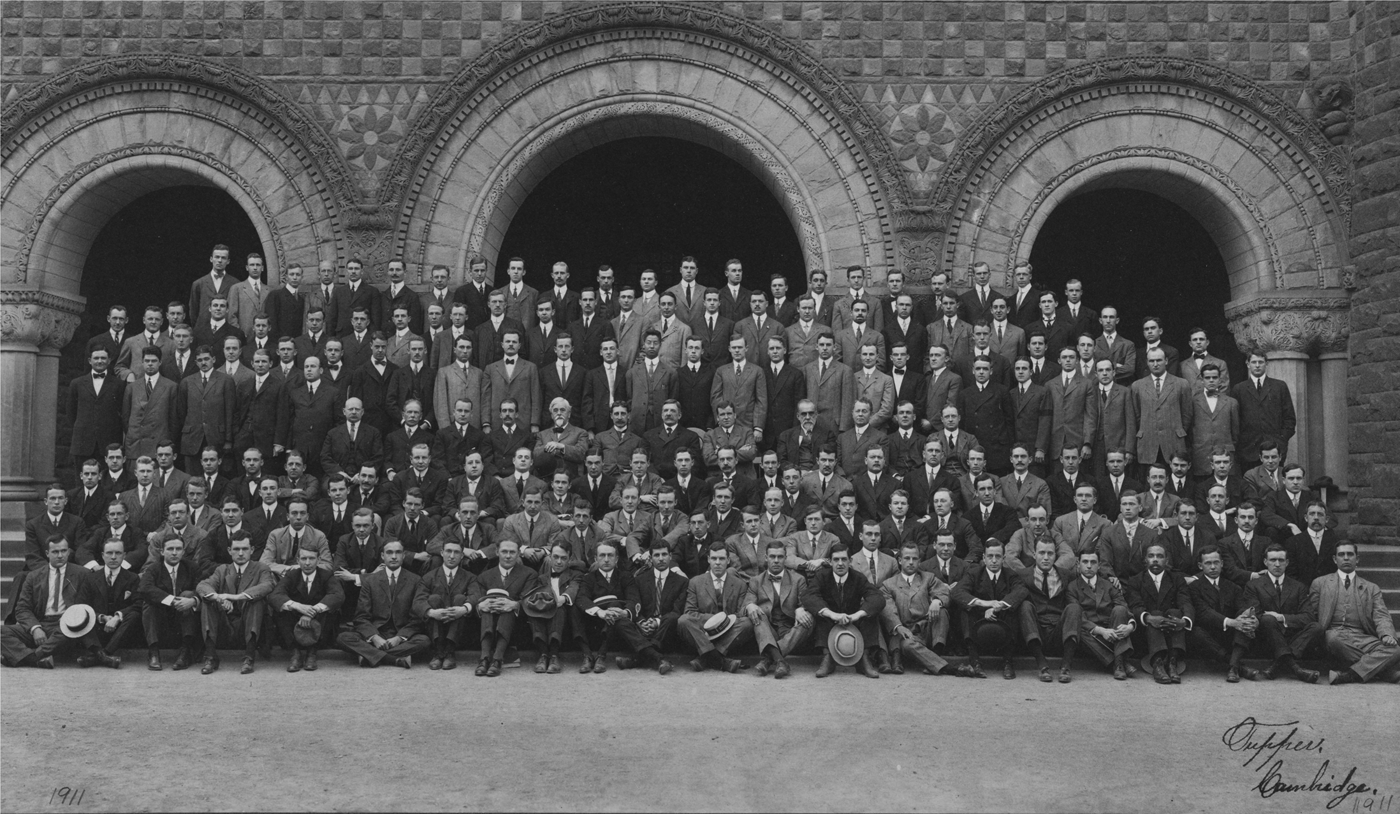
The Harvard Law School class of 1911. Sitting in the fourth row are the faculty and officers from left to right: Joseph H. Beale, Joseph D. Brannan, Austin W. Scott, Secretary Richard Ames, Librarian John H. Arnold, Dean Ezra R. Thayer, Samuel Williston, Bruce Wyman, John C. Gray, Eugene Wambaugh, Roland Gray, Joseph Warren. Photo by Pach Brothers, 1911. Courtesy of Historical & Special Collections, Harvard Law School Library.

When Thayer assumed his post the following September, he naturally did not appreciate “the critical role of the dean in professional school fund raising,” as it is understood today.Footnote 43 Few, if any, deans did at Harvard or elsewhere. But Thayer was apparently the first individual at HLS to comprehend and analyze the financial malaise of the school. In his second year, the dean made an analysis of the trends of expenses, revenue, enrollment, and tuition in prior decades and inferred not only the coming deficits, but also the structural problem of tuition dependence in HLS finances. Thayer balanced the budget in his first year but started running a deficit in the 1911–12 fiscal year.Footnote 44 Soon the university comptroller and president began pressuring him about the budget.Footnote 45 Thayer responded with various strategies: “We are going to try to do the best we can and no doubt shall be able to save something on library expense,” and “the present entering class is larger than the entering class was last year at the same time.” Above all, “if the School is not to suffer seriously we have got to raise an endowment,”Footnote 46 and he began making the case in his annual report for 1912–13 and before various audiences of alumni.Footnote 47
Distaste for other strategies strengthened the focus on endowment. Concerned about excluding talented students with limited means, the dean and faculty resisted increasing the tuition of $150. They held the line even when the rest of Harvard raised tuition from $150 to $200 and the governing boards and prominent alumni urged that HLS follow suit.Footnote 48 Nor did Thayer wish to increase enrollment, largely because he feared the temptation to relax academic standards in order to retain students. In fact, the dean attributed a modest decline in enrollment “to the increased stringency with which we have excluded the poorer men … which I think bespeaks a healthy condition of affairs in the Law School.” Still, the countervailing pressures on increasing tuition revenue and academic standards resulted in the perverse outcome of admitting more students to the first year and then flunking them out.Footnote 49
If the substantive problems were not difficult enough, Thayer also had to cope with the widespread perception that HLS was prosperous. This view arose due to the large annual surpluses that had been accumulating in prior decades and were reported annually in the Harvard treasurer's reports and trumpeted in Eliot's annual reports. By 1914 Thayer realized that this misperception was a serious issue and sought advice about correcting it.Footnote 50 He was referred to the editor of the Harvard Alumni Bulletin to ask for help in “bringing to the public attention some facts about our financial condition,” although, he confessed, “one feels some embarrassment about a public wail concerning the poverty of his institution.” Furthermore, “the idea that the Law School needs money will no doubt surprise most people. The general impression is that the School is rolling in wealth. This is not surprising considering the record of the School.” However, “the conditions which made such things possible were temporary and are now altogether changed, as can easily be shown; and this being so, the impression that we are so rich is not a healthy one.” Drawing on Thayer's writings, the Bulletin published an account of the financial difficulties of HLS, while the editor observed, “The fact that there can be any need for money … will be noted with some surprise.”Footnote 51
Having swallowed his embarrassment and publicly confessed “the poverty of his institution,” it was only one more step for Thayer to envision a public appeal for funds in 1914. This took some initiative because he received no support from the president. Reacting against the policies of Eliot, Lowell deemphasized professional education.Footnote 52 In particular, Lowell omitted HLS from the list of university departments that “are in want” in his annual reports for 1910–11 and 1911–12. This omission may have reflected a broad perception that law schools did not need or could not attract endowment, because the treasurer and president at Yale likewise omitted its law school from their appeals for deserving units, such as the medical school, the music school, and the forestry school.Footnote 53 Moreover, Lowell, a Boston Brahmin, was averse to asking for gifts and provided no help or encouragement to the inexperienced dean, writing to Thayer, “I know little or nothing about begging money. I have not the knack for it.”Footnote 54 It is no surprise, then, that Thayer's initial effort was unfruitful and discouraging.
In the summer of 1913 the HLS faculty learned that Felix Frankfurter, a stellar graduate in the class of 1906, might be recruited to join them from his work as an attorney in the U.S. Bureau of Insular Affairs.Footnote 55 Although the faculty immediately endorsed Frankfurter, no vacancy was available or anticipated. The professors assumed, however, that the law school could raise an endowment to support a professorship for Frankfurter and dispatched Edward Warren to offer a position to him. Frankfurter was receptive and requested a few weeks to seek counsel from his mentors, particularly Oliver W. Holmes Jr. and Henry L. Stimson, both of whom advised against leaving government service. Thayer supported the appointment, and soon Frankfurter agreed to join the faculty.Footnote 56
Then came what the faculty considered the easy part, left to the dean: raising an endowment to support the additional professorship. Thayer enlisted three alumni to lead the effort: Stimson, Louis Brandeis, and Walter Meyer. These reluctant conscripts made little effort or progress through the fall of 1913, despite Thayer's persistent entreaties.Footnote 57 Meanwhile, the dean's personal inquiries to raise money in Boston did not bear fruit. As the end of the year approached, Frankfurter needed to know whether the school could afford to hire him, so Thayer abandoned the search for endowment and tried to scrape together enough smaller annual pledges to cover Frankfurter's salary for five years until a vacancy opened on the faculty.Footnote 58 This approach succeeded in a few weeks as prominent jurists made the necessary commitments. But the entire effort proved unnecessary when a faculty member suddenly resigned in December, opening a vacancy. In January 1914 Thayer proposed the appointment of Frankfurter to the Harvard Corporation and returned the money that he had collected.Footnote 59 Frankfurter then joined the faculty for the 1914–15 academic year.
This modest fund-raising effort must have deflated Thayer. The donors were reluctant, the alumni were unhelpful, and the faculty did not grasp the difficulties. In April 1914 he was therefore heartened when the New York City chapter of the HLSA proposed that a fund-raising campaign be held in conjunction with the centennial of the school in 1917. Thayer immediately wrote back “that the coming anniversary might make just the occasion for some substantial demonstration in tangible form from the graduates. I shall be much interested to know what the … committee thinks is the right way to go at it.”Footnote 60 Thayer's words suggest that he regarded such a campaign as the responsibility of the graduates, not the dean.
The alumni effort began auspiciously. In June 1914 a study committee of the New York chapter recommended procedural steps: that the national HLSA assume responsibility for the campaign and appoint “committees throughout the country to assist in the raising of such fund.” Meanwhile, the New York City district, being the wealthiest and strongest, would “appoint a Committee of Seven, to be known as the Centennial Endowment Fund Committee, … to confer with the authorities of Harvard University and … assist in raising the proposed endowment fund.”Footnote 61
All this was precisely what Thayer had been seeking, yet he expressed frustration with the details of organization and with specifying and justifying the financial needs of the school. “The situation with me,” he wrote, “is simply and solely that we need money and need it badly. I do not care in the least for what purpose it is given. We need it for all purposes, and it would be as acceptable for one as for another. … As to a Committee, my notion was that New York would be the center, that a small Committee was better than a large one, that whenever it was appointed President Lowell and I had better … confer with them about methods. As to its personnel, my ideas would be summed up in two propositions, (1) that they should be men who cared for the School enough to work for it, and (2) that they should have the gift (a miraculous one to me) of getting hold of money.”Footnote 62 Again, the dean seemed to be looking to the alumni to lead.
At this point, the initiative stalled. One reason is that even prominent and supportive alumni, such as Louis Brandeis, did not share the dean's sense of urgency that “we ought to get to work at once” preparing for the centennial. After six months elapsed with little progress, Thayer appealed to Brandeis for help in recharging the effort, but the latter replied in December 1914, “It is no doubt true that the coming Centenary of the founding of the Law School might be utilized for raising a considerable endowment for the School;” however, “as the needs of the Law School for added revenue are not urgent, … we might await the making of the attempt to raise the endowment fund, say two years hence.”Footnote 63
Thayer must have found Brandeis's response discouraging. An active alumnus, Brandeis underestimated the financial problem and overestimated the capacity of the alumni to help. But he did qualify his optimistic assessment with the proviso that “in the Law School Association, if revivified, we have the proper instrument for accomplishing this.”Footnote 64 Here was the second reason for the delay. The alumni association was nearly moribund,Footnote 65 though Thayer had been trying to invigorate it since he arrived.Footnote 66 In May 1915 he was so hungry for alumni involvement that an invitation to speak to the Associated Harvard Club in Utah made his “mouth water” because he was “most anxious” to energize the HLSA.Footnote 67
Nearly a year passed before the New York committee and the HLSA committee met in about July 1915. By that point the dean was so depressed that he could not work, a condition aggravated by feeling “ashamed and disgusted” at his incapacity.Footnote 68 Having graduated first in his class both from Harvard College and from Harvard Law School, Thayer had served as legal secretary to U.S. Supreme Court Justice Horace Gray; and the depression likely stemmed from his intensely conscientious perfectionism combined with harsh self-criticism. As a result, he was besieged with unrelenting doubt about his fitness to be dean from the moment he assumed office. The combination of superlative standards and extreme self-doubt was wholly unsuited to the deteriorating and intractable situation of HLS in the 1910s, following its meteoric ascent in the preceding decades. Spiraling downward in the succeeding months, Thayer committed suicide in mid-September 1915.Footnote 69
Following Thayer's death, little seemed to change at first. Professor Austin W. Scott became acting dean and wistfully “hoped that eventually the friends of the School will by means of an endowment save the Library from its present hazardous dependence on necessarily fluctuating tuition fees.”Footnote 70 Early in 1916 Lowell appointed a permanent dean. Roscoe Pound had been the first professor hired by Thayer, who looked to him to lead “the work we owe the community in advanced study of comparative law, administration, legislation, and law reform.”Footnote 71 Soon Thayer came to rely on Pound for administrative assistance and advice on virtually all issues concerning the school, and Pound was influential in arranging the Frankfurter appointment and attempting to endow it. As Thayer's depression deepened in spring 1915, he looked to Pound to substitute for him at meetings and answer his mail. By the time of Thayer's death, Pound was acting as the dean's lieutenant, and his subsequent appointment was not surprising.Footnote 72
Shortly after Pound became dean, Lowell began pressing him, “You know that I look to you to make the ends meet in the Law School budget. That is one of your jobs.”Footnote 73 Like Thayer, Pound did not believe that raising tuition solved anything and argued the point in his annual report for 1915–16. Nevertheless, Lowell in his report announced a tuition increase to $200 across the university, pointedly observing the exceptions of the divinity school, which was bound by external commitments, and the law school, which, implicitly, had no excuse. Pound and Lowell continued to joust over this point.Footnote 74
Meanwhile, alumni planning for the centennial campaign continued to flounder. The New York committee and the national HLSA committee corresponded with each other for nine months through spring 1916, making no progress and seeking to avoid responsibility. One disgusted alumnus wrote that the HLSA “has been warding off being put in default by answering a note from the New York Committee when the New York Committee wrote to them, and the New York Committee has been warding off being put in default by sending an answer to this Harvard Law School Association committee every time they wrote to them. In my opinion that will go on indefinitely and nothing will be done. The … men selected by the Harvard Law School Association to raise this endowment fund are about as capable of doing it as a dandelion is of sustaining a boulder weighing twenty tons.” This complaint was made to Pound, who, like Thayer, seemed unwilling or unable to take charge of the campaign, although he provided summary statements outlining the financial needs of the school and the danger of depending on tuition.Footnote 75 But he offered no more help in response to inquiries from Lowell and others: “What about the endowment fund? Have you any general plan? What do you think we ought to do out here? What steps if any have been taken in New York?”Footnote 76 Yet, Pound stood apart from the effort in spring 1916.
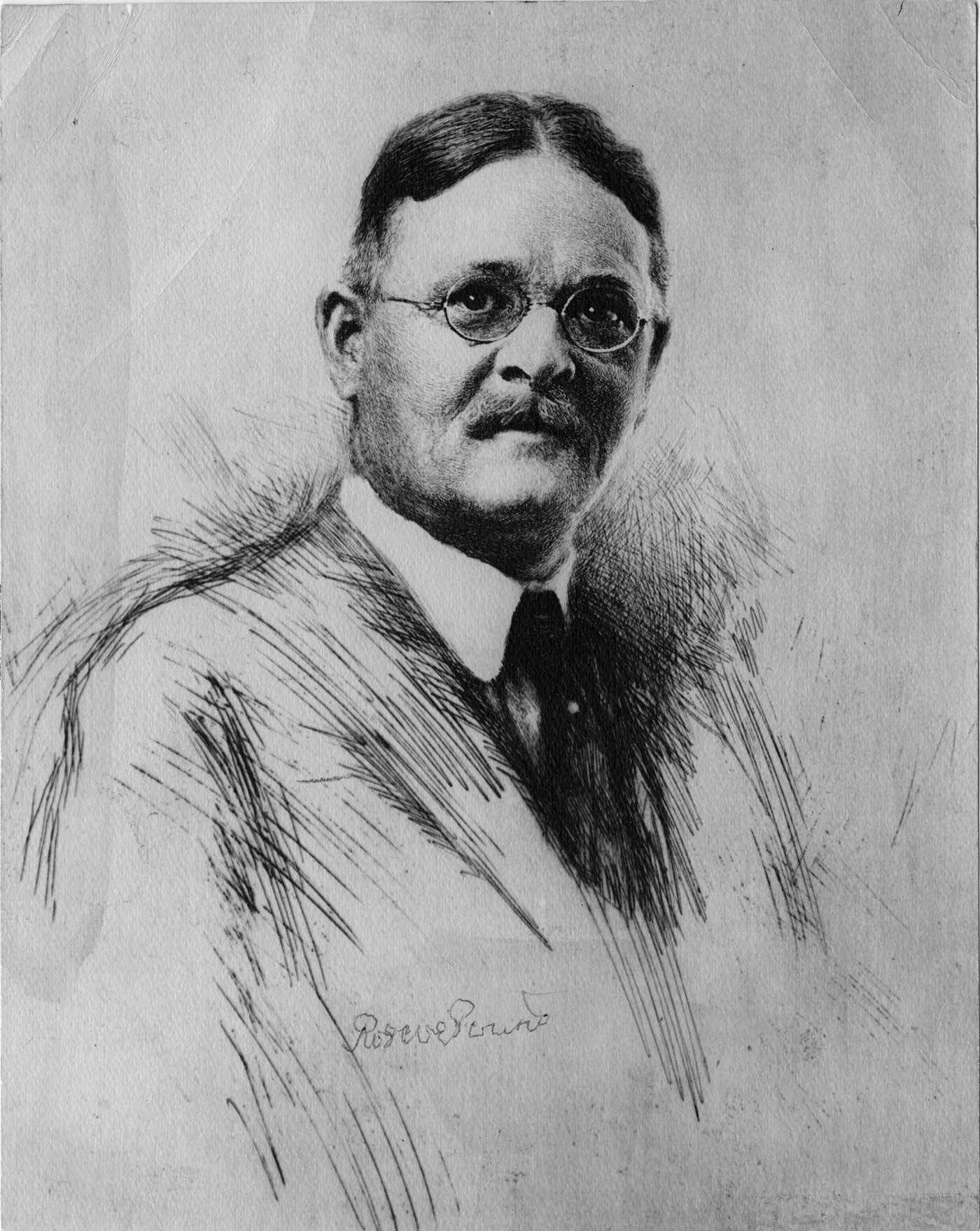
Roscoe Pound, dean of Harvard Law School, c. 1920s. Artist unknown. Courtesy of Historical & Special Collections, Harvard Law School Library.
Notwithstanding these discouraging continuities, Thayer's suicide did prompt change. Lowell adopted a new tone: “We seem to be overworking our best Professors, tiring them out. The death of Dean Thayer was a warning.” Lowell worried especially about overworking the new dean, writing that Pound “feels that he is being driven very hard. He cannot reduce his teaching, and the work of begging, in addition, is likely to be more than he can support … perhaps we can find some other people who can ‘spell’ and spare Pound.”Footnote 77
The president also began to lobby for HLS. Soon after Thayer died, he discussed with the Harvard Corporation “raising an endowment for the Law School at the centennial in 1917,” and the governing board encouraged HLS “to confer with the joint committee of the Corporation and Overseers on the resources of the University.”Footnote 78 In his annual report for 1915–16 Lowell wrote for the first time that the law school's “endowments are small in comparison with the work to be done, and have not grown with enlargement of the student body … [T]he one hundredth anniversary of the founding of the School … would seem an appropriate occasion for increasing the endowment, and providing new professorships.”Footnote 79 Finally, Lowell began to serve as the main contact at Harvard for the HLS centennial campaign. Pound kept to the side, while the president corresponded with alumni organizers about the strategies, timeline, and goal, recruited the campaign chairman, and solicited prospective major givers.Footnote 80
Thayer's suicide also spurred the HLSA Committee, which asserted that Thayer had championed HLS and the centennial campaign “at the cost of his life.”Footnote 81 Hence, “there is no better advance agent than Thayer himself and no more fitting memorial to him.”Footnote 82 Acknowledging the lethargy of the alumni, as well as their “general and widespread ignorance” about “the present condition of the School,”Footnote 83 the committee in July 1916 issued a pamphlet memorializing Thayer and sent it to every alumnus as “an immediate sign of activity on the part of the Association and a fitting preliminary to the approaching centennial.”Footnote 84 In addition, the committee envisioned publishing a centennial history of the school and distributing it to the alumni and hosting a centennial celebration in Cambridge during June 1917.Footnote 85
Meanwhile, the committee had been seeking a chairman to take charge of the campaign, believing that “there is but one way of getting that money and that is to put the whole matter in the hands of one person … who has the confidence of … men of wealth. Two million nor … one million dollars cannot be obtained from the alumni of the Law School alone.”Footnote 86 While Pound looked on, the HLSA committee identified a candidate whom Lowell approached without success.Footnote 87 Finally, in July James Byrne, an HLS graduate of 1882 and a lawyer from New York City, reluctantly acceded to the pleas of Lowell and HLSA leaders to serve as chairman.Footnote 88 From this point, others stepped away and left it to a three-person executive committee and, primarily, to its reluctant chairman to guide the effort to raise a million dollars or more in the next eleven months.
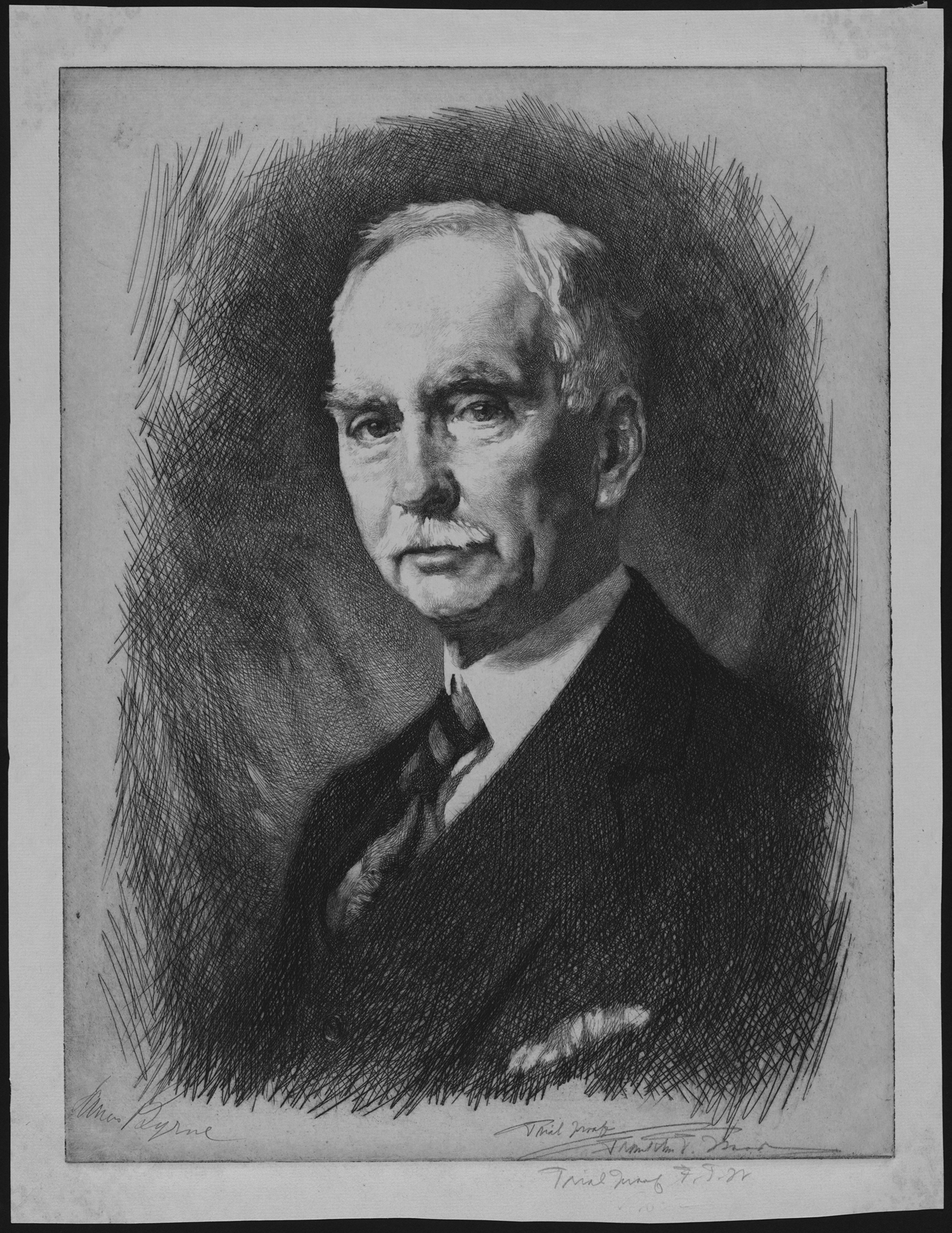
James R. Byrne, graduate of Harvard in 1877 and Harvard Law in 1882, chair of the ill-fated HLS fund-raising campaign. Engraving by Frank Moor. Courtesy of Historical & Special Collections, Harvard Law School Library.
During fall 1916 the HLS faculty commenced its primary contribution to the campaign: preparing the Centennial History. Intended to make the case for endowing the school,Footnote 89 the 400-page Centennial History was a composite work, overseen by Pound, Professor Joseph H. Beale, and HLSA president Frank W. Grinnell. But Beale served as the guiding editor and wrote anonymously the three opening chapters, setting forth a 120-page narrative history of the institution, the instruction, and the library. He also assigned to various professors and alumni the task of writing the four supplementary chapters and 250 pages of appendices. Beale and Pound harnessed Assistant Professor Zechariah Chafee Jr., hired in 1916 and soon to be famous for his writings on freedom of speech, to the irksome task of administering the many details of producing the volume and gathering drafts for review by Beale.Footnote 90
The narrative of this widely distributed and seemingly authoritative version of HLS history was tendentious in certain respects. In particular, Beale glorified his mentor Ames, whose contributions were exaggerated and shortcomings overlooked. In its conclusion, the Centennial History presented the financial needs of the school, observed that the endowment of the medical school was nearly six times that of the law school ($3,632,000/$620,000), and concluded that because “increase of tuition is not the remedy,” the law school needed a healthy endowment to maintain its standards.Footnote 91
The HLSA membership and executive committee meanwhile accomplished little during fall 1916, except that Chairman Byrne secured one significant gift—his own—endowing a professorship. Also, he and Lowell cooperated in soliciting some potential benefactors, while the dean offered advice but never mentioned the centennial campaign in his annual reports.Footnote 92 Yet, Pound was not inactive. He and Frankfurter were seeking funds for endowed professorships of their own design. Initially enthusiastic about Pound's effort, Byrne soon voiced some frustration because the executive committee was evidently told to restrain their effort and leave the field open for Pound and Frankfurter to raise money for their favored projects, including a professor of criminal law.Footnote 93
Some competition also arose from New Haven where Yale administrators were tracking the financial standing of HLS, and the centennial campaign doubtlessly attracted attention. Notwithstanding the willingness of the Yale administration to let the law school depend on tuition, Dean Henry W. Rogers had appealed for endowment in his annual reports for 1912–13 and 1913–14. He went further at the end of 1915, as HLS was formulating its plans, declaring that “we were the first to establish such courses … for the study of International Law, General Jurisprudence, Roman Law and Modern Continental Law,” and Yale Law School needed endowment “to establish, what does not exist as yet in America, a School of Jurisprudence.”Footnote 94
These claims did not go unnoticed in Cambridge, where Dean Pound in his annual report for 1915–16—later mailed to all HLS alumni—announced the needs of HLS. Without mentioning Yale explicitly, Pound dismissed Rogers's proposal: “How are these new demands upon the American law school to be met? One way might be to set up a ‘school of jurisprudence’ with pretentious courses in jurisprudence, philosophy of law, comparative law, theory of legislation, administrative law, and criminology, perhaps adding a certain number of ‘research professors.’ Such a plan has many advocates and some such schools are not unlikely to be established in the near future. But … since the life of the law is in its concrete application, those who taught in such a school, divorced from the living law taught in the professional curriculum, would not be likely to achieve the results which alone could justify the large endowments demanded.”Footnote 95
Undaunted, Rogers's successor, Dean Thomas W. Swan, reaffirmed in his annual report for 1916–17 “the intention of this School” to address “the scientific and theoretical side” of law. In November 1916 the faculty issued a pamphlet proposing A Program for the Expansion of the Yale School of Law into a “School of Law and Jurisprudence,” which would require $500,000 for a building and “at least 2,500,000 dollars, and probably more” in endowment. In March 1917 the Yale Alumni Weekly reprinted this pamphlet “for confidential distribution among friends of the school.”Footnote 96 In response, Pound and Beale, who were concurrently finishing the Centennial History, took one more swipe at the Yale proposal in their concluding call for funds: “The right line of development is not to set up a pretentious ‘school of jurisprudence’ with elaborate courses in every phase of legal science and perhaps a number of ‘research professors.’”Footnote 97
Notwithstanding this exchange, the Yale proposal does not seem to have yielded any gifts or presented a substantive threat to the HLS campaign. The strongest competition arose within Harvard from the Harvard Endowment Fund drive that Harvard College alumni began planning early in 1916. The HEF aimed to raise at least $10,000,000 of unrestricted endowment for use by the university governing board. In organizing the first such campaign in higher education, Harvard had to stem the customary practice of “miscellaneous begging.” This was the traditional approach that any department could pursue fund-raising at any time it chose without coordination or approval by the central administration. After careful negotiation, Harvard's governing board introduced the policy that, “while the endowment fund campaign is underway, the University must temporarily restrain all miscellaneous begging.”Footnote 98
Applied to HLS, the new policy seemed unfair, however, because the school had begun planning the campaign earlier and because the centennial entailed a time limit. Lowell therefore asked the HEF chairman, Thomas W. Lamont, to meet with Byrne and discuss some accommodation permitting HLS to solicit “the graduates of the law school and outsiders who would not be interested in the University otherwise.”Footnote 99 In February 1917 Byrne and Lamont met and agreed to this arrangement.
However, the meeting also revealed that the HLS campaign was still floundering. Chairman Byrne presented himself as “the unofficial head” who did not know exactly how much money HLS hoped to raise or the specific purposes apart from “several professorships, and then, in addition, … if possible, a couple hundred thousand dollars, of course more, if feasible.” HEF leaders were surprised that the HLS leadership was so vague and its plan so uncertain, compared to the highly organized HEF campaign.Footnote 100 Sensing this perception, Byrne wrote to Lowell somewhat defensively two weeks later, at the beginning of March, that “the delay so far has been caused (a) by the hope that [Pound and Frankfurter] might succeed in getting something and (b) by the general vague expressions which came from all sides that we should not interfere with the HEF.”Footnote 101
Having resolved the latter issue with Lamont, Byrne decided that “the general appeal is not to wait upon [Pound's and Frankfurter's] action any longer.” He then optimistically proposed a two-week blitz for large gifts preceding a general canvass before June: “The important work is to have someone raise 50 or 75 or 100,000 in the next two weeks in Boston. In New York we have 30 or 35,000 already promised … 50,000 dollars can certainly be obtained in New York, probably 75,000 dollars and possibly 100,000 dollars in the next fortnight. If 200,000 dollars can be obtained in that time and added to the other 150,000 dollars we are in a position to say in the general appeal that 350,000 dollars has been collected and we wish to double the amount. … If we can get 500,000 dollars for our Law School Fund by June I think we shall be doing very well. … We can only do it if a Boston committee will see what it can get during the next two or three weeks.”Footnote 102
Lowell dutifully tried to find a Boston chairman for the centennial campaign and, after at least one rejection, finally convinced his cousin Arnold Lowell, the treasurer of HLSA, to fill the role.Footnote 103 Meanwhile, the executive committee composed a two-page general appeal that was mailed to all HLS alumni on March 31. The appeal stated, “The school needs an endowment of at least one million dollars. The present tuition fee of one hundred and fifty dollars cannot be raised, because it would mean the loss of students who should be encouraged to come … Is it too much to hope that this school, without a peer in the past and with the certainty of realizing a future equal to its past, should have an adequate endowment for carrying on its work as a birthday present at its Centennial Celebration?” A pledge card was enclosed, along with Pound's annual report for 1915–1916 specifying financial needs of the school pertaining to physical plant, faculty, instruction, graduate education, research, and general endowment.Footnote 104
Soliciting proceeded through the tumultuous spring of 1917, and notices appeared in the newspapers, announcing a goal of $1,000,000.Footnote 105 On April 6, 1917, the United States entered World War I, and a few weeks later the HEF decided to postpone its drive. Yale also delayed its plan to build “A School of Law and Jurisprudence,” although the Yale trustees agreed to hire four more professors after thirty-one alumni promised to “guarantee” any debt that resulted.Footnote 106 In effect, this arrangement confirmed the rule that the law school was responsible for generating its own revenue and deserved neither a subvention from the university nor an endowment from its alumni.
Meanwhile, Lowell and some alumni argued that HLS should postpone its centennial event.Footnote 107 Involving himself for the first time, Pound urged going ahead,Footnote 108 and in May the school and alumni made detailed plans for the celebration in conjunction with the Harvard commencement in late June and invited U.S. Supreme Court Justices to speak.Footnote 109 Finally, HLSA canceled the celebration in early June, and notified the alumni. Hoping to realize something, Pound appended to the notification his own appeal for subscriptions of ten dollars from recent graduates and twenty dollars from older graduates to meet the anticipated deficit that HLS would face through loss of enrollment during the war.Footnote 110 He also arranged for the newspapers to publish the projected deficit and wrote to some donors to see if they would honor their centennial pledges.Footnote 111 Through the end of 1917, a few more pleas for endowment were published, including a preprint of the 160-page narrative section of the Centennial History, which the HLSA mailed to every alumnus.Footnote 112
As Pound feared, many HLS students soon joined the legions leaving higher education for war-time duty. Whereas 857 students began the 1916–1917 academic year, only 292 students enrolled at the start of 1917–1918. As a result, HLS suffered “the greatest loss” of revenue among schools and departments at Harvard “owing to the comparatively small amount of endowment” and “the diminution in tuition fees.” In the fall of 1918 HLS enrollment fell to sixty-eight, and Lowell suggested to Pound raising tuition.Footnote 113
Nevertheless, the school remained solvent. Expenses were pruned, especially salaries, as faculty also departed to help the war effort. The large enrollment in 1916–17 produced a surplus of more than $26,000, bringing the accumulated surplus to nearly $77,000. Despite the deficit during 1917–18, the surplus stood at over $45,000, and “the prospect, even if we have but a handful of students, is not at all discouraging,” Pound wrote to the president in August 1918.Footnote 114 Indeed, the school broke even in 1918–19 and ran a surplus of nearly $26,000 in 1919–20.Footnote 115
Still, the finances of HLS had worsened considerably because war-time inflation, running 79 percent from 1915 to 1920, severely diminished the value of the reserves, endowments, and tuition throughout higher education. Early in 1919 Lowell made a few private appeals, and some alumni hoped to resume the centennial campaign as soon as the war ended. The executive committee had dissolved, however, and Byrne became a member of the university's governing board and began soliciting for the HEF when it restarted in spring 1919.Footnote 116
During the summer, the HEF actively involved Pound. In fact, it appeared that the revived phase of the HEF campaign would explicitly include HLS, so Pound participated enthusiastically.Footnote 117 However, Lowell did not support the inclusion of HLS among the priorities of the university campaign, and the school's needs were dropped from the HEF list to Pound's disgust.Footnote 118 The challenge fell to the HLSA, which published the complete Centennial History and, in concert with the law faculty, planned “a great reunion of the graduates of the school” for June 1920.Footnote 119 Highlighted by speeches from the dean and former U.S. Supreme Court justice Charles Evans Hughes, the event was held, but little money was raised, and the centennial campaign quietly expired.Footnote 120
It is telling that no definitive records exist of the total amount contributed toward the goal of $1,000,000. No one at HLS, including the dean, assumed responsibility for keeping books or acknowledging gifts, and the amount received scarcely required bookkeeping anyway. But the general outcome is clear.
The lone major gift was the $150,000 from Byrne to endow a professorship in administrative law.Footnote 121 The second largest gift came from a non-alumnus, non-lawyer, and industrialist from Chicago, Max Epstein, who donated $50,000 to HEF for the purpose of providing repayable loans to law students. No one knew quite what to do with this donation, and some records treated it as an anomaly, not a gift to either HEF or HLS.Footnote 122 The third largest donation of $10,000 came from an alumnus, and all others were a thousand dollars or less with the vast majority a hundred dollars or less. The fullest tally lists about 183 gifts totaling less than $250,000.Footnote 123 The HLS centennial campaign therefore netted less than a fourth of its goal and received donations from about 2 percent of its 8,700 living former students.Footnote 124 A closer examination of some of the givers and non-givers makes the outcome even more pathetic.
Abbott Lawrence Lowell, president of Harvard University, c. 1910. Courtesy of Harvard University Archives.
Many of the small donations of $100 dollars or less came from lawyers working at prominent law firms and banks who were earning at least $20,000 annually.Footnote 125 For example, in 1897 HLS had offered a professorship to Blewett Lee, a 1888 LL.B., and he declined, unwilling to relinquish or curtail his lucrative law practice. Though a successful attorney who had turned down a professorship in order to make money, Lee gave what he admitted to be only a “little contribution” of $100 for the centennial campaign.Footnote 126
Meanwhile, many HLS graduates did make large gifts, but not to the law school. At least thirty individuals who graduated from both Harvard College and HLS gave $10,000 or more to HEF and nothing to the law school. Ten such individuals gave between $25,000 and $85,000 unrestricted to HEF and nothing to HLS. Moreover, at least six individuals who had graduated from both the college and the law school gave restricted gifts of between $20,000 and $50,000 to other parts of Harvard, particularly the arboretum or the school of education, rather than HLS. These givers included President Lowell. Even more striking, five HLS alumni whose only association with Harvard was graduating from the law school gave $10,000 or more to the HEF and nothing to HLS.Footnote 127 Fifteen such alumni who lived in New York gave between $1,000 and $25,000 to the HEF and nothing to HLS.Footnote 128
In fact, several figures closely associated with HLS gave $10,000 or more to the HEF and nothing to the HLS centennial effort. These included one of the three members of the executive committee of the HLS campaign, the widow and son of Professor John Chipman Gray, who had taught at HLS for nearly thirty years, and the widow of James Barr Ames, who had taught for forty years at HLS and was lionized in the Centennial History. Virtually no one had responded to pleas that the centennial was “the time when the alumni of the School and of the entire University and the other friends of Harvard must provide a sufficient endowment for its great law school” on the occasion of its centennial.Footnote 129 Why not?
Certainly, the tragedies of Thayer's suicide and World War I interrupted and weakened the campaign, but these untimely events alone do not explain all, or even most, of the outcome. Another reason was that the centennial campaign ran into difficult competition both nationally and locally. As early as May 1916 some HLS alumni began warning that “all we can spare ought to go to the relief of the sufferers” in the war rather than to their alma mater.Footnote 130 As the hostilities intensified in Europe, broad solicitations for disaster relief began to compete with other fund-raising. During the very week planned for the centennial celebration, June 18–25, 1917, the school watched as the reorganized and energized Red Cross raised more than $114,000,000 in an unprecedented national fund-raising effort.Footnote 131
Within Harvard, prominent HLS alumni warned that the centennial campaign, even though it started earlier, could not and should not compete with the HEF: “No matter what arrangements are made … for the purpose of avoiding conflict or of allowing contributions to be divided between the two Funds, … I feel sure that the chances of obtaining an endowment for the Law School would be seriously affected by the work for the other Fund.”Footnote 132 This warning reflected the facts that alumni generally felt a stronger allegiance to their college than their professional school and that many university policies favored graduates of the college above the professional schools. For example, graduating professional students who were not Harvard College alumni could not obtain tickets to commencement until HLS dean Thayer appealed to the president to change the rule. Similarly, Harvard did not recognize the graduates of professional schools as full-fledged alumni with the right to vote for Overseers or to join the alumni association of the university until April 1916.Footnote 133
Nevertheless, HEF honored the “very satisfactory arrangement” with the HLS centennial campaign until the middle of 1917.Footnote 134 The hiatus of the war, however, seemed to make the HEF impatient, and, when both campaigns tried to resume in 1919, the university drive marginalized the law school in a number of ways. HEF recordkeeping classified donors by their Harvard College class and did not recognize the classes of professional schools, even if the alumnus had not graduated from Harvard College. Intent on gathering unrestricted endowment, the HEF did not keep careful lists of restricted gifts to parts of Harvard.Footnote 135
Nor did the HEF announce that gifts could be restricted to HLS or even inform HLS graduates who made a gift of this possibility. By default, donations from HLS graduates were credited to the unrestricted total, and some complained about this practice.Footnote 136 A striking example of this default occurred when Lamont received a letter from a wealthy graduate of both Yale College and HLS who had read about the HEF and offered to help, and Lamont made no reference to the HLS campaign.Footnote 137
Furthermore, some HEF agents misrepresented the destination of contributions from HLS alumni by incorrectly telling them that the school would share proportionately from any donations made to HEF. Hence, Pound later wrote resentfully that “those in charge of [the HEF] used the Law School to procure money from our graduates by creating the impression that we were to share in the money. There never was the faintest intention that we should share.”Footnote 138 Finally, Lamont and others began actively soliciting HLS graduates for the HEF even if they had no connection to any other part of Harvard. Only when HEF was satisfied that it could not extract anything from an HLS graduate would it refer that alumnus to the centennial campaign.Footnote 139 The law school thus lost in the competition with the university campaign.
These HEF tactics were successful because, third, the HLS campaign was poorly managed. The organizers wasted time in needless delays. When they finally began requesting volunteers to help with solicitation, prominent HLS alumni declined because “in order to raise any considerable amount in the short time remaining … it would be necessary for me to devote all my time,” as one wrote.Footnote 140 Also, their strategy was apparently to write, publish, and disseminate statements and expect contributions to arrive. Pound devoted most of his effort to writing visionary statements to be printed and mailed or delivered as speeches, usually to those actively involved in the campaign. He did little visiting of prospective donors or even writing personal letters. Nor is there any record that the alumni leaders did so. They seemed to believe that issuing a persuasive brief would elicit donations. In contrast, the HEF organizers and staff acted on the rule that in fund-raising “personal solicitation is the only satisfactory method.” Writing statements “results in very few subscriptions.”Footnote 141
Even had the strategy of writing and publishing appeals been sound, the HLS publications fell short of the rhetorical standard espoused by one of Harvard's leading fundraisers: “Campaign literature … demands an English style strong, direct, and suggestive, the handling of facts in a way to stimulate the imagination and the kindling of a generous sentiment.”Footnote 142 Most of the HLS appeals, particularly those of Pound, read like legal briefs, setting forth abstract arguments with passive constructions, parenthetical qualifications, and double negatives, while lacking specific facts appealing to imagination or sentiment. Even in the public press, such statements appeared:
The permanent maintenance of civil liberty depends upon the ultimate control through civil institutions of the belligerent tendency in human nature, whether of a domestic or international character, and this requires the training and scattering through the community of the most highly trained minds that the country can produce. The training of such minds has been the great contribution, not only of the Harvard Law School, but of the other leading law schools in the country in the past, and it is essential that this work should continue at its highest practicable standards in the midst of, and as a part of, the campaign in support of civil liberty under law, the defense of which is the professed object for which this country has entered the European war. If the alumni will read this account of the school and its development and reflect on the significance of the service of scattering through the country highly trained minds for the practical study of the multitude of problems of civil liberty under law, the unique opportunity offered by this anniversary … will not have been wholly lost.Footnote 143
Such prose could scarcely kindle a generous sentiment, particularly in contrast to the HEF literature:
American universities are constantly on the verge of insolvency. They are forced to live from hand to mouth; teachers are underpaid; equipment does not keep pace with modern demands; as educational institutions they will be unable to keep up to standard. And Harvard is no exception. … Two obstacles stand in their way and threaten to reduce them to mediocrity within the next twenty years. First, the insufficient pay of university teachers, which inevitably will result in a poorer grade of teachers. Second, lack of funds for adequate budgets and thorough equipment.Footnote 144
The inept management reflected, fourth, the weak leadership of the centennial campaign. The president did not support the effort until Dean Thayer committed suicide. The next dean, Pound, engaged the campaign selectively, largely confining himself to composing statements and rarely interacting directly with the alumni leaders. Left to organize the effort, the lethargic alumni association dithered, and its leaders were difficult to contact and unresponsive, according to HEF staff. Apparently wishing to do as little as possible, the HLSA leaders sought to find a campaign chairman who would take over “the whole matter” and hoped that one of the recently formed Carnegie or Rockefeller Foundations would meet the goal with one large gift and thus end the campaign. The situation was exemplified by alumnus Joseph P. Cotton, one of the most prominent figures in the HLS campaign. Cotton ultimately gave $20,000 to HEF and nothing to HLS, which, he hoped, would secure its funds from Carnegie or Rockefeller.Footnote 145
Still, HLS alumni were certainly capable, energetic, and willing to lead fund-raising efforts other than the law school campaign. HLS alumni who were partners of leading Boston law firms, such as Thomas N. Perkins, filled key positions for the HEF. In fact, four HLS alumni contributed $2,500 each, apart from their gifts, toward the operating expenses of the HEF office, while giving nothing to HLS.Footnote 146 Consequently, a fifth and deeper reason for the centennial failure was the “apathy” pervading the HLSAFootnote 147 and the “pessimism” surrounding the HLS campaign.Footnote 148
These sentiments might be explained by the disaffection attributed to students and alumni due to the destructive academic competition, anxiety, and depression said to have arisen at HLS by the beginning of the twentieth century. This disaffection has been attributed to the meritocratic reforms that Langdell instituted between 1870 and 1886. However, recent research has indicated that those factors did not emerge until the 1920s and 1930s.Footnote 149
Instead, the apathy—or reluctance to give—was likely rooted in the self-satisfaction, or pride, of those associated with HLS during this period, as discussed above. HLS refused to humble itself by admitting any shortcoming. The centennial literature persistently argued that HLS needed funds in order to maintain its preeminence—a rationale that scarcely prompted an urgency to help. In addition, the centennial literature evinced, in Thayer's words, “some embarrassment about a public wail concerning the poverty” of the school. Hence, the literature equivocated about the gravity of its needs: “The situation of the Law School is precarious. This is not from any weakness in the school or its faculty.” Reluctance to admit a shortcoming similarly explains why no reference to the centennial campaign appears in the records of the school's next fund-raising campaign held during the 1920s.Footnote 150 Within five years, the utter failure had been erased from institutional memory.
In contrast, the HEF campaign was not reluctant to confess “that Harvard's financial position is not secure”Footnote 151 and that “the present crisis confronting the university” is profound.Footnote 152 Meanwhile, the self-glorification and equivocation of HLS literature prompted apathy and pessimism among both solicitors and givers.
Precedent reinforced the lack of urgency and reluctance to give. HLS had no established custom of soliciting or receiving benefactions. Since the mid-1890s, President Eliot had treated the law school as the one “tub” at Harvard that could float on tuition indefinitely and did not need gifts for endowment. In addition, the myth of the prosperity of HLS remained strong, despite Thayer's efforts to extinguish it. Some published appeals for the centennial campaign attempted to debunk the myth, but it still crept in, and HEF leaders still credited it.Footnote 153 In fact, when HEF assembled data to demonstrate the budget shortfalls of various parts of Harvard, the figures revealed that only HLS was running a healthy annual surplus in 1920.Footnote 154 In addition, the firm resistance of HLS to raising tuition contributed to the view that it must be prosperous, and allies warned HLS about this perception.Footnote 155
Furthermore, some alumni were reluctant to support HLS because they opposed the progressive politics of the faculty. Three issues stoked this opposition. First, members of the faculty endorsed President Woodrow Wilson's nomination of Louis Brandeis to the U.S. Supreme Court in January 1916.Footnote 156 Second, immediately following the war, HLS professor Felix Frankfurter became controversial for his supposedly Zionist and radical political views.Footnote 157 Third, Harold J. Laski, HLS instructor, gave a speech in October 1919 on behalf of the striking Boston police officers, arguing that everyone had a right to affiliate with any labor organization or union.Footnote 158 Faculty involvement in these respects riled some of the alumni but did not cost many contributions. In fact, Lowell argued that, apart from the principle involved, upholding academic freedom attracted greater contributions than any that were lost.Footnote 159
Underlying all these other factors, however, the resistance to donating was apparently founded in prevailing views of the legal profession and its relation to legal education. The extant correspondence pertaining to the centennial campaign contains little testimony from those refusing to give. However, in 1914 Dean Thayer had asked the secretaries of the local chapters of the HLSA to request that the members of each chapter support a scholarship for a student at HLS. The replies “were uniformly discouraging, the corresponding secretaries all stating that there was no prospect of raising any money.”Footnote 160
In explaining their views, HLS alumni repeatedly distinguished between “law school scholarships,” which they opposed, and “college scholarships,” which they strongly supported.Footnote 161 HLS students, they felt, did not deserve scholarship help, because such professional training served their own interests. Nor did they really need help because they could make their own way, having already earned a bachelor's degree. Even if law students were destitute, then poor undergraduates in Harvard College ought to be helped first. In fact, discouraging destitute law students might be beneficial, because “the country is not only in danger of having too many lawyers, but such a condition already exists. The establishment of law school scholarships therefore has the effect of artificially forcing men who would probably otherwise make themselves useful in some less crowded line of work into a profession already too much over-crowded.”Footnote 162
These objections were not new. Remarkably, Dean Langdell in 1882 had itemized these same objections when appealing for scholarship aid for students. “First, it is said that young men study law for their own advancement in life, and not with any view to serving the public.” In addition, “it is sometimes said that a young man who has received a good college education ought to be able to make his own way.” Finally, it is believed “that the attractions of the profession are so great that too many, rather than too few, enter it; and hence it neither deserves nor needs any pecuniary support from the public.”Footnote 163
These objections identified by Langdell in the 1880s and echoed to Thayer in the 1910s reflect the longstanding American animus toward lawyers that prevailed in the colonial period, intensified in the Jacksonian period, and persisted subsequently. Whether due to the seeming amoralism of the advocacy system, or the fact that lawyers must lose half their cases, or the traditional English hostility toward lawyers,Footnote 164 this cultural animus was a foundational reason for the failure of the centennial campaign to attract support from those inside the legal profession as well as those outside, including, perhaps, those running the HEF campaign. Thus, the Centennial History observed in 1917, “Dissatisfaction with law and distrust of lawyers are no less marked than a century ago.”Footnote 165 Byrne likewise had these points in mind when he observed in March 1917, “No amount of committees or effort is going to make contributing to a law school popular. I have spoken to enough people to know what the general feeling about giving money to a law school is.”Footnote 166
The failure of this first fund-raising campaign in legal education therefore appears to be rooted in these longstanding cultural and professional objections that law alumni themselves observed and, to some extent, shared. In sum, law students and law schools neither need nor deserve benefactions, and such gifts, in fact, merely worsen the overcrowding of the bar. These objections appeared in the lethargy, apathy, and pessimism surrounding the HLSA and the centennial campaign. Those factors weakened the leadership of the alumni association, the dean, and the president and contributed to poor management, resulting in wasted time and an unlikely strategy that was pursued ineffectively. All this doomed the campaign, particularly given the tragic interruptions of the dean's suicide and World War I and the competition from both the well-run university campaign and the call to provide aid for those suffering during the war.
The failure had important consequences. A successful campaign would surely have inspired Yale or Columbia law schools, which had some success in raising money contemporaneously, to organize full-fledged campaigns. The failure likely discouraged Yale from pursuing its announced aspiration in 1916. The failure also seemed to confirm the longstanding objections to giving to law schools, which persisted into the future.
In the mid-1920s HLS tried again, also with little support from the university administration, and once more the school's campaign fell far short of its goal.Footnote 167 Needing to maintain “swollen” enrollments in order support its revenue, the school had to borrow nearly $1,500,000 from the university in order to complete the construction of Langdell Hall in 1929.Footnote 168 The Great Depression followed, and in 1936, when James Landis succeeded Roscoe Pound as dean, HLS was still financially weak and did not receive a single endowed professorship during the 1930s. When Erwin Griswold became dean in 1946, he found that HLS “had ‘a great reputation’ and ‘a superb library,’ but was ‘unbelievably poor,’ with a large mortgage on its major building, Langdell Hall.” It was not until the 1980s that HLS conducted its first really successful campaign.Footnote 169
The long-term financial implications were serious. Among law schools, HLS is extremely wealthy. In October 2008 the school completed the most successful fund-raising drive in the history of legal education, raising more than $475,000,000. Its endowment is now about three times larger than the next largest endowments of any law school in the country, which belong to Yale, Stanford, and Columbia.Footnote 170 However, HLS has not fared well compared to schools in other professional fields. Looking across the university in 1959, Dean Erwin Griswold complained that the law school's “total endowment is little more than 3 percent of the endowment of Harvard University, and this small proportion is one which has been declining in recent years. We have some 13 percent to 14 percent of the students in the University.”Footnote 171
The endowment of HLS today is less than half that of the much smaller Harvard Medical School, as compared to the parity that existed in the 1890s. Its endowment is about two-thirds that of the business school, founded a century later in an academic field with a lesser pedigree. Even more significant, during the 2000s the fraction of revenue that HLS draws from tuition is greater than for any other school at Harvard, including the education school, the school of design, the divinity school, and so forth. The wealthiest law school in the country is still relatively dependent on tuition, needing to run large classes and charge high tuition, like other law schools.Footnote 172 And the disastrous first fund-raising campaign in legal education set the course toward “this deplorable dependence which debases so many of the professional schools of this country.”Footnote 173