





Gall-inducing insects represent an extreme type of phytophagous specialism, whereby the insects induce novel growths on host plants that house and feed the developing young (Espírito-Santo and Fernandes Reference Espírito-Santo and Fernandes2007). Gall growth is determined by the insect’s genetics and serves as a complex extended phenotype (Stone and Schönrogge Reference Stone and Schönrogge2003). The ability to induce galls has evolved independently in multiple insect orders, including Thysanoptera, Hemiptera, Diptera, Hymenoptera, Lepidoptera, and Coleoptera (Csóka et al. Reference Csóka, Stone and Melika2005; Miller and Raman Reference Miller III and Raman2019). One key adaptation that any gall-inducing insect must evolve is how to dig through gall tissue, which in some species can be thick and lignified. This process happens in different ways in different lineages. For example, many gall-inducing Dipterans do most of their exit-tunnelling during the larval stage (Gagné Reference Gagné1989), whereas Hymenopteran gall-formers pupate within their larval chambers and dig out of the gall with their adult mandibles (Eliason and Potter Reference Eliason and Potter2001).
One intriguing behaviour observed during the exit-tunnelling of some galling insects is what is here termed “windowing.” Windowing behaviour occurs when an insect tunnels up to the very outer layer of gall tissue, leaving a thin epidermis. The insect will then cease tunnelling until a later date, upon which the adult will push through the thin outer layer and exit into the environment. This behaviour has been chiefly observed in gall-inducing Dipterans. The third-instar larva of the goldenrod gall fly, Eurosta solidaginis Fitch, 1855 (Diptera: Tephritidae), excavates a tunnel reaching the outer epidermis of the gall, after which the larva enters diapause over winter, pupates, and emerges as an adult through the thin layer (Newell Reference Newell1994; Sandro and Lee Reference Sandro and Lee2006). Cecidomyiid gall midges also exhibit similar behaviour in some taxa, particularly the tribes Alycaulini and Lasiopterini. In these species, larvae use a sclerotised structure known as the sternal spatula to cut a passageway to the exterior of the gall, leaving only a thin layer (Gagné Reference Gagné1989).
Here, the first known instances of “windowing” in gall-inducing Hymenoptera are reported, based on two observations from two species of oak gall wasp (Cynipidae: Cynipini). The first instance of the behaviour was observed by the iNaturalist user Noriko Ito in the species Cynips conspicuus Kinsey, 1930 (Hymenoptera: Cynipidae), from two galls collected on Quercus lobata Née (Fagaceae) near Sacramento, California, United States of America (Fig. 1A; norikonbu 2026). Upon cutting the adult wasps out from the galls, Ito observed that the wasps had excavated a tunnel to the edge of the gall, leaving only a thin membrane that let light through to the interior (Fig. 1B, C). Shortly after Ito’s observation was posted on iNaturalist, the same phenomenon was observed by the author in Disholcaspis cinerosa Beutenmuller, 1909 (Hymenoptera: Cynipidae).
A, An adult female Cynips conspicuus immediately after being cut out of its gall; B, interior view of a Cynips conspicuus gall, showing the light-permeable “window”; C, exterior view of a Cynips conspicuus gall, showing the externally visible “window” membrane. Images used with the permission of Noriko Ito.

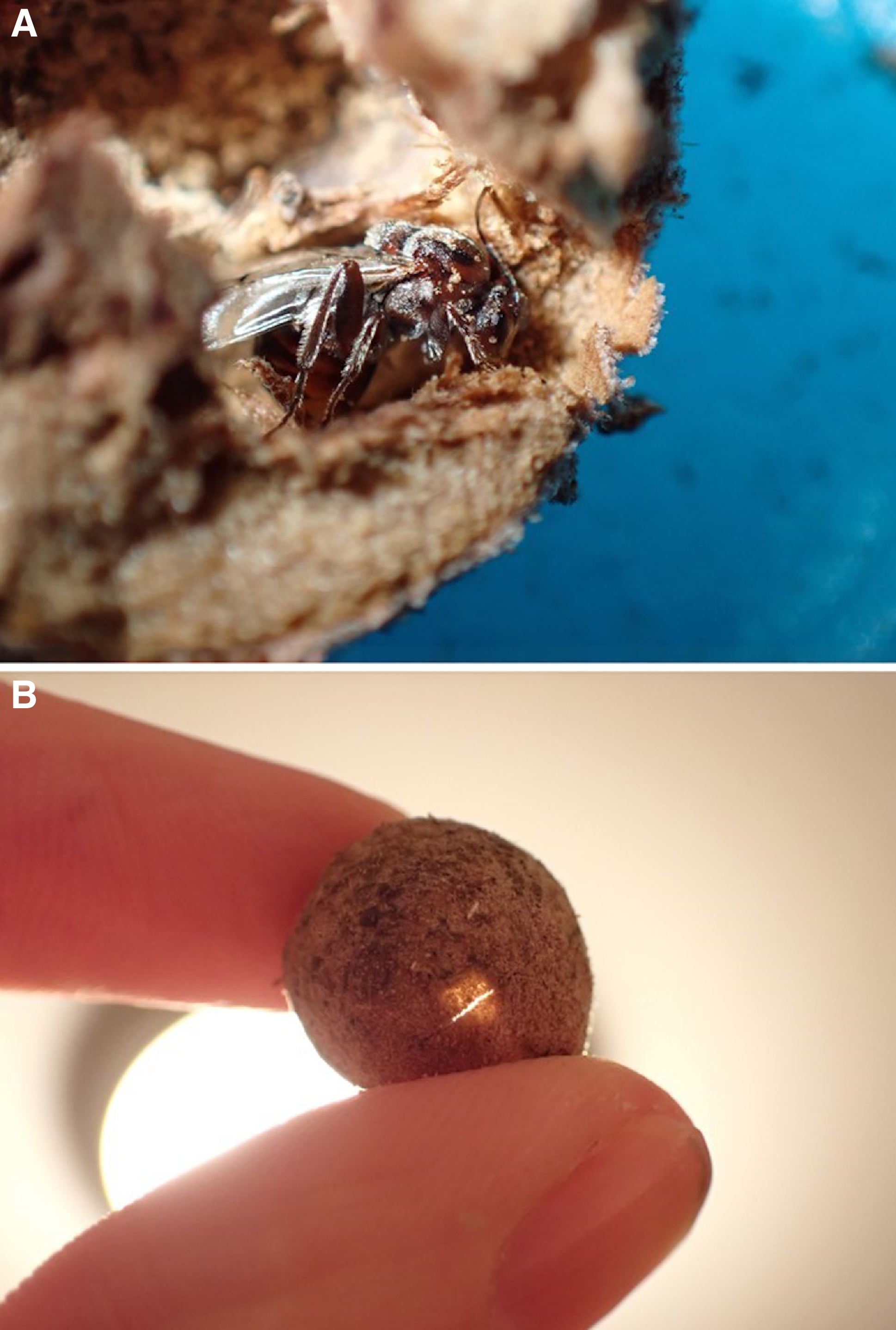
On 17 January 2026, a gall collected from a large live oak (Fagaceae) at Camp Verde, Texas, United States of America (29.8939, –99.1053) was cut open. The adult wasp was discovered in a deep excavated tunnel that ended just underneath the gall’s surface (Fig. 2A). The female faced the outer wall of the gall and sat almost immobile. It would not move until physically removed, after which it began the typical ambulatory behaviour of a cynipid. Upon holding the gall up to a light, it was apparent that the tunnel ended with a light-penetrable membrane resembling the one seen in Cynips conspicuus (Fig. 2B). Clearly, it seems that these cynipids do not exit as soon as they pupate but instead carry out “windowing” and exit sometime afterwards.
A, Adult female Disholcaspis cinerosa standing immobile at the end of an excavated tunnel to the gall’s outer edge; B, exterior view of a Disholcaspis cinerosa gall, showing the light-permeable “window.”
The function of this behaviour is unclear, but it is hypothesised that it may allow the adult wasp to select environmental conditions that optimise fitness. In galling Diptera, “windowing” enables adults to easily exit the gall because adult flies do not possess chewing mouthparts to excavate hardened plant tissue. This cannot be the case for cynipids, adults of which possess robust mandibles that enable them to chew through extremely lignified tissue. One striking possibility is that this behaviour quite literally gives the wasps a “window” to the outside environment. Given the thinness of the outer layer left after “windowing,” the wasps should be able to detect changes in light intensity, air temperature, and chemical volatiles. With this information, individual wasps could select for the optimal environmental conditions under which to exit, providing individuals with the plasticity needed to handle year-to-year fluctuations in weather and host plant growth. Additional rearing experiments will be required to determine how widespread this behaviour is and if the wasps are truly responding to environmental cues only accessible through the “window.”
Acknowledgements
The author thanks Noriko Ito for allowing her observations and photos to be published and for her many contributions to the research and public awareness of galls in California and beyond.
Competing interests
The author declares no competing interest.


 Open access

