Being the largest terrestrial megaherbivores, elephants have unique ecological properties. They play a major role in forest ecosystems by their activities such as browsing, trampling of trees and by dispersal of seeds. Seed dispersal by elephants has been reported by many authors (Blake et al. Reference BLAKE, DEEM, MOSSIMBO, MAISELS and WALSH2009, Dudley Reference DUDLEY2000, Kitamura et al. Reference KITAMURA, YUMOTO, POONSWAD and WOHANDEE2007, Lieberman et al. Reference LIEBERMAN, LIEBERMAN and MARTIN1987, Samansiri & Weerakoon, Reference SAMANSIRI and WEERAKOON2008, Short Reference SHORT1981, Yumoto et al. Reference YUMOTO, MARUHASHI, YAMAGIWA and MWANZA1995) but most of these reports dealt with the African elephant (Loxodonta spp.). A recent review of the role of elephants in seed dispersal revealed that knowledge on the seed dispersal by the Asian elephant is fragmentary as few studies have been done on this and those available studies on seed dispersal have been mostly from human-dominated tropical dry-forest environments (Campos-Arceiz & Blake Reference CAMPOS-ARCEIZ and BLAKE2011).
The present study reports on frugivory and seed dispersal by wild Asian elephants in a mid-elevation tropical evergreen forest in India based on dung analysis and seed germination trials. An attempt was also made to study the fate of the seedlings germinated from elephant dungs.
The study was conducted in Silent Valley National Park (11o05′N, 75o27′E) of Kerala state, India. The area is part of the Western Ghats, one of the hotspots of the world. It spreads in an area of 237 km2 with 89.5 km2 of core zone. The altitude ranges from 680 to 2383 m asl. The climate is tropical with mean annual rain fall of over 4400 mm and annual mean temperature of 20.2 °C. It harbours tracts of tropical evergreen forests intermixed with low-level grasslands and high-altitude grasslands. The evergreen forest is dominated with Cullenia exarillata–Palaquium ellipticum–Mesua ferrea–Calophyllum elatum associations (Basha Reference BASHA, Manoharan, Biju, Nayar and Easa1999, Pascal Reference PASCAL1988). Some of these forest tracts towards the south of the park are degraded due to forest fire. Plant names follow Manilal (Reference MANILAL1988). A recent study showed that Silent Valley and adjacent Nilambur forests foster a population of 150–200 elephants (Sukumar & Easa Reference SUKUMAR and EASA2006).
Searches for elephant dung were made once in a month from February 2007 to December 2008 to determine the presence of seeds, fruit/fragments and seedlings. Observations were made from an area of approximately 28.6 km2 following several elephant trails and in the vegetation between and beyond trails in the forests towards the south-eastern portion of the park. A total of 297 fresh and relatively new dung piles (estimated up to 10 d old) and 87 old dung piles (estimated older than 10 d and up to decaying stage but still intact) were examined in situ. Each dung pile was sampled at least 5 m apart to ensure that each pile was of independent source. Intact dung piles were hand dissected and shredded to identify and count the seed/fruit content of woody plants. Small seeds (seeds < 2 mm) especially of figs have been excluded from the seed count but noted for the number of fruits consumed. Germinating seeds and/or seedlings were also noted. Seedlings were labelled and their growth observed up to December 2008. The last seedling labelling was done in December 2007. Seeds, fruits and seedlings were identified by comparing with the reference fruit/seed specimens collected during the phenological surveys. The per cent frequency of occurrence of a given seed type was calculated from the number of dung piles containing the particular seed type out of the total number of dung piles observed.
Germination trials were carried out to assess seed viability and effect of seed passage through elephant gut on germination. Forty-five seeds of seven dominant species found in the dung piles were used for this purpose viz. Mangifera indica, Artocarpus heterophyllus, Cassia fistula, Elaeocarpus serratus, Careya arborea, Syzygium cumini and Chrysophyllum roxburghii. Seeds from ripe fruits obtained from fruiting trees without any manipulation were used as control. Fifteen ingested and control seeds of each species were planted separately in 1-m2 plots of forest soil in primary and secondary forests and in grassland without any alteration to the vegetation cover. Seeds were checked regularly for appearance of cotyledons/radicle for 20 wk. The germination percentage and time taken for germination of each type of seed were determined.
A total of 23 surveys were conducted during the period. Dung piles were found in all types of forest land: 25.3% in primary (N = 97), 34.1% in degraded forests (N = 131) and 40.2% in grassland (N = 156). Out of 384 dung piles examined, 28.9% contained seeds/fruits or seedlings of woody species. Of these (N = 111), 66.7% contained seeds only and 9.0% contained seedlings only. Both seeds and seedlings were observed in 24.3% of dung piles. Most of the dung piles (73.9%) from a single defecation contained seeds or seedlings of a single species. Seed number was found high in dung observed during the months of April to June. No seeds were found during the months of August, November, December and January in either year.
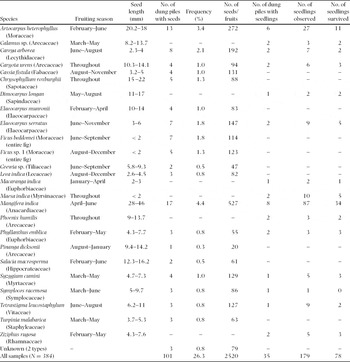
Fruits/seeds and seedlings of 27 woody species were recorded from elephant dung (Table 1). Altogether 2292 seeds (excluding figs) belonging to 21 species (with two unidentified species) were recovered from 101 dung piles. Most abundant seeds found were those of M. indica, A. heterophyllus, C. arborea, E. serratus, C. fistula and S. cumini. The majority of seeds found in the dung piles were intact except a few seeds of A. heterophyllus, Leea indica, M. indica, Salacia macrosperma and S. cumini. Overall 179 seedlings of 15 species were observed from 35 dung piles of which M. indica recorded highest number followed by A. heterophyllus (Table 1). At the end of the observation 78 seedlings of 14 species survived and established as saplings. High number of seedlings survived in degraded forest (37 saplings).
Fruits of woody species consumed by Elephas maximus in Silent Valley forest and the number of seeds/fruits and seedlings found in the dung piles.

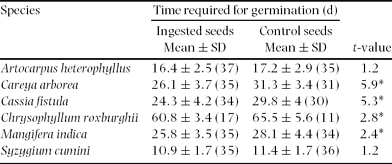
Germination experiments showed that more ingested seeds germinated than the control except in S. cumini. But these differences were not significant (z-test, P > 0.05) except in C. roxburghii (z-test, P < 0.05). However, time taken for germination decreased significantly in the case of C. arborea, C. fistula, C. roxburghii and M. indica seeds ingested by elephants (Table 2). No seeds of E. serratus in either treatment germinated.
Comparison of time (mean ± SD) to germination (d) for seeds of six species collected from elephant dung (ingested) and ripened fruits directly collected from the tree (Control). Number in parentheses represents the total number of seeds germinating. *Significant at P < 0.05.
The Asian elephants in Silent Valley ate fruits of a variety of woody species from large-seeded species such as M. indica to small-seeded species like Ficus. This observation was quite different from earlier studies conducted in Asia (Kitamura et al. Reference KITAMURA, YUMOTO, POONSWAD and WOHANDEE2007, Samansiri & Weerakoon Reference SAMANSIRI and WEERAKOON2008, Sivasubramaniyan & Sivaganesan Reference SIVASUBRAMANIYAN and SIVAGANESAN1996, Vinod & Cheeran Reference VINOD and CHEERAN2000) but comparable with African elephants, as more than 10 woody species were eaten and dispersed by them (Dudley Reference DUDLEY2000, Lieberman et al. Reference LIEBERMAN, LIEBERMAN and MARTIN1987, Theuerkauf et al. Reference THEUERKAUF, WAITKUWAIT, GUIRO, ELLENBERG and POREMBSKI2000, Yumoto et al. Reference YUMOTO, MARUHASHI, YAMAGIWA and MWANZA1995). Samansiri & Weerakoon (Reference SAMANSIRI and WEERAKOON2008) reported the presence of seeds of only four woody species from Sri Lanka, Kitamura et al. (Reference KITAMURA, YUMOTO, POONSWAD and WOHANDEE2007) reported nine species from Thailand, Sivasubramaniyan & Sivaganesan (Reference SIVASUBRAMANIYAN and SIVAGANESAN1996) reported 13 woody species in dry tropical forests and Vinod & Cheeran (Reference VINOD and CHEERAN2000) reported four tree species from mixed dry and evergreen forests of India. These differences in the type of fruit consumed are likely to be dependent on the seasonality and availability of fruiting species in the forest of Silent Valley and other habitats studied.
Elephant frugivory may be intentional or unintentional. From the dung observations, it may be assumed that intentional frugivory was found only with M. indica, A. heterophyllus and Ficus sp. as some boli or major part of the faeces contained only seeds and partially digested matter of the above fruits. The other fruits which may be included in this category are C. arborea, E. serratus and C. roxburghii. The seeds of other species except the above found in faeces may be due to the unintentional consumption of fruits along with bark and branches while browsing.
Most dominant species recorded were those of M. indica and A. heterophyllus. In fact Gautier-Hion et al. (Reference GAUTIER-HION, DUPLANTIER, QURIS, FEER, SOURD, DECOUX, DUBOST, EMMONS, ERARD, HECKETSWEILER, MOUNGAZI, ROUSSILHON and THIOLLAY1985) attributed mango as an elephant-dispersed fruit due to its large, indehiscent fruit with fibrous pericarp, dull colours and thick seed coat. Artocarpus heterophyllus also has very large fruit with dull colour and numerous seeds. In Silent Valley forests M. indica and A. heterophyllus occur naturally and have limited distribution (Manilal Reference MANILAL1988). Observations showed that the nearest fruiting M. indica was found at a distance of 4.3 km away from the deposited dung piles in 2007 and in 2008 it was at a distance of 2.8 km. Moreover, these elephants move frequently towards the adjacent forests (Sukumar & Easa Reference SUKUMAR and EASA2006) and facilitate spreading of these important tree species in that areas and thereby widening their gene pool.
Seed passage through elephant gut was not harmful to seeds as determined from the seed germination experiments, in fact, it reduced the germination time significantly for some species (Table 2). This observation corroborated with the view of Nchanji & Plumptre (Reference NCHANJI and PLUMPTRE2003) that germination time was shorter for seeds defecated by elephants than for unpassed seeds. More rapid and higher percentage germination of seeds in response to African elephant gut passage has been reported by Alexandre (Reference ALEXANDRE1978) and Lieberman et al. (Reference LIEBERMAN, LIEBERMAN and MARTIN1987).
The present study showed that 43.6% of the seedlings survived and established. Even though seedling sample size was very low, the survival of seedlings of 14 diverse species grown up into saplings from elephant-dispersed seeds has provided clues to the quality of seed dispersal carried out by Asian elephants in this forest. It could not be confirmed whether the seedlings of Calamus sp., Dimocarpus longan, Macaranga indica, Maesa indica, Phoenix humilis and Ziziphus rugosa observed were germinated from the seeds of dung piles. But there were chances that they had germinated from the seeds consumed by elephants since all these species were reported as food plants of Asian elephants (Chen et al. Reference CHEN, DENG, ZHANG and BAI2006, Sivasubramaniyan & Sivaganesan Reference SIVASUBRAMANIYAN and SIVAGANESAN1996, Sukumar Reference SUKUMAR1990). The growth and survival of seedlings in different habitats may be affected by the availability of sunlight and other micro-environmental factors. Voysey et al. (Reference VOYSEY, McDONALD, ROGERS, TUTIN and PARNELL1999) reported that growth and survival of seedlings dispersed by gorilla were greater in open-canopy areas than closed-canopy areas in Gabon, as in the present study. The survival of seedlings of some of the important tropical forest tree and liana species such as A. heterophyllus, C. arborea, Calamus sp., D. longan, E. serratus, M. indica, Phyllanthus emblica, S. cumini and Tetrastigma leucostaphylum dispersed by elephants indicated that Asian elephants would be a legitimate seed disperser and would accelerate the natural regeneration of the degraded forests and forest succession.
Even though no obligate elephant-dependent plant species for dispersal has been observed from Silent Valley, many large-fruited species especially A. heterophyllus, C. arborea, E. serratus and M. indica reported here were poorly dispersed by other mammalian frugivores occurring in the Silent Valley forest (pers. obs.). The Asian elephant is the only extant megafaunal fruit-eater in the Indian Peninsula and might be an important seed disperser in its distributional range as observed in the present study as well as other anecdotal observations carried out in the region (Sivasubramaniyan & Sivaganesan Reference SIVASUBRAMANIYAN and SIVAGANESAN1996, Vinod & Cheeran Reference VINOD and CHEERAN2000). The conservation of shrinking wild Asian elephant population should be ensured for the success and perpetuation of the species they disperse.
ACKNOWLEDGEMENTS
The author thanks Kerala Forest Department for permission to carry out the work at Silent Valley forest and the Director, Tropical Botanic Garden and Research Institute for facilities.