Urbanization is one of the most extreme types of land use, and consists in the conversion of natural landscapes into habitats dominated by human constructions, typically harbouring few native plant species in remnants separated by a matrix generally inhospitable for most species (McKinney Reference McKinney2006, Reference McKinney2008; Pauchard et al. Reference Pauchard, Aguayo, Peña and Urrutia2006). By affecting plant diversity, urbanization changes food resources available to animals due to a decline in native species diversity and an increase in exotic plant presence (Alberti et al. Reference Alberti, Correa, Marzluff, Hendry, Palkovacs, Gotanda, Hunt, Apgar and Zhou2017, Gelmi-Candusso & Hämäläinen Reference Gelmi-Candusso and Hämäläinen2019). Consequently, changes in plant diversity and composition in urban areas may have important impacts on plant–animal interactions (Gelmi-Candusso & Hämäläinen Reference Gelmi-Candusso and Hämäläinen2019) and on the capacity of such areas to maintain ecosystem functions such as seed dispersal.
Seed dispersal by frugivorous animals is a key mutualistic interaction that is crucial for the dynamics of plant populations and regeneration of degraded areas, including green areas within cities (Hougner et al. Reference Hougner, Colding and Söderqvist2006). The persistence of frugivorous animals in urban areas depends critically on the availability of fruits in such places, as well as on the ability of frugivores to track resources and be flexible in the use of food resources (Nunes et al. Reference Nunes, Rocha and Cordeiro-Estrela2017, Santini et al. Reference Santini, González-Suárez, Russo, Gonzalez-Voyer, Von Hardenberg and Ancillotto2019).
Artibeus lituratus (Phyllostomidae) is a large frugivorous bat, often abundant in continuous preserved areas, forest patches (Muylaert et al. Reference Muylaert, Stevens, Esbérard, Mello, Garbino, Varzinczak, Faria, Weber, Kerches Rogeri, Regolin, Oliveira, Costa, Barros, Sabino-Santos, Crepaldi de Morais, Kavagutti, Passos, Marjakangas, Maia, Ribeiro and Galetti2017) and cities in the Neotropics (Ballesteros & Racero-Casarrubia Reference Ballesteros and Racero-Casarrubia2012, Jara-Servín et al. Reference Jara-Servín, Saldaña-Vázquez and Schondube2017, Nunes et al. Reference Nunes, Rocha and Cordeiro-Estrela2017), where it is one of the main seed-dispersing bats (Nunes et al. Reference Nunes, Rocha and Cordeiro-Estrela2017). Despite a preference for Cecropia and Ficus fruits, A. lituratus is known to include in its diet more than 260 fruit species across its range (Parolin et al. Reference Parolin, Bianconi and Mikich2016). This capacity to exploit a broad variety of fruits is one of the characteristics that may favour its tolerance to deep habitat modification such as urbanization (Oprea et al. Reference Oprea, Mendes, Vieira and Ditchfield2009, Nunes et al. Reference Nunes, Rocha and Cordeiro-Estrela2017).
In this context, comparing the resources consumed between natural and urban habitats can provide important insights into the success of some species in persisting in cities. For this study, we compiled data on fruits consumed by Artibeus lituratus in urban and non-urban (hereafter, natural) environments in Brazil, and compared these habitat types in terms of fruit and seed traits and sampling techniques.
We found 28 publications by searching online repositories (Supplementary Appendix 1). Searches included combinations of the keywords (in English, Portuguese and Spanish): Artibeus lituratus, bats, frugivory, diet and seed dispersal. For each of the publications obtained the following information were extracted: identity of the fruits consumed (only those identified at species level); fruit origin (native or exotic) defined according to Reflora (2019); and the sampled environment (urban and natural). We also classified studies according to the methods used to record interactions as: fecal samples (seeds taken from feces of individuals captured with mist net), roost sampling (seeds or fruit remains found in daytime shelters), direct observation (individuals observed consuming fruits directly on the plant), carried in the mouth or found under feeding perches. For each fruit species recorded, we compiled data on fruit and seed diameters obtained from the UFLA Mammals Diversity and Systematic Laboratory (LADISMA) seed collection or from the literature (Supplementary Appendix 2 and 3). Differences in fruit diameter between urban and natural habitats and between sampling methods (fecal samples versus other methods) were tested using the non-parametric Mann–Whitney test. Differences in seed sizes were tested using one-way ANOVA after log-transformation of variables.
Out of 28 studies, 18 were conducted in natural habitats, nine in urban habitats and one in both. We found 55 fruit species consumed by Artibeus lituratus, distributed in 25 genera belonging to 16 families. In natural habitats, 94% of the species consumed (n = 30 out of 32) were native, while in urban habitats 66% (n = 23 out of 35) were native (Figure 1A). Of the 55 fruit species that are part of the A. lituratus diet, 23 species were consumed exclusively in urban habitats, 20 in natural habitats and 12 in both habitat types (Figure 1B, Table 1).
(A) Number of exotic and native fruits consumed by the Artibeus lituratus in urban or natural environments in Brazil; (B) Number of fruit species consumed per habitat type.

Fruits consumed by Artibeus lituratus in urban and natural habitats in Brazil. Sampling method: (1) fecal samples; (2) direct observation; (3) roosts; (4) carried in the mouth; (5) found under feeding perches. The number of studies where each fruit was reported is specified for urban and natural habitats.

Identification of seeds present in fecal samples was the most commonly used method to describe A. lituratus diet (27 out of 28 studies). In urban habitats, eight studies used two sampling methods concomitantly: four studies combined fecal sampling and roost sampling, three studies combined fecal sampling and direct observation, and one study combined direct observation and roost sampling. In natural areas, all studies used fecal sampling but only one study complemented it with direct observations.
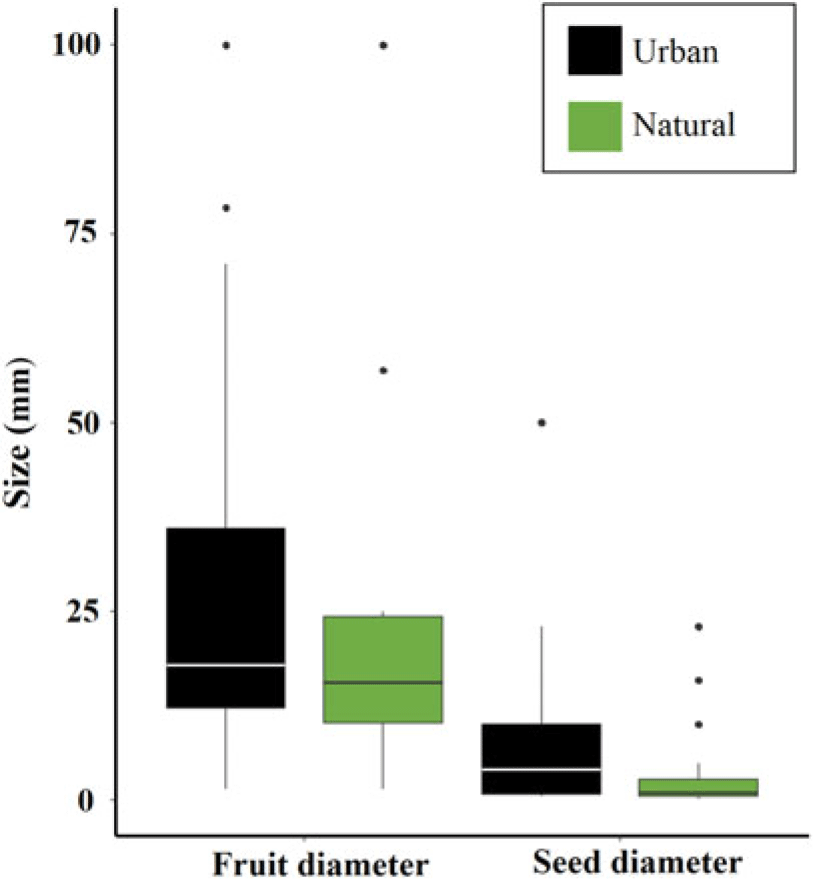
In terms of traits, the overall average fruit diameter consumed by Artibeus lituratus was 22.52 ± 20.67 mm (mean ± SD). However, the average fruit diameter recorded by fecal analysis (12.29 ± 7.05 mm) and other methods combined (39.98 ± 24.52 mm) was significantly different (U = 39.50, P < 0.01). Similarly, the average seed diameter recorded using fecal analysis (1.10 ± 0.96 mm), and other methods combined (10.62 ± 5.47 mm) was also significantly different (F = 91.19, P < 0.01). Between habitats, there was no significant difference in fruits diameter (U = 0.93, P = 0.17), but seed diameter was significantly larger in urban habitats (F = 99.8, P < 0.01; Figure 2).
Diameter of fruits and seeds consumed by Artibeus lituratus in urban and natural habitats in Brazil.

Our results show that A. lituratus may consume fruit of at least 12 exotic species in Brazil, which represents a considerable proportion of the resources consumed in urban habitats, when compared with natural areas. This ability to exploit exotic fruits may be key to this species’ persistence in habitats with varying degrees of anthropic interference, including large urban centres in Brazil (Nunes et al. Reference Nunes, Rocha and Cordeiro-Estrela2017, Oprea et al. Reference Oprea, Mendes, Vieira and Ditchfield2009). In fact, most exotic plant species found in the A. lituratus diet are common in Brazilian cities, where they are frequently used for urban forestry or backyard ornamentation (Petri et al. Reference Petri, Aragaki and Gomes2018).
Our study also demonstrates that in urban centres Artibeus lituratus consumes a high proportion of large seeded fruits with seeds that are too large to be swallowed and, therefore, are not detected in fecal samples. Detection of consumption of fruit with large seeds requires the use of methods such as direct observation and collection of seed in roosts or under feeding perches (Oprea et al. Reference Oprea, Brito, Vieira, Mendes, Lopes, Fonseca, Coutinho and Ditchfield2007, Silvestre et al. Reference Silvestre, Rocha, Cunha, Santana and Ferrari2016) in order to achieve a comprehensive description of the species’ diet. Thus, diet descriptions based only on fecal analysis, as is the case for most studies conducted in natural habitats (e.g. Laurindo et al. Reference Laurindo, Novaes, Vizentin-Bugoni and Gregorin2019), may considerably underestimate the diversity of fruits consumed by A. lituratus. Moreover, this is likely to be the case for other frugivorous bat species. Such bias may be especially important in old-growth forests, where large-seeded species often occur (Huston & Smith Reference Huston and Smith1987). Furthermore, frugivorous bats generally take such large-seeded fruits to feeding perches away from the parent plant, likely acting as legitimate seed dispersers of such species (Melo et al. Reference Melo, Rodriguez-Herrera, Chazdon, Medellin and Ceballos2009).
Because frugivorous bats may travel long distances between roosts, feeding perches and foraging areas (Chaverri et al. Reference Chaverri, Quirós and Kunz2007, Trevelin et al. Reference Trevelin, Silveira, Port-Carvalho, Homem and Cruz-Neto2013), they can facilitate invasion of exotic plants into natural habitats. In fact, some of the species consumed by A. lituratus in urban habitats are invasive in protected areas in Brazil (Ziller & Dechoum Reference Ziller and Dechoum2013), such as Hovenia dulcis (Rhamnaceae), which is a frequent invasive species in several Neotropical ecosystems (Zenni & Ziller Reference Zenni and Ziller2011). On the other hand, seeds of native species can also be carried for long distances from natural to urban habitats, facilitating the regeneration of parks and other urban green areas as well as contributing to the persistence of other frugivorous species in such areas (Hougner et al. Reference Hougner, Colding and Söderqvist2006).
In conclusion, our review summarizes the knowledge on the fruits consumed by A. lituratus in urban and natural areas in Brazil. We highlight the lack of studies using methods other than fecal sampling in natural habitats, which likely biases the description of frugivorous bats’ diets towards small-seeded species. Therefore, for the most accurate description of frugivorous bats’ diets and seeds dispersal networks in natural areas, we recommend that future studies include seed collection in daytime roosts and under nocturnal feeding perches. These methods have been used in urbanized areas and successfully detected large-seeded fruits consumed by A. lituratus (Melo et al. Reference Melo, Rodriguez-Herrera, Chazdon, Medellin and Ceballos2009, Silvestre et al. Reference Silvestre, Rocha, Cunha, Santana and Ferrari2016). Another alternative technique little explored in studies of Neotropical bats is DNA barcoding, which allows the identification of a broader range of food items including large-seeded species, based also on fecal samples analysis (Lim et al. Reference Lim, Clare, Littlefair, Ramli, Bhassu and Wilson2018). Finally, we highlight that the ability to use a high diversity of fruits, including exotic species, is remarkable in A. lituratus, and is probably linked to its persistence in altered habitats such as urban centres.
Acknowledgements
We thank Dr Renato Gregorin and the Mammals Diversity and Systematic Laboratory (LADISMA) of the UFLA for access to the seed collection. We also thank MSc Roberto L. M. Novaes and an anonymous referee for valuable suggestions on the manuscript.
Financial support
RSL thanks the Coordenação de Aperfeiçoamento de Pessoal de Nível Superior – Brasil (CAPES) – Finance Code 001.
Appendix 1
Original sources of data on the diet of Artibeus lituratus in Brazil compiled in this study.
Appendix 2
Original sources of fruits and seeds traits.