Dental clinical practice often requires the use of high-speed rotation handpieces, which are complex medical equipment, representing a challenge for suitable cross-contamination control practices. The cross contamination from microorganisms inside the handpieces could be expelled during the use of the equipment.Reference Kohn, Harte and Malvitz1 Thus, handpieces require sterilization by methods that use heat (ie, autoclave) after each use.Reference Kohn, Harte and Malvitz1 As much as sterilization is the method of choice, the presence of organic matter (proteins) remaining on the surfaces of health products resulting from an inadequate cleaning process limits the effectiveness of sterilization.Reference Rutala and Disinfection2 In addition, organic material can protect microorganisms by acting as a physical barrier,Reference Muscarella3 impairing subsequent sterilization steps, as well as favoring the formation of biofilms. Thus, removal of biomaterial is necessary for sterilization to be effective.
Even with the development of automated cleaning devices, manually cleaning dental handpieces is still the most frequent cleaning method in oral health services. In these situations, visual inspection by magnifying glasses has been the method adopted to validate the cleaning process. But is this practice enough to provide safe levels of cleanliness? One study answered this question for neurosurgical instruments using the in situ protein detection system (ProReveal, Synoptics Health, UK), capable of quantifying the protein levels by fluorescence.Reference Smith, Winter and Lappin4 The use of this innovative technology in dentistry could be valuable for measuring the protein residue accumulated on dental handpieces. In this study, we conducted an exploratory analysis of the effectiveness of manually cleaning the external surface of high-speed dental handpieces using protein identification by fluorescence.
Methods
In this cross-sectional, exploratory study, data collection took place in 3 dental clinics with at least 5 dental units for outpatient care. The sample consisted of at least 3 different high-speed handpieces from each study site. The high-speed handpieces were used in clinical procedures such as restorations and endodontic treatments. Visits were made to the service locations to analyse the cleaning process.
Proteins on the high-speed handpieces were identified after completion of the cleaning method adopted in each health service (group A) according to their choice, and after the adapted CDC-USA cleaning protocolReference Alvarenga, Reis, Tipple, Paiva and Sasamato5 (group B). This protocol was carried out by trained personnel as follows: (1) activation of the air and/or water lines of the high-speed handpieces 30 seconds); (2) wrapping the handpiece with gauze soaked in enzymatic detergent; (3) scrubbing the gauze soaked with enzymatic detergent (Indazyme7 Max/Indalabor – Brazil) over the entire handpiece body (30 seconds); (4) rinsing the handpiece under running tap water; (5) visual inspection; and (6) drying the handpiece.
The protein detection equipment (ProReveal, Synoptics Health/UK) was used according to the manufacturer’s instructions. The equipment issued a report after each reading with a digital image record, protein quantification, and the cleaning “status” of the analyzed instrument. The study utilized the criterion adopted by Technical Memorandum 01-01 of the UK Department of Health,6 which indicates that the upper limit of acceptable contamination of proteins after processing is 5 µg of protein on one side of an instrument.
The 3 parts of each handpiece (body, end cap, and bearing) were analyzed at the same time, and 2 fluorescence readings were performed: 1 reading for each side of the highspeed handpiece. Thus, each handpiece was considered to have a “passed” status when the sum of the analyses on each side of the high-speed handpiece was ≤10 µg protein residue. The results were subjected to statistical analysis using SPSS version 23 software (IBM, Armonk, NY). We adopted a significance level of 5% to verify whether there was a difference between the cleaning methods studied, considering the average protein values measured.
Results
The decontamination procedures for handpieces adopted by all clinics consisted of applying 70% ethyl alcohol solution on the external surface of the high-speed handpieces under friction with gauze or absorbent paper for an indefinite period, however, for no longer than 30 seconds.
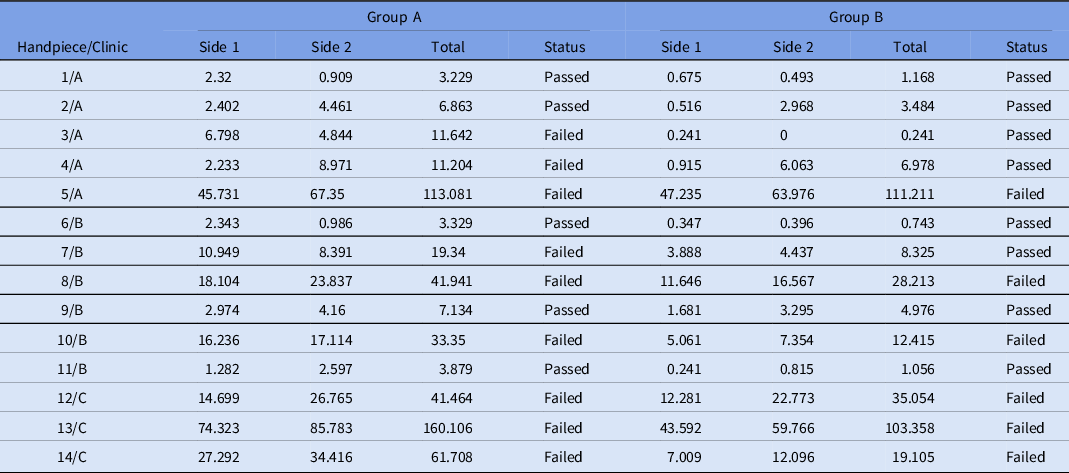
Protein quantification was performed in 14 high-speed handpieces, and the results are shown in Table 1. The average protein quantification in high-speed handpieces was 37.02 µg (group A) and 24.02 µg (group B). The proportion of devices that passed the test after the application of each cleaning protocol was 35.7% (group A) and 57.1% (group B). The paired Wilcoxon test for the comparison between the groups indicated a statistically significant reduction at the 5% level (P < .001) after cleaning.
Residual Protein Levels (µg) in High-Speed Handpieces After the Cleaning Method Adopted by the Studied Clinics (Moment 1) and After the Cleaning Protocol of the Adapted CDC-USA (Moment 2), São Paulo, 2019

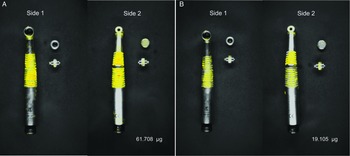
Figure 1 illustrates the images captured by the ProReveal equipment, in which the protein contaminated areas are visualized in yellow.
Images obtained using ProReveal from the 14/C high-speed handpiece showing the protein accumulation (highlighted in yellow) in Group A (after the cleaning adopted in each health service), and Group B (after the cleaning protocol of the adapted CDC-USA). It is observed that the grooves on the handpiece surface favour protein content accumulation.

Discussion
This study leads to a worrying finding that methods used to clean high-speed dental handpieces are failing to remove protein, thereby allowing potential cross contamination since these devices are used repeatedly on different patients. All high-speed handpieces exhibited a reduction in the amount of protein residue after the adapted CDC cleaning protocol was used. However, this process was not enough to guarantee levels >10 µg protein residue for 42.9% of the samples.
The presence of residual debris in handpieces is a constant risk. Because cleaning is a fundamental step for sterilization success, the method that detects and quantifies proteins by fluorescence was able to provide accurate data regarding high-speed handpieces. Importantly, the maximum protein limit adopted for recording the cleaning status (≤5 µg) accounted for a strict cleaning criterion directed to instruments used in sterile tissues, such as those used in neurosurgical procedures. Additional contamination concern is related to prions in these situations, which are transmissible and infectious protein particles that do not contain nucleic acid.Reference Azarpazhooh and Leake7 These particles are related to specific neurological degenerative diseases.Reference Jayanthi, Thomas, Bindhu and Krishnapillai8 However, there is no consensus on the acceptable protein level in the context of using high-speed handpieces in dental practice.
When considering the high-speed handpiece as an instrument, which is part of the daily routine of dental health services, it can be fit into the criterion adopted by the German Society for Hospital HygieneReference Carter and Biering9 in which the safe limit of protein content after cleaning should be ≤80 μg. Thus, when adopting this criterion, 2 handpieces in the study (5A and 13C) would have been unfit for use after sterilization. These handpieces would likely have conferred high contamination risks during clinical use.
Some factors may have contributed to the permanence of surface proteins even after cleaning. One is related to the external design of the equipment that functions as a shelter for proteins to accumulate (Fig. 1). Another aspect is the fact that many manufacturers contraindicate both immersion in detergent solutions and automated cleaning. The CDC cleaning protocol (group B) was adapted for the present study to overcome this limitation. However, the data presented here reveal the weakness in applying the high-speed handpiece manual cleaning in group B protocol. In addition, ethyl alcohol performance on high-speed handpiece surfaces has proven to be an inadequate practice without prior cleaning.Reference Pinto, Bruna and Camargo10
In conclusion, the manual cleaning protocol used by the 3 dental services providers included in the study was ineffective in reliably achieving a postcleaning protein level of ≤10 µg protein residue. The adapted CDC-USA protocol was able to able to lower the amount of residual protein. However, in >40% of the handpieces, the amounts of residual protein remained >10 µg.
Acknowledgments
We thank Cicarelli Surgical Instruments company for providing the ProReveal equipment (Synoptics Health, UK) to conduct the analysis.
Financial support
This study was financed in part by the Coordenação de Aperfeiçoamento de Pessoal de Nível Superior–Brasil (CAPES) (finance code 001).
Conflicts of interest
We confirm that all authors have no conflict of interest to declare.