Introduction
Rodents are important members of the mammalian fauna in South America, comprising approximately 45% of the species (Reig, Reference Reig, Vuilleumier and Monasteiro1986). On this continent, all species of muroid rodents are cricetids, ranked under the subfamily Sigmodontinae. Studies of sigmodontine rodents are significant for public health because these animals can be reservoirs of hantaviruses, Trypanosoma cruzi and Schistosoma mansoni (Suzuki et al., Reference Suzuki, Bisordi, Levis, Garcia, Pereira, Souza, Sugahara, Pini, Enria and Souza2004; Maldonado et al., Reference Maldonado, Gentile, Fernandes-Moraes, D'Andrea, Lanfredi and Rey2006; Padula et al., Reference Padula, Martinez, Bellomo, Maidana, Juan, Tagliaferri, Bargardi, Vazquez, Colucci, Estévez and Almiron2007; Vaz et al., Reference Vaz, D'Andrea and Jansen2007).
The genus Akodon Meyer, 1833 is broadly dispersed in the Neotropics, with over 45 species distributed throughout South America in a variety of habitats (Emmons & Feer, Reference Emmons and Feer1997). Akodon montensis Thomas, 1913 and A. cursor Winge, 1887 are cursorial rodents and have diurnal behaviour (Emmons & Feer, Reference Emmons and Feer1997; Eisenberg & Redford, 1999; Graipel et al., Reference Graipel, Miller and Glock2003). Akodon cursor is one of the most common species in forest and forest–grassland ecotones (Eisenberg & Redford, 1999). Oligoryzomys nigripes Olfers, 1818 is a scansorial rodent common to the Atlantic Forest and it can also live in open areas under deforested conditions, along river edges, and in secondary brush. Additionally, this rodent can be an agricultural pest in rice fields and storage barns (Püttker et al., Reference Püttker, Pardini, Meyer-Lucht and Sommer2008). It feeds on insects, seeds, fruits and some vegetation (Bonvicino et al., Reference Bonvicino, Lindbergh and Maroja2002; Mattevi & Andrades-Miranda, Reference Mattevi, Andrades-Miranda, Freitas, Vieira, Pacheco and Christoff2006). The three species live in sympatric conditions in the Atlantic Forest (Gentile & Fernandez, Reference Gentile and Fernandez1999), which has been suffering great anthropogenic pressure, with the consequent loss of biodiversity (Myers et al., Reference Myers, Mittermeier, Mittermeier, Fonseca and Kent2000).
Several studies have focused on the characteristics of the helminth communities of small rodents in European and African ecosystems (Fuentes et al., Reference Fuentes, Cerezuela and Galan-Punchades2000; Behnke et al., Reference Behnke, Harris, Bajer, Bernard, Sherif, Cliffe, Hurst, Lamb, Rhodes, James, Clifford, Gilbert and Zalat2004, Reference Behnke, Bajer, Harris, Newington, Pidgeon, Rowlands, Sheriff, Kulis-Malkowska, Sinski, Gilbert and Bernard2008a, Reference Behnke, Bajer, Harris, Newington, Pidgeon, Rowlands, Sheriff, Kulis-Malkowska, Sinski, Gilbert and Bernardb). In contrast, few reports have focused on the helminth fauna of small Brazilian mammals (Travassos, Reference Travassos1927; Travassos & Freitas, Reference Travassos and Freitas1941; Gomes et al., Reference Gomes, Cruz, Vicente and Pinto2003; Durette-Desset et al., Reference Durette-Desset, Goncalves and Pinto2006). Past studies have evaluated the structure of the helminth communities in a zoonotic context (Maldonado et al., Reference Maldonado, Gentile, Fernandes-Moraes, D'Andrea, Lanfredi and Rey2006) or under anthropogenic pressure (Simões et al., Reference Simões, Gentile, Rademaker, D'Andrea, Herrera, Freitas, Lanfredi and Maldonado2009). To date, only a few taxonomic records of helminth parasites in A. cursor, A. montensis and O. nigripes are known (Moraes Neto et al., Reference Moraes Neto, Lanfredi and De Souza1996; Notarnicola & Navone, Reference Notarnicola and Navone2002; Robles & Navone, Reference Robles and Navone2007a; Souza et al., Reference Souza, Digiani, Simões, Luque, Rodrigues-Silva and Maldonado2009a, Reference Souza, Simões, Thiengo, Lima, Mota, Rodrigues-Silva, Lanfredi and Maldonadob).
In an ecological context, host specificity can be defined as the number and identity of host species that are used by a parasite population. Parasites that are highly host-specific will occur in a single host species, whereas generalist parasites will be dispersed unequally among individual hosts from several different species (Morand et al., Reference Morand, Krasnov and Poulin2006). From an evolutionary perspective, host specificity reflects the parasite's historical associations with hosts (Brooks & McLennan, Reference Brooks and McLennan1993), which contribute to shape the helminth community structure. Sympatric hosts with short phylogenetic and geographic distances support likeness between their parasite communities (Poulin & Morand, Reference Poulin and Morand1999; Poulin, Reference Poulin2007), although little is known about the community structure of South American rodents.
In this paper, we characterize the component community structure of helminths among three closely related rodents (A. cursor, A. montensis and O. nigripes) living in sympatric conditions in an area of the coastal Atlantic Forest of Rio de Janeiro, Brazil.
Materials and methods
Location and collection of rodents
The study was carried out in Serra dos Órgãos and its surroundings (22°24′36″S, 42°58′48″W), Rio de Janeiro state, Brazil. Serra dos Órgãos is a mountain chain covered by pluvial montane Atlantic Forest, which runs through many municipalities, all of which have mild, humid mesothermal climates (Nimer, Reference Nimer1989). The average altitude is 871 m, average annual temperature of the region is 21°C and mean annual rainfall is 1671.6 mm.
Twenty-five specimens of A. cursor, 98 of A. montensis and 57 of O. nigripes were collected during 2004–2005 using two live traps: the Tomahawk® trap (model 201; 16 × 5 × 5 inches (40.6 × 12.5 × 12.5 cm), Wisconsin, USA) and the Sherman® trap (model XLK; 3 × 3.75 × 12 inches (7.6 × 9.5 × 30.5 cm), Florida, USA). The captured rodents were transported to a base camp for euthanasia and necropsy. All animal procedures followed the guidelines for capture, handling and care of mammals of the American Society of Mammalogy and the bio-security procedures of the Brazilian Health Ministry. The animals were collected under the permission of the Brazilian government's Institute for Wildlife and Natural Resources (IBAMA numbers 012/2004 and 068/2005). Bio-security techniques and individual safety equipment were used during all procedures involving animals or biological samples (Lemos & D'Andrea, Reference Lemos, D'Andrea, Martins, Martins, Silva, Lopes, Moreno and Silva2006). The captured rodents were identified according to Bonvicino et al. (Reference Bonvicino, Oliveira and D'Andrea2008).
Parasitological procedures
Nematodes, trematodes and cestodes collected from the lungs, bile ducts, stomach, small intestine, caecum, thoracic and abdominal cavity were washed in saline solution (NaCl 0.85%) and fixed in AFA (acetic acid 2%, formaldehyde 3% and ethanol 95%). The nematodes were cleared in lactophenol, and the trematodes and cestodes were stained with chlorhydric carmine and studied using a Zeiss Standard 20 light microscope. General identification of helminth parasites was according to Travassos (1937), Yamaguti (Reference Yamaguti1961), Khalil et al. (Reference Khalil, Jones and Bray1994), Vicente et al. (Reference Vicente, Rodrigues, Gomes and Pinto1997), Gibson et al. (Reference Gibson, Jones and Bray2002) and Jones et al. (Reference Jones, Bray and Gibson2005).
Data analysis
To analyse the helminth community structure, we considered prevalence, mean intensity of infection and mean abundance of each species by taking into account all captured rodents and using procedures described by Bush et al. (Reference Bush, Lafferty, Lotz and Shostak1997). Component community refers to all infrapopulations of parasites associated with some subset of a host species (Bush et al., Reference Bush, Lafferty, Lotz and Shostak1997). The prevalence and confidence limits were calculated according to Rósza et al. (Reference Rósza, Reiczigel and Majoros2000). Statistical analyses were performed only for those parasite species with higher than 10% prevalence. Chi-squared analyses were used to test significant differences in the prevalence of parasites among the three species of rodents. Analysis of variance (ANOVA) on log(x+1) transformed data was used for comparison of parasite abundance, and statistical significance was tested by comparing the F-test statistic (Zar, Reference Zar1999). The variance-to-mean ratio of parasite abundance (index of dispersion) and discrepancy index (Poulin, Reference Poulin1993), computed using the software Quantitative Parasitology 3.0 (a free statistical toolset for parasitologists), were employed to detect distribution patterns of the helminth infrapopulation (Rósza et al., Reference Rósza, Reiczigel and Majoros2000).
The following community descriptors were calculated at the parasite infracommunity level: (1) number of parasite individuals (total abundance), (2) species richness, (3) Brillouin's diversity index (log10), (4) evenness associated with Brillouin's diversity index, (5) Berger–Parker dominance index and frequency of dominance (percentage of infracommunities in which either parasite species was numerically dominant). In addition, two measures of similarity, the Jaccard qualitative and the Sørensen quantitative indices, were calculated among parasite infracommunities between host rodent species (Magurran, Reference Magurran1988). The level of statistical significance was taken to be P < 0.05.
To determine whether helminth abundance can be used to identify the host helminth community, canonical multivariate analysis (CMA) was performed using helminth burdens as explanatory variables (previous log(n+1) transformation of abundance data for each helminth species). This analysis was performed following the recommendations of Wilkinson (Reference Wilkinson1990) using the SYSTAT® statistical software.
Results
Component community
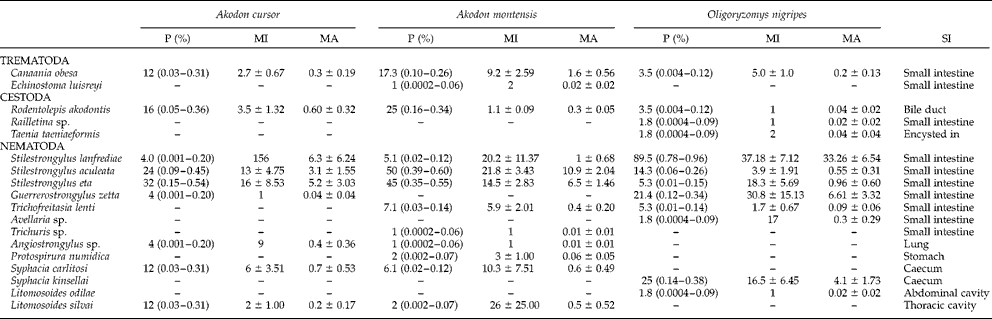
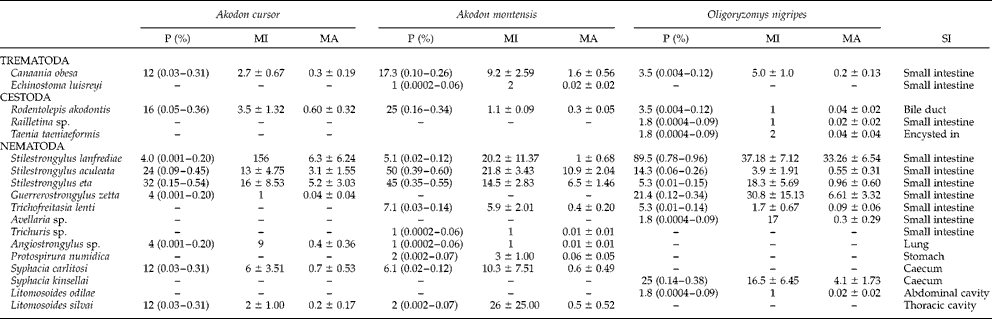
Eighteen helminth parasite species were collected in the three hosts studied: 9 in A. cursor, 12 in A. montensis and 12 in O. nigripes (table 1). The rodents A. cursor and A. montensis are new host records for the nematodes Stilestrongylus lanfrediae and Syphacia carlitosi, while A. montensis is a new host record for the nematodes Trichofreitasia lenti and Protospirura numidica and the trematode Echinostoma luisrey. Oligoryzomys nigripes is a new host record for the nematode T. lenti, the cestode Rodentolepis akodontis and the trematode Canaania obesa. Five species were common to all the rodent species, and eight were common to A. cursor and A. montensis. Nematodes were the dominant species and the highest species number, with nine species in A. montensis, eight in O. nigripes and seven in A. cursor, representing 88.6%, 99.4% and 94.5% of all parasite specimens collected, respectively.
Prevalence (P) with 95% confidence limits, mean intensity (MI), and mean abundance (MA) followed by standard error, and site of infection (SI) of helminth parasites of Akodon cursor, Akodon montensis and Oligoryzomys nigripes.
Infracommunities
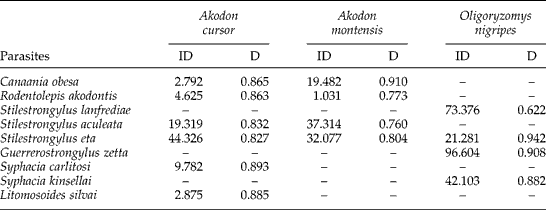
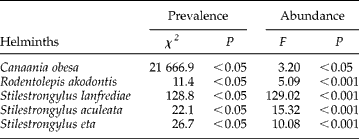
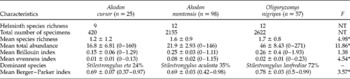
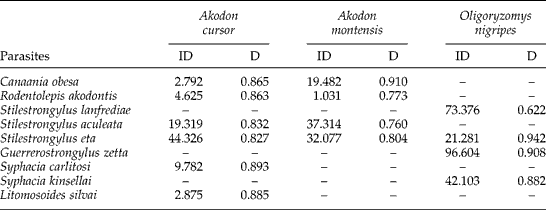
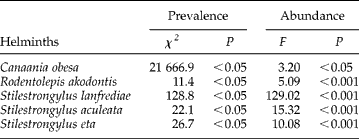
One hundred and sixty-one rodents were parasitized by one or more helminth species (18 A. cursor, 87 A. montensis and 56 O. nigripes), and 19 were negative for parasites (7 A. cursor, 11 A. montensis and 1 O. nigripes). A total of 5197 individual parasites were collected: 420 in A. cursor, 2155 in A. montensis and 2622 in O. nigripes, with mean total abundances of 16.8 ± 6.81 (0–160), 21.9 ± 2.93 (0–146) and 46 ± 8.43 (0–271), respectively. Four trichostrongylid nematode species contributed to the high abundance in the helminth community. All helminth species had an aggregated distribution pattern, and overall they showed discrepancy index values higher than 0.7 (table 2). The prevalence and abundance comparison of common helminth species to A. cursor, A. montensis and O. nigripes revealed significant differences for the following species: C. obesa, R. akodontis, S. lanfrediae, Stilestrongylus aculeata and Stilestrongylus eta (table 3). The trichostrongylids, S. eta in A. cursor, S. aculeata in A. montensis and S. lanfrediae in O. nigripes, were the species with the highest frequency of dominance (table 4).
Distribution of the infracommunity. Values of variance to mean ratio of parasite abundance (ID) and index of discrepancy (D) for helminth parasites of Akodon cursor, Akodon montensis and Oligoryzomys nigripes. Statistical analyses were performed only for those parasite species with higher than 10% prevalence.
Values for comparisons of prevalence (χ2) and abundance (ANOVA F), of helminth community component species of Akodon cursor, Akodon montensis and Oligoryzomys nigripes from the Atlantic Forest, Rio de Janeiro state, Brazil. Degrees of freedom =2.
Characteristics of the helminth parasites infracommunities found in Akodon cursor, Akodon montensis and Oligoryzomys nigripes. F=values of F in ANOVA (degrees of freedom=2).

* , P < 0.05
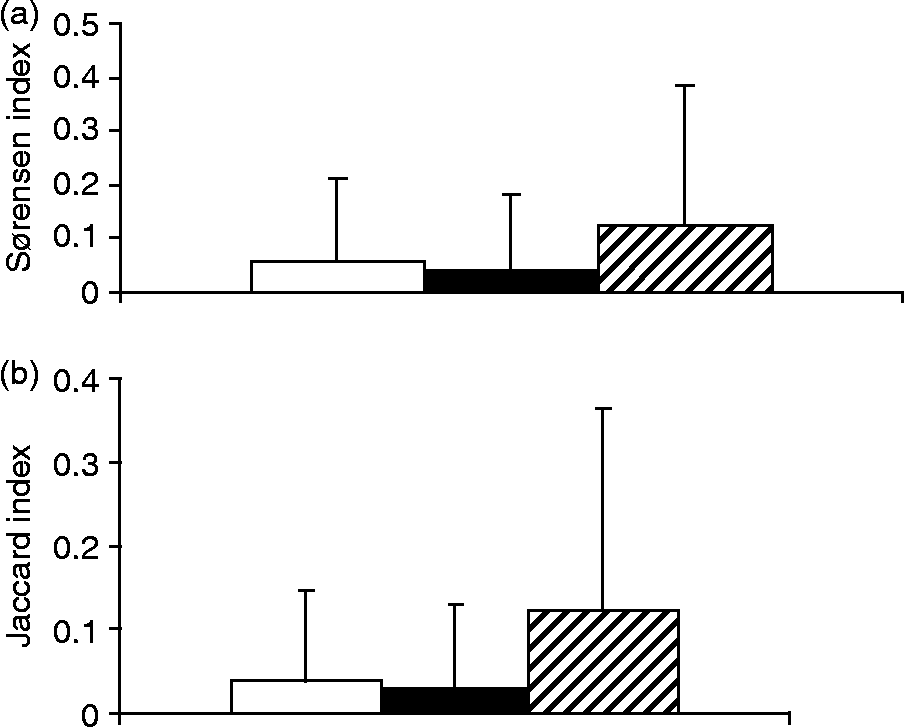
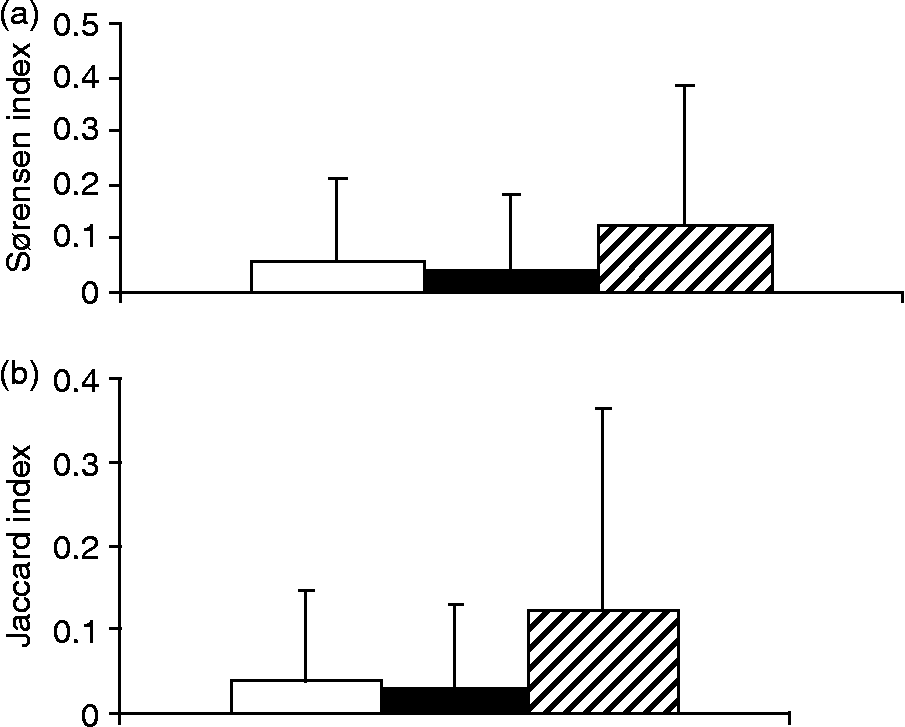
Mean species richness and mean abundance were lower in A. cursor than in A. montensis and O. nigripes. The mean evenness was higher in A. montensis than in the other two host species, and the mean Berger–Parker index value was higher in O. nigripes than in Akodon spp. (table 4). Additionally, variability among communities of the three rodents was observed when analysed using the Jaccard qualitative and Sørensen quantitative indices (fig. 1a and b) (see standard deviation). The communities were more similar between A. cursor and A. montensis than O. nigripes.
Similarity indexes in helminth infracommunities of Akodon montensis, Akodon cursor and Oligoryzomys. (a) Quantitative similarity between A. montensis, A. cursor and O. nigripes. (b) Qualitative similarity between A. montensis, A. cusor and O. nigripes. White bars, A. montensis and O. nigripes; black bars, A. cursor and O. nigripes; striped bars, A. cursor and A. montensis.
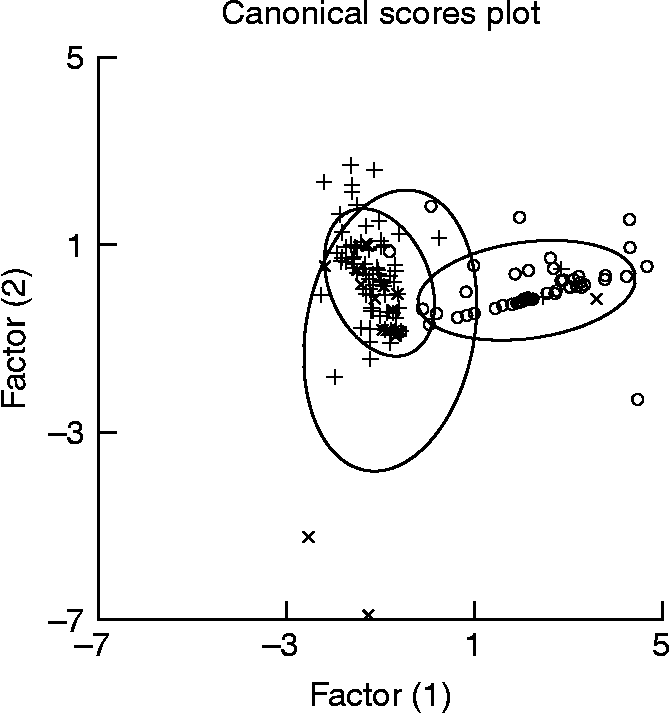
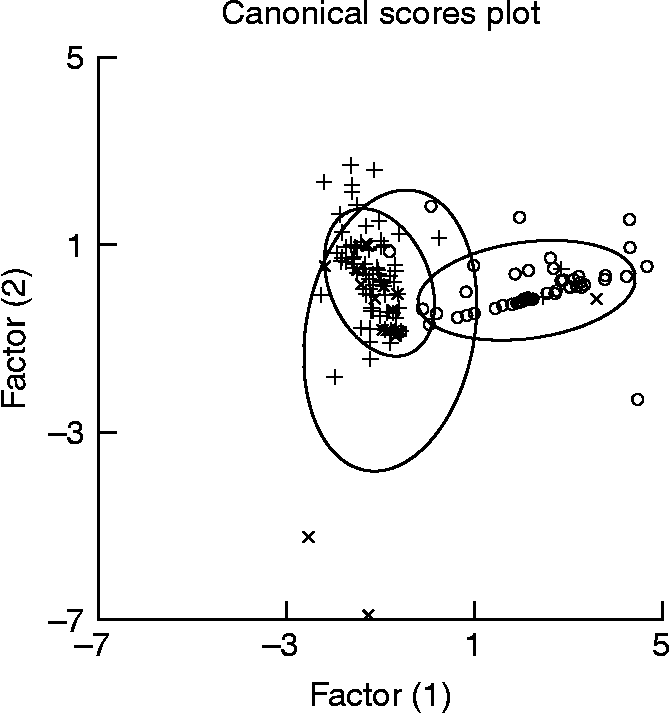
The classification matrix indicates that, overall, 67% of the helminths were correctly classified within a helminth community. Figure 2 indicates that the helminth community is differently structured in O. nigripes (Wilks's lambda 0.288; df 38, 318; approximately F = 7.226; P < 0.001).
Results of canonical multivariate analysis showing host discrimination using abundance data for each helminth species; Oligoryzomys nigripes (○), Akodon cursor ( × ) and Akodon montensis (+).
Discussion
The structure and composition of helminth communities in sympatric host populations represent communities assembled from a pool of locally available parasite species. This structure and composition can be related to various features of the hosts themselves, host phylogeny relationships and the physicochemical and biological characteristics of the habitat (Poulin, Reference Poulin2007). Thus, short phylogenetic and geographical distances between host species affected the similarities between their parasite communities. CMA corroborated the high helminth community discrimination between Akodon spp. and O. nigripes and high similarity between A. cursor and A. montensis communities. This occurs due to the exchange of parasite species over evolutionary time, a process that is facilitated by phylogenetically related species and among geographically adjacent host populations (Poulin & Morand, Reference Poulin and Morand1999; Poulin, Reference Poulin2007). Thus, similarity between structure and composition of parasite communities of sympatric and related host species is expected when hosts share a habitat and resources (Poulin & Morand, Reference Poulin and Morand1999; Bush et al., Reference Bush, Fernandez, Esch and Seed2001; Poulin, Reference Poulin2007). The helminth communities in small rodents worldwide are mainly colonized by nematode species (Kinsella, Reference Kinsella1990; Fuentes et al., Reference Fuentes, Sáez, Trelis, Galán-Punchades and Esteban2004). In South America, the Sigmodontinae rodents comprise a large proportion of all small rodent taxa, inhabit a great diversity of ecosystems (Bonvicino et al., Reference Bonvicino, Oliveira and D'Andrea2008) and are infected mainly by nematodes (Gomes et al., Reference Gomes, Cruz, Vicente and Pinto2003; Maldonado et al., Reference Maldonado, Gentile, Fernandes-Moraes, D'Andrea, Lanfredi and Rey2006; Simões et al., Reference Simões, Gentile, Rademaker, D'Andrea, Herrera, Freitas, Lanfredi and Maldonado2009).
The helminth communities of the congeneric species A. cursor and A. montensis revealed similar characteristics when compared with O. nigripes, supporting coevolution speciation and habitat overlap as important determinants of community structure. The Stilestrongylus genus was the dominant species for the three rodent hosts; however, the highest dominance index observed in O. nigripes can be explained as the outcome of the higher abundance of S. lanfrediae when compared to the dominant species S. aculeata and S. eta infecting A. montensis and A. cursor, respectively. The Stilestrongylus genus includes 23 Neotropical species, of which 22 are parasites of Sigmodontinae rodents (Digiani & Durette-Desset, Reference Digiani and Durette-Desset2003). This suggests a coevolutionary relationship. The Stilestrongylus species found infecting the congeneric Akodon species showed similar parasitological parameters when compared to S. lanfrediae in O. nigripes, reinforcing the hypothesis of a coevolutionary relationship, as suggested by Durette-Desset (Reference Durette-Desset1985). In fact, Stilestrongylus has been found in hosts with sympatric and possibly syntopic distributions that may be closely phylogenetically and/or ecologically related (León et al., Reference León, Gardner and Falcón-Ordáz2000). The level of specificity showed by the Stilestrongylus species suggests its function in partially shaping the community's structure.
The component community may be influenced by many factors, such as the habitat connection of the host species, the broad geographic distribution and the generalist behaviour of some helminth species. For instance, Guerrerostrongylus zetta was collected in this study in A. cursor and O. nigripes and has been reported in other sigmodontines, including Nectomys squamipes, Euryoryzomys russatus, Oligoryzomys subflavus and in the Cavidae Galea spixii (Vicente et al., Reference Vicente, Rodrigues, Gomes and Pinto1997). Additionally, Trichofreitasia lenti has been described infecting Oryzomys flavescens and Akodon simulation (Sutton & Durette-Desset, Reference Sutton and Durette-Desset1991; Digiani et al., Reference Digiani, Navone and Durette-Desset2007). Furthermore, Syphacia carlitosi was described in Akodon azarae and Syphacia kinsellai in O. nigripes, both in the Chaco ecosystem in Argentina (Robles & Navone, Reference Robles and Navone2007a, Reference Robles and Navoneb).
The helminth richness value was slightly higher in O. nigripes and A. montensis than in the other rodents. This finding agrees with the report of Gomes et al. (Reference Gomes, Cruz, Vicente and Pinto2003) in A. cursor and O. nigripes from the Atlantic Forest. Lacher et al. (Reference Lacher, Mares, Alho, Eisenberg and Redford1989) found that A. montensis and O. nigripes do not interact competitively with each other and A. montensis seems to be a greater microhabitat specialist than O. nigripes. The presence of nematode species infecting A. montensis, such as Angiostrongylus lenzii, Protospirura numidica and Echinostoma luisreyi, could be related to the use of an intermediate host as the alimentary resource, including insects and other invertebrates (Alho, Reference Alho, Mares and Genoways1982), differing from O. nigripes, which preferentially feeds on seeds (Emmons & Feer, Reference Emmons and Feer1997). Moreover, the host species that coexist spatially might show differences in feeding strategies, occupy different habitats or present distinct temporal activity patterns (Schoener, Reference Schoener1974; Feliciano et al., Reference Feliciano, Fernandez, De Freitas and Figueredo2002), and these differences could be mechanisms to reduce competition (Pimm & Rosenzweig, Reference Pimm and Rosenzweig1981). The scansorial behaviour of O. nigripes determines the share of soil resources with A. montensis and A. cursor and probably favours the possibility of new infections.
Kennedy et al. (Reference Kennedy, Bush and Aho1986) outlined factors that influence the diversity of helminth communities, including host vagility, host diet, host physiology/anatomy, selective feeding on intermediate hosts, and exposure of hosts to the direct life cycle of helminths. Some of these factors may be applicable to the differences in the helminth community in a sympatric population of wild rodents. The non-significant differences in the Brillouin diversity index for helminth infracommunities may have resulted from the short phylogenetic host distances and low specificity of some of the helminth species.
An aggregated distribution of the parasite population is considered the most frequent pattern for parasites in the wild (Bush et al., Reference Bush, Fernandez, Esch and Seed2001; Poulin, Reference Poulin2007). In the present study, two aggregation measures were used: the variance-to-mean ratio and a discrepancy index. The latter is a measure of the disparity between the observed and uniform distributions of the parasite population in host samplings, with values ranging from 0 to 1 (Poulin, Reference Poulin1993). Values obtained from these two indices revealed a high aggregation level, confirming a characteristic typical of parasite populations in wild animals, as has been observed in wild rodents (Fuentes et al., Reference Fuentes, Sáez, Trelis, Galán-Punchades and Esteban2004; Brouat et al., Reference Brouat, Kane, Diouf, Bâ, Sall-Dramé and Duplantier2006).
The trematode Echinostoma luisreyi has been primarily described in mice and hamsters under experimental conditions (Maldonado et al., Reference Maldonado, Vieira and Lanfredi2003) and the natural vertebrate host is now identified as A. montensis.
As stated by Brouat et al. (Reference Brouat, Kane, Diouf, Bâ, Sall-Dramé and Duplantier2006), the species composition of helminth parasites in a host species may be determined not only by host–parasite relationships but also by host–habitat or parasite–habitat relationships. The activity pattern in A. montensis is characterized as twilight and in A. cursor as nocturnal (Graipel et al., Reference Graipel, Miller and Glock2003). Both are completely terrestrial and travel in tunnels under the leaf litter and nest in burrows (Emmons & Feer, Reference Emmons and Feer1997). Akodon cursor is susceptible to habitat disturbances and is more habitat selective (Gentile & D'Andrea, Reference Gentile and D'Andrea2000). Akodon cursor and A. montensis occur in proximity: A. cursor occurs from sea level to 800 m, while A. montensis is found above 800 m (Geise & Smith, Reference Geise and Smith2001). The study was carried out at an altitude of 871 m, which represents the boundary of A. cursor's distribution. In spite of the small sample of A. cursor collected, the data showed the habitat effect on the helminth community structure, since it was reported to be infected by other helminths (Gomes et al., Reference Gomes, Cruz, Vicente and Pinto2003). Oligoryzomys nigripes is nocturnal and can be caught on the ground as well as in trees. These rodents build ball nests, usually in trees, although they are also reported to burrow under logs (Emmons & Feer, 1997). These findings suggest a key role of host habitat in shaping the community structure.
Acknowledgements
We would like to thank Paulo Sérgio D'Andrea for help in rodent capture and PAPES IV (Strategic Program to Support Health Research) for funding. R.O.S. was supported by a graduate fellowship from the CAPES (Office to Improve University Research). J.L.L. was supported by a fellowship from the National Scientific and Technological Development Council (CNPq). We are also grateful to Dr Marcelo Oliva Moreno for multivariate discriminant analyses.