Introduction
According to a recently published study, 80.5% of persons living in Norwegian nursing homes have dementia (Selbaek et al., Reference Selbaek, Kirkevold and Engedal2007). In addition to cognitive decline, neuropsychiatric symptoms (NPS) are disturbing symptoms in all dementia diseases. Of the patients with dementia in Norwegian nursing homes, 71% have at least one clinically significant neuropsychiatric symptom as measured by the Neuropsychiatric Inventory (Selbaek et al., Reference Selbaek, Kirkevold and Engedal2007). Neuropsychiatric symptoms cause distress for the patients, their relatives and nursing home staff (Sourial et al., Reference Sourial, McCusker, Cole and Abrahamowicz2001), and increase the incidence of physical restraints in the nursing homes (Werner et al., Reference Werner, Cohen-Mansfield, Braun and Marx1989; Kirkevold et al., Reference Kirkevold, Sandvik and Engedal2004) and the prescription of psychotropic drugs (Bartels et al., Reference Bartels2003).
As dementia becomes more severe, the NPS occur more frequently (Selbaek et al., Reference Selbaek, Kirkevold and Engedal2007). Not surprisingly therefore, the prevalence of NPS among community-dwelling patients with dementia is lower (Lyketsos et al., Reference Lyketsos, Lopez, Jones, Fitzpatrick, Breitner and DeKosky2002; Aalten et al., Reference Aalten, de Vugt, Jaspers, Jolles and Verhey2005; Savva et al., Reference Savva, Zaccai, Matthews, Davidson, McKeith and Brayne2009) than among patients living in nursing homes (Ballard et al., Reference Ballard2001; Selbaek et al., Reference Selbaek, Kirkevold and Engedal2007; Zuidema et al., Reference Zuidema, Derksen, Verhey and Koopmans2007). Previous studies assessing the course of NPS have included community-dwelling patients (Devanand et al., Reference Devanand1997; Marin et al., Reference Marin1997; Haupt et al., Reference Haupt, Kurz and Janner2000; Aalten et al., Reference Aalten, de Vugt, Jaspers, Jolles and Verhey2005; Ryu et al., Reference Ryu, Katona, Rive and Livingston2005) and nursing home patients (Burton et al., Reference Burton, Rovner, German, Brant and Clark1995; Wagner et al., Reference Wagner, Teri and Orr-Rainey1995; Ballard et al., Reference Ballard2001; Wancata et al., Reference Wancata, Benda, Meise and Windhaber2003; Selbaek et al., Reference Selbaek, Kirkevold and Engedal2008b; Wetzels et al., Reference Wetzels, Zuidema, de Jonghe, Verhey and Koopmans2010). Although the studies differ in terms of their assessment instruments, length of the follow-up period and number of assessments within the follow-up period, they have some results in common. Most of the patients with dementia have at least one neuropsychiatric symptom present at all times, but it seems that the specific NPS have a fluctuating course. Only one study on the course of NPS in nursing home patients has a longer follow-up period than one year (Wetzels et al., Reference Wetzels, Zuidema, de Jonghe, Verhey and Koopmans2010). Therefore, there is a lack of long-term follow-up studies focusing on the course of NPS. The aim of our study was to assess the prevalence, incidence, resolution and persistence of NPS, and to study the severity of NPS with frequent assessments during a 16-month follow-up period in a group of nursing homes patients.
Methods
Patients
Patients were recruited between April 2008 and April 2010 from seven nursing homes in two counties in the south-eastern part of Norway. The seven nursing homes were non-randomly invited to take part in the study. They contain special care units and regular units and are a mix of small and big nursing homes. All 271 patients in these nursing homes were invited to take part in the study, and the inclusion criterion was that the patient or a relative consented to participation. Sixty-one patients were not included in the study, leaving 210 patients for inclusion. Of the 61 who were not included, 29 declined to participate, 25 relatives declined on behalf of the patients, two patients moved out of the nursing home before data collection commenced, one patient was in a terminal stage of life, and four patients were not asked to participate because it was deemed improper to ask for the consent by the nursing home care workers. Fifty-seven patients (27.1%) lived in a Special Care Unit (SCU) and 153 patients (72.9%) lived in Ordinary Units (OU). Of the 210 patients, 169 patients (80.5%) had dementia defined as a Clinical Dementia Rating Scale (CDR) score > 0.5. An analysis was done using data collected from these 169 patients with dementia.
Procedure and assessments
The patients were assessed every four months for 16 months, a total of five assessments (T0–T4) by 25 registered nurses from the nursing homes. All assessors attended a two-day course on the use of the assessment scales prior to the data collection and were experienced in administering tests to patients with dementia. The assessors interviewed professional caregivers (registered nurses or assistants) at the nursing homes, and the same assessor interviewed the same professional caregiver at each assessment. T0 refers to the baseline assessment, while the other four assessments are referred to as T1 to T4, respectively. The mean time between the assessments was 140.2 days, SD 19.6 (T0–T1), 140.1 days, SD 22.2 (T1–T2), 130.7 days, SD 15.9 (T2–T3) and 129.7 days, SD 17.7 (T3–T4).
Assessments scales
The NPS were assessed with the Neuropsychiatric Inventory (NPI) (Cummings et al., Reference Cummings, Mega, Gray, Rosenberg-Thompson, Carusi and Gornbein1994). We used the 12-item version (Cummings, Reference Cummings1997), which includes the following neuropsychiatric symptoms: delusions, hallucinations, agitation, depression, anxiety, apathy, irritability, euphoria, disinhibition, aberrant motor behavior, night time behavior disturbance and appetite and eating abnormalities.
For each symptom, the severity and the frequency were scored based on a structured interview with the professional caregivers in the nursing homes. The severity (1–3 points) and frequency (1–4 points) for each symptom were multiplied to get the score for each symptom (1–12 points). A score above three on an individual symptom was defined as a clinically significant symptom (CS-NPS) (Steinberg et al., Reference Steinberg2004). The total NPI score (0–144 points) was obtained by summing the scores of the 12 symptoms. The validity and reliability of the NPI have been established (Cummings and McPherson, Reference Cummings and McPherson2001), as have the reliability and the validity of the Norwegian version of NPI (Selbaek et al., Reference Selbaek, Kirkevold, Sommer and Engedal2008a).
In addition to the NPI, the Mini-Mental State Examination (MMSE) (Folstein et al., Reference Folstein, Folstein and McHugh1975) and the CDR (Hughes et al., Reference Hughes, Berg, Danziger, Coben and Martin1982; Berg, Reference Berg1988) were administered to the patients. MMSE was used to assess the cognitive function of the patients, and CDR to assess the severity of the dementia. No etiological dementia diagnoses were established. The validity and inter-tester reliability for each assessment scale has been established.
Demographics and information on psychotropic drug use were collected from the patients’ records. We used the Anatomical Therapeutic Chemical (ATC) classification system to select five groups of psychotropic drugs: antipsychotics, antidepressants, tranquilizers (sedatives and anxiolytics), cognitive enhancers and other.
Statistical analysis
Statistical analyses were performed with Statistical Package for Social Science (SPSS), version 15.0. We did an exploratory analysis, and the differences between patients with complete and incomplete data were analyzed with independent student's t-test and χ2 test for continuous and categorical data, respectively. Non-parametric statistics were used for non-normally distributed data. We calculated point prevalence, cumulative prevalence, incidence, cumulative incidence, and persistence and resolution rates for each of the 12 items of the NPI. Point prevalence is the proportions of patients with a CS-NPS at each assessment, and cumulative prevalence is the proportions of patients with a CS-NPS on at least one of the five assessments. Incidence is the proportion of patients who were symptom free at one assessment, but developed a CS-NPS at the next assessment. Cumulative incidence is the proportion of patients who were symptom free at baseline but developed a CS-NPS at one of the following assessments. Persistence is the ratio of residents with CS-NPS at follow-up to residents with CS-NPS at the previous assessment, and resolution is the ratio of residents without CS-NPS at follow-up to the residents with CS-NPS at the previous assessment. To analyze the variation in severity of the NPI over time, we used the linear multiple level model (MLM). MLM is a good statistic technique for analyzing hierarchically data with repeated assessments, also when data are missing (Field, Reference Field2009).
Ethical and legal considerations
Patients or their next of kin gave their informed consent, depending on the severity of the patient's dementia. The study was approved by the Regional Ethics Committee for Medical Research in South-Eastern Norway and by the Data Inspectorate and the Norwegian Directorate of Health.
Results
Demographic characteristics
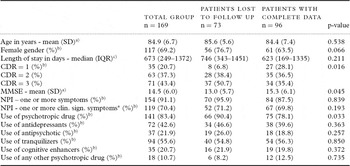
Table 1 shows the demographic data of the included patients at baseline (T0). The number of patients lost to follow-up were 19 (11.2%), 37 (21.9%), 53 (31.3%) and 73 (43.2%) for assessments two to five (T1–T4), respectively. Sixty-eight patients (40.2%) died during the follow-up period and five patients (3.0%) moved to another nursing home. Premature discontinuations from the study due to moving to another nursing home were at 3, 12, 19, 24 and 36 weeks. The mean age of the included patients was 84.9 years (SD 6.7), 69.2% were women and the median length of stay in the nursing home was 673 days, minimum 28 days and maximum 6087 days (inter-quartile range, IQR, 249–1372). For the 61 patients not included in the study, their mean age was 84.9 years (SD 9.9), 63.9% were women and the median length of stay was 658 days (IQR 314–1568). The age, the gender, the length of the stay and the NPI score were not significantly different in the two groups. The average MMSE score at baseline was 14.5 (SD 6.0). The group of patients who completed the five assessments had an MMSE score of 15.3 (SD 6.1) at baseline and the group of patients who did not complete the five assessments had a MMSE score of 13.0 (SD 5.7) (p<0.05). Regarding the use of psychotropic drugs we found a statistical difference between the groups: 90.4% of patients lost to follow-up and 78.1% of the completers used at least one psychotropic medication, p = 0.033. The groups also differed in terms of CDR with the group of patients who completed five assessments having a significantly lower CDR score (p<0.05).
Demographic characteristics at baseline for all included patients, patients completing the study period and patients lost-to-follow up, with statistical comparison of patients with and without complete data

CDR = Clinical Dementia Ratio, MMSE = Mini Mental State Examination, NPI = Neuropsychiatric Inventory, IQR = Interquartile Range.
SD = Standard Deviation.
* Clinical Significant Neuropsychiatric Symptoms = NPI > 3.
a) Independent Student's t-test, b) Pearson Chi-square test c) Mann-Whitney U test.
Prevalence and cumulative prevalence rates
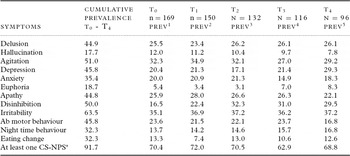
Table 2 shows the prevalence and the cumulative prevalence rates of the individual CS-NPS. The prevalence of any CS-NPS varied between 62.9% and 72.0% over the five assessments. The three most prevalent CS-NPS were irritability, agitation and apathy (T0 and T1), irritability, agitation and disinhibition (T2 and T3) and depression, disinhibition and irritability (T4). The three CS-NPS with the highest cumulative prevalence were irritability (63.5%), agitation (51.0%) and disinhibition (50.0%). In all, 91.7% of the patients had at least one CS-NPS at one or more assessments over the 16 months.
Prevalence and cumulative prevalence of Clinically Significant Neuropsychiatric Symptoms* (%)

* Clinically Significant Neuropsychiatric Symptoms = NPI > 3.
T0 = Baseline/first assessment, T1 = second assessment, T2 = third assessment, T3 = fourth assessment, T4 = fifth assessment.
1, 2, 3,4 and 5 Prevalence among all patients completing the first, second, third, fourth and fifth assessment, respectively.
Incidence and cumulative incidence rates
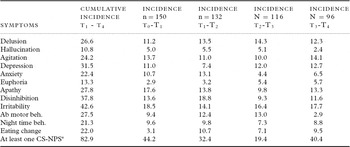
The incidence and the cumulative incidence rates are shown in Table 3. The NPS with the highest incidence rate were irritability, apathy and agitation (T0–T1) disinhibition, irritability and apathy (T1–T2), irritability, delusions and aberrant motor behavior (T2–T3) and irritability, apathy and agitation (T3–T4). Irritability (42.6%), disinhibition (37.8%) and depression (31.5%) showed the highest cumulative incidence.
Cumulative incidence and Incidence of Clinically Significant Neuropsychiatric Symptoms* (%)

* Clinically Significant Neuropsychiatric Symptoms = NPI > 3.
T0 = Baseline/first assessment, T1 = second assessment, T2 = third assessment, T3 = fourth assessment, T4 = fifth assessment.
Persistence and resolution
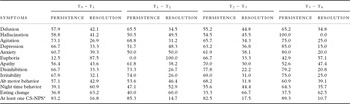
The persistence and the resolution rates of the CS-NPS are shown in Table 4. The three CS-NPS with the highest persistence rates were agitation, irritability and disinhibition for the first (T0–T1) and second (T1–T2) follow-up period. For the third (T2–T3) follow-up period disinhibition, apathy and irritability showed highest persistence rates, while for the last follow-up period (T3–T4) the three CS-NPS with the highest persistence rates were hallucination, depression and anxiety. On the other hand, the three CS-NPS with the highest resolution rates were euphoria, eating change and night-time behavior (T0–T1) and (T1–T2), eating change, hallucination and delusion (T2–T3) and eating change, euphoria and apathy (T3–T4).
Persistence and resolution of Clinically Significant Neuropsychiatric Symptoms* (%)

* Clinically Significant Neuropsychiatric Symptoms = NPI > 3.
T0 = Baseline/first assessment, T1 = second assessment, T2 = third assessment, T3 = fourth assessment, T4 = fifth assessment.
Persistence = ratio of residents with CS-NPSs at follow up to residents with CS-NPSs at the previous assessment.
Resolution = ratio of residents without CS-NPSs at follow up to the residents with CS-NPSs at the previous assessment.
Severity over time
We calculated the multilevel linear models statistics for the first-, second- and third-order polynomial growth curve of the individual NPI items. Analysis of the severity of the individual NPI items over time did not show significant differences for individual NPI items, reported as the linear, quadratic or cubic trend best describing the pattern of the data over time: delusion F(1, 287.92) = 0.59, p = 0.44; hallucination F(1, 300.73) = 1.09, p = 0.28; agitation F(1, 319.15) = 2.47, p = 0.12; depression F(1, 277.67) = 2.71, p = 0.10; anxiety F(1, 310.78) = 0.20, p = 0.65; euphoria F(1, 311.39) = 0.57, p = 0.45; apathy F(1, 284.70) = 1.53, p = 0.22; disinhibition F(1, 297.89) = 0.21, p = 0.65; irritability F(1, 283.85) = 0.02, p = 0.90; aberrant motor behavior F(1, 276.72) = 1.33, p = 0.25; night-time behavior F(1, 311.90) = 2.22, p = 0.14; and eating change F(1, 296.62) = 0.32, p = 0.57.
Use of psychotropic drugs
Of the 169 patients analyzed in the study, 83.4% used at least one psychotropic drug on a daily basis at the baseline registration; 42.6% used an antidepressant, 21.9% used an antipsychotic, 55.6% used a tranquilizer and 20.7% used a cognitive enhancer.
Of the 96 patients completing the five assessments, 82 (85.4%) used one or more psychotropic drug at least at one assessment. Sixty-two out of the 90 patients (75.6%) had a persistent use as they used at least one psychotropic drug at four or five out of five assessments. Tranquilizers were the group of psychotropic drug most frequently prescribed. Sixty-three out of 97 patients (75.6%) used a tranquilizer at least at one of the assessments during the follow-up period, and 37 of these 63 (58.7%) used a tranquilizer at four or five assessments during the period. Thirty-two out of 96 patients (33.3%) used an antipsychotic at least at one assessment, and 10 of these 32 (31.3%) used the antipsychotic at four or five assessments. Fifty out of the 96 patients (52.1%) used an antidepressant at least at one assessment during the follow-up period, and 26 of these 50 (52.0%) used the antidepressant at four or five assessments.
Discussion
We report the prevalence, incidence, persistence and resolution of neuropsychiatric symptoms of patients living in Norwegian nursing homes. Our cohort consisted of 210 patients (from a total of 271) living in seven nursing homes. Of these, 169 patients had dementia according to a CDR rating of 1 and above, and results from these patients were analyzed.
Prevalence
We found that irritability, agitation and disinhibition are the most prevalent NPS in nursing homes, which correspond to other studies (Ballard et al., Reference Ballard2001; Selbaek et al., Reference Selbaek, Kirkevold and Engedal2007; Wetzels et al., Reference Wetzels, Zuidema, de Jonghe, Verhey and Koopmans2010). In contrast, apathy, depression and aberrant motor behavior are found to be more prevalent among outpatients (Aalten et al., Reference Aalten, de Vugt, Jaspers, Jolles and Verhey2005). Owing to differences in assessment instruments, the studies by Wancata et al. (Reference Wancata, Benda, Meise and Windhaber2003) and Wagner et al. (Reference Wagner, Teri and Orr-Rainey1995) are difficult to compare with ours, but Wancata et al. report a cumulative prevalence over six months of depression 32.6%, delusion 9.3% and hallucination 2.4%. The studies by Aalten et al. (Reference Aalten, de Vugt, Jaspers, Jolles and Verhey2005) and Wetzels et al. (Reference Wetzels, Zuidema, de Jonghe, Verhey and Koopmans2010) are comparable to our study using the same design, following a cohort of patients with dementia over five consecutive assessments with the NPI. However, the two Dutch studies differ from our study as the time between each assessment in their studies was six months not four. We report that the cumulative prevalence of any CS-NPS over 16 months is 91.7% compared to 96.6% in a nursing home population in the Netherlands (Wetzels et al., Reference Wetzels, Zuidema, de Jonghe, Verhey and Koopmans2010). When looking at single NPI symptoms, Wetzels et al. report that delusion, hallucination, depression and disinhibition are approximately half as prevalent as we report in our study. In the study by Aalten et al. (Reference Aalten, de Vugt, Jaspers, Jolles and Verhey2005) on Dutch outpatients they reported similar figures to ours on the cumulative prevalence of individual clinically significant NPS. Our drop-out rate was 43.2%, caused by death (68 patients) and moving from the nursing home (five patients). Aalten et al. (Reference Aalten, de Vugt, Jaspers, Jolles and Verhey2005) reported a drop-out rate of 50%, with 24% due to death and 26% refusing to participate. Wetzels et al. (Reference Wetzels, Zuidema, de Jonghe, Verhey and Koopmans2010) reported a drop-out rate of 60% (54% due to death and 6% moving to another nursing home). At inclusion our patients had a mean MMSE score of 14.5 points, whereas those in the study by Aalten et al. (Reference Aalten, de Vugt, Jaspers, Jolles and Verhey2005) had a mean MMSE score of 18.1 (SD 4.7) and those in the study by Wetzels et al. (Reference Wetzels, Zuidema, de Jonghe, Verhey and Koopmans2010) had a mean MMSE score of 7.6 (SD 7.1). These MMSE differences and the differences in drop-out rates should be regarded as a possible explanation for the difference in the results. The follow-up periods in their studies was eight months longer than in our study, with the same number of assessments, which also could explain the difference in the results. In addition, pharmacological treatment and non-pharmacological interventions could also have influenced the results of the three studies, but we do not have sufficient information of such variables to make any conclusions. In our study the nursing homes received extra attention from the department of Old Age Psychiatry during the study. They were given extensive information on dementia and the different assessment scales. Parallel with the assessment of the NPS the nursing homes were encouraged to create their own small research project to improve the quality of their care. This extra attention might therefore have improved the quality of care in the nursing homes, which could explain some of the differences between our study and other similar studies.
Incidence
We report that irritability (42.6%), disinhibition (37.8%) and depression (31.5%) showed the highest cumulative incidence. A previous Swiss study has reported an incidence after six months of 10.5% for depression, 4.7% for delusion and 0.0% for hallucination (Wancata et al., Reference Wancata, Benda, Meise and Windhaber2003), while a previous Norwegian study reported that agitation, apathy and irritability have the highest cumulative incidence after one year (Selbaek et al., Reference Selbaek, Kirkevold and Engedal2008b). This result was confirmed in the study from the Netherlands by Wetzels et al. (Reference Wetzels, Zuidema, de Jonghe, Verhey and Koopmans2010), which also found that depression (19.6%) and disinhibition (16.7%) had a fairly low cumulative incidence. Why this difference? Selbæk and colleagues report data for a large number of patients on two assessments over one year, but do not have information on the symptoms experienced by the patients between the two assessments. Both Wetzels’ study and our own have a remarkably higher cumulative incidence rate than that reported by Selbæk and colleagues, indicating that the NPS show a rapid cycling in their course. The study by Wetzels and colleagues was based on patients with dementia living in Special Care Units (SCU), and their dementia was more severe than in other studies. As the dementia progresses the presentation of the NPS changes. This could contribute to the differences between the studies. Delusion, hallucination, agitation/aggression, apathy, disinhibition and aberrant motor behavior all significantly increase in frequency with more severe dementia (Selbaek et al., Reference Selbaek, Kirkevold and Engedal2007).
Persistence, resolution and possible influence of psychotropic drug use
In our study delusions, agitation, depression, disinhibition, irritability and aberrant motor behavior showed high persistence over the five assessments, which correspond with the results from a previous study on nursing home patients who reported agitation/aggression and aberrant motor behavior to be the most persistent NPS (Wetzels et al., Reference Wetzels, Zuidema, de Jonghe, Verhey and Koopmans2010). In the Swiss study (Wancata et al., Reference Wancata, Benda, Meise and Windhaber2003), depression was persistent in 63.3%, delusion in 50.0% and hallucination in 50.0%. In outpatients, depression, apathy and aberrant motor behavior were the NPS with highest persistence (Aalten et al., Reference Aalten, de Vugt, Jaspers, Jolles and Verhey2005). Compared to the two Dutch studies it seems that patients with dementia living at home differ in their symptom expression from the nursing home patients with dementia. This difference could be due to dementia severity, but also to environmental factors, caregiver burden and pharmacological and non- pharmacological interventions (Rozzini et al., Reference Rozzini, Cornali, Chilovi, Ghianda, Padovani and Trabucchi2006).
We noted that the use of psychotropic drugs was very common among our study subjects; 83.4% of them used at least one psychotropic drug at one assessment during the 16 months period. Almost 76% of the patients used one or more psychotropic drugs at four or five out of the five assessments. We did not specifically compare the persistent use of psychotropic drugs with the persistence of the CS-NPS. However, as the persistent use of psychotropic drugs generally is very high, we assume that the persistence of NPS is not influenced to a significant degree by the drug use. According to the results of two previous studies of nursing home patients, the severity of dementia and factors associated with being institutionalized most probably explain the persistence of the NPS (Selbaek et al., Reference Selbaek, Kirkevold and Engedal2008b; Wetzels et al., Reference Wetzels, Zuidema, de Jonghe, Verhey and Koopmans2010).
Severity over time
We did not find any significant change in the severity of the NPS during the 16-month follow-up period. This contradicts the findings of Aalten et al. (Reference Aalten, de Vugt, Jaspers, Jolles and Verhey2005) in their two-year study of NPS in outpatients and Wetzels et al. (Reference Wetzels, Zuidema, de Jonghe, Verhey and Koopmans2010) in their nursing home cohort. Aalten et al. reported significantly decreased severity of depression and increased severity of aberrant motor behavior and apathy, while Wetzels et al. reported significant reduction in depression and anxiety. We do not know how to explain these contradictory findings, although differences in statistical methods may play a role. Wetzels et al. used Friedman test to analyze change in NPI severity score over time, whereas Aalten et al. used analyses of variance (ANOVA) with repeated measurements; in our study we used the Multiple Level Method.
Clinical implications and treatment options
Our study confirms the findings from previous studies. Most of the patients with dementia, living either in nursing homes or in their own homes, will experience at least one NPS over the course of 16 to 24 months. Individual symptoms have a fluctuating course, with high resolution and incidence rate throughout the period. As clinicians we should monitor our patients well, with repeated assessments with the NPI or another systematic tool for the NPS. In the same way as we monitor the blood sugar and adjust the treatment in patients with Diabetes Mellitus we should monitor and adjust the treatment in patients with dementia and NPS. According to our results, delusion, hallucinations, disinhibition, agitation and irritability have a resolution rate between assessments varying from 30 to 40%, indicating that approximately one-third of the patients with these symptoms are symptom-free four months later. At the same time, we know that 75% of patients with dementia using an antipsychotic are still prescribed the same antipsychotic 12 months later (Selbaek et al., Reference Selbaek, Kirkevold and Engedal2008b). We see the same trend concerning the symptoms of depression, anxiety, apathy and irritability. The resolution rates for these symptoms are between 26% and 50% while the persistence rates for antidepressant prescription is 79.2% over 12 months (Selbaek et al., Reference Selbaek, Kirkevold and Engedal2008b).
There are several weaknesses in the present study. The nursing homes taking part in the study were a convenience sample of nursing homes from the south-eastern part of Norway. There was no randomization or stratification when inviting nursing homes to take part in the study, and the patients in our study may not be representative of the Norwegian nursing home population. In fact, we believe that the nursing homes taking part in the study were among the better nursing homes in the region, according to their knowledge of, education and interest in dementia. It is likely that knowledge of and interest in dementia among the professional caregivers in the nursing homes will reduce NPS among the nursing home residents, and our study may underestimate the prevalence of NPS in Norwegian nursing homes. Dementia was diagnosed based on a CDR scale score of 1, 2 or 3, but we did not make any etiological dementia diagnosis which could improve the quality of our study. We were therefore unable to perform regression analysis adjusted for dementia diagnosis; however, previous studies have demonstrated that staging dementia based on the CDR score is a valid substitute for a dementia diagnosis (Nygaard and Ruths, Reference Nygaard and Ruths2003). We did not make any adjustments for use of psychotropic drugs and somatic or psychiatric comorbidity, nor did we adjust for differences in nursing staff and type of ward in the nursing homes. The patients were assessed by several assessors, and although they all attended a two-day training course and the Norwegian version of the NPI has been found to have good inter-rater reliability, the relatively high number of assessors could bias the results. Almost all the patients lost to follow-up died during the follow-up period, and as shown in the analysis, the patients lost to follow-up had significantly more severe dementia than the patients completing the follow-up period. In our study, as well as in other studies (Selbaek et al., Reference Selbaek, Kirkevold and Engedal2008b; Wetzels et al., Reference Wetzels, Zuidema, de Jonghe, Verhey and Koopmans2010), changes in symptoms may partly be due to the Hawthorn effect whereby the symptoms of the patients taking part in the study can improve just because they are taking part (Roethlisberger et al., Reference Roethlisberger, Dickson and Wright1939).
The strength of our study is the relatively large number of included patients, and the relatively low drop-out rate (43.2%) compared to other nursing home studies. We made assessments of the patients every four months, a shorter interval than other reported studies.
Conclusion
We report a high prevalence of neuropsychiatric symptoms in Norwegian nursing homes. Only 8% of the patients did not experience a CS-NPS over the 16-month follow-up period. The most prevalent NPS were irritability, agitation and disinhibition, and these also had the highest persistence. Most of the NPS are fluctuating in their course, and very few symptoms are present continuously for more than eight months.
Conflict of interest
None.
Description of authors' roles
Sverre Bergh took part in the design of the study, did all the statistical analysis and wrote the paper. Irene Røen took part in designing the study, the data collection and approved the manuscript. Knut Engedal and Geir Selbæk took part in designing the study and writing the paper.
Acknowledgments
The study was supported by unrestricted grant from the Norwegian Medical Association.