1 Introduction
Defensive medicine can be defined as the avoidance of certain high-risk procedures or patients (avoidance behaviour or negative defensive medicine), or the ordering of procedures, tests or visits (assurance behaviour or positive defensive medicine), primarily (but not solely) due to the threat of medical liability (OTA, 1994). The existence of such defensive practices can be explained as follows. Medical liability laws affect malpractice pressure, i.e. financial and nonfinancial outcomes of the malpractice system, which influences physicians’ perceptions of appropriate best practices (Kessler and McClellan, Reference Kessler and McClellan1997). These perceptions affect treatment decision making and consequently also patient health outcomes (Kessler and McClellan, Reference Kessler and McClellan2002). Hence, a medical liability system might be considered as the trigger, while physicians’ perceptions of the system actually determine how they practice the medical profession. Therefore, it is important to analyse the determinants affecting physicians’ perception of liability risk and their defensive behaviour.
Although defensive practices could increase health care resources use (e.g. Frakes, Reference Frakes2012) and decrease accessibility to care (e.g. Klick and Stratmann, Reference Klick and Stratmann2007), they are not necessarily pernicious for society. For example, liability pressure may stimulate physicians to provide additional explanation to patients, better document the patient record and intensify follow-up of patients (Summerton, Reference Summerton1995). Furthermore, liability risk may drive physicians that have a below average quality of performance out of business (Van Velthoven and van Wijck, Reference Van Velthoven and van Wijck2012) and lead to a group of specialised physicians treating patients with highly complex case-mix (Black, Reference Black1990).
While these potentially beneficial effects have never been studied before, many scholars have elaborately examined the presumed disadvantageous phenomenon of defensive practices. As a result, a strand of empirical defensive medicine literature exists either linking differences in physicians’ actual clinical decision making to differences in their liability risk or using direct physician surveys. On the one hand, many studies analyse the effects of the medical malpractice environment on health care provider behaviour, using health care expenditures, the supply of physicians and specific medical procedures as a proxy for defensive medicine (e.g. Kessler and McClellan, Reference Kessler and McClellan1996; Currie and MacLeod, Reference Currie and MacLeod2008; Hellinger and Encinosa, Reference Hellinger and Encinosa2006).Footnote 1 Focussing almost exclusively on the United States, they find mixed results regarding the effects of state level tort reforms (adopted to mitigate liability risk) on physician’s defensive practices.
On the other hand, several articles use direct surveys to analyse the extent of both assurance and avoidance behaviour of physicians in a fixed medical malpractice climate. In general, these studies report higher percentages of physicians engaging in assurance behaviour than in avoidance behaviour. Studdert et al. (Reference Studdert, Mello, Sage, DesRoches, Peugh, Zapert and Brennan2005) and Nahed et al. (Reference Nahed, Babu, Smith and Heary2012), e.g., found that 59 and 66% of the physicians reported that they often ordered more diagnostic tests and referred patients to consultants respectively because of liability concerns. Mello et al. (2005) and Asher et al. (Reference Asher, Greenberg-Dotan, Halevy, Glick and Reuveni2012), on the other hand, found that respectively 42 and 17% of the respondents reduced or eliminated certain (high-risk) procedures or interventions following malpractice concerns. Some of these studies contribute to the understanding of defensive medicine by analysing physicians’ characteristics potentially affecting their clinical decision making and career choices. Mello et al. (2005), Nash et al. (Reference Nash, Walton, Daly, Kelly, Walter, van Ekert, Willcock and Tennant2010) and Elli et al. (Reference Elli, Tenca, Soncini, Spinzi, Buscarini and Conte2013) apply univariate analyses, while Lawthers et al. (Reference Lawthers, Laird, Lipsitz, Hebert, Brennan and Localio1992), Studdert et al. (Reference Studdert, Mello, Sage, DesRoches, Peugh, Zapert and Brennan2005), Carrier et al. (Reference Carrier, Reschovsky, Mello, Mayrell and Katz2010) and Asher et al. (Reference Asher, Greenberg-Dotan, Halevy, Glick and Reuveni2012) consider the impact of several physician characteristics on defensive behaviour simultaneously.
This paper further elaborates on the existing studies and literature on defensive medicine in several ways. First, we analyse a hypothesised change in the defensive behaviour of physician specialists following a change in the medical malpractice system, rather than studying the prevalence of defensive practices. Second, the 2010 reform of the Belgian medical malpractice system is more radical than those studied before, i.e. usually US tort reforms. Third, in addition to the qcommonly used characteristics, we hypothesise that physicians’ access to an incident reporting system may mitigate their defensive behaviour. Given the lack of centralised and accessible data concerning medical malpractice in Belgium, these analyses provide further insight into the impact of the Belgian medical malpractice reform, which is also important for future policy decisions.
2 The Belgian medical malpractice reform
Until recently, no specific compensation system was available in Belgium for health care-related injuries. As a result, patients alleging to suffer from health care-related injuries could only claim compensation relying on tort, contractual and criminal liability rules in court or via traditional out-of-court settlement. From the compensatory perspective, though, this system was criticised for leaving many medical malpractice victims uncompensated, entailing expensive and time-consuming procedures, and making the outcome of medical malpractice trials unpredictable and uncertain. From the preventive perspective, this negligence-based system caused physicians to practice defensively. After all, medical lawsuits entail negative publicity, lost working time, reputational and moral damage for the health care provider (King, Reference King1986; Carrier et al. Reference Carrier, Reschovsky, Mello, Mayrell and Katz2010; Van Velthoven and van Wijck, Reference Van Velthoven and van Wijck2012) and cause an increase in professional liability insurance premiums. Furthermore, some insurers restricted their cover’s extent, while others stopped offering liability insurances for the most severe risk categories or even left the medical malpractice insurance market altogether (Vansweevelt, Reference Vansweevelt1997).
During the last four decades, numerous governments in other countries expressed the same concerns regarding the use of conventional tort rules for resolving medical malpractice cases. To improve the performance of the medical malpractice system, and subsequently also health care (quality), six main alternatives or reform options exist: (1) tort reforms, (2) enterprise liability, (3) guideline-based systems, (4) alternative dispute resolution, (5) health courts and (6) administrative compensation systems. Consequently, the Belgian government had many policy alternatives to choose from as well as plenty of examples on which to base its decision. Since the 1990s, many alternatives for implementing a no-fault compensation system were proposed. Already in 1996, an interuniversity reflection group suggested the introduction of a fund awarding compensation for abnormal and unforeseeable injuries, without requiring a proof of negligence. However, no consensus was reached on whether to retain or abolish the current tort system (Vansweevelt, Reference Vansweevelt2011).
Eventually, a three-track system, similar to the French scheme (G’Sell-Macrez, Reference G’Sell-Macrez2011), was introduced by the ‘Act concerning the compensation of an injury resulting from health care’ of 31 March 2010.Footnote 2 As a result, since 1 September 2012, medical malpractice victims can either file suit, request compensation via an administrative body called the Fund for Medical Accidents (FMA) or resolve a dispute directly with the health care provider involved.
Although negligent health care providers remain liable for compensating harm inflicted in the out-of-court procedure managed by the FMA, compensation may also be awarded on a no-fault basis. Non-negligent injuries are eligible for compensation, either in court or via the FMA, though only in case of abnormal and serious harm.Footnote 3 This FMA procedure entails no legal costs for applicants, which may also benefit from the FMA possibly helping them with the burden of proving fault, harm suffered and causation, which is a necessary condition for being compensated under fault liability. Nonetheless, the FMA only has an advisory role, i.e. decisions and opinions are not legally binding, and can be appealed in court.
From September 2012 to December 2014, each month ~90 requests for compensation were filed with the FMA. Though, few patients received compensation via the out-of-court track and procedures were still time-consuming. This significant backlog and delay in processing compensation requests was mainly due to the FMA being understaffed, facing a continuous flow of new compensation requests and experiencing lengthy medical assessments.Footnote 4
However, beside a number of budgetary impact analyses performed by the Belgian Health Care Knowledge Centre, profound evidence on which to base policy decisions or to evaluate the current reform’s impact is unavailable. Although this reform will affect all parties involved, little attention has been given to physicians’ responses to this reform. Consequently, little is known about physicians’ perceptions of the medical malpractice system in Belgium and the impact of the reform on their clinical decision making and professional activities.
We hypothesise that physicians may have increased their defensive behaviour due to this reform for several reasons. First, an increasing number of physicians may be involved in medical malpractice claims. After all, patients may be encouraged to request compensation given the FMA’s easy accessibility and the possibility of receiving damages without proving fault. Second, fault liability remains the primary compensation rule, which may result in a potential increase in professional insurance premiums. Third, the FMA acts as a gatekeeper to disciplinary proceedings and physicians can be referred to professional boards in serious cases. Fourth, cooperation in FMA procedures is also mandatory for physicians, under penalty of financial sanctions.
3 Methods
3.1 Study design
A questionnaire was developed including questions on six basic domains that could affect physicians’ behaviour: (1) physician’s background information, (2) private insurance information, (3) knowledge of, (4) perception of and (5) experience with the medical malpractice system and (6) reporting of adverse events. The design of the survey was based on similar surveys in existing literature (e.g. Summerton, Reference Summerton1995; Mello et al., 2005; Studdert et al., Reference Studdert, Mello, Sage, DesRoches, Peugh, Zapert and Brennan2005; Carrier et al., Reference Carrier, Reschovsky, Mello, Mayrell and Katz2010; Nash et al., Reference Nash, Walton, Daly, Kelly, Walter, van Ekert, Willcock and Tennant2010) and was supplemented and validated with findings from key informants of the Belgian health care setting. Several draft versions as well as the final version of the survey were pretested and multiple physicians from various disciplines appraised the questionnaire. Most adjustments related to reformulating questions to comply with physicians’ jargon. The final version of the questionnaire included 34 questions, took 10–15 minutes on average to complete, and was developed in both Dutch and French, the two main languages in Belgium. Physicians from all specialties were targeted in this research. The online survey was conducted over a five-week period in October and November 2013. Belgian hospitals were informed of our research goal and invited to distribute the online questionnaire among their physician specialists. However, to ensure complete anonymity and prevent tracing physicians practicing in relatively rare specialties afterwards, participating hospitals preferred to remained anonymous. We also distributed the survey via the Society of Belgian Professional Associations of Physician Specialists (VBS-GBS)Footnote 5 to reach physicians practicing in hospitals that did not participate. Of course, we made sure that physicians could fill out the survey only once. In total, 508 specialists (2% of all physician specialists in BelgiumFootnote 6 ) completed the survey of which 258 responded via the hospitals and 250 via the professional associations.Footnote 7
3.2 Defensive medicine index
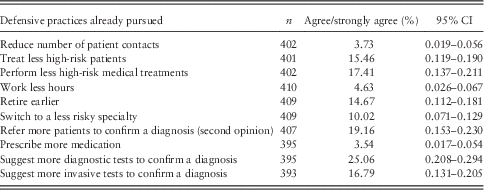
We hypothesise that physicians’ defensive behaviour in Belgium has increased because of the 2010 reform. To measure the overall extent of increased assurance or avoidance behaviour, we developed a defensive medicine index. This index is based on 10 defensive medicine statements (see Table 1), which were selected after several steps. A first selection was based on existing studies (Lawthers et al., Reference Lawthers, Laird, Lipsitz, Hebert, Brennan and Localio1992; Summerton, Reference Summerton1995; Mello et al., 2005; Studdert et al., Reference Studdert, Mello, Sage, DesRoches, Peugh, Zapert and Brennan2005; Hiyama et al., Reference Hiyama, Yoshihara, Tanaka, Urabe, Ikegami, Fukuhara and Chayama2006; Carrier et al., Reference Carrier, Reschovsky, Mello, Mayrell and Katz2010; Nash et al., Reference Nash, Walton, Daly, Kelly, Walter, van Ekert, Willcock and Tennant2010; Asher et al., Reference Asher, Greenberg-Dotan, Halevy, Glick and Reuveni2012; Nahed et al., Reference Nahed, Babu, Smith and Heary2012; Elli et al., Reference Elli, Tenca, Soncini, Spinzi, Buscarini and Conte2013). Key informants were then consulted to select those statements that were the most applicable and relevant in the Belgian health care setting. Furthermore, a test panel was asked to determine the relevance of each statement, taking into account that they should be sufficiently general so they could be applied to nearly all medical specialties. Although this is beyond the scope of this study, analysing certain specialties in-depth would require the use of more specific statements, e.g. caesarean delivery (Studdert et al., Reference Studdert, Mello, Sage, DesRoches, Peugh, Zapert and Brennan2005).
Changes in defensive behaviours due to the 2010 medical malpractice reformFootnote a

a Respondents that used the opt-out option were not included.
Respondents were asked to indicate how strongly they agree with these statements (e.g. ‘I treat less high-risk patients due to the 2010 reform’) on a five-point Likert-scale, ranging from ‘strongly disagree’ to ‘strongly agree’. Opt-out responses, i.e. using the ‘not applicable’ option, were excluded from further analyses, as well as the respondents unaware of the 2010 reform. We used an aggregate index by awarding a score of respectively ‘−2’, ‘−1’, ‘0’, ‘+1’ and ‘+2’ to respondents’ answers resulting in three indexes with lower and upper bounds of respectively −20 to +20 (overall defensive behaviour), −12 to +12 (avoidance behaviour) and −8 to +8 (assurance behaviour). A positive score on the index indicates an overall increase in defensive practices, while a zero or negative score indicates no increase, though not necessarily a decrease.
To construct our index, we considered an equal magnitude of differences between categories in order to convert an ordinal scale to a continuous scale, although potential issues have been pointed out (Bertram, Reference Bertram2006). However, aggregating the statements into one index is possible as they all use the same Likert scale. Furthermore, Allen and Seaman (Reference Allen and Seaman2007) state that Likert scales can be analysed as interval values as they are combined to form indexes, assuming this combination forms an underlying characteristic or variable and insisting that such combination of scales should pass the Cronbach’s α.
The defensive medicine index is a continuous variable and passes the validity test. Cronbach’s α was 0.9230, 0.8968 and 0.8764 for the overall defensive, avoidance and assurance behaviour index, respectively, which indicates internal consistency in the defensive medicine statements used. The average inter item covariance was 0.5847, 0.6277 and 0.7040, respectively.
A discrete analysis was also performed to examine differences between respondents reporting a change (i.e. a positive index score) and no change (a negative or zero index score) in their defensive behaviour. Though, the outcome of logistic regression models yielded no significantly different results compared with analysing the continuous index.
3.3 Classification of medical specialties
We hypothesise that a physician’s medical specialty is one of the determinants of defensive practices. Therefore, all disciplines were classified into three groups according to their malpractice risk: low, medium and high risk. Lawthers et al. (Reference Lawthers, Laird, Lipsitz, Hebert, Brennan and Localio1992) and Studdert et al. (Reference Studdert, Mello, Sage, DesRoches, Peugh, Zapert and Brennan2005) provide some useful information on this classification, while Jena et al. (Reference Jena, Seabury, Lakdawalla and Chandra2011) report malpractice risk levels for nearly each discipline. In addition, insurance premium rates in Belgium can be considered as a reliable proxy for specialty risk and were therefore used to accomplish the classification.
3.4 Statistical analysis
The data were analysed by applying two-sample t-tests, ordinary least squares (OLS) regressions and logistic regressions, using the STATA 12.1 statistical software package. Cronbach’s α was used to determine the reliability of the defensive medicine index. The OLS method was applied to estimate the coefficients of variables possibly affecting overall, positive and negative defensive behaviours, as measured by the defensive medicine index. Logistic regression models were conducted to determine the variables significantly affecting each defensive behaviour statement. The dependent variable in these analyses was physicians who agreed and strongly agreed with a particular behaviour statement due to the 2010 reform, compared with the responses strongly disagree, disagree and neutral. Two-sample t-tests and pairwise methods were performed to determine independent variables that were eligible to include in the multivariate regression models (Appendices 1, 2 and 3). Other variables were also included due to their potential impact on the outcome variables. Multiple models and independent variables were tested, resulting in certain variables being dropped from the final model (e.g. age and hospital category). Robustness checks were performed by forward selection and backward removal of variables.
4 Results
4.1 Respondent characteristics
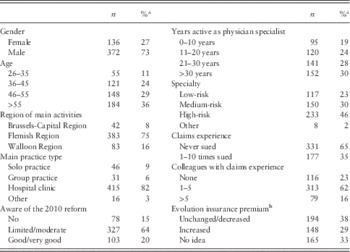
The characteristics of the 508 respondents are shown in Table 2.Footnote 8 The sample contained 233 high-risk specialists,Footnote 9 150 medium-risk specialistsFootnote 10 and 117 low-risk specialists.Footnote 11 Nearly three quarters (372) of our respondents were male; 82% (415) of the respondents had their main activities based in a hospital, 6% (31) worked in a group practice, 9% (46) were solo practitioners and 3% (16) worked in another setting. Three quarters (383) of the sample had their main activities located in the Flemish Region. The majority (65%) of the specialists had never been named in a malpractice suit, while almost 80% (392) knew at least one physician in their own specialty that had been named in a malpractice lawsuit.
Physician sample characteristics (n=508)

a Percentages may not add to 100% due to rounding.
b One specialist reported to have no professional liability insurance.
4.2 General findings
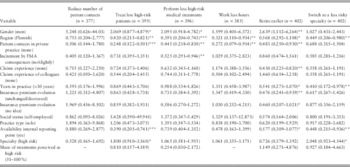
Most respondents (86%) reported no increase in their overall defensive behaviour following the 2010 medical malpractice reform in Belgium. Nevertheless, several physicians subsequently pursued more defensive practices, like suggesting more diagnostic tests to confirm a diagnosis (25%) and performing less high-risk treatments (17%). Though, fewer respondents reduced their number of patient contacts (4%) and worked less hours (4%) due to the reform. Gender, region and access to an incident reporting system were found to be the most frequent predictors of increased aggregate as well as specific defensive practices. Male physicians reported a higher increase in defensive behaviour, while practicing in the Flemish part of Belgium and having access to an incident reporting system mitigates this effect.
4.3 Overall defensive behaviour
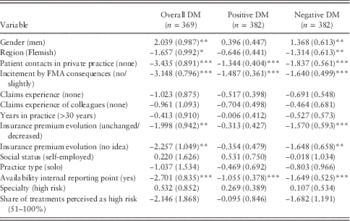
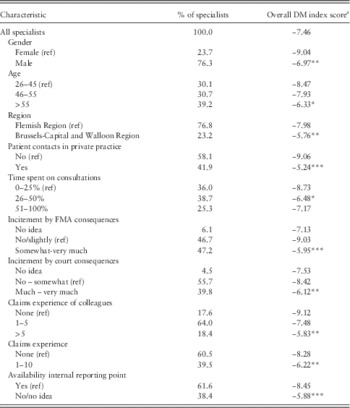
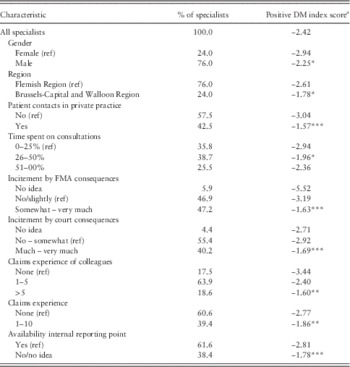
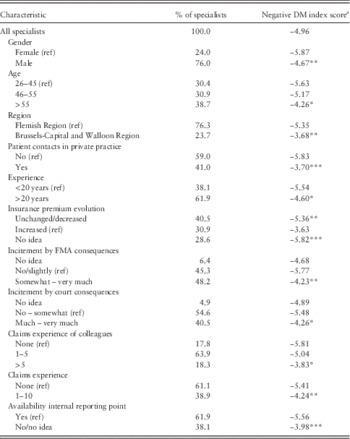
Interesting differences in defensive behaviour can be found between several specialist subgroups. Table 3 shows all statistically significant and insignificant predictors of increased overall, positive and negative defensive medicine due to the 2010 reform. The number of patient contacts in private practice,Footnote 12 the level of incitement by FMA consequences and a physician’s availability of an internal reporting point to disclose medical errors have a significant impact on all three measures of increased defensive medicine.
Determinants of increased overall, positive and negative defensive behaviour in multivariate regression analyses (index scores)Footnote a

FMA=Fund for Medical Accidents; DM=defensive medicine.
Standard errors appear in parenthesis.
a The eight specialists that reported to be employed in a specialty other than provided by the Belgian Medical Association were excluded in these analyses.
*Significant at 10%, **significant at 5%, ***significant at 1%.
Physicians without patient contacts in a private practice have increased their overall (−3.435; p<0.001), positive (−1.344; p=0.001) and negative (−1.837; p=0.001) defensive behaviour to a lower extent. Specialists who are not or only slightly incited by the consequences of an FMA procedure,Footnote 13 reported less increased overall (−3.148; p<0.001), positive (−1.487; p<0.001) and negative (−1.640; p=0.001) defensive practices. The availability of an internal reporting point has a significant negative impact on the increase in physicians’ overall (−2.701; p=0.001), positive (−1.055; p=0.006) and negative (−1.649; p=0.002) defensive practices. Specialists active in the Flemish Region increased their overall and avoidance behaviour to a lower extent compared with their colleagues from the Walloon and Brussels-Capital Region (−1.657; p=0.096 and −1.314; p=0.033), while male physicians reported a greater increase (2.039; p=0.040 and 1.368; p=0.026). No such significant effect was found on aggregate assurance behaviour though.
4.4 Assurance behaviour
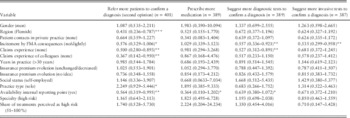
Assurance behaviour, or positive defensive medicine, is the ordering of procedures, tests or visits by a physician primarily (but not solely) due to the threat of medical liability (OTA, 1994). Specialists who were not or only slightly incited by the consequences of an FMA procedure were half as likely as other specialists to refer more patients (OR 0.576; 95% CI 0.329–1.006; p=0.053), suggest more diagnostic (OR 0.557; 95% CI 0.336–0.921; p=0.023) and invasive tests (OR 0.535; 95% CI 0.299–0.958; p=0.035) to confirm a diagnosis (Table 4). The odds of prescribing more medication (OR 0.364; 95% CI 0.110–1.202; p=0.097), referring more patients (OR 0.564; 95% CI 0.319–0.995; p=0.048) and suggesting more diagnostic tests (OR 0.639; 95% CI 0.380–1.072; p=0.090) to confirm a diagnosis were lower for specialists who had access to an incident reporting system to report medical injuries. Claims experience was the only significant objective measure of liability risk in any of the regression models: the odds of referring more patients (OR 0.500; 95% CI 0.280–0.893; p=0.019) and suggesting more diagnostic tests (OR 0.527; 95% CI 0.312–0.891; p=0.017) to confirm a diagnosis were lower for specialists who had never been exposed to a medical lawsuit.
Determinants affecting increased physician specialists’ assurance behaviour in multivariate logistic regression analyses (odds ratios)Footnote a

FMA=Fund for Medical Accidents.
Odds ratios are adjusted.
95% CI appear in parenthesis.
a The eight specialists that reported to be employed in a specialty other than provided by the Belgian Medical Association were excluded in these analyses.
*Significant at 10%, **significant at 5%, ***significant at 1%.
4.5 Avoidance behaviour
Avoidance behaviour, or negative defensive medicine, is the avoidance of certain high-risk procedures or patients by a physician primarily (but not solely) due to the threat of medical liability (OTA, 1994). The odds of five out of six avoidance behaviours due to the 2010 reform were lower for physicians practicing in the Flemish Region (Table 5). Specialist physicians without patient contacts in their private practice were less than half as likely as other specialists to treat less high-risk patients (OR 0.248; 95% CI 0.122–0.501; p<0.001), perform less high-risk medical treatments (OR 0.445; 95% CI 0.238–0.830; p=0.011), work less hours (OR 0.272; 95% CI 0.079–0.934; p=0.039) and retire earlier (OR 0.483; 95% CI 0.250–0.930; p=0.030). Claims experience only had a significant impact on physicians’ desire to retire earlier because of the 2010 reform. The odds of treating less high-risk patients (OR 0.390; 95% CI 0.205–0.741; p=0.004), retiring earlier (OR 0.577; 95% CI 0.309–1.077; p=0.084) and switching to a less risky specialty (OR 0.448; 95% CI 0.215–0.936; p=0.033) were lower for physicians with access to an incident reporting system.
Determinants affecting increased physician specialists’ avoidance behaviour in multivariate logistic regression analyses (odds ratios)Footnote a

FMA=Fund for Medical Accidents.
Odds ratios are adjusted.
95% CI appear in parenthesis.
– Variable omitted due to perfect failure prediction of the dependent variable.
a The eight specialists that reported to be employed in a specialty other than provided by the Belgian Medical Association were excluded in these analyses.
*Significant at 10%, **significant at 5%, ***significant at 1%.
5 Discussion
This study is the first to analyse the variables affecting a change in physician defensive practices because of the 2010 reform of the medical malpractice system in Belgium. Unlike existing studies, we explicitly asked whether physicians have altered their clinical behaviour due to the medical malpractice reform of 2010. Thereby, we isolate the liability-related incentive from other factors that may affect physicians’ clinical decision making (Bradley, 1992). Moreover, our survey addressed nearly all specialties instead of focussing on high-risk medical groups (e.g. Mello et al., 2005; Studdert et al., Reference Studdert, Mello, Sage, DesRoches, Peugh, Zapert and Brennan2005) or specific specialties (e.g. Summerton, Reference Summerton1995; Vimercati et al., Reference Vimercati, Greco, Kardashi, Rossi, Loizzi, Scioscia and Loverro2000; Hiyama et al., Reference Hiyama, Yoshihara, Tanaka, Urabe, Ikegami, Fukuhara and Chayama2006; Dick et al., Reference Dick III, Gallagher, Brenner, Yi, Reisch, Abraham, Miglioretti, Carney, Cutter and Elmore2009; Nahed et al. Reference Nahed, Babu, Smith and Heary2012; Elli et al., Reference Elli, Tenca, Soncini, Spinzi, Buscarini and Conte2013) only. In addition to existing studies, we also included some new variables thought to have an effect on defensive behaviour. The design of our questionnaire and the use of a defensive medicine index made it possible to analyse overall, assurance and avoidance defensive behaviour together or separately.
In order to reduce socially desirable responding, inherent in physician self-report questionnaires, our survey was performed anonymously. Nevertheless, response bias remains inevitable as physicians do not always correctly distinguish between appropriate and inappropriate care in clinical situations (Eddy, Reference Eddy1998). In addition, unconscious defensive medicine is frequently practiced, though not reported by physicians (Asher et al., Reference Asher, Parag, Zeller, Yerushalmi and Reuveni2007). A limitation in this study is the low response rate, which could cause non-response bias. Also participation bias was taken into account, as the sample characteristics are not entirely comparable with the population characteristics. For example, 38% of all Belgian physician specialists was female in 2013 (vs 27% in the sample) and 53% had their main activities in the Flemish Region (vs 75% in the sample). However, using sampling weights and weighting the data by gender and region did not yield significantly different results in our regression models. Furthermore, one could also argue that specialists contacted via the professional organisations may be more interested in medical malpractice than non-members. This selection bias is mitigated by distributing the survey also directly via the hospitals. Though, average scores on the overall defensive medicine index did not significantly differ between those reached via the hospitals or via the professional associations (p=0.0553).
Although Studdert et al. (Reference Studdert, Mello, Sage, DesRoches, Peugh, Zapert and Brennan2005), Hiyama et al. (Reference Hiyama, Yoshihara, Tanaka, Urabe, Ikegami, Fukuhara and Chayama2006) and Elli et al. (Reference Elli, Tenca, Soncini, Spinzi, Buscarini and Conte2013) reported higher response rates, the response rate in this study is comparable with Asher et al. (Reference Asher, Greenberg-Dotan, Halevy, Glick and Reuveni2012). In contrast to other countries, this shows that Belgian physicians appear to be averse to participate in surveys on sensitive topics like medical malpractice.
The results of our survey also capture the impact of the altered medical malpractice system on physicians as they perceive it will function. At the moment of the inquiry, though, the FMA was operational for only one year and had not yet publicly disclosed any advices or decisions concerning medical malpractice cases. Therefore, our findings do not necessarily reflect how they will perceive it once the full consequences of the policy have become clear. Furthermore, the analysis of behavioural change in health care settings (as done in e.g. Damschroder et al. (Reference Damschroder, Aron, Keith, Kirsh, Alexander and Lowery2009) and Bergs et al. (Reference Bergs, Lambrechts, Simons, Vlayen, Marneffe, Hellings, Cleemput and Vandijck2015) is beyond the scope of this study. This analysis of behavioural change and its determinants could be interesting for future research.
5.1 The extent of increased defensive behaviour
Under the three-track compensation system, it is rather unlikely that physicians have reduced their defensive practices compared to before the 2010 reform. After all, victims can still claim compensation in court, while the FMA offers a simple, expeditious and free procedure for patients requesting compensation. Hence, the risk of being involved in a medical malpractice claim has not decreased for physicians. Therefore, we hypothesised an increase in physicians’ defensive behaviour following the medical malpractice system reform in Belgium.
However, the majority of the specialists reported no increase in their defensive behaviour due to the 2010 reform of the Belgian medical malpractice system, which can be explained by three reasons. First, the impact of the reform may still be unclear for physicians and subsequently their clinical decision making may not yet be affected. Second, physicians may also perceive that the 2010 reform does not increase their liability exposure for medical malpractice, resulting in little observed adaptations in their clinical decisions and career choices. Given the benefits, it is almost obvious that medical malpractice victims will prefer the FMA procedure over a judicial procedure, probably resulting in a reduced physicians’ risk of getting sued. Third, the FMA not yet reaching its goal of compensating more victims and shorter procedures may as well lead to a low(er) perceived threat to physicians thus far. After all, we analysed the influence of the Belgian medical malpractice system reform on physicians at a moment that the FMA was not yet fully operational and many uncertainties existed regarding its decision making. Although the concept and the idea of the FMA’s introduction were probably clear to physicians, the potential consequences for their professional activities were possibly not. Therefore, it is highly likely that physicians’ perception of the FMA’s impact may have been incomplete at that time, resulting in our findings only reflecting a tentative picture of the impact. This also fits with our finding that physicians who are not or only slightly incited to deliver proper medical care by the consequences of a procedure via the FMA were significantly less inclined to behave more defensively in their profession.Footnote 14 However, further research should reveal whether more physicians will significantly adapt their defensive behaviour, once the FMA has become fully operational and its decision making is published.
Nonetheless, respectively 14, 18 and 13% of the physician specialists did claim that the 2010 reform has driven them to engage in more overall, assurance and avoidance defensive behaviour. Again, two possible arguments can explain these findings. The absence of FMA decision making may result in physicians not knowing how careful to be in order to avoid liability, which may cause them to raise their level of care beyond the level of due care (Van Velthoven and van Wijck, Reference Van Velthoven and van Wijck2012). Furthermore, the FMA procedure lowered patients’ threshold for requesting compensation: no legal costs are charged, damages can be awarded on a no-fault basis and the FMA is more involved during the administrative procedure compared with a court procedure. As a result, specialists may perceive that their exposure to liability has increased.
5.2 Defensive practices and physicians’ characteristics
The way physicians perceive a medical malpractice system may be as important as the system itself. Existing literature about defensive medicine shows that numerous factors have an effect on physicians’ perception of their malpractice risk, e.g. Lawthers et al. (Reference Lawthers, Laird, Lipsitz, Hebert, Brennan and Localio1992), Studdert et al. (Reference Studdert, Mello, Sage, DesRoches, Peugh, Zapert and Brennan2005) and Carrier et al. (Reference Carrier, Reschovsky, Mello, Mayrell and Katz2010). Some of these studies also found evidence of male physicians engaging more in defensive behaviour, though the rationale behind this relationship was never explored. A possible explanation may be that women have better interaction and interpersonal skills with their patients (Taragin et al., Reference Taragin, Wilczek, Karns, Trout and Carson1992), which are correlated with patient satisfaction (Hickson et al., Reference Hickson, Clayton, Githens and Sloan1992; Beckman et al., Reference Beckman, Markakis, Suchman and Frankel1994), and therefore may mitigate their impulse to behave defensively. Although this may also be associated with the fact that male physicians are more likely to be sued (Sloan et al., Reference Sloan, Mergenhagen, Burfield, Bovbjerg and Hassan1989; Taragin et al., Reference Taragin, Wilczek, Karns, Trout and Carson1992; Entman et al., Reference Entman, Glass, Hickson, Githens, Whetten-Goldstein and Sloan1994; Weycker and Jensen, Reference Weycker and Jensen2000; Asher et al., Reference Asher, Greenberg-Dotan, Halevy, Glick and Reuveni2012), our findings do not support this.
Physicians practicing in the Flemish Region were also found less likely to have increased their defensive practices following the 2010 reform. This may be due to differences between Dutch and French-speaking physicians, which were also reported by Vlayen et al. (Reference Vlayen, Schrooten, Wami, Aerts, Barrado, Claes and Hellings2015) concerning the perceptions on safety culture in Belgian hospitals. This study found that having positive values towards patient safety was significantly lower for French-speaking in comparison with Dutch-speaking health care professionals. These findings may contribute to explaining physicians’ different perceptions of the 2010 reform in these regions. Furthermore, 60% of compensation requests received by the FMA is also from the French-speaking part of Belgium (RIZIV, 2015), which represents 33% of all Belgian physicians, though this was not yet known at the moment of the survey. Moreover, court rulings appear to differ between the Flemish and Walloon Region, specifically regarding compensation amounts awarded. Although these explanations may contribute to the variations in perception between Belgian regions, they require further exploration, as clear evidence is lacking.
In general, both our objective and subjective measures of specialists’ liability risk were found not to be associated with an increased physicians’ propensity to practice defensively because of the 2010 reform. Although this finding is in contrast with (Lawthers et al., Reference Lawthers, Laird, Lipsitz, Hebert, Brennan and Localio1992) and (Nash et al., Reference Nash, Walton, Daly, Kelly, Walter, van Ekert, Willcock and Tennant2010), multiple other studies also concluded that physicians’ prior claims experience has no significant impact on their defensive behaviour (Goyert et al., Reference Goyert, Sidney, Treadwell and Nehra1989; Weisman et al., Reference Weisman, Morlock, Teitelbaum, Klassen and Celentano1989; Baldwin et al., Reference Baldwin, Hart, Lloyd, Fordyce and Rosenblatt1995; Studdert et al., Reference Studdert, Mello, Sage, DesRoches, Peugh, Zapert and Brennan2005; Dick et al., Reference Dick III, Gallagher, Brenner, Yi, Reisch, Abraham, Miglioretti, Carney, Cutter and Elmore2009). Glassman et al. (Reference Glassman, Rolph, Petersen, Bradley and Kravitz1996) concluded that physicians’ prior malpractice experience is not a predominant factor that prompts physicians to practice defensively. They suggested that the collective anxiety may overshadow individual physician’s experience, as practicing defensively may have been so widely spread. This rationale may be extended to the presumed impact of physicians’ specialty and their perceived share of high-risk treatments on defensive medicine, which is also not confirmed by our results. Nonetheless, our results indicate that both claims experience and specialty appear to significantly affect certain specific defensive practices.
Furthermore, we hypothesised that the option of reporting an adverse event confidentially may ease physicians’ fear of being punished for their actions. Generally, physicians are reluctant to report medical incidents because of the threat of lawsuits and repercussions of their own health care organisation, which are often accompanied with punitive consequences (Gallagher et al., Reference Gallagher, Waterman, Garbutt, Kapp, Chan, Dunagan, Fraser and Levinson2006). Fostering transparency regarding medical incidents is one of the leitmotifs of patient safety. As a result of this culture, health care organisations shift from an approach that blames individuals to a non-punitive approach that stimulates reporting and open communication regarding medical incidents (Studdert et al., Reference Studdert, Mello and Brennan2004). We found that specialists’ availability of an internal reporting point was the most frequently found significant predictor of overall defensive behaviour measures as well as of specific defensive practices. Physicians with access to such an incident reporting system were less likely to practice more defensively due to the 2010 reform. Therefore, these incident reporting systems may mitigate defensive practices. Thus, health care institutions can play an active part in the evolution and controlling of defensive medicine. However, more than 40% of the respondents reported to have no access to or to be unaware of such an incident reporting system. Almost 39% even admitted not using this reporting option, while they had been involved in a medical incident.
One has to bear in mind that we used a change in defensive practices due to a medical malpractice reform as opposed to the extent of defensive medicine applied in existing studies on defensive medicine. Moreover, it is difficult to explain why some physician characteristics have a significant impact on certain defensive practice changes without affecting other. For example, claims experience seems to significantly affect physicians’ willingness to retire earlier because of the 2010 reform, while not affecting other avoidance behaviour. Therefore, further research is necessary to reveal and explore dissimilarities between physicians’ defensive behaviours.
5.3 Implications for health care policy and quality
For several clinical activities and career choices, we found evidence of a modest increase in physicians’ practicing more defensively following the 2010 reform. In literature, this defensive behaviour is mainly considered a counterproductive outcome of medical malpractice systems. For example, avoiding high-risk patients and procedures may decrease access to health care (Mello et al., 2005). Delaying adequate treatment may impact costs as well, since patients could end up in a more expensive treatment option. Furthermore, defensive medicine may increase health care resources use, due to initiating unnecessary care such as the ordering of extra second opinions, (non)invasive procedures, medical imaging and laboratory tests to confirm a diagnosis. These unnecessary acts may also be harmful for patients and affect patient safety. Fear of a malpractice claim may also stop physicians applying experimental treatments, and consequently hamper innovation in health care.
Nevertheless, defensive practices may also have beneficial effects. For example, the quality of care may even improve rather than worsen if the avoidance of malpractice risks results in patients with seldom and/or highly complex case-mix being treated by only a small group of specialised physicians (Black, Reference Black1990). The threat of a potential claim may as well stimulate physicians to better document patient records and provide intensified follow-up and additional explanation to patients (Summerton, Reference Summerton1995). Furthermore, unnecessary testing may lead to coincidentally detecting diseases and consequently reduce medical incidents as well as the number of malpractice lawsuits.
Thus, defensive practices are very case- and specialty-dependent, and can be counterproductive as well as beneficial, whether focussing on health care expenditures, patient safety or quality of care. For the benefit of policy makers, health care management and professionals, one should continue research on defensive behaviours and their effects, although they are hard to determine and quantify accurately.
5.4 Conclusions
The impact of the 2010 medical malpractice reform in Belgium on defensive practices among specialists was found to be rather modest. Respectively, 14, 18 and 13% of respondents aware of the reform reported to subsequently engage in more overall, assurance and avoidance defensive behaviour. However, respectively 25.06, 16.79 and 19.16% of the respondents who were aware of the reform confirmed to prescribe or perform more diagnostic and invasive tests and to refer more patients to confirm a diagnosis, solely because of the reform. For the same reason, respectively 17.41 and 15.46% reported to perform less high-risk treatments and to treat less high-risk patients. Often used determinants of defensive medicine in prior studies resulted in comparable findings. The most frequent predictors of increased defensive practices were gender, region and access to an incident reporting system, which may be important for future policy decisions. The newly included determinant physician’s access to an incident reporting system yielded a remarkable significant relationship with defensive behaviour. Physician specialists who had the opportunity of confidentially reporting medical incidents were found to be less likely to increase their defensive practices because of the 2010 reform. Hence, health care institutions can play a leading role in reducing defensive practices, although they are not necessarily pernicious for society. Nevertheless, further research is required to determine the evolving impact of the 2010 reform on physicians’ behaviour as well as on other aspects like health outcomes, malpractice payments, medical lawsuits and patient satisfaction.
Appendices
Appendix 1
Overall defensive medicine index score, by physician characteristics (n=375)

Appendix 2
Positive defensive medicine index score, by physician characteristics (n=388)

Appendix 3
Negative defensive medicine index score, by physician characteristics (n=388)