Cigarette smoking is one of the most preventable causes of death in the world (World Health Organization [WHO], 2002) and not surprisingly, is a major risk factor for cardiovascular disease (Ockene & Houston, Reference Ockene and Houston1997) and preventable cancers (WHO, 2002). Failure to cope with nicotine withdrawal symptoms (Hughes et al., Reference Hughes, Gulliver, Fenwick, Valliere, Cruser and Pepper1992) and severe cravings for cigarettes (West, Hajek, & Blecher, Reference West, Hajek and Belcher1989) have been linked to high relapse rates among smokers (Taylor & Katomeri, Reference Taylor and Katomeri2007). These symptoms include anxiety, tension, general fatigue, weight gain, and sleep disturbances as well as other common mental and physical problems (Hatsukami, Hughes, Pickens, & Svikis, Reference Hatsukami, Hughes, Pickens and Svikis1984; Shiffman & Jarvik, Reference Shiffman and Jarvik1976). Evidently, it is critical to develop a breadth of smoking behaviour aids that can contribute to reductions in craving and withdrawal symptoms, and promote long-term abstinence.
A single bout of light, moderate, and vigorous intensity exercise has been shown to significantly reduce cravings and withdrawal symptoms in temporarily abstinent smokers (Daniel, Cropley & Fife-Schaw, Reference Daniel, Cropley and Fife-Schaw2007; Elibero, Janse Van Rensburg, & Drobes, Reference Elibero, Janse Van Rensburg and Drobes2011; Everson, Daley, & Ussher, Reference Everson, Daley and Ussher2008; Faulkner, Arbour-Nicitopoulos, & Hsin, Reference Faulkner, Arbour-Nicitopoulos and Hsin2010; Janse Van Rensburg & Taylor Reference Janse Van Rensburg and Taylor2008; Janse Van Rensburg, Taylor, & Hodgson, Reference Janse Van Rensburg, Taylor and Hodgson2009). Two recent meta-analyses (Haasova et al., Reference Haasova, Warren, Ussher, Van Rensburg, Faulkner, Cropley, Byron-Daniel, Everson-Hock, Oh and Taylor2012; Roberts, Maddison, Simpson, Bullen, & Prapavessis, Reference Roberts, Maddison, Simpson, Bullen and Prapavessis2012) provide further empirical evidence for acute exercise having a positive effect on cigarette cravings during abstinence. The magnitude of these craving reductions is similar to nicotine replacement therapy (NRT). It has been shown that exercise is more than a distraction from cravings and withdrawal symptoms, as the benefits of exercise last after the bout of exercise is over (Daniel et al., Reference Daniel, Cropley and Fife-Schaw2007; Ussher, West, Doshi, & Sampuran, Reference Ussher, West, Doshi and Sampuran2006). Furthermore, if the effects of exercise on craving and withdrawal were merely a distraction technique, the outcome of engagement in a comparable cognitive demanding task (albeit sedentary) would be the same. However, this does not appear to be the case, as the reduction in craving and withdrawal symptoms after engagement in exercise is reportedly greater than a distracting task (Daniel et al., Reference Daniel, Cropley and Fife-Schaw2007; Ussher, Nunziata, Cropley, & West, Reference West and Shiffman2001). In addition, treatment expectations are unrelated to reductions in cravings and withdrawal following an acute bout of exercise (Daniel et al., Reference Daniel, Cropley and Fife-Schaw2007; Harper, Fitzgeorge, Tritter, & Prapavessis, Reference Harper, Fitzgeorge, Tritter and Prapavessis2012).
With respect to the intensity of exercise, a recent meta-analysis by Haasova et al. (Reference Haasova, Warren, Ussher, Van Rensburg, Faulkner, Cropley, Byron-Daniel, Everson-Hock, Oh and Taylor2014) found that the level of intensity moderated craving reductions. Specifically, moderate and vigorous exercise studies produced similar effects (i.e., 34% and 31% craving reductions, respectively) and these studies were superior to light intensity exercise manipulations (9% craving reductions). All three levels of exercise intensity were superior to no exercise. There has been increased interest in the potential role of light intensity activities as a means to reduce cravings and withdrawal symptoms. The rationale is that light intensity activities will be more enjoyable and less difficult to implement for smokers wanting craving relief during a quit attempt. For instance, both yoga (Elibero et al., Reference Elibero, Janse Van Rensburg and Drobes2011) and isometric exercise (Ussher et al., Reference Ussher, Cropley, Playle, Mohidin and West2009) have had positive effects on cravings post treatment. These findings raise an interesting question-how low in intensity and accompanying movement can one go before these craving effects no longer exist?
Imagery (mental pictures created in the mind) is known to have powerful effects on behaviour and cognitions (Johnson & Lutgendorf, Reference Johnson and Lutgendorf2002; Paivio, Reference Paivio1986; Taylor, Pham, Rivkin, & Armor, Reference Taylor, Pham, Rivkin and Armor1998). For instance, research has shown that the co-activation of areas evoked during motor imagery (i.e., the mental simulation of a specific action without any corresponding motor output; Jeannerod, Reference Jeannerod1994), correspond with specific areas of neuronal activity elicited during physical execution of the same task (Buccino et al., Reference Buccino, Binkofski, Fink, Fadiga, Fogassi, Gallese and Freund2001; Ehrsson, Geyer, & Naito, Reference Ehrsson, Geyer and Naito2003). Further support for this similarly is highlighted by Gallese and Goldman (Reference Gallese and Goldman1998) who found that the regions activated when one images a particular task are closely related to the regions activated during the physical performance of the same task. Evidence of this association can also be seen from the comparable responses experienced independently from motor imagery and physical movement execution. Behaviour such as heart rate and pulmonary frequency (Decety, Jeannerod, Germain, & Pastène, Reference Decety, Jeannerod, Germain and Pastene1991; Fusi et al., Reference Fusi, Cutuli, Valente, Bergonzi, Porro and Di Prampero2005), ventilation and systolic blood pressure (Wang & Morgan, Reference Wang and Morgan1992; Wuyam et al., Reference Wuyam, Moosavi, Decety, Adams, Lansing and Guz1995), as well as the recruitment of neural substrates (using fMRI; Guillot et al., Reference Guillot, Collet, Nguyen, Malouin, Richards and Doyon2008), respond similarly under both conditions (i.e., motor imagery or motor movement). In short, motor imagery and motor performance share similar behavioural, physiological, and anatomical characteristics, which can be utilized for learning, execution, and performance in a variety of contexts. Through extension, exercise imagery may be just as effective as actual exercise in decreasing craving and withdrawal symptoms in abstinent smokers. Exercise imagery may be a helpful aid to use in situations where physical engagement is not feasible (i.e., at work, while commuting) and/or by individuals attempting to quit who are unable to engage in exercise (e.g., physical limitations).
Hence, the main purpose of the present research was to determine if exercise imagery could contribute to reductions in smoking cravings (primary outcome) and withdrawal symptoms (secondary outcomes) after a short period of abstinence. It was hypothesized that participants assigned to exercise imagery or actual moderate intensity exercise conditions would experience greater reductions in cigarette cravings and withdrawal symptoms than those in the control condition. Based on previous research, it was also hypothesised that those in the exercise condition would demonstrate greater reductions in cravings and withdrawal than their exercise imagery counterparts.
Methods
Participants
Twenty-nine cigarette smokers (n = 17 females, n = 12 males; Mage = 28.45 (13.0) years) participated in this study. Participants predominately spoke English (89.7%), reported their marital status as single (72.4%), and classified their employment status as student (69%). Participants were eligible if they smoked ten or more cigarettes per day (M = 12.6 (3.9) cigarettes/day) for the last year, were not using any nicotine replacement therapy, and were able to engage in a moderate bout of exercise without contra-indications. Participants reported an average weekly activity score of 37.9, suggesting they were an active group, as assessed by the Leisure Time Exercise Questionnaire (LTEQ; Godin, Jobin, & Bouillon, Reference Godin, Jobin and Bouillon1986; Godin & Shepherd, Reference Godin and Shepherd1985). According to Godin (Reference Godin2011), a score greater than 24 units (using moderate and vigorous bouts) should be classified as active. A similar study (men/women, Mage = 43; 15.9 cigarettes per day) using a sample of inactive smokers reported a mean activity score of 29.6 at baseline (Linke, Rutledge, & Myers, Reference Linke, Rutledge and Myers2012), suggesting that the current sample is more active than other smoking populations.
Measures
Demographics and smoking characteristics
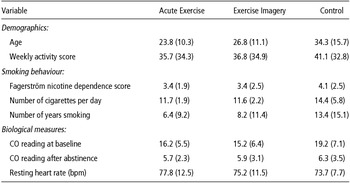
Participant demographic information and smoking behaviour can be found in Table 1. The Fagerström Test for Nicotine Dependence (FTND; Heatherton, Kozowski, Frecker, & Fagerström, Reference Heatherton, Kozlowski, Frecker and Fagerström1991) was employed along with breath carbon monoxide (CO) readings (piCO Smokelyzer©) to determine participant smoking behaviour.
Means (and standard deviations) of demographic and smoking characteristics by condition at baseline

Cravings (primary outcome)
One item assessed the current strength of an individual's desire to smoke using the Mood and Physical Symptoms Scale (MPSS). This item was rated on a 7-point scale, ranging from 1 (not at all) to 7 (extremely) (West & Hajek, Reference West and Hajek2004).
Withdrawal symptoms (secondary outcomes)
Withdrawal symptoms were measured using the MPSS (West & Hajek, Reference West and Hajek2004). Seven items were used to address commonly cited withdrawal symptoms, measuring the extent to which participants were currently experiencing: anxiety, irritability, depression, tension, restlessness, difficulty concentrating, and stress. All items were rated on a 7-point scale, ranging from 1 (not at all) to 7 (extremely).
Heart rate (manipulation check)
Physiological responses to treatment conditions were objectively recorded using Polar RS400 Running Computer™ heart rate monitors (HRM). The HRM was utilised to provide an average heart rate for individual treatment duration in beats per minute (bpm).
Procedure
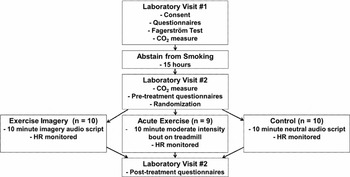
After obtaining ethical approval from a university's research ethics board, participants were recruited from a mid-sized Canadian community. Upon clearance of eligibility criteria, including completion of the PAR-Q (Thomas, Reading, & Shepard, Reference Thomas, Reading and Shephard1992), each participant visited the laboratory facility to review the letter of information and provide written consent. The first visit further included the completion of questionnaires (see Figure 1 for procedural flow chart), measurement of a baseline resting heart rate, and a breath carbon monoxide (CO) level measured using the piCO Smokelyzer© (Note. Participants smoked ab libitum before the first assessment). Upon completion, participants scheduled their second visit to the facility (one week later) and were thanked for their time.
Procedural flow diagram for intervention

Prior to their second scheduled visit to the research facility, participants were requested to abstain from smoking for a period of 15 hours which was confirmed by a reduction in CO levels (≤ 6ppm). Previous research has employed a similar abstinence time (M = 13 hours, Daniel, Cropley, & Fife-Schaw, Reference Daniel, Cropley and Fife-Schaw2007; M = 17 hours, Everson, Daley, & Ussher, Reference Everson, Daley and Ussher2006; M = 15 hours, Janse Van Rensburg, & Taylor, Reference Janse Van Rensburg and Taylor2008). Upon arrival, participants completed a packet of questionnaires to assess their pre-treatment cognitions and were instructed to put on the heart rate monitor. Participants were then randomised to one of the three conditions (stratified by gender) and underwent treatment.
Exercise condition
Participants in the exercise condition (n = 9) engaged in a single bout of moderate intensity exercise (i.e., walking) on a standard treadmill for 10 minutes, in addition to approximately 3 minutes warm-up and 3 minutes cool down. For each individual, a moderate intensity exercise prescription of 48–60% of heart-rate reserve was calculated and followed using guidelines from the Canadian Society for Exercise Physiology (CSEP,2003). Once the lower limit of the heart-rate prescription was reached, timing of the 10 minute intervention period commenced.
Exercise imagery condition
Participants in the exercise imagery condition (n = 10) listened to an audio script (10 minutes) which progressed through the physical behaviour and associated physiological responses which would be experienced in the actual exercise bout. Participants listed to the audio recorded script in an isolated environment using headphones and were instructed to picture the images as clearly and vividly as possible.
Control condition
Participants in the control condition listened to an audio script (10 minutes) which described general activities of daily living (e.g., making dinner, watching television, and getting ready for bed) with no reference to planned exercise behaviour. Following treatment, all participants completed the MPSS. Upon completion, participants were thanked for their assistance and compensated for their time.
Results
Baseline
Comparison between participants in the three conditions at baseline revealed no differences on demographic and smoking behaviours (Table 1). It should be noted that despite a visual inspection between group characteristics alluding to an age difference, no significant differences were reported (p = .19). In addition, ANOVAs revealed that there were no significant differences between conditions on breath carbon monoxide (CO) level at baseline, F(2, 26) = 1.04, p = .367, partial η2 = .07, breath carbon monoxide after abstinence, F(2, 26) = .103, p = .902, partial η2 = .01, and resting heart rate, F(2, 26) = .348, p = .710, partial η2 = .03. Comparison on strength of desire to smoke and each MPSS item highlighted successful randomisation as no statistical differences were observed between conditions at baseline (Table 2).
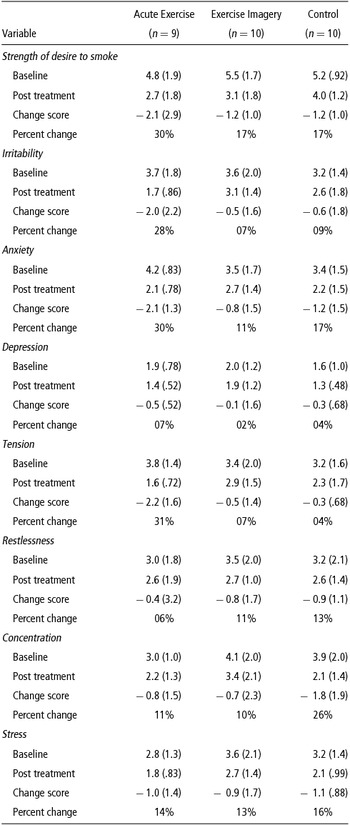
Means, standard deviation, change for desire to smoke and withdrawal symptoms (MPSS) from pre-to post treatment

Note. For all the above variables, responses were rated on a 7-point Likert scale ranging from 1 (Not at all) to 7 (Extremely).
Heart rate
Analysis of heart rate response for each condition, revealed that participants in the acute exercise condition reached an average heart rate of 132.4 (23.0) bpm, ~65% of heart rate reserve, or moderate intensity (American College of Sports Medicine; ACSM, Reference Bushman2011), while the exercise imagery participants recorded 78.7 (19.0) bpm, ~40% or light intensity (ACSM, Reference Bushman2011), and the control participants recorded 68.9 (9.0) bpm, ~40% or light intensity (ACSM, Reference Bushman2011). The ANOVA revealed significant differences between the conditions, F(2, 23) = 29.2, p = .000, partial η2 = .72. Post-hoc tests demonstrated that the acute exercise condition reported significantly higher average heart rate during treatment than the exercise imagery (p< .01) and control (p< .01), while no significant differences were observed between exercise imagery and control (p > .05).
Cravings
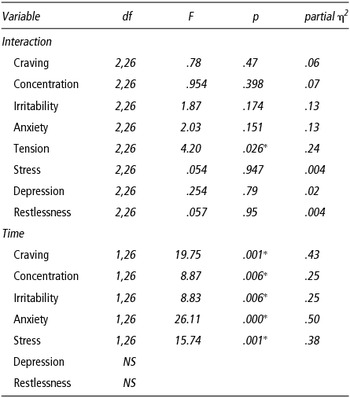
Descriptive and change score statistics can be found in Table 2. A 3 (Condition) by 2 (Time) repeated measure ANOVA showed a medium non-significant interaction effect in favour of the exercise condition for strength of desire to smoke (see Table 3). A significant time effect was found for strength of desire to smoke (see Table 3).
ANOVAs for interaction and time

*significant at p = .05
Withdrawal symptoms
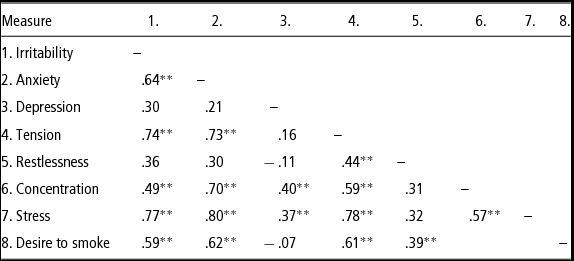
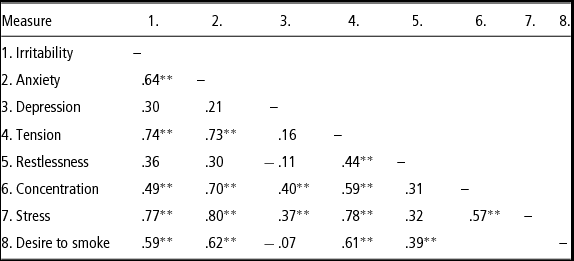
Descriptive and change score statistics can be found in Table 2. A 3 (Condition) by 2 (Time) repeated measure ANOVA showed a significant group by time interaction for tension, in favour of exercise. Medium to large non-significant interaction effects, again favouring exercise, were revealed for difficulty concentrating, irritability, and anxiety. Significant time effects were shown for concentration, irritability, anxiety, and stress. Small non-significant interaction effects were found for stress, depression, restlessness. A significant time effect was found for stress, whereas the symptoms of depression and restlessness did not significantly change over time regardless of condition (p > .05). ANOVA results for all withdrawal symptoms can be found in Table 3. Examination between variables is observed from the bivariate correlations presented in Table 4.
Bivariate correlations
** significant at 0.01
Discussion
The primary purpose of the present study was to determine if exercise imagery could contribute to reductions in smoking cravings (primary outcome) and withdrawal symptoms (secondary outcomes) after a temporary period of abstinence. It was hypothesised that participants in either the moderate intensity exercise or exercise imagery condition would report greater reductions in cravings (strength of desire to smoke) and withdrawal symptoms after treatment than their control counterparts. Furthermore, it was hypothesised that those in exercise condition would report greater reductions in cravings and withdrawal than those in the exercise imagery condition. Overall, findings offer weak evidence for the former prediction and stronger evidence for the latter prediction.
With respect to cravings, a non-significant interaction effect was observed between conditions on strength of desire to smoke from pre-to post treatment. However, the effect (.06) was moderate in size according to Cohen (Reference Cohen1988), and favoured the exercise condition. The mean change in desire to smoke between acute exercise (−2.1; 30%), exercise imagery (−1.2; 17%), and control (−1.2; 17%) conditions highlight this effect (see Table 2). This represents a net difference of 13% between acute exercise and the other two conditions and indicates that the study was underpowered to reach statistical significance between treatment groups. Given cigarette cravings are one of the most common reasons for an inability quit (Allen et al., Reference Allen, Bade, Hatsukami and Center2008) and the intensity of craving experienced by an abstinent smoker over the first few days of quitting is often predictive of their success (Shiffman, Ferguson, & Gwaltney, Reference Shiffman, Ferguson and Gwaltney2009), any additional reduction in craving may be of clinical importance. Meta-analyses that examined changes in strength of desire to smoke between participants engaged in exercise against passive controls (across all studies) showed a mean difference score of −1.91 points (Haasova et al., Reference Haasova, Warren, Ussher, Van Rensburg, Faulkner, Cropley, Byron-Daniel, Everson-Hock, Oh and Taylor2012) and −2.41 points (Roberts et al., Reference Roberts, Maddison, Simpson, Bullen and Prapavessis2012), respectively. The current findings show a mean difference of -0.90 points, and hence are not in line with these results. One reason for this discrepancy is the fact that those in the control condition also experienced a noticeable reduction in desire to smoke (−1.2 points). Previous acute exercise trials utilising control participants (see Haasova et al., Reference Haasova, Warren, Ussher, Van Rensburg, Faulkner, Cropley, Byron-Daniel, Everson-Hock, Oh and Taylor2012) has found minimal changes from pre-to-post treatment cravings (mean change across 15 studies = .07 points, SD = .53). Taken together these findings accentuate that control scores in these studies are lower and more stable than what is reported by controls in the present study (−1.2 points; SD = 1.0). Evidently, a less pronounced reduction in the craving scores reported by the control group post-treatment would have permitted greater differences between the exercise and control treatment groups, possibly better reflecting results from previous studies (Haasova et al.; Roberts et al.). This would also have increased statistical power.
Unlike previous research, the control condition reported the same reduction in the desire to smoke as the exercise imagery condition (−1.2). Further exploration into the content of the audio script may aid in the observed finding. Specifically, participants were most likely to have spontaneously imagined themselves engaging in various activities of daily living (e.g., making dinner, watching TV and getting ready for bed), which was likely to have had a relaxing effect on them. This in turn provided participants with some craving relief. Evidence of a relaxing effect is supported by the modest but systematic reduction in the withdrawal symptoms of stress, restlessness, concentration disruption, and anxiety between these two treatment groups. Further evidence can be seen from the moderate size correlations that were found between strength of desire to smoke and these withdrawal symptoms (see Table 3).
Previous research has found that non-exercise treatments are effective at reducing one's desire to smoke. For example, Ussher and colleagues noted that a cognitive body scan technique produced a similar significant reduction in cravings (−2.22 points) as isometric exercise (−2.33 points) and both were superior to a passive audio-tape control (Ussher, Cropley, Playle, Mohidin, & West, Reference Ussher, Cropley, Playle, Mohidin and West2009). The pre-to-post change in desire to smoke for the audio-taped control was −1.0 points and thus is consistent with the change found for our exercise imagery and control conditions. Taken together, it seems that the material contained in both exercise imagery and control audio-scripts offer some craving relief benefit and are worthy of future research.
With respect to withdrawal symptoms, we found that the exercise group reduced their tension scores to a significantly greater extent than those in the exercise imagery or passive imagery control groups. This is not surprising, given the previous research involving acute exercise (Taylor, Katomeri, & Ussher, Reference Taylor, Katomeri and Ussher2005; Ussher et al., Reference Ussher, Nunziata, Cropley and West2001) has noted significant reductions in tension versus control conditions. Moderate to large non-significant interaction effects (effect size values were between .07 and .13) favouring exercise were also shown for concentration disruption, irritability, and anxiety. These findings are in line with other acute exercise studies that have assessed withdrawal symptoms with the MPSS (Daniel et al., Reference Daniel, Cropley and Fife-Schaw2007; Everson et al., Reference Everson, Daley and Ussher2008; Ussher et al., Reference Ussher, Taylor and Faulkner2008).
The present study is not without limitations. First, as already acknowledged, the trial was underpowered for the moderate-to-large effects found for strength of desire to smoke, concentration disruption, irritability, and anxiety to reach statistical significance. These effects consistently favoured the moderate intensity exercise group. Second, there was no light intensity exercise condition to compare the exercise imagery condition to. This warrants future investigation. Third, the imagery ability of participants was not assessed. As imagery ability has been shown to influence performance in some contexts (Hall, Reference Hall, Singer, Hausenblas and Janelle2001), it might have proven insightful to assess participants’ ability to use imagery in the current study. In addition to allowing the participant to experience the actual movement of the activity, it is suggested that multiple sessions involving the imagery script may be more valuable. The use of a single session in the current study may have weakened the effectiveness of the imagery protocol as research suggests that imagery should be practice consistently (Hale, Seiser, McGuire, & Weinrich, Reference Hale, Seiser, McGuire and Weinrich2005). Fourth, the exercise imagery condition involved a single session audio-tape. Williams, Cumming, and Edwards (Reference Williams, Cumming and Edwards2011) suggest that providing individuals with the opportunity to experience an activity initially (e.g., walk on a treadmill), may provide a clearer mental image and representation of the movements involved. Finally, it may be important to lengthen the exercise imagery condition contact time to account for the additional warm up and warm down time needed for participants exercise safely. This will ensure equal contact time between treatment conditions.
In conclusion, results from the present study suggest that exercise imagery is not as powerful as moderate intensity exercise in reducing cravings and the withdrawal symptoms of tension, concentration disruption, irritability, and anxiety following temporary abstinence. Exercise imagery or any script that promotes relaxation may assist in supplementary routes for craving relief when exercise is not feasible (e.g., commuting to work) or priming individuals to think of doing exercise when experiencing craving cues. These notions are avenues for future research.
Financial Support
This research received no specific grant from any funding agency, commercial or not-for-profit sectors.
Conflict of Interest
None
Ethics
The authors assert that all procedures contributing to this work comply with the ethical standards of the relevant national and institutional committees on human experimentation and with the Helsinki Declaration of 1975, as revised in 2008.