


INTRODUCTION
Pneumonia is the leading cause of death in children aged <5 years [1]. Most of these deaths occur in the tropics, where pneumonia in children occurs most commonly in the rainy season [Reference Enwere2–Reference Shek and Lee4]. The mechanisms underlying this seasonality are unknown but possibilities include increased pathogen survival or stability in aerosols (possibly due to variations in temperature, humidity or sunlight), reduced host immunity (possibly due to variations in nutrition, sunlight, or co-infections) and increased host mixing due to seasonal variations in behavioural patterns. Identifying the underlying causes of seasonal variations in pneumonia is important both for developing interventions as well as predicting the timing and burden of disease [Reference Paynter5].
Few studies have examined the drivers of pneumonia seasonality in tropical settings. Respiratory syncytial virus (RSV) infections were positively correlated with the number of rainy days and relative humidity in Indonesia and Malaysia, positively correlated with relative humidity and dew point in Mexico, and positively correlated with relative humidity in Hong Kong, although in Singapore a negative correlation with relative humidity was found [Reference Loh6–Reference Tang11]. In temperate settings where pneumonia peaks in winter, time-series analyses have consistently found peaks of RSV and invasive pneumococcal disease (IPD) to be inversely correlated with temperature and daylight hours [Reference Yusuf10, Reference Murdoch and Jennings12–Reference White16]. Although daylight hours vary less in tropical latitudes, sunshine hours can vary seasonally according to cloud cover (and hence are generally lowest in the rainy season). Thus the association between sunshine and childhood pneumonia warrants closer examination in tropical settings.
The present study was undertaken to examine pneumonia seasonality in children aged <3 years in Bohol, the Philippines. We hypothesized that pneumonia incidence would be higher in the rainy season, and examined the association of pneumonia incidence with variations in rainy days, sunshine, relative humidity and temperature.
METHODS
Data sources
The data were collected as part of a randomized controlled trial to investigate the efficacy of an 11-valent pneumococcal conjugate vaccine in young children, conducted in six municipalities surrounding Tagbilaran, Bohol Province in the Philippines between July 2000 and December 2004. A full description of this trial is given elsewhere [Reference Lucero17]. Respiratory infections were assessed and recorded in all children living in the trial municipalities who were admitted to local hospitals over the course of the trial [Reference Lucero17]. Study personnel were permanently assigned to hospitals involved with case ascertainment. In total 2187 cases of clinical pneumonia (as defined by discharge diagnosis) in children aged <3 years were recorded, and are included in the current study. In the study setting RSV was the most commonly isolated organism in children with clinical pneumonia, and the seasonality of isolated RSV was very similar to that of clinical pneumonia. The most commonly isolated bacterial pathogens were Streptococcus pneumoniae and Staphylococcus aureus.
Meteorological data were recorded at the Philippine Atmospheric, Geophysical and Astronomical Services Administration (PAGASA) offices in Tagbilaran. All trial municipalities were within 25 km of Tagbilaran. Available data included daily measurements of rainfall, temperature, relative humidity and hours of sunshine. The rainfall measure used was rainy days, defined as any day with precipitation greater than zero. All meteorological variables were available for the whole trial period, except for hours of sunshine, where there were two gaps in measurements (1 May 2002 to 31 December 2002, and 1 September 2003 to 30 April 2004). Hours of sunshine were measured using a Campbell–Stokes sunshine recorder. To fill the missing values in the sunshine series, sunshine hours were regressed against rainy days, and this prediction model was used to impute missing values for sunshine hours. As a sensitivity analysis, all analyses were repeated with missing sunshine values imputed using the mean sunshine.
Seasonal analysis
The number of clinical pneumonia cases, mean number of rainy days per week, mean hours of sunshine per day, mean relative humidity and mean temperature were calculated for each week (233 weeks: July 2000 to December 2004). These weekly time-series were decomposed into trend and seasonal patterns, using moving averages (52-week moving average for trend and 13-week moving average for seasonality) [Reference Peng and Dominici18]. The seasonal associations between pneumonia incidence and rainy days, sunshine, relative humidity and temperature were assessed by cross-correlation and pairwise correlation.
Regression analysis
We used a distributed lag Poisson regression model to examine short-term (within 60 days) associations between pneumonia incidence and rainy days, sunshine, relative humidity and temperature [Reference Gasparrini19]. The dependent variable was the daily number of pneumonia cases. The independent variables included terms for season and trend using natural splines to model a smooth function of time with 6 d.f. per year, and day of the week. We examined delays in the associations between the meteorological variables and pneumonia incidence of up to 60 days, and fitted this delayed response using a natural spline with knots at 0, 15, 30, 45 and 60 days.
Case-crossover analysis
We used a symmetric bi-directional case-crossover design to control for season and further investigate the short-term associations of pneumonia incidence with the number of rainy days per week, sunshine, relative humidity and temperature [Reference Carracedo-Martínez20]. Case days were the day of admission of each case of clinical pneumonia. We selected two control days per case day. Control days were the same day of the week as the case day, spaced at 2 weeks before and after case days (Fig. 1). For the study exposures we used the mean number of rainy days per week, mean sunshine hours per day, mean relative humidity, and mean temperature over the exposure period prior to case and control days (Fig. 1). Exposure periods examined were 0–7 days, 8–14 days, and 15–21 days.
Schematic of the symmetric bi-directional case-crossover design. For each case day 2 control days were selected (at 2 weeks before and after the case day). Unbroken horizontal lines indicate the exposure periods examined prior to case and control days in three separate analyses: 0–7 days, 8–14 days, and 15–21 days.

We performed data analysis using Stata v. 11.2 (StataCorp, USA) and R 2.14.0 (www.r-project.org).
Ethical approval
The concept of the trial submitted under title ‘Phase III trial on the effectiveness of an 11-valent pneumococcal conjugate vaccine in the reduction of severe and very severe pneumonia among Filipino children under 2 years of age’ was approved by the Ethical and Institutional Review Board (ERB/IRB) of the Research Institute of Tropical Medicine (RITM) in November 1998. The first version of the trial protocol was approved in November 1999, and the final protocol in June 2000. This additional analysis of the existing data was approved by the University of Queensland School of Population Health Research Ethics Committee in June 2011.
RESULTS
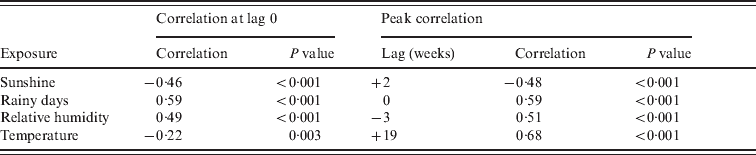
The weekly time-series are displayed in Figure 2. The annual periodicity of pneumonia incidence is clear, with peaks in the rainy season. The cross-correlograms of the seasonal patterns are shown in Figure 3. Rainy days, sunshine and humidity are most clearly associated with pneumonia incidence (although the maximum cross-correlation for relative humidity is at a negative lag, suggesting on average relative humidity is most strongly associated with pneumonia 2–3 weeks earlier). Rainy days and relative humidity are positively associated with pneumonia incidence, while sunshine is negatively associated. The results of the sensitivity analysis filling missing sunshine data with mean sunshine were similar to those shown (although the maximum cross-correlation was at lag zero). Temperature is out of phase with pneumonia incidence in the seasonal analysis. Pairwise correlation coefficients for the seasonal series are given in Table 1.
Weekly time-series: pneumonia cases in children aged <3 years; mean temperature, mean relative humidity, mean number of rainy days per week, and mean hours of sunshine per day (the periods of the time-series where missing sunshine data was imputed are shown by dotted lines), July 2000 to December 2004.

Cross-correlograms of the seasonal patterns of the four meteorological exposures with the seasonal pattern of pneumonia cases in children aged <3 years, Bohol, Philippines, July 2000 to December 2004. (Peak correlation at a positive lag means the exposure is most strongly correlated with pneumonia in the following weeks. Peak correlation at a negative lag means the exposure is most strongly correlated with pneumonia in the preceding weeks.)

Pairwise correlations of the seasonal patterns of meteorological exposures with the seasonal pattern of pneumonia cases in children aged <3 years, Bohol, Philippines, July 2000 to December 2004
The overall results of the Poisson regression are given in Table 2. Only sunshine was significantly associated overall with pneumonia incidence. The distributed lags are shown in Figure 4. Both sunshine and rainy days show significant associations over part of the lag period. Sunshine shows maximum strength of association with pneumonia incidence 2–3 weeks later. The results of the sensitivity analysis filling missing sunshine data with mean sunshine were similar to those shown.
Results of Poisson regression showing the lagged strength of association of daily meteorological exposures on the risk of clinical pneumonia over each of the following 60 days. Children aged <3 years, Bohol, July 2000 to December 2004.

Results of the Poisson regression showing the overall strength of association of daily meteorological exposures on the risk of clinical pneumonia over the following 60 days. Children aged <3 years, Bohol, July 2000 to December 2004
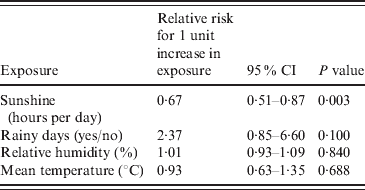
CI, Confidence interval.
The results of the case-crossover analysis are given in Table 3. The results are consistent with the Poisson analysis. Sunshine shows maximum association with pneumonia 8–14 days later. The results of the sensitivity analysis filling missing sunshine data with mean sunshine were similar to those shown.
Odds ratios for the association of the daily incidence of clinical pneumonia in children aged <3 years with mean hours of sunshine per day, number of rainy days per week, mean relative humidity, and mean temperature over the given exposure periods, Bohol, Philippines, July 2000 to December 2004

OR, Odds ratio; CI, confidence interval.
DISCUSSION
We investigated four potential drivers of pneumonia seasonality in young children in the tropics (rainy days, sunshine, relative humidity, temperature) by examining the association of these seasonal exposures with clinical pneumonia incidence using time-series analyses. Sunshine was the exposure most consistently associated with pneumonia incidence in all three analyses, with an inverse association between sunlight and pneumonia incidence at a lag of 2–3 weeks. Rainfall and humidity were also associated with pneumonia incidence in some of the analyses, but not as consistently as sunlight.
In tropical settings lower respiratory infections in children are generally found to be more common during periods of higher rainfall and humidity, consistent with our results [Reference Chan7–Reference Tang11]. Rainfall is not convincingly associated with pneumonia incidence in time-series studies from temperate settings [Reference Yusuf10, Reference Murdoch and Jennings12, Reference Watson13]. Relative humidity is not consistently associated with RSV incidence in temperate settings; however, dew-point temperature is more consistently (negatively) associated [Reference Yusuf10]. Increased relative humidity was associated with increased IPD incidence in New Zealand, but not in Australia [Reference Murdoch and Jennings12, Reference Watson13]. Low sunlight and temperature are consistently associated with high pneumonia incidence in time-series studies in temperate settings, where annual peaks of lower respiratory infections occur during the short days of winter [Reference Yusuf10, Reference Murdoch and Jennings12–Reference White16]. The association between temperature and respiratory infections in children is inconsistent in time-series studies from tropical settings, suggesting temperature is unlikely to be an important driver of pneumonia incidence in the tropics [Reference Loh6–Reference Tang11]. Less evidence examining the association of respiratory infection and sunlight exists from tropical settings. In the subtropical setting of Florida, weekly RSV incidence was inversely correlated with weekly UVB radiance, consistent with our results [Reference Yusuf10]. In contrast time-series analyses from Hong Kong and Singapore found no significant association between solar radiation and the incidence of RSV [Reference Loh6, Reference Chew9, Reference Tang11]. The discrepancy between the results from our study and the studies from Hong Kong and Singapore may be due to different factors. The Hong Kong study used solar radiation (MJ/m2) as the measure of exposure, compared to sunshine hours used in our study. Data from the Hong Kong Observatory indicate that monthly variation in sunshine hours is negatively correlated with cloud cover (r=−0·64) and relative humidity (r=−0·43) [21]. In contrast solar radiation was not strongly correlated with either cloud cover (r=0·14) or relative humidity (r=0·26). As relative humidity was positively associated with RSV incidence in this study, sunshine hours is likely to have been more strongly (negatively) associated with RSV incidence than solar radiation. Further research comparing the associations between different forms of solar radiation and RSV (and pneumonia) incidence may be useful to tease out the most promising associations for further study. In contrast, the two studies from Singapore found similar results using both sunshine hours and solar radiation as the exposure. Singapore is a well known exception to the general finding that peak RSV incidence occurs in the rainy season in tropical settings [Reference Shek and Lee4, Reference Weber, Mulholland and Greenwood22], and consistent with this, both Singapore studies found a negative association between RSV incidence and relative humidity. More detailed examination of such exceptions would be useful to investigate different environmental and behavioural factors that influence RSV incidence.
Sunshine could act as a driver of pneumonia incidence through several mechanisms. Increased ambient UV radiation could act to reduce pathogen survival in the environment, as has been suggested previously [Reference White16]. Time spent indoors may be reduced on sunny days in our study setting, potentially limiting crowding and exposure to indoor smoke, both known risk factors for lower respiratory infections [Reference Simoes23]. Finally, variations in sunlight and/or UV exposure appear to be associated with susceptibility to infection in a number of studies, although the direction of this association is not consistent [Reference Sleijffers24–Reference Dowell27], suggesting the relationship is complex. Several immunomodulatory mechanisms may be involved [Reference Sleijffers24–Reference Dowell27]. Our analyses suggest the association between sunlight and pneumonia incidence is strongest at a lag of 2–3 weeks. This is biologically plausible considering the incubation periods of pathogens such as RSV (incubation period 2–8 days) as well as the latent periods of possible causal pathways [Reference Hawker28].
We found sunshine to be the meteorological variable most convincingly associated with pneumonia incidence in young children in this tropical setting, with an inverse association between pneumonia incidence and mean sunshine hours in the previous weeks. Understanding the possible drivers of pneumonia seasonality is potentially important for the control of pneumonia; however, associations found in a single observational study cannot be used to infer causality. Further work is necessary to look for consistency in similar settings, and for other evidence suggesting causality. Some possibilities for further work include assessing the effect of other seasonally varying exposures, such as nutrition. In many tropical settings nutrition is poorest in the rainy season, and poor nutrition is a known risk factor for pneumonia in children. In addition, although the children in this study are below school age, school terms in the Philippines start in June, around the onset of the rainy season, and increased transmission among school-aged contacts may contribute to seasonality in younger children. To examine further whether the association found here between sunshine and pneumonia incidence is due to confounding with other seasonal variables, similar studies should be repeated in other tropical settings, specifically settings with different nutritional status and differing school term times.
In summary, our results suggest that even at the low latitude of this tropical setting, sunshine is the meteorological variable most convincingly associated with pneumonia incidence in young children. Although this finding is potentially important for the control of pneumonia in tropical settings, which remains the biggest cause of mortality in children worldwide, further research to examine the association between sunshine and pneumonia in other tropical settings, and to determine causality, is both necessary and urgently required.
APPENDIX: ARIVAC Consortium members
Socorro Lupisan, Beatriz Quiambao, Petri Ruutu, Taneli Pumalainen, Diozele Masigon, P. Helen Mäkelä, Ian Riley, Helena Käyhty.
ACKNOWLEDGEMENTS
This research was supported by the European Commission DG Research INCO programme (contracts IC18-CY97-2019, ICA4-CT-1999-10008, ICA4-CT-2002-10062); Academy of Finland (contracts 206283, 106974, 108873, 108878); Finnish Ministry of Foreign Affairs (bilateral contracts 75502901 and 327/412/2000); Finnish Physicians for Social Responsibility; GAVI ADIP Pneumo; Sanofi Pasteur; Research Institute for Tropical Medicine of the Philippines; National Public Health Institute Finland; University of Queensland; University of Colorado; National Health and Medical Research Council of Australia; and PATH. The views expressed by the authors do not necessarily reflect the views of PATH.
This study is part of the research of the ARIVAC Consortium. The ARIVAC Consortium thanks and acknowledges the participation of the infants, parents, staff, Local Government of the Province of Bohol and Local Government Units (LGUs) of Baclayon, Balilihan, Cortes, Dauis, Panglao and Tagbilaran City; staff of the Pathology and Pediatric Departments of the BRH, and the private hospitals Tagbilaran Community Hospital, Borja Family Clinic, Medical Mission Group of Hospitals, Ramiro Community Hospital, St Jude Hospital, Englewood Hospital, and Tagbilaran Puericulture Center. We thank PAGASA for access to meteorological data from Tagbilaran.
DECLARATION OF INTEREST
None.



