Introduction
Opiate abuse is on the rise and is now the second leading cause of accidental death in the United States.Reference Kochanek, Xu, Murphy, Minino and Kung 1 In 2008, there were 36,450 fatal drug overdoses (ODs), with prescription opioids, heroin, and cocaine the most frequently cited substances. 2 Overdose deaths are an inadequate representation of the substantially larger population of users whose drug abuse may bring them into contact with the health care system.
With prescription drug abuse on the rise and decreasing street values of heroin, unintended ODs of opiates and heroin are common emergency department (ED) presentations. 3 While the availability of naloxone to first responders and families of drug users is becoming more widespread, preventing ODs and not depending on prehospital or ED resuscitation would save more lives. Finite resources require targeted initiatives to reduce drug abuse and ODs. In order to target effectively, there is a need for timely and reliable data at the local level that provide specific location and demographic information on opiate abuse.
Emergency Medical Services (EMS) maintains records of calls for opiate OD. Recent studies in Europe, Australia, and the United States have proposed that records of EMS responses to opiate ODs may be useful in providing demographic data identifying populations at risk.Reference Merchant, Schwartzapfel, Wolf, Li, Carlson and Rich 4 - Reference Dietze, Jolley, Cvetkovski, Cantwell, Jacobs and Indig 6 Additionally, it has been suggested that this data could be used to establish temporal relationships for when opiate ODs are trending higher in specific locations or populations.
The objective of the current study was to validate externally whether prehospital naloxone use is a surrogate marker of community opiate ODs by comparing EMS naloxone administration records to an independent database of ED visits for opiate and heroin ODs in the same community.
Methods
Study Design
A retrospective chart review comparing prehospital data on naloxone administration with data on ED visits related to narcotics use over a four year period was conducted.
Study Period
The study period was from July 1, 2009 through June 30, 2013.
Institutional Review Board Approval
This study was approved by the University at Buffalo’s Health Sciences Institutional Review Board (Buffalo, New York USA).
Prehospital Data
Data were obtained from a single, large, private EMS provider that responds to approximately 130,000 requests for service per year in a mixed urban, suburban, and rural area. Patient and encounter information is entered into a prehospital electronic medical record (EMR) system by the EMS providers at the time of the encounter. This information can be queried to create de-identified reports for purposes of quality assurance and research.
For the purposes of this study, naloxone administration by EMS was considered a surrogate marker for suspected opiate OD. The regional Advanced Life Support protocols advise paramedics to “administer naloxone to suspected opiate overdose with hypoventilation.” Naloxone is to be administered as follows: “Naloxone (Narcan) 0.4 mg [intravenous] IV, may repeat to titrate to adequate ventilation, max of 2 mg. If unable to establish IV, give naloxone 2 mg [subcutaneous] SQ, [intramuscular] IM, [intraosseous] IO, or [intranasal] IN.” 7 Providers record naloxone administration using pre-defined procedure fields in the prehospital EMR.
The prehospital EMR was queried for naloxone administrations during the study period to create a de-identified data set. All patient encounters where naloxone was administered were treated as single events, regardless of the number of naloxone administrations that occurred during the encounter, total dose administered, or route of administration. Subjects may be represented in the dataset more than once if they had more than one prehospital encounter during the study period in which they received naloxone. For encounters where naloxone was administered, data on encounter date, patient age, patient race, patient gender, hospital destination, and reason for EMS primary impression on scene were collected.
Emergency Department Data
Data were obtained from the ED of a single academic, urban, Level 1 trauma center. The hospital serves an eight-county region (population 1.2 million) and evaluates approximately 70,000 adults each year. It is the only hospital in the area with specialized care for trauma, psychiatric services, and acute substance abuse detoxification services. As such, it preferentially receives the majority of the OD patients in the region. Providers create hand-written ED records using a template at the time of the encounter. These records include one or more provider diagnoses/impressions.
The ED maintains a de-identified database of narcotic-related visits for the purpose of establishing demographic patterns of narcotic use in the metropolitan area. To create this de-identified database, daily visit logs from the ED are reviewed on an ongoing basis. Visits suspected to be narcotic-related are subject to individual chart review. For example, patients with a chief complaint or discharge clinical impression of OD, detoxification evaluations, respiratory distress, chest pain, altered mental status, or delirium would be among the diagnoses flagged for further review. Emergency medicine staff performs chart reviews of the selected visits to determine the association between visit reason and narcotic use. Date of service, patient age, patient sex, narcotic and other recreational drugs associated with the visit, and the nature of visit is recorded in the de-identified database. The database captures visits in which narcotics use is the primary reason for the ED visit. It is possible that a single patient may be represented in the database more than once if he/she presented multiple times to the ED with qualifying visits.
To create the ED dataset for this study, the ED database was queried for visits during the study period in which an OD was identified as the provider diagnosis/impression and either opiates or heroin were associated with the ED visit.
Analytic Plan
Data were analyzed using SAS version 9.3 (SAS Institute Inc.; Cary, North Carolina USA). The frequency of basic demographic data for subjects in each dataset was calculated. To test whether prehospital naloxone administration was independent of ED opiate-related visits, cross-correlation analysis was conducted. The autoregressive integrated moving average procedure and cross-correlation coefficient (CCF) were used to identify the relationship between the two time series at a zero time lag between EMS naloxone administration and ED opiate visits.
Results
Prehospital Data
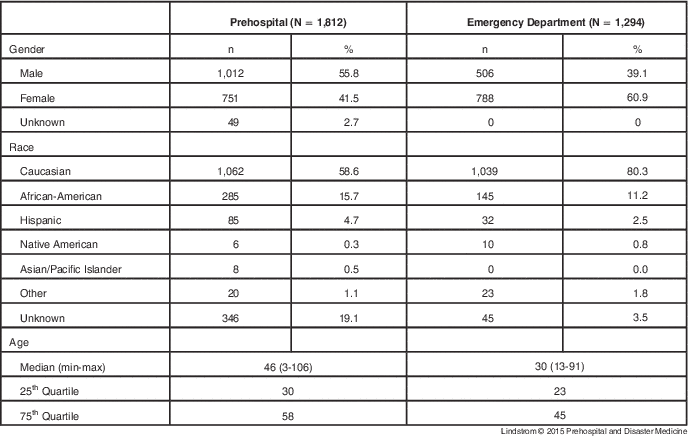
Naloxone was administered during 1,812 prehospital patient encounters (Table 1). Subjects were majority male (55.8%), Caucasian (58.6%), and had a median age of 46 years (25th quartile=30 years, 75th quartile=58 years). The median number of monthly prehospital encounters during which naloxone was administered was 36 (25th quartile=30.75 encounters, 75th quartile=47 encounters).
Demographics of Subjects in the Prehospital and Emergency Department Datasets

Emergency Department Data
A total of 1,294 ED visits for ODs associated with opiates or heroin were identified (Table 1). Subjects were majority female (60.9%), Caucasian (80.3%), and had a median age of 30 years (25th quartile=23 years, 75th quartile=45 years). The median number of monthly opiate-associated ODs was 26.5 (25th quartile=21.75 ODs, 75th quartile=31 ODs). The median number of monthly heroin-associated ODs was 8.5 (25th quartile=6 ODs, 75th quartile=13 ODs).
Comparison of Datasets
Patients in the prehospital and ED datasets were compared with respect to demographic characteristics. There were no significant differences by patient sex (X 2 =3.62; P=.057). The datasets did differ by race (X 2 =230.8; P<.0001) and age (P=.00). The prehospital dataset had fewer Caucasians, more African-Americans and Hispanics, and a greater percentage of patients of unknown race. Additionally, the prehospital dataset patients were significantly older than patients presenting to the ED.
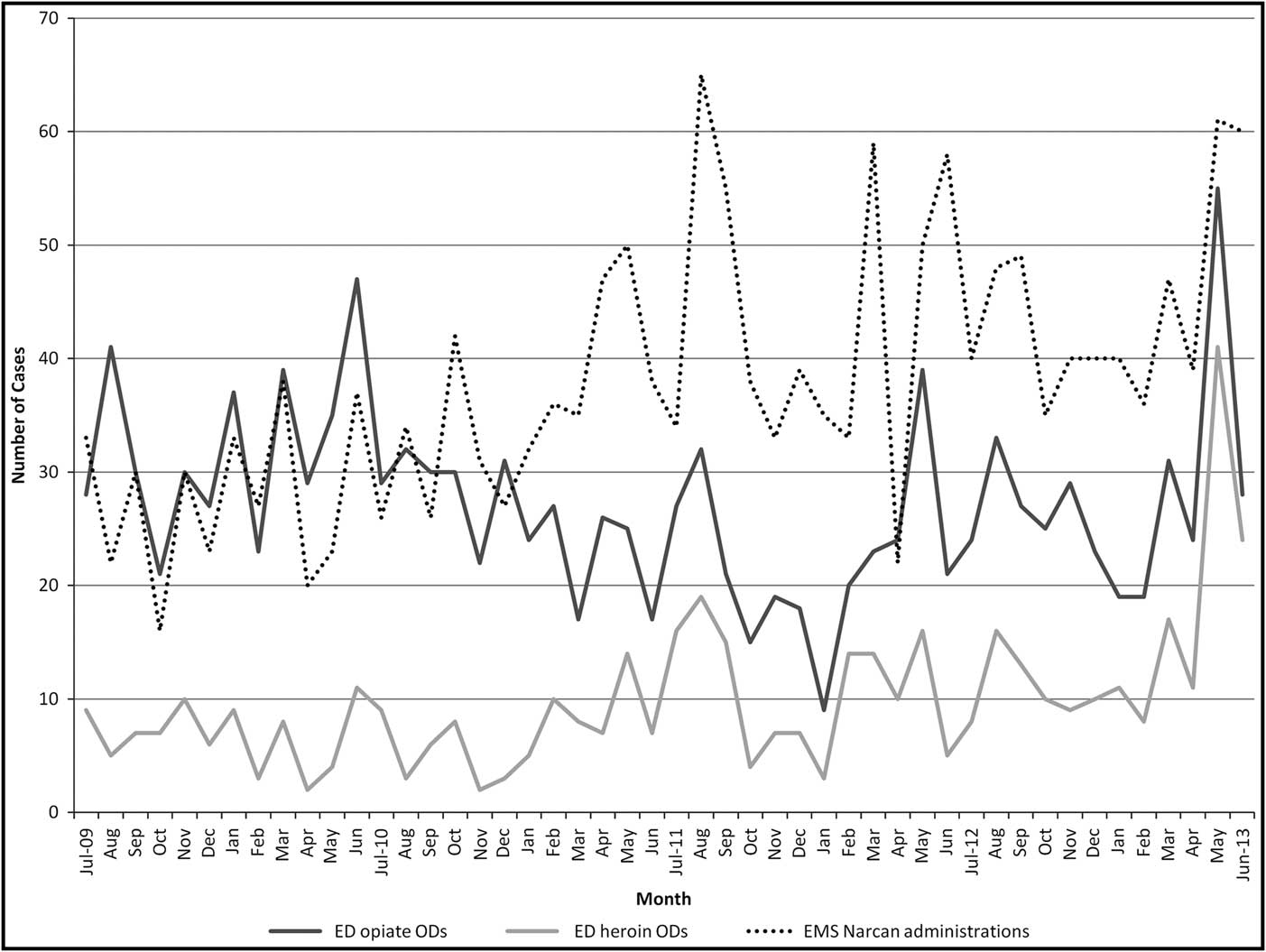
Peaks of opiate- and heroin-related ODs seen in the ED and prehospital naloxone use were observed in July and August of each study year (Figure 1). Furthermore, a general increasing trend in opiate-related ODs and naloxone administration can be seen during the study period. The frequency of naloxone administration by prehospital providers varied directly with the frequency of ED visits for opiate- and heroin-related ODs. At a lag time of zero, a monthly increase of two ED visits for opiate-related ODs was associated with an increase in one prehospital naloxone administration (CCF=0.44; P=.0021). At a lag time of zero, a monthly increase of 100 ED visits for heroin-related ODs was associated with an increase in 94 prehospital naloxone administrations (CCF=0.46; P=.0012).
Opiate and Heroin Overdoses and Narcan Administrations by Month. Abbreviations: ED, emergency department; EMS, Emergency Medical Services; OD, overdose.

Discussion
The results of this investigation indicate that there is a temporal relationship between the EMS and ED data on opiate ODs. In this regard, the use of EMS naloxone administration as a surrogate marker for community opiate use appears to hold true. Both variations in short-term volume of encounters as well as longer term trends in encounters correlated between the two databases. Given that the data were from the major EMS provider and the primary ED for substance abuse services in the community, it is reasonable to conclude that the data reflect community opiate use. However, the populations in the two databases were demographically dissimilar, which would suggest that the identification of user groups based upon either dataset alone would not necessarily be reflective of the community as a whole.
Studies from many countries over the past 20 years have suggested the use of EMS data for community drug use surveillance. A 1993 increase in opioid ODs in Vienna, Austria led to an analysis by Seidler et al of ambulance run data from 1994-1995.Reference Seidler, Schmeiser-Rieder, Schlarp and Laggner 5 The authors found that one percent of all runs were due to opiate emergencies. In 58% of cases, naloxone was administered, and in 27% of cases, the patient was not transported to the hospital. It was also determined that the “rush hour” for opiate emergencies was from 4 pm to 9 pm. The work by Seidler et al demonstrated that the data could be used in near real-time, with data available for discussion among stakeholders within ten days. Additionally, data were used to determine the deployment of mobile drug counseling and needle exchange services to areas of high need.
Multiple authors have proposed that prehospital naloxone administration could serve as a surrogate marker for opiate abuse in the community.Reference Merchant, Schwartzapfel, Wolf, Li, Carlson and Rich 4 , Reference Dietze, Jolley, Cvetkovski, Cantwell, Jacobs and Indig 6 , Reference Knowlton, Weir and Hazzard 8 Dietze et al assessed the feasibility of establishing a national database of non-fatal opiate ODs in Australia using ambulance attendance data.Reference Dietze, Jolley, Cvetkovski, Cantwell, Jacobs and Indig 6 Naloxone administration by ambulance crews was used as an indicator of opiate OD as the authors stated “…naloxone administration and/or response to naloxone administration is a good marker of opioid (primarily heroin) involvement in cases of suspected opioid overdose.”Reference Dietze, Jolley, Cvetkovski, Cantwell, Jacobs and Indig 6 (p570) Merchant et al also used naloxone administration as a proxy for opiate OD in an analysis of ambulance run data for Rhode Island (USA) from 1997-2002 in an effort to establish statewide data on opiate OD.Reference Merchant, Schwartzapfel, Wolf, Li, Carlson and Rich 4 The authors were able to characterize the population of patients with suspected opiate ODs with respect to patient demographics, geographic patterns, and temporal patterns. Patients with suspected opiate ODs had a median age of 35 years, were more likely to occur in a private residence than in another location, and more than 99% of patients were transported to the hospital.
The most recent study to look at EMS runs and naloxone administration as a proxy for suspected opiate OD in the United States was conducted by Knowlton et al.Reference Knowlton, Weir and Hazzard 8 The authors used a retrospective epidemiological study design to examine EMS electronic patient records from October 2008 through October 2009 to identify medical incidents in which naloxone was administered as a proxy for estimating opiate OD. There was consistency between the naloxone data and a previous study of medical examiner data with respect to temporal and geographic patterns. The authors therefore concluded there was limited evidence for the validity of EMS naloxone administration as a proxy for opiate OD surveillance data. Likewise, the results of this study validate the temporal relationship between the EMS and ED data.
Using ED patient logs or EMS datasets alone may not be sufficient to predict populations at risk for opiate-related complications. Generally, EMS agencies with large catchments may be a better indicator than a single hospital for a given community. However, EMS reports have shortcomings of potential over-reporting, since naloxone is given for suspected, but not confirmed, opiate toxicity. The current study did not include the patient’s response to naloxone administration, or follow-up toxicology screen to confirm that the drug was given appropriately. Individual prehospital and hospital records may contain this information, but individual case reviews may not be practical as part of a surveillance strategy, and thus, were not attempted as part of this research.
Although the temporal relationship between datasets exists, they still may not be valid single sources for community drug use surveillance. Despite the fact that the study ED was the single most common site for transport in the EMS dataset, the demographics of the populations of the two datasets were significantly different. That result leads to a conclusion that neither dataset can be assumed to be reflective of the drug abuse demographics of the community as a whole. While the EMS provider is by far the largest in the area, it is not the only EMS agency. Studies from countries where the EMS system is government run may be expected to have more representative demographic data. In areas like the one in this study, and many places in the US, community drug use surveillance data would need to come from multiple sources.
This study setting is unusual in that the hospital has the only acute dedicated substance abuse service and treats the vast majority of drug-abuse-related ED visits in the region. Additionally, the hospital has full-time staff doing chart reviews for the purpose of maintaining a drug abuse registry. Those conditions do not exist in the overwhelming majority of settings, making the use of that data for community surveillance not generalizable.
Using EMS data may be more advantageous since ambulance companies service a multitude of hospitals in a region and have a larger service area than a single hospital. Additionally, they maintain electronic records that may be easier to query and analyze than hospital charts, resulting in less resource expenditure to obtain quality surveillance data. Focusing on naloxone administration rather than trying to extract data from multiple potential diagnoses, or call request reasons, simplifies extraction as well.
Understanding demographic and geographic characteristics of opiate abuse in a community is important for prehospital preparedness, law enforcement intervention, and targeted public health programs. Using data that are already being collected by EMS may provide a cost-effective means to determine at least trends in community drug abuse.
Over the past year, there has been substantial growth in programs providing intranasal naloxone to non-paramedic first responders and citizen responders. This research was undertaken prior to the growth of these initiatives. The future inclusion of naloxone given by non-paramedics may further the understanding of community opiate trends. However, as the use of naloxone becomes more dispersed, it may become more difficult to obtain practical, easy access to that data.
Limitations
The study has several limitations. When discussing EMS naloxone administration as a surrogate marker for community drug abuse, there is no standard source of complete information on community drug abuse with which to compare. Although another source of drug abuse data was compared, the ED data are also a limited sampling of community information. However, the ED data did serve a purpose as an independent data source, to determine whether these two data sources reflected one another, and if so, likely reflected the community as a whole.
Despite using the largest EMS provider and the only ED with active substance abuse programs in the study region, it is not a closed system. Patients may be treated by other prehospital providers and may be transported or presented to other EDs. In this regard, systems in which the EMS system and hospital system are more centralized, such as in Australia, Canada, and Europe, may be able to generate data that are more reflective of the entire community.
Conclusions
Frequency of naloxone administration by EMS providers in the prehospital setting varied directly with frequency of opiate/heroin OD-related ED visits. The data correlated both for short-term frequency and longer term trends of use. However, there was a marked difference in demographic data that would suggest that neither of these data sources should be relied upon alone to determine which populations are at risk within the community.