The biggest job of blue grass is to keep out what don't belong in it.
(Bill MonroeFootnote 1)In July of 2003, the magazine Bluegrass Unlimited received a letter from a disappointed reader. He had been surprised to see the magazine review an album by the mainstream country group Dixie Chicks, despite the group's and the album's clear connections to bluegrass music. He expressed his belief that ‘the vast majority of bluegrass fans do not want … your magazine to review any group that is only borderline bluegrass at best, when there are many true bluegrass bands that never make your headlines’ (Stanley Reference Stanley2003, p. 13).Footnote 2 Roughly a decade earlier, a reader denounced bluegrass star Alison Krauss's album I've Got That Old Feeling for taking on the stylistic trappings of mainstream music, arguing that doing this was an insult to ‘those of us who love bluegrass the way it is’ (Fenster Reference Fenster and Lewis1993, p. 326).
The above comments articulate a fairly common scenario in the realm of popular music reception: a fan who claims some expertise in and ownership of a specific genre rejects artists who veer from the genre's most central practices.Footnote 3 While instances of a ‘sellout’ phenomenon in popular music often occur in the context of increasing commercialisation, involving an abandonment of authenticity and the disillusionment of an artist's original fan base, the above examples are noteworthy in that they stress an ontological claim. That is, they are more about ‘bluegrass’ than they are about the Dixie Chicks or Alison Krauss, since the writers appear less concerned with questions of how good the music is than they are with the question of whether the music qualifies as bluegrass.
As the examples suggest, the world of bluegrass music is notable for its heated, hackneyed and inconclusive debates over self-definition. The question ‘What is bluegrass anyway?’ is cliché enough to have received its own acronym, ‘WIBA’, among fans who discuss the music online, and new artists and recordings continually cause this question to be revisited. Generic identity is thus a constant area for musical and discursive negotiation, especially given the hybrid status of bluegrass as a folk music, a progressive concert music and a commercially mediated form. What, then, gives rise to these debates? What sorts of opinions about bluegrass occur within genre discourse, and how do competing ideas form? What are the consequences of the genre's occupation with its own identity?
Adding to a growing body of literature that considers genre in popular music as a flexible construct involving both musical performance and cultural formations (Frith Reference Frith1996; Negus Reference Negus1999; Brackett Reference Brackett, Hesmondhalgh and Negus2002; Holt Reference Holt2007), this article interprets the genre debate in bluegrass as a subjective negotiation and renegotiation of a category. In doing so, it devotes itself more toward answering the above questions than answering the WIBA question itself, a question that will surely never have a conclusive answer. Accordingly, my purpose is not to define bluegrass but to examine and theorise the discursive and musical means through which ontologies of bluegrass are framed. I begin by exploring the idea of bluegrass as constructed by Bill Monroe and a number of early bluegrass scholars, after which I invoke recent work on human cognition and categorisation to identify conceptual processes underlying the genre debate. Ultimately, I propose that genre debates, notwithstanding their apparent futility, can be regarded as a vital means of perpetuating a genre.
The idea of bluegrass and the WIBA debate
As Neil Rosenberg has stressed, although music now widely considered to be bluegrass existed in the mid-1940s, the term ‘bluegrass’ didn't begin to circulate until about a decade later (Rosenberg Reference Rosenberg1985, pp. 95–9). It follows that the idea of bluegrass – what Rosenberg would regard as the notion of bluegrass as a genre – took shape during this span of time. Initially the matter was straightforward: Bill Monroe and his band, the Blue Grass Boys, became commercially successful in the 1940s, in part because of the distinctiveness of their sound. This sound, which was subsequently emulated by other artists such as the Stanley Brothers, came to stand for a type of music, and the idea of bluegrass originated as a reference to any music that sounded like that of Monroe and his band.
The sound of Bill Monroe and his Blue Grass Boys was largely a reflection of aesthetic preferences that Monroe had developed over the years. It was these preferences that would later become a set of criteria by which others could define bluegrass. By the time bluegrass music had been labelled as such, the hallmarks of the style (e.g. acoustic instruments, fast tempi and high tenor vocals) included many of the features that had originally made up Monroe's artistic vision. This vision, which he continued to impart to scores of bandmates over his career, is the single most important source of the stylistic and generic parameters that have traditionally defined bluegrass.
Given Monroe's central role in originating the music, one may reasonably inquire as to exactly what his idea of bluegrass was. In looking for a definition from Monroe, though, one must keep in mind that the motivations behind his musical preferences were quite different from those of the scholars who were later to define the genre. Monroe was less concerned with an accurate characterisation of a genre or style than he was with achieving professional success and with maintaining the signature musical characteristics he had put in place. There is a distinction, then, between two processes: Monroe's efforts as a bandleader to construct and sustain a sound that conformed to his own aesthetic sensibilities while advancing his career; and the project of defining bluegrass as a type of music that, in theory, anyone could play. The latter process is not one that Monroe cared to undertake until he encountered fans and scholars who actively pursued the question in the late 1950s and early 1960s, at which point his answers conflated the above distinction.Footnote 4 The idea of bluegrass music that eventually emerges from Monroe interviews is a recipe of sorts: a dish that, when prepared using the ingredients he recommends, satisfies the people who partake of it.
Monroe presented a relatively early version of this idea of bluegrass in a 1966 radio interview.Footnote 5 By this point, folk revivalists in the Northeast such as Alan Lomax, Pete Seeger and Ralph Rinzler had identified bluegrass as a musical genre of interest and had begun to recognise Monroe as its principal exponent. Responding to the interviewer's inquiry into ‘what bluegrass music is and what elements have gone into its composition’, Monroe provided what would, in other interviews, prove to be a fairly routine reply. Although by this time his response had been shaped by people who were studying his music, Monroe's remarks are nonetheless worth quoting at length:
To start with, I wanted to have a music different from anybody else; I wanted to originate something. I wanted to put all of the ideas that I could come up with, that I could hear of different sounds and, of course, I've added the old Negro blues to blue grass. And we have some of the Scotch music in it – the bagpipes – and we also have hymn singing – you'll notice that down through the melodies and through blue grass. Starting with numbers like the ‘Mule Skinner Blues’, when I first started, it had a timing to it – the beat – that just fit perfect for what I wanted to do. It's faster than most people would do ‘Mule Skinner’ and it's in a time that you could dance by. It's good to listen to and it's good for your lead instruments like the fiddle to play the music, to play ‘Mule Skinner’, 'cause it's got the blues in it and it just makes it perfect like that. We use the mandolin as a kind of a rhythm instrument in the group, and it sets perfect for the mandolin to keep the time the way we've got it arranged …
[asked about where he got the idea to record ‘Mule Skinner Blues’:] You know, I have a yodel with ‘Mule Skinner’ – it's got a little laugh on the end of it – and when I seen that it would sell, that little yodel would help sell the number, why, I know then we had something going that would be to my advantage on down through the years, with the timing of that number and everything. And with the Blue Grass Boys, it's been kinda like you going to school – you've got a good teacher over you, somebody that knows what you should do and what you shouldn't do. So we have had to kinda set a pattern with blue grass, and, of course, each year, why, I have brought out a little something different as we've gone along. (Ewing Reference Ewing2000, pp. 34–5)
With these responses, Monroe lays out conditions for which music can be considered bluegrass music: it appropriates elements of styles including the blues, bagpipe music and gospel music to create an original sound; it has a sense of rhythm and musical time governed in large part by the mandolin and comparable to that of Monroe's version of the Jimmie Rodgers song ‘Mule Skinner Blues’; and it evolves over time in accordance with Monroe's aesthetic teachings.
Monroe's description of bluegrass can be thought of as providing a set of necessary conditions for defining the genre. If music meets these conditions, it is bluegrass; if it does not, it is not. Monroe hints at the latter case when he notes that as a teacher, he knows what his band members shouldn't do. Indeed, in many of his interviews it is clear that he is as comfortable articulating what bluegrass isn't as what it is:
GEORGE GRUHN: I'm sure that nobody could define bluegrass better than you can. What really makes it different from old-time music, or jazz, or some of the new acoustic styles?
MONROE: Bluegrass is a pure music. You follow the melody right, and you don't put in no hot, know-it-all fiddle that don't belong in there. (Ewing Reference Ewing2000, p. 195)
These remarks recall the comments that began this article: in both instances there are conventions that must be observed when playing bluegrass music, and any music violating these conventions is considered to be outside the genre.
Monroe's idea of bluegrass is relevant today because in most respects, he maintained it throughout his career. Had he not initially found some measure of commercial success, he likely would have changed his sound, and the genre of bluegrass would not have taken shape as it did. Since his conditions for how his music should and should not sound generally remained consistent, these conditions translated for many people into defining features for the genre. Monroe's refusal to adopt many of country music's stylistic trends in the 1950s, such as using professional studio musicians to record or embracing instruments such as drums and electric guitars, gave this idea of bluegrass an ontologically necessary level of autonomy. In this respect, the innovations occurring in country music, exemplified by the music of Chet Atkins and the ‘Nashville Sound’, were as important to the formation of bluegrass as a distinct genre as Monroe and his band's own innovations were. Consequently, from Monroe's perspective, the concept of bluegrass is formed both from the positive conditions under which music can be considered as bluegrass and the negative conditions under which the music is necessarily something else. The following quotation exemplifies this strict conception of bluegrass: ‘They got a little stuff they call “bluegrass rock”, and I know there's no such thing as bluegrass rock, because you got to be pure in bluegrass. You might come up there and say it's “bluegrass rock,” but it should be kept pure, and rock should be kept pure, and jazz should be played … where you're born on it’ (Ewing Reference Ewing2000, p. 71).
If Monroe was concerned mainly with the conditions necessary for bluegrass music to exist, those who have written about the music have been equally concerned with what sufficiently qualifies music as bluegrass. With Monroe hinting that bluegrass was a recipe but not articulating all of the details concerning how it should be followed, scholars such as Alan Lomax (Reference Lomax1959), Mike Seeger (Reference Seeger1959), Ralph Rinzler (Reference Rinzler1963), L. Mayne Smith (Reference Smith1965) and Neil Rosenberg (Reference Rosenberg1967) took up the more comprehensive task of describing what constitutes bluegrass music.Footnote 6 On a more practical level, the rise of bluegrass pedagogy likewise contributed to this process of determining and disseminating the elements that comprise the genre. Starting initially with song folios and eventually including detailed manuals such as Pete Seeger's The Five-String Banjo Instructor (rev. edn. 1954) and Earl Scruggs and the Five-String Banjo (1968), sheet music and instruction books focused mainly on how to duplicate an individual performer's signature repertoire or approach to an instrument. In addition to giving fans an idea of bluegrass based on specific musical details, this pedagogy provided a collective sense of ownership of the genre, since it enabled fans to possess not just the recorded sounds of bluegrass music but also the means of producing them.
The early writers on bluegrass music, all of whom had some connection to the urban folk revival, shared a reasonably consistent view of what constituted bluegrass music. Mayne Smith, who in 1965 distilled his master's thesis into what can be regarded as the first musicological article on bluegrass, presented his definition of bluegrass with a five-fold list that can be summarised as follows:
1. Bluegrass is hillbilly music, played by professional, white, Southern musicians, primarily for a Southern audience.
2. Bluegrass is not dance music.
3. Bands are made up of from four to seven male musicians who play non-electrified stringed instruments and sing as many as four parts.
4. The interaction among instruments and voices is somewhat like that of jazz, and instruments serve one of three conventionalised, changing roles: melodic lead, ornamental melodic accompaniment, and rhythmic and harmonic accompaniment.
5. Every bluegrass band includes a banjo played in ‘Scruggs style’ or some derivative thereof. (Smith Reference Smith1965)
Although it highlights an important connection to Southern culture, Smith's first feature, in which he positions bluegrass as ‘hillbilly music’, should be taken in context. At the time Smith's article was written, the study of bluegrass music had not been accepted in academia, so his way of garnering this acceptance was to characterise bluegrass as a ‘hillbilly’ (hence, a ‘folk’) music.Footnote 7 With this music featuring much of the traditional repertoire that interested folklorists at the time of Smith's writing – the issue of The Journal of American Folklore in which the article was printed was dedicated to the study of hillbilly music – presenting bluegrass in this context was a way of garnering its acceptance in the discipline of folklore. Smith's means of characterising bluegrass are predominantly stylistic, but also cultural (‘white’, ‘male’), functional (‘not dance music’) and geographical (‘Southern’). Though aware of the difficulties of defining a style of music precisely, he presented his characterisation of bluegrass as though it were a recipe of the kind that Bill Monroe suggested, stating that ‘it is at least possible to specify those characteristics of a style which, taken together, distinguish it from all others’ (Smith Reference Smith1965, p. 245).
Smith's elaboration of his initial list, along with the work of other urban folk revival writers, brings a relatively thorough, well-delineated and stable image of bluegrass into focus. By studying these writings, someone looking to form a band with a bluegrass sound could do so by: (1) using the instrumentation of bass, fiddle, mandolin, guitar, banjo and possibly Dobro; (2) featuring a combination of blues songs, traditional ballads, early 20th-century popular song and fast-paced instrumental breakdowns (primarily from fiddle repertoires); (3) including high-pitched, ‘lonesome’ male vocals, both solo and in two-, three- or four-part harmony; and (4) interspersing song verses and choruses with virtuosic instrumental soloing. In short, a band wanting to make bluegrass music could do so by modelling itself on the sound of Bill Monroe and his Blue Grass Boys when Earl Scruggs was in the group.
Despite this apparent image of stability, the idea of bluegrass did not remain unchallenged. During the late 1960s, the performers who had originally served as exemplars of the style turned to new musical approaches in order to keep their sound current and to adapt to changing tastes. Chief among these approaches was the inclusion of drums and electric instruments, which are expressly omitted from most definitions of bluegrass. As Rosenberg has noted, of the four Grand Ole Opry bluegrass acts of the 1960s (Monroe, Flatt and Scruggs, the Osborne Brothers, and Jim and Jesse), Monroe's was the only one that did not experiment with more ‘modern’ sounds, and bluegrass fans' reactions to the experiments of other musicians were often decidedly critical (Rosenberg Reference Rosenberg1985, pp. 305–15). Furthermore, the expansion and festivalisation of bluegrass brought it into contact with the counterculture of the 1960s, spurring bands representative of it and creating a traditional/progressive divide within the genre. Though these bands, such as the New Deal String Band and the New Grass Revival, typically had great respect for older artists such as Monroe, both their image (most notably their long hair) and rock-influenced music met with disapproval from more traditionally oriented performers and fans.Footnote 8
What was the problem? The artists at the time, save perhaps for Bill Monroe, had never proffered strict definitions of bluegrass, so why was there a genre debate in the first place? One explanation would be to attribute it to a folk revival essentialism, since the debate didn't occur until bluegrass was adopted by revivalists as a type of ‘folk’ music.Footnote 9 In doing so, folk revivalists subjected bluegrass to ideals of authenticity that have, in recent writings, been almost universally acknowledged as myth.Footnote 10 Since bluegrass had its origins as a commercial country music in which artists performed on the Grand Ole Opry and recorded for major labels, the music could scarcely hold up as an unchanging tradition that was anti-commercial and technologically unmediated. The unrealistic foundations of folk ideology, then, can be taken as grounds for demarcating the inherently unobtainable standards to which contemporary bluegrass musicians have been held. Critiques of this ideology are all too easy to find in current literature, much of which is written by revivalists themselves. As Bruce Jackson describes it: ‘I think the revival can be fairly characterized as romantic, naïve, nostalgic, and idealistic; it was also, in small part, venal, opportunistic, and colonialistic’ (Rosenberg Reference Rosenberg1993, p. 73). Charles Keil is perhaps even less sparing: ‘Long study of folklore and folklorists has convinced me that there never were any “folk,” except in the minds of the bourgeoisie. The entire field is a grim fairy tale’ (Keil Reference Keil1978, p. 263).Footnote 11
Whether the idea of ‘folk music’ is inherently unredeemable, as Keil argues, or whether it simply has become dated and overly coded with references to specific performers such as Bob Dylan, Joan Baez and The Kingston Trio, it has been abandoned by many scholars. Philip Bohlman, for example, notes the significance of the International Folk Music Council's 1981 name change to the ‘International Council for Traditional Music’ (Bohlman Reference Bohlman1988, pp. viii–xv). In his study of American roots music, Benjamin Filene replaces the term ‘folk music’ with ‘vernacular music’, which he hopes can ‘sit above the squabbling over what constitutes “true” folk music’ (Filene Reference Filene2000, p. 4).Footnote 12 The ‘squabbling’ to which he refers involves the same authenticity politics that undergirds the genre debate in bluegrass. Such a notion of authenticity necessarily resides in the past, for the moment music is defined is a moment at which it becomes dated. Thus, the central problem of the genre debate, as far as folk revival constructions of bluegrass are concerned, is historical change.Footnote 13
Another explanation for the emergence of the genre debate is that it has less to do with ideology and more to do with asserting and defending one's musical taste; that is, the debate is a question of musical value. By this account, the debate occurs naturally because evaluative conversations are part and parcel of everyday human interaction. These conversations are, according to Simon Frith, ‘the common currency of friendship, and the essence of popular culture’ (Frith Reference Frith1996, p. 4). If, as Frith suggests, the rhetoric of this everyday discourse necessarily invokes some claims of objectivity, it follows that authenticity can provide the basis for such claims. And since authenticity is, for the most part, fictive, its imagined construction and lack of grounding in the present stoke the debate; in this sense, authenticity is not only useful but vital to such discourse. Asserting membership in a genre can thus be a form of cultural affirmation, a process that Allan Moore has identified as ‘“second person” authenticity, or authenticity of experience’ (Moore Reference Moore2002, pp. 218–20).
The genre debate in bluegrass has formed as a result of a combination of the above two accounts. It would certainly be incorrect to refer to it exclusively as a product of the folk revival, for the politics of change existed in bluegrass music prior to the revival's encounter with it. The active engagement revivalists had with the music and their ability to put their ideas in print make revival-oriented genre debates predominate in the existing literature on bluegrass, but debates were occurring earlier in different forms.Footnote 14 Given these multiple origins, it is perhaps not surprising that the genre debate in bluegrass has continued to the present day. As audiences exposed to bluegrass music have grown in the past 50 years, the percentage of fans who are actively and overtly contesting different ontologies of bluegrass has perhaps diminished; nonetheless, the debate within this relatively small group can be remarkably intense, and differing ontologies are negotiated among less active fans in more subtle and casual ways.
As bluegrass discourse occurs through the media that new technology affords, the debate can become even more heated, since the internet allows for instant interaction between strangers from any geographic location and cultural background. Thus, what one might regard as the regional ‘scenes’ of bluegrass – the progressive eclecticism of the Bay Area, the jam-oriented ‘newgrass’ of Colorado, the neo-traditionalism of Kentucky and Tennessee, and the stylistic hybridity and continued folk-revival influence of Washington, DC and the Northeast – are coming into contact in ways that have not previously been witnessed.Footnote 15 While the emergence of bluegrass festivals brought about some of these types of encounters in the 1960s (these being particularly noteworthy in that they were musical encounters, due to the ritual of jam sessions), the geographically unconstrained diversity of backgrounds and opportunity for constant interaction did not exist until the rise of the internet in the 1990s.
It was the internet that allowed the genre debate in bluegrass to take shape in the form that the following portion of this article draws upon, the online discussion group.Footnote 16 In November of 1991, the email discussion list BGRASS-L was created by a small group of enthusiasts to serve as a forum for discussing bluegrass and old-time music in general as well as issues relating to the bluegrass industry in particular. It likely represents the first instance of this technology being used for the purposes of exchanging ideas about bluegrass; as such, its initial base consisted of a small group of people who were interested in the music, had access to the internet, and were motivated to use the relatively new discussion list technology. As the internet grew, so did the list, and currently at nearly one thousand members, it is one of the larger lists devoted to bluegrass music. Other lists of comparable size tend to either be: (1) regionally oriented, coordinating jam sessions or announcing concerts in a particular city or area; (2) instrument oriented, drawing together banjo players, guitarists, mandolinists or fiddlers to discuss different instrument models as well as aspects of playing technique; or (3) performer oriented, devoted to discussion of an individual artist's performances and recordings.Footnote 17 Consequently, BGRASS-L has the least specificity and is thus more conducive to discussion and debate about the genre of bluegrass as a whole.
In what follows, I consider quotations taken from the BGRASS-L discussion group as well as subsequent correspondence I had with people who posted to it.Footnote 18 While I would not want to argue that the postings of this group fully represent bluegrass fan discourse, I have found that many issues and ideas that appear on BGRASS-L often match, in a more concentrated form, those I have encountered in my own experience of performing, attending festivals and participating in jam sessions across the United States over roughly the last 15 years. In other words, the list represents what Holt calls a ‘center collectivity’, a group of ‘specialized subjects that [has] given direction to the larger network’ (Holt Reference Holt2007, p. 21). The archives of the list, which date back reliably to 1996, contain an extensive record of the genre debate, and the WIBA question has been appearing regularly since then, with participants demonstrating a full awareness of the question's prior existence.
While ontologies of bluegrass certainly predate the internet – many issues underlying the genre debate go back to the formation of the genre itself – the BGRASS-L archive has a greater breadth than existing records of fan opinion from these earlier periods. The archive is noteworthy in that the discourse therein has occurred independent of the act of collecting it. The members of the list include fans, amateur- to professional-level performers, DJs and record collectors (these categories frequently overlapping) from throughout the United States and a few other countries, and the most prevalent demographic is white men over the age of 30. High-profile performers occasionally appear, such as Ron Block of Alison Krauss's band Union Station and former International Bluegrass Music Association (IBMA) president Pete Wernick. Consequently, the archive is a useful forum with which to gauge the reception of the music and the views of those who produce it.
It may be tempting to explain the argumentative rhetoric of the genre debate in BGRASS-L simply in terms of ‘flaming’ or ‘trolling’, interactions specific to the internet in which discussants take advantage of their relative anonymity in order to provoke or even attack other members of a list. Individuals who do this, however, tend to have no investment in the topic at hand, whereas the posters to BGRASS-L often have close personal or professional connections to the genre. Moreover, like most email-based discussion lists, BGRASS-L expressly forbids such practices. Since some of the people on the list have ties to the industry, whether working for record labels, doing radio shows, or teaching the music, their investment can be economic as well as aesthetic. While some occasionally participate in the debate because they enjoy playing the role of provocateur, most have a deeper rationale for and investment in determining how bluegrass is defined.
In July of 2006, the WIBA debate flared up yet again regarding the question of whether or not festivals featuring progressive bluegrass and non-bluegrass music should include ‘bluegrass’ in their name. Banjoist Pete Wernick played a key role in the debate by putting forward a defence of relatively traditional definitions of bluegrass, arguing that a festival that hires mainly non-bluegrass acts creates needless confusion by labelling itself a ‘bluegrass festival’.Footnote 19 Wernick is an important figure in the bluegrass world as a result of his success as a performer in the band Hot Rize, a teacher running bluegrass camps and writing instructional books, a historian who has done numerous interviews with bluegrass musicians, and the first president (serving for 15 years) of the International Bluegrass Music Association. Keeping in mind, then, that his response carried an unusual amount of authority on the listserv, one can instantly observe how defining the genre for him is not simply an academic matter; rather, it carries deep personal meaning. His posting, delivered with the subject heading ‘“bluegrass” is a word worth defending’, included the following comments:
I generally stay clear of any debate trying to define ‘bluegrass’. Too many exceptions, too hard to codify perfectly. But I do hope we can all agree that the music we love and call ‘bluegrass’ would be better off if its name really did stand for something – which would have to include at least some common understanding of what it ‘is not’.
OK, what accounts for the high emotion?
Answering for myself, I guess I'm so devoted to bluegrass music, I do get emotional on the subject of using the word ‘bluegrass’ to describe something I consider clearly ‘not bluegrass’. …
If someone started marketing 80% coyote/20% beef mix as ‘hamburger’, they'd get in trouble with the feds. Even if the label mentioned the coyote, ‘hamburger’ is supposed to mean something. If the company prez said ‘Everyone knows that our brand includes coyote meat’, that wouldn't satisfy the feds. They have reason to retain the meaning of the word. …
What concerns me is a general tendency toward entropy and dilution of a word that stands for … A GREAT THING, a major thing in my life, that it took many long decades to nourish, protect and build, through the hard-fought, lifelong efforts of a lot of amazingly talented people, many of whom are dead and gone – Bill Monroe, Jimmy Martin, and Don Reno, naming just a few. These are musical heroes of mine, and I think they'd approve of a bluegrass lover wanting to defend the word ‘bluegrass’ when they're not around to do so.
These comments reflect a desire to maintain and preserve the connection between bluegrass as a concept and the performers who mark the beginnings of the genre's history. The comments also reflect the high degree of dedication that many fans have to the music. Nonetheless, there is more at stake than the acknowledgement of bluegrass music's main progenitors or a professed devotion to the genre. When interviewed subsequently about the issue of defining bluegrass, Wernick invoked the welfare of bluegrass performers as a reason for protecting traditional meanings of the term:
There's a significant reason why bluegrass should be shored up and it's worth defending the word bluegrass, because bluegrass has tangled with outside elements and has been blended with outside elements and often comes out injured as a result of the interaction. Not always, but often. When a bluegrass festival starts using rock ‘n’ roll acts, sometimes the rock ‘n’ roll acts start to dominate with louder music and louder fans, and the bluegrass can be left out in the cold.Footnote 20
Wernick's comments highlight bluegrass music's complex and sensitive connection to more commercially viable forms of popular music, which by opposition mark bluegrass as distinctive but can also sap the genre's prospects for economic sustainability. Accordingly, the stakes for the debate extend beyond questions of identity construction among fans, and ontological determinations can have tangible consequences regarding the stylistic evolution of bluegrass, the commercial suitability of specific performers, and the relationships between fans and artists. At the heart of these determinations is the means by which people conceive of bluegrass as a category. For the remainder of this article, I will thus invoke recent work in cognitive science to consider how genre categories are constructed, while using this perspective to examine the WIBA debate in more detail.
Framing the genre debate
My interpretation of the genre debate in bluegrass consists of the following points: first, in an effort to preserve features of music they hold dear to them, bluegrass enthusiasts sometimes construct ‘bluegrass’ as a classical category. Second, bluegrass, as with most concepts, does not function as a classical category – hence these claims are ultimately untenable (with many fans fully realising this). Third, the fallacy of misconstruing bluegrass as a classical category can have beneficial consequences for the genre. I will elaborate on these points by first discussing classical categories, addressing the third point at the conclusion of the article.
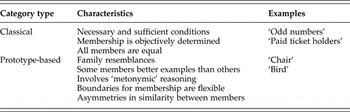
The following discussion takes as its cue the work of Lawrence Zbikowski, who has provided an account of musical ontology in terms of processes of categorisation (Zbikowski Reference Zbikowski2002, chapters 2 and 5). He distinguishes between two basic types of categories. One type, the ‘classical’ category, is marked by necessary and sufficient conditions, and it represents a common way for humans to think of categories.Footnote 21 An example of such a category could be ‘paid ticket holders for the Grey Fox bluegrass festival’. For this category, having a ticket that was bought is both a necessary and a sufficient condition, such that anyone who has such a ticket is a member of the category, and anyone who is a member of the category has necessarily paid. Classical categories such as these are clearly defined according to properties that all members share. As a result, no one member is a better example of the category than any other.
Most research, however, has shown that the categories people use in daily life in fact have graded membership, which is to say that not all members of a category belong to it equally. In the 1970s, Eleanor Rosch, drawing upon the writing of philosopher Ludwig Wittgenstein, presented this alternative view by demonstrating how categories exhibit prototype effects in which some members of a category serve as better examples than others. Such prototype-based categories can involve ‘metonymic reasoning’ in which a member of a category may be such a good example that it stands in for the category in general. Such instances will often feature asymmetries in how members of a category are considered similar: members are judged in comparison to the best examples, but not the other way around (Lakoff Reference Lakoff1987, pp. 12–57).
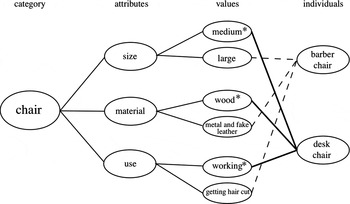
Lawrence Barsalou (Reference Barsalou, Kittay and Lehrer1992) has suggested how prototype-based categories can be represented with relational networks, or ‘frames’ that include the category in question, attributes for the category, values for these attributes, and individual cases that are connected to these values. Example 1 presents a simplified case for the category ‘chair’, in which some of the prototypical attributes for the category are indicated with asterisks. This example illustrates Rosch's common-sense finding that people find desk chairs to be more representative of the category than barbers' chairs. Even with this ‘partial’ frame (partial because it could in principle include a great deal more attributes), one can easily see how other members of the category such as lifeguards' chairs, electric chairs, etc., lie rather far away from the prototype.
Partial frame for the category ‘chair’. Values corresponding to the prototype have an asterisk above them.

While Zbikowski has shown the relevance of this perspective to the question of musical ontology, taking as his examples recordings of popular songs from the early 20th century, I find the work to be suggestive with regard to the ontology of genre. The variability of such a perspective proves useful for studying genre debates, since different subjects are free to weigh certain attributes and values differently in conceiving of a prototype. Considering genre according to frames and prototype effects thus pays attention to ‘the individual and the particular’ (Holt Reference Holt2007, p. 7) while also allowing for genre to function as a shared construct. By including attributes that affect the production and consumption of music as a commodity, this approach can incorporate studies of how genre is defined in relation to market forces (Frith Reference Frith1996; Negus Reference Negus1999). And since attributes within a frame can include aspects of musical sound as well as broader characteristics such as race, class and gender, this approach can accommodate what Brackett has highlighted as a complex relationship between style and sociological factors within genre construction (Brackett Reference Brackett, Hesmondhalgh and Negus2002, pp. 66–7, 79).
Table 1, which summarises the characteristics of classical and prototype-based categories, serves as a point of departure for how perspectives on categorisation shed light on debates about bluegrass music. For bluegrass to be a classical category it would need a rigid set of necessary and sufficient conditions for category membership; that is, a detailed and determinate version of the recipe Monroe hinted at but never clearly delineated. The list below consists of statements made on BGRASS-L that in some way treat bluegrass as such a category. While the following list does not provide a full context for the stated opinions, it is important to note that classical categorisation is not always specific to individual participants, since people often post comments exhibiting elements of multiple kinds of category formation.
1. If it ain't got a BANJO in it, it ain't BLUEGRASS! (signature of Ed Bolton)
2. Anyone who thinks AK&US [Alison Krauss and Union Station] has turned their backs on bluegrass should take in a show. I haven't noticed any drums on stage yet, nor electric guitars. (Dian Newell, 10 August 1997)
3. For moi: pedal steel, drums, and saxes: Nope. Accordion, ‘disciplined’ electric bass, acoustic piano, autoharp, harmonica: Yep. (Bill Knowlton, 25 September 1997)
4. One thing I haven't seen here, but have heard expressed elsewhere (in interviews with Frank Wakefield and Butch Robins), is the notion that it's appropriate to describe the music of Bill Monroe AND NOBODY ELSE as ‘bluegrass’ (or ‘blue grass,’ I guess it would then be). It's a position I don't quite buy, but nonetheless sort of admire. (Paul Birch, 27 September 1997)
5. True Bluegrass cannot be obtained by people who live in a city and have not lived in the country at all, or the mountains or at least lived in that way of life. (Carl Towns, 5 January 2005)
Classical vs. prototype-based categories.

In all of the above comments, the category of bluegrass is in principle defined strictly and objectively, and the discussants provide a variety of necessary and sufficient conditions for category inclusion or exclusion. Notwithstanding its prevalence in the WIBA debate, this classical construction of bluegrass is argued against by fans who invoke aspects of a prototype model similar to what Rosch has theorised. The ‘family resemblances’ argument, for example, includes questions such as the following:
Is Bill Monroe's best-known recording of ‘Blue Moon Of Kentucky’ (1954) bluegrass or not? According to Bangs's one-size-fits-all definition, it's not (no banjo); … Is the Foggy Mountain Banjo album – the best-known, most-beloved (and, IMO and that of many others, the best) 5-string banjo ever made bluegrass or not? According to the definition, it's not (drums); … Is the Osborne Brothers' recording of ‘Rocky Top’ bluegrass or not? According to the definition, it's not (drums, pedal steel). (Jon Weisberger, 24 September 1997)Footnote 22
The fact that some recordings are better examples of bluegrass than others is agreed upon by even the staunchest classicists, and it is reflected in the common metonymic construction of ‘bluegrass’ in which Bill Monroe's music from the mid-1940s represents the entire category (this is distinct from the first classical opinion above, in which case Monroe's music is the category). Finally, recalling the last characteristic in Table 1, the prototype effects for bluegrass also become apparent through asymmetries in similarity judgments: for example, a statement such as ‘The tenor vocalist from the band I saw last night sounds a lot like Ricky Skaggs’ is far more common than ‘Ricky Skaggs sounds a lot like the tenor from the band I saw last night’.
That a prototype model is more appropriate than a classical model as a way of conceptualising the genre is something bluegrass enthusiasts have taken notice of as the debate has evolved. The following comments illustrate this awareness, both through tongue-in-cheek parodies of the classical model and by invoking a centre-periphery metaphor in accordance with the prototype model:
1. I think everyone agrees with the makeup of the core of bluegrass music. But we seem to disagree where the edges are. … Clearly, it's time to renew my call for IBMA to stop all this silly professional stuff and start lobbying Congress to pass the Bluegrass Purity and Licensing Act, to ensure that the centuries-long tradition of The One True American Bluegrass Music is preserved against pretenders like Vince Gill, Alison Krauss and Dan Fogelberg. (Archie Warnock, 25 September 2007)
2. I haven't tried to establish any ‘boundaries’ for bluegrass, in the sense of necessary and sufficient conditions. What I maintain is that there must be such boundaries, however blurred they may be. The boundary will lie at a certain level of deviation from the paradigm. The bluegrass paradigm is not a matter of performers, or originators, or anything else; it's a matter of a particular sound, and that sound is exemplified in the music of the Blue Grass Boys during the Flatt and Scruggs era. (Bangs Tapscott, 25 September 1997)
3. AND – not just ANY Martin guitar can be used – it must be a D-18 (with a Lester Flatt pickguard) or a D-28 (with a Larry Sparks pickguard?) or maybe a D-45 (to play Jimmy Martin songs with) – not any other Martin, especially not any other size but a ‘D’. The mandolin must be a Gibson F-5 signed by Lloyd Loar in 1924 (OK if peghead scroll is broken off and name is scratched out). Guitar and mandolin picks must be pure tortoise shell. The Gibson banjo must be a Mastertone. … A real bluegrass band travels together in a 1930′s vintage car with the bass strapped on the top. … (Harry Moore, 28 December 2000)
4. Personally … my favorite definition goes back a few years, and was offered by Bangs. … He compared it to a pebble thrown into a still pond, and the widening circles that went out from the center. The center being Bill Monroe and the Bluegrass Boys, while Earl and Lester were with him. (Dian Newell, 3 December 2001)
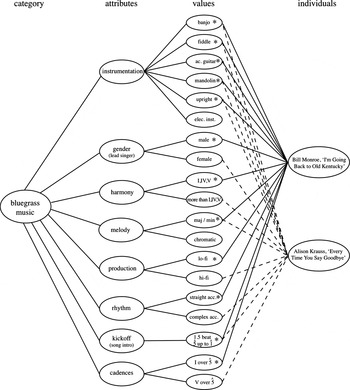
Given that bluegrass breaks down as a classical category, it can be represented as a prototype-based category through the use of frames. Example 2 presents a partial frame for the category ‘bluegrass music’, a subsection of the sort of category structure that a bluegrass listener could employ when deciding whether or not a given recording fits the generic label. The pieces represented in the example are Alison Krauss's contemporary recording of the song ‘Every Time You Say Goodbye’, written by former bandmate John Pennell, and Bill Monroe's ‘classic’ 1947 recording of his song ‘I'm Going Back to Old Kentucky’.Footnote 23 Prototypical values highlighted with asterisks correspond to common definitions of bluegrass examined thus far in this article, many of which explicitly posit Bill Monroe's centrality. It thus comes as no surprise that, for this example, Bill Monroe's recording fits the prototype perfectly, while Krauss's song succeeds on some counts and fails on others. The extent to which listeners consider Krauss's recording to be bluegrass depends on how far away from the prototype they are willing to go and how much they weigh certain attributes when determining category membership.
Partial frame for the category ‘bluegrass’.

Since it includes recordings of bluegrass as ‘individuals’ rather than artists more generally, Example 2 is relatively detailed with regard to elements of musical style. Were it instead to more broadly include ‘Alison Krauss’ and ‘Bill Monroe’ in this column, the attributes would have more to do with image, and prototype determinations would more directly involve questions such as race (is the performer white?), gender (male?), place (from the rural south?) and career trajectory (how mainstream?). Such considerations, as well as additional aspects of style (form, lyrics, etc.), could make for a more comprehensive though potentially unwieldy model. As it stands, the example gives a relatively constrained framework for determining how the recordings sound or do not sound like bluegrass music.
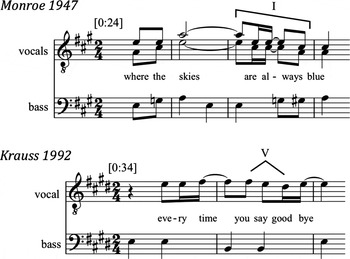
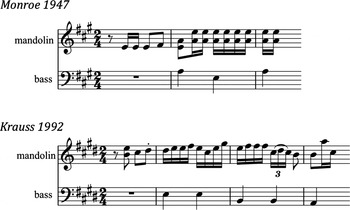
Depending on his or her level of connoisseurship, a subject employing the frame can use it at different ‘magnifications’. In other words, listeners largely unfamiliar with bluegrass may hear what I have labelled as ‘lo-fi’ in Monroe's example and simply conclude that the Krauss recording is not bluegrass since the sound is less scratchy. More specialised listeners might be able to tell that Monroe's recording was made with one microphone and that Krauss's recording was multi-tracked (since she would not play fiddle lines such as the double stops at [2:46] while singing), concluding that, despite the proper instruments being used, the music was not performed live and is thus inauthentic.Footnote 24 Listeners having some familiarity with bluegrass might note that, despite the differing approaches to melody and harmony at cadences (Monroe prototypically uses tonic harmony pitches over  for a dominant-function harmonic construction, in contrast with Krauss's employment of a leading tone), both examples include a mandolin introduction of one and a half beats that moves from up to
 , thus considering both examples to be bluegrass (see Examples 3a and 3b). A dissenting connoisseur might then counter that Adam Steffey's use of a leading tone on the kickoff, the low action and mellow timbre of his mandolin relative to Monroe's, and his choice of a B♮ in the third full measure to make a smooth pop-sounding IVsus2 harmony render the Krauss introduction fundamentally different from the Monroe recording.
Differing approaches to harmony at cadences.

Mandolin kickoffs for the Monroe and Krauss songs.

While many traditionalists evaluate Alison Krauss based on a classical model of bluegrass, those more receptive to her style seem to lean more toward a prototype model such as that of Example 2. Consider, for example, how the following listener becomes more accepting of the attributes that take a piece away from a bluegrass prototype:
I don't know what to tell you – I love the new AKUS album. Like their last couple of recordings, there are parts that need to grow on me slowly, but for me it seems to be because they are producing such new sounds that it takes a while for my ears to catch up. I remember really disliking the little tag that ends ‘Everytime You Say Goodbye’ because it sounded out of time, like a mistake. Now that I'm used to it, I can't imagine the song ending any other way … (Elizabeth Burkett [now Elizabeth Loring], 2 April 1997)
The passage in question is the syncopated guitar accompaniment occurring at the end of the song, which Example 2 indicates simply as a ‘complex acc.’ value for the ‘rhythm’ attribute and which Example 4 illustrates via transcription. Since the excerpt features a guitar playing displaced sixteenth-note accents, it is indeed not the most common approach to time that one finds in bluegrass.Footnote 25 But as the listener became used to the piece, she grew to embrace the musical characteristics that had initially distanced the song from prototypical bluegrass. Frames such as that of Example 2 can thus highlight the detailed musical dimensions of the evolving structure and content of genre debates.
Guitar tag at end of ‘Every Time You Say Goodbye’.

I would like to conclude by returning to the viewpoint with which I began, that of the staunch bluegrass ‘classicist’. Assume that, after making a judgment that certain artists are ‘not bluegrass’, he listens to other new artists and draws the same conclusion, outlining the classical conditions that justify exclusion from the category. These conditions, along with other rigidly defined boundaries for the genre, eventually get called into question by WIBA polemicists who subscribe more to prototype theory (or who have different classical formulations), forcing the classicist to reformulate his definitions and go through the process again. The result is that the WIBA question remains unanswered, while a number of beleaguered fans may wish to hear no more on the issue. However hackneyed the question may be, though, the critical point is that, during the course of the debate, those participating in it are actively interpreting and listening to the music. As long as the debate continues, people continue listening, and as long as people continue listening, performers are able to continue producing the music under discussion. The debate, then, is an important reason why the genre is sustained. Genre, as a contemporary form of musical and cultural expression, thus fuels itself through discourse.
Acknowledgements
This article began as a paper given at the 2005 International Bluegrass Music Symposium at Western Kentucky University. The author would like to thank Erika Brady, Jonathan T. King, Neil Rosenberg, Lawrence Zbikowski and the members of BGRASS-L cited here for discussion and support. He would also like to acknowledge and thank fiddler James Luther (‘Bud’) Rhodes (1930–2010) for many years of music, encouragement and enjoyable conversation about value and propriety in bluegrass.