Early detection or secondary prevention of cancer is increasingly important for the control of certain malignant diseases. Colorectal cancer (CRC) is the fourth leading cause of cancer worldwide, with approximately 875,000 new cases every year (12;20), representing 8.5 percent of all new cases of cancer. In Europe, more recent data from 2006 showed colorectal cancer to rank second in incidence after breast cancer, with 412,900 cases (12.9 percent of all incident cases of cancer), and to be the second leading cause of death from cancer after lung cancer, causing 207,400 deaths (12.2 percent) in both sexes (Reference Ferlay, Autier and Boniol6). CRC is more common in the elderly, with a peak in the seventh decade of life. Only 5 percent of CRCs occur before 40 years of age, and more than 70 percent of CRCs arise from sporadic adenomatous polyps (Reference Ferrandez and Sainz7).
While screening for colorectal cancer is supported by direct and indirect evidence, current evidence is inadequate for defining what is the most effective strategy. As there is strong evidence supporting screening but uncertainties persist about the most effective method for performing such screening, patients may benefit from discussion of the pros and cons of each method, incorporating patient preferences in the decision. New developments will result from the new screening modalities, the development of new, more effective chemotherapeutic agents, and a better understanding of the effects of diet and exercise on disease incidence (Reference Castells, Marzo and Bellas3;Reference Rex14;17–Reference Viñes, Ardanaz, Arrazola and Gaminde19).
A review report by the Galician agency AVALIA-T (Reference Paz Valiñas and Atienza Merino13) demonstrated that (i) a fecal occult blood test (FOBT) is the most widely recognized diagnostic strategy, and the best validated in a great number of randomized, controlled trials; (ii) widely variable results in terms of test sensitivity and specificity and reduction of CRC mortality are reported depending on the procedure used. In groups screened using a FOBT, CRC mortality decreased by 15 percent to 33 percent; and (iii) the number and quality of studies conducted to assess flexible sigmoidoscopy and colonoscopy as an early detection method are much lower. While a higher polyp detection rate is achieved with these examinations as compared to a FOBT, their value as screening procedures has not been analyzed using randomized, controlled trials (Reference Paz Valiñas and Atienza Merino13).
The main conclusion was that population screening for CRC resulted in a decreased mortality from CRC. However, no consensus existed about the choice of the screening method and its periodicity. The FOBT is the best supported strategy to be used as a primary detection test. Sigmoidoscopy and colonoscopy would only be used as subsequent diagnostic tools, mainly because of their invasive nature.
This uncertainty about the approach to be used and the multiple procedures and criteria to be followed requires an analysis of the current experiences in the different countries to establish the most successful strategy and recommend it for general use in population screening.
Multiple strategies have been developed and evaluated in Europe at local and regional level. However, a great heterogeneity exists at state level or in the global Community policy. As early as in 1999, a Community guideline encouraged European countries to start programs aimed at early detection of oncological diseases (Reference Castiglione, Zappa and Ciatto4;5). Many countries of the current European Union (EU) have more or less common strategies for cancers in some sites. Thus, a similar approach has been used for implementation of screening programs for breast and prostate cancer. In the abovementioned 1999 guideline, FOB testing was established as the diagnostic test of choice for colon/rectum cancer (5). To date, few EU countries have established population guidelines for colorectal cancer screening. Candidate selection criteria and the type of procedure and strategy to be used are not common either. The purpose of this article is to reflect such heterogeneity and to give information about ongoing local and regional experiences that may provide data for potential implementation of efficient colorectal screening in a health system.
OBJECTIVES
Primary Objective
To ascertain the strategies for public coverage of the different tests for detecting colon cancer in the public health systems of the EU countries.
Secondary Objectives
To ascertain the existence of programs for early detection of colon and rectum cancer in the countries of the European Union, plus Norway and Switzerland.
To describe the procedures used by the ongoing programs.
For countries with no established programs, to ascertain whether they take into account the existence of risk factors in patients to perform detection tests.
To determine the extent of public coverage or financing of the tests performed.
To ascertain and describe the existence of pilot tests, regional programs, or research projects on early detection of colon and rectum cancer.
METHODS
After reviewing the specific literature on the topic in hand, an ad hoc questionnaire including questions considered relevant and other questions that could provide additional information explaining collateral issues was prepared.
After external review of the draft questionnaire and correction of minor aspects, the final questionnaire was sent by electronic mail on May 9, 2007. When no response was received from the addressees, up to two reminders were sent 1 week and 12 days later, respectively. Response reception was finally closed on May 24.
To identify the most adequate contact persons in each of the health systems of European countries, communication was established with the European agencies that are members of the International Network of Agencies for Health Technology Assessment (INAHTA) and agencies participating in the European research project EUnetHTA.
Contact persons included people from national health systems, ministries of health, or agencies for health technology assessment from the fifteen countries of the European Union (EU-15), plus Norway and Switzerland. For countries having no agencies for health technology assessment, key informants from the corresponding ministries of health or recognized researchers were consulted.
The questionnaire (please see the questionnaire, which can be viewed online at www.journals.cambridge.org/thc) included aspects related to the decision to perform generalized screening in public systems, and in particular in patients with a known risk. There were also questions about financing issues and the existence of local or regional experiences.
RESULTS
The questionnaire response rate was 88 percent, and no survey data were obtained from only two countries: Belgium and Luxembourg. Data for these two countries were directly taken from the Web sites of their ministries of health. In other cases, more than one informant from the same country answered the survey, and their answers were compared, finding no discrepancies. Finally, all answers were also checked against the guidelines issued by the ministries of health of the countries considered, and no differences were found with the information reported by key informants, although the information drawn from the surveys was more comprehensive.
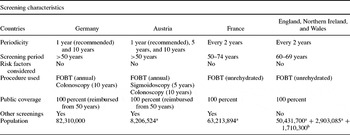
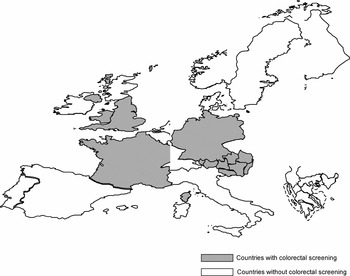
Consultation of key informants and a review of gray literature from guidelines of ministries and public health institutes of the countries considered in this report (Germany, Austria, Belgium, Denmark, Spain, Finland, France, Greece, the Netherlands, Ireland, Italy, Luxembourg, Norway, Portugal, United Kingdom, Sweden, and Switzerland) revealed that screening programs for colorectal cancer are only implemented in four of these countries (Germany, Austria, France, and the United Kingdom) and that such programs differ to each other (see Figure 1 and Table 1).
Comparison of Countries Where National Population Screening Is Implemented.

a2005 data.
b2004 data.
Distribution of colorectal population screening In countries of the Schengen area, including Norway and Switzerland.

Countries with National Screening Programs
Germany. Germany has a screening program consisting of an annual FOBT. Risk factors are not taken into account, and screening is started at 50 years of age. A colonoscopy is also recommended every 10 years. Screening of people under 50 years of age is reimbursed depending on risk factors. A 100 percent reimbursement is made by the German public insurance system.
Austria. In Austria, the situation is similar to Germany, with the same screening periods and age range, people over 50 years of age. However, an interesting difference is that, in addition to annual screening using FOBT and screening using colonoscopy every 10 years, sigmoidoscopy is performed for screening every 5 years.
France. The French public system performs population screening every 2 years from 50 to 74 years of age. The procedure of choice is FOBT. Other diagnostic techniques are used in the event of a positive FOBT, but not routinely or regularly.
United Kingdom. The British screening model is similar to the French model, but differs from the latter in the age range covered. Thus, screening every 2 years by FOBT is recommended for people 60–69 years of age. Finally, there is no additional screening based on risk factors.
Countries Having No National Screening Programs
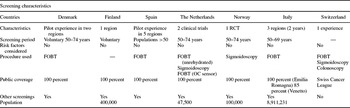
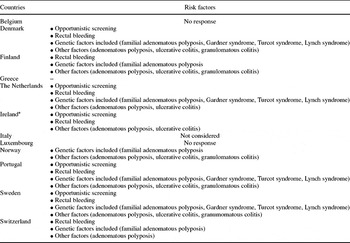
Eleven countries have stated that they have no national screening programs: Denmark, Spain, Finland, Greece, The Netherlands, Ireland, Italy, Norway, Portugal, Sweden, and Switzerland. Belgium and Luxembourg were also found to have no national screening programs. There are several countries having no national screening programs but reporting regional screening, local experiences, or ongoing clinical trials intended to establish the most useful and efficient strategies to be used for such programs. Differences were also found in the type of local and regional experiences (Table 2) and in the individual risk criteria for reimbursement of diagnostic procedures in the different countries consulted (see Table 3).
Countries with Local or Regional Experiences
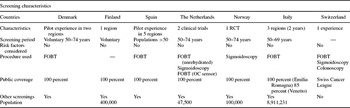
RCT, randomized clinical trial; FOBT, fecal occult blood test.
Risk Factors and Diagnostic Procedures Used for Reimbursement of Individual Procedures for Colorectal Cancer Diagnosis in Countries Having No Population Screening

Local Experiences
Regional or local screening experiences were reported in five of the consulted countries (Denmark, Finland, Italy, Spain, and Switzerland). Some of these experiences were intended to extend screening at national level if positive results were achieved.
Denmark. Two regional experiences where FOBT was performed in people 50–74 years of age were reported.
Finland. There is a regional experience where voluntary screening with 100 percent public reimbursement has been implemented. The population covered is 400,000 inhabitants.
Italy. Screening by FOBT of a population with an intermediate age range (50–69 years), without considering risk factors, has been established in three regions of Northern Italy. Public coverage is available for screening based on risk factors in other age ranges.
Spain. Opportunistic screening is performed in most regions, and there are pilot population screening programs in Valencia, Catalonia, Castile-La Mancha, Murcia, Andalucia, the Canary Islands, and Navarre (10;11). In Aragon, there is a pilot screening program in the population at risk. The program has started recently in Asturias and Madrid. The autonomous regions of the Basque Country, Balearics, Castile-Leon, Galicia and Extremadura have planned similar actions. We have no data about La Rioja, Cantabria, Ceuta, and Melilla.
Switzerland. The Swiss Cancer League sponsored an experience promoting colorectal screening using FOBT. No experiences are currently ongoing in the country.
Ongoing Studies
Two of the countries consulted reported ongoing research studies intended to establish the most adequate procedures and strategies for potential implementation of national screening programs. Results of such studies will be reported later this year. These studies are based on prior review documents that identified a wide heterogeneity and uncertainty with regard to the procedures, strategies, and age ranges to be considered.
The Netherlands. There are two clinical trials ongoing to compare on the one hand two diagnostic procedures, FOBT and sigmoidoscopy, and on the other hand use of FOBT (OC sensor) versus no screening. These are both large studies, covering populations of 32,000 and 15,500 inhabitants, respectively.
Norway. An ongoing clinical trial with a population coverage of 100,000 inhabitants is testing the convenience of screening using sigmoidoscopy in the 50- to 74-year age range.
Results of these studies sponsored by public systems may be of interest for defining criteria to be used for implementing efficient and feasible strategies in settings similar to ours.
DISCUSSION
Implementation of population or opportunistic cancer detection programs is based on the value of early cancer detection, that will allow for more effective treatment when the disease is diagnosed in the early stages of its natural history, at symptom start or, if possible, before symptoms occur, when the condition is localized in the organ of origin, with no invasion of adjacent or distant tissues (Reference Bouvier, Dancourt and Faivre2;Reference Jensen, Storm, Jensen, Parkin, MacLennan, Muir and Skeet9;Reference Rex14;Reference Ruiz-Ramos, Escolar and Hermosín15).
There are two early detection strategies: early diagnosis, based on the recognition of early signs and symptoms of cancer; and screening, involving the performance of tests to healthy people, with no symptom of disease, using procedures that may be easily applied for detection of precancerous lesions, guaranteeing treatment of all detected lesions. While both strategies may decrease population mortality when adequately implemented, better results may be obtained with screening of duly selected populations (Reference Sancho-Garnier, Signan and Ruiz de Campos16;21).
For colorectal cancer, the European Union Council recommends use of population screening programs (Reference Castiglione, Zappa and Ciatto4). The recommended procedure of choice is a fecal occult blood test, that should be performed every 1 or 2 years in both men and women 50 to 74 years of age. For follow-up of positive cases in the fecal occult blood test, the same recommendation includes colonoscopy as the procedure of choice. The fecal occult blood test is the only procedure that has been widely evaluated as a screening tool at population level. In fact, a recently published meta-analysis reported that this test may decrease mortality from colorectal cancer by 16 percent (Reference Hewitson, Glasziou, Irwig, Towler and Watson8).
While the European Council itself recommends a pattern in colorectal screening, the results reported in this article show that a great heterogeneity exists in both the criteria and procedures, and even in the reference age ranges. By contrast, there appears to be a consensus, not different from that defined by the 1996 WHO criteria or the mentioned EU standards, in that the reference procedure for population screening should be the FOBT. Since then, this procedure has been improved or even its diagnostic capacity has been refined, which makes such recommendation even more current.
The EUROCARE (European cancer registries study on cancer patients’ survival and care) study is the largest population study on cancer survival. Sixty-seven population-based cancer registries from 22 European countries currently participate in this study. EUROCARE-4 reported survival data for European adults (age > 15 years) diagnosed in the years 1995–1999 followed up until 2003. According to this study, 5-year survival from colorectal cancer in Europe is 53.8 percent (Reference Berrino, De Angelis and Sant1). In this study, no differences were noted between Western European countries warranting dissimilar or context-dependent strategies in screening.
The wide European population covered by the existing programs reflects the high population of the countries where a population screening program has been implemented. However, discrepancies between the programs, otherwise unwarranted, add a greater degree of uncertainty that does not help take a specific decision without having health and survival outcomes for each of the individual screenings. It is therefore essential that cancer registries provide data allowing for and providing results about the most effective and efficient strategies for each particular case and setting.
POLICY IMPLICATIONS
This article shows a wide range of procedures for colorectal cancer screening in the European countries. This heterogeneity is not based on local, regional or country differences in the prevalence or incidence of the pathology. Thus, following the recommendations of the European Council, it could be feasible and necessary to develop a common approach, at least, at the European level. This approach should take into account health outcomes; defined ranges, time periods, and procedures to use; and determined the value of the selected population screening in terms of cost-effectiveness, as compared to other strategies such as opportunistic screening or screening based on risk factors. Preparation of local adapted decision algorithms based on studies defining the risk population susceptible to be included in specific screening programs could even be considered.
CONTACT INFORMATION
Iñaki Gutiérrez Ibarluzea, MS, PhD (osteba7-san@ej-gv.es), Associate Profesor, Department of Biochemistry, Nursing University School Vitoria-Gasteiz, José Atxotegi z.g, 01009 Vitoria-Gasteiz (Basque Country); Health Technology Assessment Technician, Osteba-Basque Office for HTA, Department of Health–Basque Country, Donostia-San Sebastian, 1, 01010 Vitoria-Gasteiz (Basque Country)
José Asua, MD, PhD (jasua-osteba@ej-gv.es), Head, Osteba-Basque Office for HTA, Department of Health–Basque Country, Donostia-San Sebastian, 1, 01010 Vitoria-Gasteiz (Basque Country)
Kepa Latorre, MD, PhD (pedromaria.latorregarcia@osakidetza.net), Epidemiologist, Investigation Unit, Hospital Txagorritxu, Osakidetza-SVS, Jose Atxotegi s/n, Vitoria-Gasteiz, Basque Country, 01009, Vitoria