Introduction
Coronavirus disease (COVID-19) is a novel and highly communicable disease, which has posed a serious threat to human health worldwide. Reference Harapan, Itoh and Yufika1 Thousands of people are either sick or have lost their lives due to the prevalence of this disease. Reference Zu, Jiang and Xu2,Reference Vellas, Delobel, Barreto and Izopet3 COVID-19 has resulted in serious mental and socioeconomic consequences and posed challenges to all aspects of life. Reference Jiloha4,Reference Fu, Wang and Zou5 The effect of COVID-19 on people’s mental health goes far beyond its effect on their physical health and it causes fear, anxiety, depression, stress, and anger in people. Reference Brinkman6 Maintaining positive mental health in the presence of psychological distress such as stress, anxiety, and depression may be challenging. In these circumstances, people express different coping responses that can affect their psychological health and quality of life. Reference Chew, Lee and Tan7 These post-crisis emotional responses are consistent and normative as long as the function and ability to lead a highly dynamic life remain intact. Considering that health care workers, including nurses, are at the forefront of the fight against infectious diseases and COVID-19, they are the first to be exposed to the virus and are particularly vulnerable to infection due to close contact with patients. Reference Kishk, Nemr and Aly8 Research studies show that the infectious disease epidemics, including SARS, MERS, and influenza H1N1, have been accompanied by problems and challenges among the public, nurses, patients, and their families. Reference Robinson9
The most important experiences reported by nurses during the COVID-19 outbreak were the suffering from fatigue and stress caused by the risk of developing the disease and spreading the infection to their family members. Reference Nemati, Ebrahimi and Nemati10–Reference Tsay, Kao, Wang and Lin12 Moreover, by affecting nurses and, consequently, their families, the critical condition of COVID-19 has caused significant psychological disorders such as stress, anxiety, and depression symptoms in nurses and their family members, and therefore nurses’ family members are known as vulnerable groups and are included in the third priority group given the guidelines of the International Health Commission for the implementation of emergency psychological interventions for COVID-19-infected patients. Reference Ying, Ruan and Kong13,Reference Shahyad and Mohammadi14 As stress and coping are among factors determining the mental health, and the way of adaptation plays an important role in people’s health and well-being, therefore, an epidemiological study of coping strategy will provide important information about the mental health status of the target population. Reference Skapinakis, Bellos and Oikonomou15 Mental health has been defined as effective adaptation to self and environment and choosing the best option from the solutions available when facing problems. Reference Barghi Irani, Bagiyan Kulehmarz and Sharifi16 Stress and coping with stress are the main factors determining the mental health, and adaptation styles play an important role in people’s health and well-being. Reference Kar, Kar and Kar17 Considering that COVID-19-related stressors may affect people’s psychological health during the disease outbreak, investigation of the individuals’ psychological characteristics, coping styles, effective factors, and possible modulators with regard to psychological problems can help with understanding the impact of preventive behaviors on psychological health, development and maintenance of mental health, and therapeutic interventions. Reference Jungmann and Witthöft18
According to most cognitive-behavioral models, stress management and acquiring coping skills will reduce negative mental health outcomes. Therefore, it is necessary to not only study the emotions during the epidemic, but also the association between individuals and these emotions. Reference Panayiotou, Panteli and Leonidou19 Chew suggested that the coping responses be investigated in different sub-groups of the population affected by the disease prevalence. Reference Chew, Wei and Vasoo20 Psychological responses at the critical time of COVID-19 outbreak affect the well-being of the individual and society and may persist long after the outbreak. Reference Chew, Lee and Tan7 Research studies indicate that people who are exposed to the COVID-19 pandemic may be more likely to develop depression and have lower health-related quality of life. Moreover, health-related quality of life is associated with a variety of factors, including age, gender, health literacy, income, physical activity, social status, and diet. Therefore, lifestyle is very important to prevent depression and improve quality of life during the COVID-19 epidemic. Reference Solomou and Constantinidou21,Reference Nguyen, Nguyen and Do22
To date, a series of studies have investigated the effect of COVID-19 outbreak on health care providers, including nurses. However, there is scant epidemiological information about the effect of the COVID-19 pandemic on families of health care providers, including nurses. As looking after the mental health of individuals at different levels of promotion, prevention, and clinical cares is of significant importance in chaotic and critical conditions, Reference Jiloha4,Reference An, Yang and Wang23 this study attempts to perceive the relationship between coping skills, quality of life, and psychological health among family members of nurses during the COVID-19 outbreak.
Theoretical Framework and Hypotheses
The theoretical framework of this study was adopted from the theory of stress, evaluation, and coping developed by Lazarus and Folkman (1989).Reference Ying, Ruan and Kong 13 According to this theory, a stressor is a stressor when the situation is felt by the person exceeding his resources and endangering his health. Stress is classified as neither good nor bad but is classified based on the degree, type, and circumstances that it brings about. According to Lazarus and Folkman, coping refers to cognitive and behavioral efforts to prevent, organize, or reduce stress. Coping style is the process through which a person manages demands that are beyond personal resources and abilities and are threatening. According to this definition, coping is a process that varies depending on the success of its efforts. In Lazarus and Folkman’s view, our interpretation and estimation of events are more important than the events themselves. They believe that it is neither the environmental event nor the individual’s response, but the individual’s perception of events that determines the stress and its intensity. This perception includes harms, measures, threats, potential challenges, and the perceived ability of the individual to cope with them. Lazarus and Folkman’s cognitive coping model includes 3 situations: estimation, coping, and consequence, and 2 well-known general types of coping: coping with stress and coping with complex situations (problem-focused coping style and emotion-focused coping style).
Method
After obtaining the necessary permits from the Ethics, Research and Technology Committee (1399.99IR.SKUMS.REC), and after coordination with the officials of Hajar Hospital of Shahrekord, this cross-sectional study was conducted on the family members of the nurses working at Hajar Hospital of Shahrekord dedicated to admission and hospitalization of COVID-19-infected patients in 2020. To prevent the spread of COVID-19 through respiratory droplets or contact, a weblog was created using blogging software containing questionnaires for gathering data. The blog address and necessary explanations about the study and its objectives were put on the hospital website, and the nurses provided this information to their families. The inclusion criteria for research population are family members of the nurses working at Hajar Hospital which is dedicated to admission and hospitalization of COVID-19-infected patients, and having access to Internet and social media; exclusion criteria are having a history of neurological disorders, mental illness, and other serious systemic disorders and drug abuse. Participation in this study was voluntary and the research sample was selected using a census sampling method. The questionnaires were anonymous. Data were collected using a questionnaire consisting of 4 sections. The first part included demographic information about the participants (gender, age, level of education), the second part was assigned to Billings and Moos’ Coping Responses Inventory (CRI), the third part to Health-related Quality of Life Questionnaire, and the fourth part to the Mental Health Questionnaire.
Ethical considerations were considered in the present study: the necessary permits were obtained from the Ethics Committee and the Deputy Minister of Research and Technology. The objectives of the study were explained to the participants, and participation in this study was voluntary. Additionally, the study imposed no cost to participants. The participants could opt out of the study at any time. The results of this study were provided to individual participants if they requested it. The study data were analyzed and published in accordance with observance of a trusteeship, and the textbooks and scientific sources were used with the utmost care and observance of copyrights and trusteeship.
Data Gathering Tools
Billings and Moos’ Coping Responses Inventory (CRI)
This questionnaire was designed in 1984 following an easy and valid method to assess coping responses in the form of a 32-item questionnaire designed on a Likert scale with 4 options ranging from “never” to “always” (scored as never = 0, sometimes = 1, often = 2, and always = 3). The maximum and minimum possible scores that one can achieve on this questionnaire are 96 and 0, respectively. The standard reliability coefficient of this questionnaire has been reported by Shirvani et al. to be 0.75%. Reference Baghjari, Esmaeilinasab and Shahriari-Ahmadi24
SF-36 Health-Related Quality of Life Questionnaire
It is a 36-item scale that measures the health status in 8 dimensions, including physical functioning, role playing limitation due to physical reasons, role playing limitation due to emotional reasons, bodily pain, social functioning, energy and vitality, emotional role, and general health. The items of this questionnaire determine both positive and negative aspects of health. The maximum and minimum scores achieved for each part or subscale range from 100 to 0 points, with 100 points indicating good and 0 indicating poor quality of life. The total quality of life score is also obtained from the average measurement of various dimensions of health status. The standard reliability coefficient of this questionnaire has been reported by Shirvani et al. to be 0.83%. Reference Shirvani and Heidari25
Psychological Health Questionnaire (PHQ-9)
PHQ-9 was developed by Robert Spitzer at Columbia University. It consists of 9 items designed based on a 4-point Likert scale ranging from “never” to “almost every day.” The questionnaire scores each of the items as 0 (“not at all”), 1 (“several days”), 2 (“more than half of the days”), and 3 (“nearly every day”). The total score of PHQ-9 for these 9 items may range from 0 to 27. A score greater than or equal to 15 is classified as major depression, and a score greater than or equal to 20 indicates severe depression. The standard reliability coefficient of this questionnaire has been reported by Dadfar et al. to be 73.3–77.5%. Reference Dadfar, Kalibatseva and Lester26
Data Analysis
After collecting the data, the coded data were entered into SPSS software version 22 (IBM Corp, Armonk, NY). Descriptive statistics such as frequency and percentage were used to describe the categorical variables, and the mean and standard deviation were identified for the continuous variables. Pearson’s correlation test was used for a correlation analysis.
Results
Participants
Of the 220 participants in this study (ie, the family members of the nurses working at Hajar Hospital of Shahrekord dedicated to admission and hospitalization of COVID-19-infected patients), 101 participants were male and 119 were female. The mean age of the subjects was 35.78 years, and 56.4% of them had an academic education level (Table 1). Participation in this study was voluntary and the questionnaires were anonymous. The research sample was selected using a census sampling method.
Demographic characteristics of the family members of nurses

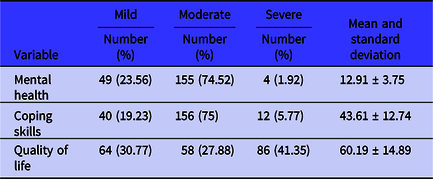
Frequency distribution and mean and standard deviation values of coping skills in the family members of nurses show that the mean and standard deviation values were 43.61 ± 12.74 such that 19.23% of people had poor coping skills, 75% had moderate coping skills, and 5.77% had good coping skills. Frequency distribution and mean and standard deviation of mental health in the family members of nurses show that the mean and standard deviation values were 12.91 ± 3.75 such that 23.56% of people had mild depression, 74.52% had moderate depression, and 1.92% had severe depression. Frequency distribution and mean and standard deviation of quality of life in the family members of nurses show that the mean and standard deviation values were 60.19 ± 14.89 such that 30.77% of people had poor quality of life, 27.88% had moderate quality of life, and 41.35% had good quality of life (Table 2).
Frequency distribution and mean and standard deviation values of coping skills, mental health, and quality of life in the family members of nurses

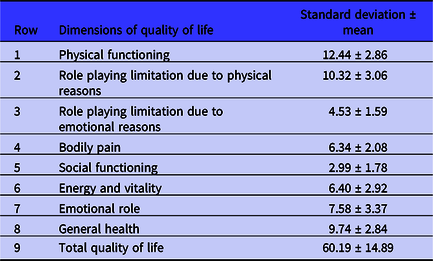
In the quantitative analysis of the quality of life in various aspects, the mean score of the quality of life was 12.44 ± 2.86 in physical functioning, 10.32 ± 3.06 in role playing limitation due to physical reasons, 4.53 ± 1.59 in role playing limitation due to emotional reasons, 6.34 ± 2.08 in bodily pain, 2.99 ± 1.78 in social functioning, 6.40 ± 2.92 in energy and vitality, 7.58 ± 3.37 in emotional role, and 9.74 ± 2.84 in general health. The mean scores of different dimensions of quality of life in nurses’ family members show that the maximum and minimum mean scores of quality of life were related to physical functioning (12.44 ± 2.86) and social functioning (2.99 ± 1.78), respectively (Table 3).
Mean and standard deviation of quality of life and their dimensions in family members of nurses

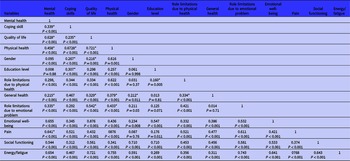
According to Table 4, Pearson’s correlation test showed a significant relationship between coping skills and mental health, quality of life items, total quality-of-life score, and demographic variables of participants (except for education level) (P < 0.05). This was a direct relationship in such a way that as the score of coping skills increases, so do the scores of mental health and quality of life.
Relationship between the participants’ mental health and coping skills, quality-of-life items, total quality of life score, and demographic variables

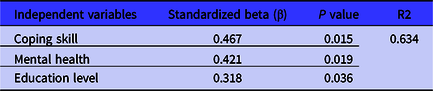
Based on regression analysis results, the predictive power of mental health, coping skills, and education level was 0.634. Coping skill variable is the most powerful predictive variable (ß = 0.467), and after that the mental health variable has the greatest predictive power (ß = 0.421) (Table 5).
Regression analysis of mental health variables, coping skills, and some demographic variables with quality of life in nurses’ family members

Discussion
The present study investigated the relationship between coping skills, mental health, and quality of life of nurses’ family members at the time of the COVID-19 outbreak. Findings showed a significant relationship between the participants’ coping skills and mental health, quality-of-life items, total quality-of-life score, and demographic variables. This was a direct relationship in such a way that as the score of coping skills increases, so do the scores of mental health and quality of life. Moreover, the results of the present cross-sectional study provided evidence of low coping skills, poor quality of life, and mental health problems. The results showed that family members of nurses had poor coping skills in the face of the challenges posed by the COVID-19 disease pandemic, and only a small part of them (5.5%) had good coping skills. In this regard, Shamblaw et al. found in their study during the COVID-19 outbreak that people who experience certain stresses in their lives will experience significant mental health symptoms and low quality of life, and further use ineffective coping methods, such as denial. Reference Shamblaw, Rumas and Best27 In the present study, coping style mediated the association between mental health and quality of life indicating a mutual effective relationship between coping style and mental health. Additionally, Wang et al. stated that the effective coping strategies differ based on the exact nature of the stressful event. Consequently, negative coping styles may lead to the next mental illness. They also state that paying attention to coping skills and effective coping style is of paramount importance during the outbreak of the disease. Reference Wang, Xia and Xiong28 The results of the present study also indicate that weakness in coping skills is correlated with negative effects on mental health. They also showed that the mental health of family members of nurses with low coping skills is at risk. In this regard, Dawson et al. reported a high level of clinical psychological problems in the general population. Moreover, they found that avoidance coping behaviors were negatively related to all indicators of anxiety such as stress, anxiety, and depression and were positively related to well-being. Reference Dawson and Golijani-Moghaddam29
Jungmann et al. found that the inefficient emotion regulation and adaptive emotion regulation have positive and negative relationships with anxiety, respectively, and optimal coping has a positive relationship with anxiety. Reference Jungmann and Witthöft18 Consistent with the results of the present study, Kar states that vulnerable populations, such as COVID-19-infected patients, people who are in close contact with these patients, the elderly, children, and health care specialists and staff have more problems with coping skills. Reference Kar, Yasir Arafat and Kabir30 Active coping behaviors are positively associated with healthy adaptive strategies and a better understanding of quality of life. In some cases, emotional coping strategies may also be a protective factor and they can help reduce depressive symptoms and contribute to health-related quality of life. Reference Greer, Jacobs and El-Jawahri31
Due to the many challenges posed by indirect contact with COVID-19-infected patients, coping skill is considered a protective factor to improve the quality of life and mental health of people, especially family members of nurses during the COVID-19 pandemic. The obtained results indicate that care planners and the health care system need to focus on planning and performing interventions for family members of nurses so that they can acquire the required adaptation to specific conditions of crises such as COVID-19 disease by focusing on learning coping skills of life to help themselves and other family members. This study suggests developing a scale to assess the challenges that family care providers are encountered with.
Limitations
Among the limitations of this study are: (1) As we conducted a cross-sectional study, our results do not show a causal relationship; (2) in order to prevent a potential COVID-19 infection, a web-based study was conducted; therefore, the sampling of our study was voluntary and might affect the results; (3) psychological problems, and personal and character differences of family members of nurses might have affected the results of the study; and (4) the findings are emerged from Iranian context, which may be different from the other cultural contexts.
Conclusion
Considering the wide international scope and global uncertainty about this disease pandemic, even people who have not been directly affected by the pandemic have experienced psychological and quality-of-life problems and need to use coping strategies. However, the analysis of the investigated factors showed that family members of nurses generally experience significant mental health symptoms due to the specific experience and situation of life stress. This may have caused them to fail to show the right adaptive coping responses. In addition, their quality of life has reduced and they use ineffective coping approaches compared to people who have not experienced mental pressure. Our findings can be proposed as useful baseline information for health care providers to allocate appropriate health resources, therapies, and interventions to family members of nurses who experience mental health problems during the COVID-19 pandemic and any outbreaks of infectious diseases in the future. Furthermore, as the results obtained from this study indicate the relationship between coping skill, mental health, and quality of life, different types of coping styles used during this pandemic in various population groups are suggested for investigation to maintain and improve health in society.
Acknowledgments
The researchers thank the contributions and sincere cooperation of COVID-19 patients and their families and all the other centers for assisting in this research.
Funding statement
The researchers extend their sincere thanks to the Shahrekord University’s Deputy of Research and Technology for their financial support.