Introduction
Behavioural issues are identified as the most significant challenge to successful community reintegration following acquired brain injury (ABI) (Cattelani, Zettin, & Zoccolotti, Reference Cattelani, Zettin and Zoccolotti2010; Kelly, Brown, Todd, & Kremer, Reference Kelly, Brown, Todd and Kremer2008). Family members often become the primary care givers (Jumisko, Lexell, & Soederberg, Reference Jumisko, Lexell and Soederberg2007; Lefebvre, Cloutier, & Levert, Reference Lefebvre, Cloutier and Levert2008; McDermott & McDonnell, Reference McDermott and McDonnell2014; Oddy & Herbert, Reference Oddy and Herbert2003), and are faced with adjustment to the impacts of the brain injury, responding to the challenges associated with caring for the person and the challenge of managing their behaviour changes within the community (Braine, Reference Braine2011; Fleming, Sampson, Cornwell, Turner, & Griffin, Reference Fleming, Sampson, Cornwell, Turner and Griffin2012).
Challenging behaviours can manifest in a variety of ways for a person with ABI, from physical and verbal aggression (Alderman, Reference Alderman2003; Dyer, Bell, McCann, & Rauch, Reference Dyer, Bell, McCann and Rauch2006), sexually inappropriate behaviours (Simpson, Blaszczynski, & Hodgkinson, Reference Simpson, Blaszczynski and Hodgkinson1999), through to absconding (Manchester, Hodgkinson, Pfaff, & Nguyen, Reference Manchester, Hodgkinson, Pfaff and Nguyen1997), apathy (Johnson & Balleny, Reference Johnson and Balleny1996; Kant, Duffy, & Pivovarnik, Reference Kant, Duffy and Pivovarnik1998), and reduced initiative (Kelly et al., Reference Kelly, Brown, Todd and Kremer2008). Research has identified a high occurrence (54%–60%) of challenging behaviours among individuals with ABI (Ponsford et al., Reference Ponsford, Downing, Olver, Ponsford, Acher, Carty and Spitz2014; Sabaz, Simpson, Walker, & Roger, Reference Sabaz, Simpson, Walker and Roger2014), as well as significant burden and lack of support for families in managing these behaviours (Kitter & Sharman, Reference Kitter and Sharman2015; McDermott & McDonnell, Reference McDermott and McDonnell2014; Murray, Maslany, & Jeffery, Reference Murray, Maslany and Jeffery2006). Behavioural problems have been reported as the leading causes of distress for care givers (Anderson, Parmenter, & Mok, Reference Anderson, Parmenter and Mok2002; Marsh et al., Reference Marsh, Kersel, Havill and Sleigh1998), which is not surprising given family care givers’ reports of despair, uncertainty, and isolation regarding behavioural disturbances following ABI (Kitter & Sharman, Reference Kitter and Sharman2015).
Furthermore, having instruction on how to best manage challenging behaviours has been reported as one of the highest unmet needs for family care givers (Murray et al., Reference Murray, Maslany and Jeffery2006). There is a suggested link between support needs being met and care giver wellbeing (Kitter & Sharman, Reference Kitter and Sharman2015). In addition, care giver wellbeing has been linked with better rehabilitation outcomes following ABI (Sander, Maestas, Sherer, Malec, & Nakese-Richardson, Reference Sander, Maestas, Sherer, Malec and Nakase-Richardson2012; Sander et al., Reference Sander, Caroseli, High, Becker, Neese and Scheibel2000). Thus, supporting family care givers in behaviour management should be a priority for further investigation.
Challenging behaviours have also been reported to be a significant issue for service providers, who are unable to meet the support needs of individuals exhibiting challenging behaviours within community settings (Department of Health, 2012). This gap in service provision, which has been recognised by both family care givers and service providers (Munce, Laan, Levy, Parsons, & Jaglal, Reference Munce, Laan, Levy, Parsons and Jaglal2014), means that many individuals with ABI are not receiving the specialised community-based support required (de Koning, Spikman, Coers, Schoenherr, & van der Naalt, Reference de Koning, Spikman, Coers, Schoenherr and van der Naalt2015). Interestingly, however, research has shown that individuals with brain injury who display challenging behaviours access more types of services compared to those who do not, with challenging behaviours being an independent predictor of higher levels of service utilisation (Simpson, Sabaz, Daher, Gordon, & Strettles, Reference Simpson, Sabaz, Daher, Gordon and Strettles2014).
Researchers have been addressing the need for more community-based neuro-behavioural supports globally. For example, Carnevale (Reference Carnevale1996) and colleagues (Carnevale, Anselmi, Busichio, & Millis, Reference Carnevale, Anselmi, Busichio and Millis2002; Carnevale, Anselmi, Johnston, Busichio, & Walsh, Reference Carnevale, Anselmi, Johnston, Busichio and Walsh2006) undertook a project titled Natural Setting Behaviour Management (NSBM) in New Jersey, which provided structured education and intervention to individuals with TBI and their care givers in their natural environments (e.g., home, work, school environments). The ABI Behaviour Consultancy in Victoria also developed the ‘Behaviour Consultancy’ Model framework for the management of challenging behaviours, involving flexible, practical, and strategic applications of existing behaviour interventions, which has proven to be effective in non-specialised community environments (Todd, Loewy, & Kelly, Reference Todd, Loewy and Kelly2004). Feeney, Ylvisaker, Rosen, and Green (Reference Feeney, Ylvisaker, Rosen and Greene2001) also described the behavioural and economic benefits of a New York State behavioural resource project for supporting individuals with challenging behaviours in community settings. Furthermore, recommendations made by the National guidelines for rehabilitation following ABI produced by the British Society of Rehabilitation Medicine (2003), and the evidence-based best practice guidelines produced by the New Zealand Guidelines Group Inc. (NZGG) (2006), emphasise the need for providing families and care givers with specific information and ongoing neuro-behavioural supports.
Initiatives such as this provide important precedents towards the development of an effective neuro-behavioural service model within South Australia. However, the first step in realising this goal is to gain a greater understanding of the South Australian perspective regarding current practices and community-based supports which address this issue, which would enhance the capacity of healthcare providers to consider and deliver the most effective services.
However, there is a notable absence of research examining family care givers’ approach to managing challenging behaviours globally, and what specific services and supports are available to support family care givers with this issue. The present study therefore aims to shed light on the current systems in behaviour management following ABI in South Australian community settings. This is then followed with identifying where improvements are needed. This research has implications for policy-makers, service managers and providers, and service users globally, who might make comparisons and establish the needs and opportunities for their own system of community supports for family care givers following ABI.
This paper reports on one component of a larger Delphi study, which also aimed to gain consensus from key stakeholders (including rehabilitation professionals and family care givers) on best practice in behaviour management following ABI in community settings and sought feedback on a proposed Family-directed Behaviour Support (FDBS) program. The additional findings, which report on best practice and the development of the FDBS program, will be presented in a separate paper.
Background – South Australian Perspective
In South Australia (SA), there are a number of government and non-government organisations available that provide rehabilitation services to individuals with ABI and their families; however, there are significant gaps in community support regarding the management of challenging behaviours (Department of Health, 2012). Government-funded brain-injury rehabilitation services are offered by the South Australian Brain Injury Rehabilitation Service (SABIRS) and Disability SA (a Government case management service). The current statewide service model includes partnerships between these organizations and other government and non-government organization, and across government sectors.
SABIRS consists of the Brain Injury Rehabilitation Unit (BIRU, both a hospital and urban facility), and outreach services provided by Brain Injury Rehabilitation Community and Home (BIRCH) services (SA Health, 2015). Individuals with ABI and persistent behaviour difficulties may be referred to BIRCH, which offers a range of multidisciplinary services and expertise relating to behaviour management following ABI. However, support is only available for a limited period of time (a maximum 6 months), and if an individual exhibits behaviours that are not deemed ‘manageable’ they may not be able to access these services (Department of Health, 2012).
Within Disability SA there is a Positive Behaviour Support Team (PBST), which consists of a team of specialist behaviour support practitioners (social workers, psychologists and developmental educators). However, this time limited support is only provided to adults residing in Disability Services’ accommodation services, and is therefore not accessible to those individuals in need who are living with their families in the community.
So what happens to individuals with ABI who exhibit challenging behaviours deemed ‘too difficult to manage’ by service providers? Research suggests that these individuals may be referred to psychiatric wards (Manchester, Hodgkinson, & Casey, Reference Manchester, Hodgkinson and Casey1997) or nursing homes (Winkler, Sloan, & Callaway, Reference Winkler, Sloan and Callaway2010); and, in other cases, may be discharged back to their homes to families who do not have the skills or support to manage challenging behaviours (Murray et al., Reference Murray, Maslany and Jeffery2006; Willis & LaVigna, Reference Willis and LaVigna2003). Research has also reported a large proportion of individuals with TBI within prison populations (Perkes, Schofield, Butler, & Hollis, Reference Perkes, Schofield and Butler2011; Schofield et al., Reference Schofield, Butler, Hollis, Smith, Lee and Kelso2006) suggesting the ineffective management of neuro-behavioural issues in the community may lead to exposure to the criminal justice system.
Individuals with ABI may be able to access community and lifestyle support and enhancement programs through a number of agencies, such as Brain Injury SA (including their Springboard program) (Brain Injury SA, 2016), the Community Re-entry Program (CRP) at Flinders University (Flinders University, 2015), Community Living Project (CLP), Take 5 (Uniting Communities, 2016), and North East Networks. However, these agencies do not offer specialised and community-based consultation regarding behaviour management.
Individuals with ABI and their families are able to access information and attend sessions regarding behaviour management through Families4Families Inc. (Families4Families Inc, 2011), a state-based peer support network that provides networking opportunities and education on a range of topic including behaviour management following ABI. However, the network also does not provide specialized individual behaviour consultation to family care givers.
Public and Private (neuro)psychologists and (neuro)psychiatrists also offer support regarding behaviour management following ABI in community settings. These services are invaluable for individuals with brain injury and their families, providing assessment, diagnosis, and individualised plans for the management of challenging behaviours (Littlefield, Stokes, Bardenhagen, & Collins, Reference Littlefield, Stokes, Bardenhagen and Collins2012). However, individuals with ABI are unable to access the specialist clinical neuropsychological services they need under the current Medicare system (Littlefield et al., Reference Littlefield, Stokes, Bardenhagen and Collins2012). These services are provided under the Department of Veterans’ Affairs (DVA) and insurance schemes (including Workcover, the Motor Accidents Insurance Board [MAIB] & Transport Accident Commission [TAC]), but many ordinary Australians are not covered by these schemes, resulting in much inequity in provision and access to services (Littlefield et al., Reference Littlefield, Stokes, Bardenhagen and Collins2012). Furthermore, there are long delays in accessing these services in SA (Department of Health, 2012). It should also be noted that even though neuropsychologists specialise in assessment, diagnosis, and treatment of psychological disorders (Littlefield et al., Reference Littlefield, Stokes, Bardenhagen and Collins2012), they may have limited experience in working with families and challenging behaviours within community settings.
These supports offered to family care givers regarding behaviour management suggest a fragmented and inconsistent model of care, resulting from: time-limited support offered through SABIRS and Disability SA; the valuable but unspecialised support provided through Brain Injury SA, Families4Families Inc. and other community-based organisations; and the inability for many families to access or be eligible for existing services (available through SABIRS, Disability SA, and Specialists) due to structural and bureaucratic divisions. There are a number of other government and non-government agencies that provide elements of behaviour support. However, on the whole this is a fragmented model of care, with no clear pathways to access specialised support.
Furthermore, individuals who are not eligible for insurance systems mentioned above may be eligible for support under the National Disability Insurance Scheme (NDIS). It is expected that individuals between 18 and 64 years in SA will be able to access NDIS from July 2017 (dependent on where they live) (NDIS, 2016). The NDIS promises to ensure the provision of information, referral, and linkage for families and care givers, enabling them to receive the community support systems to assist them in their roles (NDIS, 2016). It will be interesting to ‘watch this space’ to see what changes in the service provision may occur, whether these changes will be inclusive of supporting family care givers with the management of challenging behaviours, and how (if) issues of recognising and diagnosing mild ABI (Forsyth, Reference Forsyth2002) and related behavioural sequelae will be addressed. Considering these upcoming changes to the current model of care, the current research is timely in identifying the service gaps for family care givers, which is important for informing an optimal service model for managing challenging behaviours following ABI in community settings.
This research therefore plays an important role in identifying (1) what behaviour management strategies are used by family care giver in behaviour management following ABI, and (2) what supports are available that are specific to supporting family care givers with behaviour management following ABI, from the perspective of key stakeholders. This will provide a clearer perspective of the issues, needs, and potential opportunities for improvement in the current service systems.
Method
The present study utilised a Delphi method. This is an iterative process of obtaining the most reliable consensus of a group of key stakeholders best-suited to addressing the research questions (Okoli & Pawlowski, Reference Okoli and Pawlowski2004; Skulmoski, Harman, & Krahn, Reference Skulmoski, Hartman and Krahn2007). This method was considered most appropriate because (1) this study is dealing with a complex issue requiring knowledge from people who have expertise in this area, (2) the research questions will be answered most appropriately by a panel of key stakeholders’ responses, rather than any individual key stakeholder's response, and (3) the Delphi study is flexible in its design and amenable to follow-up interviews (Okoli & Pawlowski, Reference Okoli and Pawlowski2004). As suggested by Skulmoski et al. (Reference Skulmoski, Hartman and Krahn2007), this method is most effective when the goal is to improve understanding of problems and develop solutions, which is reflective of its aim in this study.
This research was approved by the Royal Adelaide Hospital Ethics Committee (RAH protocol number: 140906).
Selecting Participants
Since the purpose of a Delphi is not to represent the general population but rather to seek ‘expert’ opinion, a purposive sample is necessary (Fink & Kosecoff, Reference Fink and Kosecoff1985). For the purpose of this study, participants consisted of experts by experience (family care givers) and experts by service delivery for ABI (rehabilitation professionals) from within SA. These combined perspectives were considered important in effectively answering relevant research questions. It was required that participants (key stakeholders) were 18 years or older and directly involved (and had been for a minimum of two years at commencement of study) in the management of challenging behaviours by adults (18 years or older) with ABI living in community settings.
An initial list of key stakeholders was identified through professional contacts, with the ‘snowball’ sampling technique then utilised to generate subsequent participants. This technique is recommended by Fink and Kosecoff (Reference Fink and Kosecoff1985) and refers to an outreach strategy where an individual with the desired characteristics is identified and their social networks are used to recruit similar participants (Denscombe, Reference Denscombe2010). Once a list of initial contacts had been generated, a letter of invitation was sent to the relevant organisations to identify further possible participants.
Eighteen participants were invited to participate. This number was considered achievable given the specialised nature of this study. Furthermore, the Delphi group sample size is not dependent on statistical analysis, but rather on group dynamics of key stakeholder in arriving at consensus. Literature recommends 10–18 key stakeholders on a Delphi panel, however, previous studies have varied from from 4 to 171 participants (Okoli & Pawlowski, Reference Okoli and Pawlowski2004). There is therefore no ‘typical’ Delphi; rather, the method is modified to suit the circumstances and research questions.
Design
A three-round Delphi process (Skulmoski et al., Reference Skulmoski, Hartman and Krahn2007) was conducted. This design was considered appropriate for this study, providing key stakeholders the opportunity to review group consensus rates from the previous round and change their answers if desired. Each round was based on a questionnaire distributed by the researcher via SurveyMonkey, a web-based survey tool (SurveyMonkey Inc, 2016). The initial round consisted of broad questions, allowing an open-ended solicitation of ideas. The questions then became more focused on the specifics of the research at each round, which is typical of a Delphi design (Okoli & Pawlowski, Reference Okoli and Pawlowski2004).
The Delphi method utilised was consistent with the following key features outlined by Rowe and Wright (Reference Rowe and Wright1999). The Delphi participants remained anonymous, allowing them to freely express their opinions without pressure to conform to others in the group. Items were therefore evaluated on their merit, rather than who proposed them. Iteration allowed the participants’ to reflect on the group's responses each round and refine their views, and controlled feedback informed the participants of the other participants’ perspectives, providing the opportunity for them to clarify or change their views. Statistical aggregation then allowed for quantitative analysis and interpretation of group responses (Rowe & Wright, Reference Rowe and Wright1999).
The aim of the Delphi process is to gain consensus. For the purpose of this study, a 75% level of agreement was adopted, which is consistent with that recommended by Keeney et al. (Reference Keeney, Hasson and McKenna2011).
Round 1
This round consisted of an anonymous open-ended questionnaire. Participants were asked to (1) identify strategies that family care givers use to manage challenging behaviours in adults with ABI, and (2) what services and supports are currently available to family care givers that address the issue of behaviour management following ABI in community settings in SA. Participants were asked to identify a minimum of five and maximum of 10 items for each question. According to Keeney et al. (Reference Keeney, Hasson and McKenna2011), these numbers should safeguard against an unmanageable number of items for the second round and should also ensure a reasonable to good response rate. During this round, demographic information was also collected regarding the participants’ role, employment (if applicable), and length of time managing behaviours following ABI in community settings. This information was not made available to other participants, only the researcher.
Round 1 responses were then analysed thematically, in which responses that were similar in content were grouped together (Green & Thorogood, Reference Green and Thorogood2014). Once similar responses were combined, a group decision making process was used to decide whether items occurring infrequently should be included or omitted, as it was important to keep the list a manageable size (Keeney et al., Reference Keeney, Hasson and McKenna2006).
Round 2
In the second round, the items from the first round were presented to participants. Participants were asked to rate these items using a Likert scale numbered 1 to 5, with 1 indicating very important; 2, important; 3, neither important or not important; 4, less important; and 5, unimportant. Participants were informed that the aim of the exercise was to reach consensus (a minimum of 75% agreed response) regarding what behaviour management strategies are being used and what services and supports are available. Participants were also asked to indicate whether they were aware of each service that was identified as being specific to supporting family care givers in behaviour management following ABI using a closed yes/no question following each item.
Round 3
In the third round, participants were provided with items that had already reached consensus in Round 2 and items that were close to reaching consensus (>50% consensus in either upper or lower categories). Scores from the upper (e.g., ‘very important’ and ‘important’) and lower bands (e.g., ‘not important’ and ‘not at all important’) were collapsed to provide a group consensus as either ‘important’ or ‘not important’. Where there was no trend towards consensus (<50% agreement) in either the upper or lower bands, the item was omitted from the Round 3 questionnaire. In this round, the participants were provided with the group consensus rate from Round 2 (as a percentage), and were asked to reconsider their original response in the context of the group response. Participants were also informed that they did not have to change their original response if they did not wish to. Following Round 3, the results from the Delphi process were emailed to participants, who were then invited to make comments on the outcome of the study.
Results
Eleven key stakeholders returned signed consent agreeing to be involved in the study. All participants completed the three rounds of the Delphi process. Information regarding the participants’ support role and length of experience in managing challenging behaviours in individuals with ABI is presented in Table 1. Of the 11 participants, 73% (n = 8) were clinicians (two social workers, a psychologist, a registered nurse/psychologist, a rehabilitation physician, a clinician and researcher, and a speech pathologist), and 27% (n = 3) were family care givers. Seventy-three percent (n = 8) of participants were female, and 73% (n = 8) worked in the health service industry. Participants had an average of 19 years’ experience in the management of challenging behaviours following ABI in community settings.
Participant Demographics

Behaviour Management Strategies used by Family Care Givers
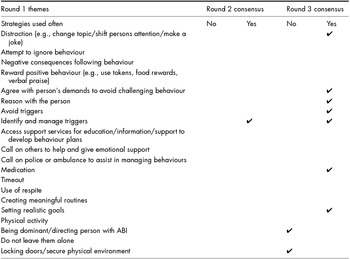
In Round 1, a total of 95 responses were obtained regarding what behaviour management strategies family care givers use in community setting. After removal of exact duplicates by the researcher, a team decision-making process was used to group together similar responses, resulting in 20 separate categories (See Table 2). The team comprised of a Developmental Educator, Brain Injury Rehabilitation Consultant, a Professor of Neurophysiotherapy, and a Professor of Psychiatry.
Behaviour Management Strategies Reaching Consensus

In Round 2, consensus was reached that family care givers often ‘identify and manage triggers’ in the management of challenging behaviours (e.g., if the person is tired [trigger] ask if they need a rest, noticing mood changes, and responding appropriately). A further 10 strategies were close to reaching consensus (between 55% and 73% agreement), which were then redistributed in the Round 3 questionnaire. In Round 3, consensus was reached that the following six strategies are also used often by family care givers: ‘distraction’ (e.g., change topic/shift person's attention/make a joke), ‘agree with person's demands to avoid challenging behaviour’, ‘reason with the person’, ‘avoid triggers’, ‘medication’, and ‘setting realistic goals’. Consensus was also reached that the following strategies are used rarely by family care givers: ‘being dominant/directing the person with ABI’, and ‘locking doors/ securing physical environment’. See Table 2.
Services Available
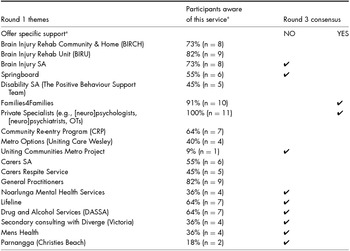
In Round 1, a total of 67 responses were obtained regarding what services are available in SA that support family care givers with the management of challenging behaviours following ABI. This number was reduced to 19 items after removal of exact duplicates (see Table 3).
Services/Supports Offering Support to Family Care givers Specific to Behaviour Management Following ABI

*in relation to supporting family care givers with behaviour management following ABI.
In Round 3, consensus was reached (minimum of 75% agreement) that there are only two service types in SA that are specific to supporting family care givers with managing challenging behaviour in community settings following ABI: Families4Families Inc., and private specialists (e.g., [neuro]psychologists & [neuro]psychiatrists]).
A number of participants were unaware that some services existed. Only 45% (n = 5) of participants were aware that Disability SA and Carers Respite Service offered support regarding behaviour management following ABI; 36% (n = 4) were aware that Noarlunga Mental Health Service, Diverge and Men's Health offered relevant services, 18% (n = 2) felt Parnangga (Christies Beach) offered relevant support and only 9% (n = 1) felt this support was available through Uniting Communities Metro Project.
Discussion
The aim of this study was to gain consensus from key stakeholders (including rehabilitation professionals and family care givers) on current family practices and available support to families regarding behaviour management following ABI in SA community settings. This has been achieved using a Delphi process.
The current study allowed participants to draw from their own definition of challenging behaviours, and their personal perspectives (experience and expertise), which reflects the broad and subjective nature of this issue. It is for this reason that participants consisted of both family care givers and professionals, which would include the likelihood of variations in service-user and service-provider perspectives regarding brain-injury rehabilitation and the system of service delivery (McDermott & McDonnell, Reference McDermott and McDonnell2014).
Behaviour Management Strategies used by Family Care Givers
The results of this study suggest that a number of strategies are being utilised by family care givers, including: ‘distraction’,; ‘agreeing with the person's demands’, ‘avoiding triggers’, ‘identifying and managing triggers’, ‘setting realistic goals’, and ‘medication’. This variability in the behaviour management strategies used is in line with studies conducted by Tam, McKay, Sloan, and Ponsford (Reference Tam, McKay, Sloan and Ponsford2015) and Braine (Reference Braine2011). These approaches consist of recommended antecedent strategies (i.e., interventions that manipulate events prior to the occurrence of problem behaviour that decrease the likelihood of it occurring in the future, while also promoting desired behaviours) following brain injury, including distraction, identifying and managing triggers (Jacobs, Reference Jacobs1995), and setting realistic goals (Feeney & Ylvisaker, Reference Feeney and Ylvisaker1995). However, there are other common and basic antecedent strategies recommended by behaviour specialists which have not been identified as being used by family care givers in this study. For example, the importance of creating a positive environment (consisting of choice, control, and meaningful experiences) is emphasised in the literature (Ponsford, Sloan, & Snow, Reference Ponsford, Sloan and Snow2013; Ylvisaker, Jacobs, & Feeney, Reference Ylvisaker, Jacobs and Feeney2003; Ylvisaker, Turkstra, & Coelho, Reference Ylvisaker, Turkstra and Coelho2005) and, although this was identified as a strategy used by family care givers in Round 1 of this study, consensus was not reached regarding its use. These strategies play an important role in behaviour management following brain injury, as neuropsychological research has found that trauma resulting in damage to the ventral or dorsal frontal lobe impedes the ability of individuals to learn from the consequences of their behaviour (Damasio, Reference Damasio1994; Rolls, Reference Rolls, Stuss and Knight2002; Schlund, Reference Schlund2002). Therefore, individuals who experience cognitive difficulties (e.g., memory impairments or difficulty with information processing), may not be responsive to contingency strategies (i.e., strategies manipulating the response to behaviour that reduce the likelihood of problem behaviour and encourage desired behaviours) such as positive reinforcement (when a reward is presented immediately following the desired behaviour) and extinction (when a particular behaviour is not reinforced) procedures (Feeney & Ylvisaker, Reference Feeney and Ylvisaker1995; Willis & LaVigna, Reference Willis and LaVigna2003). This suggests the need to further educate family care givers regarding the importance of antecedent strategies, which focus on making background setting events as positive as possible for the individual (Ylvisaker et al., Reference Ylvisaker, Turkstra and Coelho2005). As eluded to above, such procedures may include assuring an individual has adequate amount of choice and control, is engaged in personally meaningful activities, receives positive communication from communication partners, and is taught positive communication alternatives (Ylvisaker et al., Reference Ylvisaker, Turkstra and Coelho2005; Ylvisaker & Feeney, Reference Ylvisaker and Feeney1998). Antecedent strategies appear to be gaining increasing momentum, with a number of intervention experiments demonstrating their effectiveness (Arco & Bishop, Reference Arco and Bishop2009; Feeney & Ylvisaker, Reference Feeney and Ylvisaker2003, Reference Feeney and Ylvisaker2006, Reference Feeney and Ylvisaker2008). Furthermore, in recent research conducted by Tam and colleagues (Reference Tam, McKay, Sloan and Ponsford2015), family care givers reported that giving the individual with brain injury more control over their lives and restructuring their living environment to be effective strategies. However, not all individuals with brain injury experience cognitive changes; and many are therefore also able to learn from contingency strategies (Feeney & Ylvisaker, Reference Feeney and Ylvisaker1995). The effectiveness of contingency strategies has also been highlighted in the ABI literature (Stewart & Alderman, Reference Stewart and Alderman2010; Wood & Alderman, Reference Wood and Alderman2011), which suggests the important roles that both antecedent and contingency strategies play in behaviour management. Indeed, it has been suggested that these approaches should not be implemented in isolation, and that a comprehensive behavioural intervention should actively integrate antecedent and consequence strategies (Borgmeier & Rodriguez, Reference Borgmeier, Rodriguez, Brown, Anderson and De Pry2015).
Common contingency procedures such as positive reinforcement and extinction were also identified in Round 1 (‘Reward positive behaviour [e.g., use tokens, food rewards, verbal praise]’ & ‘attempt to ignore the behaviour’); however, consensus was not reached regarding the use of these among family care givers. These are two of the most common methods for increasing/maintaining a desired behaviour and decreasing the occurrence of challenging behaviours following brain injury (Jacobs, Reference Jacobs1995), yet it seems these are not common strategies being utilised in community-settings. This suggests that family care givers do not have the confidence to implement these more comprehensive procedures, which is understandable given the complex nature of behaviour management, and limited support families receive in addressing this issue (Kitter & Sharman, Reference Kitter and Sharman2015; McDermott & McDonnell, Reference McDermott and McDonnell2014; Murray et al., Reference Murray, Maslany and Jeffery2006). It is therefore unreasonable that family care givers, who have not been trained to assess, formulate, devise, and implement behavioural strategies, are expected to tackle this issue alone.
The lack of confidence of family care givers in implementing behaviour management procedures is also suggested by the findings, given that consensus was reached that family care givers often ‘agree with the persons demands’ and use ‘medication’ to manage challenging behaviours. Although medication is commonly used to manage aggression following brain injury, there is no firm evidence base for this (Fleminger, Greenwood, & Oliver, Reference Fleminger, Greenwood and Oliver2008). According to Alderman (Reference Alderman2003), the temptation to use sedative medications, and the sensitivity of people with ABI to the debilitating side effects of these medications, is concerning. In some cases, medication may have a negative impact on functioning (e.g., language, attention/concentration, speed of information processing), and finding a proper balance between severe sedation and too-limited action can be impossible (Saout et al., Reference Saout, Gambart, Leguay, Ferrapie, Launay and Richard2011). Indeed, the use of sedatives can be considered as a form of ‘chemical restraint’ (Currier & Allen, Reference Currier and Allen2000), and is subsequently associated with necessary precautionary monitoring through the Office of the Senior Practitioner (Disability SA, 2016). It has been suggested that the difference between ‘chemical restraint’ and a treatment approach depends on whether the medication is given as part of a care plan or is merely used to control an individual's behaviour (Allen et al., Reference Allen, Currier, Hughes, Docherty, Carpenter and Ross2003; Currier & Allen, Reference Currier and Allen2000). The concern is that limited availability of education and alternative behavioural supports means that family care givers may fall back on strategies such as medication (or chemical restraint) and giving in to the person's demands. Lacking the confidence and social support (including quick-responding backup that is available in hospitals and specialised rehabilitation facilities), and the fear of confronting aggressive and often unpredictable behaviours may leave no other viable alternatives. This is clearly illustrated in the case study presented by Willis and LaVigna (Reference Willis and LaVigna2003), in which a mother finds herself the primary care giver of her 17-year-old son with brain injury and significant challenging behaviours. The mother was unable to implement the strategies used in the hospital, including timeout and restraint procedures, and would therefore try to avoid altercations with her son that might precipitate angry episodes, and allow him to do what he wanted, in an attempt to avoid the likelihood of physical aggression.
According to the Delphi participants, it is not common for family care givers to call on others to help and give emotional support regarding the management of challenging behaviours. This is concerning, with literature suggesting that social support helps family care givers cope with challenging behaviours (Ergh, Hanks, Rapport, & Coleman, Reference Ergh, Hanks, Rapport and Coleman2003; Tam et al., Reference Tam, McKay, Sloan and Ponsford2015). However, these findings are in line with studies conducted by Ergh, Rapport, Coleman and Hanks (Reference Ergh, Rapport, Coleman and Hanks2002), which link care givers with low social support to caring for individuals with the most severe cognitive, neuro-behavioural, and functional impairments. This may be partly due to the demanding nature of the caregiving role, isolating families from opportunities to develop these supportive relationships (Ergh, Hanks, Rapport, & Coleman, Reference Ergh, Hanks, Rapport and Coleman2003). The results of the current study therefore emphasise the need for services to provide family care givers with opportunities to network with other families with shared experiences.
Services Available
There is growing literature regarding the impact of brain injury on family care givers, with emphasis placed on the burden of managing challenging behaviours. However, despite this, there is limited support and services available to family care givers which address this issues.
The findings of this study have highlighted the significance of this gap in service provision. Consensus was reached that there are only two service types in SA that are specific to supporting family care givers with behaviour management following ABI in community settings: Families4Families Inc., and private specialists (e.g., [neuro]psychologists & [neuro]psychiatrists). Although there has been consensus among professionals that there are limited services available, the extent of the gap revealed by this study is confronting.
Families4Families Inc. and private specialists offer invaluable support to family care givers regarding behaviour management, however, there are limitations to this support. Although Families4Families Inc. runs group education sessions regarding behaviour management following ABI, this network does not provide specialised individual behaviour consultation for family care givers. This support is offered by private specialists, however, many individuals with ABI are unable to access the specialist clinical neuropsychological services they need under the current Medicare system (Littlefield et al., Reference Littlefield, Stokes, Bardenhagen and Collins2012). This significant cost for families, who are often already financially strained (Kitter & Sharman, Reference Kitter and Sharman2015; McDermott & McDonnell, Reference McDermott and McDonnell2014), along with the delays in accessing these services in SA (Department of Health, 2012) present barriers to families who need regular ongoing support. Considering these were the only community-based services identified to support family care givers with the management of challenging behaviours, this clearly highlights the need for more specialised services.
It is surprising that the government-funded bodies for supporting individuals with brain injury, including SABIRS (BIRCH & BIRU) and Disability SA, were not recognized as services providing specific support to family care givers regarding behaviour management following ABI in community settings. These findings are especially interesting given that, at the time of this study, 64% of participants (n = 7) worked for SA Health. Furthermore, 73% (n = 8) of participants indicated that they were aware of the services offered by BIRCH (specific to supporting family care givers with behaviour management), which indicates that participants, rather than being unaware of the service, felt it did not offer the specialised support required. For example, these findings may reflect the time-limited (a maximum 6 months) services provided by BIRCH. This is insufficient for many, as challenging behaviours often have long-term implications for individuals (Kelly et al., Reference Kelly, Brown, Todd and Kremer2008), with literature highlighting the need for life-long access to services and supports (Masel & DeWitt, Reference Masel and DeWitt2010; Tam et al., Reference Tam, McKay, Sloan and Ponsford2015). Furthermore, eligibility criteria for BIRCH services allow the exclusion of individuals who exhibit behaviour not deemed ‘manageable’ (Department of Health, 2012). It was also noted by participants that the Clinical Psychology service offered through SABIRS is difficult to access. Similarly, there are limits to behavioural support provided by Disability SA, with their Positive Behaviour Support Team (PBST) only providing services to adults residing in Disability Services’ accommodation services (Disability Services, 2013). This perhaps explains why only 45% (n = 5) of participants were aware that Disability SA offers support to family care givers regarding behaviour management.
These findings suggest that specialised behaviour management is predominantly provided by non-government organisations. This limited Government support may reflect the ‘invisible’ nature of this disability, with individuals often faced with the challenge of simply persuading agencies that the problem exists (Forsyth, Reference Forsyth2002). As stated by Masel and DeWitt (Reference Masel and DeWitt2010), if brain injury was recognised as a chronic condition, being reimbursed and managed on a par with other chronic diseases, individuals may receive the support they so richly deserve.
In Round 1 of this research, participants identified a broad range of services (see Table 3), however, consensus was reached that a majority of these were not relevant to supporting family care givers with behaviour management. These results suggest a disjointed model of care, with no clear steps of service provision. It is likely that such a system leaves family care givers feeling overwhelmed, and increases the likelihood of ‘service-hopping’, with families accessing multiple services in attempt to find the required support. These findings are in line with research conducted by Simpson et al. (Reference Simpson, Sabaz, Daher, Gordon and Strettles2014), which examined the unmet needs of service utilisation among adults with severe brain injury living in the community, comparing those who did and did not display challenging behaviours. The participants of this study were all active clients of the New South Wales (NSW) Brain Injury Rehabilitation Program (BIRP) community rehabilitation team. The research showed that individuals with challenging behaviours accessed significantly more types of BIRP and non-BIRP services, with challenging behaviours being an independent predictor of higher levels of service utilisation. Furthermore, participants with challenging behaviours reported greater levels of unmet needs. Individuals with challenging behaviours accessed more services from social work, clinical psychology, and mental health services. Interestingly, in participants with challenging behaviour but no co-morbidity, an equal number had accessed or had unmet needs for mental health services, which suggests that such services are still being used in some cases to help manage challenging behaviours for individuals with no mental health problems (Simpson et al., Reference Simpson, Sabaz, Daher, Gordon and Strettles2014).
Considering this notion of ‘service-hopping’, surely this is an issue needing attention, not only for the wellbeing for the families involved, but also economically? As stated by Simpson et al. (Reference Simpson, Sabaz, Daher, Gordon and Strettles2014), the issue of challenging behaviours is an important focus of health services research, with the increasing pressure on resources globally highlighting the importance of understanding patterns of service use to inform policy, planning, and funding processes. The economical benefits of community-based behaviour management have been documented (Feeney et al., Reference Feeney, Ylvisaker, Rosen and Greene2001; Willis & LaVigna, Reference Willis and LaVigna2003); furthermore, it has been suggested that community access to specialised neuro-behavioural services could save the government millions of dollars per year as a result of the reduced use of calming and anti-psychotic medications (Littlefield et al., Reference Littlefield, Stokes, Bardenhagen and Collins2012).
This disjointed system also allows organisations to ‘handball’ the responsibility of individuals with challenging behaviours, with organisations often stating severe behavioural disorders as exclusion criteria (Munce et al., Reference Munce, Laan, Levy, Parsons and Jaglal2014). In such a system, individuals with ABI and family care givers may get caught in limbo, in a web of referrals and a constant state of transition. As stated by McDermott and McDonnell (Reference McDermott and McDonnell2014), it is during this period between accessing services that family care givers feel ‘cut loose’ (p. 84).
Family care givers have reported the need for more coordinated services, with a streamlined interconnected support system (Kitter & Sharman, Reference Kitter and Sharman2015). This need for a ‘centralised hub’ has also be identified by the Department of Health (2012); creating partnerships between government and non-government organisations and across government sectors with transparent pathways to accessing specialised services when required.
It has been clearly demonstrated throughout the literature that families experience significant burden and stress as a result of behavioural changes following ABI. The prevalence of challenging behaviours among ABI populations studied has also been significantly high. Therefore, considering approximately 31,000 individuals are living with an ABI in South Australia (AIHW, 2007), once can only presume that challenging behaviours following ABI present a significant issue for many individuals and families living in our communities. Furthermore, considering the notion of ‘service-hopping’ and the significant cost of pharmacological treatment discussed above, one can only imagine the significant cost associated with this issue. This again emphasizes the need for developing cost effective and community-based neuro-behavioural services within South Australia.
Limitations
A number of potential limitations associated with use of the Delphi method must be acknowledged. These include selection bias, small number of iterations (only three rounds), and the small sample. However, there are no set guidelines determining the number of participants to ensure validity of results, with 10–18 panel members recommended in the literature (Okoli & Pawlowski, Reference Okoli and Pawlowski2004). A purposive sample was also necessary since the purpose of a Delphi study is to seek expert opinion, not represent the general public (Fink & Kosecoff, Reference Fink and Kosecoff1985). However, a significant limitation regarding the sample was the small proportion of family care givers (27%). Although the service providers were able to comment on what strategies family care givers are using, these results are rather suggestive of what techniques are in use, not a definitive account of what strategies are actually being used. However, the larger proportion of service providers (73%) played an important role in providing further insight into what services are available and clinical expertise in identifying best practices in supporting family care givers with behaviour management (i.e., knowledge of ABI biology and evidence-based behaviour management practices).
The key representatives from statewide organisations were contacted due to their expertise, with the snowball sampling technique helping to identify family care givers. It is possible that family care givers who have strong opinions or negative experiences with the service system were more likely to participate. However, as a majority of participants consisted of professionals, this representation of both perspectives assisted in the triangulation of this data.
It is possible that with further iteration, that more items would have reached consensus, resulting in a more accurate account of the current system SA system of care regarding community-based behaviour management following ABI. In this study, items not close to reaching consensus (>50% agreement) were omitted from Round 3. However, as stated by Powell (Powell, Reference Powell2003), the findings of a Delphi study represent expert opinion, rather than indisputable fact. Furthermore, participants were asked to identify a minimum of five and a maximum of 10 items, and although this was recommended by the literature (Keeney et al., Reference Keeney, Hasson and McKenna2011), this condition could have altered the study results and provided methodological bias.
Although this research highlighted a number of strategies used by family care givers to manage challenging behaviours, the Delphi method also did not incorporate qualitative feedback from participants, allowing an in-depth examination of the issue (Iqbal & Pipon-Young, Reference Iqbal and Pipon-Young2009). This may have revealed more insight into the strategies used, and revealed if/ what prior information or training influenced the use of these strategies. This may have also revealed what specific challenging behaviours were being managed with the strategies identified.
Conclusion
The results of this study suggest significant concerns in the management of challenging behaviours following ABI in community settings in SA. It appears that families are not using many commonly recommended and basic behaviour management strategies following ABI. Furthermore, the results suggest an extensive gap in community-based services that are specific to supporting family care givers with the management of challenging behaviours following ABI.
According to these findings, family care givers are often using medication and ‘agreeing with the person's demands’ even though these strategies may not be the best options. However, considering the burdensome nature of the care giver role, the lack of education regarding behaviour management strategies, and lack of specialised community-based services, it is indeed no surprise that such methods are being used. Family care givers are not trained to assess, formulate, devise, and implement behavioural strategies, and therefore cannot be expected to tackle this issue with little or no specialised support or education.
Consensus was reached that only two types of services in SA provide specific support to family care givers regarding behaviour management: Families4Families Inc. and private specialists. These services do offer invaluable support; however, Families4Families do not offer specialised individual behaviour management, and the significant cost and delays in accessing services provided by private specialists present barriers to family care givers who need regular ongoing support.
The findings of this study therefore suggests the need to further educate and support family care givers in acquiring the skills needed to implement effective behavioural interventions for their family member with ABI, and to empower them to feel confident in this process. Furthermore, the need to develop more specific community-based behaviour management services has been acknowledged, and with upcoming changes to the model of care as a result of statewide recommendations and the NDIS, hopefully we will see a step towards a more optimal service model for supporting family care givers with the management of challenging behaviours. It is clearly evident that the current disjointed system of care is not sufficiently meeting the needs of families living with ABI in the community, and appears to be a system that places more economic burden on the government. This suggests the need for more specialised behaviour management services specific to ABI that are accessible according to individuals’ long-term needs, and embedded in a more streamlined and centralised system that assists family care givers to navigate these services.
Financial Support
This research received no specific grant from any funding agency, commercial or not-for-profit sectors.
Conflict of Interest
None.
Ethical Standards
The authors assert that all procedures contributing to this work comply with the ethical standards of the relevant national and institutional committees on human experimentation and with the Helsinki Declaration of 1975, as revised in 2008.