1. Introduction
The Richtmyer–Meshkov (RM) instability (Richtmyer Reference Richtmyer1960; Meshkov Reference Meshkov1969) occurs when an interface separating two fluids with different densities is accelerated by a shock wave, then bubbles (lighter fluids penetrating heavier ones) and spikes (heavier fluids penetrating lighter ones) arise, and the turbulence might be finally induced (Zhou et al. Reference Zhou, Clark, Clark, Glendinning, Skinner, Huntington, Hurricane, Dimits and Remington2019; Livescu Reference Livescu2020). The RM instability was first theoretically investigated by Richtmyer (Reference Richtmyer1960) and then experimentally confirmed by Meshkov (Reference Meshkov1969) in the planar geometry. The RM instability is generally regarded as the special Rayleigh–Taylor (RT) instability (Rayleigh Reference Rayleigh1883; Taylor Reference Taylor1950) at an impulsive limitation. As reviewed by Zhou et al. (Reference Zhou2021), RM instability plays an essential role in various industrial and scientific fields, including inertial confinement fusion (ICF), supernova explosions, ejecta, material strength, chemical reactions, solar prominence and ionospheric flows. The RM instability on a single-mode interface has been extensively studied due to its fundamental significance (Brouillette Reference Brouillette2002; Zhou Reference Zhou2017a,Reference Zhoub; Zhai et al. Reference Zhai, Zou, Wu and Luo2018b; Liang Reference Liang2022a). Nevertheless, the initial perturbations on the surfaces in applications are essentially multimode with wavenumbers spanning many orders of magnitude (Miles Reference Miles2004). The relationship between the multimode RM instability and the initial spectrum remains unclear. Furthermore, the ICF and other applications care more about the hydrodynamic instabilities in cylindrical and spherical geometries (Tubbs et al. Reference Tubbs, Barnes, Beck, Hoffman, Oertel, Watt, Boehly, Bradley, Jaanimagi and Knauer1999; Glendinning et al. Reference Glendinning2000; Fincke et al. Reference Fincke, Lanier, Batha, Hueckstaedt, Magelssen, Rothman, Parker and Horsfield2004; Smalyuk et al. Reference Smalyuk2014; Peterson et al. Reference Peterson, Casey, Hurricane, Raman, Robey and Smalyuk2015). Due to its significance, research on the multimode RM instability induced by a convergent shock is urgently needed.
Past studies on the planar multimode RM instability have shown that when the local perturbation on a multimode interface originating from the superposition of multiple modes becomes comparable to its wavelength, the mode-coupling between the multiple modes has an important influence on the instability development (Haan Reference Haan1989). The following theoretical, experimental and numerical works on the planar multimode RM instability are introduced below.
(i) Theoretically, Haan (Reference Haan1991) first proposed a modal model with second-order accuracy to quantify the influence of the mode-coupling between the multiple modes on the RT instability. The modal model and its extended types have achieved a wide range of validation in the issues of RT instability (Remington et al. Reference Remington, Weber, Marinak, Haan, Kilkenny, Wallace and Dimonte1995; Ofer et al. Reference Ofer, Alon, Shvarts, McCrory and Verdon1996; Elbaz & Shvarts Reference Elbaz and Shvarts2018) and RM instability (Liang et al. Reference Liang, Liu, Zhai, Ding, Si and Luo2021). Assuming that the mode-coupling is absent before each bubble of a multimode RM unstable interface reaches its asymptotic growth, Alon et al. (Reference Alon, Hecht, Mukamel and Shvarts1994) proposed a statistical potential flow model to predict the eventual average bubble distribution and bubble amplitude growth rate. However, the potential flow model is invalid when the two fluids’ densities are similar. Subsequently, Rikanati, Alon & Shvarts (Reference Rikanati, Alon and Shvarts1998) proposed the vortex model to make up the bubble asymptotic growth rate when the density ratio of the two fluids approaches unity. Both the potential flow model (Alon et al. Reference Alon, Hecht, Mukamel and Shvarts1994, Reference Alon, Hecht, Ofer and Shvarts1995; Oron et al. Reference Oron, Arazi, Kartoon, Rikanati, Alon and Shvarts2001) and the vortex model (Rikanati et al. Reference Rikanati, Alon and Shvarts1998) acquire a self-similar growth of the bubble amplitude independent of the initial spectrum. Later, the perturbation expansion model (Zhang & Sohn Reference Zhang and Sohn1997) was extended by Vandenboomgaerde, Gauthier & Mügler (Reference Vandenboomgaerde, Gauthier and Mügler2002) to predict the early nonlinear amplitude growths of the constituted modes of a multimode RM unstable interface by retaining the terms with the highest power in time. Recently, the group theory approach (Abarzhi Reference Abarzhi2008, Reference Abarzhi2010; Pandian, Stellingwerf & Abarzhi Reference Pandian, Stellingwerf and Abarzhi2017) has been proven to identify the connection between the symmetry properties of the interface morphology and the relative phases of the modes constituting the interface spectrum.
(ii) Experimentally, Sadot et al. (Reference Sadot, Erez, Alon, Oron, Levin, Erez, Ben-Dor and Shvarts1998) performed the first shock tube experiments to investigate the two-bubble competition and found that the bubbles with a larger size expand and rise faster, whereas the bubbles with a smaller size shrink and are swept downstream into the spikes of surviving bubbles. Dimonte & Schneider (Reference Dimonte and Schneider2000) conducted a series of three-dimensional linear electric motor experiments to investigate the multimode RT and RM instabilities. They found that the density ratio has a limited effect on the self-similar growth factor  $\theta$ for the bubble. When the density ratio is large, the
 $\theta$ for the spike is larger than the bubble counterpart. Niederhaus & Jacobs (Reference Niederhaus and Jacobs2003) investigated the multimode RM instability of two liquids and found that the development of the multimode perturbation strongly depends on the amplitudes of the initially constituent modes. Balasubramanian, Orlicz & Prestridge (Reference Balasubramanian, Orlicz and Prestridge2013) argued that the growth of the multimode perturbation created by a gas curtain shows a weak dependence on the initial spectra. Di Stefano et al. (Reference Di Stefano, Malamud, Kuranz, Klein and Drake2015a,Reference Di Stefano, Malamud, Kuranz, Klein, Stoeckl and Drakeb) performed the RM instability experiments of a dual-mode interface under high-Mach-number conditions. The results indicated that new harmonics are generated from the mode-coupling between the two initially constituent modes, and the perturbations of these modes grow and saturate over time. The dual-mode RM instability under weak shock conditions was considered by Luo et al. (Reference Luo, Liu, Liang, Ding and Wen2020), from which the mode-coupling effect on the RM instability cannot be ignored when the wavenumber of one constituted mode is twice the wavenumber of the other constituted mode. Mohaghar et al. (Reference Mohaghar, Carter, Musci, Reilly, McFarland and Ranjan2017) experimentally investigated the mixing of a multimode RM unstable interface using density and velocity statistics and found that the flow shows distinct memory of initial conditions. The long-wavelength perturbation has a strong influence on the interface development. Liang et al. (Reference Liang, Zhai, Ding and Luo2019) examined the RM instability on four quasi-single-mode interfaces created by the soap film technique in the early nonlinear stage. The effect of initially constituent high-order modes on the multimode RM instability was highlighted to distinguish the multimode RM instability from the single-mode counterpart. Guo et al. (Reference Guo, Cong, Si and Luo2022) further confirmed that the RM instability of a quasi-single-mode interface still has memory on the initial spectrum even though the interface is shocked twice. Mansoor et al. (Reference Mansoor, Dalton, Martinez, Desjardins, Charonko and Prestridge2020) generated a near-sinusoidal interface dominated by one mode with a novel membraneless technique where cross-flowing air is separated from SF
 $_6$ by an oscillating splitter plate. Earlier mixing transitions for higher amplitude-to-wavelength ratio cases were noted from the experiments. Liang et al. (Reference Liang, Liu, Zhai, Ding, Si and Luo2021) investigated the RM instability on a multimode air–SF
 $_6$ interface initially dominated by three modes. It was revealed that the mode-coupling is closely related to the initial spectrum and plays an essential role in RM flows from the very beginning if the initial amplitudes of the constituent modes are large. Liang, Liu & Luo (Reference Liang, Liu and Luo2022) examined the differences between the effects of bubble competition and spike competition on the multimode RM instability and concluded that the bubble competition suppresses instability of the small-wavelength perturbation more than the spike competition.
(iii) Numerically, it is commonly realized that the phases of the constituted modes influence the multimode perturbation growth (Vandenboomgaerde et al. Reference Vandenboomgaerde, Gauthier and Mügler2002; Miles et al. Reference Miles, Edwards, Blue, Hansen, Robey, Drake, Kuranz and Leibrandt2004; Pandian et al. Reference Pandian, Stellingwerf and Abarzhi2017). Besides, the self-similar growth factor  $\theta$ of the late-time RM instability depends on the scale of the initial spectrum. Although the values of
 $\theta$ in many high-fidelity simulations, including the extensive collaborations of the
 $\theta$-group (Thornber et al. Reference Thornber2017), have not been unified, it is widely accepted that the broadband perturbation leads to a larger bubble growth factor than the narrowband counterpart (Thornber et al. Reference Thornber, Drikakis, Youngs and Williams2010; Liu & Xiao Reference Liu and Xiao2016; Thornber Reference Thornber2016; Groom & Thornber Reference Groom and Thornber2020).
The convergent RM instability, involving initial conditions relevant to the ICF, has become increasingly attractive in recent years (Zhou Reference Zhou2017a; Zhou et al. Reference Zhou2021). Compared with the planar RM instability, the convergent RM instability involves more physical mechanisms. First, the unique geometric convergence inevitably influences the convergent RM instability. For example, in a high-gain ICF target, the ratio of the initial outer target radius to the final hot-spot radius is up to  $\sim$30–40. Second, the additional RT effect induced by the acceleration or deceleration of the interface complicates the interface evolution and results in the interface being more unstable or stable. Third, the compressibility of the postshock flow further influences the instability. Other theoretical, experimental and numerical works on the convergent RM instability are introduced below.
(i) Theoretically, based on the small perturbation assumption, Bell (Reference Bell1951) and Plesset (Reference Plesset1954) separately derived the linear solutions for the convergent RM instability in the cylindrical and spherical geometries. It was found that the interface amplitude growth rate varies with the radius of the shocked interface, which is later called the Bell–Plesset effect. Amendt et al. (Reference Amendt, Colvin, Ramshaw, Robey and Landen2003) further considered the case where the densities of the two fluids change uniformly with time. Later, Epstein (Reference Epstein2004) deduced a compressible linear solution for the convergent RM instability accounting for the fluid compression. Mikaelian (Reference Mikaelian1990, Reference Mikaelian2005) examined the convergent RM instability of multiple interfaces in cylindrical and spherical geometries and proposed a numerical method to solve the eigenvalue problems of the convergent RM instability on the arbitrary number of stratified fluids. In the same order of the geometry convergence, Mikaelian (Reference Mikaelian2005) separately listed the linear solutions for the planar, cylindrically convergent and spherically convergent RM instability using the impulsive acceleration assumption (Richtmyer Reference Richtmyer1960) as
 $$\begin{gather} a_n=a_n^0(1+kA\Delta vt), \end{gather}$$
 $$\begin{gather}a_n=a_n^0\left[1+(nA-1)\left(1-\frac{R_i^0}{R_i}\right)\right], \end{gather}$$
 $$\begin{gather}a_n=a_n^0\left\{1+\left[\frac{n(n+1)A}{2n+1-A}-1\right]\left[1-\left(\frac{R_i^0}{R_i}\right)^2\right]\right\}, \end{gather}$$
where  $a_n$ and
 $a_{n}^0$ are the time-varying amplitude and the initial amplitude of the single-mode perturbation with the azimuthal wavenumber
 $n$ (
 $\equiv kR_i$), respectively;
 $k$ is the wavenumber of the single-mode perturbation;
 $R_i$ and
 $R_i^0$ are the time-varying radius and the initial radius of the interface, respectively;
 $\Delta v$ is the velocity jump of the interface induced by the shock; and
 $A$ (defined as
 $(\rho ^{{ex}}-\rho ^{{in}})/(\rho ^{{ex}}+\rho ^{{in}})$, with
 $\rho ^{{ex}}$ and
 $\rho ^{{in}}$ being the density of the external fluid located at a radius
 $r$ of
 $r>R_i$ and the density of the inner fluid located at
 $R_i>r>0$, respectively, as sketched in figure 1d) is the Atwood number. Assuming that the interface moves uniformly, i.e.
 $R_i=R_i^0+\Delta vt$, (1.2) and (1.3) separately for the cylindrically and spherically convergent RM instability reduce to (1.1) for the planar RM instability at a large
 $R_i$. Recently, based on the perturbation expansion method, Liu, He & Yu (Reference Liu, He and Yu2012) derived a fourth-order weakly nonlinear solution for the RM instability of a single-mode interface at a fixed radial position in the cylindrical geometry, highlighting the cylindrical geometry effect on bubbles and spikes under different
 $A$ conditions. Subsequently, Liu et al. (Reference Liu, Yu, Ye, Wang and He2014) extended the validity range of the weakly nonlinear solution (Liu et al. Reference Liu, He and Yu2012) to the late nonlinear stage based on Padé approximation, and which agrees well with the numerical results of Matsuoka & Nishihara (Reference Matsuoka and Nishihara2006). Wang et al. (Reference Wang, Wu, Guo, Ye, Liu, Zhang and He2015) proposed a weakly nonlinear solution for the cylindrically convergent RM instability of a uniformly imploding or exploding single-mode interface. The perturbation growths of the first three-order harmonics and the high-order feedback to the fundamental mode were quantified.
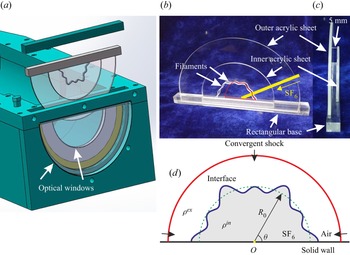
(a) Sketch of the test section of the semiannular shock tube, (b) the front view and (c) the side view of the interface formation device and (d) the experimental configuration for a cylindrically convergent shock impacting a dual-mode air–SF $_6$ interface:
 $R_i^0$ denotes the radius of the balanced position of the initial dual-mode interface;
 $O$ denotes the geometric centre; and
 $\rho ^{{ex}}$ and
 $\rho ^{{in}}$ denote the densities of the fluids located at a radius
 $r$ of
 $r>R_i$ and
 $R_i>r>0$, respectively.

(ii) Experimentally, Hosseini & Takayama (Reference Hosseini and Takayama2005) used double-exposure holographic interference technology to capture the interaction of a cylindrically convergent shock and a gas cylinder with various species in an annular vertical diaphragmless shock tube. The mixed width growth rate of the reshocked interface in the cylindrical geometry was found to be larger than that in the planar geometry. Recently, Si et al. (Reference Si, Long, Zhai and Luo2015) and Lei et al. (Reference Lei, Ding, Si, Zhai and Luo2017) improved the interface formation and flow visualization methods in the same kind shock tube. The interactions of a cylindrically convergent shock and various polygonal and sinusoidal air–SF $_6$ interfaces were experimentally investigated. Based on the gas lens method (Dimotakis & Samtaney Reference Dimotakis and Samtaney2006) to convert a planar shock to a convergent shock, the cylindrically convergent RM instability on the single-mode SF
 $_6$–air interface (Biamino et al. Reference Biamino, Jourdan, Mariani, Houas, Vandenboomgaerde and Souffland2015; Vandenboomgaerde et al. Reference Vandenboomgaerde, Rouzier, Souffland, Biamino, Jourdan, Houas and Mariani2018a) and air–SF
 $_6$ interface (Biamino et al. Reference Biamino, Jourdan, Houas, Vandenboomgaerde and Souffland2017; Vandenboomgaerde et al. Reference Vandenboomgaerde, Rouzier, Souffland, Mariani, Biamino, Jourdan and Houas2018b) were separately investigated. The influence of the supports utilized to form the initial nitrocellulose interface on the RM flow was investigated (Vandenboomgaerde et al. Reference Vandenboomgaerde, Rouzier, Souffland, Biamino, Jourdan, Houas and Mariani2018a). Recently, Brasseur et al. (Reference Brasseur, Vandenboomgaerde, Mariani, Barros, Souffland and Jourdan2021) extended the gas lens method to generate a spherically convergent shock and showed the potential to perform spherically convergent RM instability experiments. Zhai et al. (Reference Zhai, Liu, Qin, Yang and Luo2010, Reference Zhai, Si, Luo, Yang, Liu, Tan and Zou2012) designed a curved solid wall with a specific shape to directly convert a planar shock to a cylindrically convergent shock according to the shock dynamics in a horizontal shock tube. Subsequently, the interactions of a cylindrically convergent shock and various interfaces, including gas bubbles, gas cylinders, inclined interfaces and sinusoidal interfaces, were experimentally investigated in this shock tube (Si, Zhai & Luo Reference Si, Zhai and Luo2014a; Si et al. Reference Si, Zhai, Luo and Yang2014b; Zhai et al. Reference Zhai, Li, Si, Luo, Yang and Lu2017; Liang, Zhai & Luo Reference Liang, Zhai and Luo2018; Luo et al. Reference Luo, Si, Yang and Zhai2014, Reference Luo, Zhang, Ding, Si, Yang, Zhai and Wen2018, Reference Luo, Li, Ding, Zhai and Si2019). In these works, Luo et al. (Reference Luo, Zhang, Ding, Si, Yang, Zhai and Wen2018) studied the convergent RM instability on a three-dimensional air–SF
 $_6$ single-mode interface with a minimum-surface feature. They observed the interface deceleration due to the high pressure near the geometric centre. It was proved that the interface deceleration leads to the additional RT effect superposed on the evolving interface, resulting in a rapid decrease in the interface amplitude, and even causing the phase reversal of the interface before the reshock. To eliminate the interface deceleration and the additional RT effect, Luo et al. (Reference Luo, Li, Ding, Zhai and Si2019) transferred the cylindrically convergent shock to a planar one when the transmitted shock is near the geometric centre, avoiding the high pressure near the geometric centre. Recently, the shock dynamics method has been extended to generate a spherically convergent shock (Kjellander, Tillmark & Apazidis Reference Kjellander, Tillmark and Apazidis2012; Liverts & Apazidis Reference Liverts and Apazidis2016; Sembian & Liverts Reference Sembian and Liverts2020) and a cylindrically divergent shock (Li et al. Reference Li, Ding, Zhai, Si, Liu, Huang and Luo2020b). Moreover, Luo et al. (Reference Luo, Ding, Wang, Zhai and Si2015) designed a semiannular horizontal shock tube to generate a cylindrically convergent shock and showed its great potential in studying the convergent RM instability due to the convenience of forming shape-controllable gaseous interfaces. Subsequently, Ding et al. (Reference Ding, Si, Yang, Lu, Zhai and Luo2017a) examined the time-varying interface displacement of a shocked unperturbed air–SF
 $_6$ interface and the amplitude growths of a single-mode air–SF
 $_6$ interface with various amplitude-to-wavelength ratios in this shock tube. Recently, a series of experimental studies on the hydrodynamic instabilities of a gas layer driven by a cylindrically convergent shock has been conducted in this shock tube (Ding et al. Reference Ding, Li, Sun, Zhai and Luo2019; Sun et al. Reference Sun, Ding, Zhai, Si and Luo2020; Ding, Deng & Luo Reference Ding, Deng and Luo2021; Li et al. Reference Li, Ding, Si and Luo2020a, Reference Li, Ding, Luo and Zou2022). It was revealed that the mode-coupling between the two interfaces of the gas layer and the reverberating waves inside the gas layer have non-negligible influences on the gas layer evolution.
(iii) Numerically, Zhang & Graham (Reference Zhang and Graham1997) discovered the scaling laws for the RM unstable interface driven by a strong cylindrically convergent shock. Later, Zhang & Graham (Reference Zhang and Graham1998) performed a series of simulations on the RM instability of a single-mode interface driven by a cylindrically convergent or divergent shock and observed the complex instability development after the reshock. Matsuoka & Nishihara (Reference Matsuoka and Nishihara2006) numerically investigated the interface evolution using the vortex dynamics method in the cylindrical geometry. They analysed the curvatures of bubbles and spikes as well as the vorticity strength and circulation on the evolving interface. Lombardini & Pullin (Reference Lombardini and Pullin2009b) studied the linear evolution of the convergent RM instability and deduced a unified expression for the asymptotic growth rate of the planar, cylindrical and spherical RM instability, highlighting the influence of the geometric convergence on the perturbation growth rate. Lombardini, Pullin & Meiron (Reference Lombardini, Pullin and Meiron2014) performed a large-eddy simulation on the spherically convergent RM instability. It was found that the reshock mixing on an air–SF $_6$ interface is enhanced by the reverberating shocks between the interface and the geometric centre, which is different from the planar RM instability that is enhanced by the reverberating rarefaction waves between the interface and the reflection wall. Wu, Liu & Xiao (Reference Wu, Liu and Xiao2021) compared their simulations with the experiments of Lei et al. (Reference Lei, Ding, Si, Zhai and Luo2017) using the direct numerical simulation method. They concluded that both qualitative and quantitative consistencies between simulations and experiments could be achieved before the reshock provided that the premixed width of the interface is taken into account. Li et al. (Reference Li, Fu, Yu and Li2021) investigated the convergent RM instability in cylindrical and spherical geometries using the implicit large-eddy simulation method, highlighting the differences in the statistical characteristics of turbulent mixing between the cylindrically and spherically convergent RM instability. Yan et al. (Reference Yan, Fu, Wang, Yu and Li2022) investigated the cylindrically convergent RM instability with and without chemical reactions using the direct numerical simulation method to explore the influence of chemical reactions on the statistical characteristics of transition and turbulent mixing.
From the reviews of the multimode RM instability and the convergent RM instability, it is evident that the RM instability is related to the initial spectrum and the geometric domain. However, the quantitative relation between initial conditions and the multimode RM instability driven by a convergent shock is still unclear. On the one hand, elaborate convergent shock tube experiments on the multimode RM instability with controllable initial conditions are very limited. On the other hand, analytical models for predicting the multimode RM instability in cylindrical and spherical geometries are rare. In this work, experiments are performed for the first time on the convergent RM instability of a multimode interface in a shock-tube facility, and the temporal growth of each Fourier mode perturbation is measured. The mode-coupling effect on the convergent RM instability coupled with the RT effect is quantified for the first time. The different contributions of the mode-coupling to the hydrodynamic instabilities of the multimode interface and single-mode interface are highlighted. Second-order nonlinear solutions are developed to predict the multimode RM instability and the additional RT effect in the cylindrical geometry. Numerical simulations are also performed to provide quantitative data considering more initial conditions. The temporal evolutions of the mixed mass and normalized mixed mass of a shocked multimode interface are calculated for the first time to quantify the mixing of two fluids in the cylindrical geometry.
2. Experimental and numerical methods
2.1. Experimental set-up
The experiment is carried out in a semiannular convergent shock tube originally designed by Luo et al. (Reference Luo, Ding, Wang, Zhai and Si2015), which has exhibited good feasibility and reliability in producing a cylindrically convergent shock (Liang et al. Reference Liang, Ding, Zhai, Si and Luo2017; Ding et al. Reference Ding, Si, Yang, Lu, Zhai and Luo2017a, Reference Ding, Li, Sun, Zhai and Luo2019, Reference Ding, Deng and Luo2021; Sun et al. Reference Sun, Ding, Zhai, Si and Luo2020; Li et al. Reference Li, Ding, Si and Luo2020a, Reference Li, Ding, Luo and Zou2022). The main difficulty for performing an experimental study on the multimode RM instability, especially in a convergent shock tube circumstance, lies in creating an idealized initial interface because the RM instability is extremely sensitive to the initial conditions. Benefiting from the open test section, as sketched in figure 1(a), a removable interface formation device can be efficiently designed in which a shape-controllable gaseous interface can be generated using the extended soap film technique. The soap film technique can essentially eliminate the additional short-wavelength perturbations, diffusion layer and three-dimensionality (Liu et al. Reference Liu, Liang, Ding, Liu and Luo2018; Liang et al. Reference Liang, Liu, Zhai, Ding, Si and Luo2021). As shown in figures 1(b) and 1(c), a device consisting of two semicircular transparent acrylic sheets with a spacing of 5.0 mm is fixed on a rectangular base. Two microchannels (with a width of 0.50 mm and a depth of 0.20 mm) with a designed dual-mode shape are precisely engraved on the opposite surfaces of the two acrylic sheets. Two acrylic filaments (with a width of 0.45 mm and a height of 0.40 mm) with the same dual-mode shape are embedded separately in the microchannels to introduce two small bulges on the plate surfaces to restrict the soap film. Subsequently, a soap bubble full of SF $_6$ is blown within two plates through an injection tube (as marked in yellow in figure 1b). The soap bubble expands continuously along the filaments. When the volume of the soap bubble is approximately 2/3 of the constraint space (as marked in red in figure 1b), we stop injecting the SF
 $_6$ and immediately insert the interface formation device into the test section and equipped tightly with optical windows, as shown in figure 1(a). Because the density of SF
 $_6$ is much greater than that of air, it is easier for air to permeate into the soap film. Therefore, the soap bubble will keep swelling after removing the injection tube. When the soap bubble just thoroughly contacts the filaments and a sinusoidal boundary at the interface is formed, the shock wave is generated immediately and the experiment is performed.
The experimental configuration is sketched in figure 1(d), where a cylindrically convergent shock moves inward and later impacts the dual-mode interface. In a polar coordinate system, the initial interface can be parameterized as
 \begin{equation} r=R_i^0+a_{n_1}^{0}\cos(n_1\theta)+a_{n_2}^{0}\cos(n_2\theta), \end{equation}
where  $R_i^0$ equals 26.0 mm;
 $n_1$ and
 $n_2$ denote the azimuthal mode numbers of the two initially constituent modes and equal 6 and 12, respectively, in the experiment; and the initial amplitudes of mode
 $n_1$ (
 $a_{n_1}^{0}$) and mode
 $n_2$ (
 $a_{n_2}^{0}$) equal 1.0 mm.
The ambient pressure and temperature are 101.33 kPa and 293.15 K, respectively. In the experiment, the shock velocity at the time of the impact with the interface cannot be obtained precisely due to the limitation of temporal resolution. However, the Mach number of the incident shock at a radius of 34.0 mm, i.e. before the shock reaches the interface, can be measured to be  $1.29\pm 0.01$. The increment of the shock Mach number between that instant and when the shock reaches the interface is approximately 0.03, according to the Chester–Chiness–Whitham relations (Chester Reference Chester1954; Chisnell Reference Chisnell1957; Whitham Reference Whitham1958). As a result, the Mach number of the incident converging shock at the interface's impact time is evaluated to be
 $1.32\pm 0.01$.
The ambient gas is air, and the test gas is a mixture of air and SF $_6$. The mass fraction of SF
 $_6$ is deduced as 91.1 % according to the one-dimensional gas dynamics theory (Drake Reference Drake2018) and the velocities of the incident shock and the shock reflected from the interface after the incident shock impacts the interface. The Atwood number
 $A$ is
 $-0.57$ in this study. When the shock impacts the initial interface, the velocity of the incident shock (
 $v_{s}$) in the air is
 $-457\ {\rm m}\ {\rm s}^{-1}$, the velocity of the transmitted shock (
 $v_{t}$) in the mixture of air and SF
 $_6$ is
 $-236\ {\rm m}\ {\rm s}^{-1}$, the velocity of the reflected shock in the air (
 $v_{f}$) is
 $407\ {\rm m}\ {\rm s}^{-1}$ and the velocity jump of the interface (
 $\Delta v$) is
 $-123\ {\rm m}\ {\rm s}^{-1}$.
The flow field is illuminated by a direct-current-regulated light source (CEL-HXF300, the maximum power output is 249 W) and captured by schlieren photography combined with a high-speed camera (FASTCAM SA5, Photron Limited, with full resolution of  $1024\times 1024$). The camera's frame rate is 87 500, corresponding to a time interval of
 $11.43\ \mathrm {\mu }{\rm s}$. The exposure time is
 $1\ \mathrm {\mu }{\rm s}$. The pixel resolution is
 $0.26\ {\rm mm}\ {\rm pixel}^{-1}$.
2.2. Numerical scheme
Numerical simulations are performed to obtain the detailed flow field required for an in-depth analysis of flow regimes. The process of a cylindrically convergent shock interacting with a gaseous interface examined in this study is described by compressible Euler equations, which coincide with the numerical studies focusing on the early-to-intermediate regimes of RM instability with or without the reshock (Grove et al. Reference Grove, Holmes, Sharp, Yang and Zhang1993; Holmes & Grove Reference Holmes and Grove1995; Holmes et al. Reference Holmes, Dimonte, Fryxell, Gittings, Grove, Schneider, Sharp, Velikovich, Weaver and Zhang1999; Herrmann, Moin & Abarzhi Reference Herrmann, Moin and Abarzhi2008; Niederhaus et al. Reference Niederhaus, Greenough, Oakley, Ranjan, Anderson and Bonazza2008; Leinov et al. Reference Leinov, Malamud, Elbaz, Levin, Ben-Dor, Shvarts and Sadot2009; Ding et al. Reference Ding, Si, Chen, Zhai, Lu and Luo2017b, Reference Ding, Liang, Chen, Zhai, Si and Luo2018; Zhai et al. Reference Zhai, Li, Si, Luo, Yang and Lu2017, Reference Zhai, Liang, Liu, Ding, Luo and Zou2018a; Zhai, Ou & Ding Reference Zhai, Ou and Ding2019a; Zhai et al. Reference Zhai, Zhang, Zhou, Ding and Wen2019b; Zou et al. Reference Zou, Al-Marouf, Cheng, Samtaney, Ding and Luo2019; Igra & Igra Reference Igra and Igra2020; Zhou et al. Reference Zhou, Ding, Zhai, Cheng and Luo2020b; Tang et al. Reference Tang, Zhang, Luo and Zhai2021). An upwind space–time conservation elements/solution elements scheme is utilized with second-order accuracy in both space and time (Shen et al. Reference Shen, Wen, Liu and Zhang2015a; Shen, Wen & Zhang Reference Shen, Wen and Zhang2015b; Shen & Wen Reference Shen and Wen2016). A volume-fraction-based five-equation model (Abgrall Reference Abgrall1996; Shyue Reference Shyue1998) is used to illustrate the different species residing on both sides of the inhomogeneous interface. The contact discontinuity restoring Harten–Lax–van Leer contact Riemann solver (Toro, Spruce & Speares Reference Toro, Spruce and Speares1994) is used to determine the numerical fluxes between the conservation elements. The use of this scheme in capturing shocks and details of complex flow structures for the RM instability issues and shock–droplet interactions have been well validated (Shen et al. Reference Shen, Wen, Parsani and Shu2017; Shen & Parsani Reference Shen and Parsani2017; Guan et al. Reference Guan, Liu, Wen and Shen2018; Fan et al. Reference Fan, Guan, Wen and Shen2019; Zhai et al. Reference Zhai, Li, Si, Luo, Yang and Lu2017, Reference Zhai, Zhang, Zhou, Ding and Wen2019b; Zhou et al. Reference Zhou, Ding, Zhai, Cheng and Luo2020b; Liang et al. Reference Liang, Zhai, Luo and Wen2020; Liang Reference Liang2022b; Liang & Luo Reference Liang and Luo2023). A comprehensive review of the numerical scheme and its extensive applications was recently reported by Jiang, Wen & Zhang (Reference Jiang, Wen and Zhang2020).
The initial settings of the two-dimensional simulation are presented in figure 2(a). Open boundary conditions, which apply a zeroth-order extrapolation of physical quantities to ghost points, are enforced on the left-hand, right-hand and bottom boundaries ( $x=-100.0$,
 $x=100.0$ and
 $y=50.0$ mm), respectively, to eliminate the waves reflected from the left-hand, right-hand and bottom boundaries (Zhai et al. Reference Zhai, Zhang, Zhou, Ding and Wen2019b; Zhou et al. Reference Zhou, Ding, Zhai, Cheng and Luo2020b). Reflection conditions are imposed at the top boundary (
 $y=0$). The density and specific heat ratio of the ambient gas outside the perturbed gas cylinder are
 $1.20\ {\rm kg}\ {\rm m}^{-3}$ and 1.40, respectively; and the density and specific heat ratio of the test gas inside the perturbed gas cylinder are
 $4.46\ {\rm kg}\ {\rm m}^{-3}$ and 1.127, respectively. The initially incident shock wave is set to travel inward with a Mach number of 1.29 and a radius of 34.0 mm, as sketched in figure 2(a). The initial postshock flow is supposed to be uniform and calculated according to the Rankine–Hugoniot relation, which coincides with the recent numerical studies on the convergent RM instability (Zhai et al. Reference Zhai, Zhang, Zhou, Ding and Wen2019b; Zhou et al. Reference Zhou, Ding, Zhai, Cheng and Luo2020b; Li et al. Reference Li, Fu, Yu and Li2021; Tang et al. Reference Tang, Zhang, Luo and Zhai2021; Wu et al. Reference Wu, Liu and Xiao2021; Yan et al. Reference Yan, Fu, Wang, Yu and Li2022).
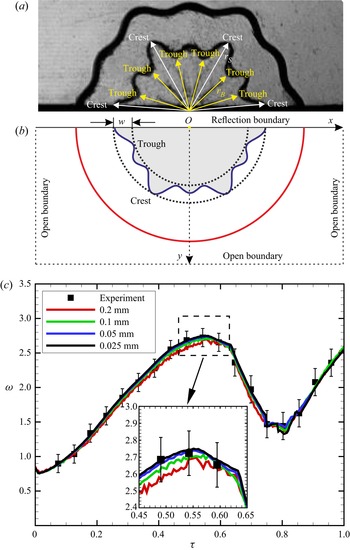
(a) Measurements of the radii of the crest ( $r_S$) and the trough (
 $r_B$) of a dual-mode interface from experimental schlieren images. (b) Schematics of the numerical set-up, with
 $w$ denoting the mixed width of the dual-mode interface. (c) Comparisons of the dimensionless mixed width of the dual-mode interface between the experimental results and numerical results at different mesh sizes. The red semicircle in (b) at
 $r=34$ mm indicates the initial imploding shock of Mach number 1.29.

2.3. Code validation
We measure the mixed width from experimental schlieren images and compare it with numerical simulations. We measure the distances between the geometry centre and four crests of a dual-mode interface, as shown in figure 2(a), and calculate the average value as the radius of the crest, i.e.  $r_S$. Similarly, we measure distances between the geometry centre and six troughs of a dual-mode interface and calculate the average value as the radius of the trough, i.e.
 $r_B$. The mixed with,
 $w$, is defined as
 $r_S-r_B$.
For the data obtained from numerical simulations, since the mass fraction of SF $_6$ in the test gas is decided by the experiment as 91.1 %, we choose the nodes with a mass fraction of SF
 $_6$ between 1.0 % and 90.0 % as the interfacial contour. Then, the mean radius of these nodes on each azimuthal angle is taken as the average position of the local interface. The mixed width
 $w$ in simulations is defined as the maximum radial distance between the crest and trough of a dual-mode interface, as sketched in figure 2(a).
The time-varying dimensionless mixed width of the dual-mode interface is measured from experiments, as shown with solid symbols in figure 2(b). The moment when the incident shock reaches the radius of  $R_i^0$ is defined as
 $t=0$. Time is scaled as
 $\tau =t\Delta v/R_i^0$, and mixed width is scaled as
 $\omega =w/w_0$, where
 $w_0$ denotes the initial mixed width of the dual-mode interface and equals 3.12 mm in the experiment. It can be found that the current numerical results, as shown with lines in figure 2(b), quantitatively agree well with the experimental results. Four mesh sizes of 0.20 mm, 0.10 mm, 0.05 mm and 0.025 mm are tested for the grid-convergence validation. The time-varying dimensionless mixed widths of the dual-mode interface converge when the mesh size is reduced to 0.05 mm and 0.025 mm in the numerical simulations. Therefore, an initial mesh size of 0.05 mm is adopted for all simulations to ensure accuracy and minimize the computational cost.
3. Qualitative analysis
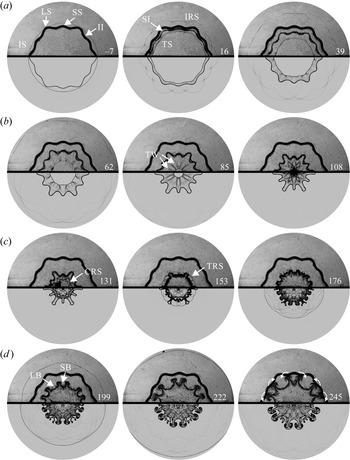
The initial dual-mode interface (II) in the experiment has a short-wavelength spike (SS) in the middle with two long-wavelength spikes (LS) located on its two sides, as shown in figure 3. Before the shock impacts the interface ( $-7\ \mathrm {\mu }{\rm s}$), the initial interface in the schlieren image seems thick because the interface is covered by two dual-mode microchannels (0.5 mm in width) engraved on the transparent acrylic sheets. First, when the incident shock (IS) passes across the interface, the shock bifurcates into an inward-moving transmitted shock (TS) and an outward-moving reflected shock (IRS). Subsequently, the shocked interface (SI) leaves its original location, and a density-gradient interface with a perfect dual-mode shape can be observed (
 $16\ \mathrm {\mu }{\rm s}$). As time proceeds, the interface undergoes sustained deformation due to the deposition of baroclinic vorticity induced by the incident shock and the geometry convergence (Lombardini & Pullin Reference Lombardini and Pullin2009b; Ding et al. Reference Ding, Si, Yang, Lu, Zhai and Luo2017a; Vandenboomgaerde et al. Reference Vandenboomgaerde, Rouzier, Souffland, Biamino, Jourdan, Houas and Mariani2018a). Our previous study (Liang et al. Reference Liang, Ding, Zhai, Si and Luo2017) found that the perturbation on the TS reduces gradually as the shock converges, which is similar to the planar case where the disturbances on a planar shock front are known to die out (Bates Reference Bates2004). However, as the TS converges, the undisturbed shock radius (the distance from the undisturbed cylindrical shock front to the geometry centre) also reduces, and the ratio of perturbation of the TS to the radius of the TS actually increases. As a result, the front of the convergent TS becomes polygonal (Apazidis & Lesser Reference Apazidis and Lesser1996; Apazidis et al. Reference Apazidis, Lesser, Tillmark and Johansson2002; Lei et al. Reference Lei, Ding, Si, Zhai and Luo2017), and the transverse waves (TW) behind the transmitted shock are prominent (
 $85\ \mathrm {\mu }{\rm s}$).
Typical schlieren images obtained from the experiment (top half of each image) and simulation (bottom half), where IS denotes the incident convergent shock, II denotes the initial interface, LS denotes the long-wavelength spike, SS denotes the short-wavelength spike, LB denotes the long-wavelength bubble, SB denotes the short-wavelength bubble, TS denotes the transmitted shock, IRS denotes the shock reflected from the initial interface, SI denotes the shocked interface, TW denotes the transverse waves, CRS denotes the shock reflected from the geometric centre and TRS denotes the transmitted reflection shock. Curved white arrows represent the orientations that spikes skew towards, and numbers in the images indicate time in microseconds. The moment when the incident shock reaches the radius of  $R_i^0$ is defined as
 $t=0$.

After the transmitted shock focuses at the geometric centre around  $108\ \mathrm {\mu }{\rm s}$, a central reflected shock (CRS) forms and moves outwards (
 $131\ \mathrm {\mu }{\rm s}$). Later, the CRS impacts the evolving dual-mode interface (
 $153\ \mathrm {\mu }{\rm s}$), leading to the phase reversal of the dual-mode interface (Brouillette Reference Brouillette2002). The perturbation on the dual-mode interface first decreases to a minimal value (
 $176\ \mathrm {\mu }{\rm s}$) and then increases with an opposite phase to the initial interface perturbation (
 $199\ \mathrm {\mu }{\rm s}$). The reshocked interface consists of a short-wavelength bubble (SB) in the middle with two long-wavelength bubbles (LB) on its two sides. Last, shocks and rarefaction waves are reflected with decreasing strengths between the interface and the geometric centre. The competition and coalescence of large coherent structures drive the bubble-merging (Sadot et al. Reference Sadot, Erez, Alon, Oron, Levin, Erez, Ben-Dor and Shvarts1998; Oron et al. Reference Oron, Arazi, Kartoon, Rikanati, Alon and Shvarts2001; Srebro et al. Reference Srebro, Elbaz, Sadot, Arazi and Shvarts2003) on the reshocked dual-mode interface, resulting in the spikes skewing towards the long-wavelength bubbles (see the white arrows in the
 $245 \ \mathrm {\mu }{\rm s}$ image).
The magnitude of the density-gradient field in the simulation is calculated as (Quirk & Karni Reference Quirk and Karni1996; Sembian, Liverts & Apazidis Reference Sembian, Liverts and Apazidis2018)
 \begin{equation} |\boldsymbol{\nabla}\rho|=\left[\left(\frac{\partial\rho}{\partial x}\right)^2+ \left(\frac{\partial\rho}{\partial y}\right)^2\right]^{{1}/{2}}. \end{equation}
The numerical results are shown in the bottom half of the images in figure 3. It can be observed that both waves and interfacial morphologies in simulations qualitatively agree well with the experimental results.
4. Quantitative analysis
4.1. Experimental and numerical results
Due to the nonlinearity of the RM instability (Velikovich & Dimonte Reference Velikovich and Dimonte1996; Nishihara et al. Reference Nishihara, Wouchuk, Matsuoka, Ishizaki and Zhakhovsky2010; Guo et al. Reference Guo, Yu, Wang, Ye, Wu and Li2014; Wang et al. Reference Wang, Wu, Guo, Ye, Liu, Zhang and He2015), the two initially constituent modes, i.e. modes  $n_1$ and
 $n_2$, generate two harmonics with wavenumbers
 $2n_1$ and
 $2n_2$, respectively. Moreover, the mode-coupling between the two initially constituent modes generates two couplings with wavenumbers
 $n_2+n_1$ and
 $n_2-n_1$ (Haan Reference Haan1989, Reference Haan1991; Ofer et al. Reference Ofer, Shvarts, Zinamon and Orszag1992).
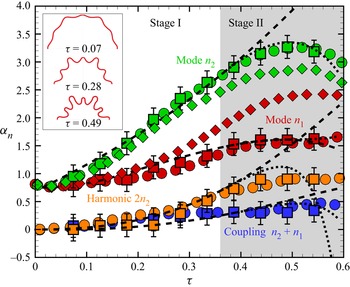
The captured interface morphology is distinct such that the interfacial contour in the experiment can be extracted by an image processing program (Luo et al. Reference Luo, Liu, Liang, Ding and Wen2020; Liang et al. Reference Liang, Liu, Zhai, Ding, Si and Luo2021), as indicated by the inset in figure 4. Spectral analysis is then performed on the coordinate of the interfacial contour before the interface is reshocked. Notably, since  $n_2=2n_1$ and
 $n_1=n_2-n_1$ in the experiment, the harmonic
 $2n_1$ and coupling
 $n_2-n_1$ are superposed on the mode
 $n_2$ and mode
 $n_1$, respectively. The time-varying amplitudes of modes
 $n_1$ and
 $n_2$ and the new harmonic
 $2n_2$ and coupling
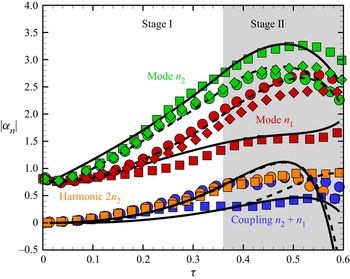
 $n_2+n_1$ are then acquired, as shown with square symbols for the experiment and circle symbols for the simulation in figure 4. The amplitude of the mode, harmonic and coupling with the azimuthal wavenumber
 $n$, i.e.
 $a_n$, is normalized as
 $\alpha _n=a_n/a_{n_1}^0$. It can be found that the numerical results quantitatively agree well with the experimental results, further validating the code utilized in the present study.
The time-varying dimensionless amplitudes of the two constituent modes (modes  $n_1$ and
 $n_2$) and the generated harmonic
 $2n_1$ and coupling
 $n_2+n_1$ obtained from the dual-mode RM instability experiment (square symbols) and simulation (circle symbols). The single-mode RM instabilities of the two constituent modes are numerically calculated and shown with diamond symbols. The dashed lines represent the theoretical predictions in stage I. The dotted lines represent the theoretical predictions in stage II. The inset shows the interfacial contours in the experiment for spectral analysis.

The amplitude of the mode  $n_2$ is larger than that of the mode
 $n_1$ for two reasons. First, according to the linear solution for the cylindrically convergent RM instability on a single-mode interface with a fixed initial amplitude (see (1.2)), the linear amplitude growth rate is larger as
 $n$ increases. Second, the mode-coupling between modes
 $n_1$ and
 $n_2$ has a non-negligible influence on the RM instability of the two constituent modes. The amplitude growths of the single-mode RM instability of modes
 $n_1$ and
 $n_2$ with the same
 $w_0$ (
 $=3.12$ mm) are numerically calculated, as shown with diamond symbols in figure 4 for comparisons. It is found that the mode-coupling promotes the RM instability of the higher frequency mode (i.e. mode
 $n_2$) but suppresses the RM instability of the lower frequency mode (i.e. mode
 $n_1$) in the experiment.
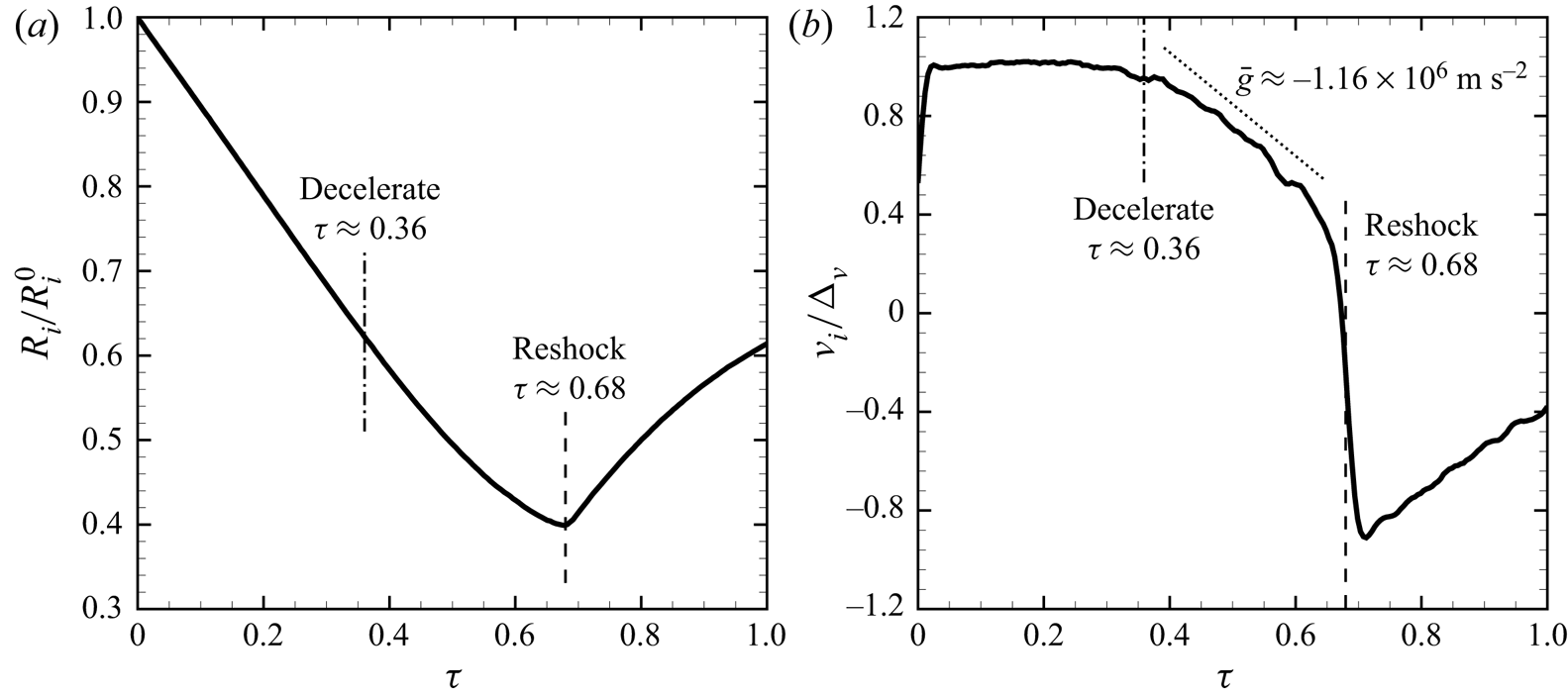
The linear solution for the single-mode RM instability (see (1.2)) indicates that the RM instability of each mode is related to the variance of the interface radius. Here, the time-varying interface radius  $R_i$ and interface velocity
 $v_i$ are extracted from the one-dimensional simulation of an unperturbed interface driven by a cylindrically convergent shock using the same initial conditions as the experiment, as shown in figures 5(a) and 5(b), respectively. It is found that the interface movement can be divided into three stages. Stage I: the interface moves inward uniformly with a speed of
 $\Delta v$ during
 $\tau <0.36$. Stage II: the interface moves inward with a decreasing velocity during
 $0.68>\tau >0.36$. If we assume that the interface decelerates at a constant acceleration, then the average acceleration (
 $\bar {g}$) is approximately
 $-1.16\times 10^{6}\ {\rm m}\ {\rm s}^{-2}$. Stage III: the interface is reshocked and moves outward when
 $\tau >0.68$. In this study, we focus on the hydrodynamic instabilities of the dual-mode interface in stages I and II.
Numerical results on the time-varying dimensionless (a) radius and (b) velocity of an unperturbed interface driven by a cylindrically convergent shock.

The initial perturbations, potential functions and boundary conditions in the convergent geometry differ from the planar counterpart. As a result, the theoretical models for the convergent multimode RM instability will be quite different from the planar counterpart (Liang et al. Reference Liang, Liu, Zhai, Ding, Si and Luo2021). Moreover, the evolution of a shocked multimode interface in the planar geometry is only dominated by the RM instability. However, the hydrodynamic instabilities of a shocked multimode interface involve both the RM instability and the additional RT effect. As a result, the theoretical models for the hydrodynamic instabilities in the convergent geometry will be more complicated than the planar geometry and more corresponding to the ICF applications. A series of linear and nonlinear solutions for quantifying the convergent RM instability and additional RT effect will be established in the next step.
4.2. Linear and weakly nonlinear solutions
In stage I, the interface motion can be regarded as uniform, and, therefore, the interface radius can be written as  $R_i=R_i^0+\Delta vt$.
Each constituent mode develops linearly at the first-order solution of the RM instability. The first-order linear solutions for the amplitude growth rates of the mode  $n_1$ (
 $\dot {a}_{n_1}^{{RM}}$) and mode
 $n_2$ (
 $\dot {a}_{n_2}^{{RM}}$) can be separately written as
 \begin{equation} \dot{a}_{n_1}^{{RM}}=\dot{a}_{n_1}^{{I}}C_r,\quad \dot{a}_{n_2}^{{RM}}=\dot{a}_{n_2}^{{I}}C_r, \end{equation}
where  $C_r$ (
 $\equiv R_i^0/R_i$) represents the convergence ratio and its maximum value in the experiment is 2.5; and
 $\dot {a}_{n_1}^{{I}}$ and
 $\dot {a}_{n_2}^{{I}}$ represent the initial amplitude growth rates of the mode
 $n_1$ and mode
 $n_2$ induced by the RM instability, respectively, and which can be calculated as (Mikaelian Reference Mikaelian2005)
 \begin{equation} \dot{a}_{n_1}^{{I}}=\frac{a_{n_1}^{+}\Delta v(1-n_1A)}{R_i^0},\quad \dot{a}_{n_2}^{{I}}=\frac{a_{n_2}^{+}\Delta v(1-n_2A)}{R_i^0}, \end{equation}
in which  $a_{n_1}^{+}$ (
 $=(1-\Delta v/v_s)a_{n_1}^0$) and
 $a_{n_2}^{+}$ (
 $=(1-\Delta v/v_s)a_{n_2}^0$) represent the postshock amplitudes of the mode
 $n_1$ and mode
 $n_2$, respectively. When the initial mixed width of the interface
 $w_0$ superposed by multiple modes is comparable to the wavelength of the interface and/or the shock intensity is large, the high-amplitude effect and/or the high-Mach-number effect will inhibit the initial amplitude growth rates (Haan Reference Haan1989; Wouchuk & Nishihara Reference Wouchuk and Nishihara1997; Rikanati et al. Reference Rikanati, Oron, Sadot and Shvarts2003; Dell, Stellingwerf & Abarzhi Reference Dell, Stellingwerf and Abarzhi2015; Campos & Wouchuk Reference Campos and Wouchuk2016; Dell et al. Reference Dell, Pandian, Bhowmick, Swisher, Stanic, Stellingwerf and Abarzhi2017). Here, the high-amplitude effect and the high-Mach-number effect on the RM instability are considered independently. Moreover, the startup process before the interface amplitude growth rate reaches the asymptotic value is taken into account. According to Lombardini & Pullin (Reference Lombardini and Pullin2009a), the characteristic times for the startup processes of the mode
 $n_1$ (
 $t^*_{n_1}$) and mode
 $n_2$ (
 $t^*_{n_2}$) can be evaluated as
 \begin{equation} t_{n_1}^*=\frac{R_i^0}{2n_1}\left[\frac{1+A}{\Delta v+v_f}+ \frac{1-A}{\Delta v-v_t}\right],\quad t_{n_2}^*=\frac{R_i^0}{2n_2}\left[\frac{1+A}{\Delta v+v_f}+\frac{1-A}{\Delta v-v_t}\right]. \end{equation}
Here, we assume that the amplitude growth rates increase linearly from zero to asymptotic values during the startup process.
With the consideration of the high-amplitude effect, the high-Mach-number effect, and the startup process, the expressions of the modified initial amplitude growth rates of the mode  $n_1$ and mode
 $n_2$ can be separately rewritten as
 \begin{equation} \dot{a}_{n_1}^{{I}}=\frac{HF_{n_1}a_{n_1}^{+}\Delta v(1-n_1A)f_{n_1}(t)}{R_i^0},\quad\dot{a}_{n_2}^{{I}}=\frac{HF_{n_2}a_{n_2}^{+}\Delta v(1-n_2A)f_{n_2}(t)}{R_i^0}, \end{equation}
in which  $H$ (
 $=1/[1+(n_{{gcd}}w_0/6R_i^0)^{(4/3)}]$, with
 $n_{{gcd}}$ being the greatest common divisor of
 $n_1$ and
 $n_2$) is the reduction factor proposed by Dimonte & Ramaprabhu (Reference Dimonte and Ramaprabhu2010) to quantify the high-amplitude effect;
 $F_{n_1}$ (
 $=1/[1+\dot {a}_{n_1}^{{I}}/(\Delta v-v_t)]$) and
 $F_{n_2}$ (
 $=1/[1+\dot {a}_{n_2}^{{I}}/(\Delta v-v_t)]$) are the reduction factors proposed by Holmes et al. (Reference Holmes, Dimonte, Fryxell, Gittings, Grove, Schneider, Sharp, Velikovich, Weaver and Zhang1999) to quantify the high-Mach-number effect on the mode
 $n_1$ and mode
 $n_2$, respectively; and
 $f_{n_1}(t)$ and
 $f_{n_2}(t)$ quantify the startup processes of the mode
 $n_1$ and mode
 $n_2$, respectively, where
 $f_{n_1}(t)=t/t_{n_1}^*$ if
 $t< t_{n_1}^*$ and
 $f_{n_1}(t)=1$ if
 $t\geqslant t_{n_1}^*$, and
 $f_{n_2}(t)=t/t_{n_2}^*$ if
 $t< t_{n_2}^*$ and
 $f_{n_2}(t)=1$ if
 $t\geqslant t_{n_2}^*$.
Based on the perturbation expansion method, Guo et al. (Reference Guo, Yu, Wang, Ye, Wu and Li2014) and Wang et al. (Reference Wang, Wu, Guo, Ye, Liu, Zhang and He2015) separately derived second-order and third-order solutions to quantify the nonlinearity of the RM instability by considering the uniform convergence of a single-mode interface. Here, we rewrite the second-order solutions in the amplitude growth rate form for the harmonic  $2n_1$ (
 $\dot {a}_{2n_1}^{{RM}}$) and harmonic
 $2n_2$ (
 $\dot {a}_{2n_2}^{{RM}}$) induced by the RM instability as
 $$\begin{gather} \dot{a}_{2n_1}^{{RM}}=\frac{a_{n_1}^{+}\dot{a}_{n_1}^{{I}}}{2R_i}(2An_1-1)(C_r-1)+ \frac{(\dot{a}_{n_1}^{{I}})^2t}{6R_i}\left[(2An_1-3)C_r^2-8An_1C_r\right], \end{gather}$$
 $$\begin{gather}\dot{a}_{2n_2}^{{RM}}=\frac{a_{n_2}^{+}\dot{a}_{n_2}^{{I}}}{2R_i}(2An_2-1)(C_r-1)+ \frac{(\dot{a}_{n_2}^{{I}})^2t}{6R_i}\left[(2An_2-3)C_r^2-8An_2C_r\right]. \end{gather}$$
Furthermore, Guo, Cheng & Li (Reference Guo, Cheng and Li2020) extended their previous work (Guo et al. Reference Guo, Yu, Wang, Ye, Wu and Li2014) and quantified the mode-coupling effect on the convergent RM instability of the mode  $n$ at the second-order solution as
 \begin{align} \frac{\mathrm{d^2}(a_nR_i)}{\mathrm{d}t^2}&=(An-3)\frac{\dot{R}_i^2}{R_i^4}\sum_{n'}(a_{n'}R_i)(a_{n''}R_i)\nonumber\\ &\quad -(An+1)\frac{1}{R_i^2}\sum_{n'}\frac{\mathrm{d}(a_{n'}R_i)}{\mathrm{d}t}\frac{\mathrm{d}(a_{n''}R_i)}{\mathrm{d}t}-\frac{1}{R_i^2}\sum_{n'}(a_{n''}R_i)\frac{\mathrm{d^2}(a_{n'}R_i)}{\mathrm{d}t^2} \nonumber\\ &\quad +\frac{\dot{R}_i}{R_i^3}\sum_{n'}\left[(a_{n'}R_i)\frac{\mathrm{d}(a_{n''}R_i)}{\mathrm{d}t}+3(a_{n''}R_i)\frac{\mathrm{d}(a_{n'}R_i)}{\mathrm{d}t} \right] \end{align}
where  $n''=n-n'$. Then, based on (4.7), we can deduce the second-order solutions for the sum and difference couplings, i.e. the amplitude growth rates of the coupling
 $n_2+n_1$ (
 $\dot {a}_{n_2+n_1}^{{RM}}$) and coupling
 $n_2-n_1$ (
 $\dot {a}_{n_2-n_1}^{{RM}}$) induced by the RM instability as
 \begin{align} \dot{a}_{n_2+n_1}^{{RM}}&=\frac{1}{2R_i}(a_{n_2}^{+}\dot{a}_{n_1}^{{I}}+a_{n_1}^{+}\dot{a}_{n_2}^{{I}})\left[A(n_2+n_1)-1\right](C_r-1) \nonumber\\ &\quad +\frac{\dot{a}_{n_1}^{{I}}\dot{a}_{n_2}^{{I}}t}{3R_i}\left[A(n_2+n_1)(C_r^2-4C_r)-3C_r^2\right], \end{align}
 \begin{align} \dot{a}_{n_2-n_1}^{{RM}}&=\frac{1}{2R_i}\left[A(n_2-n_1)(a_{n_2}^{+}\dot{a}_{n_1}^{\mathrm{I}}-a_{n_1}^{+}\dot{a}_{n_2}^{{I}})-(a_{n_1}^{+}\dot{a}_{n_2}^{{I}}+a_{n_2}^{+}\dot{a}_{n_1}^{{I}})\right](C_r-1) \nonumber\\ &\quad +\frac{\dot{a}_{n_1}^{{I}}\dot{a}_{n_2}^{{I}}t}{3R_i}\left[A(n_2-n_1)(C_r^2+2C_r)-3C_r^2\right]. \end{align}
The first sum terms on the right-hand side of (4.5), (4.6), (4.8) and (4.9) represent the time-independent linear amplitude growth rates of harmonics  $2n_1$, harmonics
 $2n_2$, couplings
 $n_2+n_1$ and couplings
 $n_2-n_1$, respectively. The second sum terms on the right-hand side of (4.5), (4.6), (4.8) and (4.9) represent the time-dependent weakly nonlinear modifications on the growth rates of harmonics
 $2n_1$, harmonics
 $2n_2$, couplings
 $n_2+n_1$ and couplings
 $n_2-n_1$, respectively. The first sum terms indicate that the nonlinearity of the convergent RM instability and the mode-coupling between the two initially constituent modes separately generate new harmonics and couplings from the very beginning, especially when the amplitudes of constituent modes are large, which coincides with our previous study on the multimode RM instability in the planar geometry (Liang et al. Reference Liang, Liu, Zhai, Ding, Si and Luo2021).
Notably, the feedback of harmonics and couplings to the modes having the same wavenumber influences the RM instability of the initially constituent modes. For example, since  $n_2=2n_1$ in the experiment, the RM instability of the mode
 $n_1$ consists of the amplitude of the mode
 $n_1$ at the first-order solution and the amplitude of the coupling
 $n_2-n_1$ at the second-order solution; and the RM instability of the mode
 $n_2$ consists of the amplitude of the mode
 $n_2$ at the first-order solution and the amplitude of the harmonics
 $2n_1$ at the second-order solution. The theoretical predictions for the time-varying amplitudes of modes
 $n_1$ and
 $n_2$, the harmonic
 $2n_2$ and the coupling
 $n_2+n_1$ are calculated using (4.1a,b), (4.4a,b)–(4.6) and (4.8)–(4.9), as shown with dashed lines in figure 4. It is found that the theoretical predictions agree well with the experimental and numerical results before the interface decelerates (
 $\tau <0.36$). When the interface begins to decelerate, the additional RT effect is superimposed on the interface, and, therefore, the theoretical predictions deviate from the experimental and numerical results. For example, the theoretical predictions obviously overestimate the amplitudes of modes and harmonics with large wavenumbers (e.g. mode
 $n_2$ and harmonics
 $2n_2$).
In stage II, the interface decelerates with an average acceleration  $\bar {g}$ and can be approximately written as
 $R_i=R_i^0+\Delta vt-\frac {1}{2}\bar {g}(t-t^d)^2$, with
 $t^d$ being the time when the interface begins to decelerate. We only consider the mode-coupling between the two initially modes since the amplitudes of modes
 $n_1$ and
 $n_2$ are much larger than the generated harmonics and couplings. Similarly, due to the nonlinearity of the RT instability (Jacobs & Catton Reference Jacobs and Catton1988; Wang et al. Reference Wang, Wu, Ye, Zhang and He2013; Liu et al. Reference Liu, Wang, Liu, Yu, Fang and Ye2020), modes
 $n_1$ and
 $n_2$ also generate two harmonics with wavenumbers
 $2n_1$ and
 $2n_2$, respectively. Moreover, the mode-coupling between modes
 $n_1$ and
 $n_2$ also generates two couplings with wavenumbers
 $n_2+n_1$ and
 $n_2-n_1$ (Haan Reference Haan1989, Reference Haan1991; Ofer et al. Reference Ofer, Shvarts, Zinamon and Orszag1992).
Wang et al. (Reference Wang, Wu, Ye, Zhang and He2013) studied the linear solution for quantifying the time-varying amplitude growth of mode  $n$ at a constant acceleration. Here, the first-order linear solutions for the mode
 $n_1$ (
 $\dot {a}_{n_1}^{{RT}}$), mode
 $n_2$ (
 $\dot {a}_{n_2}^{{RT}}$), harmonic
 $2n_2$ (
 $\dot {a}_{2n_2}^{{RT}}$) and coupling
 $n_2-n_1$ (
 $\dot {a}_{n_2-n_1}^{{RT}}$) induced by the additional RT effect at a constant acceleration can be rewritten in the amplitude growth rate form as
 \begin{equation} \left.\begin{gathered} \dot{a}_{n_1}^{{RT}}=-\gamma_{n_1}a_{n_1}^{{RM}}(t^d)\sinh(\gamma_{n_1}t^\xi),\\ \dot{a}_{n_2}^{{RT}}=-\gamma_{n_2}a_{n_2}^{{RM}}(t^d)\sinh(\gamma_{n_2}t^\xi),\\ \dot{a}_{2n_2}^{{RT}}=-\gamma_{2n_2}a_{2n_2}^{{RM}}(t^d)\sinh(\gamma_{2n_2}t^\xi),\\ \dot{a}_{n_2-n_1}^{{RT}}=-\gamma_{n_2-n_1}a_{n_2-n_1}^{{RM}}(t^d)\sinh(\gamma_{n_2-n_1}t^\xi), \end{gathered}\right\} \end{equation}
in which  $t^\xi =t-t^d$;
 $\gamma _{n_1}=\sqrt {A\bar {g}n_1/R_i}$,
 $\gamma _{n_2}=\sqrt {A\bar {g}n_2/R_i}$,
 $\gamma _{2n_2}=\sqrt {2A\bar {g}n_2/R_i}$ and
 $\gamma _{n_2-n_1}=\sqrt {A\bar {g}(n_2-n_1)/R_i}$ are the linear growth rates of the mode
 $n_1$, mode
 $n_2$, harmonic
 $2n_2$ and coupling
 $n_2-n_1$ caused by the additional RT effect, respectively; and
 $a_{n_1}^{{RM}}(t^d)$,
 $a_{n_2}^{{RM}}(t^d)$,
 $a_{2n_2}^{{RM}}(t^d)$ and
 $a_{n_2-n_1}^{{RM}}(t^d)$ are the amplitudes of the mode
 $n_1$, mode
 $n_2$, harmonic
 $2n_2$ and coupling
 $n_2-n_1$ at the moment
 $t^d$, respectively, and which can be calculated by the nonlinear solutions in stage I.
Based on the perturbation expansion method, Guo et al. (Reference Guo, Wang, Ye, Wu and Zhang2018) derived an analytical, second-order solution for the RT instability under a constant acceleration. We rewrite the second-order solutions in the amplitude growth rate form for the harmonic  $2n_1$ (
 $\dot {a}_{2n_1}^{{RT}}$) and harmonic
 $2n_2$ (
 $\dot {a}_{2n_2}^{{RT}}$) caused by the additional RT effect as
 \begin{align} \dot{a}_{2n_1}^{{RT}}&=\frac{[a_{n_1}^{{RM}}(t^d)]^2}{2R_i}[4(An_1+1) \gamma_1\sinh(\gamma_1t^\xi)\cosh(\gamma_1t^\xi)\nonumber\\ &\quad -(2An_1+1)\gamma_{2n_1}\sinh(\gamma_{2n_1}t^\xi)], \end{align}
 \begin{align} \dot{a}_{2n_2}^{{RT}}&=\frac{[a_{n_2}^{{RM}}(t^d)]^2}{2R_i}[4(An_2+1)\gamma_2\sinh(\gamma_2t^\xi)\cosh(\gamma_2t^\xi)\nonumber\\ &\quad -(2An_2+1)\gamma_{2n_2}\sinh(\gamma_{2n_2}t^\xi)]. \end{align}
Furthermore, the mode-coupling effect on the RT instability was considered by Guo (Reference Guo2018). We rewrite the second-order solutions in the amplitude growth rate form for the coupling  $n_2+n_1$ (
 $\dot {a}_{n_2+n_1}^{{RT}}$) and coupling
 $n_2-n_1$ (
 $\dot {a}_{n_2-n_1}^{{RT}}$) caused by the additional RT effect as
 \begin{align} \dot{a}_{n_2+n_1}^{{RT}}&=\frac{[a_{n_1}^{{RM}}(t^d)][a_{n_2}^{{RM}}(t^d)]}{2R_i} \left\{\frac{n_2+n_1}{2\sqrt{n_1n_2} }[\gamma_{n_1}\cosh(\gamma_{n_1}t^\xi)\sinh(\gamma_{n_2}t^\xi)\right.\nonumber\\ &\quad +\gamma_{n_2}\sinh(\gamma_{n_1}t^\xi)\cosh(\gamma_{n_2}t^\xi)]+[1+A(n_2+n_1)][\gamma_{n_1}\sinh(\gamma_{n_1}t^\xi)\cosh(\gamma_{n_2}t^\xi)\nonumber\\ &\quad +\left.\vphantom{\frac{n_2+n_1}{2\sqrt{n_1n_2} }}\gamma_{n_2}\cosh(\gamma_{n_1}t^\xi)\sinh(\gamma_{n_2}t^\xi)-\gamma_{n_2+n_1}\sinh(\gamma_{n_2+n_1}t^\xi)] \right\}, \end{align}
 \begin{align} \dot{a}_{n_2-n_1}^{{RT}}&= \frac{[a_{n_1}^{{RM}}(t^d)][a_{n_2}^{{RM}}(t^d)]}{4R_i}\left\{\sqrt{\frac{n_2}{n_1}}[\gamma_{n_1}\cosh(\gamma_{n_1}t^\xi)\sinh(\gamma_{n_2}t^\xi)\right.\nonumber\\ &\quad +\gamma_{n_2}\sinh(\gamma_{n_1}t^\xi)\cosh(\gamma_{n_2}t^\xi)]+[1-2A(n_2-n_1)][\gamma_{n_1}\sinh(\gamma_{n_1}t^\xi)\cosh(\gamma_{n_2}t^\xi)\nonumber\\ &\quad + \left. \vphantom{\frac{n_2}{n_1}} \gamma_{n_2}\cosh(\gamma_{n_1}t^\xi)\sinh(\gamma_{n_2}t^\xi)-\gamma_{n_2-n_1}\sinh(\gamma_{n_2-n_1}t^\xi)] \right\}. \end{align}
The theoretical predictions of the amplitude growths of modes, harmonics and couplings with the same wavenumbers in stage II are calculated by the nonlinear solutions of the RM instability ((4.1a,b), (4.4a,b)–(4.6) and (4.8)–(4.9)) plus the nonlinear solutions of the additional RT effect (4.10)–(4.14), as shown with dotted lines in figure 4. The theoretical predictions show a better agreement with the experimental and numerical results of the hydrodynamic instabilities of modes  $n_1$ and
 $n_2$ and the coupling
 $n_2+n_1$ than the instabilities of the harmonic
 $2n_2$. There are two possible reasons for the poor prediction of the harmonic
 $2n_2$. On the one hand, as the azimuthal wavenumber
 $n$ increases, the nonlinearity caused by high-order (third-order and greater) harmonics more influences the instability, and, therefore, the predictions with second-accuracy on the additional RT effect gradually lose their accuracy. On the other hand, we simplify the interface movement in stage II with a constant acceleration, which is different from the actual interface motion with a time-varying acceleration. Since the geometry convergence plays a more important role in the additional RT effect as
 $n$ increases, the predictions assuming a constant acceleration gradually lose their accuracy. Nevertheless, the theoretical predictions capture the most significant features, i.e. the first-order instabilities of the two constituted modes and the second-order feedback from harmonics and couplings to the modes.
Moreover, compared with the prediction that only considers the convergent RM instability, it is found that the additional RT effect suppresses the instabilities of the mode  $n_2$, harmonic
 $2n_2$ and coupling
 $n_2+n_1$ but promotes the instabilities of the mode
 $n_1$. This conclusion is different from the convergent RM instability on a single-mode air–SF
 $_6$ interface that the additional RT effect always suppresses instability (Ding et al. Reference Ding, Si, Yang, Lu, Zhai and Luo2017a; Lei et al. Reference Lei, Ding, Si, Zhai and Luo2017; Vandenboomgaerde et al. Reference Vandenboomgaerde, Rouzier, Souffland, Mariani, Biamino, Jourdan and Houas2018b; Luo et al. Reference Luo, Zhang, Ding, Si, Yang, Zhai and Wen2018, Reference Luo, Li, Ding, Zhai and Si2019), indicating that the mode-coupling complicates the hydrodynamic instabilities of a multimode interface, even resulting in different outcomes of the additional RT effect on the multimode interface and single-mode interface.
4.3. Parametric analysis
In the second-order solutions for the convergent RM instability and additional RT effect, it is evident that when the wavenumber of one constituent mode of a dual-mode interface is twice the wavenumber of the other constituent mode, the generated second-order harmonics and couplings influence the amplitude growth rates of the two constituent modes since the coupling  $n_2-n_1$ applies the feedback to the mode
 $n_1$, and the harmonic
 $2n_1$ imposes the feedback on the mode
 $n_2$. In the experiment, we only consider a specific case where the perturbations on the two constituent modes are inphase, and the ratio of the amplitude-to-wavelength ratios of the two constituent modes
 $\delta$ (
 $=n_2a_2^0/n_1a_1^0$) equals 2.0. However, the initial perturbations on the surfaces in applications are random. Therefore, the perturbations on the two constituent modes might be antiphase, and
 $\delta$ should be various. Numerical simulations on a dual-mode air–SF
 $_6$ interface having the same gas physics parameters as the experiment, but different spectra with the experiment, are performed to investigate the influences of relative phases and
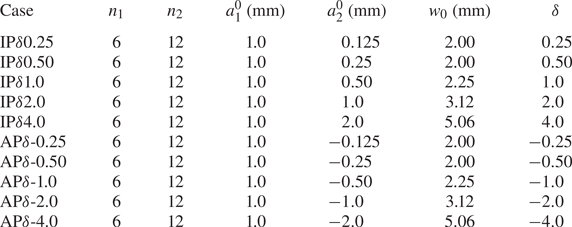
 $\delta$ on the hydrodynamic instabilities of a dual-mode interface in the cylindrical geometry. The initial spectrum parameters in different cases are listed in table 1.
The initial spectrum parameters of the two constituent modes of a dual-mode interface in numerical simulations:  $n_1$ and
 $n_2$ denote the azimuthal wavenumbers of the two constituent modes;
 $a_1^0$ and
 $a_2^0$ denote the initial amplitudes of the mode
 $n_1$ and mode
 $n_2$, respectively;
 $w_0$ denotes the initial mixed width of the dual-mode interface;
 $\delta$ (
 $=n_2a_2^0/n_1a_1^0$) denotes the ratio of the amplitude-to-wavelength ratios of the two constituent modes.

First, the influences of the phase difference between the two constituent modes on the hydrodynamic instabilities are explored by comparing cases IP $\delta$2.0 and AP
 $\delta$-2.0, as shown in figure 6. Compared with the amplitude growths of single-mode interfaces, the mode-coupling slightly promotes the lower frequency mode (i.e. mode
 $n_1$) but slightly suppresses the higher frequency mode (i.e. mode
 $n_2$) in the AP
 $\delta$-2.0 case, which is different from the IP
 $\delta$2.0 case, indicating that the phase difference influences the mode-coupling. Moreover, it is found that the amplitude growth of the coupling
 $n_2+n_1$ in the antiphase case is larger than the inphase case. In addition, the theoretical predictions of the two constituent modes and two generated harmonics in cases IP
 $\delta$2.0 and AP
 $\delta$-2.0 are shown with solid and dashed lines, and which agree well with the numerical results, further validating the nonlinear solutions.
Comparisons of the dimensionless amplitudes of the two constituent modes (modes  $n_1$ and
 $n_2$) and the generated harmonic
 $2n_2$ and coupling
 $n_2+n_1$ obtained from the simulations in cases IP
 $\delta$2.0 (square symbols) and AP
 $\delta$-2.0 (circle symbols), where the single-mode RM instabilities of the two constituent modes are shown with diamond symbols. The solid and dashed lines represent the theoretical predictions for cases IP
 $\delta$2.0 and AP
 $\delta$-2.0, respectively.

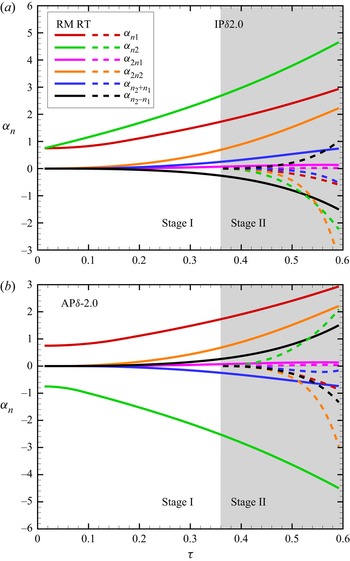
The theoretical predictions for the RM instability and the additional RT effect of all modes, harmonics and couplings in cases IP $\delta$2.0 and AP
 $\delta$-2.0 are shown in figures 7(a) and 7(b), respectively. In stage I, the influence of the phase difference on the RM instability is considered. It is evident that the RM unstable perturbation of the coupling
 $n_2-n_1$ grows in the opposite (or same) direction to the RM unstable perturbation of the mode
 $n_1$ in the IP
 $\delta$2.0 (or AP
 $\delta$-2.0) case. Meanwhile, the RM unstable perturbation of the harmonic
 $2n_1$ grows in the same (or opposite) direction with the RM unstable perturbation of the mode
 $n_2$ in the IP
 $\delta$2.0 (or AP
 $\delta$-2.0) case. Therefore, the generated coupling
 $n_2-n_1$ suppresses the instability of the mode
 $n_1$; whereas, the generated harmonic
 $2n_1$ promotes the instability of the mode
 $n_2$ when the two constituent modes are inphase. Oppositely, the generated coupling
 $n_2-n_1$ promotes the instability of the mode
 $n_1$; whereas, the generated harmonic
 $2n_1$ suppresses the instability of the mode
 $n_2$ when the two constituent modes are antiphase.
Comparisons of the dimensionless amplitudes of modes, harmonics and couplings predicted by theories in cases (a) IP $\delta$2.0 and (b) AP
 $\delta$-2.0. Solid and dashed lines represent the theoretical predictions for the RM instability and the additional RT effect, respectively.

In stage II, the influence of the phase difference on the additional RT effect is considered. It is evident that the RT unstable perturbation of the coupling  $n_2-n_1$ grows in the same (or opposite) direction to the RT unstable perturbation of the mode
 $n_1$ in the IP
 $\delta$2.0 (or AP
 $\delta$-2.0) case. Meanwhile, the RT unstable perturbation of the harmonic
 $2n_1$ grows in the same (or opposite) direction with the RT unstable perturbation of the mode
 $n_2$ in the IP
 $\delta$2.0 (or AP
 $\delta$-2.0) case. Therefore, the generated coupling
 $n_2-n_1$ and harmonic
 $2n_1$ separately promote the instabilities of the mode
 $n_1$ and mode
 $n_2$ when the two constituent modes are inphase. And the generated coupling
 $n_2-n_1$ and harmonic
 $2n_1$ separately suppress the instabilities of the mode
 $n_1$ and mode
 $n_2$ when the two constituent modes are antiphase. However, in the IP
 $\delta$2.0 case, the RT unstable perturbation of the coupling
 $n_2-n_1$ is larger than that of the mode
 $n_1$, therefore, the instabilities of the mode
 $n_1$ are promoted by the additional RT effect on comparing with the pure RM instability; whereas, the RT unstable perturbation of the harmonic
 $2n_1$ is smaller than that of the mode
 $n_2$, therefore, the instabilities of the mode
 $n_2$ are suppressed by the additional RT effect on comparing with the pure RM instability.
Moreover, the sign of the perturbation of the coupling  $n_2+n_1$ induced by the additional RT effect is the same as that induced by the RM instability in the IP
 $\delta$2.0 case. Differently, the sign of the perturbation of the coupling
 $n_2+n_1$ induced by the additional RT effect is opposite to that induced by the RM instability in the AP
 $\delta$-2.0 case. Therefore, the amplitude growths of the coupling
 $n_2+n_1$ in the antiphase case are larger than the inphase case.
Overall, the phase difference influences the mode-coupling mechanism, resulting in different feedbacks of the generated second-order harmonics and couplings to the initially constituent modes, leading to different outcomes of the RM instability and additional RT effect.
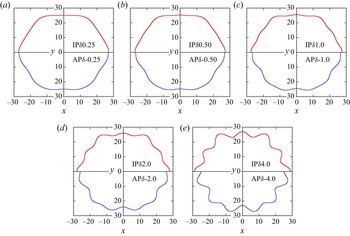
Second, the influences of  $\delta$ on the instability developments of the two constituent modes are numerically investigated. The initial amplitude of the mode
 $n_1$ is fixed as 1.0 mm. The initial amplitudes of the mode
 $n_2$ vary from 0.125 mm to 2.0 mm in the five inphase cases and
 $-0.125$ mm to
 $-2.0$ mm in the five antiphase cases. The initial interface contours in various cases are shown in figure 8. The dual-mode interface's crests and troughs in inphase cases are the troughs and crests in corresponding antiphase cases. As
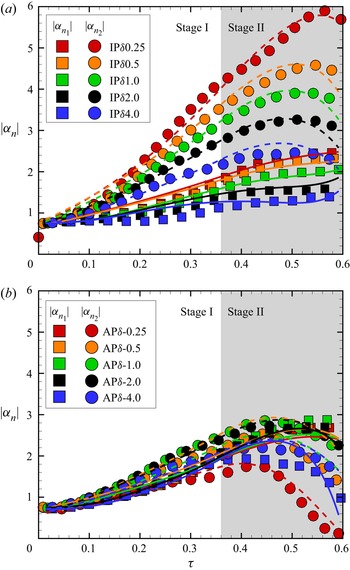
 $|\delta |$ increases, the differences of the initial interface contours in corresponding inphase and antiphase cases are more pronounced. The time-varying dimensionless amplitudes of the two constituent modes in the five inphase cases and five antiphase cases are obtained from numerical simulations, as shown in figures 9(a) and 9(b), respectively.
Initial interface contours corresponding to cases (a) IP $\delta$0.25 and AP
 $\delta$-0.25, (b) IP
 $\delta$0.50 and AP
 $\delta$-0.50, (c) IP
 $\delta$1.0 and AP
 $\delta$-1.0, (d) IP
 $\delta$2.0 and AP
 $\delta$-2.0 and (e) IP
 $\delta$4.0 and AP
 $\delta$-4.0.

Comparisons of the dimensionless amplitudes of the mode  $n_1$ (square symbols) and mode
 $n_2$ (circle symbols) obtained from numerical simulations in the (a) inphase cases and (b) antiphase cases. The solid and dashed lines with colours corresponding to the symbols represent the theoretical predictions for the mode
 $n_1$ and mode
 $n_2$, respectively.

In the five inphase cases, as  $\delta$ increases, due to the increasing negative feedback of the coupling
 $n_2-n_1$ and the increasing suppression introduced by the high-amplitude effect, the amplitude growth of the mode
 $n_1$ is more suppressed. As
 $\delta$ increases, due to the decreasing positive feedback of the harmonic
 $2n_1$ and the increasing suppression introduced by the high-amplitude effect, the amplitude growth of the mode
 $n_1$ is more suppressed.
In the five antiphase cases, as  $|\delta |$ increases from 0.25 to 1.0 (or 1.0 to 4.0), the positive feedback of the coupling
 $n_2-n_1$ is larger (or less) than the suppression introduced by the high-amplitude effect, therefore, the amplitude growth of the mode
 $n_1$ is more promoted (or suppressed). Differently, as
 $|\delta |$ increases from 0.25 to 1.0 (or 1.0 to 4.0), the decreasing negative feedback of the harmonic
 $2n_1$ is more (or less) significant than the increasing high-amplitude effect, therefore, the amplitude growth of the mode
 $n_2$ is more promoted (or suppressed).
Overall, the competition between the mode-coupling effect and the high-amplitude effect varies as  $\delta$ changes, resulting in different outcomes of the RM instability and additional RT effect. It is also noted that the lower frequency mode is largely suppressed when the two constituent modes are inphase and
 $\delta$ is large, and the higher frequency mode is largely suppressed when the two constituent modes are antiphase and
 $|\delta |$ is small. In addition, the theoretical predictions of the hydrodynamic instabilities of the mode
 $n_1$ and mode
 $n_2$ are shown with solid and dashed lines with colours corresponding to symbols, which agree well with the numerical results, further validating the generality of the nonlinear solutions.
Last, the mixed mass and normalized mixed mass of a convergent dual-mode RM unstable interface are calculated using numerical simulations. The actual amount of mixed mass could be viewed as a more direct indicator of the evolution of the mixing layers. Zhou, Cabot & Thornber (Reference Zhou, Cabot and Thornber2016) studied the mixed mass of a slow/fast RM unstable interface in the planar geometry and pointed out that an especially attractive feature of the mixed mass is that it is a conserved quantity. To frame the characterization based on how much the heavy fluid is mixed into the light fluid, the mixed mass  $M$ measurement can be defined as
 \begin{equation} M=\int4\rho Y_1Y_2\,\mathrm{d}V, \end{equation}
where  $Y_1$ and
 $Y_2$ are the mass fractions of the heavy fluid and light fluid, respectively;
 $\rho$ is the mixture density; and
 $V$ is the volume that encloses the mixing region. Since the surrounding gas is air and the test gas is a mixture of air and SF
 $_6$, and the mass fraction of SF
 $_6$ in the test gas is 91.1 % in the present study, the maximum and minimum values of
 $Y_1$ are 91.1 % and 0, respectively; and the maximum and minimum values of
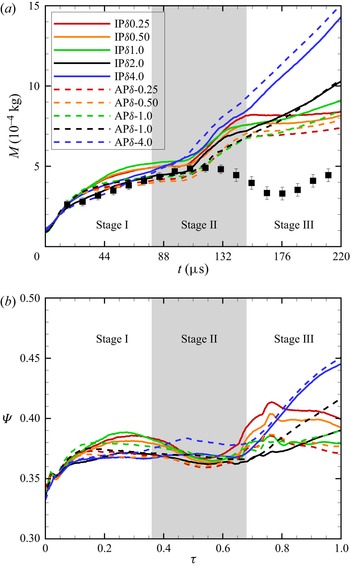
 $Y_2$ are 100 % and 8.9 %, respectively. Figure 10(a) shows the temporal evolution of the mixed mass obtained from numerical simulations in various cases (solid lines). We also present the corresponding experimental results for the mixed width (symbols) in the case IP
 $\delta 2.0$ multiplied by arbitrary constants. Clearly, before the negative growth of the mixed width in stage II (approximately 110 s, dimensionless time 0.5), the mixed mass measurements closely track the scaling of the mixed width, which is the same as the planar RT and RM instabilities (Zhou et al. Reference Zhou, Cabot and Thornber2016) and the cylindrical RT instability (Zhao et al. Reference Zhao, Wang, Liu and Lu2021). However, the amount of mixed mass of a convergent RM unstable interface shows a rapid increase due to the flow's increasing density as the transmitted shock converges at the geometric centre. As a result, the mixed mass curves of the convergent RM instability coupled with the additional RT effect differ from the planar RT instability (Zhou et al. Reference Zhou, Cabot and Thornber2016), RM instability (Mohaghar et al. Reference Mohaghar, Carter, Pathikonda and Ranjan2019; Zhou, Groom & Thornber Reference Zhou, Groom and Thornber2020a; Bender et al. Reference Bender2021) and the cylindrical RT instability (Zhao et al. Reference Zhao, Wang, Liu and Lu2021). We also compare the mixed mass of a dual-mode interface in various cases considering different initial spectra, as shown in figure 10(a). It is found that the mixed mass of the dual-mode interface in the inphase cases is slightly larger than the corresponding antiphase cases before the additional RT effect causes a quicker increase of the mixed mass. After the additional RT effect and reshock dominate the flow instability, the mixed mass shows different growth trends in various cases, indicating that the transition mixing of a convergent dual-mode interface depends on the initial spectrum.
Temporal evolutions of the (a) mixed mass  $M$ (lines) and (b) normalized mixed mass
 $\varPsi$ obtained from numerical simulations. The experimental results for the mixed width (symbols) in (a) are multiplied by arbitrary constants.

The normalized mixed mass is given by
 \begin{equation} \varPsi=\frac{\displaystyle\int\rho Y_1Y_2\,\mathrm{d}V}{\displaystyle\int\langle \rho\rangle\langle Y_1\rangle\langle Y_2\rangle \,\mathrm{d}V}, \end{equation}
where  $\langle \rangle$ denotes the spatial average in the
 $x$–
 $y$ plane. The normalized mixed mass expresses a ratio of subzonal mixing to larger-scale entrainment, describing the time evolution of how effectively the mass of the materials have been mixed within the mixing layer (Zhou et al. Reference Zhou, Cabot and Thornber2016; Bender et al. Reference Bender2021). The normalized mixed mass of the convergent RM unstable interface in various cases is shown in figure 10(b). First, after the incident shock impacts the interface, as smaller-scale structures develop and physical and numerical dissipation ensues,
 $\varPsi$ gradually rises, especially when
 $\delta$ is small. Then, the additional RT effect suppresses the development of the
 $\varPsi$ in stage II, finally with a rapid increase of the
 $\varPsi$ due to reshock in stage III. The differences of
 $\varPsi$ in various cases are enlarged by the reshock. In summary, the initial spectrum of a dual-mode interface has a non-negligible influence on the mixing evolution.
5. Conclusions
Experiments are performed for the first time on the convergent RM instability of a dual-mode interface in a shock-tube facility, and the perturbation growth of each Fourier mode is measured. The dual-mode air–SF $_6$ interface is created by an extended soap-film technique in the semiannular shock tube facility. Precise interfacial morphologies and wave patterns are captured by high-speed schlieren photography. For the first time, the influences of the mode-coupling on the convergent RM instability coupled with the RT effect of all modes, harmonics and couplings from linear to nonlinear stages are theoretically quantified with second-order nonlinear solutions. Numerical simulations solving compressible Euler equations are also performed considering various initial spectra. The temporal evolutions of the mixed mass and normalized mixed mass of a shocked multimode interface are calculated for the first time to quantify the mixing of two fluids in cylindrical geometry.
The amplitude growths of the initially constituent modes and the second-order harmonics and their couplings are obtained by a serial Fourier analysis of the interfacial contours extracted from the schlieren images. A noticeable difference between the growths of the constituent modes and the corresponding single-mode RM instability is observed, suggesting the evident mode-coupling effect on the convergent dual-mode RM instability. A series of analytical, nonlinear solutions with second-order accuracy are adopted by considering the geometry convergence, the mode-coupling mechanism, the high-amplitude effect, the high-Mach-number effect and the startup process to quantify the RM instability and the additional RT effect on the dual-mode interface. The nonlinear solutions well predict the amplitude growths of the first-order modes and the second-order harmonics and couplings before the reshock in the experiment and simulations. The mode-coupling complicates the hydrodynamic instabilities of a multimode interface, even resulting in different outcomes of the additional RT effect on the multimode interface and single-mode interface.
Referring to the nonlinear solutions, it is evident that when the azimuthal wavenumber of one constituent mode is twice the azimuthal wavenumber of the other constituent mode of a dual-mode interface, the mode-coupling has a non-negligible influence on the hydrodynamic instabilities of the two constituent modes. Based on the theory and simulations, it is proved that the phase difference and the ratio of the amplitude-to-wavelength ratios of the two constituent modes  $\delta$ greatly influence the mode-coupling mechanism. For a dual-mode interface consisting of inphase (or antiphase) modes
 $n$ and
 $2n$, the mode-coupling suppresses (or promotes) the instability of the mode
 $n$ but promotes (or suppresses) the instability of the mode
 $2n$. Moreover, as
 $\delta$ varies, the competition between the mode-coupling effect and the high-amplitude effect complicates the hydrodynamic instabilities of the constituent modes. For a dual-mode interface, the lower frequency mode is largely suppressed when the two constituent modes are inphase and
 $\delta$ is large, and the higher frequency mode is largely suppressed when the two constituent modes are antiphase and
 $|\delta |$ is small.
Last, the time-varying mixed mass and normalized mixed mass of the convergent RM unstable interface under various initial conditions are calculated using numerical simulations. It is found that the mixed mass shows a rapid increase due to the flow's density increment when the transmitted shock converges. The mixed mass curves of the convergent RM instability coupled with the additional RT effect differ from the planar RT and RM instabilities and the cylindrical RT instability. The additional RT effect suppresses, but the reshock promotes the growth of the normalized mixed mass of the convergent RM unstable interface. The initial spectrum has a non-negligible influence on the mixed mass and normalized mixed mass variations.
Overall, the hydrodynamic instabilities of a multimode interface driven by a convergent shock closely depend on the initial spectra from the very beginning. The mode-coupling mechanism revealed in the convergent dual-mode RM instability and additional RT effect would be of great use for understanding and modelling the hydrodynamic instabilities of a multimode interface consisting of random waves. We believe it is an essential step towards the elaborate study of the turbulence driven by a convergent shock.
In further studies, we will use a new quantitative experimental technique, e.g. planar laser-induced fluorescence/particle image velocimetry (Mohaghar et al. Reference Mohaghar, Carter, Musci, Reilly, McFarland and Ranjan2017, Reference Mohaghar, Carter, Pathikonda and Ranjan2019; Mohaghar Reference Mohaghar2019; Noble et al. Reference Noble, Herzog, Ames, Oakley, Rothamer and Bonazza2020; Noble Reference Noble2022) and direct numerical simulations to enhance our understanding of the physics of the flow for the convergent multimode RM instability, and in general to enhance our understanding of the RM instability and the additional RT effect. The unanswered question is how the convergent multimode RM and RT instabilities can develop into turbulence with different initial conditions at later stages, which is directly related to the ICF performance.
Funding
This work was supported by Tamkeen under the NYU Abu Dhabi Research Institute grant CG002, the Natural Science Foundation of China (nos. 91952205 and 11625211) and Hong Kong Research Grants Council (no. 15207420).
Declaration of interests
The authors report no conflict of interest.