Police officers have increasingly assumed the role of first responders in out-of-hospital cardiac arrest (OHCA) scenarios, often arriving before emergency medical services. Early cardiopulmonary resuscitation (CPR), especially within the first 4-6 minutes, significantly increases survival rates.Reference Kalejs, Maca-Kalejs, Apsite and Zima 1 Evidence shows that bystander CPR improves OHCA outcomes,Reference Yan, Gan and Jiang 2 and police-initiated defibrillation programs, such as Police AED (POA), can reduce time to first shock and improve survival.Reference Husain and Eisenberg 3 Numerous studies demonstrate that effective CPR administered in the early minutes of cardiac arrest can significantly improve both neurological and survival outcomes, particularly when performed by trained first responders who arrive before EMS.Reference Husain and Eisenberg 3
In Taiwan, programs like POA have been implemented in response to these needs. Data from New Taipei City (2020-2022) documented 12 police-assisted resuscitation cases involving AED use, including 6 first-on-scene cases and 3 successful resuscitations. 4 As first responders, police officers play a frontline role in disaster medicine systems, especially in prehospital phases of cardiac emergencies. Their ability to perform effective CPR is not only a critical clinical skill but also a fundamental component of disaster preparedness and operational resilience. Despite these efforts, CPR performance among police officers may vary due to training frequency, learning motivation, and perceived support.Reference Jaskiewicz, Kowalewski and Kaniecka 5
To evaluate training outcomes, the Kirkpatrick model offers a 4-level framework: reaction, learning, behavior, and results. This model captures not only knowledge acquisition, but also behavioral change and outcome impact, and has been widely applied in medical and public safety training.Reference Alsalamah and Callinan 6 , Reference Amiresmaili, Mirzaee and Aminizadeh 7 It also aligns with the Sustainable Development Goals (SDGs), particularly SDG 3 (Good Health and Well-being) and SDG 16 (Peace, Justice and Strong Institutions).Reference Budhathoki, Pokharel and Good 8 , 9
However, empirical studies on police CPR training are limited. Most literature focuses on health care professionals such as nurses or EMTs.Reference Chang, Hsu and Li 10 , Reference Chen, Hsieh and Tung 11 Few studies have specifically examined how training motivation, perceived responsibility, and environmental support influence CPR performance among police officers, despite their expanding role in high-risk, time-sensitive emergencies.
This study applies the Kirkpatrick model to assess CPR training outcomes in a police population using structured questionnaires and QCPR simulator data. The objectives are to: (1) examine skill differences across demographic backgrounds, (2) identify training-related predictors of CPR performance, and (3) offer evidence-based recommendations for training design and policy development.
Materials and Methods
This cross-sectional study aimed to identify key factors influencing CPR performance among police officers. Independent variables included 3 training-related dimensions: training environment support, skill mastery and perceived training effectiveness, and training motivation and sense of responsibility. Dependent variables were 3 CPR skill indicators measured by a QCPR simulator: compression depth achievement rate, compression rate achievement rate, and recoil achievement rate. Skill thresholds followed AHA guidelines: 5-6 cm for depth, 100-120 compressions/min for rate, and full chest recoil.Reference Merchant, Topjian and Panchal 12
The study was grounded in the Kirkpatrick Training Evaluation Model, incorporating its reaction, learning, and behavior levels to examine the predictive power of each training construct through hierarchical regression analysis, aiming to provide evidence for improving police CPR training systems.
Participants and Sample Size
Participants were frontline officers from 3 precincts in New Taipei City (Tucheng, Sanxia, and Shulin). Inclusion criteria required active-duty officers capable of reading Chinese and providing informed participation. Exclusion criteria included long-term leave, temporary or non-sworn personnel, and incomplete responses.
Sampling and Data Collection
Convenience sampling was used. During the pretest phase (September-November 2021), 233 valid responses were collected for item refinement and scale validation. For the main study, 138 valid responses were collected (100% response rate), covering frontline staff across the 3 precincts.
Sample Size Estimation
The pretest sample exceeded the recommended 5-10 respondents per item, with 233 participants supporting psychometric analysis. G*Power estimated a minimum of 77 participants (f2 = 0.15, α = 0.05, power = 0.80) for the main analysis; 138 valid samples achieved a power of ~0.95. Given a total of 716 officers across the 3 precincts, the sample represented ~19.3% of the population. This proportion, combined with moderate effect size assumptions common in Kirkpatrick-based research, supported the generalizability and statistical rigor of the findings.
Instruments
Two instruments were used to assess both perceived training effectiveness and actual CPR performance: a self-developed structured questionnaire and the QCPR Anne manikin.
Structured questionnaire
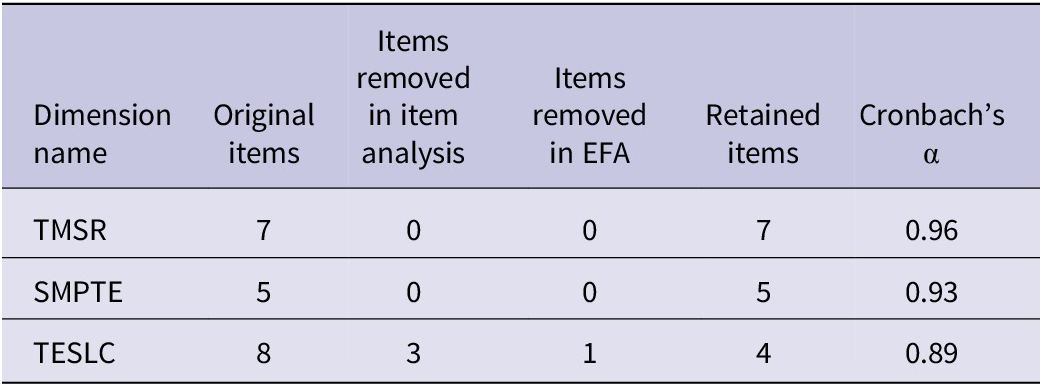
The questionnaire was designed based on the Kirkpatrick Training Evaluation Model and prior literature, incorporating the researcher’s field experience in police CPR training. It initially comprised 20 items, of which 13 were literature-derivedReference Ojifinni, Motara and Laher 13 , Reference Saquib, Al-Harthi and Khoshhal 14 and 7 were adapted from real-world observations. Items covered training motivation, skill mastery, training effectiveness, and environmental support.
Item analysis and exploratory factor analysis (EFA) were conducted using a pilot sample (n = 233). Three items were removed for low discrimination or item-total correlation (r < 0.30), and one item was excluded after EFA using oblique rotation and parallel analysis. The final version included 16 items across 3 dimensions:
-
• Training Motivation and Sense of Responsibility (Cronbach’s α = .96)
-
• Skill Mastery and Perceived Training Effectiveness (Cronbach’s α = .93)
-
• Training Environment Support and Learning Climate (Cronbach’s α = .89)
Each item used a 5-point Likert scale (1 = strongly disagree, 5 = strongly agree), with higher scores reflecting more positive perceptions. Factor structure and reliability results are detailed in Table 1.
Psychometric properties of the 3 training dimensions: item analysis, exploratory factor analysis, and internal consistency (N = 233)

Note: Results are based on item analysis and exploratory factor analysis (EFA). Items were retained if they met the following criteria: significant critical ratio (P < 0.001), item-total correlation (r > 0.30), and Cronbach’s α > 0.80. EFA was conducted using oblique rotation, and items with factor loadings greater than .50 were retained. Preliminary analysis based on pilot data.
Abbreviations: TMSR = Training Motivation and Sense of Responsibility; SMPTE = Skill Mastery and Perceived Training Effectiveness; TESLC = Training Environment Support and Learning Climate.
QCPR Anne Manikin
To assess actual CPR skills, the QCPR Anne manikin (Laerdal) was employed.Reference Cortegiani, Russotto and Montalto 15 This device uses high-precision sensors to record the percentage of adequate chest compression depth, rate, and full chest recoil, and provides real-time visual feedback via Bluetooth-connected apps.
Previous studies have demonstrated the effectiveness of QCPR in improving CPR performance, particularly for compression depth and recoil consistency. Thus, the 3 objective indicators—compression depth achievement rate (%), rate achievement rate (%), and recoil achievement rate (%)—were used as outcome variables in regression analyses to assess the predictive power of training-related factors.
Statistical Analysis
Data were analyzed using SPSS for Windows 22.0, with confirmatory factor analysis (CFA) conducted in Jamovi. The analytical approach was structured as follows:
Descriptive statistics (frequencies, percentages, means, standard deviations) were used to summarize participant demographics and key variables.
To establish construct validity and reliability of the questionnaire, exploratory factor analysis (EFA) was conducted in the pilot phase. Factors with eigenvalues >1 were initially retained, and parallel analysis was applied to determine the number of factors. Principal axis factoring (PAF) with oblique rotation (Oblimin) was used. Internal consistency was evaluated using Cronbach’s α.
During the main study phase, CFA was performed to verify the 3-factor model. Model fit was assessed using indices including CFI, TLI, and RMSEA. Convergent validity (factor loadings and AVE), discriminant validity (HTMT), composite reliability (CR), and internal consistency (Cronbach’s α and McDonald’s ω) were also examined.
Pearson’s correlations were used to explore associations among constructs. Independent-samples t tests and one-way ANOVA were applied to assess differences in CPR performance (compression depth, rate, and recoil) across background variables.
Hierarchical multiple regression analyses were used to test the predictive value of training-related factors on CPR performance, aligned with the Kirkpatrick model. Predictors were entered in 3 steps: (1) Training Environment and Learning Climate, (2) Skill Mastery and Perceived Effectiveness, and (3) Training Motivation and Responsibility. QCPR outcomes were used as dependent variables. Multicollinearity was evaluated via variance inflation factors (VIF), and independence of residuals was tested using Durbin–Watson statistics.
Finally, statistical power was confirmed via G*Power, assuming a medium effect size (f2 = 0.15), α = 0.05, and power = 0.80. The achieved sample size was sufficient for regression analysis.
Results
Participant Characteristics
A total of 138 active-duty police officers participated in the study. Most were male (89.1%) and aged 20-29 years (52.9%), followed by ≥40 years (26.8%) and 30-39 years (20.3%). The majority held the rank of officer (83.3%), with the remainder being sergeants (13.0%) or inspectors (3.6%). Educational backgrounds included Police College (65.2%), Special Examination Program (24.6%), Central Police University (3.6%), and other training programs (6.5%). Most had ≥6 years of service (73.9%).
In terms of emergency experience, only 4.3% had performed real-life resuscitation, and 13.8% had encountered cases requiring CPR on duty. Regarding CPR training, 37.0% had received training within the past year, and 57.2% within the past 1-4 years. Overall, participants were predominantly young frontline male officers with recent CPR training experience.
Construct Validity and Reliability
Confirmatory factor analysis (CFA) validated the 3-factor questionnaire structure (Figure 1). Though the chi-square test was significant (χReference Yan, Gan and Jiang 2 = 147, df = 101, P = 0.002), other fit indices indicated strong model fit: CFI = 0.999, TLI = 0.999, IFI = 0.999, SRMR = 0.043, RMSEA = 0.056 (90% CI = 0.035-0.075).
Confirmatory factor analysis of CPR training dimensions based on Kirkpatrick’s model.
Note. This model illustrates the 3-factor structure of police officers’ CPR training evaluation, aligned with Kirkpatrick’s model. The latent constructs are: TMSR = Training Motivation and Sense of Responsibility; SMPTE = Skill Mastery and Perceived Training Effectiveness; TESLC = Training Environment Support and Learning Climate.

All standardized factor loadings were significant (range = 0.84-0.98), and AVE values exceeded 0.50 for all constructs (TRMA = 0.88, SMTE = 0.79, TESLC = 0.83), supporting convergent validity. Discriminant validity was also confirmed, with HTMT values between 0.64 and 0.89.
Construct reliability (CR > 0.90) and internal consistency were excellent across all domains (Cronbach’s α / McDonald’s ω: TRMA = 0.96 / 0.96, SMTE = 0.91 / 0.91, TESLC = 0.91 / 0.92).
Questionnaire Responses and CPR Performance
Perceived Learning Dimensions
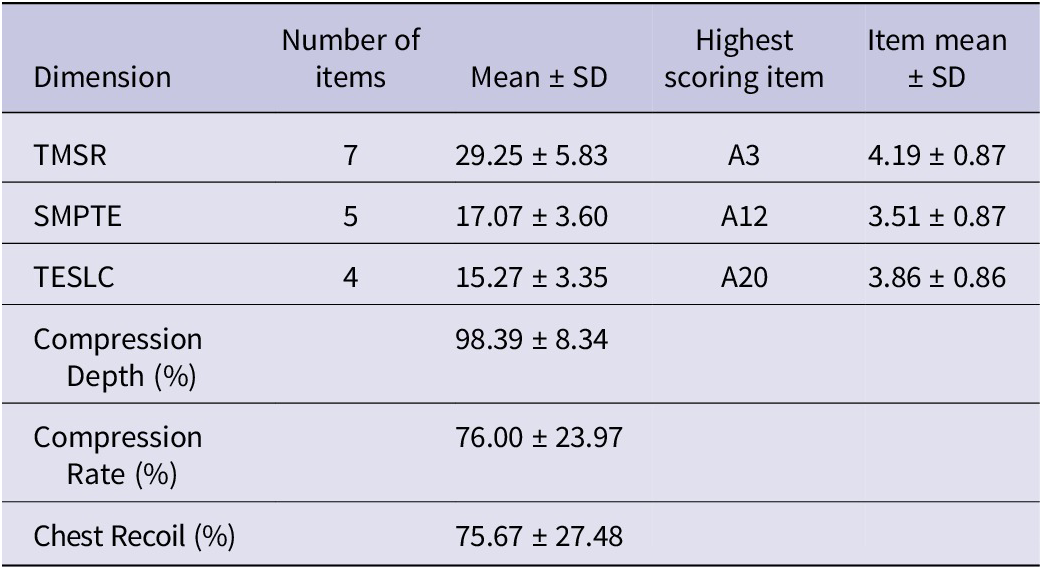
A total of 138 police officers completed both the structured questionnaire and the QCPR performance assessment. Among the 3 constructs, Training Motivation and Sense of Responsibility (TMSR) had the highest item mean score (M = 4.19, SD = 0.87), indicating strong commitment and perceived value of CPR training. Skill Mastery and Perceived Training Effectiveness (SMPTE) showed an item mean of 3.51 (SD = 0.87), suggesting moderate confidence in skill application, particularly in chest recoil. Training Environment and Supportive Learning Climate (TESLC) had an item mean of 3.86 (SD = 0.86), reflecting a generally supportive training context. Table 2 presents descriptive statistics for all questionnaire constructs and QCPR performance metrics.
Descriptive statistics for perceived training dimensions and CPR skill performance (N = 138)

Note: Data are presented as mean ± standard deviation (M ± SD). CPR skill indicators include compression depth, rate, and chest recoil achievement percentages, recorded using the QCPR Anne simulator. Higher scores indicate stronger agreement or better performance.
QCPR Skill Performance
For the QCPR Anne simulator results, the mean compression depth achievement rate was 98.39% (SD = 8.34), suggesting good adherence to the target depth of 5-6 cm, though possible over compression warrants attention. The compression rate achievement averaged 76.00% (SD = 23.97), indicating high variability in tempo control. Chest recoil rate averaged 75.67% (SD = 27.48), reflecting moderate performance but substantial variability, suggesting further improvement is needed.
Background Factors and Correlation Analyses
Group Differences by Background Variables
Independent t tests and ANOVA revealed that female officers had significantly higher recoil achievement than males (M = 86.87 vs. 74.45, t = –2.32, P = 0.030). Officers aged 30-39 years also outperformed older counterparts in recoil (F = 3.24, P = 0.042). Officers with real-life CPR experience had significantly better compression rate performance (M = 122.17 vs. 112.17, t = 2.07, P = 0.041). Other variables such as rank, education, and years of service showed no significant differences.
Correlations Between Learning Dimensions and CPR Performance
Pearson correlations revealed that Skill Mastery and Perceived Effectiveness was moderately correlated with depth (r = 0.28, P = 0.001) and rate (r = 0.32, P < 0.001). Training Environment and Learning Climate was weakly correlated with rate (r = 0.24, P = 0.005) and recoil (r = 0.22, P = 0.010). Training Motivation and Responsibility showed no significant correlation with any CPR outcomes, suggesting that motivation alone may not directly predict performance.
Hierarchical Regression Analyses for CPR Skill Performance
This study employed hierarchical regression analyses to examine predictors of 3 CPR performance indicators—compression depth achievement, compression rate achievement, and chest recoil achievement—using both background variables and questionnaire domains (Training Motivation and Responsibility, Skill Mastery and Training Effectiveness, and Training Environment and Learning Climate).
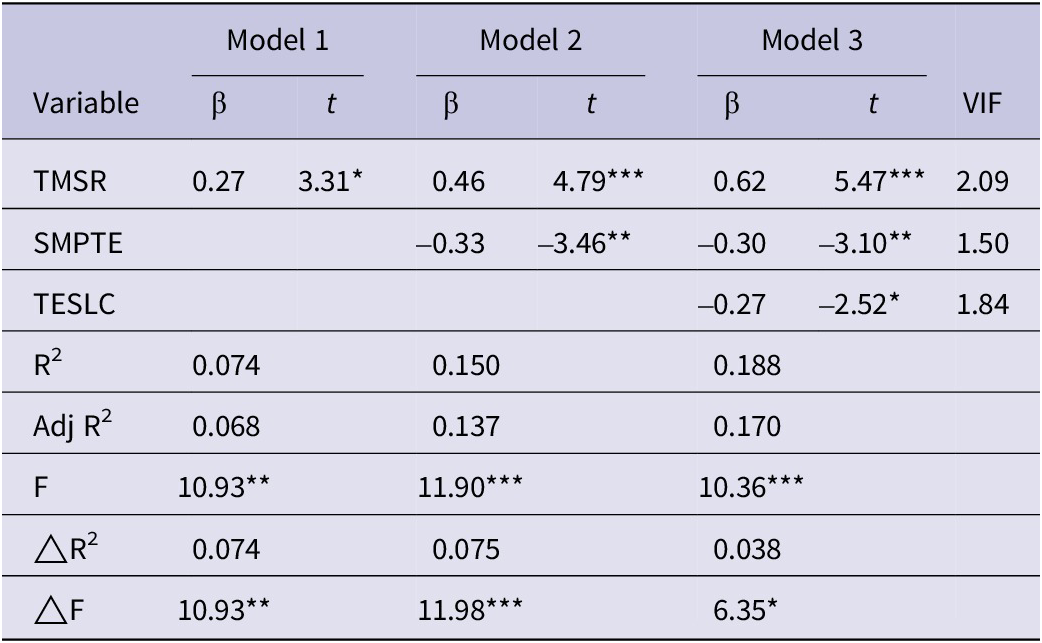
Model 1: compression depth achievement (Table 3)
As no background variables were significantly associated with compression depth, only the 3 training-related domains were included. In Step 1, Training Motivation and Sense of Responsibility significantly predicted compression depth (β = 0.27, RReference Yan, Gan and Jiang 2 = 0.074, F = 10.93, P < 0.01). In Step 2, adding Skill Mastery and Perceived Training Effectiveness increased the RReference Yan, Gan and Jiang 2 to 0.150 (β = –0.33, ΔRReference Yan, Gan and Jiang 2 = 0.075, F = 11.98, P < 0.001). Step 3 included Training Environment and Supportive Learning Climate, yielding a final RReference Yan, Gan and Jiang 2 = 0.188 (adjusted RReference Yan, Gan and Jiang 2 = 0.170, F = 10.36, P < 0.001). All 3 predictors were statistically significant: TMSR (β = 0.62, P < 0.001), SMPTE (β = –0.30, P = 0.002), and TESLC (β = –0.27, P = 0.013). VIF values ranged from 1.50 to 2.09, with no multicollinearity. The Durbin-Watson statistic was 2.00, indicating no autocorrelation.
Hierarchical regression analysis for compression depth achievement (%)

Note: Standardized coefficients (β), t statistics, and variance inflation factors (VIF) are reported. Model fit indices include R2, adjusted R2, ΔR2, and F values. Significance levels: *P < 0.05, **P < 0.01, ***P < 0.001.
Model 2: compression rate achievement (Table 4)
Step 1 included the dummy variable Performed Real-Life First Aid, which was a significant predictor (β = 0.17, t = 2.07, P < 0.05), with modest model fit (RReference Yan, Gan and Jiang 2 = 0.030, F = 4.27, P < 0.05). However, adding the training constructs in the subsequent steps did not significantly increase the model’s explanatory power. The final model reached RReference Yan, Gan and Jiang 2 = 0.054 (adjusted RReference Yan, Gan and Jiang 2 = 0.025), F = 1.88, P = 0.117, and none of the added predictors (TMSR, SMPTE, TESLC) reached statistical significance. VIF values ranged from 1.11-2.27, and the Durbin-Watson statistic (2.011) indicated no concerns with multicollinearity or autocorrelation.
Hierarchical regression analysis for compression rate achievement (%)

Note: Standardized coefficients (β), t statistics, and VIF values are provided for each model step. Model statistics include R2, adjusted R2, ΔR2, and F values. *P < 0.05 indicates statistical significance.
Model 3: chest recoil achievement (Table 5)
In Step 1, gender and age group dummy variables were included. The model was significant (RReference Yan, Gan and Jiang 2 = 0.059, F = 2.81, P = 0.042), with officers aged 30-39 showing better performance than those aged 40+ (β = 0.22, P = 0.028). After adding all 3 training domains in Step 4, model fit improved (RReference Yan, Gan and Jiang 2 = 0.114, adjusted RReference Yan, Gan and Jiang 2 = 0.073, F = 2.81, P = 0.013). Among the training variables, only Training Motivation and Sense of Responsibility significantly predicted chest recoil performance (β = 0.31, P = 0.007), suggesting a strong link between intrinsic motivation and consistent recoil. No multicollinearity was found (VIF = 1.13-2.17), and the Durbin-Watson statistic (1.820) indicated no autocorrelation.
Hierarchical regression analysis for chest recoil achievement (%)

Note: Standardized coefficients (β), t statistics, and VIF are shown. Regression model includes age and gender as background covariates. Model fit indicators include R2, adjusted R2, ΔR2, and F-statistics. *P < 0.05, **P < 0.01 denote statistical significance.
Discussion
Impact of Learning Constructs on CPR Performance: Practical Implications
This study found that Training Motivation and Responsibility significantly predicted compression depth achievement (β = 0.62, P < 0.001), suggesting that supportive instructional settings and peer interactions enhance technical consistency. This aligns with medical education literature emphasizing that a positive learning environment facilitates self-regulation and clinical performance.Reference Liu, Hu and Wang 16 Structured CPR programs have similarly been shown to improve frontline responders’ performance under pressure.Reference Peng, Xiao, Carter and Shearer 17
Skill Mastery and Perceived Training Effectiveness showed a significant negative association with compression depth (β = –0.30, P = 0.002) and a nonsignificant positive association with compression rate (β = 0.14, P = 0.179), supporting the idea that self-perceived competence reflects actual performance. This mirrors findings from EMT research where confidence was linked to compression accuracy.Reference Wyckoff, Greif and Morley 18 In contrast, Training Motivation and Responsibility was not associated with depth or rate but significantly predicted recoil achievement (β = 0.31, P = 0.007), suggesting that motivation may influence finer technical skills. Prior research supports this, noting that motivated learners exhibit better control in nuanced tasks like chest recoil.Reference Jaskiewicz, Kowalewski and Kaniecka 5
Together, these findings support Kirkpatrick’s behavioral and results-level constructs, demonstrating how motivational and cognitive dimensions translate into observable performance.Reference Alsalamah and Callinan 6 Importantly, this study extends current literature by focusing on police officers—high-probability first responders—highlighting their crucial role in enhancing emergency response systems.
The Role of Experience and Demographics: Training Challenges for First Responders
Officers with prior real-life resuscitation experience had significantly better compression rate performance (β = 0.17, P = 0.039), supporting the view that real-world exposure improves procedural fluency and tempo control. Practical exposure reduces cognitive load in high-stress situations and fosters automaticity.Reference Ndile, Lukumay and Bolenius 19
Moreover, mid-age officers (30-39 years) showed superior recoil performance (β = 0.22, P = 0.028), potentially due to differences in muscle control, stability, and accumulated experience. Literature has reported that physical attributes influence CPR quality during prolonged compressions.Reference Nachi, Nachi and Okada 20
However, variables such as rank, years of service, and education level showed no significant association with performance, aligning with studies indicating that formal education has limited predictive power for CPR proficiency.Reference Kim, Lee and Lee 21 Instead, frequent simulation and scenario-based training are essential for building muscle memory and situational responsiveness.
Experience in high-risk settings consistently enhances performance stability and resilience. Psychological resilience training also emphasizes the value of repeated exposure and self-regulation to improve field readiness.Reference Kaplan, Bergman and Christopher 22 These findings reaffirm the behavioral focus of the Kirkpatrick model and highlight the need to integrate job-related characteristics and prior exposure into training design.
Integrating Theory and Policy: Kirkpatrick Model and Sustainable Development Goals
Using the Kirkpatrick model, this study demonstrated the translation from learning behavior to measurable outcomes, confirming the model’s cross-disciplinary utility in CPR education.Reference Lund-Kordahl, Mathiassen and Melau 23 The model’s staged framework supports comprehensive training evaluation from learner reaction to final outcomes.Reference Alsalamah and Callinan 24
Studies show that incorporating simulation, feedback, and multimodal strategies improves CPR performance and retention.Reference Everett-Thomas, Yero-Aguayo and Valdes 25 , Reference Nishiyama, Iwami and Kitamura 26 Applications in military and public safety settings have shown that theory-driven, context-sensitive training enhances system responsiveness.Reference Zhang and Chen 27 Fire service planning research further highlights the need to localize training strategies based on environmental and manpower diversity.Reference Duray, Fan and French 28
This study’s findings align with the United Nations Sustainable Development Goals. SDG 3 emphasizes universal health and emergency readiness, while SDG 16 underscores the role of law enforcement in community safety and institutional trust. Police-AED systems have demonstrated reduced defibrillation times and improved neurological outcomes,Reference Krammel, Lobmeyr and Sulzgruber 29 underscoring the feasibility of integrating CPR into law enforcement training programs.
We recommend shifting CPR education beyond technical content to include systemic design—such as periodic re-training, behavior observation, and interagency collaboration. Linking training to medical and emergency systems can foster scalable, high-performing safety networks and contribute to achieving SDG 3 and 16 goals for equitable health and resilient communities.
Conclusions and Recommendations
Study Limitations
Internal validity
-
• Timing of Data Collection: Data were collected during a specific time frame and may be influenced by contemporaneous policing policies and social conditions, which limits generalizability over time.
-
• Self-Report Bias: Some variables were measured using self-administered questionnaires, which are subject to social desirability and perceptual bias. The study also lacked measurement of psychological status or on-duty stress, potentially limiting interpretation.
-
• Lack of Longitudinal Follow-Up: Only immediate post-training effects were assessed. Long-term skill retention and stability were not evaluated, warranting future longitudinal designs.
External validity
-
• Sample Representativeness: Participants were from 3 police precincts in New Taipei City. While practically relevant, the sample had low representation of female and older officers, limiting broader applicability.
-
• Sample Imbalance and Temporal Factors: Uneven distribution of critical variables (e.g., emergency experience) may reduce statistical power. Institutional and cultural changes over time could also affect CPR training relevance.
Practical Implications
For Training Design
-
• Emphasize precision skills such as chest recoil and compression control, using real-time feedback tools to enhance technical standardization and self-correction.
-
• Tailor instruction based on individual characteristics (e.g., gender, age) by offering personalized training intensity and simulator settings to improve equity and learning outcomes.
For Policing Policy
-
• Integrate CPR competency into routine performance evaluations, linking it with operational feedback and training outcomes.
-
• Implement simulation-based refresher programs combining physical practice and psychological stress exposure to reinforce emergency readiness.
-
• For officers lacking field experience, incorporate structured scenarios and practical assessments to build preparedness.
For Future Research
-
• Expand sampling across regions, police ranks, and age groups to improve external validity.
-
• Use longitudinal methods to track skill retention curves and assess the effects of training frequency and stress.
-
• Combine qualitative approaches to explore cognitive and operational challenges in CPR learning, complementing quantitative findings.
Overall Conclusion
This study confirms that training motivation significantly predicted both compression depth and chest recoil performance, while skill mastery and environmental support demonstrated selective or inverse associations with compression depth. Field experience and demographic factors also emerged as key contributors. The results substantiate the Kirkpatrick model’s linkage between learning and behavioral outcomes and emphasize the practical and policy relevance of including police as frontline responders in CPR training systems.
Data availability statement
The data that support the findings of this study are available from the corresponding author, Dr. Wei-Hsiang Huang (drddh@g.ukn.edu.tw), upon reasonable request. The data are not publicly available due to confidentiality and institutional restrictions.
Author contribution
Wei-Hsiang Huang was solely responsible for the study’s conceptualization, data collection, analysis, interpretation, and manuscript preparation.
Acknowledgements
The author wishes to express their sincere gratitude to the Emergency Medical Instructor Team of the 5th Rescue and Emergency Medical Service Division, New Taipei City Fire Department, for their invaluable assistance in participant recruitment and constructive feedback during the 2021 study period. Special thanks are also extended to all police officers from Tucheng Precinct, Sanxia Precinct, and Shulin Precinct of the New Taipei City Police Department, whose participation made this research possible. The authors would also like to express their heartfelt appreciation to Ms. Yu-Fei Ku, who, during the data collection period, served as a nurse at the 5th Rescue and Emergency Medical Service Division and provided essential support in participant coordination and recruitment. Ms. Ku currently serves as the school nurse at New Taipei Municipal Tur Ya Kar Elementary & Junior High School.
Funding statement
This research did not receive any specific grant from funding agencies in the public, commercial, or not-for-profit sectors.
Competing interests
The author declares no competing interests.
Consent to publish
No identifiable individual data are included in this manuscript.
Permission to reproduce material from other sources
No third-party material was reproduced.
Clinical trial registration
Not applicable—this study did not involve a clinical trial.
Declaration of AI and AI-assisted technologies in the writing process
The author’s native language is Chinese. The manuscript was initially drafted in Chinese, and AI-assisted tools—specifically ChatGPT (OpenAI)—were used to support the English translation and to check grammar and spelling. The author reviewed and edited all AI-generated outputs for accuracy and clarity and assumes full responsibility for the final content.
Ethical standard
This study was conducted in accordance with the Regulations on the Ethical Review of Human Research issued by the Ministry of Health and Welfare, Taiwan (July 5, 2012). It met the criteria for exemption from institutional review board (IRB) review, as it involved: (1) public policy or institutional evaluation research conducted by government agencies as part of their statutory duties, and (2) educational evaluation within regular training settings.
The study was implemented during routine annual in-service training programs at local police precincts. It involved no medical interventions, no collection of sensitive personal data, and did not target any vulnerable populations.
Despite being exempt from formal IRB review, the research team followed strict ethical standards. All participants received prior written information about the study’s purpose, procedures, and data use. Participation was voluntary, and survey completion had no bearing on training outcomes or employment status. Informed consent was implied via a checkbox on the questionnaire cover page. All data were collected anonymously and analyzed in aggregate, solely for academic and practical purposes. Participant privacy and rights were fully protected throughout the study.
Informed consent was implied through voluntary completion of the anonymous questionnaire after participants received a written explanation of the study.