INTRODUCTION
In January 2015, the attack on the headquarters of the French satirical magazine Charlie Hebdo in Paris stirred a great deal of reaction on social media, including the appearance of the sign Je Suis Charlie (see Figure 1) created by Joachim Roncin (Bazin Reference Bazin, Lefébure and Sécail2015:159). The original sign includes the logo of Charlie Hebdo and the magazine's typography. It was used at mass gatherings, but also as a profile picture on social media, creating ‘stance avatarization’ (Panović Reference Panović2016), and can be considered an internet meme (de Lucena Ito Reference de Lucena Ito, Romancini and Vassallo de Lopes2015).
Original sign Je suis Charlie.

Though many people interpret the phrase as ‘I am Charlie’, a statement of identification with the attacked magazine, some authors have pointed to the homophony in French of je suis meaning both ‘I am’ and ‘I follow’ (Bazin Reference Bazin, Lefébure and Sécail2015:163). While this ambiguity may have been useful initially, subsequent creative uses of phrases including je suis build exclusively on the ‘I am’ reading, both in French and in other languages, which becomes clear in this article.
This sign rapidly became #jesuisCharlie, a worldwide hashtag that expressed support and alignment with the victims. Note that the iconographic and typographic information of the original sign is lost in the hashtag, thus loosening the link with the Charlie Hebdo magazine and leaving only the verbal content to evoke the event. The hashtag was used 3.5 million times on the day of the attack alone (Badouard Reference Badouard, Lefébure and Sécail2015:187), and it was the first French hashtag to be used in more than five million tweets (La Libre Belgique Reference La Libre2016). In the first few days, the hashtag was also used for live reporting on the ongoing search for the attackers (Sumiala, Tikka, Huhtamäki, & Valaskivi Reference Sumiala, Tikka, Huhtamäki and Valaskivi2016:98), exemplifying the concept of ambient news (Hermida Reference Hermida2010) and reflecting ‘deeply subjective accounts and interpretations of events as they unfold’ (Papacharissi Reference Papacharissi2015:56), in the sense that these tweets combined facts with expressions of emotion. In spite of the popularity of the hashtags, discordant voices also appeared almost immediately after the attack, including hashtags expressing support for the bombers, such as #jesuisKouachi Footnote 1 (one of the terrorists), and many #jenesuispasCharlie hashtags (cf. Badouard Reference Badouard, Lefébure and Sécail2015; de Lucena Ito Reference de Lucena Ito, Romancini and Vassallo de Lopes2015; An, Kwak, Mejova, Saenz De Oger, & Gomez Fortes Reference An, Kwak, Mejova, Saenz De Oger and Fortes2016; Giglietto & Lee Reference Giglietto and Lee2017; Smyrnaios & Ratinaud Reference Smyrnaios and Ratinaud2017). This latter group condemned the attacks but did not wish to use #jesuisCharlie for various reasons, mainly to express disagreement with the ideology of the Charlie Hebdo magazine, to criticize the Islam-related cartoons that Charlie Hebdo had published at an earlier date, or to oppose the political appropriation of the attacks by individuals and parties that had not previously identified with Charlie Hebdo and/or whose ideas were not in line with those of Charlie Hebdo (Badouard Reference Badouard, Lefébure and Sécail2015). While it is important to bear these discordant voices in mind, #jesuisCharlie is clearly the most successful hashtag to date, not only in terms of its frequency, but also in terms of its longevity and the scope for variation in the second slot (after #jesuis). It is the extremely varied versions of #jesuis hashtags and their pragmatic functions that are at the heart of this article.
The stem #jesuis has been productive in the wake of other attacks, for example, #jesuisParis after the November 2015 and subsequent Paris attacks (see (1) below), or #jesuisBruxelles after the Brussels attack in March 2016, but it has also evolved into expressing support for causes unrelated to terrorist attacks, and into mocking uses.
(1) Personne ne devrait ressentir ça
 #jesuisParis #SoutienALaPolice #ChampsElysees #France (French)
‘No one should feel that
#jesuisParis #SupportToThePolice #ChampsElysees #France ’
 #jesuisParis #SoutienALaPolice #ChampsElysees #France
 (French)
Both the original and the subsequent creative uses of #jesuis abound in tweets in other languages as well. De Lucena Ito (Reference de Lucena Ito, Romancini and Vassallo de Lopes2015), for instance, has shown that in the days following the attack the French version #jesuisCharlie was much more frequent in Brazilian Portuguese tweets than the translation #eusouCharlie.
In this article, we address how the communicative affordances of hashtags allow for a wide variety of uses of #jesuis. After having introduced the theoretical framework, we present the data and method we adopted. We then show how #jesuis became a more general marker of solidarity and alignment before proceeding to discuss how it gave rise to the expression of disalignment as well.
By means of this case study, we want to show how hashtags in general may fulfill a variety of communicative functions across languages beyond merely labelling a topic. We also show how the creativity Twitter allows for contributes to them becoming the heart of a discussion concerning the expression of solidarity on Twitter.
HASHTAGS AS AN AFFORDANCE
Though also used in other digital media and even in noncomputer-mediated communications (Heyd & Puschmann Reference Heyd and Puschmann2017), hashtags are an affordance (Hutchby Reference Hutchby2001, Reference Hutchby2014) mainly associated with Twitter (Paveau Reference Paveau2013). Users can create new hashtags and, since it is not possible to register them, they can also adapt them freely. Hashtags create an ‘attributive relationship’ (Zappavigna Reference Zappavigna2014:100), labelling the tweet as being of a certain type. In that sense, hashtags are a kind of metadata. In fact, the idea is that users may search for hashtags (Zappavigna Reference Zappavigna2012, Reference Zappavigna2015; Mancera & Pano Reference Mancera and Pano2013) and then read strings of thematically related tweets. Adding a hashtag is therefore a way of labelling one's tweet as part of a broader theme—and of linking oneself with other users interested in the same topic, thus creating networked publics (boyd Reference boyd and Papacharissi2010). Moreover, since a hashtag indicates a topic, it can occupy positions that are peripheral with respect to the main utterance from a syntactic point of view (Coesemans & De Cock Reference Coesemans and Cock2017). This ties in with its being more peripheral from a more discursive point of view in that it indicates a label that is not necessarily part of the main proposition.
The fact that Twitter users label their tweets using a hashtag results in hashtags being searchable by the wider community of users. Consequently, anyone can see whether a hashtag is used by many users or not. Moreover, the concept of trending topics relies mainly on the increasing use of a specific hashtag over a certain time span (the specific algorithm to calculate a trending topic is not made public, thus making it difficult to give a precise definition of the role of other elements, such as geographic position of the user or popularity within the network of followed users and followers). Users can therefore see which topics are trending (at least for their geographical situation and network) and may wish to affiliate themselves with them.
In addition to this labelling function, hashtags have developed a variety of other purposes (see, for example, Wikström Reference Wikström2014). As already pointed out by Zappavigna (Reference Zappavigna2015:277), hashtags are not only used for searchability purposes, but may also be used for the merely interpersonal purpose of increasing the visibility of a cause and/or of one's own presence on Twitter (‘being louder’, Zappavigna Reference Zappavigna2011:799). This use is observed in campaigns concerning political (Roginsky & De Cock Reference Roginsky and Cock2015) or societal topics, such as #muslimrage following the appearance of a controversial front cover of Newsweek magazine (Schwell Reference Schwell2015). The #jesuisCharlie hashtags and other #jesuis hashtags seem to fulfill this interpersonal function primarily. Indeed, tweets containing only the #jesuis hashtag—without further text—show that the desire to increase visibility occasionally prevails over linking the content of a tweet with others or commenting on a message. This ties in with the finding that ad hoc publics are created around some hashtags (Bruns & Burgess Reference Bruns and Burgess2011). Thus, these uses raise awareness of a cause and at the same time display one's own views through public affiliation, possibly to reinforce one's own public image as someone who is aware and committed. The commitment indicated by the #jesuis hashtag is further specified by the particular cause mentioned in the second slot. As we argue here, using #jesuis then becomes an emblem of this kind of public image, in the sense of Agha (Reference Agha2007:235): ‘a thing to which a social persona is attached’.
DATA COLLECTION AND METHODOLOGY
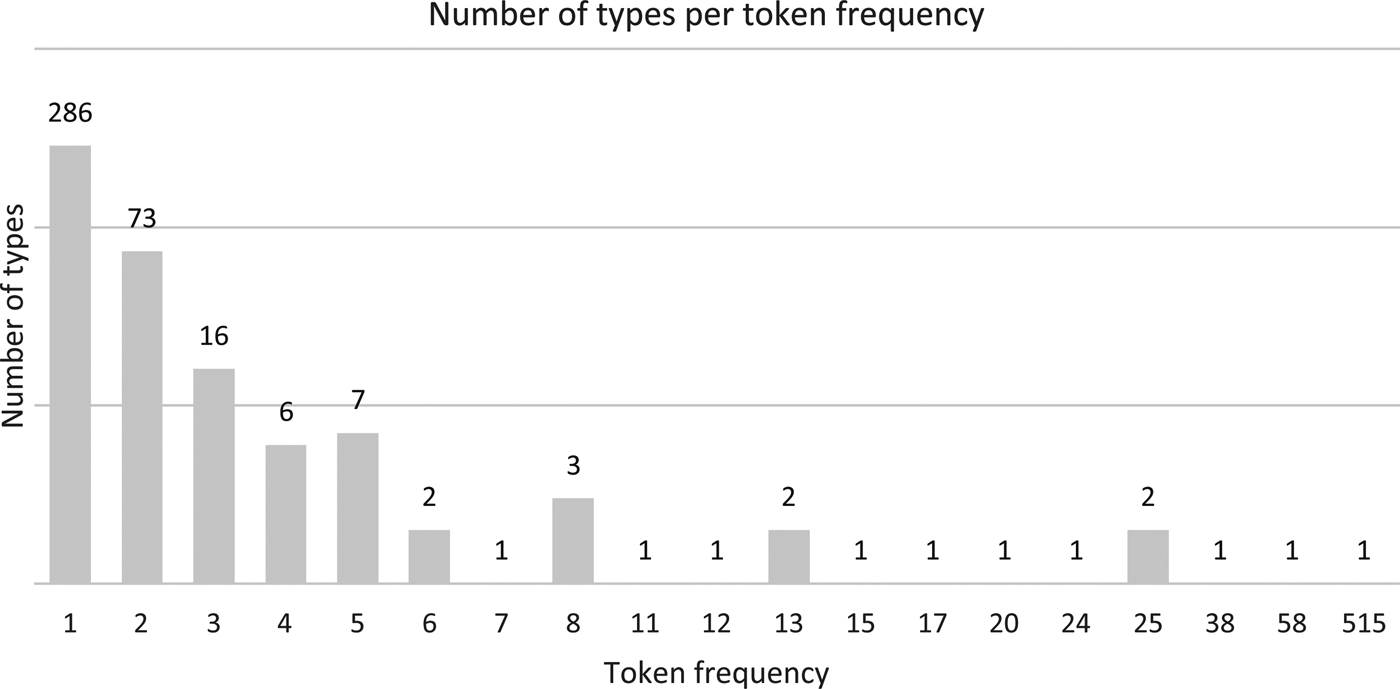
Since our research aim is to analyze the pragmatic meanings that can explain the variable content in the slot following #jesuis in #jesuis hashtags, we wanted to collect the most diverse sample possible of #jesuis hashtags used to date. In order to do so, we relied on a mixed approach combining manual and automatic methods. On the one hand, from 2015 through July 2016 we carried out continuous observation and manual retrieval of multimodal data including #jesuis memes, both hashtags and image memes (in a digital ethnographic way similar to that described by Sumiala et al. Reference Sumiala, Tikka, Huhtamäki and Valaskivi2016), with the aim of improving our understanding of the phenomenon. On the other hand, since it is not possible to search for all hashtags starting with #jesuis on Twitter without specifying the second slot, a specific procedure was devised for automatic retrieval. A script was developed to extract tweets using API.Footnote 2 From this corpus, we could then search for tweets starting with #jesuis. This method enables the widest possible search to be carried out, randomized by Twitter. As a result, while we do not claim to have an entirely exhaustive set of #jesuis hashtags, we obtained a representative subsample of all tweets containing #jesuis during the period in question that contains a very diverse range of #jesuis hashtags. A total of 1,378 tweets with a #jesuis hashtag, featuring 407 different #jesuis hashtags, was obtained between March and April 2016 (for a more detailed description of the extraction of tweets, see Naets Reference Naets2018). The six most frequent types (with more than twenty tokens each) account for approximately half of the total (685 tokens): #jesuisBruxelles (515), #jesuisCharlie (58), #jesuisPanama (38), #jesuisBrussels (25), #jesuisbelge (25), and #jesuisBoehmi (24) (see Figure 2). The dominance of hashtags related to the Brussels attacks is probably due to the timing of this collection phase. For both methods, tweets were collected regardless of the language in which they were published, thus offering a crosslinguistic perspective on the use of the #jesuis hashtags.
Number of types per token frequency in our database.

We are continuing to monitor the use of #jesuis hashtags. While new cases have appeared, for example, #jesuisQuebec following an attack on a mosque in Quebec City, these do not represent different uses than those described in this article.
The complete tweets are stored in an Excel database classified by the typographically normalized hashtag present in each tweet (arranged alphabetically). In this article, we have maintained the capital letters only with proper nouns. In the data, the use of capitals oscillates, but a detailed study of this phenomenon is beyond the scope of this article. Other information about the tweets (date, interactive nature—retweet, answer—etc.) and the Twitter user handle are also stored. For ethical reasons, the users’ names or nicknames have been eliminated, as well as the user handles that may be used in tweets (e.g. in retweets, replies, or tags). Where the presence of the Twitter handle is relevant, we have replaced it with @X. Except for this anonymization protocol, the examples are reproduced as they appear on Twitter, without any spelling corrections.
The hashtags were analyzed in terms of the element that follows the stem jesuis, in order to identify the events to which they refer. A qualitative analysis was then carried out in order to observe the possible connections between the 407 different hashtags. Despite the surface variability in the particular lexical elements, we can draw semantic connections between them: one group of hashtags refers strictly to terrorist attacks, another refers to other disasters or violent deaths, a third to news perceived as sad but not involving deaths, and finally another group points to a nonconforming/critical use of the hashtag. In the following sections, we present our analysis of these data with illustrative examples. We argue that the process of meaning broadening and formal evolution of #jesuis hashtags to a more general alignment meaning, which eventually also results in disalignment uses, is responsible for the continued production of new hashtags starting with #jesuis.
ANALYSIS
Broadening of meaning
The initial hashtag #jesuisCharlie establishes a direct identification between the speaker and Charlie Hebdo. The use of je suis ‘I am’ creates an identification between the speaker and Charlie, which, in turn, is a metonym for the staff of the magazine and/or for what happened to them. Note that the most popular and iconic hashtag is #jesuisCharlie, rather than #jesuisCharlieHebdo (the latter is also found, but to a much lesser extent). Besides being shorter—an important feature on a medium best known for its 140-character limit—#jesuisCharlie also has the advantage of including a name that could be a real person's name. In that sense, its identification purpose is perhaps more evident and lends itself better to the expression of empathy (Bazin Reference Bazin, Lefébure and Sécail2015:163–64). This personification reinforces the idea of sympathizing with the Charlie Hebdo staff, rather than with the magazine as an abstract institution, and is often reinforced further by a message of condolence (Smyrnaios & Ratinaud Reference Smyrnaios and Ratinaud2017:7).
Identification by means of this kind of construction is of course not unique: the strategy has been around for a long time, ranging from the grammatically disastrous Ich bin ein Berliner, expressing solidarity in difficult times for Cold War Berlin, to #IamLeicester following Leicester City's victory in the 2016 English Soccer league. The wordplay in #IAmsterdam is a specific example, in that it is clearly part of a marketing campaign that includes a huge sign bearing these words in one of Amsterdam's main squares. This identification strategy has therefore already been used to express solidarity or proud affiliation with a winning team or a vibrant city. In that sense, #jesuisCharlie clearly builds on a longstanding tradition. As we show, however, it is unique in the degree to which it has spread, in terms of both the diversity of causes that appear in the second slot and the languages with which it is combined, well beyond the French-speaking world. Moreover, the specific feature of #jesuisCharlie—and subsequent variations—is that it has acquired a predominant meaning of solidarity and condolence. Almost immediately, a wide range of other hashtags developed, also in tweets in other languages and/or mixing French #jesuis with other languages, as a result of the affordances of Twitter to use and adapt hashtags freely, and of the peripheral nature of hashtags. A variety of Twitter users have created bonds—have affiliated—with each other through the use of #jesuis hashtags, creating what Zappavigna (Reference Zappavigna2011) calls ‘ambient affiliation’, that is, the social bond with ‘a copresent (Goffman, Reference Goffman1963), impermanent community around evolving topics of interest’ (Zappavigna Reference Zappavigna2011:801). Through our analysis of the elements following #jesuis, we have been able to establish pragmatic similarities based on the causes present in the second slot. We show that the original condolence function has broadened into a more general marker of alignment with a variety of topics. This development goes hand in hand with the onset of a micro-lexicalization process of the marker, which we discuss further on.
Solidarity and condolence after terrorist attacks
First, the stem #jesuis has been used in similar constructions to express alignment with any cause related to terrorist attacks. These all accomplish the performative speech act of expressing condolence and condemning violence. The authors use a toponym that metonymically refers to the event and the victims involved. This place for event metonymy then becomes a very productive way to express solidarity with victims of attacks in a certain place, for example, #jesuisParis, #jesuisBruxelles, #jesuisBataclan (the concert hall in Paris where the attacks took place), #jesuisPakistan. An interesting case in this respect is #jesuisenterrasse (lit. ‘I am on a terrace’, after the attacks on Paris sidewalk cafés). While it may refer, as in (2), to the place where some of the November 2015 attacks occurred (made explicit by the mention of La Belle Equipe, one of the restaurants attacked) and express condolence, many Twitter users used #jesuisenterrasse to show resistance to the attacks (see (3)), proclaiming their commitment to continuing their way of life. Analysis of the results of a search focusing on this specific hashtag showed that the resistance use is more frequent than the condolence use.
(2) Memory Duty… #prayforparis #jesuisenterrasse @ La Belle Equipe https://t.co/ARKtaEblaV (English and French)
(3) Ils attaquent nos bars, nous répondons #jesuisenterrasse Ils attaquent nos sexualités, répondons #jefaislamour (French)
‘They attack our bars, we answer #jesuisonaterrace They attack our sexualities, let's answer #jefaislamour [‘I make love’]’
In addition to these place-linked hashtags, various others are used by Twitter users to identify with the victims, as in #jesuisbelge ‘I am Belgian’ after the March 22, 2016 attacks in Belgium, but also #jesuischien ‘I am dog’ after the death of a police dog during a raid on a flat occupied by terrorists.
All of the above examples refer to solidarity after incidents that have been regarded as terrorist attacks and, as such, the hashtags are a new way of expressing condolence. They have acquired a performative function (though the verb involved is not typically performative) and have become a pragmeme, ‘a generalized pragmatic act’ (Mey Reference Mey2001:211) associated with this kind of situation. The tweet in (4) similarly suggests that #jesuis has become associated with (Islamist) terrorist attacks, even if the tweet is cynical due to the deliberate use of hesitation following #jesuis (note the disfluency marks …uh…) and the rhetorical question “who's been shot up by islamists recently?”.
(4) #Jesuis…uh… who's been shot up by islamists recently? (English)
Other causes of human suffering
However, solidarity with victims of terrorist attacks has broadened so that #jesuis is also used to express alignment and condolence with any cause, in contexts that are not directly related to violent attacks, for example, #jesuisr é fugi é, #jesuisEcuador, #jesuisJoske. The case of #jesuisr é fugi é ‘I am refugee’ is the most ambivalent and closest to the original hashtags, in the sense that many refugees are fleeing violence in their home country.
In the case of #jesuisEcuador ‘I am Ecuador’, used following a massive earthquake in Ecuador, the hashtag certainly expresses solidarity with human suffering and the loss of loved ones, but the cause in this case is a natural disaster, not human violence. The hashtag #jesuisJoske ‘I am Joske’ was used by a few Belgian Twitter users after the death of Belgian comedian Gaston Berghmans, whose best-known character was a little boy called Joske. The hashtag therefore expresses solidarity with this character, who has now lost its creative father, as a way of expressing sadness at the death of Berghmans. The above-mentioned cases express solidarity with other people's suffering or, as in the last case, one's own sadness in a specific situation. Note that, in contrast with #jesuisEcuador, the #jesuisJoske hashtag arose in response to the natural death of a ninety-year-old, which may have been less unexpected than the deaths mourned in the hashtags previously discussed. All of these hashtags share with the original #jesuisCharlie solidarity with those in a situation of suffering and loss, thus creating ambient affiliation (Zappavigna Reference Zappavigna2014) through the gathering of ‘affective publics’ (Papacharissi Reference Papacharissi2015), but a violent terrorist cause of this suffering is no longer present.
These uses testify to the fact that Twitter allows for the immediate expression of condolence after disasters, which can become massive, as it was for #jesuisCharlie. It has been previously pointed out that digital storytelling on Facebook allows for new ways of expressing mourning (see also Giaxoglou Reference Giaxoglou2015), and Twitter, in a much more restricted character extension, has become undoubtedly a key mourning locus for many, though not approved by all, as we see later.
Broader societal causes
Solidarity may be expressed in other contexts, however, as shown in the following examples. The hashtag #jesuiscirconflexe ‘I am circumflex’ arose in the context of a French spelling reform causing the disappearance of the circumflex in many words. This hashtag is used to convey discontent with the reform, express mocking reactions (as we explain later) and disseminate merely informative listings of the main changes the reform involves without explicitly taking a stance. The fact that this hashtag also appears in tweets in other languages (see (6) and (7) below) is perhaps particularly striking, given the fact that it concerns a French spelling reform.
(5) Réforme stupide de l'orthographe!!! #ReformeOrthographe #JeSuisCirconflexe (French)
‘Stupid spelling reform!!! #SpellingReform #JesuisCircumflex’
(6) super late but feeling rather indignant about the Académie moving forward with this #jesuiscirconflexe http://www… (English)
(7) Hellyttävää, että ranskalaisilla on taas omat syynsä nurinaan #JeSuisCirconflexe #ranskankieli #uudistukset (Finnish)
‘Endearing that the French have yet another reason to complain. #JeSuisCircumflex #frenchlanguage #reform’
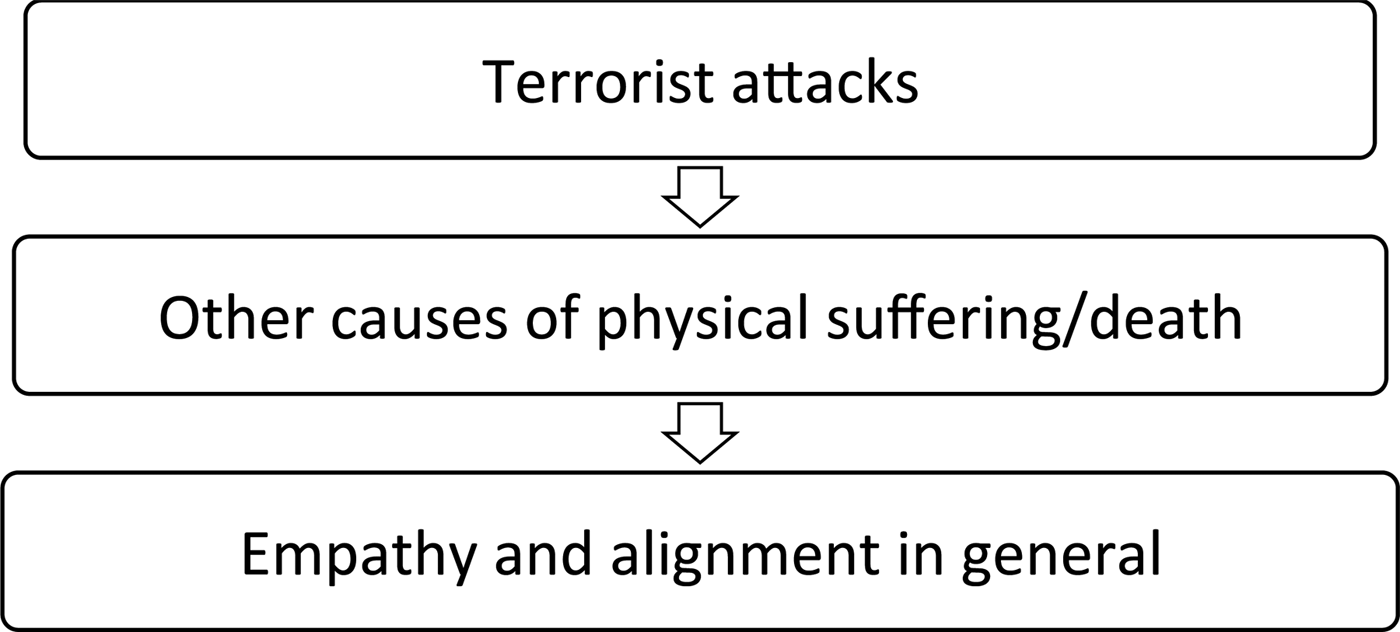
There is no link at all here with physical or other suffering as a result of human loss or pain; these Twitter users have taken up the hashtag to express solidarity with other types of causes, in this instance the figurative death of the circumflex. The idea of being attacked may still have been the origin of this use, though. We notice in these and similar uses a gradual broadening of meaning from solidarity with the victims of a terrorist attack to the expression of support in much broader contexts, as summarized in Figure 3. Note that the different uses appeared very quickly after the initial hashtag and, up to now, continue to be present in newly created #jesuis hashtags.
Summary of the meaning broadening.

Freedom of speech
So far we have focused on the development of hashtags based on #jesuis to express condolence and solidarity with deaths or suffering. For many people, however, #jesuisCharlie was also a way to align with those attacked when claiming freedom of speech, in addition to (or even rather than) expressing mourning. This especially holds for rather polemic expressions concerning freedom of speech. Interestingly, this meaning has given rise to fewer hashtags, even though it is much more in line with the spirit of the Charlie Hebdo magazine, which defines itself as ‘a punch in the face. Against those who try to stop us thinking. … It's a periodical that argues and a journal that thinks’.Footnote 3 Indeed, some creative uses of #jesuis also focus on this idea of freedom of thought and expression in polemic contexts. This emphasizes a certain culture-specificity of some uses, since freedom of speech is not valued the same way in different cultures.
The most widespread hashtag of this type is #jesuisBoehmermann (and its variant #jesuisBoehmi), when German comedian Jan Boehmermann recited an obscene satirical poem about Turkish Prime Minister Erdogan, which led the latter to file a complaint against Boehmermann, shown in (8). In this case, the support expressed by means of #jesuis is a claim for freedom of speech in the context of a conflict with a political leader concerning political satire. The freedom-of-speech claim also occurs in more local contexts, as in (9). Eddy De Smet is a Belgian headmaster in the city of Ronse, who was suspended after sending an insulting email to Secretary of State Liesbeth Homans, comparing her party to the Nazis.
(8) In Germania un comico rischia 5 anni di carcere per aver fatto satira su Erdogan. Ma la loro stampa è libera … #JeSuisBoehmermann ? (Italian)
‘In Germany a comic risks 5 years in jail for having satirized Erdogan. But their [German] press is free… #JeSuisBoehmermann?’
(9) RT @X: Vrijheid v meningsuiting? Schooldirecteur Ronse bekoopt scheldmail aan Homans: directeur af #jesuiseddydesmet https:… (Dutch)
‘RT @X: Freedom of speech? Headmaster Ronse pays for insulting mail to Homans: no longer headmaster #jesuiseddydesmet https:…’
Although the hashtags supporting freedom of speech could have been considered as expressing solidarity for broader societal causes, we believe that the notion of freedom of speech is prominently linked to Charlie Hebdo, as has been studied before (Giglietto & Lee Reference Giglietto and Lee2017:6), and thus deserves special attention. As shown elsewhere, the double standard concerning freedom of speech displayed by those who tweet #jesuisCharlie has also been the subject of criticism on Twitter (Pizarro Pedraza & De Cock Reference Pizarro Pedraza, Cock, Cougnon, Cock and Fairon2018).
In sum, in this section we have explained the basic pragmatic function of the hashtags based on #jesuis: broadly, expressing alignment with a cause, not only after (violent) deaths, as in its original form, but also with virtually any topic of concern. The uses expressing solidarity with human suffering are more frequent in our dataset and continue to appear following new attacks or major disasters. The more general aligning uses, but also the disaligning ones (which are discussed later), continue to appear.
Formal evolution
In this section, we discuss formal indications of an increasing independence and invariability of #jesuis, which seems to have become lexicalized, motivating the impressive combinatorial possibilities exemplified to date. First of all, there are several features of #jesuis hashtags that point to a lexicalization process, that is, ‘the process that turns linguistic material into lexical items’ (Wischer Reference Wischer, Fischer, Rosenbach and Stein2000:359). However, since the process is fairly recent, we consider it, for now, a micro-lexicalization process, which may mark the onset of a full-fledged lexicalization process, depending on the future functional needs of the speakers. The following elements show the formal evolution and onset of lexicalization. The first part of the #jesuis hashtag is almost invariable: as mentioned earlier, despite some rare cases, the hashtag is based on the first person singular and the present tense. This invariability goes together with a loss of compositional meaning typical of semantic lexicalization (Bauer Reference Bauer1983:50–61, in Wischer Reference Wischer, Fischer, Rosenbach and Stein2000:358), since instead of the literal identificatory meaning, #jesuis hashtags have developed the aforementioned nonliteral meanings of condolence and solidarity. In other words, specific pragmatic meanings are lexicalized on the item #jesuis, which is preceded by the punctuation mark # in digital contexts but not necessarily in other formats such as on banners, sculptures, or drawings.
Second, the hashtag #jesuis appears in some tweets independently, with the attribute presented as a separate hashtag, as is the case for #refugee in (10). This suggests that the speaker has distinguished between two segments, namely #jesuis and #refugee, which may each function individually and allow independent searches. Note that this separation does not happen in the Spanish hashtag #soyrefugiado (which has the same meaning), which underlines the fact that the stem #jesuis is autonomous while #soy is not.
(10) #jesuis #Refugee #SoyRefugiado Sobran las #palabras, hacen falta #hechos. (Spanish)
‘#jesuis #refugee #Iamrefugee There are too many #words, #facts are lacking.’ (accompanied by photos of refugees)
Third, while some variants are grammatically correct in standard French, such as #jesuisParis and #jesuisenterrasse, others are less so. For example, #jesuischien would require an article in Standard French: je suis un chien ‘I am a dog’. The lack of the article hints, in our view, at the nonliteral meaning of this phrase and at the willingness to copy an existing pattern, namely #jesuis + noun. Furthermore, in cases where number or gender variation is possible (which does not hold for the large group of toponyms and proper nouns), singular-plural concordance is not necessarily respected, and neither is gender concordance with the Twitter user. For example, #jesuisCharlie can be used by male and female Twitter users alike. This shows again that #jesuis can no longer be considered to function as a normal copular verb.
Fourth, the use of #jesuis supplemented with elements from other languages also suggests an increasing independence of the unit #jesuis. Again, some of these uses relate to terrorist attacks, such as (11), which moreover places solidarity with the Brussels victims in a context of overall rejection of violence, by means of both the hashtag #NoALaGuerra ‘#NoToWar’ and the hashtag #JeSuisAllTheWorld. The latter clearly aims at expressing more general solidarity with anyone who is suffering from violence in this world, irrespective of the place. In this sense, it also counters a criticism that has sometimes been made, namely that #jesuis hashtags appear more frequently following attacks on Western cities than those on cities in the Middle East or Africa (see Pizarro Pedraza & De Cock Reference Pizarro Pedraza, Cock, Cougnon, Cock and Fairon2018).
(11) RT @X: Ni un atentado más ! #JeSuisBruxelles #NoALaGuerra #JeSuisAllTheWorld https://t.co/39VJPrmhjm (Spanish)
‘RT @X: Not another attack! #JeSuisBruxelles #NoToWar #JeSuisAllTheWorld https://t.co/39VJPrmhjm’
The following multilingual examples deal with other issues that fall within the scope of the above-mentioned broadening of meaning, namely solidarity with other causes of human suffering, as in (12), with political change, as in (13), or freedom of speech defense, as in (14). This shows that #jesuis is recognizable for speakers of other languages, not only in its initial meaning but also in its more creative uses as an expression of alignment.
(12) RT @X: El Mundo No puede permitir q un campo de Refugiados se convierta en un campo de Concentración #jesuisRefugiado https://t… (Spanish)
‘RT @X: The world cannot allow that a refugee camp becomes a concentration camp #jesuisrefugee https://t…’
(13) Is #jesuisUK al trending? (Dutch tweet concerning the Brexit vote)
‘Is #jesuisUK already trending?’
(14) Heute ist also der Anfang vom Ende der Ära #Merkel #jesuisboehmermann #jesuisböhmi #EnKötüBaşkan #kaçAKP @janboehm https://t.co/SnGLGyosEe (German and Turkish)
‘Today is also the beginning of the end of the #Merkel era #jesuisboehmermann #jesuisböhmi #theworstpresident #goawayAKP @janboehm https://t.co/SnGLGyosEe’
The ongoing lexicalization of #jesuis becomes even more apparent when we consider that #jesuis has acquired a more abstract meaning of a pragmemic nature, representing a whole class of tweets typically associated with mourning or solidarity. On a formal level, this is clear from the use of #jesuis as an adjective modifying ‘messages’, which implies the existence of the ‘#jesuis messages’ (as in (15)). In these cases, the Twitter user certainly associates #jesuis with its meaning of alignment.
(15) But ISIS are getting their #jesuis equivalent messages posted by the online wankers who support the ‘Syrian’ rebels @X (English)
While this process is ongoing on Twitter, the use of print signs and T-shirts based on #jesuis to express solidarity with a certain cause in public demonstrations suggests that it is also relevant outside the Twittersphere. The online/offline convergence in the use of other hashtags has also been described by Heyd & Puschmann (Reference Heyd and Puschmann2017).
Emblematic status
We mentioned earlier that #jesuis has acquired an emblematic status of a particular kind of social identity. We now develop this argument. It is very clear that #jesuis has the three characteristic properties of an emblem stated by Agha (Reference Agha2007:235): first, it is ‘a perceivable thing, or diacritic’, as shown by lexicalized uses such as example (15), where #jesuis is recognized as ‘a thing’ that can be the object of metalinguistic reference. Second, there is also a kind of recognizable ‘social persona’ associated with it (Agha Reference Agha2007:235). Through metonymy, in (16) les #jesuis ‘the #jesuis’ refers to the Twitter users that post #jesuis-based hashtags as a type of persona that uses them to show alignment and support for victims of disasters, as mentioned earlier. Of course, the slot following #jesuis offers more specific information concerning how Twitter users wish to construct their identity and with which specific causes they wish to align, but the very use of the #jesuis hashtag as a resource points already to a particular kind of Twitter identity behavior. Third, there is also ‘someone for whom it is an emblem (i.e. someone who can read that persona from that thing)’ (Agha Reference Agha2007:235). This criterion is evidently present in examples such as (16), where the Twitter user explicitly links the use of #jesuis to the mentioned kind of persona through a labelling act. As is typical of labelling practices, the clear association of #jesuis with a certain group of people serves the purpose of social stereotyping, in that it ‘becomes the overt topic of social comment’ (Labov Reference Labov1972:180). In tweets where #jesuis is used as a label, it connotes an implicit criticism, often suggesting that these Twitter users care only about attacks on Western European cities and do not express sufficient alignment with victims of attacks in other regions such as Africa or the Middle East. In (16), the rhetorical question “Where are you, the #Jesuis?” following attacks on Aleppo, in Syria (the link in the tweet leads to photos of Aleppo), questions the #jesuis users about their absence, that is, their lack of reaction.
(16) Où êtes-vous les #Jesuis? http://fb.me/2TvEpVC1F (French)
‘Where are you, the #Jesuis? http://fb.me/2TvEpVC1F’
We consider this another sign that #jesuis has become emblematic of a certain group of people, namely those who express their condolences after Western terrorist attacks by means of #jesuis and, by extension, through social media, but without taking real social action (Pizarro Pedraza & De Cock Reference Pizarro Pedraza, Cock, Cougnon, Cock and Fairon2018). Many Twitter users use #jesuis hashtags to express alignment with the victims and affiliation with a group of people who strongly condemn this type of terrorist attack. Yet, the critical reference in (16) shows that these hashtags are perceived as (morally) unacceptable mourning behavior by some Twitter users who do not approve of the use of #jesuis, or who do not see them as a true solidarity gesture. Crucially, the alignment functions of #jesuis and its development as an emblem of a certain kind of Twitter user provide the material for the development of disalignment uses of the hashtag.
DISALIGNMENT
So far, we have shown how alignment with the victims of the Charlie Hebdo attacks through #jesuisCharlie has developed both semantically and formally, leading to a more general expression of alignment with a variety of causes, including in languages other than French. In this section, we show how #jesuis has also developed into an expression of disalignment, often through mocking uses based on imitating the original linguistic behavior (Norrick Reference Norrick1993), in this case the aligning uses of #jesuis hashtags. In fact, humorous effect, sometimes through maxim flouting, has also been documented for other hashtags (Wikström Reference Wikström2014:144; Schwell Reference Schwell2015).
Note that the strong association of #jesuis with alignment is necessary for parodying or for mocking uses expressing disalignment to make sense. As such, the disalignment uses are ex abstracto further proof of the specific alignment meaning that #jesuis has developed. We make a distinction between disalignment de re (linked with semantic variation of the attribute following #jesuis) and disalignment de dicto (disalignment with the process of using #jesuis).
Disalignment de re is achieved by combining #jesuis with fake causes to support. Charlie Hebdo, for example, does this in the following cartoon (See Figure 4) concerning the Panama papers, copying the original printed #jesuisCharlie sign, including the Charlie Hebdo typography. The hashtag #jesuisPanama was also prolific on Twitter and copies the structure of one of the early uses of the hashtag, as in #jesuisParis, namely identification with a place. This echoing of the original #jesuisCharlie through the linguistic construction and, in the case of this cartoon, by typographically echoing the original sign by Roncin, shows its ironic purpose (Clift Reference Clift1999). Its ironic effect lies in ‘the mismatch between [this] expectation and what is actually said’ (Clift Reference Clift1999:536). This is because we expect #jesuis to be followed by a cause we spontaneously sympathize with, related to human suffering and attacks. This creates a ‘script incompatibility’ (Raskin Reference Raskin1985; Attardo & Raskin Reference Attardo and Raskin1991).
Cover Charlie Hebdo, 6/4/2016.Footnote 4

The fact that this identification is mocking can be deduced in the first place from world knowledge; readers know that the individuals affected by the Panama papers scandal are rich and, therefore, much less likely to be considered victims or people in a difficult position with whom we are likely to sympathize. This is a first indication of a lack of sincerity in what takes the form of an expression of solidarity via Twitter. Second, the hashtag may appear combined with other humorous features, for example, the Charlie Hebdo (or other) cartoons (see (17), which includes a link to the cartoon) or pictures of panama hats. However, the hashtag regularly appears in tweets where the rest of the content is not necessarily humorous but reports on the Panama papers in a neutral or critical way, as in (18), announcing the resignation of the Icelandic Prime Minister. Thus, the mocking effect is limited to the hashtag. Taking into account the specific nature of hashtags as graphically and, at times, syntactically peripheral, topicalizing elements (Zappavigna Reference Zappavigna2015), hashtags appear to be an ideal locus to express a disapproving attitude through mocking uses. In examples such as (17) and (18), the hashtag is not only graphically detached from the rest of the utterance but also syntactically. This detached position offers the opportunity to formulate a mocking hashtag as an afterthought, commenting on an otherwise fairly neutral announcement, as in (18).
(17) RT @X: El daño que se ha hecho a esos pobres evasores de impuestos merece toda nuestra solidaridad #JeSuisPanama https://t.co/2FW2... (Spanish)
‘RT @X: The damage that has been done to those poor tax evaders deserves all our solidarity #JeSuisPanama https://t.co/2FW2...’
(18) https://t.co/m4FGO4CQFz Dimite el primer ministro de Islandia por lo de los ‘Papeles de Panamá’ #JeSuisPanama (Spanish)
‘https://t.co/m4FGO4CQFz The Prime Minister of Iceland resigns because of the ‘Panama Papers’ #JeSuisPanama’
As with the alignment uses, #jesuis may be combined with different types of predicates to express disalignment, not only toponyms. In reaction to #jesuischien, which expressed mourning for the death of a police dog in a counterterrorism action, a series of semantically related hashtags including other animals was produced by people who considered the solidarity expressed in #jesuischien to be exaggerated. The disaligning Twitter users include in their hashtags animals from an even lower position on the animacy scale (cf. Yamamoto Reference Yamamoto1999), for example, in (19) #jesuiscafard ‘#jesuiscockroach’ and #jesuisfourmi ‘#jesuisant’ to mock the #jesuischien tweet and its author. Because of their lower position on the animacy scale and their perceived greater harmfulness, most humans would not feel particularly emotional about the death of cockroaches or ants and, indeed, would be happy to exterminate them. These parodies often include reference to the original #jesuischien, thus making it explicit that they are parodying and ridiculing the initial hashtag. In (19), the author explicitly categorizes #jesuischien as pathetic and includes emoticons expressing the intended mocking effect. Through imitation (of the initial hashtag) (Norrick Reference Norrick1993), the user mocks the author(s) of the initial #jesuischien hashtag and those who subsequently used it, more particularly by targeting their tendency to exaggerate (Drew Reference Drew1987). By doing so, the author of (19) disaffiliates him/herself from these people. This kind of example illustrates very well that humor is based on challenging the boundaries of the pragmatic act of condolence, since the limits of what qualifies as a death worthy of condolence are set at the dog's death for some, and at the death of humans for others.
(19) Penser au fourmis et cafard qui meurent tous les jours. De grand guerrier. #JeSuisFourmis #JeSuisCafard
#JeSuisChien Pathétique (French)‘Think about the ant and cockroach that die every day. Great warrior. #JeSuisAnt #JeSuisCockroach
#JeSuisDog Pathetic’
 #JeSuisChien Pathétique (French)
In the above cases, a pattern originally used in the context of terrorist attacks (#jesuis + place/victim) is copied and parodied. However, uses with a broader meaning expressing support (and not necessarily sympathy) are also parodied. In Spain, the hashtag #jesuisgafas ‘#jesuisglasses’ was used quite widely after a young man attacked Prime Minister Mariano Rajoy, resulting in Rajoy's glasses being broken. Twitter users then expressed their ironic support for Rajoy's glasses, which suffered in the attack, as in (20).
(20) tanto recorte en educacion trae estas cosas mariano #rajoy #JeSuisGafas (Spanish)
‘That many cuts in education brings about these things mariano #rajoy #JeSuisGlasses’
The fact that this parody is based on a hashtag originally used to condemn violence is clear in Figure 5, which was frequently shared by means of #jesuisgafas and which contains a direct reference to the idea of condemning violence.
Screenshot of tweet #jesuisgafas. Translation: ‘#jesuisglasses We want to condemn any violence exercised against glasses’.

Finally, creative uses may also show disalignment de dicto, that is, with the process of using #jesuis by ridiculing not a certain cause, but the people who use #jesuis hashtags, of whom they are emblematic (Agha Reference Agha2007). In (21), the stem is used to indicate the superficiality of the process itself. It ridicules Twitter users by using a derogatory adjective, e.g. #jesuiscon ‘#Iamstupid’.Footnote 5 In this case, the context makes it possible to interpret the reading of the lexicalized stem #jesuis as nonfigurative. In fact, through ‘alternating grounds’ (Rubba Reference Rubba, Fauconnier and Sweetser1996), the speaker does not describe him/herself as stupid, but rather points out how another Twitter user should describe him/herself (see (21)) in a sort of hypothetical reported speech (with a zero introducer). The indexical relation between je ‘I’ and the Twitter user in #jesuis hashtags is subverted and je becomes someone different than the I of the user.
(21) @X ras-le-bol de ces #jesuis! Charlie ça avait un sens, mais là c'est surtout #jesuiscon! (French)
‘@X enough of those #jesuis! Charlie, that had a meaning, but now it's mainly #jesuisstupid!’
More general disalignment with the bombings and the way in which they are being dealt with appears in tweets such as (22). The fact that #jesuis is completed with lo que sea ‘whatever’ shows that the Twitter user is skeptical about the mobilizing force of #jesuis hashtags as a way of protest.
(22) RT @X: Cronología del terrorismo: -Atentado -#Jesuisloquesea -Detenciones -Bombardeos con F-16 -Repita de nuevo (Spanish)
‘RT @X: Chronology of terrorism: -Attack -#Jesuiswhatever -Detentions -Bombings with F-16 -Repeat again’
These uses in which disalignment de dicto is evident implicitly recognize the specific aligning effect of #jesuis, since they use #jesuis to represent a whole set of practices and even the people who carry them out. What underlies this kind of disalignment is criticism of the superficiality of such a protest, which does not qualify as real social mobilization or support. In this case, for the purpose of (darker) humor, the very pragmatic act of expressing condolence through #jesuis is situated outside the boundaries of ‘real’ or consequential social protest.
CONCLUSIONS
With this qualitative study of a wide range of creative uses of hashtags starting with #jesuis, we have shown that the original hashtag #jesuisCharlie rapidly gave rise to a variety of others, with more than 407 types in our 1,378-token database. These built on the expression of alignment realized through the original #jesuisCharlie, extending this alignment from solidarity and condolence for victims of terrorist attacks, deaths, and physical suffering due to other causes, to solidarity with any kind of cause, even those not involving physical or other suffering. The cause with which the Twitter user expresses solidarity appears in the second slot of the hashtag.
We have furthermore shown that this broadening of meaning goes hand in hand with a formal evolution in which #jesuis gradually becomes an independent element that may be used separately, in ungrammatical constructions and/or in combination with languages other than French. This evolution suggests the onset of a lexicalization process. We have also demonstrated how #jesuis is becoming emblematic of a certain kind of people, namely Twitter users that express condolence or solidarity through this kind of hashtag.
Following this analysis of how #jesuis hashtags express alignment, we have further shown how disaligning uses also developed almost simultaneously with aligning ones. These disaligning uses may express, on the one hand, disalignment with the causes invoked, often through mocking uses. In these cases, they parodically echo the initial uses, thus confirming the specific pragmatic meaning developed by #jesuis hashtags. On the other hand, we analyzed various cases of disalignment with the practice of using #jesuis hashtags, showing again that these hashtags have acquired an emblematic value, representing certain types of people, who in these cases are criticized.
The wide variety and continuing development of creative uses based on #jesuis show that the functions of hashtags do indeed go far beyond labelling or categorizing. Twitter users exploit the affordances of Twitter across languages in order to align and disalign, and to index themselves, thus creating ambient affiliations.
The case of #jesuis hashtags exemplifies an interesting opposition between those who adopt a global resource and those who reject it. In situations of violent deaths, crisis, or disasters, the affordances of Twitter become crucially problematic, since the gravity of the situation seems to clash with the format and the effortlessness of the resource. In that sense, Twitter allows for aligning massively and immediately with a global affective public through hashtags such as #jesuisCharlie and its variants, but many other users ask themselves how consequential that alignment is. It is beyond doubt that, for many, affective displays such as #jesuis hashtags are genuinely valid ways of showing support and condolence, while many others judge them through a different moral lens. These kinds of phenomena show the importance of Twitter (and other social media) for the analysis of social conflict and the pragmatic strategies through which it may be expressed.