Analysis of the linguistic skills of Williams syndrome (WS) children and adolescents has focused on the debate about the relative “sparing” of their lexical and grammatical capabilities, primarily using tests of language use in isolated contexts. Studies looking at language at the sentence level limit our ability to explain how these individuals use language in functional contexts. Because of their strengths in spontaneous speech and conversations, WS individuals’ pragmatic capabilities have largely been taken for granted, and not as extensively studied. To fully understand the extent of the linguistic profile of WS children, there is a need to look at how discrete linguistics elements are used in discourse contexts.
Narratives are a suitable genre for examining the use of language in an embedded context, for example, discourse. Studies that have examined narratives constructed by WS individuals have looked at grammatical accuracy and complexity, but only a few have examined how grammatical elements are used to create and develop the narrative itself (e.g., Lorusso, Galli, Libera, Gagliardi, Borgatti, & Hollebrandse, Reference Lorusso, Galli, Libera, Gagliaridi, Borgatti and Hollebrandse2007; Stojanovik, Perkins, & Howard, Reference Stojanovik, Perkins and Howard2004). The current study examines the use of cohesive devices including tense, connectives (such as and, because, therefore), pronouns, and determiners in the oral narratives of children and young adolescents with WS compared to typically developing children.
WS is a rare, genetically based neurological disorder characterized by growth and developmental delays, heart defects, mental retardation, and distinctive facial features (Bellugi, Lichtenberger, Mills, Galaburda, & Korenberg, Reference Bellugi, Adolphs, Cassady and Chiles1999; Mervis, Morris, Bertrand & Robinson, Reference Mervis, Morris, Bertrand, Robinson and Tager-Flusberg1999). The WS population is notable because of their distinct cognitive profile, which includes very strong abilities in face recognition, language, verbal and nonverbal auditory memory, alongside severe deficits in visual–spatial abilities, and perceptual planning for motor tasks (Atkinson, Anker, Braddick, Nokes, Mason, & Braddick, Reference Atkinson, Anker, Braddick, Nokes, Mason and Braddick2001; Bertrand & Mervis, Reference Bertrand and Mervis1996). Williams children's strong language abilities are present despite early acquisitional delays (Mervis & Becerra, Reference Mervis and Becerra2007; Singer-Harris, Bellugi, Bates, Jones, & Rossen, Reference Singer-Harris, Bellugi, Bates, Jones and Rossen1997). A hallmark characteristic of this population is their intense sociability and seemingly remarkable language facility.
There are anecdotal reports that individuals with WS have good conversational skills and an ease when approaching strangers (Gosch & Pankau, Reference Gosch and Pankau1997; Tomc, Williamson, & Pauli, Reference Tomc, Williamson and Pauli1990). WS individuals demonstrate an unusual lack of typical social fears. WS individuals perceive strangers as more approachable than typically developing (TD) individuals do. Compared with TD, autistic, and Down syndrome (DS) children, WS individuals are rated by their parents as being highly sociable with strangers (Bellugi, Adolphs, Cassady, & Chiles, Reference Bellugi, Lichtenberger, Mills, Galaburda and Korenberg1999; Doyle, Bellugi, Korenberg, & Graham, Reference Doyle, Bellugi, Korenberg and Graham2004; Jones et al., Reference Jones, Bellugi, Lai, Chiles, Reilly and Lincoln2000). Very young children (15–58 months) also show lower levels of distress when separated from their parents (Jones et al., Reference Jones, Bellugi, Lai, Chiles, Reilly and Lincoln2000). This fascination and ease with strangers, and lack of discomfort with being separated from a parent at these young ages demonstrates the early roots of WS individuals’ highly social nature, which is consistently evident throughout their development. This “hypersociability” and early intense interest in people over things may contribute to their ultimate linguistic development and their perceived ease with conversational interactions (Doyle et al., Reference Doyle, Bellugi, Korenberg and Graham2004; Jones et al., Reference Jones, Bellugi, Lai, Chiles, Reilly and Lincoln2000; Udwin & Yule, Reference Udwin and Yule1990). WS individuals’ unusually high level of sociability, however, can also result in vulnerability to exploitation and overfriendliness, which is inappropriate for standard social settings (Dykens, Hodapp, & Finucane, Reference Dykens, Hodapp and Finucane2000; Laing et al., Reference Laing, Butterworth, Ansari, Gsödl, Longhi and Panagiotaki2002).
The WS population has been of interest to linguistic researchers because of their apparently “intact” language despite other cognitive deficits, a profile that seemed to support the idea that language and nonlinguistic cognition may be independent of each other. This assertion has been the cornerstone of debate between those who maintain that their language is intact or “preserved” relative to their other impairments (e.g., Bellugi, Bihrle, Neville, Doherty, & Jernigan, Reference Bellugi, Bihrle, Neville, Doherty, Jernigan, Gunnar and Nelson1992; Clahsen & Almazan, Reference Clahsen and Almazan1998, Reference Clahsen and Almazan2001), and those who see it simply as a relative strength within the cognitive profile defining the syndrome (e.g., Karmiloff-Smith et al., Reference Karmiloff-Smith, Grant, Bethoud, Davies, Howlin and Udwin1997). Studies to date suggest that the linguistic phenotype of individuals with WS is complex and heterogeneous (Stojanovik, Perkins, & Howard, Reference Stojanovik, Perkins and Howard2006). A recent comprehensive review by Brock (Reference Brock2007) concludes that there is strong evidence for specific areas of strength (receptive vocabulary), and weakness (spatial language), but not enough evidence to support claims that language is intact, nor to support dichotomies between grammatical and lexical abilities, or phonological and lexical abilities (also see Mervis & Becerra, Reference Mervis and Becerra2007).
Research on grammar has shown that relative to their IQ's, individuals with WS have strong receptive grammar skills, and strengths relative to their mental ages with regular grammatical structures (e.g., regular vs. irregular past tense), but overall they still exhibit weaknesses compared to typically developing age-matched controls (Clahsen, Ring, & Temple, Reference Clahsen, Ring, Temple, Bartke and Siegmuller2004; Joffe & Varlokosta, Reference Joffe and Varlokosta2007; Karmiloff-Smith et al., Reference Karmiloff-Smith, Tyler, Voice, Sims, Udwin and Howlin1998; Perovic & Wexler, Reference Perovic and Wexler2007).
In terms of spontaneous speech, individuals with WS exhibit fluent speech and an extensive vocabulary (Rossen, Klima, Bellugi, Bihrle, & Jones, Reference Rossen, Klima, Bellugi, Bihrle, Jones, Beitchman and Cohen1996; Tyler et al., Reference Tyler, Karmiloff-Smith, Voice, Stevens, Grant and Udwin1997). They also use a variety of syntactic structures in their spontaneous speech (Bellugi et al., Reference Bellugi, Bihrle, Neville, Doherty, Jernigan, Gunnar and Nelson1992). However, it is unclear whether WS individuals are always appropriately engaged in interactions. Philofsky, Fidler, and Hepburn (Reference Philofsky, Fidler and Hepburn2007) reported impaired pragmatics in WS children (mean chronological [CA] age = 9 years, 1 month [9;1]) as measured by the Children's Communication Checklist (Bishop, Reference Bishop1998). In an older group (mean CA = 14;10), Law and Bishop (Reference Law and Bishop2004) found that WS individuals showed more pragmatic impairment than TD individuals and similar performance to individuals with DS and specific language impairment (SLI). The WS group performed notably worse on the subscales related to building connectedness and understanding among interlocutors: stereotyped conversation, initiation of conversation, the use of context for conversation, and development of conversational rapport. Other studies have reported that WS individuals showed difficulties in interactions especially in responding to interlocutors appropriately (Davies, Udwin, & Howlin, Reference Davies, Udwin and Howlin1998; Udwin & Yule, Reference Udwin and Yule1991).
Studies of conversational interactions comparing children with WS (mean CA = 9;06) and SLI (mean CA = 9;09) have found variability in WS children's conversational language skills (Stojanovik, Reference Stojanovik2006; Stojanovik et al., 2001). The most notable finding from Stojanovik et al. (2001) is the tendency for the WS group to provide too little information, which is unexpected, given the anecdotal perception of WS individuals as talkative. By contrast, they found that SLI children commonly provide too much information even though their overall linguistic skills are impaired. This tendency to provide inadequate information was also observed in a slightly larger study (Stojanovik, Reference Stojanovik2006), which also found that WS individuals respond inadequately to requests for clarifications, and have difficulty interpreting literal or inferential meanings compared to TD children.
A recent study by John, Rowe, and Mervis (Reference John, Rowe and Mervis2009) examining children's proficiency to identify and communicate message inadequacy found that WS children reported communication breakdowns to their conversation partners only half of the time. Moreover, the authors report that the children's performance on first order theory of mind (ToM) tasks (unexpected contents false belief), a measure of one's ability to infer the mental states and intentions of others, was the most predictive of the child's ability to identify and communicate a problem.
These findings may reflect that WS individuals have difficulties in appreciating what their interlocutors may know (shared information) and/or an inability to determine what their listener might be interested in. Stojanovik et al. (2001) observed that WS children can be quite verbose when talking about subjects they like, but talk very little about subjects that are not of interest to them. Such insensitivity of WS children to appreciate what the interlocutor knows or needs to know may be associated with ToM difficulties observed in this population. Especially relative to children with autism spectrum disorders to whom they are typically compared as having “opposite” profiles, WS children have been presumed to have superior performance on ToM because of their strong verbal skills and increased empathy (Gosch & Pankau, Reference Gosch and Pankau1997; Jones et al., Reference Jones, Bellugi, Lai, Chiles, Reilly and Lincoln2000). However, they have been reported to have difficulties with representational aspects of ToM. Tager-Flusberg and Sullivan (Reference Tager-Flusberg and Sullivan2000) have defined a componential approach to ToM that divides it into representational components (social-cognitive ToM) and affective components (social–perceptual ToM). Compared with age and IQ matched children with Prader–Willi and nonspecific mental retardation, the WS children performed worse on the false belief task, which taps into representational capabilities that are not highly dependent on emotional perception. On social–perceptual tasks, they performed similarly to the other groups.
Using nonverbal tasks to control for WS children's relative linguistic advantage, Porter, Colheart, and Langdon (Reference Porter, Coltheart and Langdon2008) found that WS children performed worse on false belief tasks than mental age (MA)-matched peers. In tasks measuring understanding of pretence and intention, they performed similarly to MA-matched children, and both groups performed worse than the chronological age (CA)-matched group. Together, these findings demonstrate that WS children showed no superior ToM skills overall with respect to their MA, and are actually more impaired in false belief tasks. The Porter et al. (Reference Porter, Coltheart and Langdon2008) study also showed that there is variability in performance among WS children with different phenotype profiles. WS individuals without perceptual deficits and more deficits in spatial perception, response inhibition, and emotion perception, actually performed better on the false belief task than a WS subgroup with the opposite phenotype. The difference between the WS subgroups was not seen for the pretence and intention tasks. This would indicate that WS children experience difficulties with aspects of ToM for which they cannot tap into their strengths in emotional perception, particularly those children with perceptual problems.
A recent study by Santos and Deurelle (Reference Santos and Deruelle2009) showed that WS individuals made more errors than TD controls on both a ToM task (attribution of intention) and the control task (physical causality) in both verbal and visually based tasks. The WS group, as may be expected given their relative verbal strengths and visual impairments, made more errors on the visual task than the verbal task. Although they did not show worse performance on the attribution of attention task, the differences between verbal and visually based tasks were greater for the attribution of attention.
As a whole, the findings indicate that WS children have particular trouble with aspects of ToM requiring them to demonstrate understanding of what other people know, in contrast to what people feel, or with understanding general cause and effect relationships. Such weaknesses could be relevant to their use of language in discourse settings, and go toward helping to explain reported problems with sharing and repairing informational difficulties in conversational interactions.
Given the controversy with regard to WS individuals’ grammatical and lexical competence and their particular pragmatic difficulties, examination of cohesion in narratives by these individuals can be a useful approach to assessing their linguistic competence within discourse contexts. Narrative development follows a distinct pattern that relates to, but is distinct from, development and acquisition of linguistic forms. A fundamental aspect of narrative development in children is learning to use the grammatical elements in narratives for cohesive purposes (Berman & Slobin, Reference Berman and Slobin1994; Hemphill, Picardi, & Tager-Flusberg, Reference Hemphill, Picardi and Tager-Flusberg1991; Hudson & Shapiro, Reference Hudson, Shapiro, McCabe and Peterson1991). Berman and Katzenberg (Reference Berman and Katzenberg1998) found that although young typically developing children (ages 4–6) have all the linguistic forms necessary for narratives, they are not always able to use them to create cohesion in narratives.
According to Halliday and Hasan (Reference Halliday and Hasan1976), cohesion is a way of describing “relations of meaning” within discourse, and at the same time it is the existence of these relationships that makes a collection of utterances a meaningful unit. Learning to differentiate cohesive uses of grammatical structures reflects development in the ability to use grammar to express discourse information, and it is vitally important to examine these areas to provide a complete picture of the linguistic profile of children with WS and other developmental disorders. Across utterances, cohesive uses of structures such as tense, pronouns, and determiners require the child to select and use grammatical structures in a deliberate way across utterances in order for the entire section of discourse to make sense. The grammar anchors the sentence locally, but not intersententially. Thus, looking at grammatical accuracy alone will not provide a complete picture of a child's linguistic capabilities.
For example, the use of determiners and pronouns in extended discourse requires an understanding of the multiple ways in which they can be used and interpreted in extended conversations or narratives (Hemphill et al., Reference Hemphill, Picardi and Tager-Flusberg1991; Karmiloff-Smith, Reference Karmiloff-Smith1985). Children must understand that pronouns can be used exophorically to refer outside of a stretch of discourse, or endophorically to refer within the stretch of discourse (Beliavsky, Reference Beliavsky2003). For narratives in particular, children must learn to master the use of determiners and pronouns to create an unambiguous chain of reference to characters anchored within the story (anaphoric uses; Shapiro & Hudson, Reference Shapiro and Hudson1991). Similarly, the use of connectives requires an understanding of the relations these elements create between various linguistic structures. In typical development, for instance, children must learn how to use various connectives to express the logical and temporal relationships within a story such as additive, temporal, adversative, resultive, and causal relationships (Hudson & Shapiro, Reference Hudson, Shapiro, McCabe and Peterson1991; Petersen & McCabe, Reference Petersen, McCabe, McCabe and Peterson1991). Because tense, pronouns, and determiners have discourse as well as grammatical properties (e.g., Hoekstra & Hyams, Reference Hoekstra and Hyams1998), that is, anchor sentences in relation to the discourse context, examination of their use provides insight into the nature of the relationship between the grammatical and discourse abilities of this population.
Most investigation of narratives by children with WS has focused on grammatical accuracy, the use of affective language within narratives, and narrative enrichment devices such as character speech, affective state description, sound effects, emphatics and “audience hookers” (exclamatory phrases used to get the audience's attention), primarily using the wordless picture book Frog, Where Are You? (Mayer, Reference Mayer1969). The key finding is that WS children show an overuse of affective devices and emotional language in narratives compared to both MA- and CA-matched TD developing children, as well as children with DS, SLI, and high-functioning autism (Losh, Bellugi, Reilly, & Anderson, Reference Losh, Bellugi, Reilly and Anderson2000; Pearlman-Avnion & Eviatar, Reference Pearlman-Avnion and Eviatar2002; Reilly, Klima, & Bellugi, Reference Reilly, Klima and Bellugi1990; Reilly, Losh, Bellugi, & Wulfeck, Reference Reilly, Losh, Bellugi and Wulfeck2004).
With respect to linguistic accuracy and structural complexity, WS children show better linguistic performance when compared to children with DS (Bernicot, Lacroix, & Reilly, Reference Bernicot, Lacroix and Reilly2003), but not compared to children with SLI (Reilly et al., Reference Reilly, Losh, Bellugi and Wulfeck2004). Findings pertaining to comparisons with typically developing groups are consistent with observations that linguistic development of WS children is delayed. Losh et al. (Reference Losh, Bellugi, Reilly and Anderson2000) found that young WS children (ages 5–10) made more morphological errors and used less complex syntax than the CA- and MA-matched controls, but their performance improved with age. Reilly et al. (Reference Reilly, Losh, Bellugi and Wulfeck2004) also reported a similar finding for WS children compared to CA-matched TD controls in children of a similar age range (4;9–12;9). In an older group (6;6–18;11, M = 13;4), Bernicot et al. (Reference Bernicot, Lacroix and Reilly2003) found no difference in morphological errors between the WS and CA-matched group but did demonstrate that the sentence structures used by the WS group were not as complex as the TD controls.
It has been suggested that the perception of strong narrative abilities in WS individuals is actually a reflection of an extensive use of paralinguistic devices such as social engagement devices that take advantage of their strong social and affective sensitivities (Pearlman-Avnion & Eviatar, Reference Pearlman-Avnion and Eviatar2002). It may be that the cohesiveness of their stories is achieved by the use of narrative elements such as evaluative devices (e.g., sound effects, character speech, hedges), which can be memorized or used as routine or idiomatic “language chunks.” Studies of narratives do demonstrate a delay in linguistic capabilities in terms of accuracy and complexity, but none of the studies has directly measured how the grammatical structures are used for narrative elements in order to test this assertion. Given their problems with referential aspects of ToM and difficulties in taking into account what their interlocutors may know, and considered with their early linguistic delay, it is likely that WS children will not be proficiently implementing the cohesive uses of key grammatical structures.
To my knowledge, there are only two small studies that examined narratives by WS children for grammatical cohesive structures. Stojanovik et al. (Reference Stojanovik, Perkins and Howard2004) examined narratives of WS and SLI children (n = 5 for each group; ages 7–12) for morphological accuracy and cohesive ties. To measure cohesion, the authors determined the number of complete and incomplete uses of reference devices, which included personal and demonstrative pronouns, and conjunctive ties. They found no significant differences between the groups in either the number of correct or incorrect reference ties used. The conjunctive ties were organized by function and included additive, adversative, causative, temporal, and continuative ties. Here, too, there was no significant difference between the two groups in terms of the overall use of conjunctive ties. They did find, however, that SLI children used significantly more complete adversative and temporal conjunctive ties. The SLI group also used more continuative and additive ties, but the difference was only marginally significant. Stojanovik and colleagues (Reference Stojanovik, Perkins and Howard2004) assert that these findings demonstrate that the linguistic differences between SLI and WS groups cannot be used as evidence that language and general cognition are dissociable. The two groups are often used to support this assertion because SLI children have language impairments with no general cognitive deficits, and WS children often have nonverbal cognitive deficits, but strong language skills.
In the second study, Lorrusso et al. (Reference Lorusso, Galli, Libera, Gagliaridi, Borgatti and Hollebrandse2007) compared linguistic structures relevant to ToM in narratives produced by MA-matched TD children and children with WS (n = 6), DS (n = 6), and Cornelia de Lange syndrome (n = 6), a rare genetic disorder whose linguistic profile includes strong comprehensive skills with severely impaired expressive skills. Among the variables measured, they included linguistic links (i.e., conjunctive ties such as and, then, and so, and here), personal pronouns (e.g., he, she, they), and referential words (e.g., determiners). Linguistic links were measures of the use of conjunctive ties to connect ideas between pictures. Personal pronouns were characterized as correct uses (references to known characters), and incorrect uses (pronouns used with no clear referent) and omissions of personal pronouns. Analysis of referential words focused on incorrect uses of articles or other structures for subsequent mentions of characters. Pronoun use was the only discerning variable among the groups. Compared to the TD children, all the developmental disorder groups used fewer personal pronouns for reference. The WS group was more likely than the TD group and the Cornelia de Lange syndrome group to use ambiguous pronouns (pronouns without a clear referent).
These studies provide some preliminary evidence of WS children's ability to use certain grammatical structures to create cohesion in oral narratives, and suggest the presence of difficulties with the use of pronouns for reference. The study by Stojanovik et al. (Reference Stojanovik, Perkins and Howard2004) suggests that overall WS children perform no differently than children with SLI, but because there was no TD comparison group, it is difficult to draw conclusions about their performance relative to typical development.
AIMS AND PREDICTIONS OF THE STUDY
On the whole, as noted above, there has been little work on the use of cohesive ties in narrative by children with WS. Moreover, the studies to date are very small (n < 10). The current study examined these structures in a larger group of WS children and adolescents and included both mental and CA-matched typically developing comparison groups. Because mastery of the cohesive uses of linguistic forms is developmental and related to pragmatic capability, it was predicted that the performance of the WS children would be similar to MA-matched children and would be worse than their CA-matched peers for tense, referential, and connective cohesion. Because previous studies have shown that WS children's grammatical performance is strong relative to their developmental capabilities but delayed compared to children their own age, it was predicated for overall grammatical error rates that there would be no significant difference between the MA-matched group and the WS group, but that the WS group would make significantly more errors than the CA-matched group.
METHODS
Participants
A total of 20 WS participants were recruited from local families in the Southern California area and through the national Williams Syndrome Association's Biannual Conference. A confirmed fluorescent in situ hybridization (FISH) diagnosis for the WS children was obtained from parents. The FISH diagnosis is used to confirm the existence of the deletion on chromosome 7. Eighteen of the children had a confirmed FISH diagnosis. The other two children had a diagnosis confirmed through clinical observation by a geneticist. Demographic information collected included native language, other languages spoken in the home, age of speech onset, handedness, gender, and number of days hospitalized. Twenty-eight TD control participants were recruited through three local schools in the Los Angeles area: Hancock Park Elementary School, Los Angeles Family School, and the Corrine A. Seeds University Elementary School. TD siblings of WS participants were also recruited.
Group matching
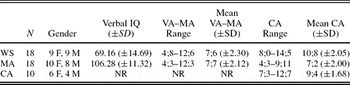
The WS children were matched to the TD children based on CA and verbal MAs derived from the Kaufman Brief Intelligence Test (K-Bit; Kaufman & Kaufman, Reference Kaufman and Kaufman1990). IQ test scores were unavailable for two of the WS children, so 18 WS children were available for MA-matched comparison. The WS group had a mean CA of 10;8 (8;0–14;5), a mean K-Bit verbal IQ of 69.16 (±14.69; range = 40–89), and a mean K-Bit nonverbal IQ of 65.83 (±13.23; range = 41–84). The younger MA-matched control group (n = 18) had a mean CA of 7;2 (4;3–12;4), a mean K-Bit verbal IQ of 106.28 (±11.32; range = 90–137), and a mean K-Bit nonverbal IQ of 106.78 (±10.64; (range = 88–126). A t test showed no significant difference in mental age between the two groups (p = .94).
Because of limitations in recruiting for the CA-matched group, the CA -matched comparison group (n = 10) was not of equal size, but nonetheless well matched for age and gender. A t test showed no significant difference in CA between the two groups (p = .07). Because of the policies at the school where most of the children were recruited, the K-Bit was not done for 7 of the 10 children, so IQ is not reported for the group. Descriptive statistics for the groups are shown in Table 1.
Group descriptive statistics

Note: The IQ measures are only available for three of the typically developing children so verbal IQ and verbal mental age are not reported. Ages are reported in years;months. VA, verbal age; MA, mental age; CA, chronological age; WS, Williams syndrome; NR, not reported.
Narrative task
Participants were shown pictures from a modified version of a storybook (Thunder Cake, Polacco, Reference Polacco1990). The number of pictures from the original story was reduced, and the pictures were simplified to reduce visual complexity. The storybook includes two characters, a young girl and her grandmother. The modified story included six episodes: (a) deciding to make the cake, (b) finding and writing down the ingredients, (c) collecting the ingredients (includes getting eggs, milking a cow, and getting flour), (d) making the cake (gathering the ingredients in the kitchen, mixing the ingredients, putting the cakes in the oven), (e) decorating the cake, and (f) serving the cake. The participants were told that the book is a story about a girl and her grandmother on a farm who were making a cake, and then were shown all of the pictures in order. After seeing the pictures, the children returned to the beginning of the book and were asked to make up a story about the pictures. They were instructed to tell the story to someone who had not seen the book and did not know the story. Subjects were seated catty-corner (or next to) to the experimenter. In some cases, an assistant was present during the time the child told the story, who was seated catty-corner or next to the child on the opposite side. The assistant did not view the pictures as they were being shown to the child. All tasks were audio taped and video taped.
The choice of Thunder Cake (Polacco, Reference Polacco1990) as the story stimuli has two advantages over the standard book used for WS storytelling studies, Mayer's (Reference Mayer1969) Frog, Where Are You? First, because Thunder Cake involves two human female characters, it provides appropriate stimuli to test how the children disambiguate between the two characters when using pronouns for reference. Second, its use is not ubiquitous among the WS population and the story stimuli was a modified version of the original storybook, so it is not likely that the children are highly familiar with the story.
Coding procedures
The narratives were transcribed using the Codes for Human Analysis of Transcripts (CHAT) conventions from the Child Language Data Exchange Systems database (MacWhinney, Reference MacWhinney2000). The audio was transcribed and then checked by a second listener. The narratives were coded for linguistic as well as narrative elements. Morphological coding for the narratives was done using the MOR program in CHAT. Morphological errors were coded by hand using the CHAT error codes and checked by hand by a second coder. The narrative cohesion coding for the narratives was performed by two independent coders using CHAT. Interrater reliability is reported for all transcripts as the percent agreement between the two raters for each type of narrative cohesion to be measured. Disagreements were resolved through discussion between the two coders. Referential and connective cohesion coding each had a percent agreement of 82%. Percent agreement for tense shifts was 60%, but there were overall a small number of tokens.
The coding scheme for linguistic and narrative elements was modified from a narrative coding system created by Curtiss (unpublished). The coding of linguistic features provides measures of the children's language performance in terms of grammatical accuracy. The narrative features measure how and the extent to which grammatical devices are used as discourse devices to provide cohesiveness to the story. The coding scheme includes measures of the error rates for grammar, referential cohesion, connective cohesion, and tense cohesion. A description of each component of the narrative coding scheme is described below.
Grammatical error coding
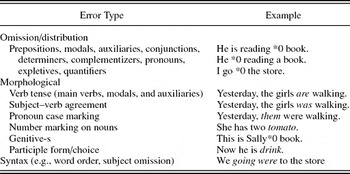
To measure the proportional length of the stories, the number of propositions was determined. A proposition was defined as a verb and its arguments. Table 2 presents the types of grammatical errors coded for and a hypothetical example of each type. Errors that were made and corrected within the same or following clause were not counted in the error tally.
Grammatical error types

Referential cohesion coding
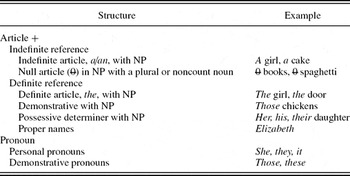
A breakdown of referential cohesive devices examined is presented in Table 3. The noun phrases were identified as definite or indefinite reference. Null articles were included in the count because the omission of the article with singular count nouns would be an error (*0 girl eats); the uses of an indefinite article with a plural (*a girls) or a noncount noun (*a spaghetti) would also be errors. The use of a/an/ 0, the, possessive determiners, demonstratives, or pronouns for first and subsequent mentions of a character were identified and counted. The use of these referential structures was coded as felicitous, infelicitous, or ambiguous. Felicitous structures for first mention were the use of a/an/ 0 with a lexical noun phrase (NP) and the use of possessive determiner +NP if the possessor had previously been mentioned. Because the indefinite article is canonically used to mark new information, it was considered most appropriate for first mention. For subsequent mentions of a character, the use of the, a possessive, a demonstrative, or the use of a pronoun when the referent was clear were considered appropriate. Structures coded as infelicitous included the use of the, a demonstrative, or the use of a pronoun for first mentions, the use of a/an/ 0 for a subsequent reference except when used in character speech or 0 to refer to a plural or noncount noun. The use of a pronoun when the referent was not clear for a subsequent mention was coded as ambiguous. The total number of referential errors consisted of the total number of ambiguous and infelicitous references. This was then transformed into a percentage of total number of attempted references.
Referential cohesive devices

Note: NP, noun phrase.
Connective cohesion coding
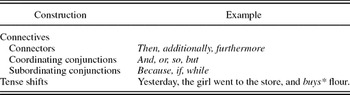
The connective cohesion devices included counts of the appropriate and inappropriate use of the structures shown in Table 4. The counts for the connectors, coordinating conjunctions, and subordinators included only instances when these connectives were used to link the events in the story. The use of a conjunction to combine noun phrases was not considered a cohesive use. Connective uses were coded as felicitous or reflecting one of three error types: (a) semantic, (b) structural, or (c) unclear. Semantic errors were errors in choosing a connective with an inappropriate meaning as in He hates spinach, so he eats it anyways. In this case, the contrastive but would be more appropriate. Structural errors in this study were defined as instances when a child may have chosen a semantically appropriate conjunction, but failed to use it with the right logical structure. For example, She went home, so she was sick.
Other cohesive devices

Tense cohesion coding
Because tense anchors a clause to its discourse context, tense was examined as a cohesion device. Based on which tense was used predominantly within a given narrative, a determination of the basic time frame for that narrative was made. Both narrative past and narrative present are considered appropriate for narratives that are not autobiographical accounts of past events. This time frame was used as the basis for determining the appropriateness of shifts in tense within a given narrative. Tense shifts were coded as felicitous, infelicitous, or unclear. For example, a tense shift made to switch into character speech was considered to be appropriate. A shift from the basic time frame to another tense, followed by a shift back, was counted as two tense shifts. The tense shift error score was presented as the ratio of the total number of tense shift errors to the total number of tense shifts attempted. If the child was prompted into changing tenses by the researcher, the shift was counted as felicitous.
Qualitative analysis
Qualitative analyses were conducted for connectives, tense, and reference. The connectives were categorized by their semantic category (e.g., additive, resultive). For the use of tense, whether the child uses predominantly present tense or predominantly past tense was determined. For reference, the type of strategy the children use for character reference was determined by ascertaining whether children used predominantly noun phrases or pronouns for subsequent references to previously introduced characters.
RESULTS
Quantitative results for narrative cohesion
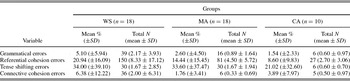
The descriptive statistics for the groups for each measure are reported in Table 5. The mean error rates for grammar and connective cohesion were very low for all groups, whereas tense and referential errors were higher. It should be noted that there were only a small number of tokens of tense shifts overall. So, children who made very few shifts may end up with a very high percentage of errors from only a small number of errors.
Descriptive statistics for grammatical and narrative measures

It was predicted that there would be no significant differences between the WS and MA groups on all measures, but by contrast the WS group would make more errors than the CA group on every measure. As the comparisons between the WS and each of the TD comparison groups were the focus of the study, planned pairwise comparisons using Mann–Whitney tests were performed for the three groups. There were no significant differences between groups except between the WS and CA groups for referential cohesion (Mann–Whitney 46.00, p = .03, r = −.4). The Bonferroni correction was not applied as it is overly conservative for the size of the groups. The Bonferroni correction not only reduces power, it increases the possibility of type II errors (Perneger, Reference Perneger1998). Given that there is little done on this area, it is important not to be overly strict in ruling out potentially important differences.
Qualitative results for narrative cohesion
Connective cohesion. The most frequently used conjunction by all groups was and. The connectives and, and then, and then constituted at least 75% of the total of connectives used by any of the groups. All other connectors, in particular subordinating conjunctions (e.g., because, when, and while), that were semantically more complex were used far less frequently by all groups.
Across the groups, children seldom made any errors with the structures they use most frequently, and as was noted in the previous section, the rate of errors for all groups is low. The data suggest that all groups follow a similar strategy by using connectives which have straightforward, additive/sequential meanings such as and, and then, and then. Compared to the typically developing children, there is a slight tendency, although statistically insignificant, for the WS children to use fewer connectives with complex semantic meanings such as because or while.
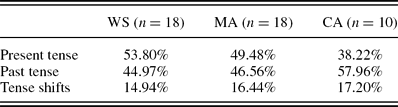
Tense shifts. In narratives, either a present or past time frame can be used. Table 6 demonstrates the children's choice of a dominant tense by showing the percentages of present and past tense use in the narratives and the percentage of tense shifts. The WS children and MA-matched group showed a slight preference for present tense but essentially were equally likely to choose present or past as their dominant tense. The CA-matched group showed a preference for past tense. The mean percentage of tense shifts was low overall, indicating that most children were able to choose a main tense for their story.
Dominant tense in percentages of past versus present use
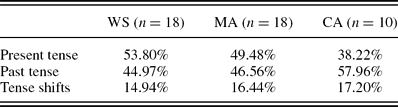
In terms of types of errors, the WS group performed more similarly to MA-matched children. The CA-matched group was distinct in that their errors followed no discernable pattern. The CA group tended to use tense shifts appropriately to move in and out of character speech, as seen in (1).
- (1)
a. CA1 9;2
*CHI: And the grandma said + “/.
*CHI: +” Ah, don't worry. (Past to present)
*CHI: +” They’re just eggs.
*CHI: And then she picked one up and put it into her basket. (Present to past)
*CHI: Then they walked together with some milk.
There were three common types of errors among the WS- and MA-matched children. The first type was simply a shift from the main tense into another with no clear motivation as shown in (2a) and (2b).
- (2)
a. MA23 8;9
*CHI: And her [/] her grandchild comes up to her and says + “/.
*CHI: +” I’m scared.
*CHI: +” the storm is coming.
*CHI: And she asked her if I [//] she could bake a cake. (present to past)
*CHI: a thundercake.
*RE2: ah!
*CHI: . . . And the grandma asked her to get the book of ingredients.
b. WS05 10;9
*CHI: And the girl had to grab everything that was on that table.
*CHI: First she has to get eggs ## from mean Penny! (past to present)
*CHI: Then she had to milk the cow from this bossy cow. (present to past)
*CHI: And then she had to go outside to the tool shed to get the flour.
The second type of tense shift error was a shift between past and present progressive or vice versa where there is an emphasis on the immediate, ongoing action in the picture as can be seen in the examples in (3a) and (3b).
- (3)
a. MA21 9;11
CHI: And had it, # a cake.
CHI: Then # they put the *dessert on # the cake.
CHI: They covered it with a *blanket.
CHI: The girl’s laughing at the grandma. (past to present)
CHI: And the end.
b. WS11 8;9
*CHI: That gorl [: girl] is picking up sik [: six] eggs.
*RE1: mmhm.
*CHI: And then she picked up uh # another egg. (Present progressive to past)
The third type of error was a failure of the child to return to their established narrative tense after asking questions or making comments that may reflect the child's inability to stay focused on the task and subsequently to remember the established story tense.
To summarize, these findings demonstrate that overall, both the WS children and typically developing children prefer to choose a dominant tense and deviate from that tense infrequently. Although there are few tense shifts, the errors made in those tense shifts by younger TD children and WS seem to follow certain types of patterns.
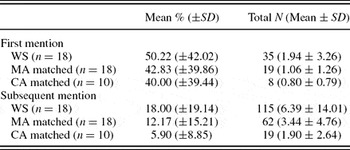
Referential cohesion. A narrator's strategy for reference includes both their choice of article and/or pronoun for first mentions of characters and the subsequent mentions of those characters. Table 7 shows a breakdown of the referential errors by the percentage of errors for first and subsequent mentions. Error rates are each calculated out of the number of instances for each type of character reference. In general, all groups had a greater percentage of infelicitous uses for their first mention of characters than for subsequent mention of characters.
Breakdown of errors rates for first and subsequent mentions

Note: WS, Williams syndrome; MA, mental age; CA, chronological age.
The indefinite +NP was considered the canonical choice for first reference to the characters. The possessive pronoun was also acceptable in certain cases. Only the CA-matched group showed a clear preference for the use of the canonical a/an +NP. Sixty percent of the children in the CA-matched group used indefinite determiners for a first reference, compared to 33% and 28% among the MA-matched children and WS children, respectively.
The most common error for first mentions made by the WS and CA children was the infelicitous use of the +NP as shown in (4), whereas the use of a pronoun for a first mention was infrequent. The MA children, on the other hand, made nearly an equal number of errors by using pronouns and the definite article for first reference.
- (4)
a. The little girl and the mom make some cake and some xxx. (WS20 8;0)
b. . . . # but # the girl is scared. (WS19 14;1) (granddaughter)
c. The girl is, um is looking at the cookbook. (WS31 11;0) (granddaughter)
Children who correctly used the indefinite article to introduce their characters were more likely to initiate their stories with a stereotypical story opening as shown in (5). In this way, the children were depending more on a story schema-based anchor as opposed to a picture-based anchor.
- (5)
a. Once upon a time, a old lady and her granddaughter # and the farm and the animals were getting ready to bake a cake. (WS6 11;6)
b. Once upon a time there was a old lady who lived on a farm and had lots of fun animals with her. (MA02 9;2)
c. Once upon a time, there was a farm, and on that farm, there was an old woman (CA48 11;8)
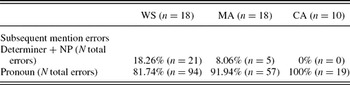
In terms of errors for subsequent mention of characters, all groups made the majority of their errors for subsequent mentions with pronouns as is shown in Table 8. However, it should be remembered that the CA-matched group made the fewest errors and made a very low percentage of errors overall.
Percentage of pronoun errors versus determiner + NP errors for subsequent mentions

Note: NP, noun phrase; WS, Williams syndrome; MA, mental age; CA, chronological age.
Most pronoun errors were made in contexts when the referent was ambiguous. A very common error pattern used by both the WS and TD groups was a shift from the use of a plural pronoun to refer to both characters to the use of the singular pronoun to refer to one of the characters as shown in (6). The ambiguous referent is in italics.
- (6)
a. WS37 13;11
*CHI: And then # they stirred it and stirred it.
*CHI: . . . and then she cooked the cake. (grandmother)
b. MA33 6;8
*CHI: And they start making the cake.
*CHI: Then she cracked the eggs. (granddaughter)
As a group, the WS children predominantly used pronouns for subsequent mentions as did both the MA-matched and CA-matched TD control groups. However, like the MA-matched children, the WS children in this study used a high number of ambiguous pronoun references.
DISCUSSION
Although the prediction that the WS and MA-matched groups would perform similarly for grammatical accuracy and the use of grammatical structures for cohesion was supported by the findings, the prediction that the WS group would perform worse than their CA-matched peers was only confirmed for referential cohesion. These findings suggest that WS children are not globally impaired in their ability to use grammatical structures correctly for complex tasks, such as oral narratives but rather have a specific deficit for referential cohesion. Although WS children tend to show a preference for the use of pronouns for subsequent mentions, WS children are not able to use them proficiently. Specifically, WS children used more ambiguous pronouns for subsequent reference to previously mentioned characters, which was also reported by Lorusso and colleagues (Reference Lorusso, Galli, Libera, Gagliaridi, Borgatti and Hollebrandse2007). For subsequent mention of characters, narrators can use article +NPs or pronouns, but a preference for pronouns used judiciously with NPs to ensure clarity is considered a more sophisticated, adultlike strategy (e.g., Hudson & Shapiro, Reference Hudson, Shapiro, McCabe and Peterson1991; Karmiloff-Smith, Reference Karmiloff-Smith1985).
The tendency of WS children to simply repeat the pronoun without taking into account whether the referent is clear to the listener is similar to what has been observed in studies of their conversational skills (John et al., Reference John, Rowe and Mervis2009; Stojanovik, Reference Stojanovik2006). Moreover, their inability to use pronouns proficiently may also be reflective of underlying problems with referential aspects of ToM (e.g. Porter et al., Reference Porter, Coltheart and Langdon2008; Tager-Flusberg & Sullivan, Reference Tager-Flusberg and Sullivan2000). Coordinating the use of determiners and pronouns for reference is a particularly complex task that depends on an understanding of both syntactic and pragmatic uses of the structure. For example, choosing the correct pronoun involves not only identifying the semantic properties (gender and number) of the referent, but also who has been recently talked about, who was most recently referred to with a pronoun, and what the interlocutor knows and remembers. It can also involve remembering who the major characters are because the choice of a pronoun over a lexical NP can be used to delineate who is seen as the primary actor in the story. All of this knowledge must be maintained over the span of the entire narrative. Coordinating and maintaining this information would be particular challenging for a child who was not able to continuously assess and reassess what their interlocutor knows, as has been observed with WS children.
The current study also provides new preliminary data about the use of articles and pronouns for first reference by WS children. When introducing characters for the first time, the WS children made more errors than age-matched peers, primarily in the infelicitous use of the +NP and to a lesser extent the use of a pronoun. It is interesting to note that for children across all groups a large portion of their first mention errors were choosing the definite article for the introduction of a new character in contrast to using the indefinite, which is canonically used to mark information as new. It could be argued that the use of the indefinite +NP may actually not be the canonical choice for new characters in real usage, and that the restriction of felicitous uses to only the indefinite +NP was too strict. Studies of narratives in typical development including adult control groups have found that even adults showed only a slight preference for the indefinite article for first mentions when telling stories based on a storybook (e.g., Bamberg, Reference Bamberg1987). However, in studies of both typical development and developmental disorders, the adult and the older TD groups used the indefinite in higher proportions than younger or impaired groups (e.g., Hemphill et al., Reference Hemphill, Picardi and Tager-Flusberg1991; Hickman, Reference Hickman, Kreiman and Ojeda1980), so it was not inappropriate to devise a coding system that would test whether a similar type of pattern is seen for WS children. In fact, in the current study, it was observed that the CA-matched children were more likely than the other two groups to use the indefinite, and used the indefinite for the majority of first mentions.
As highlighted above, differences between the WS- and CA-matched groups were only observed for referential cohesion. Contrary to expectations, WS children perform comparably to children their own age in the use of connectives and tense for cohesion. Negative findings with respect to connective devices may be accounted for by the fact that WS children preferred to use additive and temporal conjunctions, which are connectives that are structurally and semantically simple and that children can use well. This finding is consistent with what was found by Lorusso et al. (Reference Lorusso, Galli, Libera, Gagliaridi, Borgatti and Hollebrandse2007) and Stojanovik et al. (Reference Stojanovik, Perkins and Howard2004), and reflects what is also found for young TD children (Bloom, Lahey, Hood, Lifter, & Fiess, Reference Bloom, Lahey, Hood, Lifter and Fiess1980; Petersen & McCabe, Reference Petersen, McCabe, McCabe and Peterson1991). In order to be able to differentiate between WS and TD groups, it may be necessary to use prompts that are designed to specifically elicit more complex structures.
With respect to the use of tense for cohesion, the lack of significant differences between the CA and WS groups may be due to the fact that the overall number of tense shifts was low and that there may not have been enough instances of the tense shifts to differentiate between the WS and TD groups in this respect. Although the ability to establish a narrative tense is an important aspect of using tense for cohesion (Berman & Slobin, Reference Berman and Slobin1994), a measure of tense shifting errors alone may not be enough to fully measure proficiency in using tense for cohesion. It would also be important to measure how the use of tense and variations in affect within the same tense are used for specific purposes, such as foregrounding or backgrounding, throughout the story.
The current study also provides additional information about WS children's production of morphological structures in connected discourse. The lack of difference in grammatical accuracy errors between the WS, MA, and CA groups found in the current study concurs with the study by Bernicot et al. (Reference Bernicot, Lacroix and Reilly2003) for an older group of children (6;6–18;11, M = 13;4; five of the seven individuals were older than 13;5). However, this finding contrasts with those from Losh et al. (Reference Losh, Bellugi, Reilly and Anderson2000) and Reilly et al. (Reference Reilly, Losh, Bellugi and Wulfeck2004), who found poorer performance in a younger range of children (5–10;1 M = not reported, and 4;9–12;9; M = 8;6, respectively) compared to TD groups. Losh et al. (Reference Losh, Bellugi, Reilly and Anderson2000), however, did note that performance improved with age. It should be recalled that age range of WS children in the current study is 8;0–14;5 (M = 10;8). Taken together, these findings, which indicate that WS children's grammatical performance improves with age, support the proposal that WS children's language development follows a normative although delayed trajectory.
CONCLUSION AND FUTURE RESEARCH DIRECTIONS
The current study is one of the few studies of WS children to specifically address the use of grammatical structures for cohesive uses, and is the largest to date focusing on this area. One underlying assumption of the study was that delays in language acquisition would mean delays in the WS children's ability to use grammatical structures (determiners, pronouns, tense, and connectives) for cohesion. This assumption was not fully supported by the findings of the current study, and was only confirmed for the use of referential cohesion. With regard to WS children's abilities to use connectives and tense for cohesive purposes, we can tentatively say that WS children do not seem to perform differently than typically developing children. What the study was able to highlight is that tense and connectives as measured did not differentiate between the WS and TD children. Future studies will need to use stimuli designed specifically to elicit the use of these structures in order to confirm that WS performance is no different than CA-matched peers. Moreover, because WS children were found to perform worse than TD for reference structures in this and previous studies, further study of narrative skills in the WS population may benefit from a more in-depth study of referential cohesion. Because telling stories from a storybook is inherently a shared activity, it may be useful to include additional types of tasks so that their referential skills are measured in a variety of contexts.
Further study of the use of grammatical structures in narratives is an important area of investigation for children with WS because this is an area that could have particular impact on children's academic success. Atlhough WS children are often described as good oral storytellers, they are known to have struggles with academic performance in school. It is important to not only emphasize their linguistic strengths (grammatical accuracy, verbal fluency) but to carefully identify areas of weakness, so these can be addressed. Because WS children can often tell a great story informally, it may be assumed that they have the skills to translate this into more formal means of narrative production. The use of grammatical structures to create cohesion is a fundamental basis for academically oriented presentations and writing (e.g., book reports, explaining steps in a process). With further study, the particular areas where WS children struggle can be identified and targeted for further assistance. The goal of this analysis is not to diminish a relative strength of children with WS. However, to overstate their linguistic abilities, particularly for complex linguistics tasks, can be a disservice for WS children as they enter school, where necessary additional educational support may be withheld on a belief that there is no variability in their linguistic performance.
ACKNOWLEDGMENTS
This research was supported through a National Science Foundation Doctoral Dissertation Grant (BCS-0418994). I gratefully acknowledge the following organizations for their assistance in recruiting children for the study: National and Western Regional Williams Syndrome Association, Los Angeles Family School, Hancock Park Elementary School (Los Angeles), CONNECT Center for Research at University Elementary School (UCLA), the Corrine A. Seeds University Elementary School (Los Angeles), and Dr. Susan Hepburn, University of Colorado.