In the 2010 general election, the British Liberal Democratic party achieved its highest ever vote share. Curiously, in the preceding campaign, the party devoted considerable time to some of its less popular policies—such as amnesty for illegal immigrants or opposition to nuclear power—instead of spending that time on its more popular and more moderate economic policies, such as raising the income tax threshold.Footnote 1 This is evident from the parties' social media campaigns in 2010. Compared to Labour and the Conservatives, the Liberal Democrats referenced policies on taxation and public services considerably less often, and policies on the environment considerably more often, in their official tweets.Footnote 2 Might emphasizing its more extreme and less popular policies have been a vote-winning strategy for a party like the Liberal Democrats—and if so, why?
Drawing on both saliency theory and spatial analyses of party competition, I propose a unified theory of parties' joint policy and emphasis decisions which can explain patterns like the above. Following Wagner (Reference Wagner2012), I distinguish between the policy position adopted by a party on an issue and how much it emphasizes the issue in its campaigns. As previously noted (Aldrich Reference Aldrich1983; Miller and Schofield Reference Miller and Schofield2003; Bawn et al. Reference Bawn, Cohen, Karol and Masket2012), I observe that party platforms are frequently anchored by the policy preferences of activists and core supporters, leading political parties to adopt some policies which may be unpopular with their target voters. However, if parties are able to increase the electoral salience of an issue by emphasizing it, they can limit any negative electoral fallout from unpopular positions by disproportionately emphasizing the issues where the policies preferred by their activists and core supporters are also popular with target voters.
Crucially, in a departure from previous work on party strategy, I argue that which voters a party targets not only depends on characteristics like its nicheness (Meguid Reference Meguid2005), governing experience (van de Wardt et al. Reference van de Wardt, Vries and Hobolt2014) or party organization (Schumacher et al. Reference Schumacher, de Vries and Vis2013), but also past electoral performance. I suggest that historically successful parties—“major parties”—will tend to target the median voter, but parties that have often struggled to secure a parliamentary foothold—“minor parties”—will instead pursue voters with distinctive policy preferences. That minor parties, even ostensibly “centrist” ones, may actually benefit by emphasizing their more distinctive positions is consistent with the experience of the Liberal Democrats—a canonical example of such a party.Footnote 3
Analyzing cross-sectional party-issue level data on the issue emphases of 177 parties in 27 Eastern and Western European countries, I present evidence consistent with this account. In particular, I show that, throughout Europe, both major and minor parties adopt more extreme policies when their core supporters are more extreme on an issue. However, whereas major parties de-emphasize their more extreme issue positions, minor parties typically emphasize these positions. Perhaps surprisingly, even minor parties that are often considered “centrist” typically emphasize their more extreme issue positions.Footnote 4
These differences between major and minor parties appear to be induced by differences in these parties' past electoral performance, rather than simply because major and minor parties are different in other fundamental respects. I suggest that it may be electorally optimal for major and minor parties to behave in this way if major parties are preferred to minor parties by voters, all else equal. I also discuss a range of alternative explanations for these patterns and find all wanting. For instance, although a party's issue emphases may influence its vote share, I show that this cannot by itself account for the observed differences between major and minor party emphasis strategy: these differences are well predicted by party performance in 1995, and also if we instrument for each party's current major or minor status using its seat share in 1995, but not predicted by parties' current electoral performance. Further, while major and minor parties systematically differ on several criteria, I also show that the observed difference between major and minor party strategy cannot be accounted for by differences in prior governing experience, party organization, nicheness or left-right ideology. Finally, I argue that these differences also cannot entirely be accounted for by activists selecting into certain parties based on the issues they emphasize. Cumulatively, the analyses suggest that whether a party is major or minor has a distinct and substantial effect on its electoral strategy.
1. Related literature
This paper bridges several distinct but overlapping literatures. Most importantly, in building a theory linking a party's choice of which issues to emphasize in campaigns to its preferred policies on those issues, I draw on both saliency theory and spatial analyses of party behavior. Saliency theory has long argued that parties will emphasize issues on which they are favored by voters to increase the electoral importance of those issues (Budge and Farlie Reference Budge and Farlie1983; Petrocik Reference Petrocik1996), whereas spatial analysis has frequently been used to study the origins and effects of parties' positional choices (Adams Reference Adams2012). By combining elements from both literatures, I am able to explain why some parties may adopt favorable issue positions and others unfavorable ones, and moreover, why parties with unfavorable issue positions may choose to de-emphasize those issues rather than adopt more favorable positions instead. To date, most work on party strategy has not focused on these questions, instead taking the issues favorable for a party as given.Footnote 5
That said, this paper relates closely to, and builds on, the few studies that also investigate the relationship between party position-taking and emphasis strategy—notably, Wagner (Reference Wagner2012) and de Sio and Weber (Reference de Sio and Weber2014). For instance, Wagner (Reference Wagner2012) also suggests that smaller parties will emphasize their more extreme, or distinctive, policies due to the electoral benefits of policy differentiation—whereas larger parties might de-emphasize their more extreme issue positions. I replicate these findings, but clarify that a party's historical electoral performance—and not just its recent vote share—influences its emphasis strategy, and also show that the effect of party size is distinct from that of its nicheness.Footnote 6 Meanwhile, de Sio and Weber (Reference de Sio and Weber2014) argue that the issue positions associated with a party are those favored by its core voters, and that parties will emphasize “bridge policies”—issue positions which are popular with both the party's target and existing voters. This resembles the strategy I suggest should be favored by major parties. However, I show that a different emphasis strategy may be optimal for minor parties, and also discuss the additional constraints that activist and core supporter preferences imply for parties.
The second contribution of this paper is to the literature on party types. I determine that a party's major or minor status has a separate but complementary effect on its strategy, supplementing the effect of other party characteristics identified in the literature. These include whether a party is niche or mainstream (Meguid Reference Meguid2005), whether a party is a challenger or mainstream (Hobolt and de Vries Reference Hobolt and de Vries2012), whether a party is activist-dominated or leader-dominated (Schumacher and Giger Reference Schumacher and Giger2017), and whether a party is office-seeking or policy-seeking (Schumacher et al. Reference Schumacher, Van de Wardt, Vis and Klitgaard2015). For instance, the distinction I draw between major and minor parties may resemble that often drawn between mainstream and niche parties, but I show that while niche parties—however measured—are more often “minor”, they can be “major”, and mainstream parties are about equally likely to be major or minor. Similarly, while minor parties are more likely to be challenger parties than major parties, are slightly more dominated by activists and tend to have lower levels of office-seeking ambition, I show that the distinction in behavior between major and minor parties that I identify survives even after controlling for these factors, as measured by these authors.Footnote 7
The third contribution is to the literature on parties' electoral incentives for differentiation. I propose that minor parties face stronger incentives to differentiate themselves from their competitors than do major parties, and they do so by emphasizing their more distinctive issue positions. This departs from earlier studies of electoral differentiation that do not consider how these incentives may vary by party type (Cox Reference Cox1990; Kitschelt Reference Kitschelt1994). That said, this argument resembles that of Schofield (Reference Schofield2004), who argues that high valence parties have more incentive to locate near the median than low valence parties. This echoes the argument in Section 2, where I posit that, ceteris paribus, historically successful parties may be more attractive to the median voter than historically smaller parties, imbuing major parties with a non-policy advantage among voters. However, whereas Schofield focuses on party position-taking, I adapt this reasoning to understand party emphasis strategies instead. The difference in behavior between major and minor parties I identify also reinforces the conclusions of earlier studies arguing that smaller parties face stronger electoral incentives to adopt distinctive policy positions (Spoon Reference Spoon2009; Abou-Chadi and Orlowski Reference Abou-Chadi and Orlowski2016).
Finally, this paper complements other work on the origins of parties' issue reputations (Walgrave et al. Reference Walgrave, Lefevere and Nuytemans2009; Dahlberg and Martinsson Reference Dahlberg and Martinsson2015), as well as on the determinants of parties' emphasis strategies on positional issues (Green-Pedersen and Mortensen Reference Green-Pedersen and Mortensen2010; van de Wardt Reference van de Wardt2014; van de Wardt et al. Reference van de Wardt, Vries and Hobolt2014). These studies identify several other factors which are important for parties' emphasis decisions, such as disagreement among a party's supporters on the issue, governing experience, and the issues emphasized by other parties in the same country or party family. I control for these additional factors in my analyses, and continue to find that a party's major or minor party status influences its emphasis decisions on positional issues.
2. Theory
I distinguish between a party's position on an issue dimension (its policies on the issue) and its emphasis on the issue in public statements (how much it talks about the issue). This differs from work equating positional extremism on an issue with emphasis, clarity or “intensity” on the issue.Footnote 8 Accepting this distinction allows that parties may emphasize either an extreme position or a centrist position. Likewise, parties may de-emphasize extreme or centrist positions. For simplicity, I assume that parties take a position on every issue dimension in a multidimensional Downsian policy space—even if they place no emphasis on this position.Footnote 9 Throughout, I focus on the vote-maximizing incentives faced by both major and minor parties, arguing that such incentives lead these parties to behave differently.Footnote 10
I develop a theory where the preferences of a party's activists and core supporters influence the policies adopted by a party and, thereby, the issues it emphasizes in public. The theoretical argument rests on five claims. The first claim is as follows.
Claim 1:
Party platforms are anchored by the preferences of their activists and core supporters.
This follows trivially if activists are key in internal decision-making: the party leadership is more reliant on activist support for survival, and may need activist approval when devising policy. More generally, party elites must take note of the opinions of “policy-demanding groups” (Bawn et al. Reference Bawn, Cohen, Karol and Masket2012), including activists and core supporters, since they rely on their financial and logistical support in campaigns, and this support may be conditional on policy payoffs.Footnote 11 This is plausible even in an era of increasing electoral volatility and declining party membership (Mair et al. Reference Mair, Müller and Plasser2004), as canvassing by activists remains an important means by which parties persuade and mobilize likely voters.Footnote 12 Meanwhile, core supporters—as distinct from a party's core voters—provide parties with a reservoir of volunteer campaign workers (Scarrow Reference Scarrow2015), and may persuade others to support a particular party. As such—and consistent with a large literature (Aldrich Reference Aldrich1983; Miller and Schofield Reference Miller and Schofield2003; Bawn et al. Reference Bawn, Cohen, Karol and Masket2012)—we may expect that, when choosing policies, parties will endeavor to locate close to their activists and core supporters, leading all parties to take non-centrist positions on some issues.
From Claim 1, the following testable hypothesis follows straightforwardly.
H1:
Parties typically adopt positions closer to the median voter on issues where the preferences of their activists and core supporters are more similar to the median voter.
The second theoretical claim concerns party issue emphases.
Claim 2:
Parties tend to disproportionately emphasize the issues where their policies are more popular with their target voters.
This claim is based on the premise that a party will be better able to attract its target voters if the election is fought on issues where these voters prefer the party's policies to those of its opponents. Then, the party may wish to particularly emphasize such issues to increase their importance to target voters. Such a strategy is consistent with previous research on “heresthetics” and saliency theory (Riker Reference Riker1996), arguing that parties are able to influence voters' issue priorities by selectively emphasizing certain issues, and that parties disproportionately emphasize electorally favorable issues to increase their salience.
Claim 3:
Historically electorally successful parties typically face strategic incentives to target the median voter.
This claim builds on fairly standard Downsian reasoning. If there are more moderate than extreme voters on each issueFootnote 13, a party may expect to do best electorally if able to appeal to voters near the median. Then, a party will have a strategic incentive to target such voters if it believes it can win them over. The parties with the most realistic hope of doing so will often be those that have performed well in recent elections. I term such parties “major parties”. If major parties can realistically expect to obtain the support of the median voter but historically smaller parties—“minor parties”—usually cannot, then only major parties will consistently have a strategic incentive to target the median voter.
In combination, Claims 1–3 suggest the following testable hypothesis:
H2:
Major parties typically emphasize the issues on which the party's position, and the preferences of activists and core supporters, are closer to the median voter than other parties in the same system.
The reasoning behind H2 is as follows. If the strategic incentives described in Claim 3 are sufficiently powerful, major parties will tend to target the median voter. Based on Claim 1, if major party platforms are anchored by activist and core supporter preferences, major parties will typically only adopt policies like those preferred by the median voter on issues where their activists and core supporters are also close to the median voter. If voters care about ideological proximity to some degree, then a major party's policies are likely to be more popular with the median voter on issues where its activists and core supporters are closer to the median voter. Then, based on Claim 2, we may expect major parties to emphasize these issues to increase their electoral salience—so as to appeal to voters near the median—in which case H2 follows. Although a major party could be more popular with such voters if it adopted a moderate position on all issues, this is not possible if the party is anchored to particular policies by activists and core supporters (Claim 1).
The next claim asserts that minor parties do not have the same strategic incentives as major parties.
Claim 4:
Minor parties do not typically face strong strategic incentives to target the median voter.
While major parties can often realistically expect a high vote share—and therefore seat share—by appealing to voters near the median, minor parties usually cannot expect this in the short term. As such, targeting the median voter may be a sensible strategy for major parties but not minor parties.
One reason that major parties may be advantaged over minor parties, and so have more success appealing to the median voter, is that a party's historical electoral performance may shape voters' expectations regarding the party's likely vote share in future. This may lead some voters to vote tactically for major parties. In particular, the single largest party in a parliamentary system is likely to either form a single-party government or to be the formateur in a multi-party government (Ansolabehere et al. Reference Ansolabehere, Snyder, Strauss and Ting2005). Consequently, voters may try to coordinate on parties likely to obtain a plurality of seats. In most cases, these will be major parties, as voters use a party's past electoral performance as a heuristic for its future viability (Blais et al. Reference Blais, Erisen and Rheault2014). Provided voters wish to influence the choice of executive, this incentivizes strategic voting for major parties. This applies at the district level under majoritarian electoral systems, and applies at the national level under both majoritarian and proportional electoral systems.Footnote 14 As such, studies have found that smaller parties frequently lose votes to large parties due to strategic voting under both types of electoral systems (Abramson et al. Reference Abramson, Aldrich, Blais, Diamond, Diskin, Indridason, Lee and Levine2010).
Therefore, it may be difficult for minor parties to compete effectively with major parties for voters near the median. If a minor party tries to attract the same voters as a major party—by taking similar positions to the major party or by emphasizing similar issues—then tactical considerations may lead such voters to choose the major party regardless. Moreover, there are other reasons voters may prefer the major party to the minor party in such a scenario.Footnote 15 For instance, the major party may have more activists and media exposure than the minor party, allowing it to establish a stronger party brand. Major parties may also benefit from more widespread partisan allegiances, and voters may value the major party's greater legislative experience.
Thus, it may not be viable for a minor party to target the median voter. The next claim proposes that minor parties will instead target voters whose policy preferences are poorly represented by other parties.Footnote 16
Claim 5:
Minor parties typically face strategic incentives to target voters who are ideologically distant from the positions taken by other parties.
If a minor party does not expect to win over many voters targeted by major parties, it is more likely to target voters who feel their preferences on issues salient to them are not being well represented by other parties—including major ones. Such voters may be less easily swayed by tactical or other reasons to support major parties, and so more likely to support minor parties. One approach by which minor parties can attract these voters is by espousing policies that are distinct from other parties on one or more issues. Then, in many cases, the policies of a minor party that are most electorally valuable will be those that are most distinct from the policies being advocated by other parties. Based on Claim 1, these are likely to be issues where the minor party's activists and core supporters have views that are most distinct from those supporting other parties. Moreover, based on Claim 2, minor parties should be expected to emphasize the issues where their policies are most distinct from other parties to increase the salience of these issues. This line of reasoning suggests the following testable hypothesis:
H3a:
Minor parties typically emphasize the issues on which the position of the party, and the preferences of its activists and core supporters, are most distinct from those of other parties in the same system.
So long as there are no issues where all major parties adopt very extreme policies, the issues where a minor party's policies are most distinctive will necessarily be those where its policies, and activist and core supporter preferences, are most extreme, since its centrist policies are not very distinctive. This in turn suggests another testable hypothesis:
H3b:
Minor parties typically emphasize the issues on which the position of the party, and the preferences of activists and core supporters, are further from the median voter.
When all major parties hold very extreme positions on an issue, H3b may not hold, since a minor party's most distinctive position may then be a centrist one. Nevertheless, I conjecture that H3a will still hold under these circumstances. The example of the British Liberal Democrats discussed in the introduction illustrates the implications of H3b. Similarly, the radical right parties of Europe have won considerable electoral support while emphasizing their relatively extreme positions on immigration. These parties have increasingly adopted relatively moderate economic platforms (for instance, of a “welfare chauvinist” hue); nevertheless, they continue to emphasize their positions on immigration considerably more than their economic policies,Footnote 17 appealing to voters' national identities rather than their economic interests (Kriesi et al. Reference Kriesi, Grande, Lachat, Dolezal, Bornschier and Frey2006).
Major and minor parties may differ in a number of ways that are important for their political behavior. For instance, major parties might be more leader-dominated than minor parties (Schumacher et al. Reference Schumacher, de Vries and Vis2013); they may differ in whether they have governing experience (Hobolt and de Vries Reference Hobolt and de Vries2012), in their office-seeking ambitions (Schumacher et al. Reference Schumacher, Van de Wardt, Vis and Klitgaard2015), or in whether they are mainstream or niche (Meguid Reference Meguid2008). Nevertheless, Claims 3 and 4 propose that differences in strategy between major and minor parties partly reflect the different strategic incentives faced by these parties resulting from their past electoral performance. It follows that major and minor parties can be expected to behave differently in part because of their past electoral performance rather than simply due to other differences that may exist between these parties. Moreover, it follows that major and minor party status is not simply a consequence of the emphasis strategies that different parties adopt, but itself determines parties' strategic incentives and therefore their emphasis strategies.Footnote 18 This implies a further testable hypothesis:
H4:
Differences in issue emphases between major and minor parties cannot be entirely attributed to other long-standing differences between these parties, such as organization, government experience or nicheness.
In Section 4, I show that hypotheses H1–H3b are consistent with recent patterns of party issue emphasis in Europe, and discuss several analyses providing suggestive evidence in favor of H4. A full empirical evaluation of H4 is left to future work. In sum, the evidence provided for H1–H4 suggests that the underlying theoretical Claims 1–5 characterize the incentives facing political parties in Europe in recent times, and their resulting behavior, to some degree.
3. Data description
To evaluate the empirical support for hypotheses H1–H4, I estimate the effect of variation in the extremism of a party's core supporters on its positional extremism and emphasis decisions across various issues. I combine data from the 2014 European Election Study (EES) (Popa and Schmitt Reference Popa and Schmitt2015) and the 2014 Chapel Hill Expert Survey (CHES) (Bakker et al. Reference Bakker, Edwards, Hooghe, Jolly, Marks, Polk, Rovny, Steenbergen and Vachudova2015) to construct a country-party-issue level measure of core supporter extremism, parties' positional extremism and issue emphasis for eight issues (all the available issues).Footnote 19 For each issue, respondents were either asked to place their policy position (in the EES) or that of the party (in the CHES) on an 11-point scale.Footnote 20 In the CHES, experts were also asked to identify and rank the three most important issues for each party.
In a few analyses, the main outcome variable is a party's positional extremism on an issue. I measure this by the difference between a party's position on an issue (according to the CHES) and that of the average voter in its country (according to the EES).Footnote 21, Footnote 22 In most analyses, the main outcome variable is a given party's emphasis on an issue in a given country. Absent a continuous measure of issue emphasis, I construct an ordinal measure using data from the CHES, which takes values between 0 and 3.Footnote 23 For instance, if experts, on average, considered an issue to be the most important issue for a party, the issue is scored 3; the second most important issue for a party is scored 2, and so on. In some instances, two or more issues were, on average, ranked as being similarly important to a party. In such cases, these issues were awarded the same score.Footnote 24
In most analyses, the key independent variable is either the issue extremism or the ideological distinctiveness of a party's core supporters. For each country-issue, I measure the extremism of a party's core supporters by the absolute difference between the average self-placement of core party supporters and the mean voter on that issue in the EES. I measure the distinctiveness of a party's core supporters on each issue by the absolute difference between the average self-placement of its core party supporters and those of all other parties in the same country. The EES does not ask about political behavior aside from voting; consequently, I cannot use party membership or campaign activity to identify party activists. Thus, I only evaluate the theory with respect to the implications of core supporter preferences for party strategy. As discussed in Section 2, core supporters, like party activists, are valuable to parties not only for their votes, but also for their support during campaigns. Moreover, insofar as the views of core supporters are an accurate proxy for activists' views, this approach is also informative about the constraints activists impose on parties.
As described in Section 2, a party's core supporters are those “strong party identifiers who are deeply engaged in the political process” (Egan Reference Egan2013, 126). Two types of respondents are considered party “core supporters”: (i) those “very” interested in politics and “very” or “fairly” close to a party, or (ii) “somewhat” interested in politics but “very” close to a party. Although imperfect, this is the best cross-national measure of core supporter preferences available. By this approach, 6.8 percent of EES respondents are core supporters of a party, with an average of 27.8 core supporters for each major party and 7.9 core supporters for each minor party. However, my results are robust to eliminating parties with fewer than 15 core supporters from the sample, or using any of the following approaches to identify core supporters: (i) strong partisans with at least moderate political interest, (ii) all partisans with at least moderate political interest, (iii) all strong partisans and (iv) all partisans (see Appendix E.6).
Finally, across specifications, I control for other factors that may be important for party emphasis strategies. Country-issue fixed effects allow that country, issue, or country-issue specific factors may influence party emphasis decisions—for instance, voter polarization (Spoon and Klüver Reference Spoon and Klüver2015), party system size (Wagner Reference Wagner2012), party system “crowdedness” (Kitschelt Reference Kitschelt1994) or the prior salience of an issue (Meyer and Wagner Reference Meyer and Wagner2016). Country-issue fixed effects are also essential to correctly identify the relationships implied by the theory, as I discuss in Appendix C. I also include separate issue-specific intercepts for major and minor parties to account for differences in the issues favored by each type of party—as, for instance, major parties are more likely to emphasize economic issues than minor parties. Further, I control for disagreement among core supporters on an issue (Rovny Reference Rovny2013)—measured by the standard deviation in the self-placement of a party's core supporters on each issue—as well as whether a party has previously held office (Hobolt and de Vries Reference Hobolt and de Vries2012) and the mean emphasis placed on each issue by a party's coalition partners, if anyFootnote 25 (Sagarzazu and Klüver Reference Sagarzazu and Klüver2017).
3.1. Types of parties
As per the discussion in Section 2, I empirically distinguish between major and minor parties based on their recent past electoral performance. In the main specification, parties are classed as “major” if they received at least 13 percent of seats in the national legislature, on average, between 2000 and 2014, and “minor” otherwise.Footnote 26 By the baseline measure, the median and modal number of major parties in a country is two, and the maximum number of major parties in a country is four. By comparison, the number of minor parties in a country ranges between one and eight, with a median and mode of five. I rely on seat share rather than vote share to measure parties' past electoral performance for two reasons. First, seat share allows us to identify the relative importance of different parties within the same pre-electoral coalition, when the vote shares of individual parties cannot be calculated. Second, when the two deviate, a party's seat share is more indicative of its legislative clout.Footnote 27
Applying these criteria, I obtain a core sample of 177 parties from 27 Eastern and Western European countries, of which 61 are major parties, and 116 are minor parties. In the main specification, I treat Belgium as two separate countries—Flanders and Wallonia—each with a distinct party system. This is because, with Flemish and Francophone parties only contesting the same seats in the Brussels Capital region, and otherwise contesting seats in Flanders and Wallonia respectively, each party's national performance underestimates its true electoral strength in seats it does contest.Footnote 28
4. Results and discussion
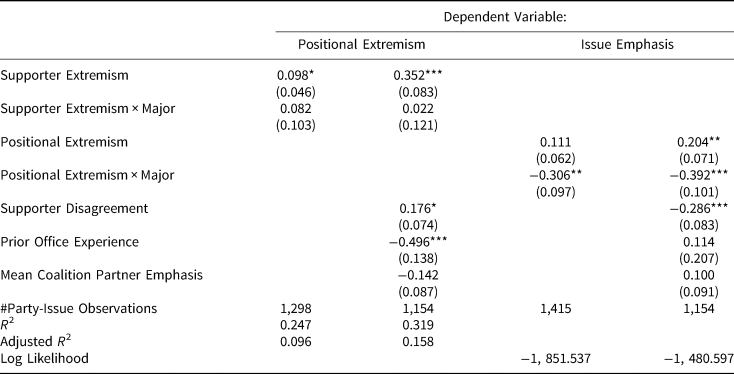
Table 1 presents some initial support for H1–H3b. Models 1 and 2 report results from OLS regressions with country-issue fixed effects, regressing parties' positional extremism on the extremism of their core supporters with and without additional controls. The positive and statistically significant coefficient on supporter extremism in both models, in conjunction with an insignificant coefficient on the interaction term between major party status and supporter extremism, is consistent with H1—suggesting major and minor parties respond similarly to supporter extremism when choosing policies. Next, Models 3 and 4 regress party issue emphases on their positional extremism. Now, the positive and statistically significant coefficient on positional extremism in Model 4 suggests that minor parties emphasize their more extreme issue positions (H3b). However, for major parties, positional extremism decreases party emphasis on the issue, since the combined effect on party emphasis implied by the constituent and interaction term is negative and statistically significant (H2). In these analyses—and in all analyses where issue emphasis, an ordinal variable, is the dependent variable—I estimate an ordered logit model—using the BUC fixed effects ordered logit estimator proposed by Baetschmann et al. (Reference Baetschmann, Staub and Winkelmann2015) in order to allow for country-issue fixed effects.Footnote 29
Positional Extremism and Party Emphasis Strategy

* p<0.05; **p<0.01; ***p<0.001
Note: Models 1 and 2 present OLS estimates from a linear fixed effects model, and Models 3 and 4 BUC estimates from a fixed effects ordered logit model of party issue emphases. All models include issue-specific intercepts for major and minor parties and country-issue fixed effects. Standard errors are robust and clustered by country-issue.
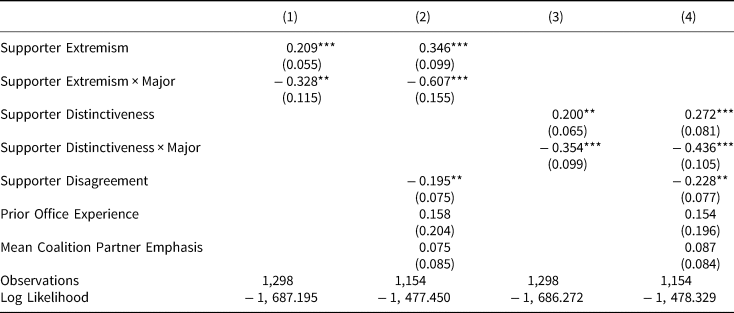
As stated in H1–H3b, we would expect an analogous relationship between the positional extremism, or positional distinctiveness, of parties' core supporters and the issue emphasis strategies of major and minor parties. Table 2 reports results consistent with these expectations. Models 1 and 2 regress party issue emphases on core supporter extremism. Model 1 presents the baseline specification, with no controls except country-issue fixed effects and issue-specific intercepts for major and minor parties. Model 2 adds controls for disagreement among supporters on an issue, parties' prior office experience and mean emphasis by coalition partners. In both specifications, the magnitude and statistical significance of the coefficients indicate that an increase in supporter extremism on an issue is associated with a substantial increase in minor party emphasis on that issue, but a decrease in major party emphasis on the issue. As discussed in Section 2, in the unlikely event that all major parties advocate very extreme policies on an issue, a minor party may prefer to emphasize an issue where their relatively moderate position is distinctive (H3a). To account for this possibility, Models 3 and 4 replicate Models 1 and 2 while substituting the policy distinctiveness of a party's core supporters as the main independent variable. The results are also robust to this alternative specification.
Emphasis Strategy for Major and Minor Parties

*p < 0.05 ; **p < 0.01; ***p < 0.001
Note: Cell entries report BUC estimates from a fixed effects ordered logit model of party issue emphases. All models include issue-specific intercepts for major and minor parties and country-issue fixed effects. Standard errors are robust and clustered by country-issue.
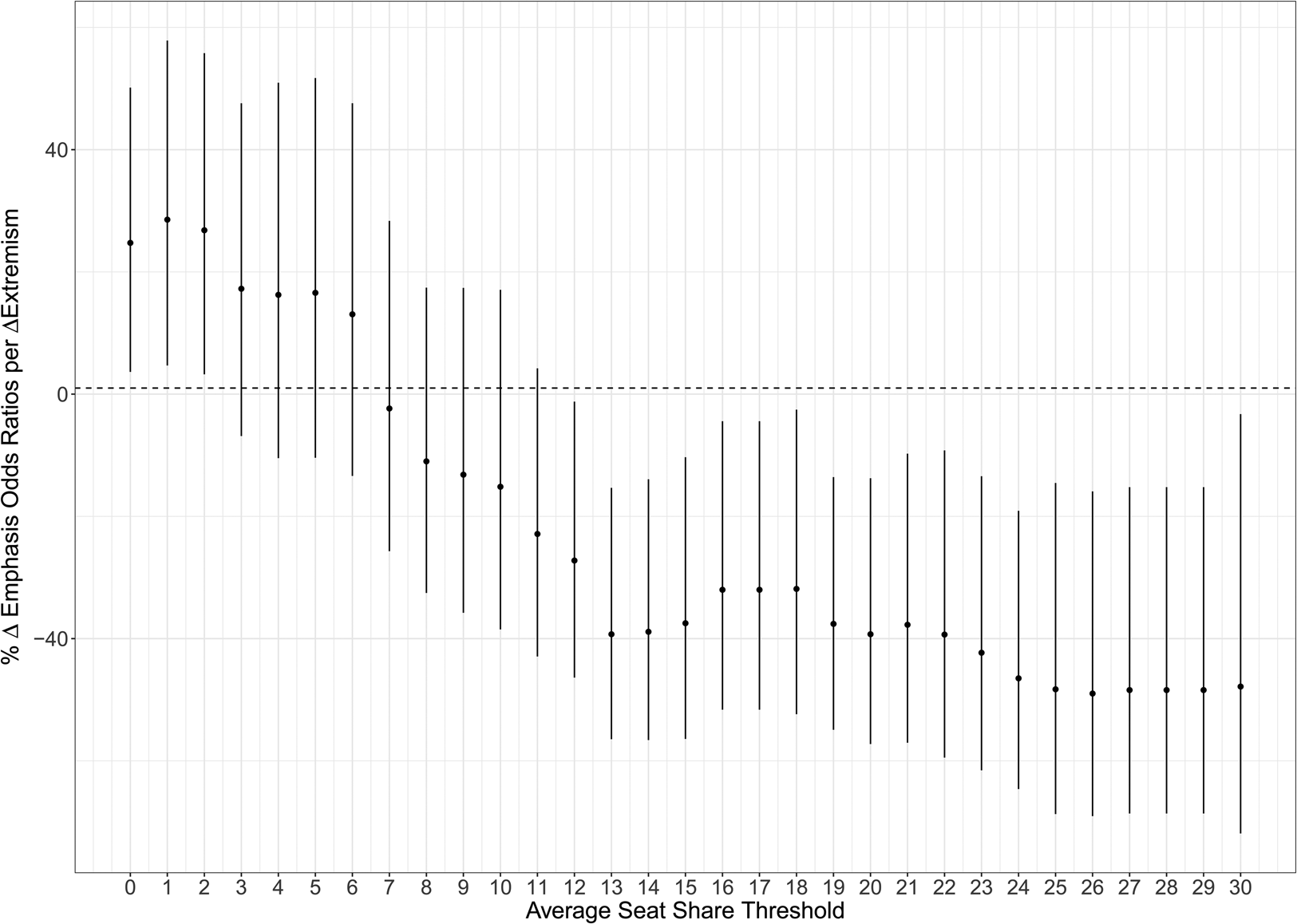
The decision to classify a party as major based on a 13 percent average seat share threshold may seem arbitrary. Figure 1 shows the robustness of estimates to varying this threshold. For very low thresholds, there is a positive and statistically significant relationship between supporter extremism and emphasis, but for high thresholds—beyond approximately 12 percent—the sign reverses. In fact, Figure 1 displays a function that looks almost discontinuous at a 12 percent seat threshold, supporting the view that emphasis strategy is qualitatively different for parties above and below this threshold. This is confirmed by a comparison of the in-sample fit of the regression analyses reported in Table 2 with statistical models using a continuous measure of historical electoral performance instead (results reported in Appendix E.2).
Effect of Supporter Extremism on Issue Emphasis by Seat Share Threshold. Note: This figure plots exponentiated BUC coefficient estimates for fixed effects ordered logit model of party issue emphases, while varying the average seat share threshold for a party to be included in the sample. All models include country-issue fixed effects and control for parties' prior office experience, supporter disagreement and mean coalition partner emphasis on each issue. Exponentiated 95% confidence intervals are reported, based on standard errors clustered by country-issue.

One may wonder if these results are due to reverse causality. That is, parties emphasizing their more moderate positions are more likely to become major, and those emphasizing their more extreme positions are more likely to remain minor. However, in additional analyses presented in Appendix D, I show that even if this is the case, this cannot credibly account for my findings. Rather, it is more plausible that major parties prefer to emphasize their more moderate positions, and minor parties typically emphasize their more extreme positions. In these analyses, I first show that the difference in behavior between major and minor parties we observe is better predicted by historical electoral performance than more recent electoral performance. Next, I show that the observed difference in emphasis strategy between major and minor parties survives if we, first, use party seat share from 1995 as a proxy, and second, as an instrument, for parties' current electoral performance. Together, these analyses strongly counter the suggestion that party emphasis strategies are primarily driving their electoral performance, rather than the reverse.
The only remaining alternative explanation for my findings is that there exists some other extremely persistent factor that is highly correlated with whether a party is major or minor, or which determines a party's historical electoral performance and also its current emphasis strategy. Further analyses reported in Appendix D suggest that none of the following long-standing party characteristics can fulfill this role: (1) a party's left-right ideologyFootnote 30, (2) party familyFootnote 31, (3) whether a party is mainstream or niche (Meguid Reference Meguid2005), (4) whether a party has held ministerial office in the post-war period (or its challenger party status) (Hobolt and de Vries Reference Hobolt and de Vries2012), (5) whether a party is leadership or activist-dominatedFootnote 32 (Schumacher et al. Reference Schumacher, de Vries and Vis2013), and (6) how frequently a party has been in office since its foundation (a measure of the party's latent office aspirations) (Schumacher et al. Reference Schumacher, Van de Wardt, Vis and Klitgaard2015). This provides suggestive evidence in favor of H4. That even leadership-dominated or office-seeking minor parties may prefer to emphasize issues where their preferred policies are relatively extreme need not be surprising, as this strategy may be more likely to win the party votes than emphasizing an issue where the minor party's position is more moderate but less distinctive.
Finally, the selection of core supporters into parties cannot plausibly explain the observed difference in emphasis strategy between major and minor parties. This requires that, not only do activists and core supporters select into parties based on their policies, but that they do so differently depending on party size. This argument requires that, for major parties, individuals with more extreme preferences on an issue are more likely to support a party that emphasizes the issue less, but for minor parties, individuals with more extreme preferences on an issue prefer to support a party that emphasizes the issue more.
5. Conclusion
How do parties remain popular while advocating unpopular policies? And why advocate unpopular policies at all? This paper argues that party platforms are anchored by the preferences of their activists and core supporters. To limit any negative electoral fallout from adopting unpopular policies, parties turn to “salience strategies”: disproportionately emphasizing the issues they would prefer voters to prioritize. However, I suggest that whether this nudges a party towards emphasizing its more centrist or its more extreme issue positions rests on its electoral performance in recent decades. I conjecture that traditionally successful parties—major parties—do best by emphasizing the issues where their preferred policies are relatively moderate, whereas traditionally smaller parties benefit from emphasizing their relatively distinctive, and potentially extreme, issue positions. Consistent with this theory, I find a clear difference in the emphasis strategies of major and minor parties in my analyses. Throughout, major parties de-emphasize issues on which their core supporters are relatively extreme, whereas minor parties emphasize issues on which their core supporters are relatively extreme or distinctive. In this respect, a party's historical performance emerges as an important determinant of electoral strategy in addition to other long-standing characteristics, such as prior office experience, party organization or whether a party is mainstream or niche.
This paper is deliberately ambitious in trying to develop a joint theory of party position-taking and emphasis decisions that can account for key patterns in party behavior. Inevitably, such an endeavor entails substantial generalization and requires making many assumptions that may be contested. A definitive empirical verification of all aspects of this theory is well beyond the scope of this study. As such, I focus on only evaluating the empirical support for the four hypotheses that I set out in Section 2, relating the preferences of a party's activists and its historical electoral performance to its preferred emphasis strategy. Nevertheless, I suggest that the empirical support that I uncover for all four hypotheses suggest that the underlying theoretical claims are, at least, worth taking seriously. Further empirical investigation and evaluation of this theory is left to future work.
This opens the door to many other avenues for future research. While I rely solely on cross-sectional data, a time-series analysis would allow us to analyze the effects of changing activist and supporter composition on party emphasis strategies. Further, this line of reasoning raises the possibility that minor parties may move to emphasizing their less distinctive issue positions if their electoral performance improves with time. Conversely, previously major parties might move to emphasizing their more extreme issue positions if their electoral position decays to the point that they cease to be major. Future work could also evaluate the evidence for these processes.
Supplementary Material
The supplementary material for this article can be found at https://doi.org/10.1017/psrm.2019.2
Author ORCIDs
Chitralekha Basu, 0000-0001-7026-6830.
Acknowledgments
Earlier versions of this paper were presented at the 2015 Toronto Political Behaviour Workshop, the 2016 Midwest Political Science Annual Meeting, the 2016 Elections, Public Opinion and Parties Conference and the 2017 Party Congress Research Group Workshop. The author thanks all participants, as well as Jim Adams, Chris Donnelly, Matthew Knowles, Rabia Malik, Bonnie Meguid, Bing Powell, Svanhildur Thorvaldsdottir, Jae-Jae Spoon, Mariken van der Velden, the URDPS Women's Working Group, audiences at the University of Barcelona, the University of Nottingham, the National University of Singapore, the University of Strathclyde, the University of Zurich, and two anonymous reviewers for very helpful suggestions and feedback.