The perfect is the enemy of the good.
—VoltaireParenting practices are consensually believed to contribute to the course and outcome of child development. For example, parental practices such as involvement, devotion, investment, and responsiveness are commonly assumed to be good things for parents and children. Here we asked how the performance of a commonly understood important and potent parenting practice is judged with respect to its frequency of occurrence. Perhaps more is better, or alternatively, less is more or some is more. Just as a parent might not be sufficiently involved, devoted, invested, or sensitive, a parent might be too involved, too devoted, too invested, or too responsive.
We address this basic theoretical and practical question related to individual variation in parenting infants. Specifically, we asked, How are global judgments of maternal parenting sensitivity assigned to levels of specific maternal contingent responsiveness to specific infant behaviors? In a large community sample, we counted and timed infant and maternal behaviors microanalytically throughout an extended video-recorded observation, and we separately and independently rated the same mothers macroanalytically for their global parenting sensitivity. For infants, exploration, facial affect, and vocalization (the behaviors we studied) serve as principal expressions of state of arousal and affect, and cognitive, communicative, emotional, and social functioning. They are frequent and prominent behaviors in the first half-year of life (the age we studied), and they are behaviors that mothers monitor closely and to which they respond. Maternal responsiveness (the reactions to young children their mothers display in the context of everyday dyadic interactions) has often been singled out as especially significant in child development. For mothers, therefore, we microanalytically counted and timed their most frequent and prominent responses, engaging their infants one-on-one socially, encouraging their infants to attend to the environment, and speaking to their infants. To evaluate the global quality of maternal parenting, we separately and independently rated maternal sensitivity using a standardized, validated, and reliable macroanalytic scale. Associating maternal responsiveness with maternal sensitivity yielded novel insights into parenting practices, perceptions that may have telling consequences in children's normal and atypical development because they expose basic processes underlying adaptation and maladaptation (Cicchetti & Toth, Reference Cicchetti and Toth2009). Identifying and exploring prominent processes that motivate developmental trajectories constitute basic goals of developmental science (Cicchetti & Pogge-Hesse, Reference Cicchetti, Pogge-Hesse, Zigler and Balla1982).
Responsive Parenting
Maternal responsiveness has attracted the attention of developmental scientists for many reasons. Following Drillien (Reference Drillien1957), Bowlby (Reference Bowlby1969) asserted that one of the principal antecedents of secure attachment in children was the attachment figure's responsiveness to child distress. Ainsworth, Blehar, Waters, and Wall (Reference Ainsworth, Blehar, Waters and Wall1978, p. 152) later concluded that “the most important aspect of maternal behavior commonly associated with the security–anxiety dimension of infant attachment is manifested in different specific ways in different situations, but in each it emerges as sensitive responsiveness to infant signals and communications.” Responsiveness reflects a key parent element of recurring and meaningful sequences in everyday exchanges between child and parent that involve child action and parent reaction that generalizes across caregiving contexts (e.g., laboratory and home; Lohaus, Keller, Ball, Elben, & Völker, Reference Lohaus, Keller, Ball, Elben and Völker2001). Responsive parenting fosters a broad array of highly valued developmental outcomes in children, including awareness of the caregiver's availability and reliability, thus promoting a sense of security and trust, behavioral independence, social facility, symbolic competence, verbal ability, and intellectual achievement (Ainsworth, Bell, & Stayton, Reference Ainsworth, Bell, Stayton and Richards1974; Bornstein, Tamis-LeMonda, Hahn, & Haynes, Reference Bornstein, Tamis-LeMonda, Hahn and Haynes2008; Bus & van IJzendoorn, Reference Bus and van IJzendoorn1992; De Wolff & van IJzendoorn, Reference De Wolff and van IJzendoorn1997; MacDonald, Reference MacDonald1992).
Despite its consensual familiarity, centrality, robustness, and predictive validity, certain assumptions about maternal responsiveness (and parenting more generally) have gone untested. One such assumption concerns perceived caregiving sensitivity of different levels of responsiveness.
Undercontingency and Overcontingency
Parents vary in responding to their young children. In Western cultures, mothers reportedly respond to only approximately 30%–50% of their infants' babbling (e.g., Gros-Louis, West, Goldstein, & King, Reference Gros-Louis, West, Goldstein and King2006) and 50%–75% of their infants' expressions of distress (van IJzendoorn & Hubbard, Reference van IJzendoorn and Hubbard2000). What meaning should we ascribe to amount of parental responsiveness? If meaningfulness is judged in predictive validity terms (e.g., for children's development), undercontingency as well as overcontingency appear to be less than optimal parenting strategies. A number of macro- and microanalytic studies converge on an “optimum midrange model” of parenting contingency, where both higher and lower degrees of contingency are deemed problematic.
Undercontingency
From an early age, infants are sensitive to a lack of contingency in normal social interactions with their parents, as evidenced by their vivid (and unhappy) response when mothers become still-faced (Goldstein, Shwade, & Bornstein, Reference Goldstein, Schwade and Bornstein2009; Tronick, Als, Adamson, Wise, & Brazelton, Reference Tronick, Als, Adamson, Wise and Brazelton1978) or when synchronous interactions with mothers are replaced via video with noncontingent actions (Bigelow, MacLean, & MacDonald, Reference Bigelow, MacLean and MacDonald1996). In neither case is the mother attempting to elicit negative affect, but rather merely not responding as she normally would. That even young infants react negatively to noncontingent maternal behavior attests to the importance of contingency rules by which infants and mothers normally interact (Moore et al., Reference Moore, Hill-Soderlund, Propper, Calkins, Mills-Koonce and Cox2009). Maternal failures to respond to infant signals result in poorly timed, mutually unsatisfying interactions and ultimately undesirable child outcomes: maternal unresponsiveness at 3 and 9 months predicts insecure attachment at 12 months (Isabella & Belsky, Reference Isabella and Belsky1991), aggressive and disruptive behavior at 3 years (Shaw, Keenan, & Vondra, Reference Shaw, Keenan and Vondra1994), and externalizing problems at 10 years (Wakschlag & Hans, Reference Wakschlag and Hans1999).
Overcontingency
In the general context of the foregoing literature, it would seem that more consistent responsiveness would be primed to foster the development of more positive outcomes in children (Van Egeren, Barratt, & Roach, Reference Van Egeren, Barratt and Roach2001). Some have theorized or posited that more contingent parents create more optimal developmental environments for children (Chapple, Reference Chapple1970; Cohn & Elmore, Reference Cohn and Elmore1988; Dunham & Dunham, Reference Dunham, Dunham, Moore and Dunham1994; Tarabulsy, Tessier, & Kappas, Reference Tarabulsy, Tessier and Kappas1996; Van Egeren et al., Reference Van Egeren, Barratt and Roach2001); for example, on learning principles, consistent contingency increases the predictability of interaction. Hsu and Lavelli (Reference Hsu and Lavelli2005) reported that more responsive Italian and Canadian mothers had more verbal children and, although specific associations emerged in each culture, each association turned on presumed linear relations between maternal responsiveness and child language outcomes. However, high levels of contingency may be intrusive or inappropriate and are associated with communicative stress and hypervigilance (Beebe et al., Reference Beebe, Jaffe, Buck, Chen, Cohen and Feldstein2008). Malatesta, Culver, Tesman, and Shepard (Reference Malatesta, Culver, Tesman and Shepard1989, p. 29) concluded “that even if maternal responses were in some sense ‘appropriate’ (concern to sad faces, smiling to happy faces), the sheer amount of stimulating activity might exceed the infants' arousal tolerance.” Similarly, van den Boom (Reference van den Boom1994) contended that infant acquisition of self-reliance might develop under a mother who is responsive but who is not continuously attentive to every infant signal; a parent being totally responsive leaves little room for the development of child self-sufficiency. Overcontingent parenting is not focused on being appropriately responsive to a child, but rather on indiscriminately responding to all of the child's needs and cries for attention.
“Goldilocks”
Thus, the literature suggests that undercontingency and overcontingency to young infants may both be detrimental to development. Therefore, it is possible to find in the literature behavioral indicators that point to a curvilinear relation between maternal responsiveness (or, for that matter, stimulation or involvement) and positive child outcomes. Belsky, Rovine, and Taylor (Reference Belsky, Rovine and Taylor1984) reported that an intermediate amount of reciprocal interaction at 9 months was associated with secure attachment in infants at 12 to 13 months, whereas insecure–resistant infants had engaged in less reciprocal interaction and insecure–avoidant infants had engaged in more reciprocal interactions. Malatesta et al. (Reference Malatesta, Culver, Tesman and Shepard1989); Lewis and Feiring (Reference Lewis and Feiring1989); Isabella, Belsky, and von Eye (Reference Isabella, Belsky and von Eye1989); Leyendecker, Lamb, Fracasso, Scholmerich, and Larson (Reference Leyendecker, Lamb, Fracasso, Scholmerich and Larson1997); and Beebe and colleagues (Beebe et al., Reference Beebe, Jaffe, Lachmann, Feldstein, Crown and Jasnow2000, Reference Beebe, Jaffe, Markese, Buck, Chen and Cohen2010; Jaffe, Beebe, Feldstein, Crown, & Jasnow, Reference Jaffe, Beebe, Feldstein, Crown and Jasnow2001) subsequently reported similar findings. However, these studies all focused on relations between levels of maternal responsiveness and later child attachment classification.
This Study
The focus of the extant literature on the differential predictive validity of levels of maternal responsiveness (or stimulation) in relation to child (usually attachment) outcome is valuable and instructive. That said, this attachment research emphasizes the interpersonal over the intrapersonal, and it also oversteps several key intermediary questions that otherwise address process and mechanism, and so refine and explain the observed predictions. Thus, the present study addresses the following questions: How does maternal contingency vary by different responses and to different infant behaviors? How can levels of maternal contingency be quantified in ways that go beyond the usual qualitative attributions of, for example, “low” versus “midrange” versus “high”? What quantitative levels of maternal contingency are judged to be optimally sensitive? With the preceding review and these questions in mind, we wished to discern how different maternal responses to different infant behaviors distribute themselves, to bring a quantitative perspective to bear on the distribution of maternal responsiveness and to determine how levels of mothers' contingency to their infants' behaviors in situations of natural interactions might be evaluated in terms of mothers' perceived global parenting sensitivity. Guided by the existing literature, we hypothesized that maternal over- and undercontingency would be rated as generally less sensitive, whereas levels surrounding significant maternal contingency would be rated as optimally sensitive. In this study, we parsed two key modalities of interaction (gaze and vocalization) in infant–mother dyads. The literature on maternal responsiveness has included responsiveness to both positive and negative infant behaviors; however, the present study focuses on responsiveness to positive infant behaviors.
Maternal Sensitivity
To test the study's main hypothesis, we evaluated the sensitivity of maternal responsiveness. To do so, we separately and independently assessed global dimensions of the same mothers' emotional relationships with their infants using a validated and reliable instrument, the Emotional Availability Scales (EA Scales; Biringen, Robinson, & Emde, Reference Biringen, Robinson and Emde1998). The EA Sensitivity Scale assesses overall acceptance, appropriateness, flexibility, affect regulation, and variety and creativity of behavior displayed toward the infant. To appraise the generalizability of our findings, we also coded a second maternal EA Scale, Structuring. Maternal structuring captures the extent to which the mother successfully organizes or scaffolds in a way that is received by the child and that still offers opportunities for the child to exercise his or her autonomy. The results for sensitivity and structuring (r = .84) were the same. In the balance of this paper, when we refer to sensitivity, our results apply equally to structuring (more information is available from the authors).
The traditional approach to analyzing infant–mother interaction has applied correlation (e.g., Bornstein & Tamis-LeMonda, Reference Bornstein and Tamis-LeMonda1990). This approach to characterizing interaction tells us about the relative standing of dyads in a group on a pair of variables. Although informative, correlation is relatively mute about the nature and mechanics of interaction of individual dyads, and it gains no purchase on causality. It is sometimes assumed that behaviors that are correlated are also contingent, but in actuality, correlation is not necessarily related to interactional contingency. Exclusive reliance on tests of simple association therefore sells short an understanding of temporal or causal relations that are believed to structure infant–mother interactions and predict child outcomes. Our design and analyses were also geared to redress this shortcoming. We supplemented correlations with microanalytic measurement that is requisite to deconstruct contingencies in interaction over time and then applied sequential analysis to investigate which behaviors tend to lead and lag temporally when infants and mothers interact. Sequential analysis lays bare the underlying dynamic contingent structure of interactions (Bornstein, Toda, Azuma, Tamis-LeMonda, & Ogino, Reference Bornstein, Toda, Azuma, Tamis-LeMonda and Ogino1990; Damast, Tamis-LeMonda, & Bornstein, Reference Damast, Tamis-LeMonda and Bornstein1996). One supplementary hypothesis of this study was that specific infant and mother behaviors would covary, and a second supplementary hypothesis was that mother behaviors would be contingent on infant behaviors.
Method
Participants
The sample consisted of 335 European American mother–infant dyads (154 mothers and daughters, and 181 mothers and sons). Mothers were recruited from hospital birth notifications, mass mailings, and newspaper advertisements and were primiparous with healthy infants. Infants ranged from 4.7 to 6.5 months (M = 5.4, SD = 0.2) at birth, and 99.10% were term (M birth weight = 3510.19 g, SD = 489.04). Mothers' ages ranged from 13.91 to 42.48 years (M = 28.27, SD = 6.13). Of participating mothers, 11.6% had not completed high school, 12.8% had completed high school, 21.2% had partial college, 29.9% had completed college, and 24.5% had completed university graduate programs. Family socioeconomic status (SES; Hollingshead, Reference Hollingshead1975; see also Bornstein, Hahn, Suwalsky, & Haynes, Reference Bornstein, Hahn, Suwalsky, Haynes, Bornstein and Bradley2003) varied across nearly the full range of social class, 14–66, with a mean of 48.37 (SD = 13.80). Thus, ours is a socioeconomically heterogeneous (not homogenous middle-class) community sample in terms of maternal education and family SES, but we recruited an ethnically homogenous European American sample because they are currently the majority cultural group in the United States (~75% of the population of the United States self-identifies as European American in descent; Humes, Jones, & Ramirez, Reference Humes, Jones and Ramirez2011; Tilton-Weaver & Kakihara, Reference Tilton-Weaver, Kakihara and Arnett2008; US Census Bureau, 2008) and because parenting processes and child behavior alike are known to vary with ethnicity (e.g., Graham, Reference Graham1992; Parke, Reference Parke2000; Tomlinson & Swartz, Reference Tomlinson and Swartz2003). An ethnically homogenous community sample constitutes a first step in understanding the matrix of associations surrounding infant behavior, maternal contingent interactions, and maternal sensitivity that logically antecedes embarking on more complex studies and analyses with ethnically diverse samples. This study therefore intentionally avoids ethnicity confounds that have plagued the parenting literature and would cloud our findings.
Procedure
Each mother–infant dyad was visited at home by a single filmer to make an hour-long audiovisual record of the dyad's naturalistic behavior. After a conventional period of acclimation (McCune-Nicolich & Fenson, Reference McCune-Nicolich, Fenson, Yawkey and Pelligrini1984), filming commenced. The filmer resisted talking to the mother or making eye contact or otherwise interacting with the infant or mother during filming. Dyads were recorded at a time when the infant was awake and alert (M = 99.66% of the session), and mothers were in view of their infant (M = 94.06% of the session) and solely responsible for the baby. The filmer explained that she was interested in the typical activities of young infants, and the mother was asked to go about her normal routine and to disregard the filmer insofar as possible. In general, we attempted to remain faithful to a principle of ecological validity by focusing on naturalistic interactions between mothers and infants in their own homes. By allowing infants and mothers to be observed in the surroundings most familiar to them and in which they are most comfortable, home study yields behavioral data that are as natural, uninhibited, and valid as possible. Observations encompassed a variety of routine mother–infant daily activities, such as feeding, diapering, bathing, and playing. The filmer focused on the infant, but included the infant and mother in the same frame when they were proximal, panned the environment with any changes in physical setting, indicated if mother left the room, and briefly captured any object or person on which the infant fixated (Vibbert & Bornstein, Reference Vibbert and Bornstein1989).
Data coding and scoring
All records were coded independently by two separate coding teams, one team of coders for microlevel coding of individual behaviors and another team of coders for macrolevel coding of sensitivity. The two teams of coders were unaware of each other's coding, and coding was fully separate and independent. All coders also were blind to the hypotheses of the study (Bornstein, Azuma, Tamis-LeMonda, & Ogino, Reference Bornstein, Azuma, Tamis-LeMonda and Ogino1990).
Microcoding of infant and maternal behaviors
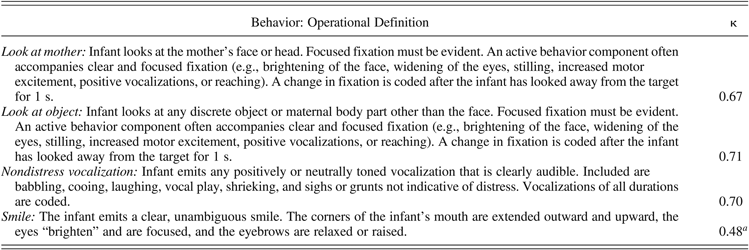
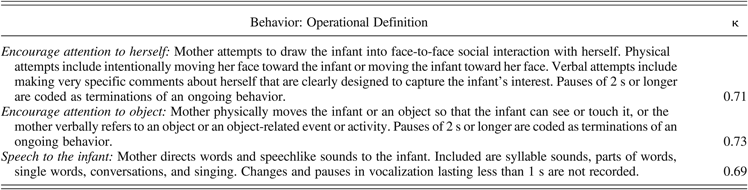
Mutually exclusive and exhaustive independent coding schemes were brought to bear for different infant and maternal behaviors. Coders made separate passes through the records for infant behaviors (look at mother, look at object, nondistress vocalization, and smile) and maternal behaviors (encourage attention to mother, encourage attention to object, and speech to the infant). The first 50 min of the record were used to accommodate occasional momentary interruptions and early endings of recordings. For all cases, the total length of the record that could be coded was more than 48 min. (If codable time totaled less than 50 min, data for the case were prorated. There were two cases with codable time less than 50 min, and for both cases the total duration was ≥2947 s.) Coders were trained to reliability on consensus codings, and between 18% and 26% of the sample was coded independently by alternate coders (or coders other than those who were trained on reliability coding). None of these coders participated in EA Scale coding, and they were not aware of the EA Scale scores. Table 1 and Table 2 provide operational definitions and reliability indices for all behavior codes.
Operational definitions and reliability indices of infant behaviors

aInfant smiling was an infrequent (and very brief) event, accounting for <5% of the events coded in the mode for infant facial expression.
Operational definitions and reliability indices of maternal behaviors
Onsets and offsets of maternal and infant behaviors were coded to the nearest 0.1 s, resulting in timed-sequential data (Bakeman, Reference Bakeman, Lewis-Beck, Bryman and Liao2004; Bakeman, Deckner, & Quera, Reference Bakeman, Deckner, Quera and Teti2005). The data were then formatted for sequential analysis using the Sequential Data Interchange Standard. For each dyad, codes for infant behaviors were followed by codes for maternal behaviors, along with the onset time for each. We used the Generalized Sequential Querier program (version 4.1.2; Bakeman & Quera, Reference Bakeman and Quera2004; http://www.gsu.edu/~psyrab/sg.htm) to conduct simple and sequential statistical analyses. We calculated an odds ratio, which is a descriptive measure of effect size (Bakeman et al., Reference Bakeman, Deckner, Quera and Teti2005), of lead–lag interactions for each dyad for 12 behavioral sequences:
1. infant look at mother—mother encourage attention to herself;
2. infant look at mother—mother encourage attention to object;
3. infant look at mother—mother speech to the infant;
4. infant look at object—mother encourage attention to herself;
5. infant look at object—mother encourage attention to object;
6. infant look at object—mother speech to the infant;
7. infant nondistress vocalization—mother encourage attention to herself;
8. infant nondistress vocalization—mother encourage attention to object;
9. infant nondistress vocalization—mother speech to the infant;
10. infant smile—mother encourage attention to herself;
11. infant smile—mother encourage attention to object; and
12. infant smile—mother speech to the infant.
Coding of maternal and infant behaviors was mutually exclusive, except that some behaviors were coded both in mother speech to the infant and mother encouraging attention to object (e.g., “Baby, look at this toy”), and between mother speech to the infant and mother encouraging attention to herself (e.g., “Baby, look at mommy”). However, different aspects of behavior were coded in mother encouraging attention (to object or to herself) and mother speech. Maternal encouragement describes a goal-directed form of maternal behavior that can include many different component behaviors (e.g., talking, looking, facial expression, or offering objects), whereas coding maternal speech exclusively comprised sounds mothers emitted to the infant. Empirically, mother speech to the infant and mother encouraging attention to object, and mother speech to the infant and mother encouraging attention to herself, shared little common variance, 3.6% and 7.8%, respectively.
In addition, the contingency analyses we planned focused on a particular maternal response to a particular infant behavior. For example, the mother may respond in different ways to an infant vocalization. We analyzed the contingency of each maternal response to each infant behavior.
Contingency was operationally defined in terms of lags of time units (Bakeman & Gnisci, Reference Bakeman, Gnisci, Eid and Diener2005), that is, the length of time after a given onset or offset that a target response could occur and constitute a contingent behavior rather than a spontaneous or isolated behavior. Based on an extensive review of existing parametric research (see Beebe et al., Reference Beebe, Jaffe, Markese, Buck, Chen and Cohen2010; Cote, Bornstein, Haynes, & Bakeman, Reference Cote, Bornstein, Haynes and Bakeman2008; Gratier, Reference Gratier2003; Van Egeren et al., Reference Van Egeren, Barratt and Roach2001) and features of our own data set (durations, gaps between onsets, and visual plots of infant–mother behaviors), we determined that a 3-s time period best captured contingencies for these mother behaviors in response to these infant behaviors in naturalistic settings. That is, the onset of a target maternal behavior had to occur within 3 s of the onset of a given infant behavior for the target to be considered contingent on the given. Because we were interested in contingent turn taking in infant–mother speech, the only exception was that maternal speech to the infant had to occur within 3 s of the offset of infant nondistress vocalization to be contingent.
Time units were tallied separately for each dyad in 2 × 2 tables for each behavioral sequence (1–12 above), and an odds ratio was computed for each table (see Bakeman et al., Reference Bakeman, Deckner, Quera and Teti2005, p. 415). Odds ratios (ORs) of >1 indicate that bouts of the target behavior were more likely to begin within 3 s of the onset of the given behavior than at other times, whereas ORs of 0–1 indicate less likelihood. If fewer than five occurrences of the given behavior were counted during the entire observation, we regarded the value of the odds ratios as missing for that dyad because there was not a sufficient sample of the behavior from that dyad to draw conclusions about behavioral contingency. With the exception of infant smile–mother speech to the infant, data for fewer than 3% of dyads were insufficient for any given analysis.
Macrocoding of maternal sensitivity
Sensitivity for each mother was separately and independently evaluated by a different team of coders from the same recorded observations using the Sensitivity Scale of the Emotional Availability Scales: Infancy to Early Childhood Version (EA Scales, 3rd ed.; Biringen et al., Reference Biringen, Robinson and Emde1998). The EA Scales were developed as a global assessment of parenting quality based on observations and ratings of parent–child interaction (Bornstein, Suwalsky, & Breakstone, Reference Bornstein, Suwalsky and Breakstone2012). The EA Sensitivity Scale has been used with a wide variety of populations and applied successfully across a range of settings (Biringen & Easterbrooks, Reference Biringen and Easterbrooks2012; Robinson, Little, & Biringen, Reference Robinson, Little and Biringen1993). The general construct of sensitivity, initially developed by Ainsworth (Reference Ainsworth1967) as normative and presumably universal, has proved to be a robust predictor of myriad positive child characteristics, including attachment, social responsibility, self-confidence, self-esteem, and behavioral adjustment in socioemotional development as well as language and play and school readiness in cognitive development (Isley, O'Neil, & Parke, Reference Isley, O'Neil and Parke1996; Pettit & Bates, Reference Pettit and Bates1989; van IJzendoorn, Dijkstra, & Bus, Reference van IJzendoorn, Dijkstra and Bus1995). Maternal sensitivity was coded on a 1 (highly insensitive) to 9 (highly sensitive) scale in half points. All coders were trained on the EA Scales to obtain satisfactory reliability with one of the authors of the EA Scales and with one another. Intercoder reliability was assessed using average absolute agreement intraclass correlation coefficients (ICCs; as recommended by Shrout & Fleiss, Reference Shrout and Fleiss1979) in a two-way random-effects model. For reliability, 23% of randomly selected records were double coded (ICC for sensitivity = 0.92).
Results
Preliminary analyses
Prior to formal analysis, univariate distributions of infant and maternal behaviors and maternal sensitivity were evaluated for normality and outliers. Bivariate plots were screened between the infant/maternal behaviors and sensitivity ratings; residuals were examined for influential cases using scatter plots, standardized residuals, studentized deleted residuals, and Cook D statistics. The frequencies of maternal and infant behaviors were normally distributed, with the exception of infant smile, which required square-root transformation. Because the odds ratio has a lower limit of 0 and no upper limit, it is known to have a skewed distribution. Hence, we used a square root transformation and excluded outliers (maximum of four per analysis) to normalize the distribution for each pair of infant–mother behaviors. Sensitivity was raised to the second power to approximate normality and reduce outliers. Transformed variables were used in analyses; for clarity, untransformed data are presented as descriptive statistics.
No gender differences emerged for any infant or maternal behaviors, infant–mother contingencies, or EA Scales; therefore, the data are reported for girls and boys combined. We examined correlations between the study variables and maternal age and family SES. Maternal age was correlated with mother speech, r (333) = .42, p < .01, and sensitivity, r (333) = .35, p < .01, and with infant looks at objects, r (333) = –.12, p < .05. SES was correlated with mother encouraging attention to herself, r (333) = .14, p < .05, speech, r (333) = .35, p < .01, and sensitivity, r (333) = .25, p < .01, and with infant looks at objects, r (333) = –.16, p < .05. Because sensitivity was strongly correlated with maternal age, and because maternal age and SES were highly correlated, r (333) = .70, p < .001, sensitivity was regressed on maternal age and residualized scores were used in analyses.
Descriptive statistics
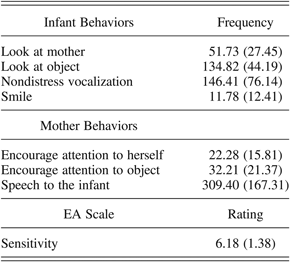
Frequencies of infant and mother behaviors are reported in Table 3. Mother speech had the highest frequency; infant smile had the lowest. For sensitivity, mothers were rated high on average but showed nearly the full range (2.0 to 8.5), suggesting that in a prolonged observation it was possible to discern wide individual differences among mothers of infants as young as 5 months. These findings compare favorably with ratings of other studies (Kogan & Carter, Reference Kogan and Carter1996).
Descriptive statistics for infant and mother behaviors and Emotional Availability (EA) Scale (N = 335)
Note: All values are means (standard deviations).
Intercorrelations between infant and mother behaviors and sensitivity
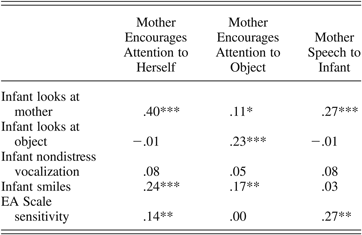
Intercorrelations between infant and mother behaviors were calculated to examine whether mothers or infants who engaged in a given behavior more frequently had partners who engaged in a complementary behavior more frequently (Table 4). Mothers who encouraged attention to themselves and to objects more frequently had infants who looked at them and smiled more frequently. Mothers who spoke more frequently had infants who looked at them more frequently. Mothers who encouraged infant attention to objects more frequently had infants who looked at objects more frequently. In addition, mothers who encouraged attention to themselves and spoke more to their infants were rated as more sensitive (Table 4).
Correlations between infant and mother behaviors (N = 335)
*p < .05. **p < .01. ***p < .001.
Contingency of mother behaviors
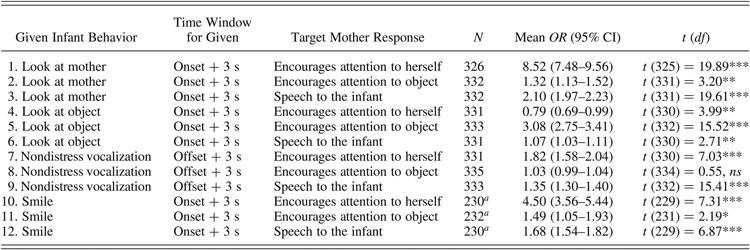
Student t tests were calculated to determine whether pairs of behaviors were contingent (i.e., whether odds ratios differed significantly from 1; Wickens, Reference Wickens1993). Eleven of 12 pairs of mothers' contingent behaviors to their infants were significant (Table 5). For example, it was significantly likely that mothers responded within 3 s of the onset of their infants looking at them by encouraging their infants to attend to the mothers themselves. Only one odds ratio, infant vocalize—mother encourage attention to object, was not significant; it was as likely that mothers responded by encouraging attention as by any other behavior within 3 s of the offset of infant vocalizing. Only the odds ratio for infant look at object—mother encourage attention to herself was <1 and significant; it was significantly unlikely that mothers responded within 3 s of the onset of their infants looking at an object by encouraging attention to themselves.
Odds ratios (OR) for infant–mother behaviors
aBecause infant smile was infrequent, 103 dyads had missing odds ratios.
*p < .05. **p < .01. ***p < .001.
Contingency in infant–mother behaviors and maternal sensitivity
Only two correlations between (transformed) odds ratios for the 12 pairs of infant–mother behaviors and (transformed and residualized) ratings of maternal sensitivity were significant (range rs = –.22 to .15). Mothers who were more likely to contingently speak to infants in response to their infants' looking at them were rated as less sensitive, r (330) = –.22, p < .001. Mothers who were more likely to encourage their infants' attention to objects contingent on infants' looking at them were rated as more sensitive, r (330) = .15, p < .01. Only one other study has compared a microanalytic approach to contingency with a macroanalytic measure of maternal sensitivity. Keller, Lohaus, Völker, Cappenberg, and Chasiotis (Reference Keller, Lohaus, Völker, Cappenberg and Chasiotis1999) analyzed the relation between contingency (assessed in a microanalytical, exclusively face-to-face procedure) and sensitivity (rated on the Ainsworth scale) in German middle-class mothers interacting with their 3-month-olds in face-to-face exchange, play with objects, and situations with an extradyadic orientation. As here, they found no zero-order associations between maternal sensitivity and contingency indexes (see also Lohaus et al., Reference Lohaus, Keller, Ball, Elben and Völker2001).
However, zero-order correlations mask potential nonlinear associations between maternal responsiveness to infants and maternal sensitivity. Nonlinear relations cannot be detected, represented, or studied within the confines of zero-order correlations or linear regressions. A nonsignificant correlation may belie curvilinear or other nonlinear relations (such as lines with different slopes) that better describe the association between the variables. To investigate nonlinear associations between maternal contingency and sensitivity, we examined the bivariate scatter plots with locally weighted fitting and smoothing scatterplots (LOWESS) smoothers between contingency odds ratios and sensitivity. LOWESS fits curves and surfaces to noisy data by a multivariate smoothing procedure (Cleveland, Reference Cleveland1979). Examination of several scatterplots with LOWESS smoothers at 0.50 tension revealed no relations, linear relations, or linear relations with different slopes before and after a given point (“knot”) on the contingency continuum. We therefore performed a series of spline regressions (Marsh & Cormier, Reference Marsh and Cormier2002) to assess whether changes in slopes at knots were significant and, if significant, to obtain linear rates of change leading to and following the knot. Spline regression does not assume a curvilinear (e.g., ∩-shaped) pattern but instead allows for different linear trend lines in segments of the sample. For each pair of contingency odds ratio–EA Scale relations, the location of a single knot was estimated using nonlinear least squares regression. The start value needed for the nonlinear least squares regression was provided by visual inspection of the scatterplots with the LOWESS line.
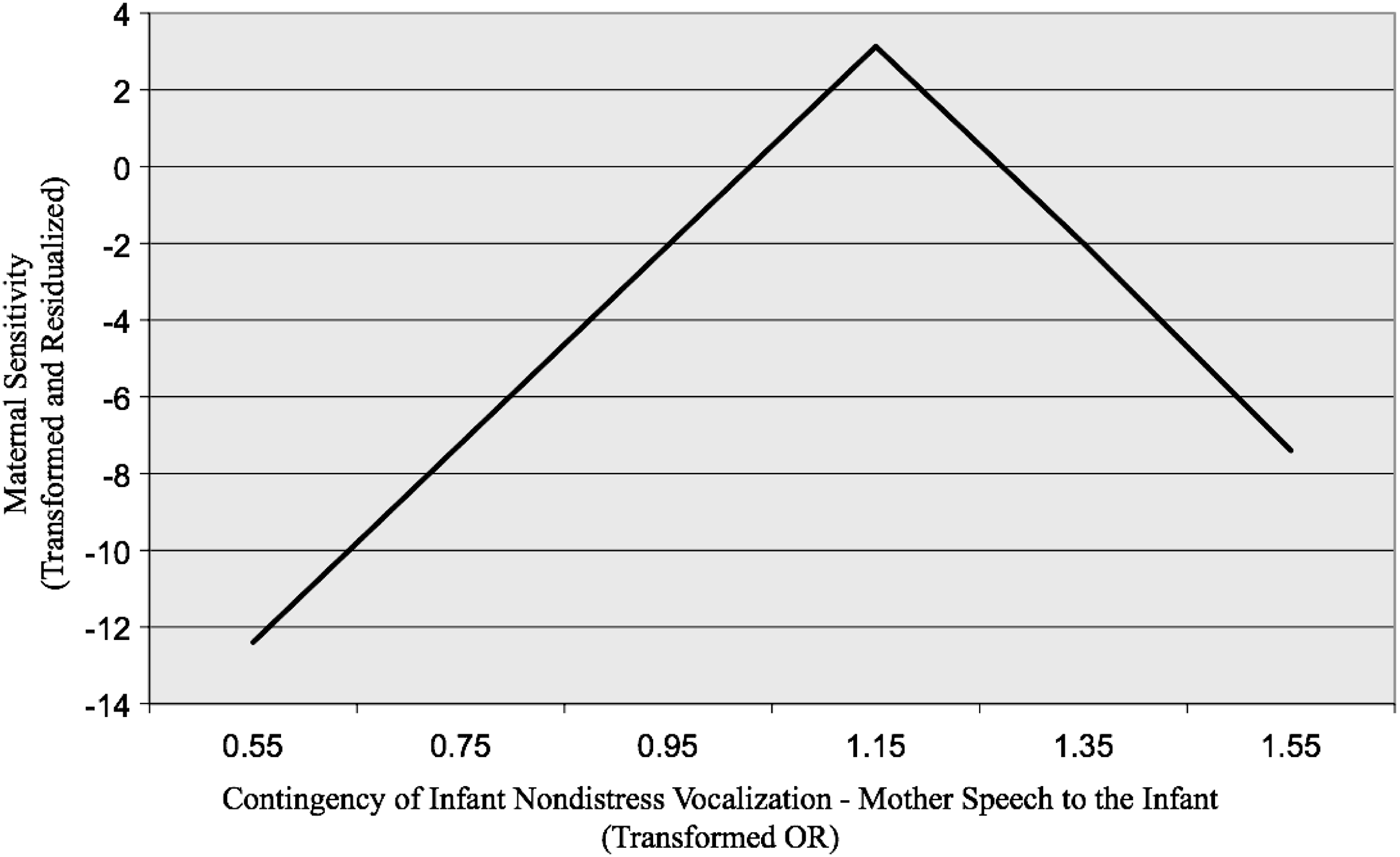
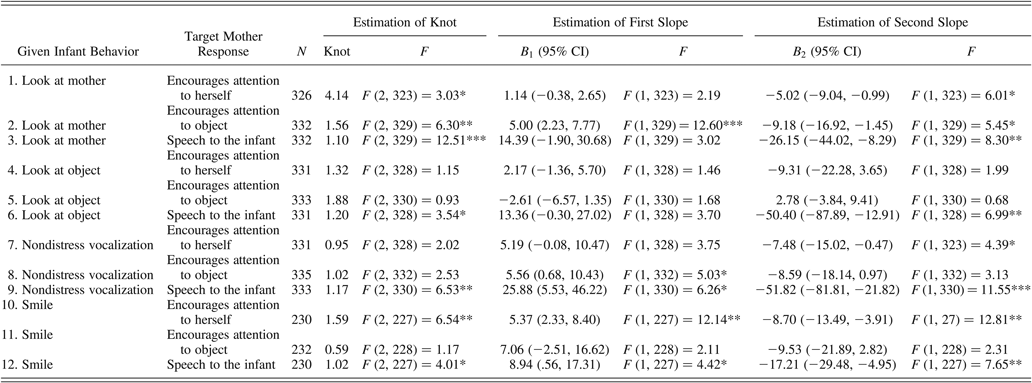
Estimations of the knots, sample sizes, and results of spline regressions are presented separately for each of the 12 contingency odds ratio–EA Scale pairs in Table 6. For example, for the contingency of infant nondistress vocalization—mother speech to the infant and maternal sensitivity (Pair 9), spline regression estimated the knot at 1.17 to be significant. Figure 1 shows the negative quadratic regression lines changed slopes at a specific point on the contingency continuum (at a transformed OR = 1.17). The linear relation between this dyadic contingency and maternal sensitivity is positive until the knot, after which the linear relation is negative. In English, as maternal responsive speech to infants contingent on infants' nondistress vocalization increased, separate and independent ratings of maternal sensitivity also increased, until a level of contingency where the odds of mothers responding were just significantly greater than 1; at greater levels of contingency, mothers whose speech was more and more contingent were rated as less and less sensitive. Eleven of 12 contingency odds ratio–EA Scale relations followed this general pattern. Seven of 12 contingency–sensitivity relations showed significant knots; for each, the linear relation between contingency and sensitivity before the knot was positive (significant or nonsignificant), and the linear relation after the knot was negative and significant. Five of 12 contingency–sensitivity relations showed no significant knot; however, 4 of those 5 followed the same negative quadratic trend (positive slope followed by negative slope). Only 1 relation in 12 pairs failed to follow the general pattern (Pair 5); examination of the graph showed no relation between sensitivity and contingency of mother encouraging attention to object in response to infant looking at object. Finally, Tables 5 and 6 show that neither odds ratios nor knots were overdetermined (ORs range = 0.79–8.52, knots range = 0.59–4.14).
Estimated knot and slopes from spline regression of contingency of infant nondistress vocalization for mother speech to the infant (transformed odds ratios) and maternal sensitivity (transformed and residualized).
Results of spline regressions for infant–mother behaviors and sensitivity
*p < .05. **p < .01. ***p < .001.
Discussion
This study focused on relations between maternal responsiveness, based on microanalytic measures of contingency, and maternal sensitivity, based on separate and independent macroanalytic global ratings. We found, in a nutshell, that, as contingency in maternal responses to infant behaviors increased, judged maternal sensitivity also increased, but only until a just-significant degree of contingency, after which mothers who were more and more contingent were rated as less and less sensitive. Mothers who adhered to levels of responsiveness just greater than OR = 1 across a range of infant-behavior—mother-response combinations were judged to be optimally sensitive. Eleven of 12 different contingency–sensitivity relations followed this general pattern.
Correlation and contingency
Six of 12 (50%) correlations between raw frequencies of mother and infant behaviors were significant; however, 11 of 12 (92%) possible contingency pairs were significant. If our analyses of infant–mother interactions had focused on correlation alone, we would incorrectly conclude that about one half of infant–mother interaction domains are coordinated. Moreover, even if dyads correspond in how relatively frequently each engages in a behavior pair, correlation provides no information on whether their behaviors are synchronized and occur contingently on one another in real time. Contingency analyses add temporal and (quasi-)causal information about moment-to-moment processes in interactions that exceed correlational analysis. (A contingency is a regular temporal relation between the occurrences of two events. A contingency exists between events A and B when the probability of occurrence of event B, given the previous occurrence of A, is greater than that of B without A. The relation between B and A may or may not be causal because the existence of a contingency is a necessary, but not a sufficient, condition for inferring causality.) Moreover, two behaviors can be correlated but not contingent, just as they can be uncorrelated but contingent (as our data demonstrate). Our approach to interaction via sequential analysis permits fine-grained assessments of infant–mother transactional processes as well as stronger inferences about causal relations between them (Bornstein, Tamis-LeMonda, & Haynes, Reference Bornstein, Tamis-LeMonda and Haynes1999).
Sensitivity–contingency relations
Zero-order bivariate correlations between contingency odds ratios and EA Scale sensitivity showed no linear relations, positive linear relations, or negative linear relations. However, further analyses revealed consistently significant nonlinear relations of contingency with EA Scale sensitivity, wherein at just-significant levels of contingency patterns of relations changed from positive (or no relation) to negative. Specifically, when the likelihood of mothers' responses to infants' behaviors was determined to fall at a just-significant level on the contingency continuum, mothers were independently judged to be optimally sensitive. Mothers could fall at the lower end of the contingency continuum because they are nonresponsive to their infants' behaviors, are noncontingent, or respond outside the 3-s time window. Low-contingency mothers were independently rated to be less sensitive. As the likelihood of mothers' contingent responsiveness increased, independent ratings of their sensitivity increased, with the highest ratings awarded to mothers just above a significant level on the contingency continuum. There are also large differences in the levels of the knots across the 12 pairs of contingencies. All of the knots (except for Pair 8) fall outside the 95% confidence interval for the mean odds ratios. The grand mean of knots, or points on the contingency continuum with highest sensitivity ratings for all pairs of infant–mother behaviors, was 1.46, showing that optimal maternal sensitivity occurs when the likelihood of mothers' responding to infants just exceeds the likelihood of not responding within a time window. However, the sensitivity of mothers who responded more and more to their infants' behaviors was independently judged to diminish. In briefer words, both under- and overcontingency in mothers are deemed less generally sensitive than just-significant levels of maternal contingency. Most of the work on maternal sensitivity has used rating scales (like the EA Scale); rating scales capture qualitative aspects of interactional sequences, but they fail to assess specific behavioral linkages in responsiveness, as does contingency.
It is noteworthy that the relation between contingency of maternal behavior and sensitivity was independent of the relation between amount of maternal behavior and sensitivity. For instance, how frequently mothers encourage infant attention to objects and their sensitivity was unrelated at a group level, even if mothers' encouraging attention to themselves as well as their speech to infants and sensitivity were positively related (Table 4). However, at the dyadic level, the contingency of these behaviors showed a more telling pattern of nonlinear relations with sensitivity, where moderate levels of contingency were judged highest in sensitivity (Table 6).
Implications for normative development
In interaction, contingencies generate expectancies of predictable partner reactions in relation to one's own behaviors, and vice versa. Mastering contingencies permits children to predict events and organize their behavior coherently, either to elicit desirable outcomes or to avoid aversive consequences. The ability to detect contingencies is one of the quintessential features of adaptation (Canfield & Haith, Reference Canfield and Haith1991), and learning contingencies between one's own behavior and environmental events is a key adaptation in childhood (Millar & Weir, Reference Millar and Weir1992).
Human infants normally develop in a responsive, social environment and quickly come to perceive contingent regularities in others' behavior (Bornstein et al., Reference Bornstein and Tamis-LeMonda1990; Feldman, Reference Feldman2003). Contingency detection may be present from birth (Gewirtz & Palàez-Nogueras, Reference Gewirtz and Palàez-Nogueras1992) and is thought to be especially salient during interactions (Rovee-Collier, Reference Rovee-Collier and Osofsky1987; Stern, Reference Stern1985; Tarabulsy et al., Reference Tarabulsy, Tessier and Kappas1996). Gergely and Watson (Gergely, Reference Gergely and Goswami2003; Gergely & Watson, Reference Gergely and Watson1996, Reference Gergely, Watson and Rochat1999) proposed an innate “contingency detection module,” which analyzes the temporal conditional probabilities affording infants the capacity to detect contingent relations in the environment. Bloom (Reference Bloom1988) and Bigelow (Reference Bigelow1998; Bigelow & Rochat, Reference Bigelow and Rochat2006), respectively, demonstrated that infants as young as 2 to 3 months discriminate between adult behaviors that occur contingently and behaviors that take place randomly and that infants identify and adapt to levels of contingency they experience frequently. Furthermore, experiences with contingent responsiveness appear to instill in infants an awareness of caregiver availability and reliability and so promote senses of security, trust, and effectance (MacDonald, Reference MacDonald1992; Watson & Ramey, Reference Watson and Ramey1972); anticipatory control, which is inherent in contingency, is also reputedly enjoyable, stimulating, and rewarding to infants (Gergely & Watson, Reference Gergely, Watson and Rochat1999).
Our study showed that European American mothers who are moderately but significantly contingent to their young infants are judged to be the most sensitive, and mothers who are either noncontingent to less contingent or more contingent to consistently contingent are judged to be less sensitive. Social responsiveness between people (mothers and infants included) is rarely, if ever, perfect. Rather, variability in social (and maternal) responsiveness is common. Mothers' quantitatively as well as qualitatively imperfect contingency may be adaptive for normal infant development in several ways. Experiences with imperfect contingency have implications for understanding the nature and structure of infant learning and interactions. For example, 3-month-olds display an attentional preference for moderate contingency over perfect contingency, and the fastest learning of novel actions occurs in situations that offer moderate levels of contingency (Watson, Reference Watson and Thoman1979). Watson (Reference Watson, Field and Fox1985) further observed that behavioral arousal in infants was reduced when no contingency existed or when experienced contingency approached perfection; rather, infant arousal was maximized at moderate levels of contingency. This observation and our findings articulate with the classic Yerkes–Dodson law, the empirical relation between arousal and performance that shows that performance increases with physiological or mental arousal, but only up to a point; when levels of arousal become too high, performance decreases (Yerkes & Dodson, Reference Yerkes and Dodson1908). For mothers, a certain level of arousal may be optimal; when levels are too high or too low, responsiveness will be disrupted or deficient (Henry & Wang, Reference Henry and Wang1998; Wang, Reference Wang1997). Thus, focusing attention on imperfect contingencies that are present in the environment or in others' behavior, rather than on consistent contingency, is adaptive. Infants' early ability to detect differences between perfect and imperfect contingencies has been hypothesized as an initial basis for distinguishing self from other. Even younger 2-month-olds detect response contingencies in interactions with mothers and prefer intermittently contingent “normal” interactions over noncontingent responses (Murray & Trevarthen, Reference Murray, Trevarthen, Field and Fox1985; Nadel, Carchon, Kervella, Marcelli, & Réserbat-Plantey, Reference Nadel, Carchon, Kervella, Marcelli and Réserbat-Plantey1999; Reddy, Chisholm, Forrester, Conforti, & Maniatopoulou, Reference Reddy, Chisholm, Forrester, Conforti and Maniatopoulou2007). Markova and Legerstee (Reference Markova and Legerstee2006) tested 5- and 13-week-old infants in face-to-face interactions with their mothers in three types of contingent situations: one involving intermittent and imperfect contingencies (a natural situation), one involving near contingencies (an imitative situation), and one involving noncontingent interactions (a yoked situation). Infants of affectively attuned mothers preferred the intermittent contingencies of natural interactions. By the end of the first month of life, infants may already prefer “normal” intermittent contingencies over noncontingent or perfectly contingent interactions with mothers. Imperfect contingency, such as we found naturalistically, fits infants' normal interactions and expectations.
Clinical implications
Parental responsiveness is best understood in relation to children's needs and proclivities, and these relations vary at different ages and in different contexts. However, hypo- and hyperlevels of parental contingency can translate into “withdrawn” and “vigilant” parenting, respectively, engendering nonoptimal child development. As Ainsworth et al. (Reference Ainsworth, Bell, Stayton and Richards1974) observed, high maternal contingency often is judged as overstimulating, insensitive, hypervigilant, or hovering, and constant, rapid parental responses may be nonproductive. Overcontingent parenting risks failing to instill a child with the confidence and ability to self-regulate and explore, and prevent or inhibit the proper development of coping skills generally deemed as interfering with children's autonomy and individuation. By the other side of the same token, unresponsive parenting risks poor development, as is the case with children of depressed mothers (Cohn & Tronick, Reference Cohn and Tronick1989; Cooper, Tomlinson, Swartz, Woolgar, & Murray, Reference Cooper, Tomlinson, Swartz, Woolgar and Murray1999; Feldman, Reference Feldman2003; Murray & Cooper, Reference Murray and Cooper1997). Interactive contingency that is insufficient or excessive predicts or engenders insecure-type attachments. Where “tightly coupled” mother–infant dyads experience disruptions as psychologically “shattering,” relatively “loosely coupled” (midrange) dyads are more resilient (Sander, Reference Sander1995).
By contrast, moderate levels of maternal contingency have been associated with secure attachment relationships (Belsky et al., Reference Belsky, Rovine and Taylor1984; Hane, Feldstein, & Dernetz, Reference Hane, Feldstein and Dernetz2003; Isabella & Belsky, Reference Isabella and Belsky1991; Jaffe, Beebe, Feldstein, Crown, & Jasnow, Reference Jaffe, Beebe, Feldstein, Crown and Jasnow2001; Leyendecker et al., Reference Leyendecker, Lamb, Fracasso, Scholmerich and Larson1997; Malatesta et al., Reference Malatesta, Culver, Tesman and Shepard1989; Tobias, Reference Tobias1995; Völker, Keller, Lohaus, Cappenberg, & Chasiotis, Reference Völker, Keller, Lohaus, Cappenberg and Chasiotis1999; Warner, Reference Warner1992). Jaffe (Jaffe et al., Reference Jaffe, Beebe, Feldstein, Crown and Jasnow2001) and Beebe (Beebe et al., 2011), for example, found that midrange levels of coordination between maternal and infant vocal exchanges were associated with security of attachment, whereas either very low or very high levels of coordination were associated with insecure attachment. Sensitive mothers may choose not to respond to each and every infant behavior, thereby allowing their infants the opportunity to act in a more autonomous fashion, a hypothesis that we plan to test. Because our program of research is longitudinal, our own next steps also include examining the relative predictive validity of maternal odds ratios for children's long-term developmental outcomes.
Our pattern of findings is consistent with the notion that undercontingency and overcontingency in mother–infant interactions are suggestive of maternal psychopathology. Clinically depressed mothers, although not a homogenous group, tend to be unresponsive to infant regulatory signals and fail to provide infants with appropriate and contingent stimulation (Cohn & Tronick, Reference Cohn and Tronick1989; Feldman, Reference Feldman2003; Jameson, Gelfand, Kulcsar, & Teti, Reference Jameson, Gelfand, Kulcsar and Teti1997; Reck et al., Reference Reck, Noe, Stefenelli, Fuchs, Cenciotti and Stehle2011), thereby making for longer response latencies, larger and longer mismatches, and few reparations. As a consequence, the infants of chronically depressed mothers experience negative affect and, over time, develop a depressed negative mood (Reck et al., Reference Reck, Noe, Stefenelli, Fuchs, Cenciotti and Stehle2011). By contrast, overcontingency overrides appropriateness, a key ingredient of responsiveness (Ainsworth et al., Reference Ainsworth, Bell, Stayton and Richards1974), and seems to index communicative stress and hypervigilance (Beebe et al., Reference Beebe, Jaffe, Buck, Chen, Cohen and Feldstein2008; Kaitz & Mayal, Reference Kaitz and Maytal2005) that may inhibit the development of security and autonomy (Belsky et al., Reference Belsky, Rovine and Taylor1984). Thus, it seems that nonoptimal interactions indicative of distress are characterized by both heightened interactive contingency (in some modalities) and lowered (in others; Belsky et al., Reference Belsky, Rovine and Taylor1984; Hane et al., Reference Hane, Feldstein and Dernetz2003; Leyendecker et al., Reference Leyendecker, Lamb, Fracasso, Scholmerich and Larson1997; Lewis & Feiring, Reference Lewis and Feiring1989; Malatesta et al., Reference Malatesta, Culver, Tesman and Shepard1989; Roe, Roe, Drivas, & Bronstein, Reference Roe, Roe, Drivas and Bronstein2006).
In the mutual regulation model (Tronick, Reference Tronick2003, Reference Tronick2007; Tronick & Cohn, Reference Tronick and Cohn1989), mother–infant interplay is typically a moderately coordinated affair, in which affective interactive “matches” (coordinated behavioral and affective states) and “mismatches” (uncoordinated behavioral and affective states) occur, with mismatches frequently and quickly being repaired (“interactive repair”) back to interactional matching states (Reck et al., Reference Reck, Noe, Stefenelli, Fuchs, Cenciotti and Stehle2011; Tronick & Reck, Reference Tronick and Reck2009). Reparation or its failure has important developmental consequences. In normal interactions, reparations over time can instill a sense of mastery and control (Tronick & Reck, Reference Tronick and Reck2009). Unrepaired interactive mismatches can accumulate negative affect in the infant and eventuate in the development of psychopathology (Tronick & Reck, Reference Tronick and Reck2009).
Limitations and future directions
Although the characteristics of our sample may limit broad generalizability of the findings, our participants were socioeconomically heterogeneous, recruited over wide age, education, and SES ranges, and represented a demographically significant portion of the US population. Nonetheless, it may be revealing to explore the generalizability of contingency–sensitivity relations in more diverse and even clinical populations. In addition, the potential long-term consequences of individual variation in parental responsiveness are not well understood. Avoiding simple “dose–response” or “more is better” approaches to responsiveness (and perhaps to other forms of parenting) will be essential in future theorizing. Our measure of contingency focused on promptness between microcoded behaviors; however, sensitivity is a different, and global, construct that includes appropriateness.
The sensitivity construct developed in the context of theory and research in maternal caregiving responses to infant distress (Ainsworth et al., Reference Ainsworth, Blehar, Waters and Wall1978; Bowlby, Reference Bowlby1969). Here we studied sensitivity and contingency to nondistressed infant behaviors. Future work could look at contingency responsiveness in mothers to distress (infant cry) as well as incorporate other nondistressed interactive behaviors (touch). In addition, the complex curvilinear contingency–sensitivity associations we identified in this study are by no means unique in developmental science (see Hane et al., Reference Hane, Feldstein and Dernetz2003; Leerkes & Crockenberg, Reference Leerkes and Crockenberg2002). This pattern of findings suggests that innumerable weak to moderate correlations between parenting and child development could be revisited to discern nonlinear (η) versus linear (r) associations.
According to Cicchetti and Toth (Reference Cicchetti and Toth2009, p. 16), “developing and evaluating methods for preventing and ameliorating maladaptive and psychopathological outcomes” is a key goal of developmental psychopathology. Sensitive responsiveness is widely identified with positive parenting and is often the target of intervention because variations from optimal responsiveness may distort children's experiences with subsequent negative alterations in cognition or social interaction (Cicchetti & Tucker, Reference Cicchetti and Tucker1994). One illustrative trial was conducted in the Netherlands by van den Boom (Reference van den Boom1994). Her study targeted 100 6-month-old infants who were selected shortly after birth for being irritable and therefore at risk for developing insecure attachment. Individually tailored interventions consisted of three 2-hr sessions over 3 months that were meant to prevent attachment disorders by improving maternal responsiveness. Mothers of 50 treatment infants were encouraged to imitate infant behaviors, repeat infant verbal expressions, and responsively soothe infant cries. Van den Boom assessed mother–infant interaction and infant exploration both before and after the intervention as well as attachment security 3 months after the intervention concluded. Immediately postintervention, mothers were more responsive and infants were more sociable, self-soothing, and engaged in more sophisticated exploration. In the follow-up 3 months later, intervention infants were more securely attached than controls: 62% of treatment infants were classified as secure compared to 28% of control infants. Significant effects on maternal responsiveness and child cooperation persisted until at least the children's third year.
On the assumption that more (responsiveness) is better, a usual goal of clinical family interventions is to increase parental practices like responsiveness (e.g., Anisfeld, Casper, Nozyce, & Cunningham, Reference Anisfeld, Casper, Nozyce and Cunningham1990; De Wolff & van IJzendoorn, Reference De Wolff and van IJzendoorn1997; Dickie & Gerber, Reference Dickie and Gerber1980; Gardner, Walker, Powell, Grantham-McGregor, Reference Gardner, Walker, Powell and Grantham-McGregor2003; Kendrick et al., Reference Kendrick, Elkan, Hewitt, Dewey, Blair and Robinson2000; Mahoney & Powell, Reference Mahoney and Powell1988; Riksen-Walraven, 1978; van IJzendoorn, Juffer, & Duyvesteyn, Reference van IJzendoorn, Juffer and Duyvesteyn1995). The consensus from a large number of early reviews held that (a) interventions can enhance parental responsiveness and (b) enhancing responsiveness might brighten child development (e.g., Geeraert, Van den Noortgate, Grietens, & Onghena, Reference Geeraert, Van den Noortgate, Grietens and Onghena2004; Kendrick et al., Reference Kendrick, Elkan, Hewitt, Dewey, Blair and Robinson2000; Pelto, Dickin, & Engle, Reference Pelto, Dickin and Engle1999; van IJzendoorn, Juffer, et al., Reference van IJzendoorn, Juffer and Duyvesteyn1995). For example, Keys to Caregiving (Speitz, Johnson-Crowley, Sumner, & Barnard, Reference Speitz, Johnson-Crowley, Sumner and Barnard1990) is an intervention program designed to help parents understand and practice appropriate patterns of responding to infant behaviors that occur commonly in daily life by focusing on what mothers do with their infants. Practice sessions intend to render maternal responsiveness habitual. However, consistent with our findings, two recent meta-analyses on the effectiveness of parenting programs challenge the commonly held assumption that more is better (Kaminski, Vallew, Filene, & Boyle, Reference Kaminski, Vallew, Filene and Boyle2008; Lundahl, Risser, & Lovejoy, Reference Lundahl, Risser and Lovejoy2006).
Besides augmenting our understanding of the nature and structure of responsiveness, this study may therefore have practical implications for clinical interventions. In a nutshell, if interventions are operationalized behaviorally to move parents away from nonresponding or low levels of responding, they need to do so toward goals of just contingent (not extreme) levels of responsiveness.
Conclusions
Parenting children is a two-way street. Children are active partners in their socialization, and parents regularly respond to their children's cues: parents feed and diaper their crying baby and opt to play when the same infant is awake and alert. A transactional perspective on development underscores that parents and children influence one another through time (Bornstein, Reference Bornstein and Sameroff2009); hence, a fuller picture of parent–child mutuality can be developed only when domains of child activity and dimensions of parental responsiveness are jointly considered. Responsiveness has been thought about (and assessed) more broadly within a monotonic framework of parenting. Psychoanalysts, personality theorists, ethologists, and attachment theorists historically have conceptualized parenting as traitlike and (uni)dimensional (Holden, Reference Holden2010; Martin, Reference Martin1989). In an operational sense, the “warm,” “adequate,” and “good” parent is more involved, devoted, invested, and sensitive. However, an optimum “midrange model” of interactive contingency constitutes an important antidote to the widespread simplistic assumption in the parenting literature that more (contingency) is better.
In good responsive parenting (and perhaps in many domains in parenting), some is more.