Introduction
In music teaching at primary level, singing has long been the only teaching area in many European countries. In the 19th century, singing was joined by music literacy; other musical activities such as listening to music, playing an instrument, and musical creativity emerged as equally important areas in the early 20th century (Svalina, Reference SVALINA2015). Today, a similar concept of music teaching is prevalent in most European countries according to which the most common activities in music teaching are singing, playing an instrument, listening to music, and musical creativity activities (De Vugt, Reference DE VUGT2017; Svalina, Reference SVALINA2015; Šulentić Begić and Begić, Reference ŠULENTIĆ BEGIĆ2014).
In Croatian primary schools, several different activities are carried out at the primary level of music teaching. The Primary School Curriculum (2006) envisages only listening to music as a compulsory area, while other areas of musical activities (singing, playing an instrument, musical creativity, musical play) are left to teachers to choose. Teachers choose individual activities according to their competencies, students’ wishes and school facilities. In addition to being free to choose activities, teachers are also free to choose teaching content (Svalina, Reference SVALINA2015; Svalina and Sukop, Reference SVALINA and SUKOP2021). Such a model of music teaching is called the open model:
‘Music teaching today can therefore be conceptualized solely as an open model in which the reception area is dominant and other activities are variable. In some schools, singing will be especially nurturing, in some playing an instrument, in some musical creativity, in some places dancing, in some places maybe some kind of musical theatre, etc. This variability, this freedom, pluralism in the choice of activities, will make music teaching cease to be all-inclusive and incompetent. Reduction to achievable elements must be reflected in quality’ (Rojko, Reference ROJKO2012, p. 47)
The greater emphasis on listening to music was first introduced by the German philosopher, sociologist and musicologist Theodor W. Adorno and German music educator Michael Alt (Kertz-Welzel, Reference KERTZ-WELZEL2005, Reference KERTZ-WELZEL2009). They pointed out the presence of a gap between music teaching and the actual music culture and indicated the need to present real artistic (classical) music to students. Their goal was to educate such a listener who would be able to gain the right access to a work of art that would allow them to truly understand music; in short, they wanted to raise the so-called ‘expert listener’.
Music is taught in Croatian schools in all eight grades of primary school within the subject Music Culture. Classes are held for one hour per week, which is 35 hours per year. In the first three grades of primary school, music teaching is taught by class teachers, and from the fourth grade, it is taught by specialised music teachers (Svalina and Zelić, Reference SVALINA and ZELIć2020). The 2006 Curriculum states that students in primary education should be introduced to listening to all types of music: ‘from the so-called artistic (classical) music, through traditional (folk) music (domestic and foreign), to jazz and popular genres of all kinds’ (Primary School Curriculum, 2006, p. 66). However, in the list of suggested compositions for listening in the first four grades of primary school, most suggestions are related to classical music (Svalina and Sukop, Reference SVALINA and SUKOP2021).
Vidulin (Reference VIDULIN and Filipović2021) states that classical music is a fundamental content in the teaching of music in Croatian schools. She suggests that students can be sensitised to classical music by using different pedagogical-didactic-methodological requirements of learning and teaching. It is necessary to ‘design how to bring music closer to students and convey to them the desire to listen, experience, explore and accept music’ (Vidulin, Reference VIDULIN and Filipović2021, p. 33).
The need to introduce primary school students to classical music has also been discussed by other authors (e.g. Kuzmich, Reference KUZMICH2005; Rheingans, Reference RHEINGANS2005; Szabo, Reference SZABO2001; Woody and Burns, Reference WOODY and BURNS2001). Szabo (Reference SZABO2001) emphasises that students should be provided with positive experiences regarding the different musical styles of Western European culture:
‘Forming positive attitudes towards Western artistic music requires many positive encounters that build on one another until the young person considers this music as part of the bank of other music that they enjoy. When there has been a positive association with it in their childhood (the earlier the better) there is a likelihood that they will come back to it later in life as the sounds and structures of it are already present in their musical subconscious’ (Szabo, Reference SZABO2001, p. 298).
Rheingans (Reference RHEINGANS2005) also states that teachers should present Western European artistic music to students and develop assist them to develop an interest in this music, but considers it a great challenge for teachers:
‘For many teachers, delving into the classical masterworks is an overwhelming ambition – one that is easily neglected for lack of time, energy, or resources. Yet, most music teachers would agree that exposing our students to classical music is of critical importance. The unfortunate truth for many students is that their exposure to classical music will be limited if it is not provided by their music teacher’(Rheingans, Reference RHEINGANS2005, p. 26).
In Croatian primary schools, a lot of attention is given to listening because it can develop the ability of auditory concentration: ‘hearing specifications (ability to recognise sounds and colours of different voices and instruments), analysis of the work performed and establishes basic aesthetic criteria for music evaluation’ (Primary School Curriculum, 2006, p. 68). When choosing compositions for listening, teachers are not limited to songs intended for children, but can introduce students to various musical works by prominent composers. In doing so, they pay special attention to the duration of the compositions due to the children’s limited attention span:
‘Listening to music should be performed in such a way that the listening is repeated several times, and each time a new task is set to refer to the stated musical expressive components. Students need to come up with their own solutions to the problem solely by hearing’ (Svalina and Zelić, Reference SVALINA and ZELIć2020, p. 178).
The results of previous research have shown that it is necessary to achieve repeated listening in music teaching because it is through repeated listening that musical preferences increase (Carper, Reference CARPER2001; Getz, Reference GETZ1966; Hargreaves, Reference HARGREAVES1984; Jin, Reference JIN1999; Peery and Peery, Reference PEERY and PEERY1986). Shehan (Reference SHEHAN1979) found that repeated listening can achieve music familiarity, which then results in increased preferences and better understanding of music, while Moskovitz (Reference MOSKOVITZ1992) found that repetition can increase students’ preferences for music of any genre or style in music. Research has also shown that younger students are more accepting of different and unfamiliar styles and that they have greater preferences for all styles than older students (Dobrota and Reić Ercegovac, Reference DOBROTA and REIĆ ERCEGOVAC2016; Hargreaves, Reference HARGREAVES1982). Thus, it is possible to interest students in music of different styles and listening to music can play an important role in teaching music.
Campbell (Reference CAMPBELL2005) and McAnally (Reference MCANALLY2007) point out that a better understanding and knowledge of music will be achieved through analytical listening in class, or listening to tasks related to musical components, and suggest that students listen to musical instruments, topics, their impressions and determine the musical form of the composition while listening to music. Vidulin-Orbanić (Reference VIDULIN-ORBANIĆ2002) also states that students should activate tasks in order to observe the theme, the character of the music, the tempo, the dynamics, the musical instruments, the atmosphere and the types of voices, that is, many things that can be heard through hearing. These tasks are important because they can arouse interest in music for students but also serve ‘as an aid in finding an abstract piece of music, as a base around which they focus their attention’ (Dobrota, Reference DOBROTA2012, p. 30).
Since the Croatian Primary School Curriculum has been active since 2006, and this document states that listening to music should be a central activity in music teaching, we wondered if this reflected on the state of teaching in Croatian schools and if listening to music in the curriculum over the last 10–15 years has become the central, most important, and common activity in teaching music at the primary level of education? The results of the previous study showed that listening to music is often conducted in Croatian schools, but that in the opinion of teachers, singing is still the most important and most frequent activity in music teaching, while listening is second in importance and frequency (Svalina and Sukop, Reference SVALINA and SUKOP2021). In addition, according to the Primary School Curriculum (2006), classical compositions are most often recommended for listening. Does this mean that teachers who have a habit of listening to classical music in their leisure time pay more attention to music listening activities than other teachers? If the answer is yes, it could be deemed necessary to pay more attention to listening to and getting to know classical music during the education of future teachers. The following is a presentation of the results of the research relating to these questions, based on responses from 255 participants who were classroom teachers employed in Croatian schools in the Osijek-Baranja County.
Research aim and hypotheses
The study was conducted to determine the importance of listening to music in relation to other music activities performed in primary school music education and whether listening habits affect how much listening activity is used in music lessons. The research starts from the following four hypotheses:
H1 – Listening to music is the most important activity for classroom teachers,
H2 – There is a statistically significant difference in the importance of listening to music in music teaching in the first three grades of primary school, given the habit of listening to classical music by a teacher in their leisure time,
H3 – Listening to music is the most common activity in teaching music in the first three grades of primary school,
H4 – There is a statistically significant difference in the frequency of performing listening activities given the habit of listening to classical music by teachers in their leisure time.
Research participants
The research participants were classroom teachers employed in Croatian primary schools in the Osijek-Baranja County. We opted for a stratified sample of teachers (Cohen et al., 2007), which has the advantage of being able to represent the entire population. We organised the sample by dividing the teaching population into four groups (strata), with the first group being teachers from Osijek schools, the second teachers from other city schools in the Osijek-Baranja County, the third teachers from smaller settlements and the fourth teachers from area schools. Subsequently, we randomly selected a sample from each group. In doing so, we used the proportional stratified sample.
Method
While conducting the research, we used different procedures and instruments to collect data. We used surveying, assessment, estimation and ranking as procedures, while questionnaire, assessment scale and ranking scale were used as instruments. Teachers assessed the frequency of music teaching activities using a 5-point Likert scale (0 = I do not conduct the activity, 1 = very rarely, 2 = rarely, 3 = occasionally, 4 = often, 5 = very often). The ranking procedure was used to evaluate the importance of certain musical activities in relation to the others, and the ranking scale was used as an instrument. Teachers ranked music activities according to their importance from the highest to the lowest rank (1 = most important activity to 5 = least important activity). Prior to the statistical processing, the numbers were reversed and number 5 was added with the most important activity and number 1 with the least important one.
For the purpose of the research, a questionnaire was constructed, which in the first part contained questions that needed to determine the socio-demographic characteristics of the research participants: gender, age, education, work experience and name of the city or the place where the school in which they are employed is located. The second part of the questionnaire contained questions about the frequency of various music activities in teaching music and their importance.
We used quantitative analysis when analysing the data. Based on the obtained results, we calculated the arithmetic mean (M), standard deviation (σ), the percentage of responses obtained (%) and used certain procedures of inferential statistics. Statistical data processing was performed with the help of SPSS Statistics V26 software package. We used the nonparametric Kruskal–Wallis test (H) to compare differences in responses concerning teachers’ listening habits in leisure time (Petz, Reference PETZ2007; Suzić, Reference SUZIĆ2007; Opić, Reference OPIĆ and Jurčević Lozančić2010). Statistical significance was set at 0.05.
Research results
A total of 255 teachers (235 female and 20 male) completed the questionnaire. Most of them were teachers from ages 44 to 54, and a few were those from ages 22 to 32. Most teachers (176 or 69%) have a higher education and these are mostly senior teachers. Eighty-two teachers (32.2%) have university degrees. On average, the teachers have been working in school for 22 years. Most teachers have 11 to 21 years of service (40.4%), while the number of teachers with 22 to 32 (22.7%) and 33 or more years of service (21.6%) is the same. Only 39 or 15.3% of teachers have up to 10 years of service.
Class teachers’ music listening in their leisure time
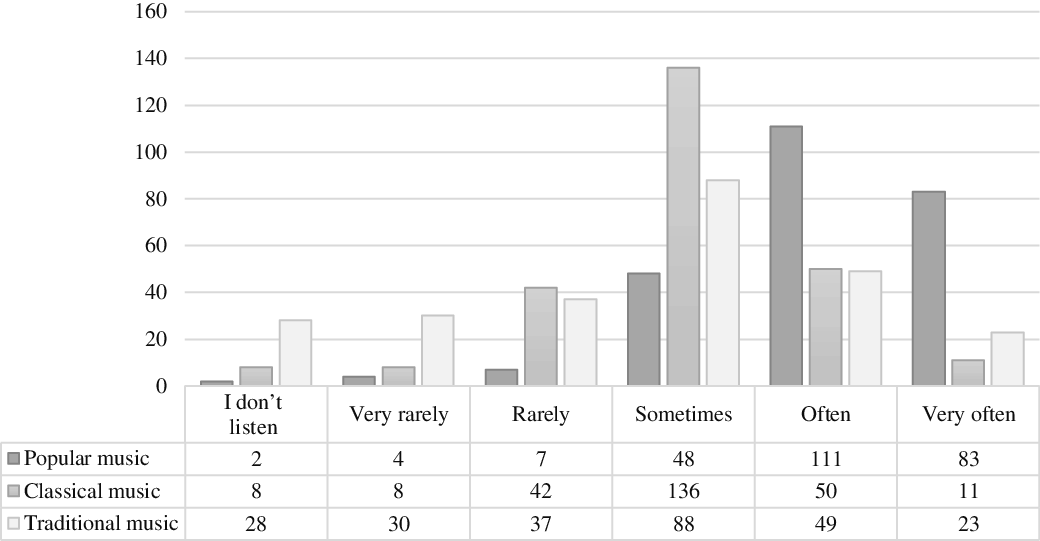
We asked teachers to indicate in their response how often they listen to each type of music in their leisure time (Figure 1). The results showed that teachers mostly listen to popular music (M = 4.54), while they listen to classical and traditional music only occasionally. Mean (M) for classical music is 2.96 and for traditional 2.66. The largest scatter in responses was obtained for listening to traditional music (σ = 2.96). The scatter is significantly less for the responses related to the habits of listening to classical music (σ = 0.97), and the least is for listening to popular music (σ = 0.94).
Habits of listening to different types of music.

The importance of music activities conducted in music teaching
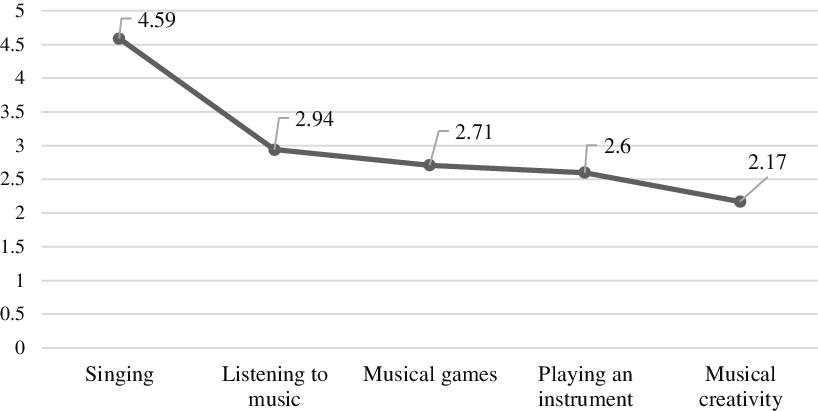
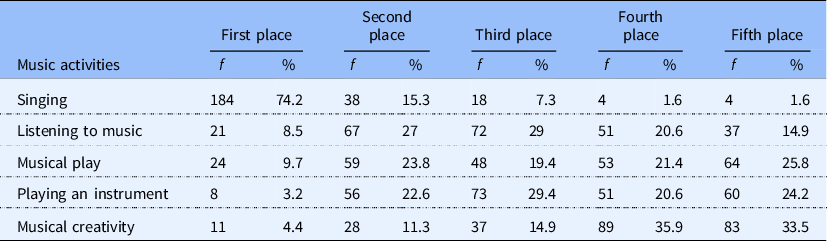
We then asked the teachers to rank all five music activities (musical creativity, musical play, listening to music, playing an instrument and singing) according to their importance in teaching music. Of the activities carried out in the teaching music, singing is placed first by these teachers (Figure 2). About 74.2% of teachers place this activity as first in importance. Thus, the research did not confirm the first hypothesis in which we assumed that listening to music was the most important for teachers. In second place, teachers place the highest priority on listening to music, which is not often the first among teachers, but most often in the third (29%), second (27%) or fourth (20.6%) place. Only 8.5% of teachers place it first (Table 1). The third most important activity is playing an instrument, then as the fourth musical play and as the fifth musically creative activities. As the least important activity, teachers most often singled out musical creativity (33.5%), musical play (25.8%) and playing an instrument (24.2%). The largest dispersion is in responses related to musical play (σ = 1.34), and the least is in the answers about the importance of singing in music teaching (σ = 0.82). This means that teachers differ most in their answers about the importance of musical play, and they mostly agree in their answers about the importance of singing.
Musical activities in teaching music by importance – average values (M).

Teachers’ Responses to the Importance of Musical Activities in Teaching Music – Absolute and Relative Frequencies

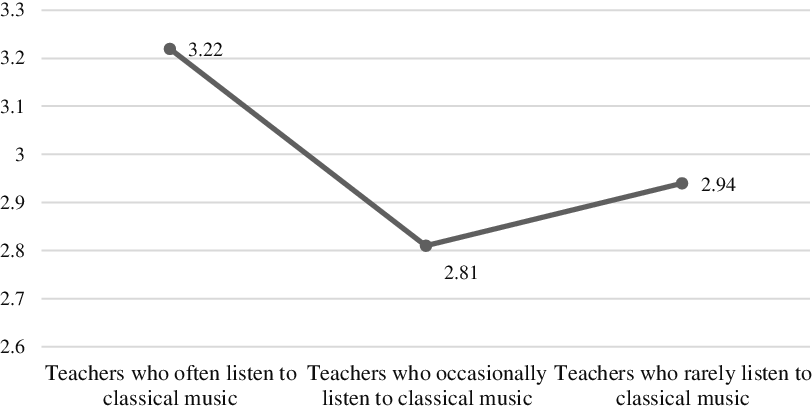
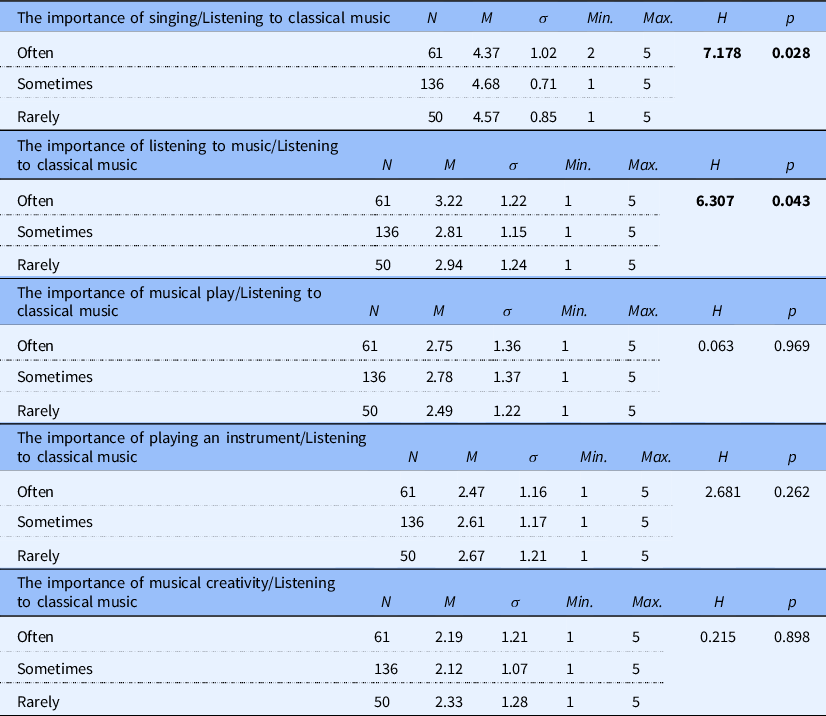
We compared teachers’ responses to the importance of music activities and grouped them according to the habits of listening to classical music in their leisure time. In the first group, there were teachers who frequently listen to classical music, in second group those who occasionally listen to this music and in the third group teachers who rarely listen to classical music. In all groups, singing comes first, while listening to music comes second. However, for the first group (for teachers who listen to classical music often) we now have a higher score for their opinion on the importance of music listening activity (M/A = 3.22) than for the score of the other two groups (M/B = 2.81, M/C = 2.94) (Figure 3). For the first group of teachers, the results related to the teachers’ opinion on the importance of musically creative activities are also significantly higher (M/A = 2.19) than the group in which teachers rarely listen to classical music (M/C = 1.28). Musical play is in the third place for the first two groups, while for the third group they are in the fourth place in importance. Playing an instrument is in the fourth place for the first two groups, while for the third group it is in third place. All three groups of teachers place musically creative activities in the fifth place by importance and therefore consider them least important.
Importance of listening to music with respect to the habits of listening to classical music by teachers in their leisure time – average rank values.

As Table 2 shows, the Kruskal–Wallis H-test showed that there were some differences. Listening to music is more important for the teachers that listen to classical music more often (H = 6307, p = 0.043) (Table 2) and singing (H = 7178, p = 0.028). This result shows that the study confirmed the second hypothesis according to which we assumed that there was a statistically significant difference in the evaluation of the importance of listening to music in music teaching in the first three grades of primary school, given the habits of listening to classical music by teachers in their leisure time.
Teachers’ Opinions on the Importance of Musical Activities Regarding the Habits of Listening to Classical Music – Average Rank Values, Range and Dispersal of Results, Kruskal–Wallis H-test

Frequency of performing music activities in music teaching
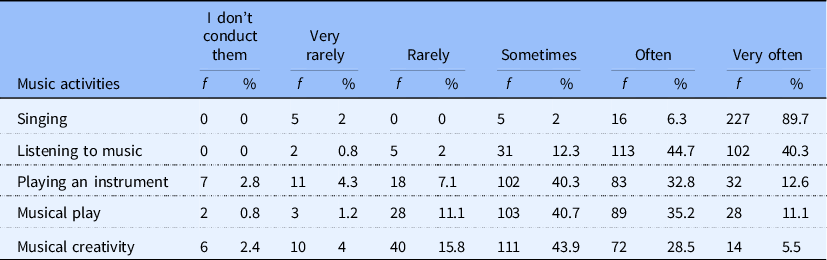
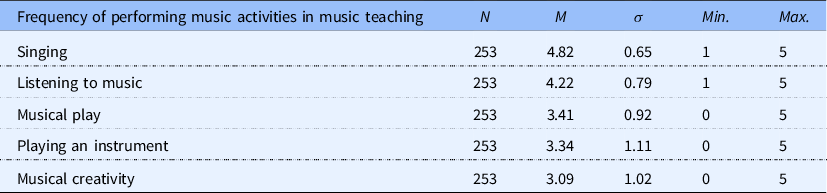
Teachers were also asked to answer a question about the frequency of music activities in music teaching. The conducted research did not confirm the third hypothesis according to which we assumed that listening to music was the most frequent activity in teaching music in the first three grades of primary school. Therefore, the most frequent activity in teaching music is not listening to music, but singing (M = 4.82), and this activity, according to the teachers, is performed very often in the classroom (Table 3). Listening to music is second in frequency (M = 4.22) and is often performed as part of music teaching, while musical play, playing an instrument and musical creativity are much less frequent and only occasionally performed in class. The highest dispersion was obtained in the responses related to playing an instrument (σ = 1.10), while the smallest dispersion was found in the responses related to singing (σ = 0.65) (Table 4). The data on the total dispersion of the frequency response of individual activities indicate large individual differences in estimates of frequency of playing an instrument and small differences in estimates of frequency of singing.
Frequency of Performing Different Music Activities in Music Teaching – Absolute and Relative Frequencies

Teachers’ Statements on the Frequency of Performing Various Music Activities in Music Teaching – Average Scale Values of Ranks, Range and Dispersion of Results

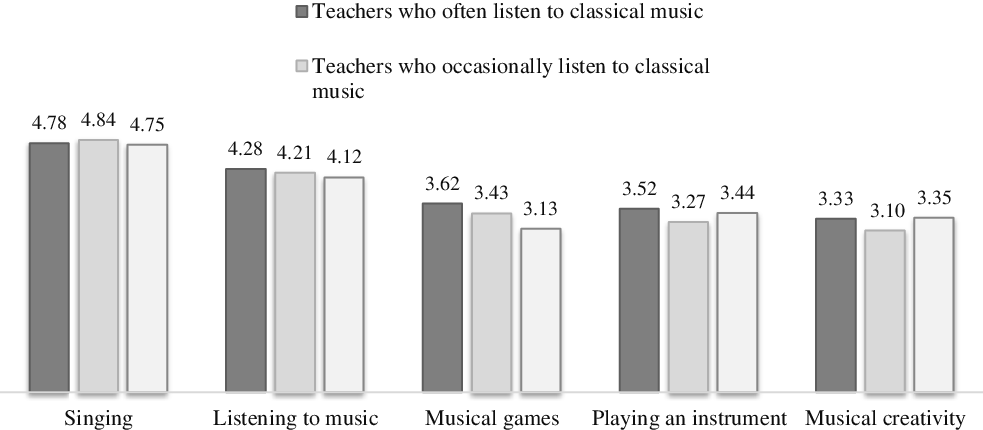
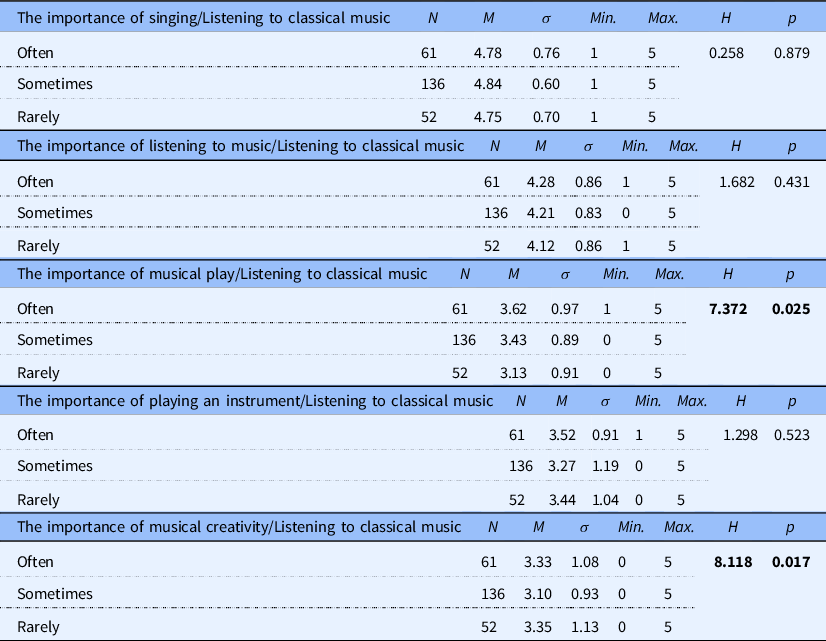
We analysed the responses from the questionnaire and the frequency of listening to classical music in teachers’ leisure time. The results can be seen in Figure 4 and Table 5. It can be seen from all the results that the three groups of teachers, by the criterion of listening to classical music in their leisure time, are almost indistinguishable. Teachers from all three groups ranked music activities equally in frequency. In all groups, singing is first placed and musical creativity in last place.
Frequency of individual music activities with respect to habits of listening to classical music by a teacher in leisure time – average scale values of ranks (M).

Teachers’ Statements on the Frequency of Musical Activities with Respect to the Habits of Listening to Classical Music – Average Rank Scales, Range and Scatter of Scores, Kruskal–Wallis H-test

Figure 4 and Table 5 also show that there are differences between the three groups in the treatment of the musical activities, but that these differences are not great. Statistically significant differences existed in the responses to the frequency of musical play (H = 7372, p = 0.025) between the first and third group, and in the responses to the frequency of musically creative activities (H = 8118, p = 0.017) between the second and third group. Applying the Kruskal–Wallis H-test to the response to the frequency of listening to music between the first and third group (H = 1.682, p = 0.431), it was found that a certain difference existed but was not statistically significant. Thus, the study did not confirm the fourth hypothesis according to which we assumed that there was a statistically significant difference in the frequency of performing music listening activities regarding the habits of listening to classical music by teachers in their leisure time.
Conclusion
In summary, we can conclude that although the Croatian Primary School Curriculum (2006) places great emphasis on listening to music, in practice classroom teachers most often perform singing activities and consider them the most important for music teaching. Listening to music comes second in importance and frequency in music teaching. Accordingly, we suggest that classroom teachers are either not familiar enough with the documentation related to teaching music, or they approach music teaching activities differently because they do not agree with what is stated in that document.
Another important result of this research is the data that shows that listening to music is more important to those teachers who often listen to classical music in their leisure time than to teachers who listen to this music occasionally, rarely or not at all. This leads us to the conclusion that teachers’ opinions about the importance of listening to music may be related to their habits of listening to classical music in their leisure time. Therefore, we suggest that more attention needs to be paid to acquiring the habit of listening to classical music with future teachers. We propose that the more developed this habit is, the more teachers attach importance to listening activities in music teaching and thus contribute to increasing students’ interest in learning about and engaging in music.
Listening to music through actual, in-classroom listening was not achievable in mainstream schools until recording equipment began to emerge. Today, this is possible by providing good resources for teachers in schools, by preparing future teachers methodically for conducting music listening activities within teacher training courses and by developing the habit of music listening as much as possible with future teachers. In schools, we need teachers who know how to get students interested in different types of music, including classical music, and how to convey their enthusiasm to their students. We need teachers who are not satisfied with achieving just any kind of listening in teaching music, but rather a listening experience that will be a special experience for them and their students.