Introduction
With the depletion of fossil fuel energy and deterioration of ecological environment, clean and high-efficiency energy storage systems, such as lithium ion batteries, electrochemical supercapacitors, Ni–O batteries, have attracted much more attentions.[ Reference Chang, Sun, Xu, Xu and Gao 1 ] Among them, electrochemical supercapacitors are regarded as the most promising candidates because of their low-cost, high-power density, faster charge–discharge properties, and long durability.[ Reference Zhang and Lou 2 ] Three-dimensional (3D) microstructures assemble from one-dimensional (1D) (nanowires or nanorods) or two-dimensional (such as nanosheet) have gained much attention owing to their higher specific area and unique characteristics compared with solid structures.[ Reference Gong, Yang, Zhan, Ma, Vajtai and Ajayan 3 , Reference Yu, Qiu, Wang and Tong 4 ] Such hierarchical microstructures are expected to satisfy the practical needs for the energy-storage devices,[ Reference Wang, Pan, Zhu, Nie, Zhang, Tang, Liang and Cao 5 ] sensors,[ Reference Alenezi, Henley, Emerson and Silva 6 ] catalysis,[ Reference Wang, Xin, Zhu, Liu, Wu and Wang 7 ] and so on.
Carbon materials in different dimensions have been widely used in energy storage systems. Among them, 1D carbon nanofibers (CNFs) and carbon nanotubes have several advantages over other forms of carbon materials. Firstly, carbon materials have high aspect ratio which makes it easy to form conductive network at an extremely low percolation.[ Reference Yang and Jin 8 ] Secondly, carbon materials with large surface area are in favor of deposition and encapsulation of metals and metal oxides even in high concentrations when employed as substrates or supports.[ Reference Jiang, Wei, Chen, Du, Li, Liu, Huang and Chen 9 – Reference Jiang, Li, Wei, Jiang, Du and Chen 11 ] Thirdly, their particular interconnected porous structures admit them to be used as versatile scaffolds to immobilize active materials for charge transfer.[ Reference Chen, Jiang, Yu, Liu, Liu, Li, Huang and Tong 12 ] Carbon fibers are a new class of flexible materials with high mechanical strength, superior electro-conductibility and excellent corrosion resistance. Meanwhile, they can supply a large surface area, which is critical for nanostructure-based photovoltaic technology.[ Reference Zhang and Gong 13 ]
So far, a variety of materials, such as carbon materials,[ Reference Yu, Ma, Liu and Li 14 ] metal oxides,[ Reference Wu, Ma, Feng, Qian and Xiong 15 ] metal nitrides,[ Reference Mohamed, Chen, Chen, Hu and Liu 16 ] and lithium alloys and their composites,[ Reference Wang, Li, Luo, Hao, Zhou, Zhang, Fan and Zhi 17 ] have been widely studied as the potential battery materials. Among them, transition metal oxides with high theoretical capacities, short electron transport, and ion transport pathways are worked as the promising electrode materials for battery materials.[ Reference Liu, Zhang, Si, Xi, Eichler, Yan and Schmidt 18 , Reference Li, Ding, Wang, Cai and Wang 19 ] Nevertheless, most of the metal oxides, which belong to semiconductors usually have disadvantages of poor conductivity, extra contact resistance and distinct volume change during the circulatory charge/discharge processes.
Recently, binary metal oxides have been studied as the high-performance electrode materials because of their higher electrical conductivity and higher electrochemical activity compared with single component oxides.[ Reference Guan, Guo, Hu, Zhang, Fu, Ren, Li and Li 20 ] NiCo2O4 with a spinel structure is a typical binary metal oxide, which has the advantages of low cost, high availability, and harmfuless.[ Reference Shen, Yu, Yu, Zhang and Lou 21 ] More importantly, the spinel NiCo2O4 is supposed to have richer redox reactions, which include contributions from both nickel and cobalt ions, than their monometallic nickel oxides and cobalt oxides.[ Reference Yuan, Li, Hou, Zhang, Shen and Lou 22 ] All these fascinating features benefit its application in electrode materials. Up to now, in order to obtain better electrochemical performance, NiCo2O4 with multifarious morphologies, including nanosheets,[ Reference Van, Lamiel and Shim 23 ] nanowires,[ Reference Xiong, Gao, Wu, Hu, Lan, Chen, Pu, Zeng, Su and Zhu 24 ] nanoflakes,[ Reference Li, Chai, Dai and Manthiram 25 ] nanoribbons,[ Reference Li, Feng, Qian and Xiong 26 ] nanotubes,[ Reference Pu, Wang, Wang, Tong, Lu, Kong and Wang 27 ] and mesoporous microspheres,[ Reference Li, Xiong, Liu, Ju and Qian 28 ] have been successfully prepared. These nanostructures have acquired a certain influence in improving the capacity and cycle performance of NiCo2O4 anodes.
In this work, CNFs were prepared from the electrospun method and carbonization treatment as substrates.Subsequently NiCo2O4–CNFs hybrids were formed by coating 3D rambutan-like NiCo2O4 microspheres onto the surface of CNFs through a solvothermal method. The composition and microstructure of NiCo2O4–CNFs hybrids were characterized by the field-emission scanning electronmicroscopy (FE-SEM), x-ray photoelectron spectroscopy (XPS), transmission electron microscopy (TEM), and x-ray diffraction (XRD). The electrochemical performance electrochemical properties of NiCo2O4–CNFs hybrids as electrode materials were investigated.
Experimental
Materials
Polyacrylonitrile (PAN, M w = 150,000) powder, N, N′-dimethylformamide (DMF), polyvinylpyrrolidone (PVP, M w = 100,000) powder, nickel nitrate [Ni(NO3)2.6H2O], cobalt nitrate [Co(NO3)2.6H2O], urea [(NH2)2CO], and potassium hydroxide (KOH) were purchased from aladdin Co. Ltd. (China).
Preparation of NiCo2O4–CNFs hybrids
Firstly, PAN and PVP were dissolved in DMF by rapid stirring for 12 h to obtain a homogeneous solution. About 10 mL of the solution was placed in a 10 mL syringe. The syringe with solution was placed in a syringe pump that maintained a solution feeding rate of 0.08 mm/min. The distance between the needle tip and collector was 12 cm, and the voltage was set at 15 kV. The collected nanofibers were annealed at 550 °C for 3 h in pure nitrogen with a heating rate of 2 °C/min to obtain CNFs. The CNFs were further put into a 80 mL-mixed solution (V ethanol:V water = 1:1) containing 0.50 g nickel nitrate, 0.63 g cobalt nitrate, and 0.60 g urea, and transferred to an 100 mL Teflon-lined stainless steel autoclave and heated at 120 °C for 16 h. The obtained intermediate products were annealed at 350 °C for 2 h in pure nitrogen with a heating rate of 1 °C/min. Finally, the products were dried at 60 °C for 6 h to obtain NiCo2O4–CNFs hybrids.
Characterization
The structures and crystal phase of the as-prepared samples were analyzed with a SIEMENS Diffraktometer D5000 x-ray diffractometer (XRD) with Cu Kα radiation source at 35 kV, with a scan rate of 4°/s in the 2θ range of 5–80°. The XPS data were obtained with an obtained with an ESCALab220i-XL electron spectrometer from VG Scientific using 300W Al Kα radiation. The ULTRA-55 FE-SEM at an accelerating voltage of 10 kV and JSM-2100 TEM were used to characterize the morphology of the as-prepared samples.
Electrochemical measurements
All the electrochemical characteristics were measured through CHI660C (Shanghai) electrochemical work station. The cycling stability was measured by a LAND battery system (CT2001A, Wuhan). For the three-electrode electrochemical measurements, the platinum silk and the Hg/HgO electrode acted as the counter and reference electrodes, and the as-prepared NiCo2O4–CNFs acted as the working electrode. The 2 M KOH aqueous solutions worked as the electrolyte.
Results and discussion
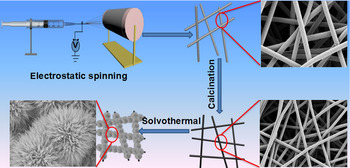
Herein, we present the design and fabrication of a hybrid nanostructure composed of ultrathin NiCo2O4 nanosheets supported on CNFs as an advanced electrode for supercapacitors. The growth of NiCo2O4 nanosheets involves a simple electrospunning method and post-solvothermal treatments. Firstly, the PAN/PVP nanofiber membrane is prepared through an electrospunning method. Then, the PAN/PVP nanofibers membrane is further transferred into CNFs after calcination treatment. Finally, the NiCo2O4–CNFs are obtained through a solvothermal method. The schematic representation for preparation of NiCo2O4–CNFs is shown in Scheme 1.
The schematic representation for preparation of NiCo2O4–CNFs.

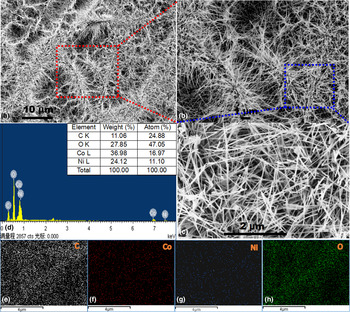
Figure 1 shows the SEM and mapping images of as-synthesized NiCo2O4–CNFs at different magnifications. As shown in Fig. 1(a), large-scale and dense NiCo2O4 nanoneedles grow vertically on CNFs to form like rambutan-like microspheres. The rambutan-like NiCo2O4 with average diameters about 3 µm are uniformly grown on surface of CNFs. Because the surface of CNFs is rough, it is beneficial for growing of NiCo2O4 nanoneedles. SEM images of NiCo2O4–CNFs at higher magnifications are shown in Fig. 1(b) and (c), it is clearly noted that the length of the NiCo2O4 nanoneedles is more than 500 nm and the diameter is about 15 nm. The special morphology could provide large active surface areas and much shorter paths for electron transport and effective channels for the electrolyte. Figure 1(d) shows the energy dispersive spectroscopy spectrum of the NiCo2O4, which verifies the existence of Ni, Co, O, and C elements in NiCo2O4–CNFs. The C, Co, Ni, and O edge mappings are shown in Fig. 1(e–h), respectively. It can be seen that the blue color (assign to Ni), red color (assign to Co), white color (assign to C), and green color (assign to O) are uniformly distributed in the sample of NiCo2O4–CNFs membranes, which indicates the target products are successfully prepared.
SEM images of NiCo2O4–CNFs with magnification at 5 K (a), 10 K (b), and 20 K (c); EDS spectrum (d) and elemental mappings (e–h) for NiCo2O4–CNFs hybrids.

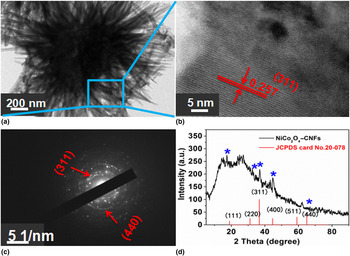
The TEM is used to analyze the microscopic morphology and structure information of NiCo2O4–CNFs. As shown in Fig. 2(a), the dense nanoneedle-like NiCo2O4 are grown uniformly on CNFs, and the microscopic morphology and structure are consistent with SEM results, which further related that the rambutan-like NiCo2O4 microspheres are actually assembled by very small nanoneedle with the size ranging from 10 to 15 nm. Figure 2(b) shows the high-resolution TEM (HRTEM) image of NiCo2O4–CNFs. The observed interplanar spacing is 0.297 nm, which can be indexed to the (311) lattice planes of the NiCo2O4 phase. Two distinct diffraction rings marked by red arrows can be observed from the selected area electron diffraction (SAED) pattern in inset of Fig. 2(c), which can be indexed to (311) and (440) crystal planes of NiCo2O4. The large amount of diffraction dots can be founded, which indicate the poly-crystalline nature of the as-prepared products. The crystalline phases of the NiCo2O4–CNFs are further identified by the XRD. The typical XRD pattern of the NiCo2O4–CNFs is shown in Fig. 2(d). All diffraction peaks can be indexed to the cubic NiCo2O4 phase (JCPDS card no. 20-0781).[ Reference Zhu, Pu, Song, Wu, Zhou, He, Lu, Jing, Tang and Ji 29 ]
TEM image (a), HR-TEM image (b), SAED pattern (c), and XRD pattern (d) of NiCo2O4–CNFs hybrids.

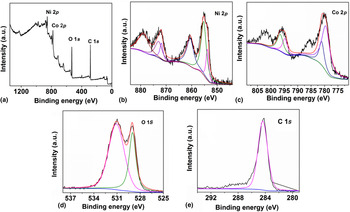
The chemical composition of the as-prepared NiCo2O4–CNFs hybrids are further confirmed by the XPS measurement. The XPS spectrum of the NiCo2O4–CNFs membrane exhibits prominent peaks of Ni, Co, O, and C, as shown in Fig. 3(a). The high-resolution XPS spectrum of Ni 2p on the composite membrane is shown in Fig. 3(b). It can be well fitted as two peaks with binding energies at 855.6 and 873.2 eV, and with a spin-energy separation of 17.6, which is the signal from Ni3+.[ Reference Zhu, Pu, Song, Wu, Zhou, He, Lu, Jing, Tang and Ji 29 – Reference Liu, Zhang and Tang 32 ] For Co 2p spectrum in Fig. 3(c), the spectrum can be fitted at 779.2 and 794.6 eV, which corresponding to the Co 2p 3/2 and Co 2p 1/2 energy levels, respectively.[ Reference Zhou, Chen, Tang, Ren and Yang 33 ] In Fig. 3(d), the O1s spectrum can be fitted into two peaks at 529.8 and 531.3 eV, which are represent OI, metal-oxygenbonds[ Reference Marco, Gancedo, Gracia, Gautier, Rios and Berry 34 ] and OII, the low oxygen coordination in the material with a small particle size, respectively.[ Reference Dupin, Gonbeau, Vinatier and Levasseur 35 ] The C1s spectrum shows a dominant peak at 284.7 eV, which corresponding to the carbon single/double bonds (C−C/C = C).[ Reference Chen, Jiang, Yu, Liu, Liu, Li, Huang, Tong and Chen 36 ]
The XPS spectrum of NiCo2O4–CNFs (a), the high-resolution XPS spectra of Ni 2p (b), Co 2p (c), O 1s (d), and C 1s (e).

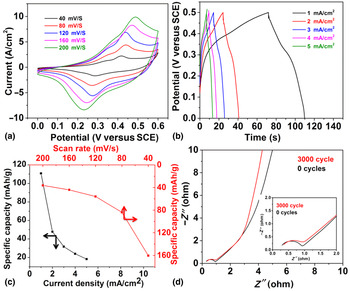
The electrochemical characteristics are performed by three-electrode electrochemical measurements. Figure 4(a) shows the typical cyclic voltammetry (CV) curves for NiCo2O4–CNFs hybrids at various scan rates ranged from 40 to 200 mV/s. The obvious pair of redox peaks of CV curves can be observed that indicate the electrochemical capacity of as-prepared NiCo2O4–CNFs from the reversible Faradaic redox reactions.[ Reference Brousse, Bélanger and Long 37 ] Figure 4(b) reveals the galvanostatic charge–discharge results at different current densities (1, 2, 3, 4, and 5 mA/cm2) with the voltage between 0 and 0.5 V. The potential plateaus can be founded in all curves between 0.15 and 0.25 V and they reveal the battery-type characteristic of the composite electrode. The specific capacities of the NiCo2O4–CNFs electrode are calculated from the discharge times, which were about 110, 48, 32, 24, and 18 mAh/g at current densities of 1, 2, 4, 7, and 10 mA/cm2, respectively. The specific capacities of the NiCo2O4–CNFs electrode calculated from CV curves are showed in Fig. 4(c) (red curves). The maximum specific capacitance is 160 mAh/g at 40 mV/s. As illustrated in Fig. 4(c), with the increasing of discharge current density, the areal specific capacity is gradually decreased due to the incremental potential drop and relatively in sufficient active material involved in redox reaction under higher current densities. Electrochemical impedance spectroscopy is measured and the corresponding Nyquist plots are shown in Fig. 4(d). In the high-frequency area, the intersection of the curve at real part Z′, which is equal to internal resistances (R b), indicates the bulk resistance of the electrochemical system. R b for the NiCo2O4–CNFs electrode slightly increased after 3000 cycles, indicating a slight electron conductivity decrease of the electrode. The low charge-transfer resistance (R ct) represented by the high-frequency semicircle indicates the large electro active surface area of the electrode.[ Reference Guan, Guo, Hu, Zhang, Fu, Ren, Li and Li 20 ] The diffusive resistance (Warburg impedance) of the NiCo2O4–CNFs electrode represented by the slope in the low-frequency curve is a little higher after 3000 cycles. These results can be related to a slight change in surface and microstructure of the NiCo2O4 after 3000 successive cycles.
Cyclic voltammetry curves with different scan rates (a), galvanostatic charge–discharge curve (b), specific capacitance at different current densities and scan rates (c), and electrochemical impedance spectroscopy (d) of NiCo2O4–CNFs hybrids.

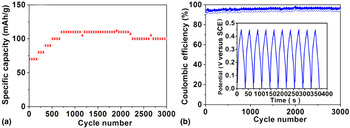
Cycling stability is an important factor that determines the practical applications of electrode materials. Figure 5(a) shows the cycling performance of the NiCo2O4–CNFs-based electrode at a current density of 1 mA/cm2. The specific capacity can be gradual increased to 112 mAh/g with cycle number until about 600 cycles, and then keeps high specific capacity (>110 mAh/g) to 2000 cycles. Further increasing the cycles, the specific capacity exhibits a slightly decrease to ~100 mAh/g, which degraded by 9.1% after 2000 cycles. The specific capacitances have a gradual increase before hundreds of cycles, and can reach a maximum value. Then they decrease slightly compared with the maximum value. This may be attributed to the cycling-induced improvement in the surface wetting of the electrode, leading to more electroactive surface areas.[ Reference Huang, Zhao, Wu, Lang, Liu and Hu 38 ] As shown in Fig. 5(b), the Coulombic efficiency is above 95.4% in the cycles, which indicated that NiCo2O4–CNFs electrode well performed reversibility of Faraday reactions behaved. The inset in Fig. 5(b) shows the last ten cycles of representative voltage profiles at a current density of 1 mA/cm2. They exhibit highly symmetric charge/discharge characteristics, confirming the excellent long-term cyclability of the hybrid electrode.[ Reference Yu, Sun, Sun, Lu, Wang, Hu, Qiu and Lian 39 ]
Cycling performance (a) and coulombic efficiency (b) of NiCo2O4–CNFs hybrids.

Conclusions
In summary, we presented the design and fabrication of a hybrid nanostructure composed of ultrathin NiCo2O4 nanosheets supported on CNFs as an advanced electrode material for supercapacitors. The growth of NiCo2O4 nanosheets involved a simple electrospunning method and post-solvothermal treatments. The as-prepared NiCo2O4–CNFs hybrids exhibited significantly improved electrochemical performance in terms of high specific capacitance, remarkable rate capability, and excellent cycling stability. The excellent electrochemical behaviors could be attributed to the unique nanostructure of NiCo2O4 nanosheets that provided large electro-active surface and facilitates charge transport, and after 3000 cycles, the specific capacity could be remained over 95%. The novel 3D rambutan-like unique microscopic structure and excellent specific capacity properties make NiCo2O4–CNFs be a suitable candidate for battery-style electrode materials.
Acknowledgements
This work was financially supported by the National Natural Science Foundation of China (Grant no. 51373155), Collaborative Innovation Center for Modern Textile Technology of Zhejiang Province (2011-Program) (Grant no. 20160202) and “521 Talents Training Plan” in Zhejiang Sci-Tech University (ZSTU).