1 Introduction
Turbulence remains one of the great unsolved problems of classical physics. Throughout the universe, from distant galaxy clusters to our own heliosphere, 99 % of baryonic matter occurs in the plasma state, and these plasmas are nearly always found to be magnetized and turbulent. On the frontier of plasma physics research is the effort to understand how turbulence affects the evolution of any system in which it arises, from terrestrial settings to distant regions of the universe. Plasma turbulence mediates the conversion of the energy of plasma flows and magnetic fields at large scales to plasma heat, or other forms of particle energization. Turbulence may also be a key ingredient in the acceleration of high-energy particles at collisionless shocks and magnetic irregularities caused by turbulence affect the propagation of energetic particles, such as cosmic rays in the Galaxy and solar energetic particles in the heliosphere. The physics of magnetic reconnection may be fundamentally altered in a turbulent medium. Turbulence enhances the loss of angular momentum from accretion disk plasmas, enabling the fuelling of black holes and other compact objects. In terrestrial laboratories, turbulence limits the efficiency of proposed magnetically confined fusion devices by enhancing the transport of heat and particles across the confining magnetic field.
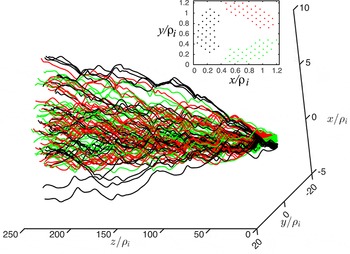
Three-dimensional plot of the spreading and tangling of magnetic field lines in a driven, nonlinear gyrokinetic simulation of plasma turbulence relevant to the solar wind. Field lines within four small regions at
 $z=0$
are coloured red, green, blue and black. From an initially straight magnetic field, continually driven turbulence, possibly in combination with magnetic reconnection, leads to a stochastically tangled magnetic field. Note the scale of the
 $z$
-axis is compressed in this plot, so the domain is, in fact, highly elongated.

Although studies of astrophysical turbulence generally focus on how turbulence mediates the conversion of energy from one form to another, plasma turbulence also naturally generates a tangled magnetic field. For example, consider a quiescent, incompressible magnetohydrodynamic (MHD) plasma embedded with a straight and uniform magnetic field. If one drives finite-amplitude Alfvén waves in both directions along that magnetic field, nonlinear interactions among those counterpropagating Alfvén waves will lead to a turbulent cascade of fluctuation energy to small scales (Kraichnan Reference Kraichnan1965; Similon & Sudan Reference Similon and Sudan1989; Sridhar & Goldreich Reference Sridhar and Goldreich1994; Goldreich & Sridhar Reference Goldreich and Sridhar1995; Maron & Goldreich Reference Maron and Goldreich2001; Howes et al.
Reference Howes, Drake, Nielson, Carter, Kletzing and Skiff2012; Drake et al.
Reference Drake, Schroeder, Howes, Kletzing, Skiff, Carter and Auerbach2013; Howes & Nielson Reference Howes and Nielson2013; Howes et al.
Reference Howes, Nielson, Drake, Schroeder, Skiff, Kletzing and Carter2013; Nielson, Howes & Dorland Reference Nielson, Howes and Dorland2013). In the process, the magnetic field becomes increasingly tangled, taking on a stochastic appearance, as shown by the rendering of magnetic field lines from a driven, gyrokinetic simulation of plasma turbulence in figure 1. Here, magnetic field lines passing through four small regions at
 $z=0$
are given distinct colours. As the field lines are followed through the simulation domain, they spread out and become increasingly tangled up with field lines initially from other regions of the plasma. This phenomenon of magnetic field line wander arises due to the nonlinear interactions that mediate the turbulent cascade of energy to small scales, likely in combination with the process of magnetic reconnection.
The inevitable wandering of the magnetic field in turbulent plasmas affects a number of other physical processes, with important unanswered questions regarding its impact on energetic particle propagation in astrophysical and fusion plasmas, the cascade of energy in plasma turbulence, particle acceleration and magnetic reconnection. Most of the existing studies that attempt to assess the effect of magnetic field line wander on other physical processes, as reviewed below in § 2, have used a turbulent magnetic field derived from a simplified model or other analytical prescription rather than a turbulent magnetic field generated by direct numerical simulations. Here we advocate a more fundamental approach, using direct numerical simulations to develop a quantitative understanding of how a magnetic field becomes tangled in plasma turbulence as a function of the parameters of the plasma and the turbulence. Theoretical considerations of the tangling of a magnetic field in plasma turbulence are presented in § 3, including the fundamental parameters upon which the development of magnetic field line wander is likely to depend. Finally, we present some initial quantitative results on the development of magnetic stochasticity and the separation of field lines using nonlinear gyrokinetic simulations that accurately resolve the kinetic microphysics of collisionless magnetic reconnection.
2 Impact of magnetic field line wander
Magnetic field line wander arising from plasma turbulence impacts important plasma physics processes that govern the evolution of a wide range of important space, astrophysical and laboratory plasma systems. We review below previous investigations of how the wandering of the magnetic field affects the propagation of energetic particles in astrophysical and fusion plasmas, the cascade of energy in plasma turbulence, the acceleration of particles at collisionless shocks and the physics of magnetic reconnection.
2.1 Propagation of cosmic rays and energetic particles
The attempt to understand and predict the propagation of cosmic rays through the interplanetary and interstellar magnetic fields has been a major driver of research into the effect of turbulence on the tangling of the magnetic field. In a seminal early paper, Jokipii (Jokipii Reference Jokipii1966) performed the first detailed quasilinear statistical calculation of the motion of charged particles in a spatially random magnetic field, establishing a quantitative connection to the turbulent power spectrum of magnetic field fluctuations. Subsequent work conceptually explained the observed spreading of solar energetic particles from an active region over
 $180^{\circ }$
in solar longitude as a consequence of a magnetic field line random walk due to turbulent magnetic field fluctuations (Jokipii & Parker Reference Jokipii and Parker1968).
The scattering and acceleration of cosmic rays by a spectrum of Alfvén waves with strictly parallel wavenumbers was treated analytically by Schlickeiser (Schlickeiser Reference Schlickeiser1989), and was later extended to include the interaction with fast mode waves in a low beta plasma (Schlickeiser & Miller Reference Schlickeiser and Miller1998). A nonlinear diffusion theory of the stochastic wandering of magnetic field lines, developed by Matthaeus et al. (Matthaeus et al. Reference Matthaeus, Gray, Pontius and Bieber1995), lead to the expectation of diffusive field line wandering in the perpendicular direction.
By the mid-1990s, numerical modelling of the wandering of magnetic field lines began to be widely used, including test particle calculations of energetic particle transport along those turbulent magnetic fields. These efforts require, as input, a model of the spectrum of magnetic fluctuations generated by the plasma turbulence, and a wide variety of such turbulent magnetic field models have been used. Sophisticated numerical field line following algorithms and complementary analytical approaches have been used to study realizations of slab turbulence models with magnetic field fluctuations
 $\unicode[STIX]{x1D6FF}\boldsymbol{B}(z)$
(Schlickeiser Reference Schlickeiser1989; Shalchi & Kourakis Reference Shalchi and Kourakis2007a
,Reference Shalchi and Kourakis
b
; Shalchi Reference Shalchi2010b
), two-dimensional (2-D) turbulence models with
 $\unicode[STIX]{x1D6FF}\boldsymbol{B}(x,y)$
(Shalchi & Kourakis Reference Shalchi and Kourakis2007a
,Reference Shalchi and Kourakis
b
; Guest & Shalchi Reference Guest and Shalchi2012), composite models including slab plus 2-D components with
 $\unicode[STIX]{x1D6FF}\boldsymbol{B}=\unicode[STIX]{x1D6FF}\boldsymbol{B}(z)+\unicode[STIX]{x1D6FF}\boldsymbol{B}(x,y)$
(Bieber, Wanner & Matthaeus Reference Bieber, Wanner and Matthaeus1996; Giacalone & Jokipii Reference Giacalone and Jokipii1999; Shalchi & Kourakis Reference Shalchi and Kourakis2007a
,Reference Shalchi and Kourakis
b
; Qin & Shalchi Reference Qin and Shalchi2013) and full 3-D models with
 $\unicode[STIX]{x1D6FF}\boldsymbol{B}(x,y,z)$
, including both isotropic (Zimbardo et al.
Reference Zimbardo, Veltri, Basile and Principato1995; Giacalone & Jokipii Reference Giacalone and Jokipii1999; Shalchi Reference Shalchi2010a
; Ragot Reference Ragot2011) and anisotropic distributions of magnetic fluctuations (Chandran Reference Chandran2000; Zimbardo, Veltri & Pommois Reference Zimbardo, Veltri and Pommois2000; Zimbardo, Pommois & Veltri Reference Zimbardo, Pommois and Veltri2006; Shalchi & Kolly Reference Shalchi and Kolly2013; Ruffolo & Matthaeus Reference Ruffolo and Matthaeus2013).
These various investigations, conducted by a wide range of researchers, have often found conflicting results. The mean square displacement
 $\langle (\unicode[STIX]{x1D6FF}r)^{2}\rangle$
between two magnetic field lines, as they are followed along the magnetic field line a distance
 $l$
, is often modelled by the power-law form
 $$\begin{eqnarray}\langle (\unicode[STIX]{x1D6FF}r)^{2}\rangle \propto |l|^{p}.\end{eqnarray}$$
For different turbulent magnetic field models, or even a variation of the parameters within a single model, the resulting magnetic field line wandering is sometimes found to be sub-diffusive (
 $p<1$
) and other times found to be super-diffusive (
 $p>1$
), and yet other studies recover a standard diffusive behaviour (
 $p=1$
). Based on a broad reading of the literature, the results of the analytical and numerical modelling appear to be rather sensitive to the parameters and properties of the turbulence model chosen. For example, analytical modelling of anisotropic 3-D turbulence (with
 $k_{\bot }\gg k_{\Vert }$
, where
 $k$
is the wavenumber and perpendicular and parallel are with respect to the direction of the local magnetic field) suggests the field line wandering is diffusive (
 $p=1$
) (Shalchi & Kolly Reference Shalchi and Kolly2013), in contrast to the anomalous diffusion (
 $p\neq 1$
) often found using other turbulent models. At present, the wandering of magnetic field lines, and its impact on the propagation of energetic particles, remains an active area of research.
Improved modelling of the propagation of energetic particles in turbulent magnetic fields can have a significant impact on our technological infrastructure, with serious implications for national security. Our society is increasingly dependent on space-borne assets, such as global positioning system (GPS) navigation and communication satellites, so the prediction of severe space weather events in near-Earth space has become critically important for the protection of these assets. Solar energetic particle (SEP) events, in which a violent event on the surface of the sun spews high-energy electrons and protons into the heliosphere, represent a threat to both robotic and human assets in space. This prompts an urgent need to develop the ability to predict whether high-energy particles from a particular SEP event will reach the position of a potentially susceptible spacecraft. A predictive capability requires understanding how the SEP particles propagate through the turbulent interplanetary magnetic field. For example, on 3 NOV 2011, an SEP event erupted on the far side of the solar surface, spewing out energetic protons and electrons that were measured at the STEREO A, SOHO and STEREO B spacecraft, covering more than
 $200^{\circ }$
of solar longitude (Richardson et al.
Reference Richardson, von Rosenvinge, Cane, Christian, Cohen, Labrador, Leske, Mewaldt, Wiedenbeck and Stone2014). This wide longitudinal spread of significant SEP particle fluxes is not satisfactorily predicted by existing models of SEP propagation. An improved understanding of the magnetic field line wander in the turbulent interplanetary magnetic field, as a function of the plasma and turbulence parameters, is necessary to develop a reliable predictive capability.
In addition to studies of energetic particle propagation, thermal conduction in astrophysical plasmas, such as that occurring in galaxy cluster cooling flows, has also been found to be strongly affected by a stochastic magnetic field (Chandran & Cowley Reference Chandran and Cowley1998).
2.2 Magnetic confinement fusion
Coincident with the earliest studies on the propagation of energetic particles in space and astrophysical plasmas were complementary studies of anomalous electron heat transport in tokamaks of the magnetic confinement fusion program. In tokamak plasmas, gradient-driven instabilities generate turbulent fluctuations in the confining magnetic field. It has been proposed that the distortion of magnetic flux tubes as they are mapped along the turbulent confining magnetic field leads to a destruction of the magnetic flux surfaces (Rosenbluth et al. Reference Rosenbluth, Sagdeev, Taylor and Zaslavsky1966; Filonenko, Sagdeev & Zaslavsky Reference Filonenko, Sagdeev and Zaslavsky1967) that prevent radial mixing of hot central plasma with cold exterior plasma. It was recognized that collisional diffusion is unable to account for all of the electron heat transport measured in experiments, and that magnetic field line wander could potentially explain the additional, ‘anomalous’ transport. Further work quantitatively estimated the diffusion in collisional and collisionless regimes, suggesting that fluctuations of sufficient amplitude, caused by microinstabilities at the scale of the ion gyroradius, would consistently explain both the stochastic nature of the magnetic field and the observed electron heat transport (Rechester & Rosenbluth Reference Rechester and Rosenbluth1978).
Exploring the role of magnetic field line wander in enhancing electron heat transport in a tokamak plasma has continued over the years using analytical calculations and test particle modelling, and with the comparison of these results to experimental measurements (Galeev & Zeleny Reference Galeev and Zeleny1981; Krommes, Oberman & Kleva Reference Krommes, Oberman and Kleva1983; Haas & Thyagaraja Reference Haas and Thyagaraja1986; Laval Reference Laval1993; Spatschek Reference Spatschek2008). Recent advancements in the direct numerical simulation of weakly collisional plasma turbulence using nonlinear gyrokinetic simulations (Pueschel, Kammerer & Jenko Reference Pueschel, Kammerer and Jenko2008; Nevins, Wang & Candy Reference Nevins, Wang and Candy2011; Wang, Boldyrev & Perez Reference Wang, Boldyrev and Perez2011; Hatch et al. Reference Hatch, Pueschel, Jenko, Nevins, Terry and Doerk2012, Reference Hatch, Pueschel, Jenko, Nevins, Terry and Doerk2013) and other direct numerical approaches (del-Castillo-Negrete & Blazevski Reference del-Castillo-Negrete and Blazevski2014, Reference del-Castillo-Negrete and Blazevski2016) have enabled breakthrough studies of the cause of magnetic field line wander and its impact on confinement in fusion plasmas. Under fusion-relevant plasma conditions, gyrokinetic simulations showed that the magnetic field indeed rapidly becomes stochastic through gradient-instability-driven turbulence, but that this stochasticity does not always produce a significant enhancement in the electron heat flux (Nevins et al. Reference Nevins, Wang and Candy2011). The development of stochasticity appears to arise through nonlinear interactions among overlapping magnetic islands (Wang et al. Reference Wang, Boldyrev and Perez2011), supporting an idea proposed in early studies based on analytical considerations (Rechester & Rosenbluth Reference Rechester and Rosenbluth1978). By focusing on the properties of the dominant turbulent modes in ion temperature gradient and trapped electron mode instability-driven turbulence, this overlapping of magnetic islands arises through the nonlinear transfer of energy from the unstable ballooning modes of odd parity to stable tearing modes of even parity (Hatch et al. Reference Hatch, Pueschel, Jenko, Nevins, Terry and Doerk2012, Reference Hatch, Pueschel, Jenko, Nevins, Terry and Doerk2013).
2.3 The cascade of energy in plasma turbulence
It has been suggested that one can view the cascade of energy to small scales in magnetized plasma turbulence as due to the distortion of the perpendicular structure of Alfvén wavepackets as they propagating along a wandering, turbulent magnetic field (Similon & Sudan Reference Similon and Sudan1989), and this concept has been demonstrated numerically (Maron & Goldreich Reference Maron and Goldreich2001). An illustration of the distortion of a wavepacket with an initially circular cross-section perpendicular to the equilibrium magnetic field from a nonlinear gyrokinetic simulation of plasma turbulence is presented in figure 2. Recent work has adopted this framework to interpret current sheet formation in coronal loops (Rappazzo & Parker Reference Rappazzo and Parker2013), the nonlinear transfer of energy to smaller-scale Alfvén waves in basic laboratory experiments of plasma turbulence (Howes et al. Reference Howes, Drake, Nielson, Carter, Kletzing and Skiff2012; Drake et al. Reference Drake, Schroeder, Howes, Kletzing, Skiff, Carter and Auerbach2013; Howes & Nielson Reference Howes and Nielson2013; Howes et al. Reference Howes, Nielson, Drake, Schroeder, Skiff, Kletzing and Carter2013; Nielson et al. Reference Nielson, Howes and Dorland2013) and the evolution of magnetic flux surfaces in 3-D reduced MHD simulations (Servidio et al. Reference Servidio, Matthaeus, Wan, Ruffolo, Rappazzo and Oughton2014).
The distortion of a circular wavepacket as it propagates along the wandering magnetic field in a nonlinear gyrokinetic simulation of plasma turbulence.

Looking at this problem in more detail, the nonlinear physics underlying the turbulent cascade of energy from large to small scales is often described in Fourier space, where a nonlinear three-wave coupling mechanism has been identified that leads to a secular transfer of energy to modes with higher perpendicular wavenumber (Shebalin, Matthaeus & Montgomery Reference Shebalin, Matthaeus and Montgomery1983; Sridhar & Goldreich Reference Sridhar and Goldreich1994; Montgomery & Matthaeus Reference Montgomery and Matthaeus1995; Ng & Bhattacharjee Reference Ng and Bhattacharjee1996; Galtier et al.
Reference Galtier, Nazarenko, Newell and Pouquet2000; Howes & Nielson Reference Howes and Nielson2013), resulting in an anisotropic cascade of energy in wavevector space. But the physical manifestation of the
 $k_{\Vert }=0$
mode that mediates this resonant three-wave interaction is obscured by the use of the Fourier (plane wave) decomposition. An analytical calculation modelling interactions between localized Alfvén wavepackets demonstrated that wavepackets involving a
 $k_{\Vert }=0$
component will lead to this lowest-order three-wave nonlinear coupling (Ng & Bhattacharjee Reference Ng and Bhattacharjee1996), and this mechanism has been demonstrated using laboratory experiments (Howes et al.
Reference Howes, Drake, Nielson, Carter, Kletzing and Skiff2012, Reference Howes, Nielson, Drake, Schroeder, Skiff, Kletzing and Carter2013; Drake et al.
Reference Drake, Schroeder, Howes, Kletzing, Skiff, Carter and Auerbach2013). Physically, the
 $k_{\Vert }=0$
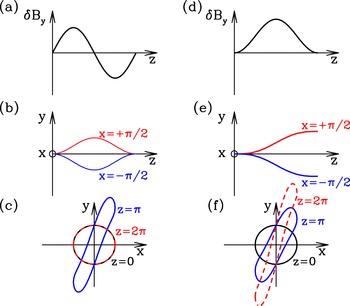
component of a wavepacket represents a shear in the magnetic field, as depicted in figure 3. Investigation of the propagation of Alfvén waves in a wandering magnetic field demonstrates that the cascade of energy to small scales is represented in physical space (as opposed to Fourier space) as a shearing of the perpendicular structure of an Alfvén wave as it propagates along a wandering magnetic field, as depicted in figure 3(c,f). Thus, exploring the complementary picture of the plasma turbulent cascade as the distortion of Alfvén waves as they propagate along a wandering magnetic field may yield fresh insights into the nature of plasma turbulence.
Distortion of a magnetic flux tube in the perpendicular
 $(x,y)$
plane due to wandering of the magnetic field. (a) Magnetic field fluctuation
 $\unicode[STIX]{x1D6FF}B_{y}$
contains no
 $k_{z}=0$
component. (b) Three-dimensional tracing of magnetic field lines due to the magnetic fluctuation in (a) at positions
 $x=+\unicode[STIX]{x03C0}/2$
(red) and
 $x=-\unicode[STIX]{x03C0}/2$
(blue). The oscillating shear causes the magnetic field to become sheared and then subsequently to ‘unshear’. (c) The distortion of an Alfvén wave with an initially circular perpendicular structure (black) as it propagates along the wandering magnetic field. (d) For the case of a magnetic field fluctuation
 $\unicode[STIX]{x1D6FF}B_{y}$
with a non-zero
 $k_{z}=0$
component, the (e) 3-D magnetic field has a monotonic shear, leading to (f) the permanent distortion (red) of an initially circular Alfvén wave structure (black).

2.4 Particle acceleration
Models of diffusive shock acceleration at collisionless shocks require irregularities in the upstream magnetic field to return reflected particles back to the shock front repeatedly to achieve significant acceleration (Ragot Reference Ragot2001; Guo & Giacalone Reference Guo and Giacalone2010, Reference Guo and Giacalone2013, Reference Guo and Giacalone2015). The efficiency of such a shock acceleration mechanism is likely to be dependent on the nature of the upstream magnetic field irregularities, but existing investigations of these particle acceleration mechanisms often use unrealistic models of the turbulent plasma, such as slab turbulence with only a one-dimensional variation of the turbulent field,
 $\unicode[STIX]{x1D6FF}\boldsymbol{B}(z)$
(Guo & Giacalone Reference Guo and Giacalone2010). The development of a new empirical model of magnetic field line wander based on direct numerical simulations of plasma turbulence will enable more realistic modelling of the diffusive acceleration mechanism at collisionless shocks.
2.5 Magnetic reconnection
It has been proposed theoretically that magnetic field line wander can alter the physics of magnetic reconnection when the upstream plasma is turbulent (Lazarian & Vishniac Reference Lazarian and Vishniac1999), increasing the rate of reconnection and the thickness of the current sheets in the turbulent medium (Vishniac et al. Reference Vishniac, Pillsworth, Eyink, Kowal, Lazarian and Murray2012). Numerical simulations have played a key role in bearing out these ideas (Kowal et al. Reference Kowal, Lazarian, Vishniac and Otmianowska-Mazur2009, Reference Kowal, Lazarian, Vishniac and Otmianowska-Mazur2012). It has also been claimed that exponential field line separation in turbulent plasmas will lead to reconnection even in the absence of intense current sheets (Boozer Reference Boozer2014). It has been shown that stochasticity of the magnetic field in MHD turbulence simulations degrades the usual notion of flux freezing in an MHD plasma, potentially explaining fast reconnection of large-scale structures at MHD scales (Eyink et al. Reference Eyink, Vishniac, Lalescu, Aluie, Kanov, Bürger, Burns, Meneveau and Szalay2013). More recently, numerical simulations have been used to explore how breaking field line connectivity by stochasticity of the magnetic field can be a mechanism for fast reconnection (Huang, Bhattacharjee & Boozer Reference Huang, Bhattacharjee and Boozer2014). The properties of the turbulent upstream magnetic fields very likely influence how the reconnection mechanism is modified, so an improved model of magnetic field line wander in plasma turbulence will contribute to progress in the understanding of magnetic reconnection under the turbulent conditions of realistic space and astrophysical plasma environments.
3 Theoretical considerations
This study aims to use direct numerical simulations to illuminate the physical processes influencing the development and saturation of magnetic field line wander in astrophysical plasma turbulence. The ultimate goal is to construct an empirical description of the magnetic field line wander in terms of the fundamental turbulence and plasma parameters. This empirical description can be utilized to describe accurately the properties of the turbulently tangled magnetic field for application to studies of energetic particle transport in astrophysical and laboratory plasmas, the cascade of energy to small scales in plasma turbulence, the acceleration of particles to high energies by collisionless shocks, and the physics of magnetic reconnection in a turbulent plasma.
3.1 Improving our understanding through direct numerical simulations
As detailed above, the nature of the magnetic field line wander in previous studies appears to be quite sensitive to the characteristics and parameters of the models describing the turbulent magnetic field. Many of the models of the turbulent magnetic field used in the literature exploring the phenomenon of magnetic field line wander and its implications are severely outdated, being inconsistent with the current understanding of plasma turbulence. Specifically, models employing slab, 2-D composite (slab plus two dimensions) and isotropic distributions of magnetic fluctuations, although more susceptible to theoretical analysis, are at odds with the anisotropic, 3-D nature of plasma turbulence that is now well established through decades of experimental, analytical and numerical research on magnetized plasma turbulence (Belcher & Davis Reference Belcher and Davis1971; Robinson & Rusbridge Reference Robinson and Rusbridge1971; Zweben, Menyuk & Taylor Reference Zweben, Menyuk and Taylor1979; Montgomery & Turner Reference Montgomery and Turner1981; Shebalin et al. Reference Shebalin, Matthaeus and Montgomery1983; Cho & Vishniac Reference Cho and Vishniac2000; Maron & Goldreich Reference Maron and Goldreich2001; Cho & Lazarian Reference Cho and Lazarian2004, Reference Cho and Lazarian2009; TenBarge & Howes Reference TenBarge and Howes2012). Recent direct multi-spacecraft measurements of turbulence in the solar wind confirm this anisotropic nature of the turbulent fluctuations (Sahraoui et al. Reference Sahraoui, Goldstein, Belmont, Canu and Rezeau2010; Narita et al. Reference Narita, Gary, Saito, Glassmeier and Motschmann2011; Roberts, Li & Li Reference Roberts, Li and Li2013; Roberts, Li & Jeska Reference Roberts, Li and Jeska2015).
In addition, the models employed in the studies reviewed above almost universally employ randomly phased magnetic field fluctuations, a characteristic inconsistent with any self-consistent realization of a turbulent magnetic field. Kolmogorov’s four-fifths law (Kolmogorov Reference Kolmogorov1941) is an exact statistical formula relating the mean energy dissipation rate to the third moment of the velocity fluctuations in hydrodynamic turbulence; subsequently, this third moment approach has been extended for the case of MHD turbulence (Chandrasekhar Reference Chandrasekhar1951; Politano & Pouquet Reference Politano and Pouquet1998; Yousef, Rincon & Schekochihin Reference Yousef, Rincon and Schekochihin2007). A spectrum of magnetic fluctuations with random phases yields an average third moment of zero, because it is the phase correlations among different magnetic fluctuations that are responsible for the nonlinear turbulent cascade of energy. Random phase models therefore lack some of the inherent attributes of a self-consistently determined turbulent magnetic field (Howes Reference Howes2015, Reference Howes2016). It remains an open question whether such correlations will indeed alter the nature of the magnetic field line wander resulting from plasma turbulence, but the apparent sensitivity of the results of previous studies to the characteristics of the magnetic field model suggests that a self-consistent turbulent magnetic field will yield the most well justified and physically relevant results.
The uncertainty in describing the turbulent magnetic field can be eliminated by using a turbulent magnetic field that is generated self-consistently by direct numerical simulation of the equations governing the turbulent plasma dynamics. Of the studies directly investigating magnetic field line wander reviewed above, only the recent studies of stochastic magnetic field development in fusion plasmas (Pueschel et al. Reference Pueschel, Kammerer and Jenko2008; Nevins et al. Reference Nevins, Wang and Candy2011; Wang et al. Reference Wang, Boldyrev and Perez2011; Hatch et al. Reference Hatch, Pueschel, Jenko, Nevins, Terry and Doerk2012, Reference Hatch, Pueschel, Jenko, Nevins, Terry and Doerk2013) employed direct numerical simulations, specifically using a nonlinear gyrokinetic code. A general approach to understand the development and saturation of the tangled magnetic field in general astrophysical plasma turbulence has not been attempted, and this provides a strong motivation for the present work.
3.2 The role of magnetic reconnection
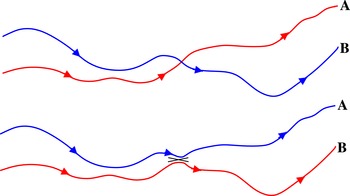
Illustration of how magnetic reconnection can instantaneously change the magnetic connectivity in a turbulent plasma, thereby influencing the development of magnetic field line wander.

Another important ingredient in understanding how magnetic fields become dynamically tangled by plasma turbulence is the process of magnetic reconnection. Although the impact of pre-existing turbulent magnetic fields on the process of magnetic reconnection has been examined previously (Lazarian & Vishniac Reference Lazarian and Vishniac1999; Kowal et al. Reference Kowal, Lazarian, Vishniac and Otmianowska-Mazur2009, Reference Kowal, Lazarian, Vishniac and Otmianowska-Mazur2012; Vishniac et al. Reference Vishniac, Pillsworth, Eyink, Kowal, Lazarian and Murray2012; Boozer Reference Boozer2014; Huang et al. Reference Huang, Bhattacharjee and Boozer2014), the investigation of how reconnection mediates the tangling and untangling of magnetic fields in plasma turbulence has not been addressed by any existing study. For example, consider the two turbulent magnetic field lines depicted in figure 4. When a small reconnection event (denoted by the black cross) occurs between the two field lines, the connectivity of those two field lines changes instantaneously. Particles streaming along the red field line from the left end of the plasma, which previously had been connected to point A, will suddenly find themselves magnetically connected instead to point B. An open question is whether the impact of magnetic reconnection on the wandering of magnetic field lines can be described in the framework of a diffusion, or whether this possibility of sudden jumps in connectivity alter the nature of the resulting magnetic field line wander. Direct numerical simulations of the turbulent plasma that resolve the physics of magnetic reconnection, even in the collisionless limit relevant to many space and astrophysical systems of interest, are critical for answering this open question.
3.3 The turbulent solar wind as a fiducial example
The turbulent solar wind that pervades our heliosphere represents a fiducial system supporting a broad spectrum of turbulent plasma motions over more than seven orders of magnitude in scale (Kiyani, Osman & Chapman Reference Kiyani, Osman and Chapman2015). It is also the most thoroughly diagnosed turbulent astrophysical plasma in the universe, thereby providing unique opportunities for confronting any empirical description of magnetic field line wander with direct, in situ measurements of the turbulent interplanetary magnetic field. Thus, the solar wind provides an ideal case study for discussing the phenomenon of magnetic field line wander in a turbulent plasma. In addition, the tangling of the magnetic field in the solar wind has important consequences for the propagation of solar energetic particles erupting from violent solar activity, constituting an important space weather hazard for spaceborne human and technological assets. Improving the modelling of the tangled magnetic field in the heliosphere therefore has important societal implications.
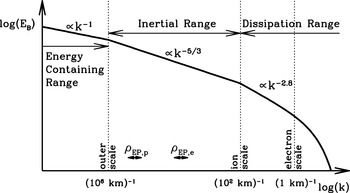
Schematic of the magnetic energy wavenumber spectrum in the solar wind, showing the form of the spectrum in the energy containing, inertial and dissipation ranges. Ranges for the typical Larmor radius scales for protons
 $\unicode[STIX]{x1D70C}_{\text{EP},p}$
and electrons
 $\unicode[STIX]{x1D70C}_{\text{EP},e}$
from solar energetic particle events are depicted.

Figure 5 presents a diagram of the solar wind magnetic energy wavenumber spectrum – assuming the Taylor hypothesis (Taylor Reference Taylor1938) to convert the spacecraft-frame frequency to a corresponding wavenumber of spatial fluctuations in the super-Alfvénic solar wind (Howes, Klein & TenBarge Reference Howes, Klein and TenBarge2014; Klein, Howes & TenBarge Reference Klein, Howes and TenBarge2014) – for near-Earth space at heliocentric radius
 $R\sim 1$
AU. At the largest scales
 $l>10^{6}$
km (lowest wavenumbers) is the energy containing range (Matthaeus et al.
Reference Matthaeus, Oughton, Pontius and Zhou1994; Tu & Marsch Reference Tu and Marsch1995; Bruno & Carbone Reference Bruno and Carbone2005), populated by large-scale plasma flow and magnetic field fluctuations. Through nonlinear interactions, these energy containing fluctuations feed their energy into the turbulent cascade at the outer scale,
 $l\sim 10^{6}$
km, where the steepening of the magnetic energy spectrum marks the beginning of the turbulent inertial range (Tu & Marsch Reference Tu and Marsch1995; Bruno & Carbone Reference Bruno and Carbone2005). Within the inertial range, energy is nonlinearly transferred scale by scale in a self-similar manner, leading to a single power-law spectrum down to the inner scale, which corresponds to one of the characteristic ion kinetic length scales at
 $l\sim 10^{2}$
km. At this ion scale, the magnetic energy spectrum breaks once again (Bourouaine et al.
Reference Bourouaine, Alexandrova, Marsch and Maksimovic2012), marking the transition to the dissipation rangeFootnote
1
(Alexandrova et al.
Reference Alexandrova, Saur, Lacombe, Mangeney, Mitchell, Schwartz and Robert2009; Kiyani et al.
Reference Kiyani, Chapman, Khotyaintsev, Dunlop and Sahraoui2009; Sahraoui et al.
Reference Sahraoui, Goldstein, Robert and Khotyaintsev2009; Chen et al.
Reference Chen, Horbury, Schekochihin, Wicks, Alexandrova and Mitchell2010; Sahraoui et al.
Reference Sahraoui, Goldstein, Belmont, Canu and Rezeau2010, Reference Sahraoui, Huang, Belmont, Goldstein, Rétino, Robert and De Patoul2013). Finally, at the characteristic electron length scale of
 $l\sim 1$
km, the magnetic energy spectrum is often observed to exhibit an exponential roll off (Alexandrova et al.
Reference Alexandrova, Lacombe, Mangeney, Grappin and Maksimovic2012; Sahraoui et al.
Reference Sahraoui, Huang, Belmont, Goldstein, Rétino, Robert and De Patoul2013), interpreted to indicate the ultimate termination of the turbulent cascade. Also plotted in figure 5 is a representation of the Larmor radius scales for protons and electrons from SEP events,
 $\unicode[STIX]{x1D70C}_{\text{EP},p}$
and
 $\unicode[STIX]{x1D70C}_{\text{EP},e}$
; collisionless wave–particle interactions of energetic particles with the turbulent magnetic fluctuations lead to scattering rates that peak at these Larmor scales. Simulations using the gyrokinetic code AstroGK reproduce quantitatively the features of the solar wind magnetic energy spectrum from the middle of the inertial range down to the sub-electron scales (TenBarge et al.
Reference TenBarge, Podesta, Klein and Howes2012; TenBarge, Howes & Dorland Reference TenBarge, Howes and Dorland2013).
It is the turbulent magnetic field fluctuations over this broad range of scales that lead to the stochastic character of the magnetic field, so investigating how fluctuations in different scale ranges of this spectrum affect the magnetic field line wandering is an important long-term goal. To accomplish this goal, direct numerical simulations can be used to learn how magnetic field line wander develops and saturates in plasma turbulence.
3.4 A model for the development and saturation of magnetic field line wander
Here we propose a novel theoretical picture of the plasma physical processes involved in the development of magnetic field line wander and its saturation. The nonlinear interactions that underlie the turbulent cascade of energy to small scales also lead to a tangling of the magnetic field. In an ideal plasma with no magnetic reconnection, this tangling of the field would continue indefinitely, generating turbulent structures on ever smaller scales, leading to an ever more intricate wandering of the magnetic field. But, once the turbulent structures have reached sufficiently small scales that non-ideal physics breaks the frozen-in condition, magnetic reconnection may ensue, thereby untangling the magnetic field. We propose that the saturation of the magnetic field line wander represents a balance between the nonlinearly driven tangling and the magnetic-reconnection-mediated untangling, a physical picture that we aim to test thoroughly using direct numerical simulations.
A key observation is that these two mechanisms, nonlinear interactions (turbulence) and magnetic reconnection, depend differently on the fundamental parameters describing the turbulence and the plasma. For example, the physics of magnetic reconnection has a strong dependence on the plasma
 $\unicode[STIX]{x1D6FD}$
, but the physics of the turbulent nonlinear energy transfer appears to have very little dependence on this plasma parameter (Howes & Nielson Reference Howes and Nielson2013; Nielson et al.
Reference Nielson, Howes and Dorland2013; Howes Reference Howes2015). What is entirely new here, compared to the body of literature on turbulent magnetic field line wander, is that most previous worksFootnote
2
have completely ignored any role played by magnetic reconnection. From the theoretical picture above – a balance between turbulent tangling and reconnective untangling – we believe that it is inevitable that magnetic reconnection plays an important role in the physics of magnetic field line wander, possibly leading to an important, and as yet unrecognized, dependence on the plasma
 $\unicode[STIX]{x1D6FD}$
. A study based on direct numerical simulations that resolve the kinetic microphysics of magnetic reconnection is likely to break new ground on this important frontier in the study of magnetic field line wander and its implications for many important physical processes in the universe.
Discussions of the tangling of the magnetic field by plasma turbulence often employs the term ‘stochastic magnetic field’ as a generic label for any turbulently tangled magnetic field. Here we reserve the use of the term stochastic to cases in which the magnetic field indeed demonstrates a stochastic character, as demonstrated by an appropriate analysis, such as a Poincaré recurrence plot (see § 6). We choose to use the term magnetic field line wander to refer to the general case when the magnetic field does exhibit a topology in which the separation between two field lines increases (or decreases) as one moves a distance along the field, whether or not the magnetic field exhibits a stochastic character. How the physics of energetic particle propagation in astrophysical plasmas, heat and particle transport in fusion plasmas, magnetic reconnection and particle acceleration differs when the magnetic field lines merely wander, but are not fully stochastic, is interesting open question.
3.5 Key questions
To investigate and characterize the development and saturation of magnetic field line wander in turbulent plasmas, direct numerical simulations provide a valuable tool. Since magnetic reconnection may play an essential role in the physics of the field line tangling, a numerical method that resolves the kinetic microphysics of magnetic reconnection, particularly under the weakly collisional conditions relevant to many turbulent space and astrophysical plasma systems, is essential. This can be supplemented by fluid methods to explore how the nonlinear dynamics at large scales governs the tangling of the magnetic field. Such an approach, maintaining a strong connection to the nonlinear dynamics of plasma turbulence and magnetic reconnection, will enable important new questions about the nature of magnetic field line wander caused by plasma turbulence to be addressed:
-
(i) How does magnetic field line wander develop and saturate in plasma turbulence?
-
(ii) Do the properties of magnetic field line wander depend on the underlying physical mechanism that enables magnetic reconnection (collisionless versus resistive versus numerical reconnection)?
-
(iii) Is magnetic field line wander dominated by the large-scale or small-scale fluctuations of the turbulence?
-
(iv) Can we construct an empirical description of the magnetic field line wander in terms of the fundamental plasma and turbulence parameters?
3.6 Quantitative dependence on fundamental turbulence and plasma parameters
Turbulence in heliospheric and other astrophysical plasmas naturally leads to the tangling of the magnetic field, leading to the development of magnetic field line wander, a property that we would like to characterize quantitatively. To develop a quantitative measure of the wandering of field lines in such a plasma, consider choosing two points on different field lines separated by a distance
 $\unicode[STIX]{x1D6FF}r$
perpendicular to the magnetic field. For these two particular points, one may compute the perpendicular separation between the two field lines in the perpendicular plane as a function of the distance along the magnetic field line
 $l$
. Computing statistics of this quantity using direct numerical simulations of plasma turbulence enables the development of the quantitative characterization of the magnetic field line wander.
The statistics of this perpendicular separation
 $\unicode[STIX]{x1D6FF}r$
between two magnetic field lines can be quantitatively characterized in terms of a small number of important parameters. First are basic parameters to describe the wandering of field lines away from each other, including the distance travelled along the field line
 $l$
and the time for which turbulence has been dynamically tangling the field. Next are the dimensionless parameters that describe the turbulence itself. The amplitude, or strength, of the turbulence is characterized by the nonlinearity parameter,
 $\unicode[STIX]{x1D712}=k_{\bot }\unicode[STIX]{x1D6FF}B_{\bot }/(k_{\Vert }B_{0})$
(Goldreich & Sridhar Reference Goldreich and Sridhar1995; Howes & Nielson Reference Howes and Nielson2013), describing the amplitude of the turbulence at the driving scale (equivalent to the ‘Kubo’ number in some previous studies (Zimbardo et al.
Reference Zimbardo, Veltri and Pommois2000)). For example, to explore the impact on particle diffusion by the amplitude of turbulent fluctuations, one study computed particle trajectories numerically in a tangled magnetic field consisting of 1000 randomly phased plane-wave modes (Hauff et al.
Reference Hauff, Jenko, Shalchi and Schlickeiser2010), and another study used Ramaty High Energy Solar Spectroscopic Imager (RHESSI) observations of hard X-rays to estimate the magnitude of magnetic field line diffusion in flaring coronal loops under several assumptions (Bian, Kontar & MacKinnon Reference Bian, Kontar and MacKinnon2011). Both studies found that, in the large Kubo number limit (
 $\unicode[STIX]{x1D712}\gg 1$
), perpendicular diffusion becomes independent of the turbulence spectrum, in agreement with the predictions of percolation theory (Gruzinov, Isichenko & Kalda Reference Gruzinov, Isichenko and Kalda1990; Isichenko Reference Isichenko1992).
Another key dimensionless parameter is the isotropic driving wavenumber,
 $k_{0}\unicode[STIX]{x1D70C}_{i}$
(Howes et al.
Reference Howes, Cowley, Dorland, Hammett, Quataert and Schekochihin2008a
; Howes, TenBarge & Dorland Reference Howes, TenBarge and Dorland2011), describing the driving scale, or energy injection scale, of the turbulence normalized to the ion Larmor radius, where it is assumed the turbulent fluctuations are isotropic with respect to the direction of the mean magnetic field at this scaleFootnote
3
. Finally, the key dimensionless parameters that describe the plasma are the ion plasma beta,
 $\unicode[STIX]{x1D6FD}_{i}=8\unicode[STIX]{x03C0}n_{0}T_{i}/B_{0}^{2}$
, and the ion-to-electron temperature ratio,
 $T_{i}/T_{e}$
. In summary, therefore, we expect that the separation between two magnetic field lines
 $\unicode[STIX]{x1D6FF}r$
as one follows the field lines through the plasma to have a dependence on these fundamental parameters given by
 $\unicode[STIX]{x1D6FF}r(l,t,\unicode[STIX]{x1D712},k_{0}\unicode[STIX]{x1D70C}_{i},\unicode[STIX]{x1D6FD}_{i},T_{i}/T_{e})$
.
For the most likely case of saturated turbulence in steady state, where the tangling of the magnetic field by the turbulence and untangling of the field by magnetic reconnection statistically balance, we conjecture that the
 $\unicode[STIX]{x1D6FF}r$
will not depend on time. A reasonable form to seek for the average squared field line separation in a turbulent steady state,
 $\langle (\unicode[STIX]{x1D6FF}r)^{2}\rangle$
, based on the previous analyses reviewed in § 2, can be written
 $$\begin{eqnarray}\langle (\unicode[STIX]{x1D6FF}r)^{2}\rangle =Al^{p}.\end{eqnarray}$$
Here
 $A(\unicode[STIX]{x1D712},k_{0}\unicode[STIX]{x1D70C}_{i},\unicode[STIX]{x1D6FD}_{i},T_{i}/T_{e})$
represents the amplitude of the average spreading of field lines, and we assume the average squared field line separation can be expressed as a power law of the distance along the field line
 $l$
, given by the exponent
 $p(\unicode[STIX]{x1D712},k_{0}\unicode[STIX]{x1D70C}_{i},\unicode[STIX]{x1D6FD}_{i},T_{i}/T_{e})$
. The long-term goal of this project is to determine empirically forms for
 $A$
and
 $p$
that can be used to characterize the magnetic field line wander in terms of the turbulence and plasma parameters.
Although the two turbulence parameters
 $\unicode[STIX]{x1D712}$
and
 $k_{0}\unicode[STIX]{x1D70C}_{i}$
together with the two plasma parameters
 $\unicode[STIX]{x1D6FD}_{i}$
and
 $T_{i}/T_{e}$
lead to a four-dimensional parameter space, the broad range of different turbulence models previously used to explore magnetic field line wander requires a much longer list of possible parameters. The most likely culprit responsible for the many conflicting results found in the literature is the tremendous variation among the different models chosen to describe the turbulent magnetic field. The use of direct numerical simulations of plasma turbulence enables us to eliminate the huge parameter space necessary to describe the plethora of different magnetic field models reviewed in § 2, at the expense of the necessarily limited dynamic range attainable by direct numerical simulations. But we believe that a more physically faithful characterization of the magnetic field line wander in plasma turbulence can be patched together through a judicious use of different simulation models appropriate to different ranges of the turbulent spectrum, as depicted in figure 5.
4 Code and description of turbulence simulations
The astrophysical gyrokinetics code, or AstroGK, described in detail in Numata et al. (Reference Numata, Howes, Tatsuno, Barnes and Dorland2010), evolves the perturbed gyroaveraged distribution function
 $h_{s}(x,y,z,\unicode[STIX]{x1D706},\unicode[STIX]{x1D700})$
for each species
 $s$
, the scalar potential
 $\unicode[STIX]{x1D711}$
, parallel vector potential
 $A_{\Vert }$
and the parallel magnetic field perturbation
 $\unicode[STIX]{x1D6FF}B_{\Vert }$
according to the gyrokinetic equation and the gyroaveraged Maxwell’s equations (Frieman & Chen Reference Frieman and Chen1982; Howes et al.
Reference Howes, Cowley, Dorland, Hammett, Quataert and Schekochihin2006), where
 $\Vert$
is along the total local magnetic field
 $\boldsymbol{B}=B_{0}\hat{\boldsymbol{z}}+\unicode[STIX]{x1D6FF}\boldsymbol{B}$
. The velocity space coordinates are
 $\unicode[STIX]{x1D706}=v_{\bot }^{2}/v^{2}$
and
 $\unicode[STIX]{x1D700}=v^{2}/2$
. The domain is a periodic box of size
 $L_{\bot }^{2}\times L_{z}$
, elongated along the equilibrium magnetic field,
 $\boldsymbol{B}_{0}=B_{0}\hat{\boldsymbol{z}}$
. Note that, in the gyrokinetic formalism, all quantities may be rescaled to any parallel dimension satisfying
 $\unicode[STIX]{x1D716}\equiv L_{\bot }/L_{z}\ll 1$
. Uniform Maxwellian equilibria for ions (protons) and electrons are used, with the correct mass ratio
 $m_{i}/m_{e}=1836$
. Spatial dimensions
 $(x,y)$
perpendicular to the equilibrium field are treated pseudospectrally; an upwind finite-difference scheme is used in the parallel direction. Collisions are incorporated using a fully conservative, linearized Landau collision operator that includes energy diffusion and pitch-angle scattering due to electron–electron, ion–ion and electron–ion collisions (Abel et al.
Reference Abel, Barnes, Cowley, Dorland and Schekochihin2008; Barnes et al.
Reference Barnes, Abel, Dorland, Ernst, Hammett, Ricci, Rogers, Schekochihin and Tatsuno2009), yielding an isotropic Maxwellian stationary solution.
The simulations presented here are similar to previous nonlinear gyrokinetic simulations used to investigate the physics of the turbulence in the weakly collisional solar wind (Howes et al.
Reference Howes, Dorland, Cowley, Hammett, Quataert, Schekochihin and Tatsuno2008b
, Reference Howes, TenBarge, Dorland, Quataert, Schekochihin, Numata and Tatsuno2011), in particular the small-scale simulations of the kinetic Alfvén wave cascade down to the scales of the electron Larmor radius (TenBarge & Howes Reference TenBarge and Howes2013; TenBarge et al.
Reference TenBarge, Howes and Dorland2013). We present here results of a simulation of a driven, strongly turbulent kinetic Alfvén wave cascade in a plasma with parameters
 $\unicode[STIX]{x1D6FD}_{i}=1$
and
 $T_{i}/T_{e}=1$
, where
 $\unicode[STIX]{x1D6FD}_{i}=v_{ti}^{2}/v_{A}^{2}$
,
 $v_{A}$
is the Alfvén speed,
 $v_{ti}=\sqrt{2T_{i}/m_{i}}$
is the ion thermal speed and temperature is expressed in units of energy. The simulation domain has dimensions
 $(n_{x},n_{y},n_{z},n_{\unicode[STIX]{x1D706}},n_{\unicode[STIX]{x1D700}},n_{s})=(64,64,32,32,16,2)$
, yielding a simulation covering the fully dealiased range of
 $5\leqslant k_{\bot }\unicode[STIX]{x1D70C}_{i}\leqslant 105$
, or
 $0.12\leqslant k_{\bot }\unicode[STIX]{x1D70C}_{e}\leqslant 2.5$
. It is worthwhile noting that it has been demonstrated, via comparisons with particle-in-cell (PIC) simulations, that nonlinear gyrokinetic simulations using AstroGK accurately describe the physics of magnetic reconnection in the strong guide field limit, as long as the simulation resolves the electron Larmor radius scale (TenBarge et al.
Reference TenBarge, Daughton, Karimabadi, Howes and Dorland2014).
The simulation is driven at the domain scale using an oscillating Langevin antenna (TenBarge et al.
Reference TenBarge, Howes, Dorland and Hammett2014) to achieve turbulence with a nonlinearity parameter
 $\unicode[STIX]{x1D712}\sim 1$
, yielding critically balanced, strong turbulent cascade of kinetic Alfvén waves (Goldreich & Sridhar Reference Goldreich and Sridhar1995; Howes et al.
Reference Howes, Cowley, Dorland, Hammett, Quataert and Schekochihin2008a
, Reference Howes, TenBarge and Dorland2011; TenBarge et al.
Reference TenBarge, Howes, Dorland and Hammett2014). The linear frequency of a kinetic Alfvén wave at the domain scale, determined by the collisionless linear gyrokinetic dispersion relation (Howes et al.
Reference Howes, Cowley, Dorland, Hammett, Quataert and Schekochihin2006), is given by
 $\unicode[STIX]{x1D714}=3.6\unicode[STIX]{x1D714}_{A0}$
, where
 $\unicode[STIX]{x1D714}_{A0}=k_{\Vert 0}v_{A}$
. The parameters of the oscillating Langevin antenna are amplitude
 $A_{0}=0.2$
, driving frequency
 $\unicode[STIX]{x1D714}_{0}=3.6\unicode[STIX]{x1D714}_{A0}$
and decorrelation rate
 $\unicode[STIX]{x1D6FE}_{0}=0.6\unicode[STIX]{x1D714}_{A0}$
. We drive four modes,
 $(k_{\bot 0}\unicode[STIX]{x1D70C}_{i},k_{\bot 0}\unicode[STIX]{x1D70C}_{i},k_{\Vert 0}\unicode[STIX]{x1D70C}_{i}/\unicode[STIX]{x1D716})=(5,0,\pm 1)$
and
 $(0,5,\pm 1)$
, where
 $k_{\bot 0}=2\unicode[STIX]{x03C0}/L_{\bot }$
and
 $k_{\Vert 0}=2\unicode[STIX]{x03C0}/L_{z}$
. Note that the 3-D simulation spatial domain has size
 $L_{\bot }^{2}\times L_{z}$
, with
 $L_{\bot }=2\unicode[STIX]{x03C0}\unicode[STIX]{x1D70C}_{i}/5$
and
 $L_{z}=2\unicode[STIX]{x03C0}\unicode[STIX]{x1D70C}_{i}/(5\unicode[STIX]{x1D716})$
, where
 $\unicode[STIX]{x1D716}\ll 1$
is the arbitrary gyrokinetic expansion parameter. These parameters are found to yield a statistically steady-state value of the nonlinearity parameter of
 $\unicode[STIX]{x1D712}\simeq 1$
.
Collision frequencies
 $\unicode[STIX]{x1D708}_{i}=0.2\unicode[STIX]{x1D714}_{A0}$
and
 $\unicode[STIX]{x1D708}_{e}=0.5\unicode[STIX]{x1D714}_{A0}$
are chosen to prevent a build-up of small-scale structure in velocity space, yet to avoid altering the weakly collisional dynamics,
 $\unicode[STIX]{x1D708}_{s}\ll \unicode[STIX]{x1D714}$
. All dissipation required to achieve a statistically steady state in the simulation occurs via physically resolved interactions, primarily collisionless damping via the Landau resonance with electrons; no additional hypercollisionality is needed in this simulation.
5 Development and saturation of turbulent cascade and magnetic field line wander
In this section, we present numerical results describing the development and saturation of the turbulent magnetic energy spectrum and of the magnetic field line wander. In addition, we use Poincaré plots to characterize the development of stochasticity in the magnetic field.
5.1 Development and saturation of turbulent magnetic energy spectrum
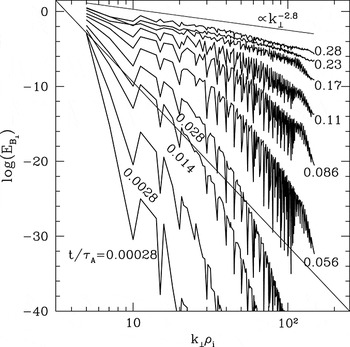
These driven turbulence simulations begin with a straight, uniform magnetic field and zero fluctuations. The oscillating Langevin antenna drives an external parallel current that generates perpendicular magnetic field fluctuations, each driven mode with a plane-wave pattern specified by the wavevector. Nonlinear interactions between the counterpropagating Alfvén waves generated by the antenna immediately begin to transfer energy to higher wavenumbers, and the magnetic energy spectrum begins to fill in as energy is continually injected into the driven modes. Figure 6 presents the perpendicular magnetic energy spectrum
 $E_{B_{\bot }}(k_{\bot })=\int _{-\infty }^{\infty }\,\text{d}k_{z}\int _{0}^{2\unicode[STIX]{x03C0}}\,\text{d}\unicode[STIX]{x1D703}k_{\bot }|\unicode[STIX]{x1D6FF}B(k_{\bot })|^{2}/8\unicode[STIX]{x03C0}$
at a number of times early in the development of the turbulent energy spectrum, where time is normalized using the linear kinetic Alfvén wave period for modes at the domain scale,
 $t/\unicode[STIX]{x1D70F}_{A}$
and
 $\unicode[STIX]{x1D714}_{A0}\unicode[STIX]{x1D70F}_{A}=1.74$
. Note that, due to the broad range of the logarithmic vertical axis, at the very early times
 $t/\unicode[STIX]{x1D70F}_{A}<0.1$
, very little energy has been injected into the turbulent cascade.
Development of the magnetic energy spectrum in the nonlinear gyrokinetic simulation of driven kinetic Alfvén wave turbulence. The normalized time for each spectrum
 $t/\unicode[STIX]{x1D70F}_{A}$
is labelled. The saturated spectrum for strong kinetic Alfvén wave cascade is expected to have a spectral index of
 $-2.8$
, plotted for comparison.

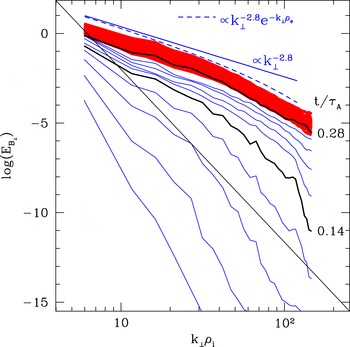
Figure 7 shows how the spectrum saturates to a statistically steady state. Ten perpendicular magnetic energy spectra (blue and black) are plotted at uniform linear time intervals
 $t_{j}/\unicode[STIX]{x1D70F}_{A}=j\unicode[STIX]{x0394}t/\unicode[STIX]{x1D70F}_{A}$
for
 $j=1,2,3,\ldots ,10$
and
 $\unicode[STIX]{x0394}t/\unicode[STIX]{x1D70F}_{A}=0.028$
. We also overplot all spectra over the time range
 $0.28\leqslant t/\unicode[STIX]{x1D70F}_{A}\leqslant 3.6$
(red). This plot shows that, although more energy is injected into the turbulent magnetic energy spectrum at
 $t/\unicode[STIX]{x1D70F}_{A}>0.28$
, the shape of the spectrum appears to be saturated at
 $t/\unicode[STIX]{x1D70F}_{A}=0.28$
– only the total energy content changes, but the shape of the spectrum does not. We also plot the exponentially cutoff magnetic energy spectrum (blue dashed) determined empirically from a sample of 100 Cluster spectra,
 $E_{B_{\bot }}(k_{\bot })\propto (k_{\bot }\unicode[STIX]{x1D70C}_{i})^{-2.8}\exp (-k_{\bot }\unicode[STIX]{x1D70C}_{e})$
(Alexandrova et al.
Reference Alexandrova, Lacombe, Mangeney, Grappin and Maksimovic2012), a result reproduced previously using nonlinear gyrokinetic simulations (TenBarge & Howes Reference TenBarge and Howes2013; TenBarge et al.
Reference TenBarge, Howes and Dorland2013). The present simulation also agrees well with this model magnetic energy spectrum.
Note that the spectra in figure 7 have been binned in bins of width
 $\unicode[STIX]{x0394}k_{\bot }\unicode[STIX]{x1D70C}_{i}=5$
, producing a smoother appearance than the spectra in figure 6, in which all possible values of
 $k_{\bot }\unicode[STIX]{x1D70C}_{i}$
from our perpendicular wavevector grid are represented.
Perpendicular magnetic energy spectra plotted at uniform time intervals of
 $\unicode[STIX]{x1D6FF}t/\unicode[STIX]{x1D70F}_{A}=0.028$
(blue and black), and all spectra overplotted over the range
 $0.28\leqslant t/\unicode[STIX]{x1D70F}_{A}\leqslant 3.6$
(red). For comparison, the slope for a power-law spectrum
 $E_{B_{\bot }}\propto k_{\bot }^{-2.8}$
(blue solid) and an exponentially cutoff spectrum
 $E_{B_{\bot }}\propto k_{\bot }^{-2.8}$
(blue dashed) are shown for comparison.

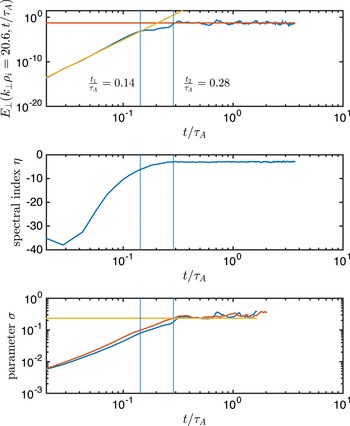
The time scales associated with the development and saturation of the turbulent cascade can be nicely illustrated by plotting the amplitude of the energy at a perpendicular wavenumber in the middle of the dynamic range at
 $k_{\bot }\unicode[STIX]{x1D70C}_{i}=20.6$
as a function of time, as shown in figure 8(a). At early times
 $t/\unicode[STIX]{x1D70F}_{A}<0.14$
, the perpendicular magnetic energy at
 $k_{\bot }\unicode[STIX]{x1D70C}_{i}=20.6$
increases as a steep power law with time,
 $E_{B_{\bot }}(k_{\bot })\propto t^{12}$
. At time
 $t_{1}/\unicode[STIX]{x1D70F}_{A}=0.14$
, the increase of energy with time at this wavenumber reduces to a less steep approximate power law with
 $E_{B_{\bot }}(k_{\bot })\propto t^{6}$
, before reaching a statistically steady value at
 $t_{2}/\unicode[STIX]{x1D70F}_{A}=0.28$
.Footnote
4
Beyond this time, the shape of the magnetic energy spectrum no longer evolves, as illustrated by the spectra plotted in figure 7, but the total amplitude of the energy varies over a factor of four, with the same spectral shape simply shifting up and down. This variation of the total energy in the spectrum is due to the fact that the finite-time-correlated driving of the oscillating Langevin antenna leads to a significant variation in the rate of energy injection (TenBarge et al.
Reference TenBarge, Howes, Dorland and Hammett2014).
It is worthwhile pointing out how rapidly the magnetic energy spectrum saturates, requiring a length of time that is only a fraction of the period of the kinetic Alfvén wave at the domain scale,
 $0.28\unicode[STIX]{x1D70F}_{A}$
. This is likely due to the dispersive nature of the kinetic Alfvén wave fluctuations in the sub-ion length scale regime.
 $k_{\bot }\unicode[STIX]{x1D70C}_{i}\gg 1$
, where the parallel phase velocity of the waves increases linearly with
 $k_{\bot }\unicode[STIX]{x1D70C}_{i}$
, with an approximate scaling (Howes et al.
Reference Howes, Klein and TenBarge2014)
 $$\begin{eqnarray}\frac{\unicode[STIX]{x1D714}}{k_{\Vert }}=v_{A}\frac{k_{\bot }\unicode[STIX]{x1D70C}_{i}}{\sqrt{\unicode[STIX]{x1D6FD}_{i}+2/(1+T_{e}/T_{i})}}.\end{eqnarray}$$
Thus, the increasingly fast dynamics of the fluctuations with decreasing scale appears to saturate the energy spectrum more rapidly than the wave period of the domain-scale kinetic Alfvén waves that drive the cascade. It is also worthwhile noting that the turbulent cascade is very efficiently generated by driving counterpropagating kinetic Alfvén waves at the domain scale.
In figure 8(b), we plot the evolution of the spectral index
 $\unicode[STIX]{x1D702}$
of the perpendicular magnetic spectrum
 $E_{B_{\bot }}$
as a function of normalized time
 $t/\unicode[STIX]{x1D70F}_{A}$
. To determine the value of the spectral index, we perform a fit of the perpendicular magnetic spectrum at each time using the form
 $$\begin{eqnarray}E_{B_{\bot }}\propto (k_{\bot }\unicode[STIX]{x1D70C}_{i})^{\unicode[STIX]{x1D702}}\exp [-k_{\bot }\unicode[STIX]{x1D70C}_{e}]\end{eqnarray}$$
over the range of scales
 $10\leqslant k_{\bot }\unicode[STIX]{x1D70C}_{i}\leqslant 105$
. As shown in panel (b), the rate of increase of the spectral index decreases, particularly for
 $t>t_{1}$
, finally saturating to a constant value for
 $t\geqslant t_{2}$
.
(a) Evolution of the energy in modes with
 $k_{\bot }\unicode[STIX]{x1D70C}_{i}=20.6$
versus normalized time
 $t/\unicode[STIX]{x1D70F}_{A}$
, showing power-law growth until
 $t_{1}/\unicode[STIX]{x1D70F}_{A}=0.14$
, and a slower growth until
 $t_{2}/\unicode[STIX]{x1D70F}_{A}=0.28$
. (b) Evolution of the spectral index,
 $\unicode[STIX]{x1D702}$
, where the spectrum is fit by
 $(k_{\bot }\unicode[STIX]{x1D70C}_{i})^{\unicode[STIX]{x1D702}}\exp (-k_{\bot }\unicode[STIX]{x1D70C}_{e})$
, showing saturation at time
 $t_{2}/\unicode[STIX]{x1D70F}_{A}=0.28$
. (c) Evolution of the scalar expansion parameter
 $\unicode[STIX]{x1D70E}$
, showing that the separation of field lines saturates only at
 $t_{2}/\unicode[STIX]{x1D70F}_{A}=0.28$
, with little noticeable change at
 $t_{1}/\unicode[STIX]{x1D70F}_{A}=0.14$
. A second identical run (with a different pseudo-random number sequence governing the forcing) shows the evolution is statistically repeatable.

5.2 Development and saturation of magnetic field line wander
To estimate the development and saturation of magnetic field line wander, we devise a new diagnostic, the expansion parameter
 $\unicode[STIX]{x1D70E}$
, derived in appendix A. This diagnostic yields a scalar quantity that parameterizes the separation of magnetic field lines in the turbulent magnetic field throughout the simulation domain.
In figure 8(c), we plot the evolution of expansion parameter
 $\unicode[STIX]{x1D70E}$
as a function of normalized time
 $t/\unicode[STIX]{x1D70F}_{A}$
. We plot the results for two independent simulations (red and blue), with all of the same numerical and physical parameters, but different pseudo-random number sequences governing the driving by the oscillating Langevin antenna. The expansion parameter
 $\unicode[STIX]{x1D70E}$
increases as a power law right up to the time
 $t_{2}/\unicode[STIX]{x1D70F}_{A}=0.28$
, at which point
 $\unicode[STIX]{x1D70E}$
saturates to a statistically steady value. Note that unlike in panel (a), where the rate of increase of amplitude of turbulent cascade shows a marked decrease at time
 $t=t_{1}$
, the power-law increase of the expansion parameter
 $\unicode[STIX]{x1D70E}$
in panel (c) shows little change at
 $t=t_{1}$
. Note also that the two independent simulations generate statistically similar results for the evolution of this expansion parameter
 $\unicode[STIX]{x1D70E}$
. Therefore, it appears for these simulations with plasma parameters
 $\unicode[STIX]{x1D6FD}_{i}=1$
and
 $T_{i}/T_{e}=1$
and turbulent amplitude
 $\unicode[STIX]{x1D712}\simeq 1$
, the magnetic field line separation appears to saturate on the same time scale as the turbulent magnetic energy spectrum.
6 Development of magnetic stochasticity
In well-developed turbulence, the magnetic field appears to become tangled up in a stochastic manner, raising two very important questions about the development of magnetic stochasticity in turbulent plasmas. First, how long must the turbulence evolve before the magnetic field becomes stochastic? Second, must the amplitude of the turbulence exceed some threshold value for the development of stochasticity? We reiterate here that we reserve the term ‘stochastic magnetic field’ for a field topology that displays a stochastic nature in a Poincaré plot (see below), whereas we employ the term ‘magnetic field line wander’ for the general case of a turbulent magnetic field, whether or not that field demonstrates a stochastic character.
Although figure 8(c) shows the time scale of the saturation of the separation of magnetic field lines, as diagnosed by the scalar expansion parameter
 $\unicode[STIX]{x1D70E}$
, it does not provide alone any information about whether the magnetic field has become stochastic. To investigate the development of stochasticity, we use Poincaré plots to yield a qualitative measure of the stochasticity (Dombre et al.
Reference Dombre, Frisch, Henon, Greene and Soward1986; Nevins et al.
Reference Nevins, Wang and Candy2011; Wang et al.
Reference Wang, Boldyrev and Perez2011).
To construct the Poincaré plot, we begin with the magnetic field
 $\boldsymbol{B}(\boldsymbol{x})$
at some time
 $t$
. On the perpendicular plane at one end of the simulation domain at
 $z=0$
, we specify a sparse pattern of points with the colour of each point creating a bullseye pattern. The magnetic field line passing through each point is traced through the domain to the far end of the simulation domain at
 $z=L_{z}$
, and a point is plotted there, with colour matching that of the original field line position. That field line is periodically wrapped to
 $z=0$
, and the process is continued, with a coloured point plotted at each crossing at
 $z=L_{z}$
. We trace through the box
 $20$
times for each field line, generating a sufficient number of points in the Poincaré plot to visually determine whether or not the magnetic field has become stochastic. A fourth-order Runge–Kutta method with adaptive step size is used to trace each field line by integrating the ordinary differential equation
 $\text{d}\boldsymbol{r}/\text{d}l=\hat{\boldsymbol{b}}(\boldsymbol{x})$
, where
 $\hat{\boldsymbol{b}}(\boldsymbol{x})=\boldsymbol{B}(\boldsymbol{x})/|\boldsymbol{B}(\boldsymbol{x})|$
. If the field line passes through the boundaries of the simulation domain in the
 $x$
or
 $y$
directions, it is periodically wrapped to the opposite boundary. We have checked that using the field line following routine to trace back down the field line returns to the original starting point.
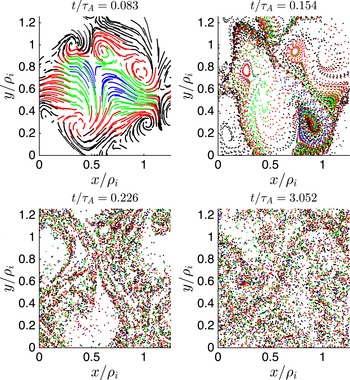
Figure 9 shows the Poincaré plots for the magnetic field at times
 $t/\unicode[STIX]{x1D70F}_{A}=0.083$
,
 $0.154$
,
 $0.226$
and
 $3.052$
. At the early time
 $t_{1}/\unicode[STIX]{x1D70F}_{A}=0.083$
, the Poincaré plot remains well ordered, indicating that the magnetic field has not yet become stochastic. By the time
 $t/\unicode[STIX]{x1D70F}_{A}=0.155$
, some regions of the Poincaré plot demonstrate a disordered mixture of coloured points, indicating regions that have become stochastic, while other regions maintain some semblance of order. Thus, it appears that as the magnetic field becomes stochastic, that stochasticity manifests itself in some regions of the domain but not others. By time
 $t/\unicode[STIX]{x1D70F}_{A}=0.226$
, the entire domain demonstrates a stochastic character. Since the turbulent spectrum appears to saturate to a constant shape at
 $t_{2}/\unicode[STIX]{x1D70F}_{A}=0.28$
, we conclude that, for this critically balanced simulation with nonlinearity parameter
 $\unicode[STIX]{x1D712}\sim 1$
, the magnetic field is generically stochastic for well developed turbulence. Since space and astrophysical plasmas are almost always found to be turbulent, this finding has significant implications for many systems of interest.
Note that we can use these results to relate indirectly the expansion parameter
 $\unicode[STIX]{x1D70E}$
to the development of stochasticity of the magnetic field. The expansion parameter has the advantage that it can be computed locally, depending only on the value of the magnetic field and its derivatives at a single point, whereas the computation of the Poincaré plot requires knowledge of the magnetic field throughout the simulation domain. Future work will more thoroughly compare the expansion parameter
 $\unicode[STIX]{x1D70E}$
to Poincaré plots for cases of turbulence with different amplitudes to determine whether the
 $\unicode[STIX]{x1D70E}$
can be useful as a proxy to estimate the stochasticity of a given magnetic field configuration.
Poincaré plots in the
 $z=L_{z}$
plane that diagnose the magnetic field topology at times
 $t/\unicode[STIX]{x1D70F}_{A}=0.083$
,
 $0.154$
,
 $0.226$
and
 $3.052$
, showing regions of stochasticity at
 $t/\unicode[STIX]{x1D70F}_{A}=0.154$
and fully developed stochasticity for
 $t/\unicode[STIX]{x1D70F}_{A}\gtrsim 0.226$
.

7 Conclusion
Here we have presented a general context for understanding the tangling of magnetic lines in a turbulent plasma from direct numerical simulations of weakly collisional plasma turbulence. We have discussed the broader issue of magnetic field line wander, including the effect on the propagation of cosmic rays and energetic particles in the heliosphere and other astrophysical plasmas, the degradation of particle confinement in magnetic fusion devices, the relation to the cascade of energy in plasma turbulence and the role played by tangled magnetic fields in particle acceleration and magnetic reconnection. We have identified some key questions about the development and saturation of magnetic field line wander in plasma turbulence and discussed the fundamental turbulence and plasma parameters upon which this behaviour is likely to depend.
We present the analysis of a driven kinetic Alfvén wave simulation of strong plasma turbulence with plasma parameters
 $\unicode[STIX]{x1D6FD}_{i}=1$
and
 $T_{i}/T_{e}=1$
and a nonlinearity parameter
 $\unicode[STIX]{x1D712}\simeq 1$
. We show how the magnetic energy spectrum develops in time from uniform conditions and saturates to a steady spectral shape, and identify two time scales that characterize the evolution and saturation. Next, we investigate the development of tangling in the magnetic field using a scalar expansion parameter
 $\unicode[STIX]{x1D70E}$
to characterize the separation of field lines in the plasma turbulence. Finally, we use Poincaré plots to qualitatively demonstrate how the magnetic field attains a stochastic character in our strong plasma turbulence simulation.
We find that, for the case of strong plasma turbulence analysed here, the magnetic field indeed develops a stochastic character. We expect that, on general grounds, the magnetic field in turbulent space and astrophysical plasmas is likely to always be stochastic. Such a stochastic nature of the magnetic field is very important to the prediction of the propagation of energetic particles through the turbulence heliospheric interplanetary magnetic field, with implications for energetic particles hazards to spaceborne robotic and human assets.
The companion work to this paper, Bourouaine & Howes (Reference Bourouaine and Howes2017), explores the magnetic field line wander over a range of turbulent amplitudes
 $0.1\lesssim \unicode[STIX]{x1D712}\lesssim 5$
with
 $\unicode[STIX]{x1D6FD}_{i}=1$
and
 $T_{i}/T_{e}=1$
to test whether one should indeed always expect turbulent astrophysical plasmas to contain a stochastic magnetic field. We find that the magnetic field becomes fully stochastic when the turbulence amplitude exceeds a threshold value,
 $\unicode[STIX]{x1D712}>\unicode[STIX]{x1D712}_{\text{thresh}}\simeq 0.1$
. Analysis of the spreading of the field lines finds slightly super-diffusive behaviour for stronger turbulence with
 $\unicode[STIX]{x1D712}>1$
and slightly sub-diffusive behaviour for weaker turbulence with
 $\unicode[STIX]{x1D712}<1$
, and we provide a functional form for the dependence on the turbulent amplitude
 $\unicode[STIX]{x1D712}$
for the coefficient
 $A(\unicode[STIX]{x1D712})$
and exponent
 $p(\unicode[STIX]{x1D712})$
in (3.1). For the case of critically balanced turbulence with
 $\unicode[STIX]{x1D712}\sim 1$
, the behaviour appears to be quite close to diffusive, with the exponent in (3.1) given by
 $p(\unicode[STIX]{x1D712}=1)\simeq 1$
. This appears to be in agreement with the Rechester–Rosenbluth model of diffusive behaviour (Rechester & Rosenbluth Reference Rechester and Rosenbluth1978), although away from critical balance the direct numerical simulations suggest this simple model may break down.
Acknowledgement
The work has been supported by NSF CAREER Award AGS-1054061 and NASA NNX10AC91G.
Appendix A. Definition of the scalar expansion parameter
 $\unicode[STIX]{x1D70E}$

It is useful to derive a scalar quantity that can parameterize the separation of field lines in a turbulent magnetic field. For this purpose, we derive here the scalar expansion parameter,
 $\unicode[STIX]{x1D70E}$
.
We begin with the magnetic field specified throughout the triply periodic simulation domain at a single time,
 $\boldsymbol{B}(\boldsymbol{x})$
. We define the unit vector that specifies local direction of the magnetic field,
 $$\begin{eqnarray}\hat{\boldsymbol{b}}(\boldsymbol{x})\equiv \frac{\boldsymbol{B}(\boldsymbol{x})}{|\boldsymbol{B}(\boldsymbol{x})|},\end{eqnarray}$$
where
 $\boldsymbol{x}=(x,y,z)$
is the position. Field line tracing can be performed by following along the local magnetic field direction at each point,
 $$\begin{eqnarray}\frac{\unicode[STIX]{x2202}\boldsymbol{r}}{\unicode[STIX]{x2202}l}=\hat{\boldsymbol{b}}(\boldsymbol{r}),\end{eqnarray}$$
where
 $l$
is the distance along the magnetic field line. A field line is defined by the vector
 $\boldsymbol{r}(l,\boldsymbol{r}_{0})$
, where the starting point at
 $l=0$
is
 $\boldsymbol{r}_{0}=\boldsymbol{r}(0,\boldsymbol{r}_{0})$
.
Since we are interested in the separation between field lines as you progress along either of those field lines, we chose another field line
 $\boldsymbol{r}^{\prime }$
separated from the field line
 $\boldsymbol{r}$
by the separation
 $\unicode[STIX]{x1D6FF}\boldsymbol{r}$
, such that
 $\boldsymbol{r}^{\prime }(l,\boldsymbol{r}_{0}^{\prime })=\boldsymbol{r}(l,\boldsymbol{r}_{0})+\unicode[STIX]{x1D6FF}\boldsymbol{r}(l)$
. Taylor expanding the field line
 $\boldsymbol{r}^{\prime }$
about
 $\boldsymbol{r}$
, one may obtain an expression for the evolution of
 $\unicode[STIX]{x1D6FF}\boldsymbol{r}$
as you move a distance
 $l$
along the field line
 $\boldsymbol{r}$
,
 $$\begin{eqnarray}\frac{\unicode[STIX]{x2202}\unicode[STIX]{x1D6FF}\boldsymbol{r}}{\unicode[STIX]{x2202}l}=(\unicode[STIX]{x1D6FF}\boldsymbol{r}\boldsymbol{\cdot }\unicode[STIX]{x1D735})\hat{\boldsymbol{b}}(\boldsymbol{r}).\end{eqnarray}$$
Since we are primarily interested here in the separation of magnetic field lines due to turbulence at scales sufficiently below the outer scale of the inertial range, we take the local magnetic field to be
 $\boldsymbol{B}(\boldsymbol{x})=B_{0}\hat{\boldsymbol{z}}+\unicode[STIX]{x1D6FF}\boldsymbol{B}(\boldsymbol{x})$
, where the perturbations are small compared to the mean magnetic field,
 $|\unicode[STIX]{x1D6FF}\boldsymbol{B}|\ll B_{0}$
. In this limit, the total magnetic field magnitude
 $$\begin{eqnarray}B=|\boldsymbol{B}|=\sqrt{B_{0}^{2}+2B_{0}\unicode[STIX]{x1D6FF}B_{z}+|\unicode[STIX]{x1D6FF}\boldsymbol{B}|^{2}}\simeq B_{0}+\unicode[STIX]{x1D6FF}B_{z}+O(|\unicode[STIX]{x1D6FF}\boldsymbol{B}|^{2}).\end{eqnarray}$$
Substituting this result into the definition of
 $\hat{\boldsymbol{b}}$
and dropping terms of order
 $O(|\unicode[STIX]{x1D6FF}\boldsymbol{B}|^{2}/B_{0}^{2})$
and higher, we obtain a first-order expression for the magnetic field direction,
 $$\begin{eqnarray}\hat{\boldsymbol{b}}(\boldsymbol{r})=\hat{\boldsymbol{z}}+b_{x}\hat{\boldsymbol{x}}+b_{y}\hat{\boldsymbol{y}},\end{eqnarray}$$
where
 $b_{x}=\unicode[STIX]{x1D6FF}B_{x}/B_{0}$
and
 $b_{y}=\unicode[STIX]{x1D6FF}B_{y}/B_{0}$
. Therefore, to first order, the variation of the direction of the magnetic field depends only on the components of the magnetic field perpendicular to the mean magnetic field,
 $\boldsymbol{B}_{0}=B_{0}\hat{\boldsymbol{z}}$
. In this limit, to first order in
 $|\unicode[STIX]{x1D6FF}\boldsymbol{B}|$
, we may express the displacement of the magnetic field lines
 $\unicode[STIX]{x1D6FF}\boldsymbol{r}(l)$
in terms of the initial displacement
 $\unicode[STIX]{x1D6FF}\boldsymbol{r}_{0}$
by
 $$\begin{eqnarray}\unicode[STIX]{x1D6FF}\boldsymbol{r}(l)=\unicode[STIX]{x1D6FC}(l)\unicode[STIX]{x1D64D}[\unicode[STIX]{x1D719}(l)]\cdot \unicode[STIX]{x1D6FF}\boldsymbol{r}_{0},\end{eqnarray}$$
where
 $\unicode[STIX]{x1D6FC}(l)$
represents expansion (positive) or contraction (negative) of the separation between the field lines, and
 $\unicode[STIX]{x1D64D}[\unicode[STIX]{x1D719}(l)]$
is a matrix representing rotation in the perpendicular plane of the vector by an angle
 $\unicode[STIX]{x1D719}(l)$
,
 $$\begin{eqnarray}\unicode[STIX]{x1D64D}[\unicode[STIX]{x1D719}(l)]\equiv \left(\begin{array}{@{}cc@{}}\cos [\unicode[STIX]{x1D719}(l)] & -\text{sin}[\unicode[STIX]{x1D719}(l)]\\ \sin [\unicode[STIX]{x1D719}(l)] & \cos [\unicode[STIX]{x1D719}(l)]\\ \end{array}\right).\end{eqnarray}$$
Thus, the evolution of the displacement (in the perpendicular plane, to lowest order) between two particular magnetic field lines may be characterized by the two scalar quantities
 $\unicode[STIX]{x1D6FC}(l)$
and
 $\unicode[STIX]{x1D719}(l)$
.
Here we are primarily interested in the separation of field lines
 $\unicode[STIX]{x1D6FC}(l)$
, so we eliminate
 $\unicode[STIX]{x1D719}(l)$
by taking a dot product of (A 6) with itself, obtaining the result,
 $$\begin{eqnarray}|\unicode[STIX]{x1D6FF}\boldsymbol{r}|^{2}=\unicode[STIX]{x1D6FC}^{2}|\unicode[STIX]{x1D6FF}\boldsymbol{r}_{0}|^{2}\end{eqnarray}$$
We can obtain an expression for
 $\unicode[STIX]{x1D6FC}$
by using (A 3) to obtain
 $$\begin{eqnarray}\unicode[STIX]{x1D6FF}\boldsymbol{r}=\unicode[STIX]{x1D6FF}l(\unicode[STIX]{x1D6FF}\boldsymbol{r}_{0}\boldsymbol{\cdot }\unicode[STIX]{x1D735})\hat{\boldsymbol{b}}(\boldsymbol{r}_{0})+\unicode[STIX]{x1D6FF}\boldsymbol{r}_{0},\end{eqnarray}$$
an expression for the separation valid to first order in
 $\unicode[STIX]{x1D6FF}l$
. One may then obtain the expression, valid to first order in
 $\unicode[STIX]{x1D6FF}l$
,
 $$\begin{eqnarray}\unicode[STIX]{x1D6FC}=\frac{|\unicode[STIX]{x1D6FF}\boldsymbol{r}|}{|\unicode[STIX]{x1D6FF}\boldsymbol{r}_{0}|}=1+\frac{\unicode[STIX]{x1D6FF}\boldsymbol{r}_{0}\cdot [(\unicode[STIX]{x1D6FF}\boldsymbol{r}_{0}\boldsymbol{\cdot }\unicode[STIX]{x1D735})\hat{\boldsymbol{b}}(\boldsymbol{r}_{0})]}{|\unicode[STIX]{x1D6FF}\boldsymbol{r}_{0}|^{2}}\unicode[STIX]{x1D6FF}l.\end{eqnarray}$$
Finally, we define the dimensionless scalar expansion parameter,
 $\unicode[STIX]{x1D70E}$
, by
 $$\begin{eqnarray}\frac{\unicode[STIX]{x2202}(\unicode[STIX]{x1D6FF}r/\unicode[STIX]{x1D70C}_{i})}{\unicode[STIX]{x2202}(l/a_{0})}=\unicode[STIX]{x1D70E}(\unicode[STIX]{x1D6FF}r_{0}/\unicode[STIX]{x1D70C}_{i})\end{eqnarray}$$
where the perpendicular length scale is normalized by the ion thermal Larmor radius
 $\unicode[STIX]{x1D70C}_{i}=v_{ti}/\unicode[STIX]{x1D6FA}_{i}=(2T_{i}/m_{i})^{1/2}m_{i}c/q_{i}B_{0}$
and the parallel length scale is normalized by a characteristic length
 $a_{0}$
. Note that by normalizing to two separate length scales, this definition enables a strong connection to gyrokinetic simulations in which the gyrokinetic expansion parameter,
 $\unicode[STIX]{x1D716}\equiv \unicode[STIX]{x1D70C}_{i}/a_{0}\sim |\unicode[STIX]{x1D6FF}\boldsymbol{B}|/B_{0}\ll 1$
, enables the results of a single simulation to be scaled to any ratio for the strength of the equilibrium field to the perturbed magnetic field,
 $B_{0}/|\unicode[STIX]{x1D6FF}\boldsymbol{B}|\sim a_{0}/\unicode[STIX]{x1D70C}_{i}$
. This expression can be simplified to
 $$\begin{eqnarray}\frac{\unicode[STIX]{x2202}\unicode[STIX]{x1D6FF}r}{\unicode[STIX]{x2202}l}=\unicode[STIX]{x1D70E}\left(\frac{\unicode[STIX]{x1D6FF}r_{0}}{\unicode[STIX]{x1D70C}_{i}}\right)\left(\frac{\unicode[STIX]{x1D70C}_{i}}{a_{o}}\right),\end{eqnarray}$$
where the presence of the gyrokinetic expansion parameter in the last pair of parentheses yields a value of
 $\unicode[STIX]{x1D70E}$
of similar magnitude for different ratios of
 $B_{0}/|\unicode[STIX]{x1D6FF}\boldsymbol{B}|$
.
In the limit
 $\unicode[STIX]{x1D6FF}l\rightarrow 0$
, this dictates
 $\unicode[STIX]{x1D6FF}r=\unicode[STIX]{x1D6FF}r_{0}+(\unicode[STIX]{x1D70E}\unicode[STIX]{x1D6FF}l/a_{0})\unicode[STIX]{x1D6FF}r_{0}$
. Comparing this expression for
 $\unicode[STIX]{x1D6FC}$
in (A 10), and using (A 8), we obtain a simple result for the expansion parameter,
 $$\begin{eqnarray}\unicode[STIX]{x1D70E}=\unicode[STIX]{x1D6FF}\hat{\boldsymbol{r}}_{0}\boldsymbol{\cdot }[(\unicode[STIX]{x1D6FF}\hat{\boldsymbol{r}}_{0}\boldsymbol{\cdot }\hat{\unicode[STIX]{x1D735}})\hat{\boldsymbol{b}}(\boldsymbol{r}_{0})],\end{eqnarray}$$
where we define the direction of the initial separation vector
 $\unicode[STIX]{x1D6FF}\hat{\boldsymbol{r}}_{0}=\unicode[STIX]{x1D6FF}\boldsymbol{r}_{0}/\unicode[STIX]{x1D6FF}r_{0}$
. In addition, we have normalized the gradient operator to the ion Larmor radius scale, so that the perpendicular components of this operator (the only ones that contribute to (A 13)) are given by
 $\hat{\unicode[STIX]{x1D735}}_{\bot }=\hat{\boldsymbol{x}}\unicode[STIX]{x1D70C}_{i}(\unicode[STIX]{x2202}/\unicode[STIX]{x2202}x)+\hat{\boldsymbol{y}}\unicode[STIX]{x1D70C}_{i}(\unicode[STIX]{x2202}/\unicode[STIX]{x2202}y)$
. If we take an initial separation vector to have an angle
 $\unicode[STIX]{x1D6FE}$
in the
 $x$
–
 $y$
plane with respect to the
 $x$
-axis,
 $\unicode[STIX]{x1D6FF}\hat{\boldsymbol{r}}_{0}=\cos \unicode[STIX]{x1D6FE}\hat{\boldsymbol{x}}+\sin \unicode[STIX]{x1D6FE}\hat{\boldsymbol{y}}$
, then this expression simplifies to
 $$\begin{eqnarray}\unicode[STIX]{x1D70E}=\cos ^{2}\unicode[STIX]{x1D6FE}\frac{\unicode[STIX]{x2202}b_{x}}{\unicode[STIX]{x2202}x}+\sin \unicode[STIX]{x1D6FE}\cos \unicode[STIX]{x1D6FE}\left(\frac{\unicode[STIX]{x2202}b_{y}}{\unicode[STIX]{x2202}x}+\frac{\unicode[STIX]{x2202}b_{x}}{\unicode[STIX]{x2202}y}\right)+\sin ^{2}\unicode[STIX]{x1D6FE}\frac{\unicode[STIX]{x2202}b_{y}}{\unicode[STIX]{x2202}y}.\end{eqnarray}$$
In the limit
 $|\unicode[STIX]{x1D6FF}\boldsymbol{B}|\ll B_{0}$
, one may obtain an expression for
 $\hat{\boldsymbol{b}}$
up to
 $O(|\unicode[STIX]{x1D6FF}\boldsymbol{B}|^{2}/B_{0}^{2})$
,
 $$\begin{eqnarray}\hat{\boldsymbol{b}}=\frac{\boldsymbol{B}}{|\boldsymbol{B}|}=\hat{\boldsymbol{z}}\left(1+\frac{|\unicode[STIX]{x1D6FF}\boldsymbol{B}|^{2}}{B_{0}^{2}}\right)+\frac{\unicode[STIX]{x1D6FF}B_{x}}{B_{0}}\hat{\boldsymbol{x}}+\frac{\unicode[STIX]{x1D6FF}B_{y}}{B_{0}}\hat{\boldsymbol{y}}-\frac{\unicode[STIX]{x1D6FF}B_{z}}{B_{0}}\frac{\unicode[STIX]{x1D6FF}\boldsymbol{B}}{B_{0}}.\end{eqnarray}$$
Taking the divergence of the field direction, we obtain
 $$\begin{eqnarray}\displaystyle \unicode[STIX]{x1D735}\boldsymbol{\cdot }\hat{\boldsymbol{b}}=\frac{\unicode[STIX]{x2202}}{\unicode[STIX]{x2202}x}\left(\frac{\unicode[STIX]{x1D6FF}B_{x}}{B_{0}}\right)+\frac{\unicode[STIX]{x2202}}{\unicode[STIX]{x2202}y}\left(\frac{\unicode[STIX]{x1D6FF}B_{y}}{B_{0}}\right)-\frac{\unicode[STIX]{x2202}}{\unicode[STIX]{x2202}x}\left(\frac{\unicode[STIX]{x1D6FF}B_{x}\unicode[STIX]{x1D6FF}B_{z}}{B_{0}^{2}}\right)-\frac{\unicode[STIX]{x2202}}{\unicode[STIX]{x2202}y}\left(\frac{\unicode[STIX]{x1D6FF}B_{y}\unicode[STIX]{x1D6FF}B_{z}}{B_{0}^{2}}\right)-\frac{\unicode[STIX]{x2202}}{\unicode[STIX]{x2202}z}\left(\frac{\unicode[STIX]{x1D6FF}B_{x}^{2}\unicode[STIX]{x1D6FF}B_{y}^{2}}{B_{0}^{2}}\right). & & \displaystyle \nonumber\\ \displaystyle & & \displaystyle\end{eqnarray}$$
In the anisotropic limit
 $\unicode[STIX]{x1D716}\equiv k_{\Vert }/k_{\bot }\sim |\unicode[STIX]{x1D6FF}\boldsymbol{B}|/B_{0}\ll 1$
that is relevant to turbulent fluctuations at small scales, then
 $\unicode[STIX]{x2202}/\unicode[STIX]{x2202}z\sim \unicode[STIX]{x1D716}\unicode[STIX]{x2202}/\unicode[STIX]{x2202}x\sim \unicode[STIX]{x1D716}\unicode[STIX]{x2202}/\unicode[STIX]{x2202}y$
, and the terms in the equations above have the following order: the first two terms are
 $O(\unicode[STIX]{x1D716})$
, the next two terms are
 $O(\unicode[STIX]{x1D716}^{2})$
and the final term is
 $O(\unicode[STIX]{x1D716}^{3})$
. Therefore, dropping terms of order
 $O(\unicode[STIX]{x1D716}^{2})$
and higher, we obtain the simplified expression,
 $$\begin{eqnarray}\unicode[STIX]{x1D735}\boldsymbol{\cdot }\hat{\boldsymbol{b}}_{\bot }=0,\end{eqnarray}$$
where
 $\hat{\boldsymbol{b}}_{\bot }=\unicode[STIX]{x1D6FF}B_{x}/B_{0}\hat{\boldsymbol{x}}+\unicode[STIX]{x1D6FF}B_{y}/B_{0}\hat{\boldsymbol{y}}$
. Therefore, we obtain the important simplifying result,
 $\unicode[STIX]{x2202}b_{x}/\unicode[STIX]{x2202}x=-\unicode[STIX]{x2202}b_{y}/\unicode[STIX]{x2202}y$
. This important result means that, to lowest order, compressions and expansions of the magnetic field are divergence free in the perpendicular plane.
One consequence of this property is that, for a given initial field line,
 $\boldsymbol{r}$
, the expansion parameter
 $\unicode[STIX]{x1D70E}$
yields a zero value when integrated over all possible directions
 $\unicode[STIX]{x1D6FE}$
of displacement about that point. Specifically,
 $$\begin{eqnarray}\displaystyle \int _{0}^{2\unicode[STIX]{x03C0}}\text{d}\unicode[STIX]{x1D6FE}\unicode[STIX]{x1D70E}(\unicode[STIX]{x1D6FE}) & = & \displaystyle \int _{0}^{2\unicode[STIX]{x03C0}}\text{d}\unicode[STIX]{x1D6FE}\!\left[\cos ^{2}\unicode[STIX]{x1D6FE}\frac{\unicode[STIX]{x2202}b_{x}}{\unicode[STIX]{x2202}x}+\sin \unicode[STIX]{x1D6FE}\cos \unicode[STIX]{x1D6FE}\!\left(\frac{\unicode[STIX]{x2202}b_{y}}{\unicode[STIX]{x2202}x}+\frac{\unicode[STIX]{x2202}b_{x}}{\unicode[STIX]{x2202}y}\right)+\sin ^{2}\unicode[STIX]{x1D6FE}\frac{\unicode[STIX]{x2202}b_{y}}{\unicode[STIX]{x2202}y}\right]\quad \qquad\end{eqnarray}$$
 $$\begin{eqnarray}\displaystyle & = & \displaystyle \frac{1}{2}\left(\frac{\unicode[STIX]{x2202}b_{x}}{\unicode[STIX]{x2202}x}+\frac{\unicode[STIX]{x2202}b_{y}}{\unicode[STIX]{x2202}y}\right)=0.\end{eqnarray}$$
Note that the values of the derivatives
 $\unicode[STIX]{x2202}b_{i}/\unicode[STIX]{x2202}x_{j}$
are constant in this integration.
The consequence of this finding is that the value of the expansion parameter as a function of angle
 $\unicode[STIX]{x1D6FE}$
is bounded by some maximum value,
 $|\unicode[STIX]{x1D70E}(\unicode[STIX]{x1D6FE})|\leqslant \unicode[STIX]{x1D70E}_{\text{max}}$
. Thus, at each point
 $\boldsymbol{r}$
, we can simply use this maximum value as a scalar value that simply characterizes the expansion (and the consequent equal and opposite contraction at other angles necessary to yield
 $\int _{0}^{2\unicode[STIX]{x03C0}}\,\text{d}\unicode[STIX]{x1D6FE}\unicode[STIX]{x1D70E}(\unicode[STIX]{x1D6FE})=0$
). In the body of the paper, the parameter
 $\unicode[STIX]{x1D70E}$
at a given instant of time is computed as the value of
 $\unicode[STIX]{x1D70E}_{\text{max}}$
averaged over all points in the simulation domain.
A treatment of the twisting of the magnetic field about itself, characterized by the parameter
 $\unicode[STIX]{x1D719}(l)$
, will be presented in subsequent work.